


The property market landscape in England is undergoing a fundamental transformation. As 2026 unfolds, property surveyors face unprecedented challenges stemming from the government's introduction of the High Value Council Tax Surcharge—a new tax targeting residential properties valued at £2 million or more. This seismic shift in property taxation, set to take effect in April 2028, demands that surveyors fundamentally rethink their valuation methodologies, client advisory approaches, and professional practices. The Valuation Challenges from 2026 Budget Taxes on High-Value Properties: Surveyor Adaptation Strategies represent not just technical adjustments but a comprehensive recalibration of how high-value properties are assessed, marketed, and positioned in an increasingly complex fiscal environment.
The stakes are substantial. With property valuations based on 2026 values and a targeted valuation exercise already underway, surveyors must navigate a landscape where their assessments carry heightened significance for property owners, buyers, and local authorities alike. The surcharge scheme, estimated to raise approximately £430 million per year from 2028/29 onwards[1], affects fewer than 1% of properties in England but represents a critical segment of the market where precision, expertise, and strategic adaptation are paramount.
Key Takeaways
- 🏛️ New Tax Framework: The High Value Council Tax Surcharge applies to properties valued at £2 million or more, with four value bands and annual charges ranging from £2,500 to £7,500, effective April 2028[1]
- 📊 Valuation Baseline Critical: Property valuations will be based on 2026 values, making current assessments crucial for determining long-term tax liability with five-year revaluation cycles[1][2]
- 🔍 Enhanced Methodology Required: Surveyors must adopt sophisticated comparable analysis techniques and sensitivity testing to account for tax implications in property valuations
- 💼 Strategic Advisory Role: Professional surveyors must expand their services to include tax impact consultations, exemption guidance, and long-term financial planning for high-value property owners
- 🚀 Technology Integration Essential: Advanced data analytics, AI-powered valuation tools, and comprehensive market intelligence systems are becoming indispensable for accurate high-value property assessments
Understanding the High Value Council Tax Surcharge Framework
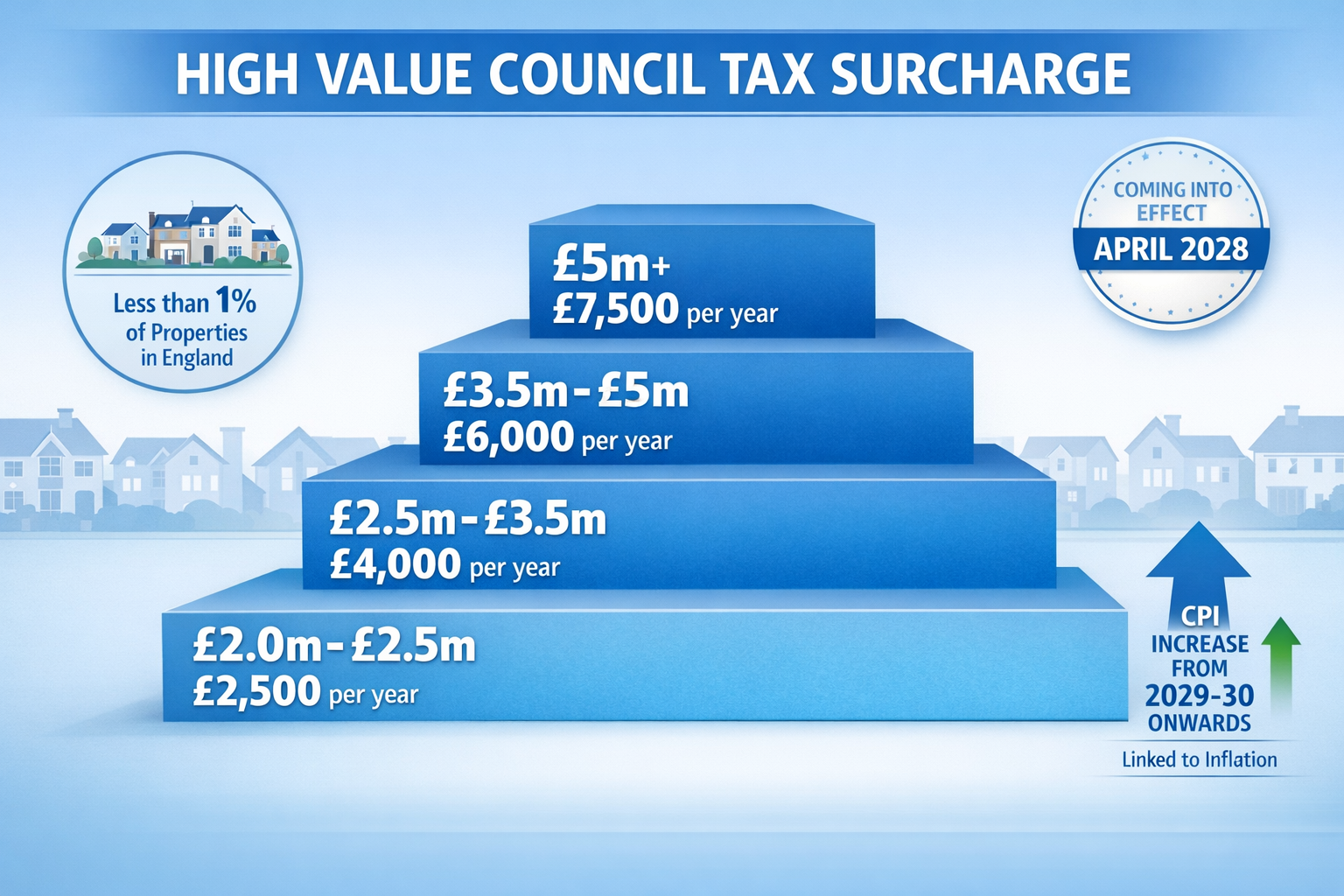
The High Value Council Tax Surcharge represents the most significant change to property taxation in England in decades. Introduced in the 2024 Autumn Budget and taking effect from April 2028, this new tax layer fundamentally alters the financial landscape for luxury property ownership[1].
The Four-Tier Surcharge Structure
The surcharge operates through a tiered band system that applies fixed annual charges based on property values assessed in 2026[2]. This structure creates distinct valuation thresholds that carry substantial financial implications:
| Property Value Band | Annual Surcharge | Percentage of £2m Base |
|---|---|---|
| £2.0m – £2.5m | £2,500 | 0.125% |
| £2.5m – £3.5m | £4,000 | 0.16% |
| £3.5m – £5.0m | £6,000 | 0.17% |
| £5.0m+ | £7,500 | 0.15% |
These charges will increase annually in line with CPI inflation from 2029-30 onwards[1], creating a compounding tax burden that property owners and potential buyers must factor into their long-term financial planning.
Targeted Valuation Exercise and Timeline
The Valuation Office is currently conducting a targeted valuation exercise to identify properties above the £2 million threshold[1]. This exercise, happening throughout 2026, establishes the baseline valuations that will determine surcharge liability for the initial five-year period. The timeline creates urgency for property owners who may wish to challenge valuations or understand their position before the April 2028 implementation date.
Critical dates for surveyors and property owners:
- ✅ 2026: Baseline valuation year—current market assessments determine initial surcharge band
- ✅ Early 2026: Public consultation on surcharge details, reliefs, and exemptions[1]
- ✅ April 2028: Surcharge implementation begins
- ✅ Every 5 years: Mandatory revaluations to adjust surcharge bands[1]
- ✅ 2029-30 onwards: Annual CPI inflation adjustments to surcharge amounts[1]
Scope and Market Impact
While fewer than 1% of properties in England fall above the £2 million threshold[1], these properties represent a disproportionately significant segment of the market in terms of value, transaction complexity, and professional service requirements. The geographic concentration in areas like London, the Home Counties, and select affluent regions means certain surveying practices will experience profound impacts.
The government's commitment to conducting a new burdens assessment to ensure local authorities are fully compensated for administering the additional tax[1] indicates the administrative complexity involved. For surveyors, this translates to increased documentation requirements, more rigorous valuation justifications, and enhanced quality assurance processes.
Core Valuation Challenges from 2026 Budget Taxes on High-Value Properties
The introduction of the surcharge creates multiple layers of complexity that surveyors must address when assessing high-value properties. These challenges extend beyond simple valuation arithmetic to encompass market psychology, strategic positioning, and long-term value forecasting.
Challenge 1: Threshold Effect and Market Distortion
The £2 million threshold creates a sharp discontinuity in the market. Properties valued just below this mark avoid the surcharge entirely, while those marginally above it incur an immediate £2,500 annual charge. This creates powerful incentives for both buyers and sellers to position properties strategically relative to the threshold.
Surveyor implications:
- Increased scrutiny of valuations near threshold boundaries
- Pressure from clients to justify valuations below £2 million
- Need for robust, defensible comparable analysis to resist downward pressure
- Potential for appeals and challenges to Valuation Office assessments
Professional building surveyors must maintain strict adherence to RICS valuation standards while acknowledging the legitimate market impact of the surcharge on property values.
Challenge 2: Comparable Property Analysis Complexity
Traditional comparable property analysis becomes significantly more complex when the surcharge is factored into market dynamics. Properties sold or valued before widespread awareness of the surcharge may not accurately reflect post-2028 market conditions.
Key considerations for comparables:
- Temporal adjustments: Pre-announcement vs. post-announcement sales
- Buyer profile shifts: Changes in the demographic and financial profile of high-value property buyers
- Holding period assumptions: Impact of annual surcharge on long-term ownership economics
- Geographic variations: Different market responses in various high-value property locations
When conducting a building survey, surveyors must now layer tax implications into their market analysis, creating more nuanced and sophisticated valuation narratives.
Challenge 3: Five-Year Revaluation Cycle Uncertainty
The five-year revaluation cycle[1] introduces significant uncertainty into property value projections. A property valued at £1.95 million in 2026 might appreciate to £2.3 million by the 2031 revaluation, triggering surcharge liability. Conversely, properties initially above the threshold might fall below it in subsequent cycles.
This creates a dynamic valuation environment where surveyors must:
- Project potential value trajectories over five-year periods
- Assess renovation and improvement impacts on surcharge band positioning
- Advise clients on strategic timing of property enhancements
- Consider market cycle positioning within the revaluation framework
Challenge 4: Complex Ownership Structures
The government's consultation on rules for complex ownership structures including companies, trusts, and partnerships[1] adds another dimension of complexity. Many high-value properties are held through corporate vehicles, family trusts, or partnership arrangements, each with unique valuation considerations.
Surveyor responsibilities expand to include:
- Understanding beneficial ownership structures
- Assessing how different ownership models affect surcharge liability
- Coordinating with tax advisors and legal professionals
- Providing valuations that account for structural complexity
Challenge 5: Reliefs, Exemptions, and Support Schemes
The government's commitment to consulting on reliefs, exemptions, and support schemes for those struggling to pay[1] creates an evolving regulatory landscape. Surveyors must stay current with exemption criteria and understand how various relief mechanisms might affect property valuations.
Potential exemption categories requiring surveyor awareness:
- Properties undergoing significant renovation or development
- Heritage properties with preservation obligations
- Properties with mixed-use characteristics
- Temporary vacancy or uninhabitability situations
- Financial hardship provisions
Surveyor Adaptation Strategies for High-Value Property Valuation
Addressing the Valuation Challenges from 2026 Budget Taxes on High-Value Properties requires surveyors to develop comprehensive adaptation strategies that combine technical excellence, technological innovation, and enhanced client advisory capabilities.
Strategy 1: Enhanced Comparable Analysis Methodology
Surveyors must evolve their comparable property analysis to incorporate tax-adjusted valuation frameworks. This involves creating sophisticated models that account for the surcharge's impact on market values.
Advanced comparable analysis techniques:
📊 Surcharge-Adjusted Comparable Selection
- Identify properties sold with full market awareness of surcharge implications
- Weight recent transactions more heavily than historical comparables
- Segment comparables by surcharge band to identify band-specific pricing patterns
- Adjust for temporal differences in market awareness and regulatory clarity
📊 Net Present Value Integration
- Calculate the present value of future surcharge payments over typical holding periods
- Incorporate these costs into overall property value assessments
- Develop band-specific discount factors based on market behavior
- Create sensitivity analyses showing value impacts across different holding period assumptions
📊 Geographic Market Segmentation
- Recognize that different high-value property markets respond differently to the surcharge
- Develop location-specific adjustment factors for areas like Marylebone, Wimbledon, and Battersea
- Account for local market depth and buyer profile variations
- Consider proximity to international buyers and their sensitivity to additional taxes
Strategy 2: Comprehensive Sensitivity Analysis
Sensitivity analysis becomes essential for high-value property valuations in the post-surcharge environment. Surveyors must provide clients with comprehensive scenario modeling that illustrates how different assumptions affect both valuation and surcharge liability.
Key sensitivity variables:
- Market growth rates: How different appreciation scenarios affect future surcharge band positioning
- Holding period variations: Impact of short-term vs. long-term ownership on total surcharge burden
- Renovation impact: How property improvements might push values across surcharge thresholds
- Market cycle timing: Effects of purchasing at different points in the property cycle
- Inflation assumptions: CPI variations and their impact on surcharge amount growth post-2029[1]
A comprehensive sensitivity analysis might include:
"Based on current market conditions and the £2 million surcharge threshold, this property valued at £1.95 million faces a 60% probability of crossing into surcharge liability within the first five-year revaluation cycle, assuming historical appreciation rates of 3-4% annually. Strategic renovation deferrals or selective improvements could manage this threshold risk while maintaining property condition and marketability."
Strategy 3: Technology and Data Analytics Integration
Modern valuation challenges demand modern solutions. Surveyors must embrace advanced technology platforms that provide comprehensive market intelligence, automated comparable analysis, and sophisticated modeling capabilities.
Essential technology investments:
🔧 AI-Powered Valuation Platforms
- Machine learning algorithms that identify optimal comparables across large datasets
- Automated adjustment calculations for property characteristics
- Predictive analytics for future value trajectories
- Surcharge band probability modeling
🔧 Comprehensive Market Intelligence Systems
- Real-time transaction data from multiple sources
- Historical price trend analysis with surcharge impact overlays
- Demographic and buyer profile tracking
- Regulatory change monitoring and impact assessment
🔧 Client Reporting and Visualization Tools
- Interactive dashboards showing valuation ranges and surcharge implications
- Scenario modeling interfaces for client exploration
- Professional report generation with surcharge-specific sections
- Digital delivery platforms for enhanced client accessibility
Strategy 4: Expanded Advisory and Consultation Services
The complexity of the Valuation Challenges from 2026 Budget Taxes on High-Value Properties elevates surveyors from technical assessors to strategic advisors. This expanded role requires new service offerings and enhanced client engagement models.
Strategic advisory services:
💼 Pre-Purchase Tax Impact Consultations
- Comprehensive analysis of surcharge implications for prospective buyers
- Comparison of properties across different surcharge bands
- Long-term ownership cost modeling including surcharge projections
- Strategic timing advice for property acquisitions
💼 Renovation and Improvement Planning
- Assessment of how proposed improvements affect surcharge band positioning
- Strategic sequencing of renovations to manage threshold crossing
- Value optimization within surcharge band constraints
- Cost-benefit analysis of improvements considering tax implications
💼 Portfolio Optimization for Multiple Property Owners
- Cross-property analysis for clients with multiple high-value holdings
- Strategic acquisition and disposition planning
- Tax-efficient portfolio structuring advice (in coordination with tax professionals)
- Long-term wealth preservation strategies
💼 Exemption and Relief Navigation
- Identification of potential exemption eligibility
- Documentation support for relief applications
- Coordination with local authorities on exemption processes
- Ongoing monitoring of regulatory changes affecting relief provisions
This enhanced advisory role aligns with the broader responsibilities outlined in guidance on what party wall surveyors do, demonstrating how surveying professionals must expand their expertise across multiple domains.
Strategy 5: Professional Development and Specialization
Successfully navigating the Valuation Challenges from 2026 Budget Taxes on High-Value Properties requires continuous professional development and potentially specialized certification in high-value property taxation and valuation.
Professional development priorities:
📚 Technical Knowledge Enhancement
- Deep understanding of the High Value Council Tax Surcharge regulations[1][3]
- Mastery of tax-adjusted valuation methodologies
- Expertise in complex ownership structure implications
- Proficiency with advanced valuation software and analytics tools
📚 Regulatory Compliance and Standards
- RICS Red Book compliance for high-value property valuations
- Understanding of Valuation Office procedures and appeal processes
- Knowledge of local authority administration requirements
- Awareness of evolving exemption and relief frameworks
📚 Interdisciplinary Collaboration Skills
- Effective coordination with tax advisors and accountants
- Communication with legal professionals on ownership structures
- Partnership with financial planners for client holistic advice
- Networking with local authority valuation officers
📚 Client Communication Excellence
- Ability to explain complex tax implications in accessible terms
- Skill in presenting sensitivity analyses and scenario modeling
- Confidence in defending valuations under client pressure
- Expertise in managing client expectations in uncertain regulatory environments
Strategy 6: Quality Assurance and Documentation Enhancement
The heightened stakes of high-value property valuations in the surcharge era demand enhanced quality assurance processes and more comprehensive documentation standards.
Quality assurance best practices:
✓ Robust Valuation File Documentation
- Comprehensive comparable property analysis with detailed adjustments
- Clear articulation of surcharge impact considerations
- Sensitivity analysis documentation with assumption justifications
- Peer review for valuations near threshold boundaries
✓ Transparent Methodology Disclosure
- Explicit statement of valuation approach and standards applied
- Clear explanation of how surcharge implications were factored into analysis
- Documentation of any client instructions or constraints
- Disclosure of limitations and uncertainties in the valuation
✓ Regular Calibration and Benchmarking
- Comparison of valuations against Valuation Office assessments
- Analysis of appeal outcomes to refine methodologies
- Market feedback integration from actual transactions
- Continuous refinement of adjustment factors and models
Professional surveyors conducting RICS surveys must ensure their documentation meets the elevated standards required for high-value properties subject to the surcharge.
Regional Variations and Market-Specific Considerations
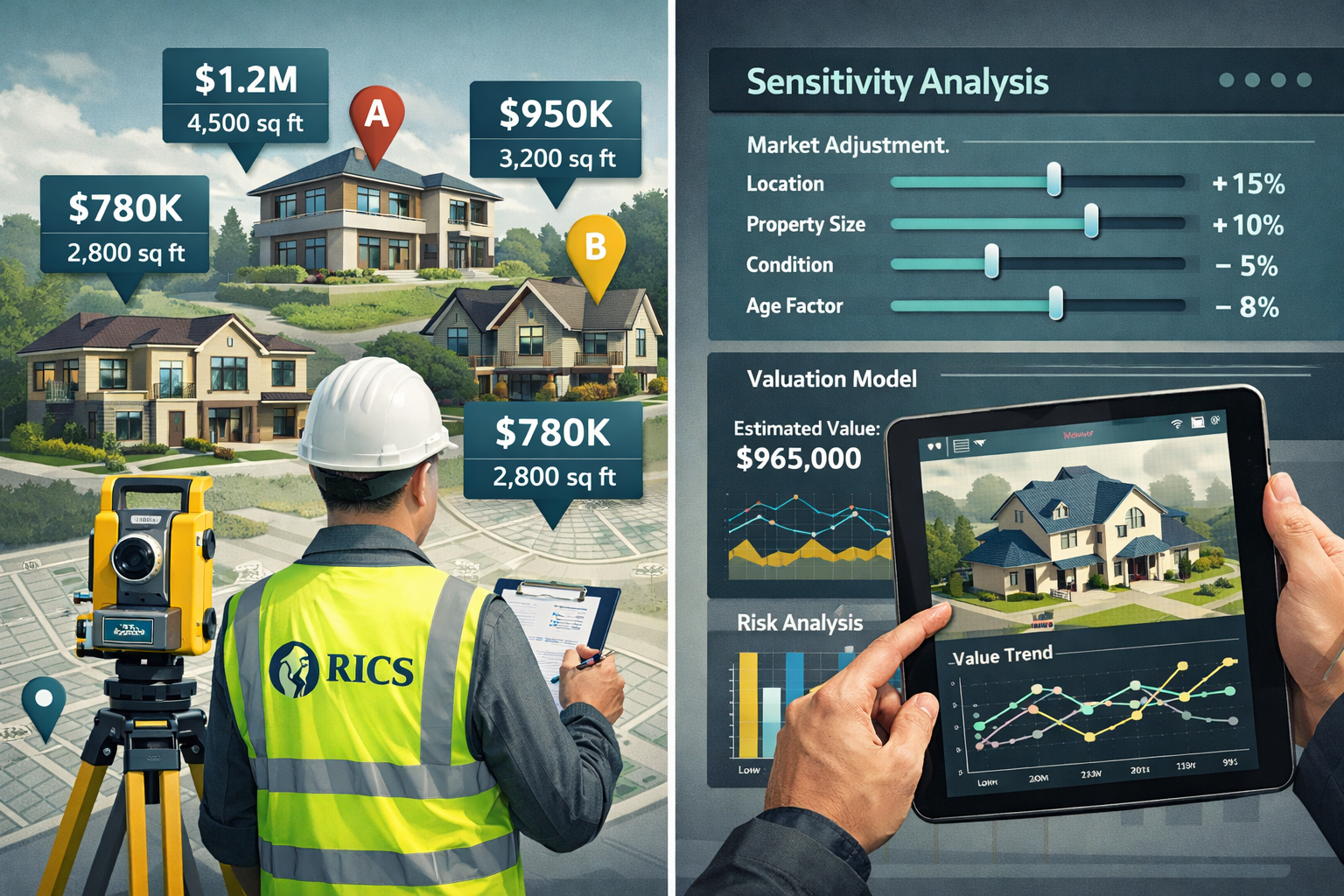
The impact of the Valuation Challenges from 2026 Budget Taxes on High-Value Properties varies significantly across different regional markets. Surveyors must develop location-specific expertise and adapt their strategies to local market conditions.
London and Prime Central Markets
London's prime property markets face the most concentrated impact, with substantial numbers of properties exceeding the £2 million threshold. Areas like Knightsbridge, Mayfair, Chelsea, and Kensington experience different market dynamics than outer London locations.
London-specific considerations:
- International buyer sensitivity: Foreign buyers may be particularly sensitive to additional tax layers
- Leasehold complexities: Many high-value London properties are leasehold, adding valuation complexity
- Market depth variations: Different submarkets show varying liquidity and price resilience
- Heritage property concentrations: Listed buildings and conservation areas with unique valuation challenges
Surveyors operating in areas like Merton, Kingston, and Barnet must understand how outer London markets respond differently to the surcharge than prime central locations.
Home Counties and Commuter Belt
The Home Counties contain significant concentrations of high-value properties, particularly in areas with excellent transport links to London. These markets often feature larger properties with substantial grounds, creating different valuation dynamics.
Home Counties considerations:
- Land value components: Larger plot sizes require careful land value allocation
- Renovation potential: Many properties have significant development or improvement potential
- School catchment premiums: Education-driven demand patterns affect value stability
- Commuter accessibility: Transport infrastructure changes impact long-term value trajectories
Surveyors working in locations like Brentwood, Chelmsford, and Chigwell must account for these regional factors in their valuation approaches.
Regional Cities and Coastal Areas
While fewer properties in regional cities and coastal areas exceed the £2 million threshold, those that do often represent unique property types with specialized valuation requirements.
Regional market considerations:
- Market depth limitations: Fewer comparable transactions require broader geographic searches
- Unique property characteristics: Historic estates, waterfront properties, and architectural landmarks
- Local economic drivers: Regional economic conditions affecting long-term value sustainability
- Buyer profile differences: Different demographic and financial profiles than London buyers
Client Communication and Expectation Management
Effectively addressing the Valuation Challenges from 2026 Budget Taxes on High-Value Properties requires surveyors to excel at client communication and expectation management. The complexity of the surcharge framework and its implications demand clear, comprehensive client engagement.
Educating Clients About Surcharge Implications
Many property owners and prospective buyers remain unaware of the surcharge's details or its potential impact on their property decisions. Surveyors play a crucial educational role.
Key educational topics:
📖 Surcharge Basics and Timeline
- Clear explanation of the four-tier band structure[1]
- Timeline from 2026 valuation baseline through 2028 implementation
- Five-year revaluation cycle implications[1]
- Annual CPI inflation adjustments from 2029-30[1]
📖 Valuation Methodology and Process
- How the Valuation Office conducts assessments
- Rights of appeal and challenge procedures
- Role of professional surveyor valuations in the process
- Importance of the 2026 baseline valuation year[2]
📖 Long-Term Financial Planning
- Total cost of ownership calculations including surcharge
- Comparison of surcharge burden across different property price points
- Impact on property investment returns and yield calculations
- Strategic considerations for property acquisition timing
Managing Valuation Pressure and Professional Independence
The financial implications of surcharge band positioning create strong incentives for clients to seek valuations below threshold levels. Surveyors must maintain professional independence while acknowledging legitimate client concerns.
Professional independence strategies:
🛡️ Clear Engagement Terms
- Written engagement letters specifying RICS standards compliance
- Explicit statement of surveyor independence and objectivity
- Disclosure of limitations on advocacy or strategic positioning
- Agreement on valuation purpose and intended use
🛡️ Transparent Methodology Communication
- Detailed explanation of valuation approach before commencing work
- Regular communication during the valuation process
- Presentation of findings with supporting evidence and rationale
- Willingness to discuss assumptions and address questions
🛡️ Boundary-Setting with Clients
- Respectful but firm adherence to professional standards
- Clear explanation of consequences of non-compliant valuations
- Offer of second opinions or independent reviews when appropriate
- Willingness to decline engagements with inappropriate constraints
This professional approach mirrors the independence required in other surveying contexts, such as party wall agreement work, where surveyors must balance competing interests while maintaining objectivity.
Presenting Valuation Uncertainty and Ranges
The complexity of high-value property valuation in the surcharge era often produces genuine uncertainty rather than single-point valuations. Communicating this uncertainty effectively helps manage client expectations.
Effective uncertainty communication:
- Valuation ranges: Present defensible ranges rather than false precision
- Confidence levels: Articulate confidence in different aspects of the valuation
- Scenario presentations: Show how different assumptions affect outcomes
- Threshold proximity disclosure: Explicitly address proximity to surcharge boundaries
"Given current market conditions and available comparable evidence, this property's market value is assessed at £2.05 million, with a defensible range of £1.95 million to £2.15 million. The proximity to the £2 million surcharge threshold creates significant financial implications, with the lower end of the range avoiding surcharge liability entirely while the upper end incurs £2,500 annually. This uncertainty reflects genuine market variability rather than valuation imprecision."
Practical Implementation: Case Studies and Examples
Understanding the Valuation Challenges from 2026 Budget Taxes on High-Value Properties: Surveyor Adaptation Strategies benefits from examining practical scenarios that illustrate how these challenges manifest in real-world situations.
Case Study 1: Threshold Boundary Property in Outer London
Property Profile:
- 4-bedroom detached house in Harrow
- Recent comparable sales ranging from £1.85m to £2.15m
- Property in good condition with modern kitchen and bathrooms
- 2026 valuation required for estate planning purposes
Valuation Challenges:
- Comparable properties span the £2 million threshold
- Significant value implications of threshold positioning
- Limited recent sales data with full surcharge awareness
- Client pressure to achieve sub-£2m valuation
Surveyor Adaptation Strategies Applied:
- Enhanced comparable analysis: Identified six recent sales, adjusting for property characteristics, location micro-variations, and transaction timing
- Surcharge impact modeling: Calculated present value of surcharge payments over 10-year holding period at different valuation points
- Sensitivity analysis: Presented scenarios showing value range from £1.92m to £2.08m with supporting evidence for each
- Transparent communication: Clearly explained methodology, assumptions, and limitations to client
- Professional independence: Maintained objective assessment despite client preference for lower valuation
Outcome:
Final valuation of £1.98 million with comprehensive documentation supporting the assessment, including detailed comparable analysis and acknowledgment of valuation uncertainty near the threshold.
Case Study 2: Prime Central London Apartment with Complex Ownership
Property Profile:
- 3-bedroom apartment in Knightsbridge
- Held through offshore company structure
- Market value clearly above £2 million threshold
- Leasehold with 85 years remaining
Valuation Challenges:
- Complex ownership structure affecting surcharge liability
- Leasehold valuation requiring marriage value consideration
- International comparable properties with different tax regimes
- Uncertainty about exemption eligibility for corporate ownership
Surveyor Adaptation Strategies Applied:
- Interdisciplinary collaboration: Coordinated with tax advisors and legal professionals on ownership structure implications
- Leasehold-specific methodology: Applied appropriate leasehold valuation techniques accounting for remaining term
- Surcharge band positioning: Analyzed whether property fell in £2.5-3.5m or £3.5-5m band with significant annual charge difference
- Exemption research: Investigated potential relief provisions for corporate-held properties pending consultation outcomes
- Comprehensive reporting: Produced detailed report addressing ownership complexity and tax implications
Outcome:
Valuation of £3.2 million with extensive documentation of leasehold considerations, ownership structure implications, and surcharge band positioning, providing client with comprehensive information for strategic decision-making.
Case Study 3: Heritage Property with Renovation Potential
Property Profile:
- Grade II listed Georgian townhouse in Hackney
- Current condition requiring significant restoration
- Current market value near £2 million threshold
- Substantial value increase potential post-renovation
Valuation Challenges:
- Assessing current value in unrenovated condition
- Projecting post-renovation value and surcharge band implications
- Understanding heritage property exemption possibilities
- Timing considerations for renovation and revaluation cycles
Surveyor Adaptation Strategies Applied:
- Dual valuation approach: Assessed both current condition value and post-renovation projected value
- Renovation impact analysis: Modeled how different renovation scopes affect surcharge band positioning
- Heritage exemption research: Investigated potential reliefs for listed buildings with preservation obligations
- Strategic timing advice: Analyzed optimal timing for renovations relative to five-year revaluation cycle
- Long-term value trajectory: Projected value appreciation over multiple revaluation cycles
Outcome:
Current condition valuation of £1.85 million with post-renovation projection of £2.6-2.8 million, accompanied by strategic advice on renovation timing and surcharge management, including potential exemption pathways.
Future Outlook and Emerging Trends
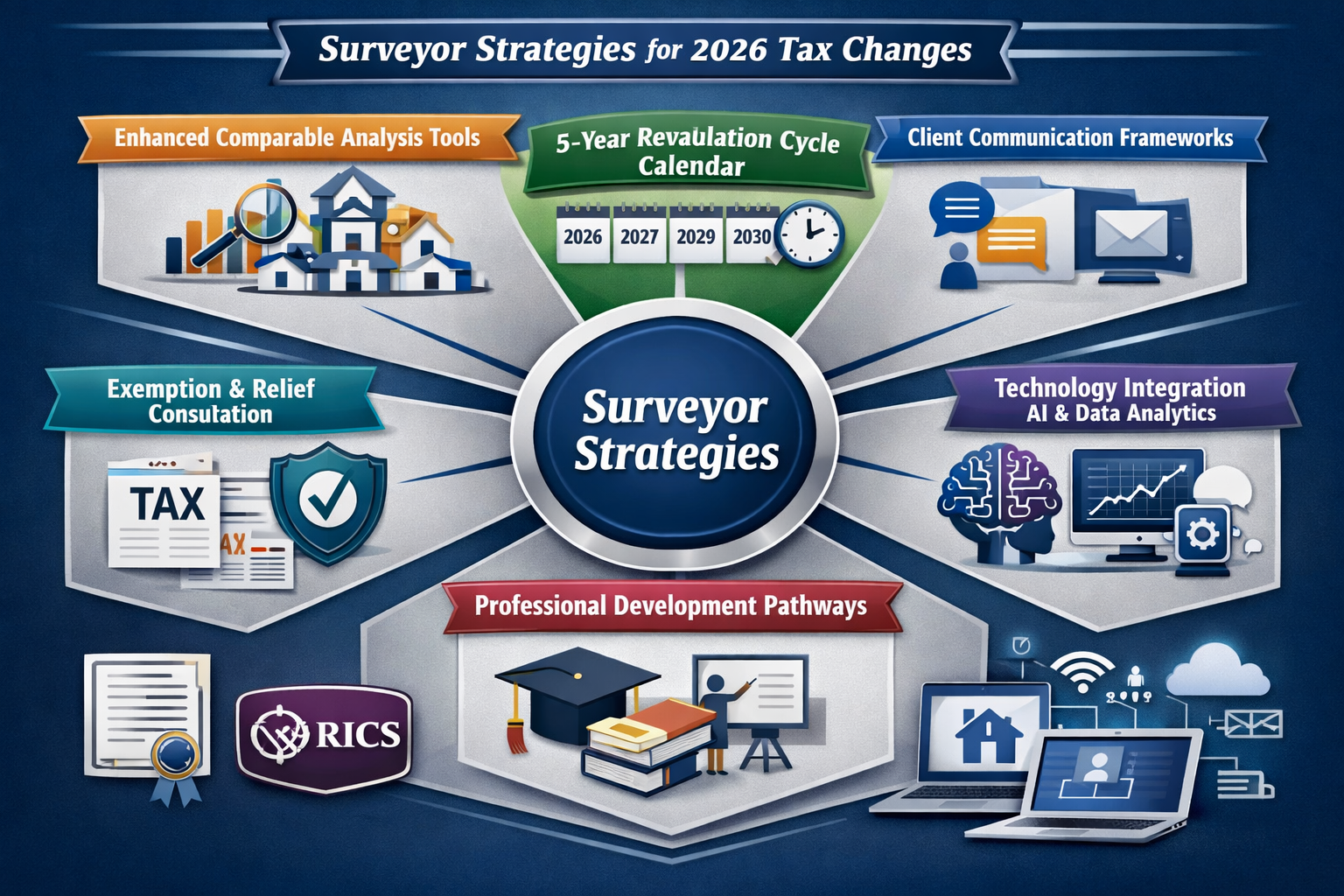
As 2026 progresses and the April 2028 implementation date approaches, several trends are emerging that will shape the ongoing evolution of the Valuation Challenges from 2026 Budget Taxes on High-Value Properties: Surveyor Adaptation Strategies.
Regulatory Evolution and Consultation Outcomes
The public consultation on surcharge details scheduled for early 2026[1] will provide crucial clarity on several outstanding issues:
🔮 Anticipated Consultation Outcomes:
- Specific exemption criteria for heritage properties, mixed-use buildings, and financial hardship cases
- Detailed rules for complex ownership structures including trusts and partnerships
- Administrative procedures for appeals and challenges
- Support schemes for asset-rich, income-poor property owners
- Transition provisions for properties near threshold boundaries
Surveyors must actively monitor consultation outcomes and rapidly integrate new guidance into their valuation practices. Professional bodies like RICS will likely issue updated guidance specifically addressing high-value property valuation in the surcharge context.
Market Behavioral Adaptations
The property market is already showing early signs of adaptation to the surcharge framework:
📈 Emerging Market Trends:
- Strategic pricing: Sellers of properties near £2 million increasingly pricing just below threshold
- Buyer negotiation leverage: Buyers using surcharge implications as negotiation points
- Renovation timing shifts: Property owners deferring major improvements until after 2026 baseline valuations
- Geographic value migration: Potential shift in demand toward areas where £2 million purchases larger/better properties
- Ownership structure innovation: Increased interest in structures that might qualify for exemptions
Surveyors must track these behavioral adaptations and incorporate them into their market analysis and valuation methodologies. Understanding how to negotiate after survey results becomes even more critical when tax implications add another dimension to negotiations.
Technology and Data Infrastructure Development
The complexity of surcharge-aware valuations is driving significant investment in technology infrastructure:
💻 Technology Developments:
- Specialized valuation software: Platforms specifically designed for high-value property valuation with integrated surcharge calculations
- Enhanced market data: More granular transaction data with surcharge band tagging and analysis
- Predictive analytics: AI-powered tools forecasting property value trajectories across revaluation cycles
- Automated compliance: Systems ensuring valuations meet evolving regulatory requirements
- Client portal integration: Digital platforms enabling clients to explore scenarios and understand implications
Forward-thinking surveying practices are investing in these technologies now to position themselves as leaders in high-value property valuation expertise.
Professional Specialization and Market Positioning
The Valuation Challenges from 2026 Budget Taxes on High-Value Properties are creating opportunities for professional specialization and differentiated market positioning:
🎯 Specialization Opportunities:
- High-value property valuation specialists: Surveyors focusing exclusively on properties above or near the £2 million threshold
- Surcharge advisory consultants: Professionals offering strategic advice on surcharge management and optimization
- Heritage and complex property experts: Specialists in listed buildings and unique properties with exemption potential
- International buyer advisors: Surveyors with expertise in explaining UK tax framework to overseas purchasers
Practices that develop recognized expertise in these areas can command premium fees and attract high-value clients seeking sophisticated guidance.
Conclusion: Navigating the New High-Value Property Landscape
The Valuation Challenges from 2026 Budget Taxes on High-Value Properties: Surveyor Adaptation Strategies represent a fundamental shift in the professional landscape for property surveyors working with luxury and high-value properties. The introduction of the High Value Council Tax Surcharge, with its £2 million threshold, four-tier band structure, and five-year revaluation cycles, creates complexity that demands sophisticated technical expertise, advanced analytical capabilities, and enhanced client advisory skills.
Successful surveyors in this new environment will distinguish themselves through:
✅ Technical Excellence: Mastery of tax-adjusted valuation methodologies, enhanced comparable analysis techniques, and comprehensive sensitivity modeling
✅ Technology Integration: Adoption of advanced data analytics platforms, AI-powered valuation tools, and sophisticated client reporting systems
✅ Strategic Advisory Capabilities: Expansion beyond pure valuation to comprehensive tax impact consultation, strategic planning support, and long-term wealth preservation guidance
✅ Professional Independence: Unwavering commitment to RICS standards and objective assessment despite client pressures and threshold proximity
✅ Continuous Learning: Ongoing professional development tracking regulatory evolution, market adaptations, and emerging best practices
The 2026 baseline valuation year creates immediate urgency for property owners and prospective buyers seeking to understand their position relative to the surcharge framework. Surveyors who position themselves as trusted advisors capable of navigating this complexity will find substantial opportunities in the high-value property market.
Actionable Next Steps for Property Surveyors
For surveyors looking to successfully adapt to the Valuation Challenges from 2026 Budget Taxes on High-Value Properties, consider these immediate action steps:
1. Knowledge Development
- Review the official High Value Council Tax Surcharge guidance comprehensively[1]
- Monitor the early 2026 consultation outcomes for exemption and relief details
- Attend RICS training sessions on high-value property valuation in the surcharge context
- Study emerging case law and appeal decisions as they develop
2. Methodology Enhancement
- Develop standardized surcharge impact analysis templates for client reports
- Create comprehensive sensitivity analysis frameworks for threshold-proximity properties
- Build databases of surcharge-aware comparable transactions
- Establish quality assurance protocols for high-value property valuations
3. Technology Investment
- Evaluate and invest in specialized valuation software with surcharge calculation capabilities
- Implement enhanced market intelligence systems for high-value property segments
- Develop client-facing digital tools for scenario exploration and tax impact visualization
- Establish secure data management systems for complex valuation documentation
4. Service Expansion
- Develop surcharge advisory service offerings as distinct revenue streams
- Create educational materials explaining surcharge implications to clients
- Build referral relationships with tax advisors, accountants, and legal professionals
- Design strategic planning services for clients with multiple high-value properties
5. Market Positioning
- Communicate high-value property expertise through thought leadership and content marketing
- Develop case studies demonstrating successful navigation of surcharge challenges
- Seek recognition as specialists in high-value property valuation
- Build relationships with estate agents and property professionals serving luxury markets
The property market transformation driven by the High Value Council Tax Surcharge presents both challenges and opportunities. Surveyors who embrace these changes, invest in necessary capabilities, and position themselves as expert guides through this complex landscape will thrive in the evolving high-value property sector.
For property owners and prospective buyers of high-value properties, engaging a qualified, experienced surveyor who understands these challenges is more critical than ever. Whether you're in Wimbledon, Newham, or any other area with significant high-value property stock, professional surveying expertise provides essential protection and strategic advantage in this new taxation environment.
The journey through the Valuation Challenges from 2026 Budget Taxes on High-Value Properties has only just begun. Those who adapt quickly, invest wisely, and maintain unwavering professional standards will emerge as leaders in this transformed market landscape.
References
[1] High Value Council Tax Surcharge – https://www.gov.uk/government/publications/high-value-council-tax-surcharge/high-value-council-tax-surcharge
[2] Budget Tax Changes Affecting Property Dividends And Savings Income – https://pkf-francisclark.co.uk/insights/budget-tax-changes-affecting-property-dividends-and-savings-income/
[3] Uk Autumn Budget Introduces Additional Tax High Value Houses – https://www.step.org/industry-news/uk-autumn-budget-introduces-additional-tax-high-value-houses