{"cover":"Professional landscape format (1536x1024) hero image featuring bold text overlay 'Valuation Adjustments for Scotland's 2026 House Price Uptick: Surveyor Strategies in a Diverging Market' in extra large 72pt white sans-serif font with dark shadow and semi-transparent navy overlay box, positioned in upper third. Background shows stunning aerial view of Edinburgh's Georgian architecture blending with modern Scottish cityscape, featuring traditional stone buildings alongside contemporary developments. Foreground elements include subtle overlay of property valuation charts showing upward trends and surveyor's measuring tools. Color scheme: deep navy blue, warm sandstone, white accents. High contrast, magazine cover quality, editorial style with professional depth of field, golden hour lighting creating dramatic shadows across rooftops.","content":["Detailed landscape format (1536x1024) image showing professional chartered surveyor conducting property inspection inside elegant Scottish Victorian townhouse, examining structural elements with digital tablet displaying Home Report valuation data and comparable sales analysis. Scene includes exposed stonework, period features, and modern survey equipment including laser measuring device. Split-screen composition showing traditional clipboard notes on left and digital valuation software interface on right with Scottish property market graphs trending upward. Warm natural lighting through bay windows, professional business attire, RICS accreditation visible. Color palette: warm wood tones, professional navy, technology blue accents, authentic Scottish interior atmosphere.","Comprehensive landscape format (1536x1024) infographic-style image displaying Scotland's regional property market divergence map with color-coded heat zones showing price variations across Edinburgh, Glasgow, Aberdeen, and rural areas. Central focus on detailed comparison table contrasting urban versus rural valuation methodologies with percentage growth indicators for 2026. Visual elements include magnifying glass highlighting specific regions, upward and downward trend arrows, mortgage rate timeline graph along bottom edge, and small inset charts showing transaction volumes. Clean, professional design with data visualization best practices, using gradient colors from cool blue (lower growth) to warm orange (higher growth). Modern sans-serif typography with clear percentage labels.","Detailed landscape format (1536x1024) professional scene showing surveyor's desk workspace with multiple valuation documents spread across surface including Home Report templates, RICS Red Book guidelines, comparable property analysis spreadsheets, and Scottish market data reports. Digital elements include laptop screen displaying property valuation software with adjustment calculations visible, smartphone showing property listing photographs, and tablet with interactive market trend graphs. Physical tools include architect's scale ruler, property photographs pinned to board, and calculator. Organized, methodical composition suggesting systematic valuation approach. Natural desk lamp lighting, professional office environment, color scheme of document whites, technology blacks, and accent colors from charts and graphs. High detail showing specific valuation adjustment percentages and Scottish property references."]}

Scotland's property market has entered 2026 with renewed confidence and momentum that sets it apart from other UK regions. As chartered surveyors navigate this distinctive landscape, they face a critical challenge: accurately valuing properties amid Scotland's leading price growth while accounting for significant regional disparities. The Valuation Adjustments for Scotland's 2026 House Price Uptick: Surveyor Strategies in a Diverging Market requires sophisticated techniques that balance national recovery trends with localized market conditions, ensuring valuations reflect genuine market value rather than temporary fluctuations.
Recent RICS survey data reveals Scotland is outpacing much of the UK in price growth, creating both opportunities and complexities for property professionals. Surveyors must now recalibrate their valuation methodologies to account for this divergence while maintaining the accuracy and reliability that buyers, sellers, and lenders depend upon.
Key Takeaways
- 🏴 Scotland leads UK price growth: Scottish property markets show stronger momentum than other UK regions in 2026, requiring region-specific valuation approaches
- 📊 Regional disparities demand tailored strategies: Urban centers like Edinburgh and Glasgow experience different growth patterns than rural areas, necessitating localized comparable analysis
- 🔍 Home Report valuations remain critical: Scottish buyers rely heavily on Home Report valuations, making surveyor accuracy essential for successful transactions
- 💰 Affordability improvements support stability: Gradually softening mortgage rates and wage growth create more sustainable market conditions for valuation confidence
- 📈 Modest but steady growth expected: Conservative price increases throughout 2026 require surveyors to balance optimism with realistic market assessment
Understanding Scotland's 2026 Property Market Position

The Scottish Advantage in a Recovering Market
Scotland's property market has demonstrated remarkable resilience entering 2026, with market stability and improved buyer confidence distinguishing it from the broader UK landscape. Unlike the hesitancy that characterized 2024 and early 2025, buyers are no longer delaying purchasing decisions, and sellers have adjusted their pricing expectations to reflect current market realities.
This shift represents a fundamental change in market psychology. The period of market adjustment has concluded, replaced by a more balanced dynamic between supply and demand. Professional surveyor services now operate in an environment where transactions proceed more smoothly, with fewer surprises during the valuation process.
Affordability pressures have eased compared to peak levels experienced in 2023-2024. This improvement stems from three converging factors:
- Gradually softening mortgage rates – While significant interest rate cuts remain unlikely, mortgage affordability continues improving incrementally
- Steadier house price growth – More moderate appreciation rates make properties more accessible to a broader buyer pool
- Continued wage increases – Income growth helps offset housing costs, particularly for first-time buyers
Regional Divergence: The Valuation Challenge
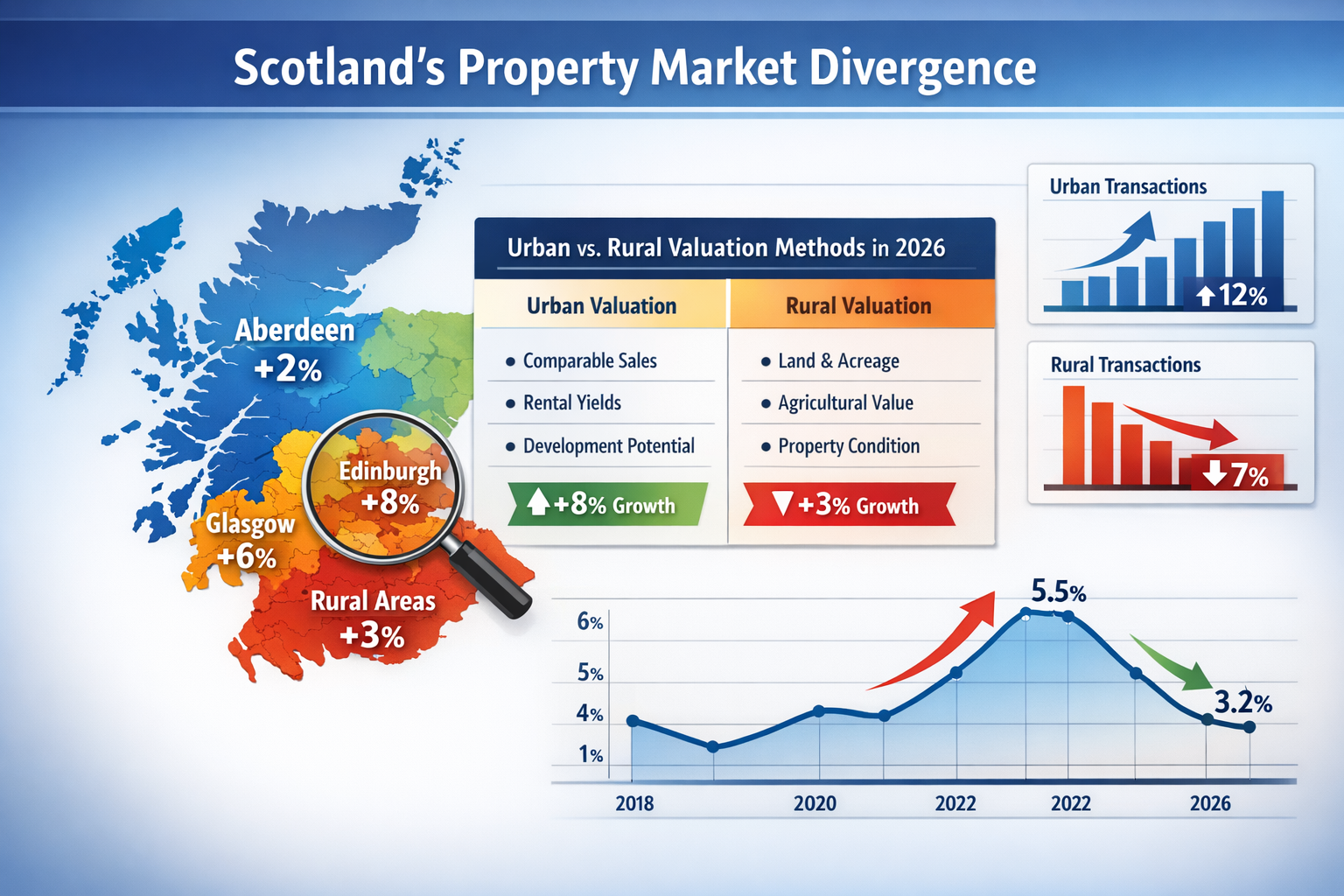
The most significant challenge facing surveyors conducting Valuation Adjustments for Scotland's 2026 House Price Uptick involves navigating regional disparities that create vastly different market conditions within relatively small geographic areas.
| Region Type | Growth Pattern | Key Valuation Factors |
|---|---|---|
| Edinburgh & Glasgow | Strong, sustained growth | High demand, limited supply, professional migration |
| Aberdeen | Recovery from oil sector downturn | Industry-dependent, volatile comparables |
| Rural Highlands | Lifestyle-driven demand | Limited transaction volume, unique properties |
| Coastal Towns | Post-pandemic stability | Remote work influence, seasonal variations |
| Central Belt Suburbs | Steady, family-driven growth | School catchments, commuter accessibility |
These diverging patterns mean that a valuation methodology effective in Edinburgh's New Town may prove entirely inappropriate for a rural Perthshire property. Surveyors must develop region-specific expertise while maintaining consistent professional standards.
"The Scottish market in 2026 isn't a single entity—it's a collection of micro-markets, each with distinct dynamics that demand tailored valuation approaches." – RICS Scotland Property Insight
Surveyor Strategies for Accurate Valuation Adjustments
Refining Comparable Analysis in Growth Markets
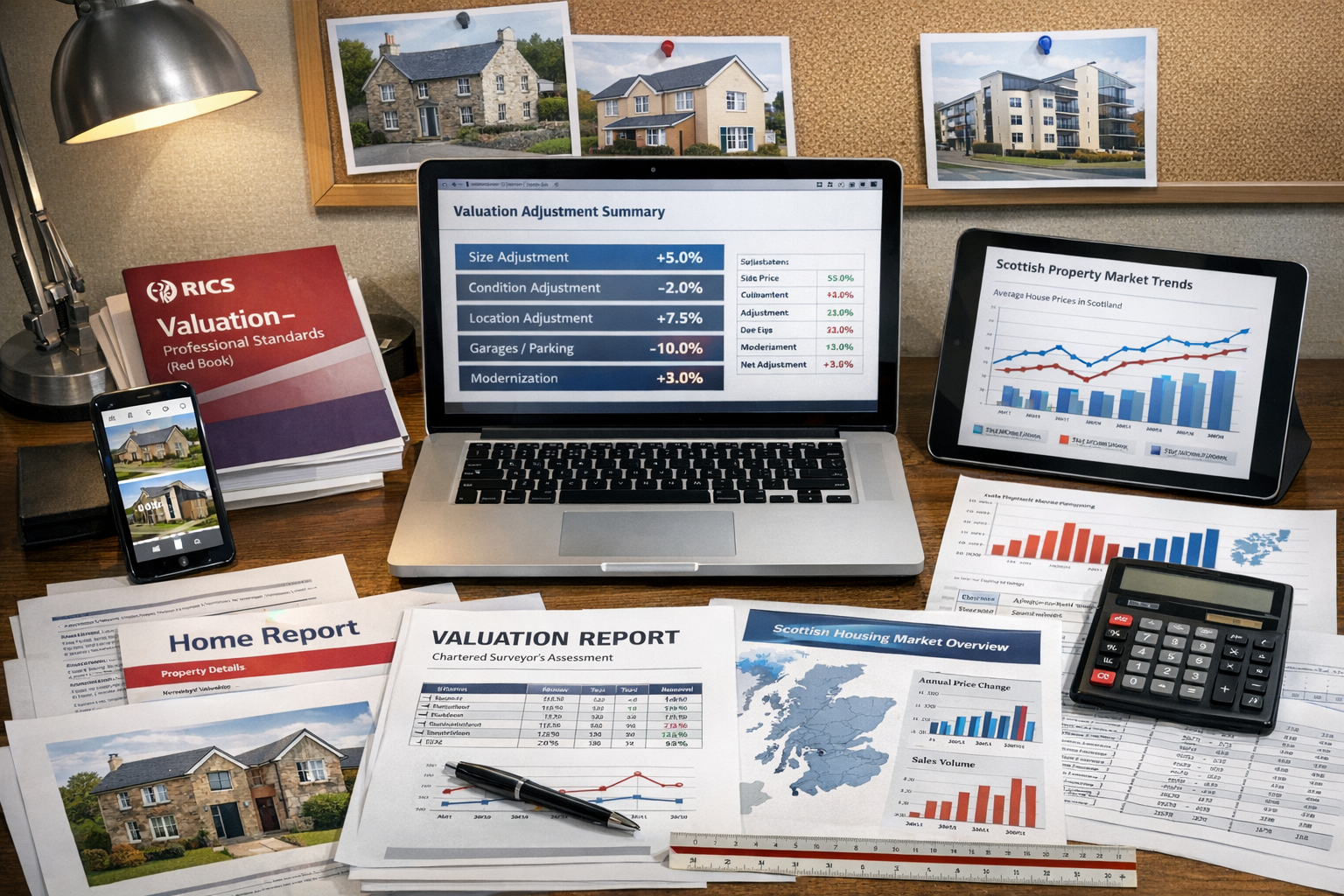
The foundation of accurate property valuation remains comparable analysis, but Scotland's 2026 uptick demands more sophisticated application of this traditional methodology. Chartered surveyors must now consider temporal adjustments alongside the standard location, size, and condition factors.
Time-adjusted comparables become essential when market conditions shift rapidly. A property that sold three months ago may no longer represent current market value if prices have risen 2-3% in the interim. Surveyors should:
- Weight recent transactions more heavily – Prioritize sales from the past 30-60 days over older comparables
- Apply percentage growth adjustments – Use local market data to adjust historical comparables to current value estimates
- Consider transaction circumstances – Distinguish between motivated sales, chain-free transactions, and distressed disposals
- Expand geographic search parameters cautiously – When local comparables are scarce, look to similar neighborhoods rather than compromising on property characteristics
Integrating Home Report Valuations Strategically
Scotland's unique Home Report system creates both opportunities and constraints for valuation accuracy. Since buyers remain highly guided by Home Report valuations, surveyors bear significant responsibility for market pricing accuracy.
The Home Report valuation serves multiple functions:
- Establishes initial asking price expectations
- Influences mortgage lending decisions
- Creates competitive dynamics when priced correctly
- Determines property marketability
For property evaluation in 2026's growth environment, surveyors should:
✅ Balance optimism with realism – Reflect genuine market improvement without inflating values beyond supportable levels
✅ Document adjustment rationale – Clearly explain why valuations differ from recent comparables, particularly in rapidly appreciating areas
✅ Consider buyer psychology – Understand that correctly priced homes generate competition while overpriced properties languish unsold
✅ Communicate market context – Provide clients with broader market insight beyond the single valuation figure
Advanced Adjustment Techniques for Diverging Markets
Valuation Adjustments for Scotland's 2026 House Price Uptick: Surveyor Strategies in a Diverging Market requires surveyors to employ advanced techniques that account for market complexity:
1. Segmented Market Analysis
Rather than treating entire regions uniformly, divide markets into micro-segments:
- Property type (tenements vs. detached vs. new builds)
- Price brackets (entry-level vs. mid-market vs. premium)
- Buyer demographics (first-time buyers vs. downsizers vs. investors)
Each segment may experience different growth rates and demand patterns, requiring separate comparable pools and adjustment factors.
2. Quality-Adjusted Pricing Models
Standard per-square-foot calculations often miss nuanced value drivers. Develop quality adjustment matrices that account for:
- Period features and architectural merit – Georgian properties command premiums beyond simple size calculations
- Energy efficiency ratings – EPC ratings increasingly influence value as buyers consider running costs
- Modern amenities – Contemporary kitchens, bathrooms, and smart home features add measurable value
- Outside space – Gardens, balconies, and parking carry enhanced value post-pandemic
3. Forward-Looking Market Indicators
While valuations reflect current market conditions, surveyors should monitor leading indicators that signal future trends:
- Planning applications and development pipelines
- Employment sector growth or contraction
- Infrastructure investment announcements
- Mortgage lending volume and approval rates
These indicators help surveyors distinguish sustainable growth from temporary spikes, ensuring valuations remain defensible even as markets evolve.
Practical Implementation: Case Studies and Methodologies
Urban Growth Scenario: Edinburgh New Town
Property Type: Georgian townhouse, 2,400 sq ft, four bedrooms, period features retained
Challenge: Limited recent comparables due to unique property characteristics and strong market appreciation
Surveyor Strategy:
- Identified three comparables from past 90 days, applied 1.5% monthly appreciation adjustment
- Sourced two additional comparables from adjacent streets with similar architectural merit
- Applied negative adjustment for properties with modern renovations that removed period features
- Considered premium for properties within specific school catchment areas
- Reviewed asking prices for currently marketed properties to gauge market sentiment
Outcome: Valuation 4% higher than six-month-old comparable, supported by robust methodology documentation
Rural Transition Scenario: Highland Perthshire
Property Type: Converted farmhouse, 3,200 sq ft, five bedrooms, three acres, remote location
Challenge: Sparse transaction volume, lifestyle-driven buyers, wide price variation based on property condition
Surveyor Strategy:
- Expanded geographic search to 15-mile radius while maintaining property type consistency
- Separated land value from building value for clearer analysis
- Applied condition adjustments based on house inspection findings
- Considered access to amenities, broadband quality, and commuting distance as value factors
- Reviewed time-on-market data to assess pricing accuracy of comparables
Outcome: Conservative valuation reflecting genuine market interest rather than aspirational asking prices
Mortgage Lending Considerations
Lenders increasingly scrutinize valuations in growth markets, concerned about overvaluation risks. Surveyors conducting valuations for mortgage purposes should:
- Provide comprehensive comparable evidence – Document all adjustments with clear rationale
- Highlight market context – Explain regional growth patterns and sustainability factors
- Flag potential risks – Note if valuation approaches upper market limits or relies on limited comparable data
- Consider lending criteria – Understand that lenders may apply additional caution in rapidly appreciating markets
When survey results reveal issues that might affect value, buyers can explore options to renegotiate after a poor building survey result, making accurate initial valuations even more critical.
Technology and Data Integration for Enhanced Accuracy
Digital Tools for Market Analysis
Modern surveyors leverage technology to enhance valuation accuracy:
Property Data Platforms provide:
- Real-time transaction data with filtering capabilities
- Historical price trends at postcode level
- Days-on-market statistics indicating pricing accuracy
- Sold-to-asking price ratios revealing negotiation patterns
Geographic Information Systems (GIS) enable:
- Visual mapping of comparable properties
- Identification of location-based value drivers
- Analysis of proximity to amenities, transport, and schools
- Assessment of development pressure and planning trends
Automated Valuation Models (AVMs) serve as:
- Initial value estimates requiring professional verification
- Sanity checks against manual valuations
- Tools for identifying outlier properties requiring investigation
- Data sources for market trend analysis
However, technology complements rather than replaces professional judgment. The nuances of Scotland's diverging markets demand human expertise that understands local context, property uniqueness, and buyer behavior patterns that algorithms cannot fully capture.
Maintaining Professional Standards
As market conditions evolve, maintaining professional standards becomes paramount. Building surveyors must adhere to RICS Red Book guidelines while adapting methodologies to current conditions.
Professional obligations include:
- 📋 Transparent disclosure of valuation methodology
- 🎯 Independence from transaction outcomes
- 📚 Continuing professional development in market trends
- ⚖️ Balanced consideration of all relevant factors
- 📝 Comprehensive documentation supporting conclusions
Understanding the difference between Level 2 and Level 3 surveys helps surveyors recommend appropriate inspection depth for different property types and client needs, ensuring valuations rest on adequate property knowledge.
Managing Client Expectations in a Growth Market
Communication Strategies for Sellers
Sellers in Scotland's 2026 market often harbor optimistic price expectations based on media reports of strong growth. Surveyors must balance encouragement with realism:
Effective communication includes:
- Presenting comparable evidence in accessible formats
- Explaining adjustment rationale in plain language
- Discussing realistic timeframes for achieving asking prices
- Highlighting market positioning relative to competition
- Recommending strategic improvements that enhance value
When valuations fall below seller expectations, providing context about market positioning and realistic alternatives helps maintain professional relationships while ensuring accurate market pricing.
Guidance for Buyers
Buyers navigating Scotland's growth market benefit from surveyor expertise that extends beyond single-property valuation:
- Market timing advice – Insight into whether current conditions favor immediate purchase or continued search
- Negotiation parameters – Guidance on reasonable offer levels based on comparable analysis
- Future value considerations – Discussion of factors likely to influence medium-term appreciation
- Risk assessment – Identification of market factors that could affect future saleability
Buyers seeking comprehensive property assessment should understand which home survey is right for them, ensuring they obtain appropriate professional advice for their specific circumstances.
Regulatory Considerations and Compliance
Scottish-Specific Requirements
Scotland's distinct legal and regulatory framework creates unique compliance considerations:
Home Report Obligations:
- Mandatory for most residential sales
- Must be commissioned before marketing
- Valid for 12 weeks (extendable to 16 weeks)
- Includes Single Survey, Energy Report, and Property Questionnaire
Valuation Standards:
- RICS Valuation – Global Standards (Red Book) compliance
- Scottish supplement addressing local market practices
- Specific guidance for rural and unique properties
- Lender-specific requirements for mortgage valuations
Quality Assurance Processes
Implementing robust quality assurance ensures valuation accuracy and defensibility:
Internal Review Mechanisms:
- Peer review of complex or high-value valuations
- Systematic checking of comparable selection and adjustments
- Verification of calculation accuracy
- Compliance checking against professional standards
- Documentation completeness assessment
External Validation:
- Participation in industry benchmarking studies
- Engagement with local property professional networks
- Monitoring of appeal outcomes and valuation challenges
- Regular calibration against market transaction data
Future-Proofing Valuation Methodologies
Anticipating Market Evolution
While 2026 shows positive momentum, surveyors must prepare for potential market shifts:
Economic Factors to Monitor:
- Interest rate trajectory and mortgage availability
- Employment trends in key Scottish sectors
- Government policy affecting property taxation
- Infrastructure investment decisions
- Migration patterns (both international and UK internal)
Emerging Trends Affecting Value:
- Climate change considerations and flood risk
- Energy efficiency requirements and retrofit costs
- Remote work patterns influencing location preferences
- Demographic shifts affecting property type demand
- Technology integration in homes (smart systems, EV charging)
Continuous Professional Development
Maintaining valuation expertise requires ongoing learning:
- Regular attendance at property market briefings
- Participation in RICS Scotland events and training
- Engagement with local market intelligence sources
- Study of appeal decisions and valuation tribunal outcomes
- Networking with fellow professionals to share insights
Finding the best local surveyor often depends on their commitment to staying current with market developments and maintaining deep local knowledge.
Conclusion
Valuation Adjustments for Scotland's 2026 House Price Uptick: Surveyor Strategies in a Diverging Market represents both a professional challenge and an opportunity for chartered surveyors. Scotland's leading position in UK property price growth, combined with significant regional disparities, demands sophisticated valuation methodologies that balance national trends with local market realities.
Successful surveyors in 2026 will distinguish themselves through:
✅ Rigorous comparable analysis with appropriate temporal and quality adjustments
✅ Deep local market knowledge that recognizes micro-market dynamics
✅ Technology integration that enhances rather than replaces professional judgment
✅ Clear communication that manages client expectations while maintaining accuracy
✅ Commitment to professional standards even when market pressures encourage shortcuts
The Scottish property market's improved stability and modest growth trajectory create favorable conditions for accurate valuation work. Unlike volatile markets where values fluctuate wildly, the current environment rewards careful analysis and methodical approach.
Actionable Next Steps
For Surveyors:
- Review and update your comparable database with recent Scottish transactions
- Develop region-specific adjustment matrices reflecting local market conditions
- Enhance documentation practices to support valuation conclusions
- Invest in technology tools that improve data access and analysis
- Engage in continuing professional development focused on Scottish market trends
For Property Professionals:
- Commission valuations from surveyors with demonstrated local expertise
- Provide comprehensive property information to support accurate assessment
- Request detailed comparable evidence and adjustment explanations
- Consider market timing in relation to regional growth patterns
- Maintain realistic expectations grounded in professional advice
For Buyers and Sellers:
- Obtain professional surveys appropriate to property type and value
- Understand that Home Report valuations reflect current market evidence
- Consider surveyor recommendations regarding pricing strategy
- Recognize regional variations in market strength and growth
- Make decisions based on professional advice rather than media generalizations
Scotland's 2026 property market offers genuine opportunities for those equipped with accurate market intelligence and professional valuation expertise. By implementing the strategies outlined in this guide, surveyors can navigate the diverging market landscape with confidence, providing the accurate valuations that underpin successful property transactions.
The combination of improved affordability, stable market conditions, and modest growth creates an environment where careful valuation work receives appropriate recognition and reward. As Scotland continues its recovery trajectory, surveyors who master these adjustment strategies will position themselves as essential advisors in an increasingly sophisticated property market.
References
[1] Scottish Assessors Association – https://www.saa.gov.uk/