
While property markets across the United Kingdom face flat or declining trends in 2026, Northern Ireland stands apart as a beacon of resilience. The region's commercial property sector demonstrates remarkable strength, with the comprehensive Reval 2026 assessment revealing a 15% increase in total non-domestic property values since the last revaluation [4]. This divergence from national patterns presents both opportunities and challenges for surveyors who must navigate a complex landscape where regional dynamics differ sharply from broader UK trends. Understanding Valuation Adjustments for Northern Ireland's 2026 Price Resilience: Surveyor Techniques in a Diverging National Market has become essential for professionals seeking to deliver accurate, defensible valuations in this unique environment.
The revaluation of more than 75,000 non-domestic properties represents the most comprehensive assessment of Northern Ireland's commercial market, with implications extending far beyond simple rate calculations [4]. For surveyors, this creates a demanding environment where traditional valuation methodologies must be adapted to account for sector-specific performance variations, geographic concentration patterns, and post-pandemic recovery trajectories that differ markedly from those observed elsewhere in the UK.
Key Takeaways
- Northern Ireland's commercial property market shows 15% overall value growth since the last revaluation, significantly outperforming flat national trends, with industrial properties leading at 16% increases
- Surveyor techniques must account for Belfast-centric growth patterns, where Grade A offices and retail properties demonstrate stronger performance compared to regional locations
- Sector-specific valuation adjustments are critical, with industrial/warehousing, office, and retail sectors each requiring distinct methodological approaches based on their unique performance characteristics
- Revenue-neutral rate adjustments mean 67% of properties fall at or below average increases, requiring surveyors to provide clear comparative analysis for clients facing varied rate liability changes
- April 2024 rental evidence forms the valuation baseline, necessitating careful market analysis and adjustment techniques to reflect achievable rents in Northern Ireland's distinct market conditions
Understanding Northern Ireland's Market Divergence from National Trends
The 2026 property landscape across the United Kingdom presents a tale of two markets. While England, Scotland, and Wales grapple with stagnant or declining property values amid economic uncertainty, Northern Ireland's commercial sector demonstrates unexpected vitality. This divergence stems from several fundamental factors that surveyors must understand when applying Valuation Adjustments for Northern Ireland's 2026 Price Resilience.
The Fundamentals Driving Northern Ireland's Resilience
Northern Ireland's commercial property market benefits from distinct economic drivers that separate it from broader UK trends. The region's industrial sector, in particular, has experienced exceptional demand driven by logistics expansion and manufacturing growth, coupled with limited modern supply that has pushed rental values upward by approximately 16% [4]. This supply-demand imbalance creates valuation scenarios rarely encountered in other UK regions during 2026.
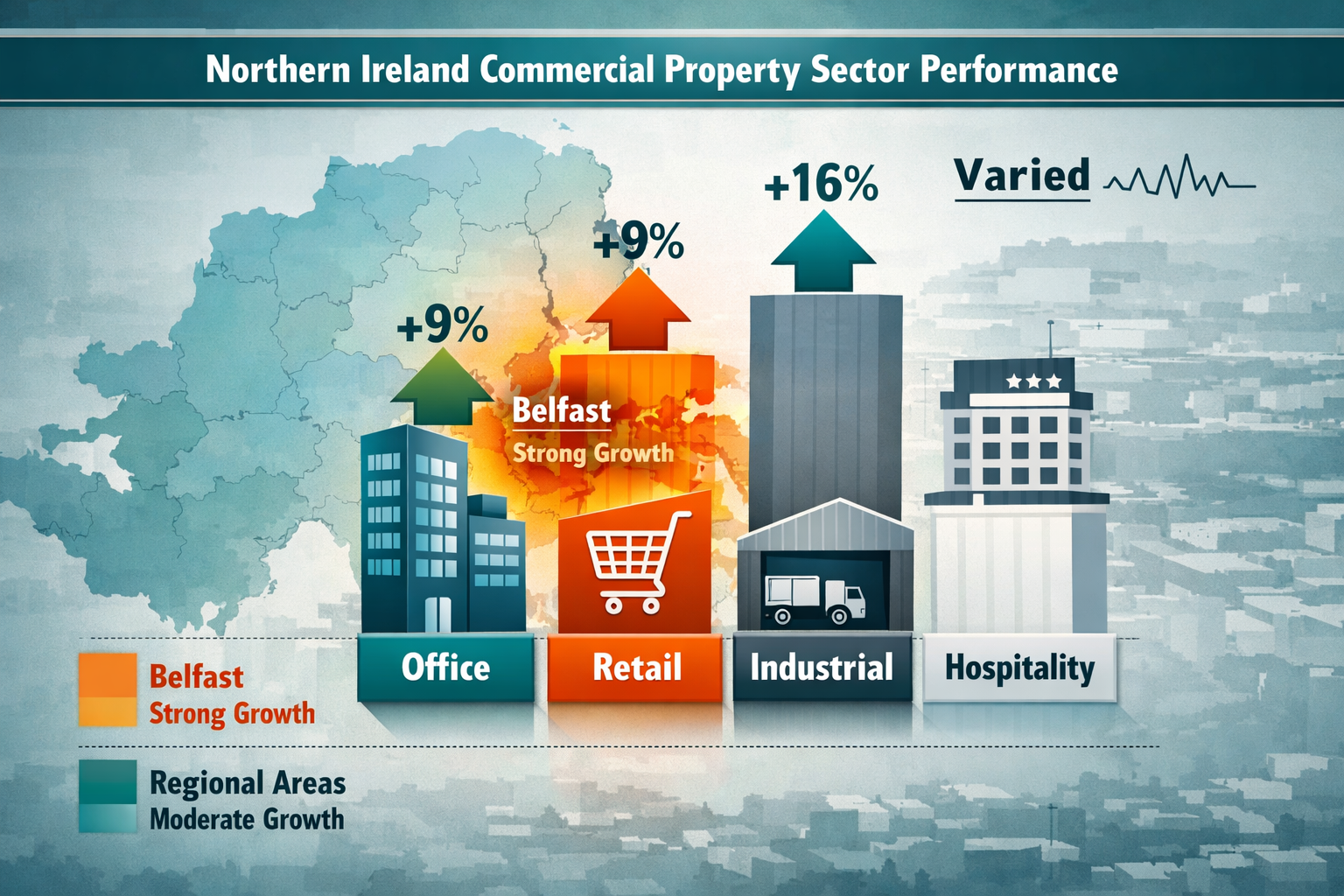
The office sector tells a more nuanced story. While overall office values increased by approximately 9%, this growth concentrates heavily in Grade A office spaces within Belfast [8]. This geographic concentration requires surveyors to apply location-specific adjustments that account for the premium commanded by Belfast's central business district compared to secondary locations throughout Northern Ireland.
Retail properties present another layer of complexity. Despite national retail challenges, Northern Ireland's retail sector achieved a 9% value increase, though performance varies significantly between Belfast's strengthening retail core and more moderate growth in regional towns [4]. Independent high street retailers, notably, have seen minimal changes to their net annual values, creating a bifurcated market that demands careful comparative analysis.
Geographic Concentration and the Two-Tier Market Dynamic
Perhaps the most critical factor in Valuation Adjustments for Northern Ireland's 2026 Price Resilience is understanding the pronounced two-tier market structure. Belfast functions as the primary growth engine, capturing disproportionate value increases across multiple sectors, while regional areas demonstrate more modest uplifts [8].
This geographic divergence requires surveyors to develop sophisticated location adjustment factors. A Grade A office in Belfast's central business district operates in a fundamentally different market than a comparable property in Londonderry or Newry. The rental evidence base, tenant demand profiles, and investment yields all vary substantially, necessitating location-specific valuation approaches that go beyond simple percentage adjustments.
For professionals seeking guidance on comprehensive property assessment methodologies, understanding which home survey is right for you provides foundational knowledge that applies across different market conditions.
Surveyor Techniques for Sector-Specific Valuation Adjustments

The Reval 2026 assessment reveals that Northern Ireland's commercial property sectors demonstrate markedly different performance trajectories, each requiring tailored valuation methodologies. Surveyors must develop sector-specific adjustment techniques that reflect these divergent market conditions while maintaining consistency with RICS valuation standards.
Industrial and Warehousing: Capturing the 16% Premium
The industrial sector's 16% value increase represents the strongest performance across all commercial property types [4]. This growth stems from fundamental supply-demand dynamics that surveyors must carefully analyze when preparing valuations. Limited availability of modern, purpose-built industrial facilities combined with robust demand from logistics operators and manufacturers has created rental growth that outpaces other sectors significantly.
When valuing industrial properties in Northern Ireland's 2026 market, surveyors should employ several specific techniques:
Rental Evidence Analysis: Focus on recent lettings of comparable modern industrial units, paying particular attention to specification differences. Properties with enhanced loading capabilities, clear heights exceeding 8 meters, and efficient yard layouts command substantial premiums that must be quantified through detailed comparable analysis.
Location Multipliers: Industrial property values vary significantly based on proximity to major transport corridors, particularly the M1 and M2 motorways and Belfast port facilities. Surveyors should develop location adjustment factors ranging from 0.85 to 1.15 based on accessibility metrics and journey times to key distribution points.
Obsolescence Adjustments: Older industrial stock without modern specifications requires careful downward adjustment. Properties lacking contemporary energy efficiency standards, limited eaves heights, or constrained yard access may warrant adjustments of 20-30% below headline rental values for prime modern units.
For those interested in comprehensive property condition assessment, our RICS property valuations service provides detailed analysis across all property types.
Office Sector: Navigating the Grade A Premium in Belfast
The office sector's 9% overall increase masks significant internal variation, with Grade A Belfast offices driving growth while secondary and regional offices show more modest appreciation [8]. This creates a complex valuation landscape requiring nuanced adjustment techniques.
Quality Grading Adjustments: Surveyors must establish clear criteria for office grading that reflect Northern Ireland market expectations. Grade A offices typically feature raised floors, suspended ceilings, air conditioning, floor plates exceeding 10,000 square feet, and prominent locations. These properties command rental premiums of 30-50% over Grade B stock in comparable locations.
Belfast CBD Premium: Central Belfast office locations demonstrate rental values 25-40% higher than suburban Belfast offices and 50-80% higher than regional town centers. Surveyors should develop distance-based adjustment curves that reflect the rental gradient extending outward from Belfast's core business district.
Specification Adjustments: Modern office specifications including energy efficiency ratings (EPC A or B), contemporary HVAC systems, and flexible floor layouts warrant premium adjustments of 15-25% over older stock with equivalent locations.
Retail Properties: Addressing the Belfast-Regional Divide
Retail valuations in Northern Ireland's 2026 market require careful consideration of location hierarchy and changing consumer patterns. While the sector achieved 9% overall growth, independent high street retailers experienced minimal net annual value changes, creating a nuanced valuation environment [4].
Location Hierarchy Modeling: Surveyors should employ a tiered location classification system:
- Prime Belfast retail: City center locations with high footfall (Zone A rents exceeding £100 per square foot)
- Secondary Belfast: Suburban shopping centers and retail parks (Zone A rents £40-£80 per square foot)
- Regional town centers: Primary retail locations in towns like Newry, Ballymena, Lisburn (Zone A rents £30-£60 per square foot)
- Local high streets: Independent retail locations (Zone A rents £15-£35 per square foot)
Zoning Adjustments: Retail valuations require careful application of zoning techniques, with Zone A (the first 20 feet of depth) commanding full rental value, Zone B (next 20 feet) at 50%, and Zone C (next 20 feet) at 25%. Remainder areas typically value at 10% of Zone A rates.
Hospitality Sector: Managing Post-Pandemic Variance
The hospitality sector presents perhaps the most complex valuation challenge, with significant variance in property performance post-pandemic. Some businesses experienced decreased valuations while the majority saw substantial increases due to improved trading conditions, expansion, and property improvements [4].
Trading Potential Assessment: Hospitality valuations in Northern Ireland increasingly rely on detailed trading potential analysis. Surveyors must evaluate location quality, accommodation standards, food and beverage facilities, and ancillary revenue opportunities to determine fair maintainable trade (FMT) levels that underpin rental value assessments.
Pandemic Recovery Adjustments: Properties that underwent significant refurbishment or repositioning during 2020-2023 require careful analysis of pre- and post-improvement trading patterns. Surveyors should examine comparable properties with similar improvement profiles to quantify the rental uplift attributable to enhanced facilities.
Understanding how to negotiate purchase prices with building survey findings provides valuable context for valuation adjustments across all commercial sectors.
Methodological Approaches for Valuation Adjustments in Northern Ireland's 2026 Market
Applying Valuation Adjustments for Northern Ireland's 2026 Price Resilience: Surveyor Techniques in a Diverging National Market requires methodological rigor that balances market evidence with professional judgment. The April 2024 valuation date established for Reval 2026 provides the temporal anchor point, but surveyors must develop robust analytical frameworks to translate this baseline into defensible valuations [4].
Rental Evidence Analysis and Adjustment Techniques
The foundation of Northern Ireland's non-domestic property valuations rests on rental evidence analysis. Land & Property Services bases revaluations on "the rent a property could reasonably be expected to achieve" as of the April 2024 valuation date [4]. This rental value approach requires surveyors to master several analytical techniques:
Comparable Evidence Hierarchy: Surveyors should establish a clear hierarchy of evidence reliability:
- Direct comparables: Same property type, similar location, transaction within 12 months of valuation date
- Adjusted comparables: Same property type, different location or size, requiring adjustment factors
- Cross-sector evidence: Different property types providing market context
- Historical evidence: Older transactions adjusted for time and market movement
Time Adjustment Factors: For rental evidence predating April 2024, surveyors must apply time adjustments reflecting market movement. Given Northern Ireland's 15% overall growth since the last revaluation, annual growth rates averaging 4-5% provide reasonable adjustment factors, though sector-specific rates should be applied where evidence supports differentiation [4].
Quantum Adjustments: Larger properties typically achieve lower unit rates than smaller properties. Surveyors should apply quantum adjustment curves, with industrial properties showing the most pronounced size effects (reductions of 15-25% for properties exceeding 50,000 square feet) and offices showing more modest adjustments (5-15% for properties exceeding 20,000 square feet).
Comparative Method Applications
The comparative method remains the primary valuation approach for most Northern Ireland commercial properties, but its application requires careful calibration to account for the region's diverging market dynamics. Surveyors must develop adjustment matrices that capture multiple variables simultaneously.
Multi-Variable Adjustment Matrix: Effective comparative valuations require systematic adjustment for:
- Location (Belfast CBD premium vs. regional locations)
- Property quality (Grade A vs. Grade B vs. Grade C specifications)
- Size (quantum adjustments for scale)
- Age and condition (obsolescence factors)
- Specific features (parking, loading, accessibility)
For example, when valuing a 15,000 square foot Grade B office in suburban Belfast, a surveyor might start with evidence of a Grade A Belfast CBD office letting at £18 per square foot, then apply:
- Location adjustment: -30% (£12.60 per square foot)
- Quality adjustment: -20% (£10.08 per square foot)
- Quantum adjustment: +5% (£10.58 per square foot)
This systematic approach ensures transparency and defensibility in valuation conclusions.
Handling Market Divergence from National Trends
One of the most challenging aspects of Valuation Adjustments for Northern Ireland's 2026 Price Resilience involves explaining and justifying valuations that diverge from national patterns. When UK-wide property indices show flat or declining values while Northern Ireland demonstrates 15% growth, surveyors must provide clear rationale grounded in local market evidence [4].
Regional Market Analysis Documentation: Surveyors should prepare comprehensive market commentary that addresses:
- Supply-demand dynamics specific to Northern Ireland
- Economic drivers supporting rental growth (employment, investment, infrastructure)
- Sector-specific performance factors
- Geographic concentration patterns and Belfast's outsized influence
Comparative Regional Analysis: When appropriate, surveyors can reference performance in other regional UK markets with similar characteristics. For instance, Northern Ireland's industrial sector performance may show parallels with strong logistics markets in the English Midlands, providing context for apparently divergent trends.
Professionals seeking to understand broader market dynamics can explore our guide on valuation methodology for flat and declining markets, which provides useful contrast to Northern Ireland's resilient conditions.
Revenue-Neutral Adjustments and Rate Liability Analysis
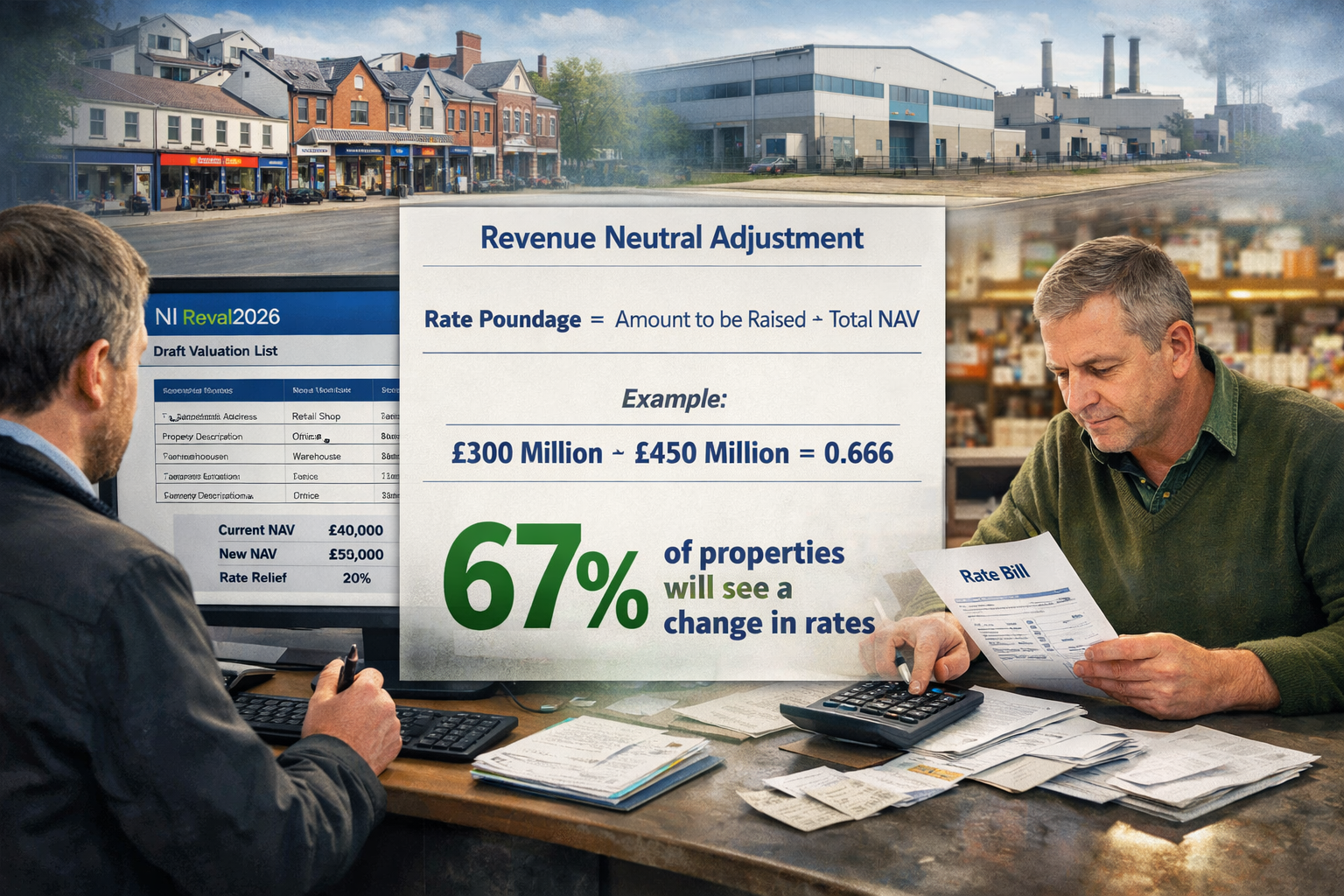
A critical but often misunderstood aspect of Reval 2026 involves its revenue-neutral structure. Although property values increased 15% overall, rate poundages adjust to maintain revenue neutrality, meaning not all properties face proportionate rate bill increases [4]. Surveyors must help clients understand this complex relationship.
Relative Position Analysis: Properties with increases below the 15% average will likely see rate bill reductions or minimal increases, while those exceeding 15% face higher bills. Approximately 67% of properties fall at or below the average increase, creating a distribution where understanding relative position matters as much as absolute valuation [4].
Rate Relief Impact Assessment: With approximately 75% of non-domestic properties entitled to some form of rate relief worth around £250 million collectively, surveyors should factor relief eligibility into practical rate liability analysis [4]. Relief schemes include:
- Industrial derating (manufacturing properties)
- Sport and recreation relief
- Charitable exemptions
- Small business rate relief
Understanding these relief mechanisms allows surveyors to provide clients with complete financial impact assessments, not merely valuation figures.
Practical Implementation: Tools and Techniques for Surveyors
Implementing Valuation Adjustments for Northern Ireland's 2026 Price Resilience: Surveyor Techniques in a Diverging National Market requires practical tools and systematic approaches that surveyors can apply consistently across diverse property types and locations.
Developing Location-Specific Adjustment Factors
Northern Ireland's two-tier market structure necessitates sophisticated location adjustment frameworks. Surveyors should develop quantified location factors based on systematic analysis of rental evidence patterns across geographic zones.
Belfast CBD Core Zone: Properties within the central business district bounded by City Hall, Cathedral Quarter, and Laganside command premium adjustments of 1.25-1.40 times regional baseline values for comparable property types.
Belfast Suburban Zone: Properties in established suburban business locations (Boucher Road, Mallusk, Holywood Exchange) warrant adjustments of 1.10-1.20 times regional baseline values.
Regional Town Centers: Primary locations in towns like Newry, Ballymena, Craigavon, and Londonderry typically achieve 0.85-1.00 times baseline values depending on local economic strength and property quality.
Secondary Locations: Properties in smaller towns and rural locations generally value at 0.70-0.85 times baseline values, with significant variation based on specific local market conditions.
Quality Assessment Matrices
Systematic property quality assessment ensures consistency and defensibility in valuation adjustments. Surveyors should develop scoring matrices that evaluate properties across multiple dimensions:
Office Quality Matrix (100-point scale):
- Building specification and services (30 points)
- Location and accessibility (25 points)
- Floor plate efficiency and layout (20 points)
- Energy efficiency and sustainability (15 points)
- Amenities and parking (10 points)
Properties scoring 85+ qualify as Grade A, 70-84 as Grade B, and below 70 as Grade C, with rental adjustments applied accordingly.
Industrial Quality Matrix (100-point scale):
- Clear height and structural capacity (25 points)
- Loading and logistics facilities (25 points)
- Site coverage and yard space (20 points)
- Location and transport access (20 points)
- Building condition and services (10 points)
These systematic approaches reduce subjectivity and provide transparent rationale for valuation conclusions.
Technology Integration for Enhanced Analysis
Modern surveying practice increasingly relies on technology tools that enhance analytical capability and efficiency. Surveyors working in Northern Ireland's 2026 market should leverage:
Geographic Information Systems (GIS): Mapping rental evidence geographically reveals spatial patterns in value distribution, helping identify location adjustment factors and market boundaries with precision.
Automated Valuation Models (AVMs): While not replacing professional judgment, AVMs provide useful benchmarking and can identify outliers requiring additional investigation. In Northern Ireland's diverging market, AVMs calibrated to local evidence offer valuable quality control.
Comparable Evidence Databases: Maintaining comprehensive databases of rental transactions, organized by property type, location, and key characteristics, enables rapid identification of relevant comparables and systematic adjustment factor development.
For surveyors seeking to expand their technical capabilities, exploring RICS homebuyer survey methodologies provides valuable insights into systematic property assessment approaches.
Client Communication and Valuation Report Best Practices
Effective implementation of Valuation Adjustments for Northern Ireland's 2026 Price Resilience: Surveyor Techniques in a Diverging National Market extends beyond technical analysis to encompass clear client communication. The complexity of Reval 2026, combined with Northern Ireland's divergence from national trends, requires surveyors to develop enhanced reporting and communication strategies.
Explaining Market Divergence to Clients
Clients accustomed to national property market commentary may struggle to understand why Northern Ireland demonstrates 15% growth while UK-wide trends remain flat or negative [4]. Surveyors should prepare clear, evidence-based explanations that address this apparent contradiction.
Market Context Statements: Valuation reports should include concise market commentary that explains:
- Northern Ireland's distinct economic drivers supporting property demand
- Sector-specific performance variations and their underlying causes
- Geographic concentration patterns and Belfast's dominant influence
- Supply constraints in key sectors (particularly industrial) driving rental growth
Comparative Performance Tables: Visual presentations comparing Northern Ireland's sector performance against UK-wide trends help clients grasp regional divergence quickly:
| Sector | NI Growth (Reval 2026) | UK Trend (2026) | Variance |
|---|---|---|---|
| Industrial | +16% | +2% to +5% | +11% to +14% |
| Office | +9% | -2% to +1% | +8% to +11% |
| Retail | +9% | -5% to 0% | +9% to +14% |
| Overall | +15% | -1% to +2% | +13% to +16% |
Rate Liability Impact Analysis
Beyond valuation figures, clients need clear guidance on practical rate liability implications. The revenue-neutral structure of Reval 2026 means valuation changes don't translate directly to rate bill changes [4].
Relative Position Reporting: Valuation reports should clearly state:
- The property's percentage valuation change
- The sector average change for comparison
- The overall 15% average change benchmark
- Likely direction of rate bill impact (increase, decrease, or minimal change)
Rate Relief Eligibility Assessment: Where applicable, reports should identify potential rate relief eligibility and quantify its impact on net rate liability. This practical guidance helps clients understand their complete financial position.
Addressing Valuation Challenges and Disputes
The significant value increases in Reval 2026, combined with sector and geographic variations, will inevitably generate valuation challenges and disputes. Surveyors should prepare robust documentation that withstands scrutiny.
Evidence Documentation Standards: Comprehensive comparable evidence schedules should include:
- Property addresses and descriptions
- Transaction dates and rental terms
- Adjustment factors applied with clear rationale
- Source documentation references
- Photographs where available
Adjustment Rationale Transparency: Each material adjustment applied to comparable evidence should include explicit explanation of the methodology and quantum. Vague statements like "adjusted for location" should be replaced with specific explanations such as "adjusted downward by 25% to reflect secondary location compared to Belfast CBD prime comparable, based on analysis of 12 transactions showing consistent 20-30% location differential."
For professionals seeking guidance on negotiation strategies following valuation assessments, our resource on renegotiating after poor building survey results provides valuable insights applicable to commercial property contexts.
Future-Proofing Valuation Approaches Beyond 2026
While Reval 2026 establishes valuations based on April 2024 rental evidence, forward-thinking surveyors must consider how Northern Ireland's market may evolve beyond the immediate revaluation period. Building flexibility into valuation methodologies ensures continued relevance as market conditions change.
Monitoring Leading Indicators
Surveyors should track several leading indicators that may signal shifts in Northern Ireland's commercial property market:
🔍 Supply Pipeline Monitoring: New development completions, particularly in the industrial sector, could ease supply constraints that currently drive rental growth. Tracking planning approvals and construction starts provides early warning of potential supply increases.
📊 Economic Performance Metrics: Northern Ireland's economic growth, employment trends, and business investment levels directly influence commercial property demand. Regular monitoring of economic indicators helps anticipate market direction changes.
🌍 Brexit and Trade Pattern Evolution: Northern Ireland's unique position regarding EU trade access continues to evolve. Changes in trading arrangements could significantly impact industrial and logistics property demand.
💡 Hybrid Working Trends: Office sector performance remains sensitive to evolving workplace patterns. Monitoring office occupation rates and tenant space requirements helps anticipate demand shifts.
Scenario Planning and Sensitivity Analysis
Given uncertainty inherent in property markets, surveyors should develop scenario-based valuation approaches that acknowledge multiple potential outcomes:
Base Case Scenario: Continued moderate growth aligned with current trends (2-4% annual rental growth across most sectors)
Upside Scenario: Accelerated growth driven by enhanced economic performance and continued supply constraints (5-7% annual rental growth)
Downside Scenario: Market softening due to economic challenges or supply increases (0-2% annual rental growth or modest declines)
Presenting valuations within this framework helps clients understand both central estimates and potential variation ranges.
Professional Development and Market Knowledge
The specialized knowledge required for Valuation Adjustments for Northern Ireland's 2026 Price Resilience: Surveyor Techniques in a Diverging National Market demands ongoing professional development. Surveyors should:
- Maintain active market engagement through regular property inspections and market participant discussions
- Participate in professional forums focused on Northern Ireland commercial property
- Review published market reports from agents, researchers, and Land & Property Services
- Undertake continuing professional development addressing regional market dynamics and valuation methodology
Building deep market knowledge creates competitive advantage and enhances valuation quality and defensibility.
Conclusion
Valuation Adjustments for Northern Ireland's 2026 Price Resilience: Surveyor Techniques in a Diverging National Market represents a critical competency for property professionals operating in this unique regional context. Northern Ireland's 15% overall commercial property value growth stands in stark contrast to flat or declining national trends, creating both opportunities and challenges that demand specialized surveying approaches [4].
The comprehensive Reval 2026 assessment of over 75,000 non-domestic properties reveals a complex market landscape characterized by significant sector variation—from industrial properties' exceptional 16% growth to more modest 9% increases in office and retail sectors—and pronounced geographic concentration favoring Belfast over regional locations [4][8]. Surveyors must develop sophisticated adjustment techniques that capture these nuances while maintaining methodological rigor and RICS compliance.
Success in this environment requires mastery of several key competencies:
✅ Sector-specific valuation methodologies that recognize distinct performance drivers across industrial, office, retail, and hospitality property types
✅ Location adjustment frameworks that quantify Belfast's premium over regional locations and account for the two-tier market structure
✅ Systematic comparable analysis employing multi-variable adjustment matrices that ensure consistency and defensibility
✅ Client communication strategies that clearly explain market divergence from national trends and translate valuations into practical rate liability implications
✅ Evidence documentation standards that withstand scrutiny in potential valuation challenges and disputes
Actionable Next Steps for Surveyors
Professionals seeking to enhance their capabilities in Northern Ireland's diverging market should take these concrete actions:
-
Build comprehensive comparable evidence databases organized by sector, location, and property quality, with particular focus on post-April 2024 transactions
-
Develop quantified adjustment factor schedules for location, quality, size, and other key variables, calibrated to Northern Ireland market evidence
-
Establish systematic quality assessment frameworks using scoring matrices that reduce subjectivity and enhance consistency
-
Create client communication templates that effectively explain market divergence, rate liability implications, and relief eligibility
-
Implement ongoing market monitoring systems tracking rental transactions, economic indicators, and supply pipeline developments
-
Engage with Land & Property Services resources including the NI Reval2026 platform to understand official valuation approaches and access published guidance
The revenue-neutral structure of Reval 2026, where approximately 67% of properties experience at or below-average increases, means that relative valuation accuracy matters as much as absolute precision [4]. Surveyors who master the specialized techniques required for Northern Ireland's resilient market will deliver superior value to clients navigating this complex revaluation landscape.
As Northern Ireland's commercial property market continues evolving beyond 2026, the analytical frameworks and methodological approaches developed for this revaluation period will provide enduring value. The region's demonstrated resilience amid challenging national conditions suggests continued divergence from UK-wide trends, making specialized regional expertise increasingly valuable for property professionals, investors, and business owners alike.
For additional guidance on property assessment methodologies and valuation best practices, explore our comprehensive resources on RICS property valuations and understanding which survey approach fits specific property scenarios.
References
[1] Valuation Accuracy Under Modest Price Growth Surveyor Tactics For 2 5 Annual Uplift Forecasts In 2026 – https://nottinghillsurveyors.com/blog/valuation-accuracy-under-modest-price-growth-surveyor-tactics-for-2-5-annual-uplift-forecasts-in-2026
[2] Property Valuations In Ireland What Every Buyer Needs To Know In 2026 – https://rentsmart.ie/blog/property-valuations-in-ireland-what-every-buyer-needs-to-know-in-2026
[3] Valuation Methodology For Flat And Declining Markets Surveyor Techniques When Regional Price Pressures Mount – https://nottinghillsurveyors.com/blog/valuation-methodology-for-flat-and-declining-markets-surveyor-techniques-when-regional-price-pressures-mount
[4] Land Property Services Publishes Draft Valuation List Reval 2026 – https://www.finance-ni.gov.uk/news/land-property-services-publishes-draft-valuation-list-reval-2026
[5] Property Valuation Ireland 2026 How To Get An Accurate Estimate – https://rentsmart.ie/blog/property-valuation-ireland-2026-how-to-get-an-accurate-estimate
[6] Revaluation 2026 Everything You Need To Know – https://valuationoffice.blog.gov.uk/2025/09/29/revaluation-2026-everything-you-need-to-know/
[7] Understanding Property Surveys A Guide For Buyers And Investors – https://homesurveysiq.co.uk/f/understanding-property-surveys-a-guide-for-buyers-and-investors
[8] Land Property Services Publishes Draft Valuation List For Reval 2026 – https://www.manufacturingni.org/land-property-services-publishes-draft-valuation-list-for-reval-2026/