More than $875 billion in commercial and multifamily real estate loans will mature in 2026 alone—a refinancing wave that will expose every weakness in property valuations built during the ultra-low rate era[2]. For owners of complex properties like high-rise conversions, mixed-use developments, and non-standard residential buildings, this tsunami of maturing debt has triggered a fundamental shift in how lenders assess value, risk, and long-term resilience.
The comfortable assumptions of 2015–2021 have evaporated. Lenders now demand evidence that properties can withstand energy cost volatility, maintenance budget pressures, and evolving tenant expectations—all while refinancing at dramatically higher rates with stricter loan-to-value requirements. Understanding Valuation Adjustments for Long-Term Resilience in Complex Properties: 2026 Lender Expectations has become essential for property owners, investors, and surveyors navigating this transformed lending landscape.
This article examines how professional surveyors must now integrate energy performance, maintenance forecasting, and future-proofing assessments into valuations for complex properties, while leveraging technology-driven insights to prevent costly transaction delays during the critical 2026–2028 refinancing cycle.
Key Takeaways
- Lenders require lower loan-to-value ratios and stricter debt coverage compared to the 2015–2021 period, with many borrowers needing additional equity just to refinance existing debt[2]
- Energy performance, maintenance reserves, and future-proofing capacity now directly impact property valuations, especially for complex buildings like high-rises and conversions
- Technology-enabled early assessment helps identify valuation risks before refinancing deadlines, preventing transaction delays and forced seller situations
- Static valuation models built for stable markets can mask emerging pressure points that become critical when $4+ trillion in CRE loans mature through 2029[2]
- Regional banks have tightened underwriting standards significantly, making traditional CRE financing more difficult and selective across property types[2]

Why Complex Properties Face Enhanced Scrutiny in 2026 Valuations
Complex properties—including high-rise residential towers, industrial conversions, mixed-use developments, and non-standard construction—face disproportionate valuation pressure in 2026's lending environment. These properties combine multiple risk factors that lenders now scrutinize with unprecedented rigor.
The Shift from Simple to Sophisticated Valuation Models
Traditional valuation approaches relied heavily on comparable sales and income capitalization rates. While these methods remain foundational, lenders now demand forward-looking resilience assessments that account for:
- Energy performance trajectories as regulations tighten and tenant expectations evolve
- Maintenance capital requirements over 10–15 year holding periods
- Adaptability potential for changing use patterns and market demands
- Climate risk exposure including flood zones, heat island effects, and extreme weather vulnerability
For complex properties, these factors carry amplified weight. A converted warehouse with single-pane industrial windows faces dramatically different energy cost projections than purpose-built residential construction. High-rise buildings with aging mechanical systems require substantially higher capital reserve allocations than low-rise developments with newer infrastructure.
Office Sector Pressures Ripple Across Property Types
The commercial real estate landscape has shifted significantly, particularly in the office sector, where remote and hybrid work models have reduced tenant demand and compressed rental income, directly impacting valuations[3]. This office sector weakness has created broader caution across all complex property types.
Lenders increasingly view any property with non-standard characteristics through a more conservative lens, recognizing that market disruptions can emerge rapidly and unexpectedly. The office sector's challenges have demonstrated how quickly tenant preferences and space utilization patterns can shift, making future-proofing capacity a critical valuation component.
Regional Bank Constraints Tighten Access
Regional banks, which hold a large share of CRE loans, have tightened underwriting standards and reduced loan-to-value ratios, making access to traditional CRE financing more difficult and shaping the pace of refinancing activity[2]. This constraint particularly affects complex properties that don't fit standard underwriting templates.
Properties requiring specialized knowledge—converted churches, adaptive reuse projects, mixed-use developments—now face longer approval timelines and more intensive due diligence. Surveyors must provide exceptionally detailed documentation to satisfy lender requirements, making early assessment and comprehensive reporting essential.
For property owners seeking guidance on selecting appropriate survey levels for complex buildings, understanding the differences between home survey levels 2 vs level 3 becomes crucial for meeting lender expectations.
Understanding Valuation Adjustments for Long-Term Resilience in Complex Properties: 2026 Lender Expectations
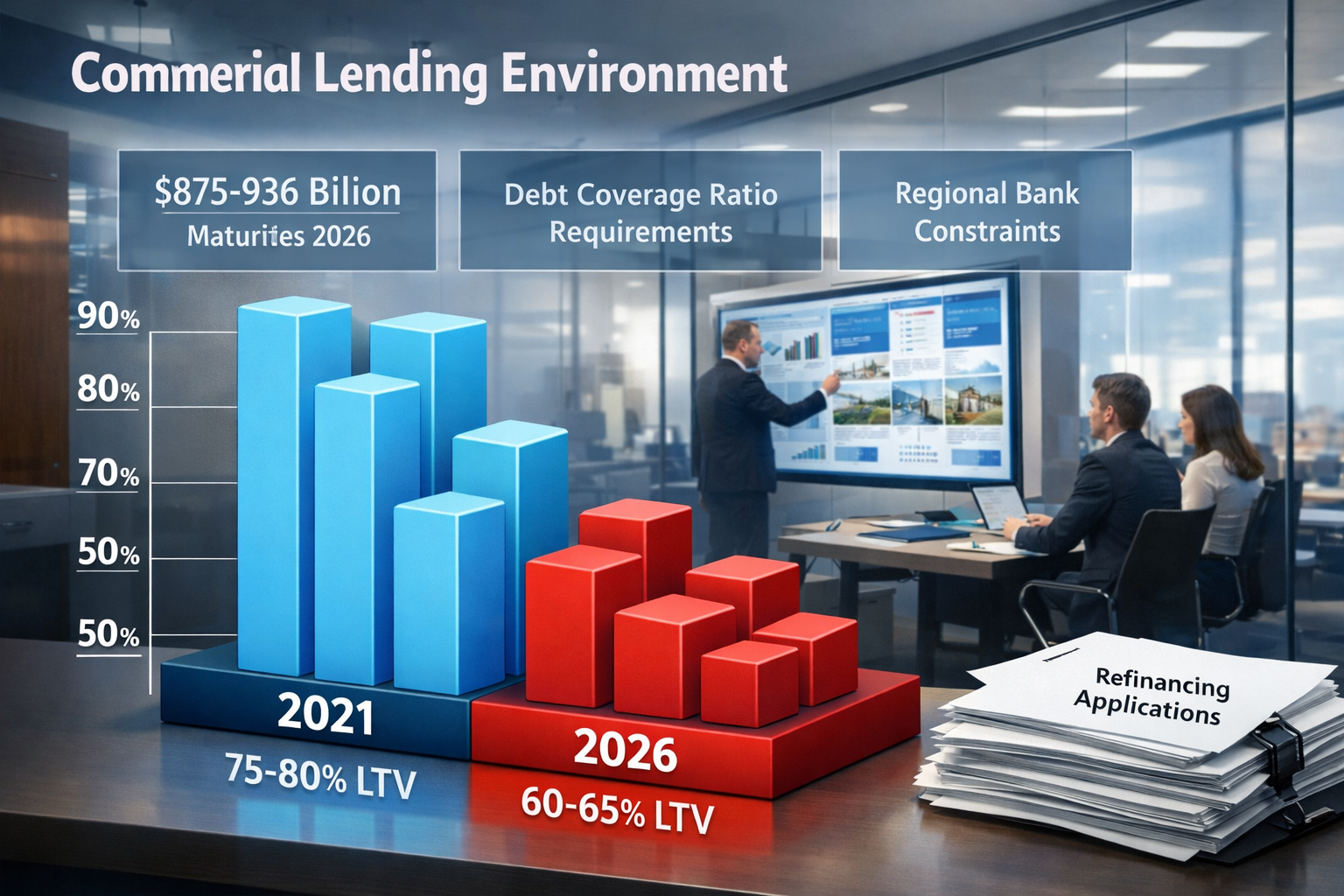
The refinancing environment of 2026 bears little resemblance to the accommodating lending conditions of recent years. Lenders are applying dramatically different standards compared to the 2015–2021 low-rate era, now requiring lower loan-to-value ratios, stricter debt-coverage requirements, and higher interest rates, with many borrowers needing to bring additional equity just to refinance[2].
Conservative Underwriting Becomes Standard Practice
The shift in lending standards reflects fundamental changes in risk assessment. Where 75–80% loan-to-value ratios were common during the low-rate period, many lenders now cap complex property financing at 60–65% LTV. Debt service coverage ratios have increased from 1.20x to 1.35x or higher for properties with non-standard characteristics.
These stricter requirements directly impact property valuations. Appraisers and auditors are asking "whether an asset's carrying value still holds up if refinancing proceeds are more limited," with buyers increasingly pricing refinancing risk into their bids, often more cautiously given the potential for forced seller situations[3].
The Refinancing Proceeds Gap
Borrowers refinancing loans may face lower loan proceeds, with some property owners unable to access the same debt levels that were available during the ultra-low rate environment of 2020–2021[2]. This "proceeds gap" creates immediate valuation pressure.
Consider a property owner who secured a £5 million loan at 75% LTV in 2020, implying a £6.67 million valuation. If that same property now qualifies for only 65% LTV at refinancing, the owner needs the property to appraise at £7.69 million just to refinance the existing £5 million debt without bringing additional equity. Any valuation below that threshold requires cash injection—a scenario playing out across thousands of properties in 2026.
Loan Extensions Delay but Don't Eliminate Pressure
Over the past two years, lenders extended maturities by 12 to 24 months while waiting for interest rates and property values to stabilize, though this strategy has helped reduce immediate distress while pushing refinancing challenges into 2026–2028[2]. These extensions provided temporary relief but concentrated refinancing pressure into a narrow window.
Maturities are projected to peak around 2027, with a large portion of loan extensions and modifications pushing maturities into this three-year window rather than forcing immediate distress[2]. Property owners who received extensions in 2024–2025 now face the moment of truth: either property values and income have improved enough to support refinancing, or equity injections become necessary.
Static Models Versus Dynamic Reality
Many property owners still rely on static valuation models built for a more stable environment, but as assumptions around income, demand, and financing evolve, these models can mask refinancing risk and hide emerging pressure points that could create surprises when debt comes due[3].
For complex properties, static models prove particularly inadequate. They fail to capture:
- Energy cost escalation as older buildings face efficiency mandates
- Maintenance capital requirements as building systems age and fail
- Tenant preference shifts toward sustainable, well-maintained spaces
- Insurance cost increases reflecting climate risk and building condition
Professional surveyors must now provide dynamic, forward-looking assessments that model multiple scenarios across varying interest rate, occupancy, and expense assumptions. This approach helps lenders understand the range of potential outcomes rather than relying on single-point estimates that may prove optimistic.
When properties reveal significant defects during survey, understanding what to do after a bad report on building survey becomes essential for managing refinancing expectations and negotiating realistic valuations.
Integrating Energy Performance, Maintenance, and Future-Proofing into Complex Property Valuations

The most significant evolution in Valuation Adjustments for Long-Term Resilience in Complex Properties: 2026 Lender Expectations involves the integration of operational performance metrics into traditional valuation frameworks. Lenders increasingly recognize that a building's long-term value depends not just on current income, but on its capacity to maintain competitiveness as market standards evolve.
Energy Performance as Valuation Driver
Energy Performance Certificates (EPCs) have transitioned from regulatory checkbox to material valuation factor. Properties with poor energy ratings face:
- Higher operating costs that reduce net operating income
- Tenant resistance as occupiers prioritize efficiency and sustainability
- Regulatory risk as minimum energy standards tighten
- Capital expenditure requirements to achieve compliance
For complex properties like converted industrial buildings or older high-rises, energy performance challenges multiply. Single-glazed windows, inadequate insulation, inefficient heating systems, and poor building envelope performance create compounding inefficiencies that directly impact valuation.
Professional surveyors now routinely incorporate thermal imaging, energy modeling, and efficiency upgrade cost estimates into comprehensive property assessments. These technical evaluations provide lenders with quantified estimates of both current performance gaps and capital requirements for improvement.
Properties with significant energy performance challenges may require specialized assessments beyond standard surveys. A damp survey can identify moisture issues that compromise insulation effectiveness and energy efficiency.
Maintenance Reserve Adequacy and Capital Planning
Lenders scrutinize maintenance reserve levels with unprecedented intensity in 2026. The question isn't whether reserves exist, but whether they're adequate for the specific building's age, condition, and complexity.
A 20-story residential tower requires substantially different reserve levels than a two-story building. Elevators, HVAC systems, fire safety equipment, facade maintenance, and roof replacement all demand significant capital allocation over typical ownership periods.
Professional surveyors provide critical input by:
- Assessing current condition of major building systems
- Estimating remaining useful life for key components
- Projecting replacement costs with appropriate inflation adjustments
- Identifying deferred maintenance that requires immediate attention
This information allows lenders to evaluate whether current reserve levels and projected cash flows can support necessary capital expenditures without jeopardizing debt service capacity. Properties with inadequate reserves or significant deferred maintenance face valuation haircuts reflecting the capital injection required to maintain building integrity.
For properties showing structural concerns, understanding subsidence and why it's a big problem helps property owners and lenders assess long-term maintenance risks and reserve requirements.
Future-Proofing Capacity and Adaptability
The most forward-thinking aspect of 2026 valuation adjustments involves assessing a property's adaptability to future market demands. This future-proofing evaluation considers:
- Floor plate flexibility for changing space utilization patterns
- Infrastructure capacity for technology upgrades and EV charging
- Accessibility compliance and potential for universal design improvements
- Sustainability upgrade potential including renewable energy integration
Complex properties vary dramatically in adaptability. A purpose-built high-rise with modern infrastructure and flexible floor plates offers substantially more future-proofing capacity than a converted building with structural constraints, limited mechanical capacity, and inflexible layouts.
Lenders increasingly value this adaptability as insurance against market disruption. Properties that can evolve with changing tenant preferences maintain occupancy and income stability, supporting long-term debt service capacity and valuation resilience.
Technology-Driven Early Insights Prevent Transaction Delays
The compressed refinancing timeline of 2026–2028 makes early property assessment essential. Technology-enabled survey tools provide rapid, comprehensive insights that prevent last-minute surprises during refinancing transactions.
Advanced survey technologies include:
- Drone-based roof and facade inspection capturing detailed imagery without scaffolding
- Thermal imaging cameras revealing insulation gaps and moisture intrusion
- 3D laser scanning documenting spatial relationships and structural conditions
- IoT sensors monitoring building performance and system efficiency
- AI-powered defect detection identifying maintenance issues from photographic data
These technologies accelerate survey timelines while improving accuracy and comprehensiveness. Property owners who commission detailed surveys 12–18 months before refinancing deadlines gain critical advantages:
✅ Time to address identified defects before lender due diligence begins
✅ Accurate capital planning for necessary improvements
✅ Realistic valuation expectations avoiding last-minute equity surprises
✅ Competitive positioning when seeking refinancing terms
For properties requiring formal valuation for lending purposes, understanding when you need a Red Book valuation ensures compliance with RICS standards that lenders require.
Residential Market Adjustments: Fannie Mae's Expanded Appraisal Waivers
While commercial property lending has tightened dramatically, residential mortgage markets show more nuanced evolution. As of Q1 2025, Fannie Mae raised Value Acceptance limits for primary residences from 80% to 90% LTV, and Value Acceptance + Property Data limits from 80% to program limits up to 97% LTV, reflecting shifting risk tolerance in residential mortgage lending[4].
These expanded appraisal waivers represent significant policy shifts, allowing more transactions to proceed without traditional appraisals when automated valuation models (AVMs) and property data provide sufficient confidence. However, complex properties typically don't qualify for these streamlined approaches.
High-rise condominiums, converted industrial lofts, properties with non-standard construction, and buildings with known defects generally require full appraisals regardless of loan-to-value ratios. The very characteristics that make properties "complex" also make them unsuitable for automated valuation approaches that rely on comparable sales of similar properties.
This creates a two-tier market where standard properties benefit from streamlined processes while complex properties face traditional, time-intensive appraisal requirements. Property owners and buyers must plan accordingly, building additional time into transaction timelines and ensuring comprehensive documentation supports valuation conclusions.
The 2026–2028 Refinancing Cycle: Strategic Implications
An estimated $875 billion to $936 billion in commercial and multifamily real estate loans are expected to mature in 2026 alone, with broader estimates suggesting more than $4 trillion in CRE loans will mature between 2025 and 2029[2][5]. This unprecedented refinancing wave creates both challenges and opportunities.
Market Return Projections Signal Modest Growth
SitusAMC forecasts the 2026 NPI-ODCE annual total return will reach approximately 5% to 6%, driven by only 2% to 2.5% value growth, with capital expenditures of 1% to 1.5% offsetting this modest expansion[1]. These modest appreciation projections mean property owners cannot rely on value growth to solve refinancing challenges.
The capital markets are seeing a "steady holding pattern" with values forecast as stable to slightly higher overall, though industrial assets face market rent capture challenges and multifamily values remain under pressure from strained budgets and higher expenses[1]. This selective pressure means property performance varies dramatically by type, location, and condition.
Strategic Positioning for Complex Property Owners
Property owners facing refinancing in 2026–2028 should prioritize:
📋 Comprehensive Early Assessment
Commission detailed surveys 12–18 months before maturity, identifying all valuation-impacting issues while time remains for remediation.
💰 Capital Improvement Prioritization
Focus capital expenditures on improvements that directly enhance valuation: energy efficiency upgrades, deferred maintenance resolution, and tenant experience enhancements.
📊 Documentation Excellence
Compile comprehensive property documentation including maintenance records, capital improvement history, energy performance data, and tenant satisfaction metrics that support valuation conclusions.
🤝 Lender Relationship Management
Engage lenders early with transparent communication about property condition, performance trends, and improvement plans, building confidence in long-term resilience.
⚖️ Equity Preparation
Model multiple refinancing scenarios with varying LTV ratios and interest rates, preparing for potential equity injections if proceeds fall short of existing debt levels.
For property owners considering whether survey findings justify price renegotiation, reviewing guidance on how to renegotiate after a poor building survey result provides practical negotiation strategies.
Regional Considerations and Location-Specific Factors
Property location significantly influences both valuation adjustments and lender expectations. Regional market dynamics, local regulations, and area-specific risks all factor into 2026 lending decisions.
London Market Complexity
London's property market presents unique challenges for complex property valuations. High-density development, diverse building ages and types, evolving sustainability requirements, and premium pricing all influence lender risk assessment.
Properties across London boroughs face varying pressures. Areas with strong transport links, employment centers, and amenities maintain valuation resilience, while locations with limited infrastructure or declining demand face greater scrutiny. Professional surveyors with local expertise provide essential context for valuation adjustments.
For property owners in specific London areas, accessing local surveyor expertise ensures valuations reflect area-specific market dynamics. Services are available across locations including Westminster property surveyors, Wandsworth property surveyors, and Islington property surveyors.
Suburban and Regional Markets
Beyond central London, suburban and regional markets experience different refinancing dynamics. Properties in areas like Ealing, Croydon, and Harrow face distinct valuation considerations reflecting local supply-demand balances, demographic trends, and development patterns.
Lenders adjust underwriting standards based on location-specific factors including:
- Local market liquidity and transaction velocity
- Employment base diversity and economic resilience
- Infrastructure investment and connectivity improvements
- Planning policy direction and development pipeline
Professional surveyors must contextualize property assessments within these broader market frameworks, helping lenders understand how individual properties fit within local market dynamics.
Conclusion: Preparing for the New Valuation Reality
The convergence of massive debt maturities, conservative lending standards, and heightened resilience expectations has fundamentally transformed property valuation in 2026. For complex properties—high-rises, conversions, mixed-use developments, and non-standard construction—these changes demand proactive, comprehensive approaches to assessment and documentation.
Valuation Adjustments for Long-Term Resilience in Complex Properties: 2026 Lender Expectations reflects a permanent shift from static, backward-looking valuation models to dynamic, forward-looking resilience assessments. Energy performance, maintenance adequacy, and future-proofing capacity now directly impact lending decisions and property values.
Actionable Next Steps
Property owners, investors, and professionals navigating the 2026–2028 refinancing cycle should:
-
Commission comprehensive surveys immediately if refinancing deadlines fall within 18 months, allowing time for remediation of identified issues
-
Prioritize energy efficiency improvements that deliver both operational savings and valuation enhancement, focusing on cost-effective upgrades with strong returns
-
Document everything systematically including maintenance records, capital improvements, system upgrades, and performance metrics that support valuation conclusions
-
Engage lenders proactively with transparent communication about property condition, improvement plans, and long-term resilience strategies
-
Prepare for multiple scenarios including potential equity injections if refinancing proceeds fall short of existing debt levels
-
Leverage technology-enabled assessment tools that provide rapid, comprehensive insights while reducing survey costs and timelines
-
Partner with experienced professionals who understand both technical building assessment and lender expectations in the current market environment
The refinancing wave of 2026–2028 will separate well-maintained, resilient properties from those with deferred maintenance, poor energy performance, and limited adaptability. Early action, comprehensive assessment, and strategic improvements position complex properties for successful refinancing while maximizing long-term value.
For professional guidance on comprehensive property assessment that meets 2026 lender expectations, explore other property services including specialized surveys for complex buildings, or contact experienced surveyors who understand the intersection of technical assessment and lending requirements.
The new valuation reality demands excellence in property management, documentation, and forward planning. Those who embrace these higher standards will navigate the refinancing cycle successfully while building long-term property resilience and value.
References
[1] Income Drives Returns Lender Competition Heats Field Notes 1q 2026 – https://www.situsamc.com/resources-insights/articles/income-drives-returns-lender-competition-heats-field-notes-1q-2026
[2] Commercial Real Estate Debt Maturity 2026 2028 Outlook – https://investingincre.com/2026/03/13/commercial-real-estate-debt-maturity-2026-2028-outlook/
[3] Cre Debt Is Coming Due – https://www.grantthornton.com/insights/articles/real-estate/2026/cre-debt-is-coming-due
[4] Desktop Appraisals In What Mortgage Borrowers Need To Know About This Fasttrack Option – https://www.amerisave.com/learn/desktop-appraisals-in-what-mortgage-borrowers-need-to-know-about-this-fasttrack-option
[5] Commercial Real Estate Borrowers 2026 Stress Test – https://gavinsolmonese.com/insights/commercial-real-estate-borrowers-2026-stress-test/