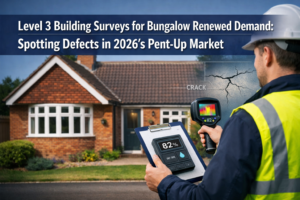
The UK property market stands at a critical inflection point in 2026. After years of turbulence driven by interest rate volatility and economic uncertainty, early signs of stabilisation are emerging. For property professionals navigating this tentative recovery, understanding how to apply RICS valuation adjustments for 2026's tentative recovery: handling stabilising prices and buyer confidence has become essential. With RICS net balances showing -10% on prices yet +35% on sales expectations, surveyors face a unique challenge: providing evidence-based valuations in a market that's simultaneously contracting and showing renewed optimism.
This comprehensive guide explores the surveyor tools, regulatory updates, and strategic approaches needed to deliver accurate, defensible valuations during this transitional period.

Key Takeaways
- Updated ESG Standards: RICS's fourth edition ESG standard (effective April 30, 2026) provides new jurisdiction-specific guidance for UK valuations, clarifying cost assumptions and ESG factor integration [1]
- Market Stabilisation Signals: Q4 2025 data shows the UK commercial property market remains subdued but with modest sentiment improvements across occupier and investment sectors
- Basel 3.1 Continuity: New banking regulations maintain reliance on professional Market Value assessments, reinforcing the surveyor's critical role in buyer confidence and lending decisions [3]
- Evidence-Based Approach: The divergence between declining prices (-10%) and rising sales expectations (+35%) requires surveyors to employ rigorous comparable analysis and market sentiment assessment
- Strategic Timing: The pre-April 2026 window for rateable value adjustments creates urgency for property owners seeking optimal valuations [4]
Understanding the 2026 Market Context: Why Recovery Remains Tentative
The Structural Forces Shaping Valuation Environments
The property market in 2026 doesn't exist in isolation. RICS has identified that structural changes globally stem from geopolitical issues, inflationary pressures leading to elevated interest rates, and banking system stresses that have reduced credit availability [2]. These macro forces create a complex valuation environment where traditional comparable analysis must account for unprecedented market dynamics.
For surveyors conducting RICS property valuations, this means recognising that 2026's tentative recovery reflects:
- Interest rate stabilisation (not reduction) maintaining mortgage affordability challenges
- Selective buyer confidence concentrated in specific property types and locations
- Credit availability improving but remaining tighter than pre-2022 levels
- ESG compliance costs increasingly factored into property values
Decoding the Net Balance Paradox: -10% Prices, +35% Sales
The apparent contradiction between declining prices and rising sales expectations reveals the nuanced reality of market stabilisation. The -10% price net balance indicates that more surveyors are reporting price declines than increases, reflecting continued downward pressure from elevated borrowing costs and economic caution.
However, the +35% sales expectations net balance tells a different story: market participants anticipate increased transaction volumes. This suggests:
| Market Indicator | What It Reveals |
|---|---|
| Declining Prices | Continued value adjustment as properties reach realistic market levels |
| Rising Sales Expectations | Growing buyer confidence that prices have stabilized or bottomed out |
| Transaction Volume Recovery | Pent-up demand beginning to release as uncertainty reduces |
| Selective Activity | Movement concentrated in fairly-priced, well-surveyed properties |
For professionals preparing RICS homebuyer surveys, this environment demands particular attention to comparable evidence quality and market sentiment indicators.
RICS Valuation Adjustments for 2026's Tentative Recovery: Updated Standards and Frameworks

The Fourth Edition ESG Standard: New Requirements for April 2026
RICS published the fourth edition of its global professional standard on ESG and sustainability in commercial property valuation, effective April 30, 2026, responding to significant regulatory, market, and professional developments [1]. This update fundamentally affects how surveyors approach valuations during the recovery period.
Key Changes Affecting 2026 Valuations
Jurisdiction-Specific Guidance 📋
The updated standard includes new sections tailored for the UK, EU, and Australia, reflecting established regulatory and disclosure frameworks [1]. For UK surveyors, this means:
- Clearer integration of Energy Performance Certificate (EPC) requirements into valuations
- Standardised approaches to assessing retrofit costs and value impacts
- Consistent treatment of climate risk factors across comparable properties
Clarified ESG Valuation Scope 🎯
Perhaps most importantly for managing client expectations during recovery, the standard distinguishes between valuation and strategic ESG advice. RICS confirms that strategic ESG advice is "typically a separate, additional service and should not be confused with valuation" [1].
This clarification matters because clients navigating the tentative recovery often seek guidance on:
- Whether to invest in ESG improvements before selling
- How future regulatory changes might affect values
- Strategic timing of property transactions
Surveyors must clearly delineate when they're providing valuation services versus strategic advisory services, ensuring clients understand the scope and limitations of each.
Cost Assumption Guidance 💰
The updated standard provides practical guidance on cost assumptions, clarifying "when and how capital and operational expenditure linked to ESG factors may be reflected in valuation, and the limits of a valuer's role in this" [1].
For stabilising markets, this means surveyors can more confidently:
- Adjust valuations for necessary ESG compliance costs (e.g., EPC improvements required for letting)
- Distinguish between mandatory and discretionary sustainability upgrades
- Provide evidence-based deductions for properties requiring significant ESG investment
When conducting building evaluations, these cost assumptions become critical for accurate market value assessments.
Basel 3.1 Implementation: Continuity in Lending Valuations
On January 23, 2026, the Prudential Regulation Authority (PRA) and Bank of England announced final rules for Basel 3.1 implementation (PS1/26). For surveyors concerned about changing valuation requirements, RICS provided reassuring clarity: "these final rules do not change the role or responsibilities of RICS valuers in the UK" [3].
Why This Matters for Buyer Confidence
The continuation of existing valuation frameworks under Basel 3.1 means:
"Reliance on professional Market Values at origination remains the cornerstone of the framework" [3]
This regulatory continuity provides stability during the tentative recovery by:
- Maintaining consistent lending criteria that buyers and brokers understand
- Preserving the surveyor's central role in mortgage approval processes
- Ensuring valuation methodologies remain aligned with lender requirements
- Supporting buyer confidence through familiar, trusted assessment processes
For professionals explaining how an RICS survey can help negotiate property prices, this regulatory stability reinforces the value proposition of professional valuations.
Surveyor Tools for Evidence-Based Valuations in Turning Markets
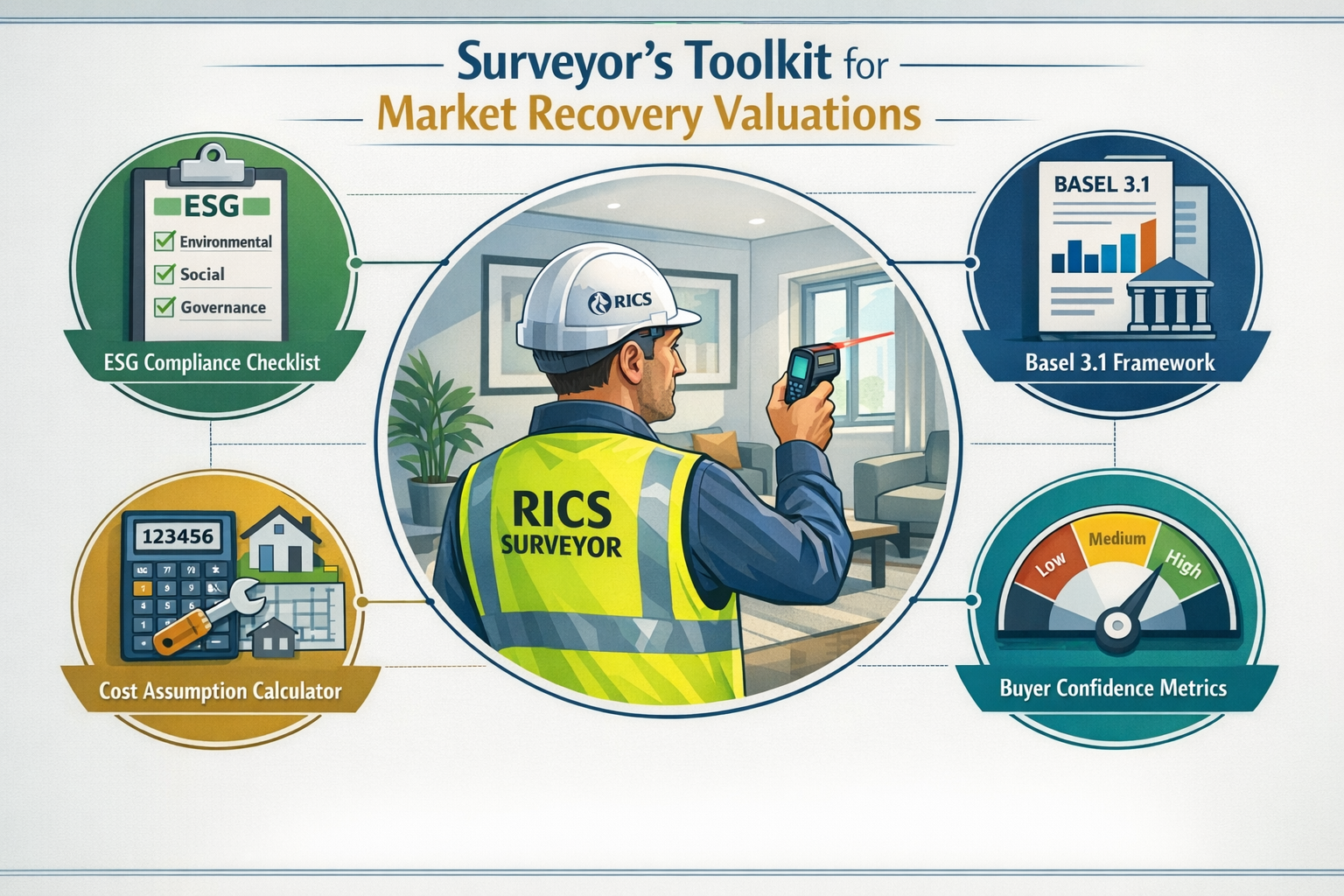
Comparable Analysis in Stabilising Conditions
When prices are stabilising rather than clearly trending, comparable analysis requires enhanced rigour. Traditional approaches that assume linear market movements break down during transitional periods.
Time-Adjusted Comparables Framework
In 2026's tentative recovery, surveyors should implement:
1. Tighter Time Windows ⏰
Reduce comparable timeframes from the traditional 6-12 months to 3-6 months maximum. In stabilising markets, even quarterly variations can be significant.
2. Transaction Date Weighting 📊
Apply greater weight to more recent transactions, using a graduated scale:
- 0-3 months old: 100% weight
- 3-6 months old: 75% weight
- 6-12 months old: 50% weight (use only if recent comparables are limited)
3. Market Condition Adjustments 📈
Explicitly adjust comparables for changing market conditions between transaction date and valuation date, documenting:
- Interest rate changes affecting buyer affordability
- Local supply/demand shifts
- Sentiment changes (using RICS survey data as supporting evidence)
Integrating Buyer Confidence Indicators
RICS valuation adjustments for 2026's tentative recovery: handling stabilising prices and buyer confidence requires moving beyond purely transactional data to incorporate sentiment and confidence metrics.
Quantifiable Confidence Indicators
Smart surveyors supplement traditional comparables with:
Market Velocity Metrics 🚀
- Average days on market (trending down suggests improving confidence)
- Sale price to asking price ratios (narrowing discounts indicate firmer demand)
- Offer-to-completion ratios (higher completion rates show committed buyers)
Local Market Intelligence 🏘️
- Estate agent feedback on viewing numbers and offer frequency
- Mortgage broker insights on application volumes and approval rates
- Local economic indicators (employment, new business formation)
Property-Specific Confidence Factors 🏡
When preparing homebuyers reports, consider how specific property characteristics affect buyer confidence:
- Survey-ready condition: Properties requiring minimal work attract more confident buyers
- Energy efficiency: Higher EPC ratings reduce future cost uncertainty
- Clear title: Properties without boundary disputes or lease complications
- Recent improvements: Documented upgrades reduce buyer risk perception
The Rateable Value Adjustment Window: Strategic Timing Considerations
After April 1, 2026, only future rateable values can be modified, making the current pre-April window critical for property owners seeking adjustments [4]. This creates a specific valuation consideration for commercial and mixed-use properties.
Surveyors should advise clients that:
- Pre-April valuations may support rateable value challenges before the deadline
- Post-April valuations will operate under the new framework with different adjustment opportunities
- Strategic timing of formal valuations can maximize client outcomes
This timing consideration particularly affects high-value properties over £2 million, where rateable value impacts can be substantial [4].
Handling Stabilising Prices: Practical Valuation Strategies
The Banding Approach for Uncertain Markets
When market direction remains unclear despite stabilisation signals, consider providing valuation ranges rather than single-point estimates (where appropriate for the instruction type).
This approach:
- Acknowledges market uncertainty transparently
- Provides clients with realistic expectations for achievable prices
- Reduces revision risk if market conditions shift during marketing periods
For example, a typical valuation band might be:
- Lower band: Based on conservative comparables assuming continued modest decline
- Mid-point: Most likely value based on current stabilised conditions
- Upper band: Optimistic scenario assuming confidence continues improving
Important: This approach suits certain advisory contexts but may not be appropriate for formal mortgage valuations or other situations requiring single-point Market Value opinions.
ESG Cost Adjustments in Practice
With the new RICS ESG standard effective from April 30, 2026 [1], surveyors have clearer frameworks for incorporating sustainability-related costs.
Practical Application Steps
Step 1: Identify Mandatory ESG Costs 🔍
Determine costs that buyers will definitely incur to meet regulatory requirements:
- EPC improvements needed to achieve minimum letting standards
- Safety compliance (fire safety, building safety act requirements)
- Immediate structural repairs affecting energy performance
Step 2: Quantify and Verify Costs 💷
Obtain specialist cost estimates rather than making assumptions:
- Engage energy assessors for retrofit costs
- Consult building contractors for structural improvements
- Document cost estimates with dated quotations
Step 3: Apply Appropriate Adjustments ⚖️
Not all costs translate to equivalent value reductions:
- Mandatory compliance costs: Often reflected £-for-£ in value adjustments
- Value-adding improvements: May be partially offset by resulting value increase
- Discretionary upgrades: Generally not reflected in current market value
When conducting property inspections, document ESG-related deficiencies with sufficient detail to support these adjustments.
Handling Client Expectations During Recovery
The tentative nature of 2026's recovery means clients often have unrealistic expectations based on:
- Peak market values from 2021-2022
- Media reports emphasizing positive recovery signals while downplaying continued challenges
- Emotional attachment to properties inflating perceived values
Communication Strategies for Surveyors
Set Context Early 📢
Begin valuation reports and client discussions by acknowledging:
- The transitional nature of the current market
- The specific evidence base for the valuation
- Why current values may differ from client expectations
Use Comparable Evidence Visually 📊
Present comparable transactions in clear, visual formats:
- Maps showing comparable property locations
- Tables highlighting key similarities and differences
- Charts showing price trends over relevant periods
Explain the Recovery Timeline ⏳
Help clients understand that stabilisation precedes recovery:
- Stabilising prices create the foundation for future growth
- Transaction volume recovery typically precedes price recovery
- Regional variations mean some areas recover faster than others
Regional Variations in 2026's Tentative Recovery
London Market Dynamics
The London property market exhibits distinct recovery patterns compared to regional markets, with particular variations across boroughs.
Areas showing stronger stabilisation signals include:
- Wandsworth: Benefiting from transport improvements and relative affordability
- Richmond: Sustained demand for family homes with green space access
- Southwark: Regeneration projects supporting buyer confidence
Areas requiring more cautious valuation approaches:
- Prime central London: Continued international buyer uncertainty
- Overleveraged development areas: Supply overhang affecting values
- Leasehold properties with cladding issues: Ongoing remediation uncertainty
For professionals providing services across multiple London locations, recognising these micro-market variations is essential for accurate valuations.
Residential vs. Commercial Recovery Trajectories
The tentative recovery affects residential and commercial sectors differently:
Residential Sector 🏠
- Faster sentiment improvement due to pent-up household formation demand
- Government support schemes potentially stimulating first-time buyer activity
- Mortgage market stability providing clearer affordability parameters
Commercial Sector 🏢
- Slower recovery due to structural changes in office and retail demand
- ESG compliance costs creating more significant value adjustments
- Hybrid working impacts still being priced into office valuations
The updated RICS ESG standard particularly affects commercial property valuations, where sustainability requirements are more stringent [1].
Buyer Confidence Restoration: The Surveyor's Role
Professional Surveys as Confidence Builders
In tentative recovery markets, professional surveys become even more valuable to buyers because they:
- Reduce uncertainty about property condition and value
- Provide negotiation leverage based on objective evidence
- Enable informed decisions when market direction remains unclear
- Support mortgage applications with credible valuations
When explaining what surveyors do, emphasize this confidence-building function alongside technical assessment.
The Survey-to-Sale Pipeline
Understanding how surveys influence buyer confidence throughout the transaction:
1. Pre-Viewing Survey Advice 🔎
Buyers increasingly seek surveyor guidance before making offers, asking:
- Which survey level is appropriate for specific properties?
- What red flags should they look for during viewings?
- How to interpret estate agent descriptions and pricing?
2. Post-Offer Survey Timing ⏱️
In stabilising markets, survey timing affects outcomes:
- Faster surveys maintain transaction momentum when buyer confidence is fragile
- Delayed surveys risk buyers withdrawing as they reconsider during waiting periods
- Coordinated surveys (survey and valuation together) streamline the process
3. Survey-Based Negotiation 💬
Professional survey reports enable evidence-based price negotiations:
- Documented defects support reduction requests
- Comparable evidence contextualizes asking prices
- Condition assessments justify buyer concerns
For guidance on choosing between survey types, buyers benefit from understanding how each level addresses different confidence needs.
Transparent Reporting in Uncertain Markets
RICS valuation adjustments for 2026's tentative recovery: handling stabilising prices and buyer confidence demands exceptional transparency in reporting.
Enhanced Reporting Elements
Market Context Sections 📝
Include dedicated sections explaining:
- Current market conditions affecting the valuation
- Relevant RICS survey data and trends
- Specific local market intelligence
Assumption Documentation 📋
Clearly state assumptions underlying the valuation:
- Market condition assumptions (e.g., "assuming continued stabilisation")
- ESG cost assumptions and their sources
- Comparable adjustment rationale
Uncertainty Acknowledgment ⚠️
Where appropriate, acknowledge valuation uncertainties:
- Material uncertainty clauses (if justified by market conditions)
- Sensitivity analysis (how value might change if conditions shift)
- Limitations of available comparable evidence
This transparency builds client confidence even when delivering valuations below expectations.
Actionable Strategies for Property Professionals
For Surveyors and Valuers
Enhance Comparable Databases 💾
- Maintain detailed records of all transactions with condition notes
- Track days-on-market and price reduction data
- Document buyer feedback and market sentiment indicators
Invest in ESG Competency 🌱
- Complete RICS ESG training aligned with the new April 2026 standard
- Develop relationships with energy assessors and retrofit specialists
- Build cost databases for common ESG improvements
Strengthen Client Communication 💬
- Develop clear explanations of market stabilisation vs. recovery
- Create visual aids showing comparable evidence
- Prepare standard responses to common client objections
For Property Buyers
Commission Surveys Early 🏃
In tentative recovery markets, early surveys:
- Prevent wasted time on unsuitable properties
- Provide negotiation ammunition when making offers
- Demonstrate serious intent to sellers
Understand Valuation Context 🧠
When receiving survey valuations:
- Ask surveyors to explain the comparable evidence
- Understand how current market conditions affect values
- Recognize that stabilisation creates buying opportunities
Consider Total Ownership Costs 💰
Factor ESG-related costs into purchase decisions:
- Request EPC ratings and improvement recommendations
- Budget for necessary compliance work
- Understand how energy efficiency affects ongoing costs
For Property Sellers
Obtain Pre-Marketing Valuations 📊
Professional valuations before listing help:
- Set realistic asking prices aligned with current market
- Identify value-detracting issues that could be addressed
- Provide confidence when negotiating with buyers
Address Survey-Likely Issues 🔧
Proactively resolve problems that surveys will identify:
- Commission specialist reports for known issues (damp, subsidence)
- Complete obvious repairs before marketing
- Gather documentation for recent improvements
Leverage the Rateable Value Window ⏰
For commercial properties, utilize the pre-April 2026 opportunity:
- Obtain valuations supporting rateable value challenges
- Submit challenges before the April 1 deadline
- Consider strategic timing of property transactions [4]
Future-Proofing Valuations: Looking Beyond 2026
Anticipating Regulatory Evolution
The RICS ESG standard's fourth edition won't be the last update. Surveyors should anticipate:
- Stricter EPC requirements for residential and commercial properties
- Enhanced climate risk disclosures affecting valuations
- Standardized sustainability metrics becoming mandatory in reports
Technology Integration
Evidence-based valuations in complex markets increasingly rely on:
- Automated valuation models (AVMs) as supporting evidence (not replacements for professional judgment)
- Geographic information systems (GIS) for sophisticated comparable analysis
- Market sentiment analytics from digital property platforms
Professional Development Priorities
To maintain competence in evolving markets, prioritize:
- Continuous market monitoring through RICS publications and local intelligence
- Cross-disciplinary knowledge (ESG, building technology, market economics)
- Communication skills for explaining complex valuations to diverse clients
Conclusion
RICS valuation adjustments for 2026's tentative recovery: handling stabilising prices and buyer confidence represents one of the most challenging environments for property professionals. The apparent contradiction between declining prices (-10% net balance) and rising sales expectations (+35% net balance) creates complexity that demands sophisticated, evidence-based approaches.
The updated RICS ESG standard effective April 30, 2026, provides clearer frameworks for incorporating sustainability factors into valuations [1], while Basel 3.1 implementation maintains the central role of professional Market Value assessments in lending decisions [3]. Together, these developments reinforce the surveyor's critical function in restoring buyer confidence during market transitions.
Key Actions for Success
For Surveyors 🎯
- Update methodologies to reflect the new ESG standard and market conditions
- Enhance comparable analysis with tighter timeframes and sentiment indicators
- Communicate transparently about market uncertainty and valuation limitations
- Invest in professional development focused on ESG and market analysis competencies
For Property Buyers 🏡
- Commission professional surveys to reduce uncertainty and support negotiations
- Understand market context when evaluating property values and survey reports
- Factor ESG costs into total ownership calculations
- Act decisively when finding suitable properties in stabilising markets
For Property Sellers 💼
- Obtain realistic valuations before setting asking prices
- Address survey-identifiable issues proactively
- Leverage timing opportunities like the rateable value adjustment window
- Work with professional surveyors to present properties optimally
The tentative recovery of 2026 creates both challenges and opportunities. Properties entering the market with professional RICS valuations and comprehensive survey reports will command buyer confidence, facilitating transactions in an environment where certainty remains scarce.
By applying rigorous, evidence-based valuation methodologies that account for stabilising prices while recognizing improving sentiment, property professionals can navigate this transitional period successfully—building the foundation for sustainable market recovery in the years ahead.
References
[1] Rics Publishes Updated Global Standard Esg Sustainability Commercial Property Valuation – https://www.rics.org/news-insights/rics-publishes-updated-global-standard-esg-sustainability-commercial-property-valuation
[2] Valuation Standards – https://www.rics.org/profession-standards/rics-standards-and-guidance/sector-standards/valuation-standards
[3] Rics Update On The Pra Boe Final Rules On The Implementation Of Basel 3 Point 1 In The Uk – https://www.rics.org/profession-standards/rics-standards-and-guidance/sector-standards/valuation-standards/rics-update-on-the-pra-boe-final-rules-on-the-implementation-of-basel-3-point-1-in-the-uk
[4] Post Budget 2026 Valuation Challenges Surveyor Strategies For High Value Properties Over 2 Million – https://nottinghillsurveyors.com/blog/post-budget-2026-valuation-challenges-surveyor-strategies-for-high-value-properties-over-2-million