
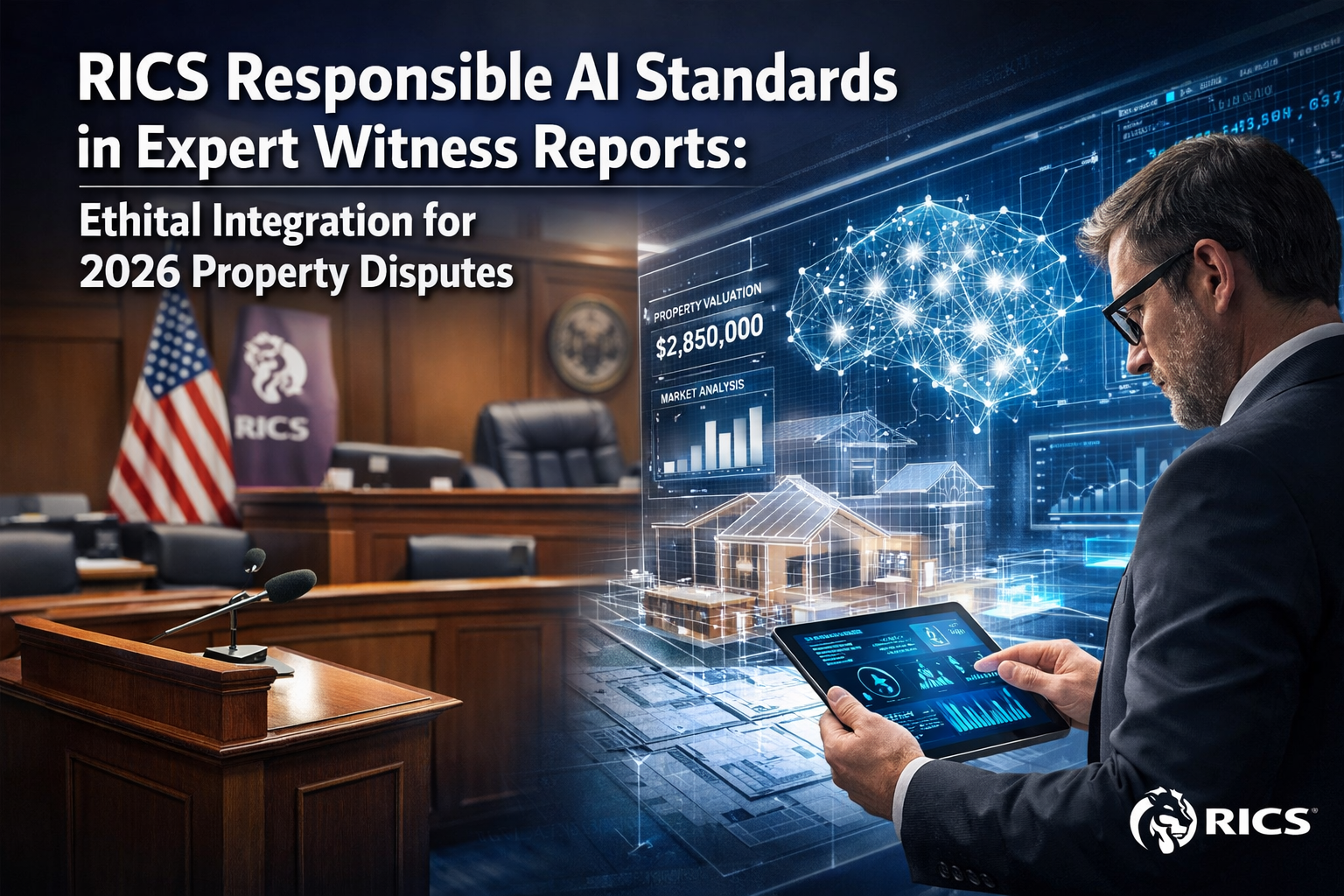
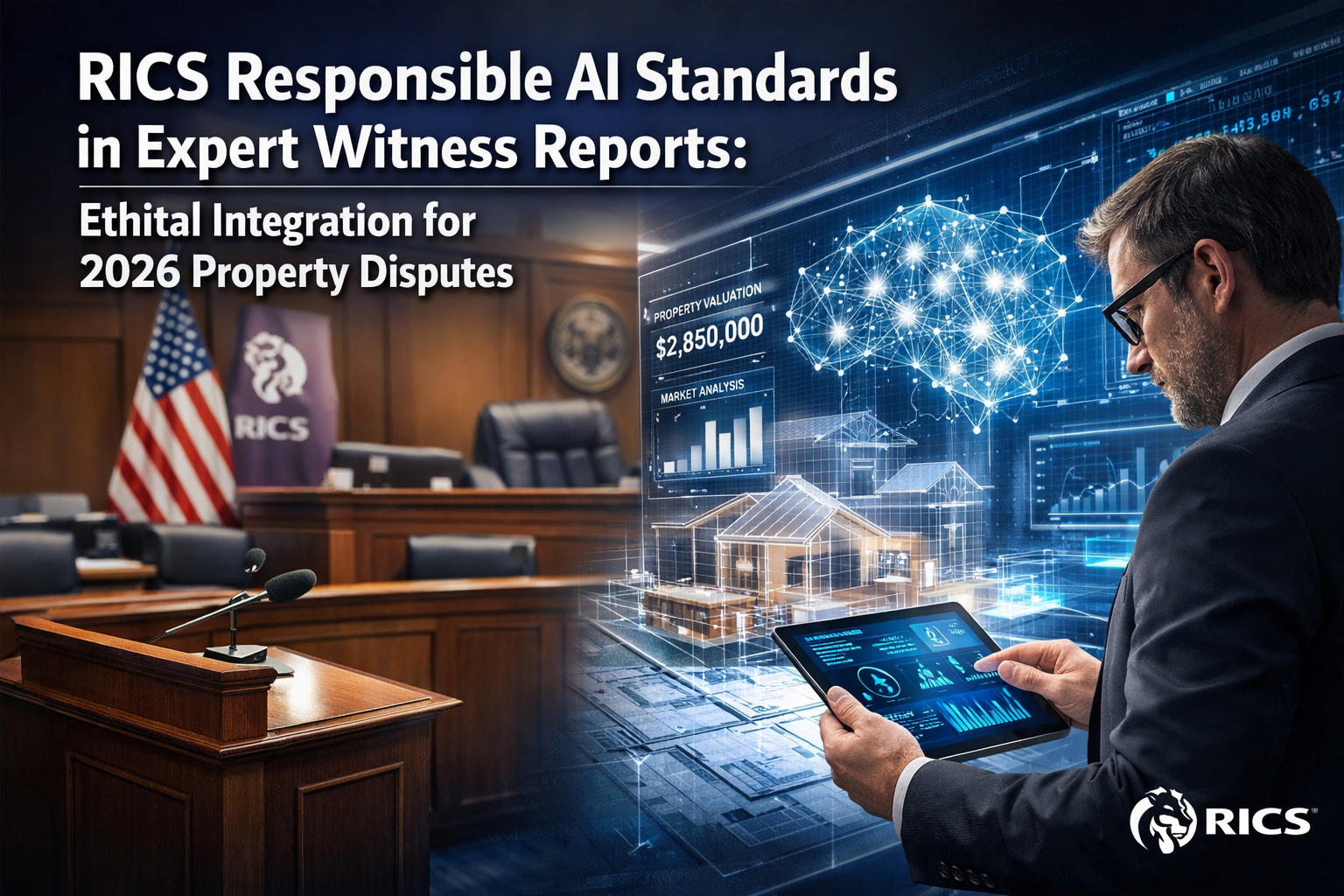
The Royal Institution of Chartered Surveyors (RICS) made history on March 9, 2026, when its Professional Standard on Responsible AI in Surveying Practice became effective—establishing the world's first globally published AI standards by a national property trade body. This groundbreaking framework now governs how all 150,000 RICS-chartered surveyors integrate artificial intelligence into their professional practice, with particularly significant implications for expert witness testimony in property disputes. As courts increasingly scrutinize AI-assisted evidence following high-profile cases involving fabricated citations, understanding the RICS Responsible AI Standards in Expert Witness Reports: Ethical Integration for 2026 Property Disputes has become essential for surveyors, legal professionals, and property stakeholders alike.
Key Takeaways
- The RICS AI standard became mandatory on March 9, 2026, requiring all regulated firms using AI with material impact to implement written policies and quarterly-reviewed risk registers [1]
- Only 20% of expert witnesses currently use AI professionally, yet 89% believe specific guidance is needed for ethical integration in testimony [2]
- AI tools may assist with formatting and language improvement but cannot replace expert judgment or write substantive report content [2]
- Firms must provide client transparency on request, disclosing AI system types, limitations, due diligence processes, and risk management approaches [1]
- Risk registers must document inherent bias, erroneous outputs, and mitigation plans using RAG (red-amber-green) ratings or equivalent categorization methods [1]
Understanding RICS Responsible AI Standards in Expert Witness Reports: Ethical Integration for 2026 Property Disputes
The new RICS framework represents a fundamental shift in how artificial intelligence intersects with professional surveying practice, particularly in the high-stakes context of expert witness testimony. Unlike technical manuals that prescribe specific tools or configurations, this standard functions as a conduct standard focusing on professional behavior and ethical decision-making [3].
The Scope and Application of the Standard
The RICS Professional Standard applies specifically to AI systems where outputs have material impact on service delivery. This includes both internally developed AI systems and third-party vendor tools used by chartered surveyors [1]. For expert witnesses involved in property disputes, this means any AI tool that influences valuation analysis, defect assessment, or opinion formation falls within the standard's scope.
The timing of this standard reflects urgent necessity. Dame Victoria Sharp, president of the King's Bench Division of the High Court, referenced two cases where fake case citations appeared in evidence due to careless AI use—a stark reminder of the consequences when technology outpaces ethical frameworks [2].
Current AI Adoption Among Expert Witnesses
Despite the transformative potential of AI in surveying, adoption remains surprisingly limited. The 2025 Expert Witness Survey revealed that only 20% of expert witnesses currently use AI in their professional role—though this represents a doubling from 9.3% in 2024. This figure sits significantly below the UK national average of 65% intentional AI use for work [2].
More telling is that 89% of expert witness respondents believe specific guidance is required for AI use in their field, reflecting widespread professional uncertainty about appropriate applications [2]. The RICS standard directly addresses this gap, providing the authoritative framework the profession has been demanding.
Core Requirements for RICS Responsible AI Standards in Expert Witness Reports: Ethical Integration for 2026 Property Disputes
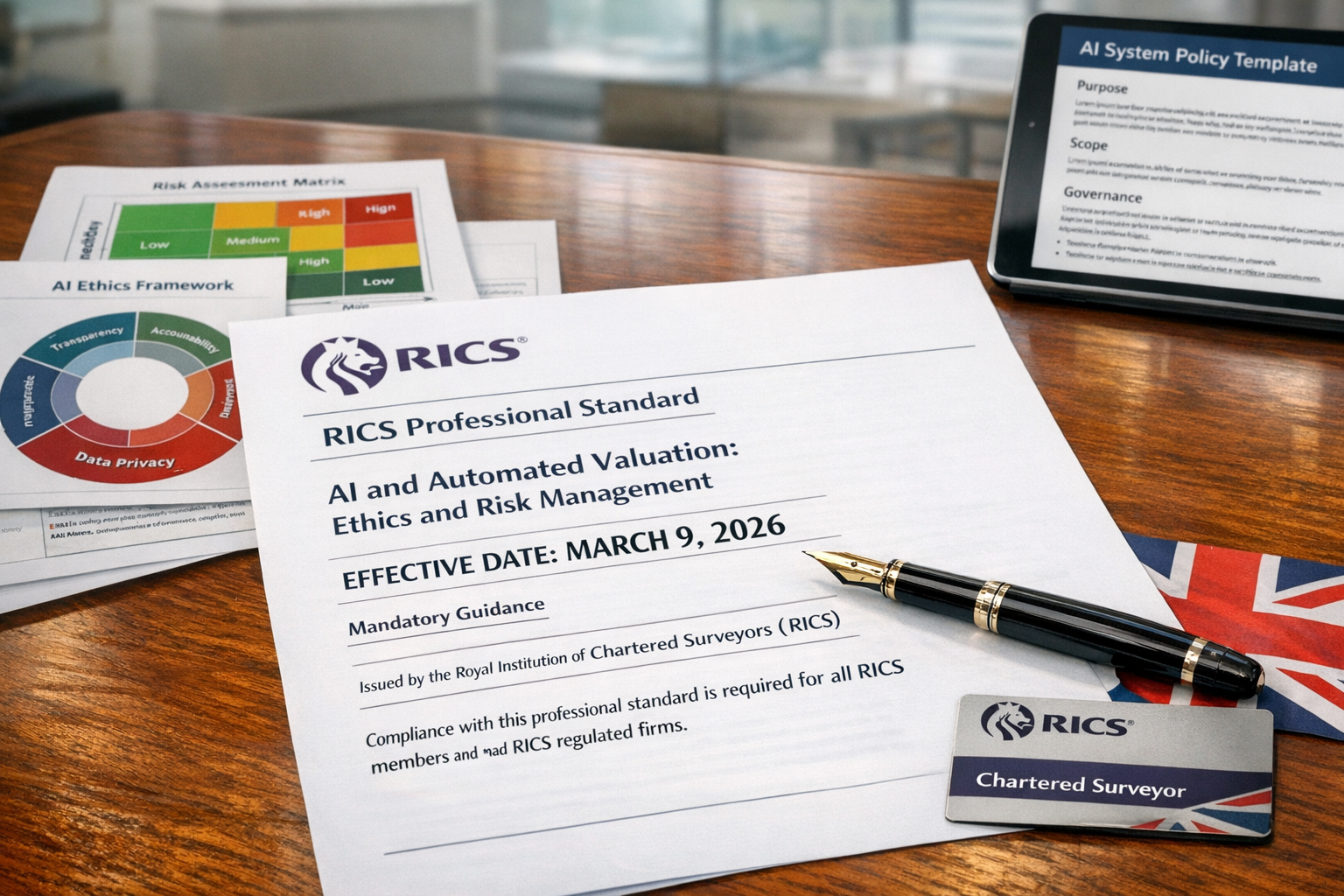
The RICS standard establishes several mandatory requirements that fundamentally reshape how expert witnesses may integrate AI into their practice. Understanding these requirements is essential for compliance and ethical practice in 2026 property disputes.
Written Policies and Risk Registers
All RICS-regulated firms using AI systems with material impact must develop and implement written policies informed by a comprehensive risk register [1]. These aren't optional best practices—they're mandatory compliance requirements.
The risk register must document:
- Inherent bias in AI systems and how it might affect property valuations or defect assessments
- Erroneous outputs and their potential consequences in dispute contexts
- Mitigation plans specific to each identified risk
- Firm risk appetite regarding AI integration in expert testimony
- Regular status updates tracking risk evolution
- Risk categorization using RAG (red, amber, green) ratings or equivalent methods [1]
These registers must be reviewed and updated at least quarterly by designated RICS-regulated firm staff, ensuring ongoing vigilance as AI systems evolve and new risks emerge.
Due Diligence Before AI System Deployment
Before using any AI system in expert witness work, firms must conduct and record comprehensive due diligence. This includes:
✅ Practical testing for fitness for purpose in surveying contexts
✅ Risk identification associated with limited or missing supplier information
✅ Capability assessment against specific use cases in property disputes
✅ Output validation protocols to catch errors before they reach reports [1]
For expert witnesses preparing reports for property boundary disputes or valuation challenges, this due diligence becomes particularly critical. A single erroneous AI output that influences expert opinion could undermine an entire case.
Permissible and Prohibited AI Applications
The standard draws clear lines regarding appropriate AI use in expert witness contexts. According to Martin Burns, head of alternative dispute resolution research at RICS, AI must not replace expert witness knowledge and judgment [2].
Permissible applications include:
- 📝 Improving language clarity and grammar in reports
- 🎨 Formatting documents for professional presentation
- 📊 Analyzing large datasets to identify patterns (subject to expert review)
- 🔍 Conducting preliminary research (with human verification)
Prohibited applications include:
- ❌ Writing substantive expert opinions or conclusions
- ❌ Making valuation determinations without expert oversight
- ❌ Generating technical assessments without verification
- ❌ Replacing expert judgment in defect analysis
Expert witnesses may use AI tools such as ChatGPT only for improving language and formatting—any AI-written report must be thoroughly reviewed by the expert to ensure it reflects their personal and honest opinion before submission [2].
Client Transparency Requirements
One of the most significant aspects of the RICS standard is its emphasis on client transparency. On client request, firms must provide written information about:
- The type of AI system used in their surveying work
- Its basic ways of working and limitations
- Due diligence processes undertaken before deployment
- How risks are identified and managed
- Decisions made about output reliability [1]
This transparency requirement acknowledges that clients have a legitimate interest in understanding how technology influences the professional advice they receive—particularly in contentious property condition assessment scenarios where substantial financial stakes may be involved.
Case Studies: Balancing AI Analytics with Professional Judgment in 2026 Property Disputes
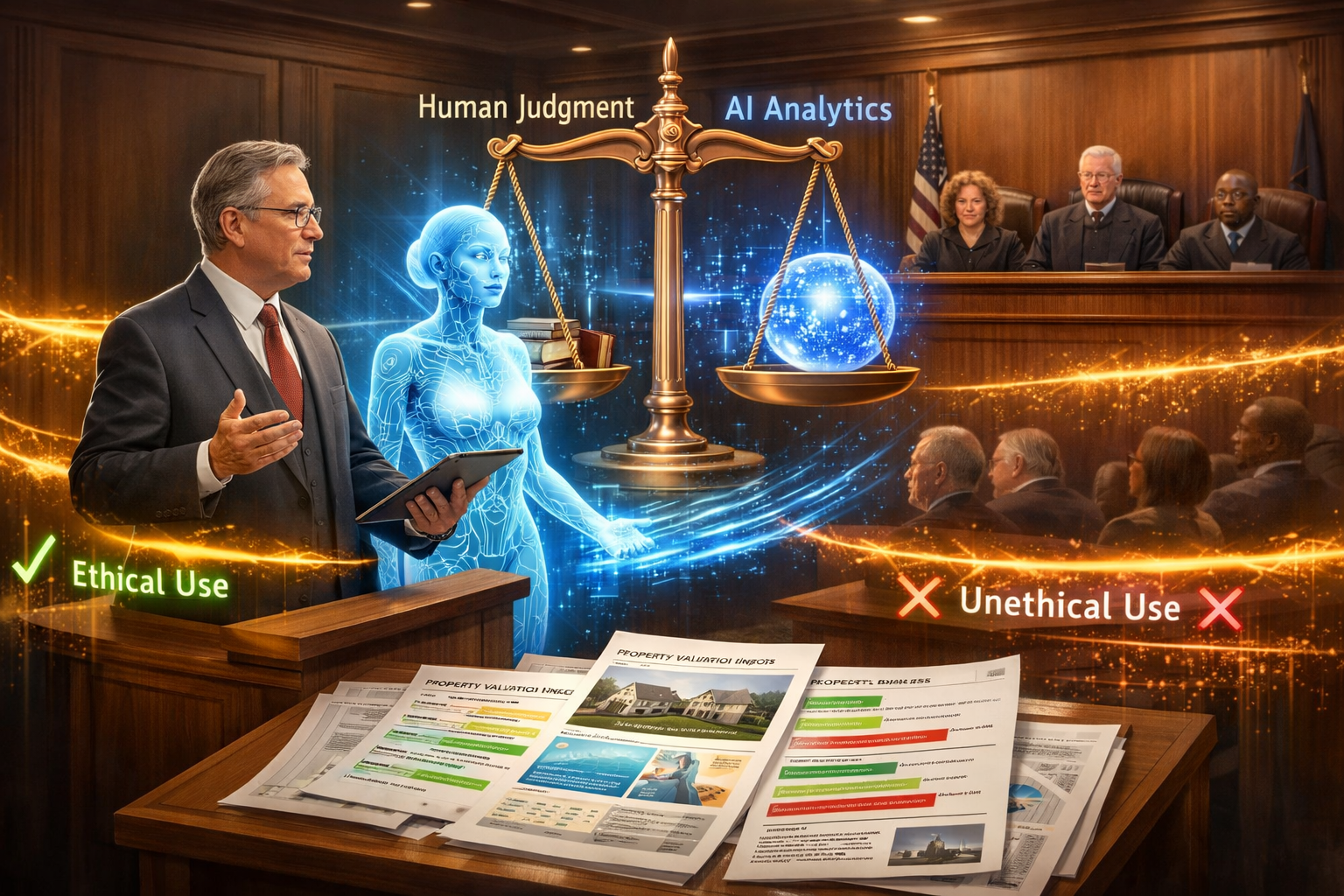
The practical application of RICS Responsible AI Standards in Expert Witness Reports: Ethical Integration for 2026 Property Disputes becomes clearer through real-world scenarios that illustrate the balance between technological capability and professional judgment.
Case Study 1: Valuation Dispute in Commercial Property
Scenario: An expert witness was retained to provide valuation evidence in a commercial lease dispute involving a London retail property. The expert used an AI-powered comparable analysis tool to identify and analyze similar properties.
AI Integration:
- AI system analyzed 500+ comparable transactions in seconds
- Generated preliminary valuation range based on algorithmic weighting
- Identified market trends across multiple data sources
RICS Compliance Approach:
- Expert reviewed all AI-identified comparables personally
- Rejected 40% of AI suggestions due to material differences
- Applied professional judgment to adjust for location-specific factors
- Clearly disclosed AI tool use in report methodology section
- Maintained risk register documenting potential algorithmic bias toward larger properties
Outcome: The court accepted the evidence, noting the expert's transparent disclosure and clear demonstration that AI served as an analytical assistant rather than decision-maker. The expert's willingness to reject AI outputs based on professional judgment strengthened credibility.
Case Study 2: Structural Defect Assessment
Scenario: An expert witness investigating subsidence claims used AI image analysis to assess crack patterns in a residential property, similar to work done in condition survey reports.
AI Integration:
- AI system analyzed photographs to classify crack severity
- Generated preliminary defect categorization
- Suggested potential causes based on pattern recognition
RICS Compliance Approach:
- Expert conducted physical site inspection despite AI analysis
- Used AI output as preliminary screening tool only
- Documented instances where AI misclassified cosmetic cracks as structural
- Included written policy disclosure about AI limitations in moisture and movement assessment
- Provided client with transparency statement about AI tool capabilities
Outcome: The expert's approach demonstrated proper integration—using AI to enhance efficiency while maintaining primacy of professional judgment. The documented instances where the expert corrected AI errors actually strengthened the report's credibility.
Case Study 3: Lease Extension Valuation
Scenario: An expert witness preparing evidence for a lease extension valuation dispute used AI to analyze historical property price trends and predict future values.
AI Integration:
- Machine learning model analyzed 15 years of local market data
- Generated price trajectory predictions for comparable properties
- Identified economic factors correlating with value changes
RICS Compliance Approach:
- Expert treated AI predictions as one input among many
- Applied professional skepticism to algorithmic assumptions
- Documented limitations of predictive models in unprecedented market conditions
- Conducted quarterly risk register review noting increased uncertainty in post-pandemic market
- Determined certain AI outputs could not reasonably be used and communicated this in writing to client with reasoning [1]
Outcome: The expert's critical evaluation of AI limitations—particularly the acknowledgment that some outputs were unsuitable for use—demonstrated exemplary compliance with RICS standards. The court valued the expert's intellectual honesty over technological sophistication.
Implementing RICS AI Standards: Practical Steps for Expert Witnesses
For surveyors serving as expert witnesses in 2026 property disputes, implementing the RICS standard requires systematic approach and ongoing commitment.
Step 1: Audit Current AI Usage
Begin with comprehensive inventory of all AI tools currently used in professional practice:
| AI Tool Type | Current Use | Material Impact? | Compliance Status |
|---|---|---|---|
| Valuation software with AI | Property appraisals | Yes | Requires policy |
| Grammar/editing tools | Report writing | Minimal | Monitor only |
| Image analysis systems | Defect assessment | Yes | Requires policy |
| Research assistants | Case law/precedent | Moderate | Requires review |
Step 2: Develop Written Policies
Create comprehensive written policies addressing:
- Purpose and scope of AI use in expert witness work
- Approval processes for new AI tools
- Training requirements for staff using AI systems
- Output verification protocols before inclusion in reports
- Disclosure procedures for clients and courts
- Escalation procedures when AI outputs appear unreliable
Step 3: Establish Risk Register
Implement a living risk register with quarterly review cycles:
🔴 Red (High Risk): AI systems generating substantive opinions without expert review
🟡 Amber (Medium Risk): AI tools analyzing complex technical data requiring validation
🟢 Green (Low Risk): AI applications for formatting and administrative tasks
Step 4: Create Transparency Templates
Develop standardized disclosure templates for:
- Report methodology sections explaining AI tool use
- Client information statements describing AI capabilities and limitations
- Court disclosure statements meeting CPR Part 35 requirements
- Vendor due diligence records documenting AI system evaluation
Step 5: Establish Continuous Monitoring
Implement ongoing oversight mechanisms:
- 📅 Quarterly risk register reviews
- 🔍 Regular output accuracy audits
- 📚 Continuous professional development on AI ethics
- 🤝 Peer review of AI-assisted reports
- 📊 Tracking of AI-related challenges or disputes
The Future of RICS Responsible AI Standards in Expert Witness Reports: Ethical Integration for 2026 Property Disputes
As AI technology continues evolving at unprecedented pace, the RICS standard provides a flexible framework that can adapt to emerging capabilities and risks. Several trends will likely shape how expert witnesses integrate AI in coming years:
Increased Judicial Scrutiny
Courts are developing more sophisticated understanding of AI capabilities and limitations. Expert witnesses should expect:
- More detailed questioning about AI tool use during cross-examination
- Requests for disclosure of AI system training data and algorithms
- Challenges to expert credibility if AI integration lacks transparency
- Precedent-setting cases establishing boundaries for acceptable AI use
Enhanced AI Capabilities
As AI systems become more sophisticated, the temptation to rely on them more heavily will increase. The RICS standard's emphasis on professional judgment becomes even more critical as AI outputs become more convincing and comprehensive.
Industry-Wide Standardization
The RICS framework may inspire similar standards across other professional bodies and jurisdictions. Expert witnesses working internationally should monitor emerging standards in other countries and consider adopting the most rigorous requirements.
Integration with Other Professional Standards
The RICS AI standard complements existing expert witness duties under CPR Part 35 and professional conduct requirements. Expert witnesses must ensure their AI integration approach satisfies all applicable standards simultaneously.
Common Challenges and Solutions
Challenge 1: Determining "Material Impact"
Problem: Uncertainty about which AI tools require full compliance measures.
Solution: Apply conservative interpretation—if an AI tool influences any aspect of expert opinion formation, treat it as having material impact and implement full compliance measures.
Challenge 2: Vendor Information Gaps
Problem: Third-party AI vendors may not provide sufficient technical information for thorough due diligence.
Solution: Document information gaps in risk register, conduct practical testing to assess actual performance, and consider whether lack of transparency itself represents unacceptable risk [1].
Challenge 3: Balancing Efficiency with Compliance
Problem: Compliance requirements may seem to reduce the efficiency gains AI promises.
Solution: View compliance as risk mitigation rather than bureaucratic burden. The time invested in proper AI governance prevents far costlier problems if AI-assisted evidence is challenged or excluded.
Challenge 4: Client Expectations
Problem: Clients may expect AI to reduce costs or accelerate timelines beyond realistic possibilities.
Solution: Educate clients early about AI's role as analytical assistant rather than expert replacement. Clear communication about AI capabilities and limitations manages expectations and demonstrates professionalism.
Conclusion
The RICS Responsible AI Standards in Expert Witness Reports: Ethical Integration for 2026 Property Disputes represents a watershed moment for the surveying profession. By establishing clear ethical boundaries and mandatory compliance requirements, RICS has provided expert witnesses with the framework needed to harness AI's analytical power while maintaining the professional judgment and personal accountability that expert testimony demands.
The standard's emphasis on transparency, risk management, and human oversight ensures that AI serves as a tool to enhance—never replace—expert witness expertise. As courts become increasingly sophisticated in evaluating AI-assisted evidence, surveyors who embrace these standards position themselves as credible, trustworthy experts whose opinions withstand the rigorous scrutiny property disputes demand.
Actionable Next Steps
For surveyors serving as expert witnesses in 2026 property disputes:
- Conduct immediate AI audit of all tools used in professional practice
- Develop written policies addressing AI use in expert witness work within 30 days
- Establish risk register with initial assessment and quarterly review schedule
- Create transparency templates for client and court disclosure
- Undertake CPD training on AI ethics and RICS standard requirements
- Review existing reports for AI disclosure adequacy and update templates accordingly
- Engage with professional networks to share best practices and lessons learned
The integration of AI into expert witness practice is not a question of if, but how. By following the RICS Responsible AI Standards in Expert Witness Reports: Ethical Integration for 2026 Property Disputes, surveyors can confidently navigate this technological transformation while upholding the highest standards of professional ethics and credibility.
Whether preparing evidence for property boundary disputes, conducting condition surveys, or providing valuation opinions, expert witnesses who master ethical AI integration will distinguish themselves in an increasingly competitive and technologically sophisticated marketplace.
References
[1] Responsible Use Of Artificial Intelligence In Surveying Practice September 2025 – https://www.rics.org/content/dam/ricsglobal/documents/standards/Responsible-use-of-artificial-intelligence-in-surveying-practice_September-2025.pdf
[2] Ai Expert Witness – https://ww3.rics.org/uk/en/modus/technology-and-data/surveying-tools/ai-expert-witness.html
[3] Artefact Co Chairs Working Group In Setting The First Global Ai Standards For Property Surveyors – https://www.artefact.com/blog/artefact-co-chairs-working-group-in-setting-the-first-global-ai-standards-for-property-surveyors/