


Countrywide Surveying Services' hundreds of daily UK home visits are revealing a critical market intelligence gap: while automated valuation models (AVMs) continue to process last quarter's data, qualified surveyors are witnessing real-time shifts in consumer sentiment, property type resilience, and emerging pricing sensitivity that could reshape property values within weeks. This divergence between algorithmic predictions and ground-level reality has never been more pronounced than in Q2 2026's uncertain housing market.
The debate between Real-Time Surveyor Insights vs. Automated Valuation Models has intensified as property markets navigate unprecedented volatility. While AVMs promise speed and cost efficiency, RICS-qualified surveyors deliver something algorithms cannot replicate: immediate market intelligence combined with physical property assessment. Understanding why human expertise drives accuracy in volatile 2026 markets is essential for lenders, investors, and property professionals making high-stakes valuation decisions.

Key Takeaways
- 📊 AVMs lag at market turning points: Historical data models miss real-time sentiment shifts that surveyors observe daily across hundreds of property visits
- 🎯 Accuracy depends on property complexity: While modern AVMs achieve 3-7% error rates for standard properties, unique or distressed properties require human assessment
- ⚖️ Hybrid approaches optimize outcomes: Combining AVM screening with selective surveyor validation delivers both efficiency and precision
- 💡 2026 market conditions favor surveyors: Flat headline prices masking localized volatility create ideal conditions for human expertise to outperform algorithms
- 🔍 Data quality remains critical: Even advanced AVMs cannot account for unreported renovations, structural issues, or neighborhood changes without physical inspection
Understanding the Fundamental Differences Between AVMs and Surveyor Valuations
The property valuation landscape has evolved dramatically, yet the core distinction between automated and human-led approaches remains profound. Automated Valuation Models process vast datasets through statistical algorithms, delivering instant property value estimates based on historical sales, tax records, and comparable properties. These systems excel at pattern recognition across thousands of transactions simultaneously.
In contrast, RICS-qualified surveyors combine property assessment expertise with real-time market intelligence gathered through daily property interactions. A building surveyor physically inspects properties, identifies structural defects, evaluates renovation quality, and integrates neighborhood-level market sentiment into valuation decisions.
How AVMs Process Property Data
Modern AVMs access multiple data sources to generate valuations [5]:
- County records and tax assessor databases providing ownership history and assessed values
- Multiple Listing Service (MLS) feeds with recent sales comparables
- Geographic Information Systems (GIS) data including flood zones and school boundaries
- Satellite imagery detecting property improvements and land features
- Building permit records identifying unreported renovations
The most advanced AI-driven platforms now achieve sub-3% error rates for standard properties in data-rich markets [4]. Traditional AVMs maintain approximately 70% accuracy within 10% of actual sale prices, with 85% falling within 20% margins [3].
The Surveyor's Comprehensive Assessment Approach
Professional surveyors conduct multi-layered evaluations that extend far beyond algorithmic processing. A comprehensive structural survey includes:
- Physical property inspection revealing condition issues, damp problems, and structural defects
- Real-time market intelligence from recent client interactions and local property transactions
- Neighborhood trend analysis identifying emerging pricing pressures or demand shifts
- Property-specific adjustments for unique features, recent renovations, or deferred maintenance
- Regulatory compliance assessment including building regulation adherence and planning permissions
This holistic approach proves particularly valuable for house evaluation in markets experiencing rapid change or for properties with unique characteristics.
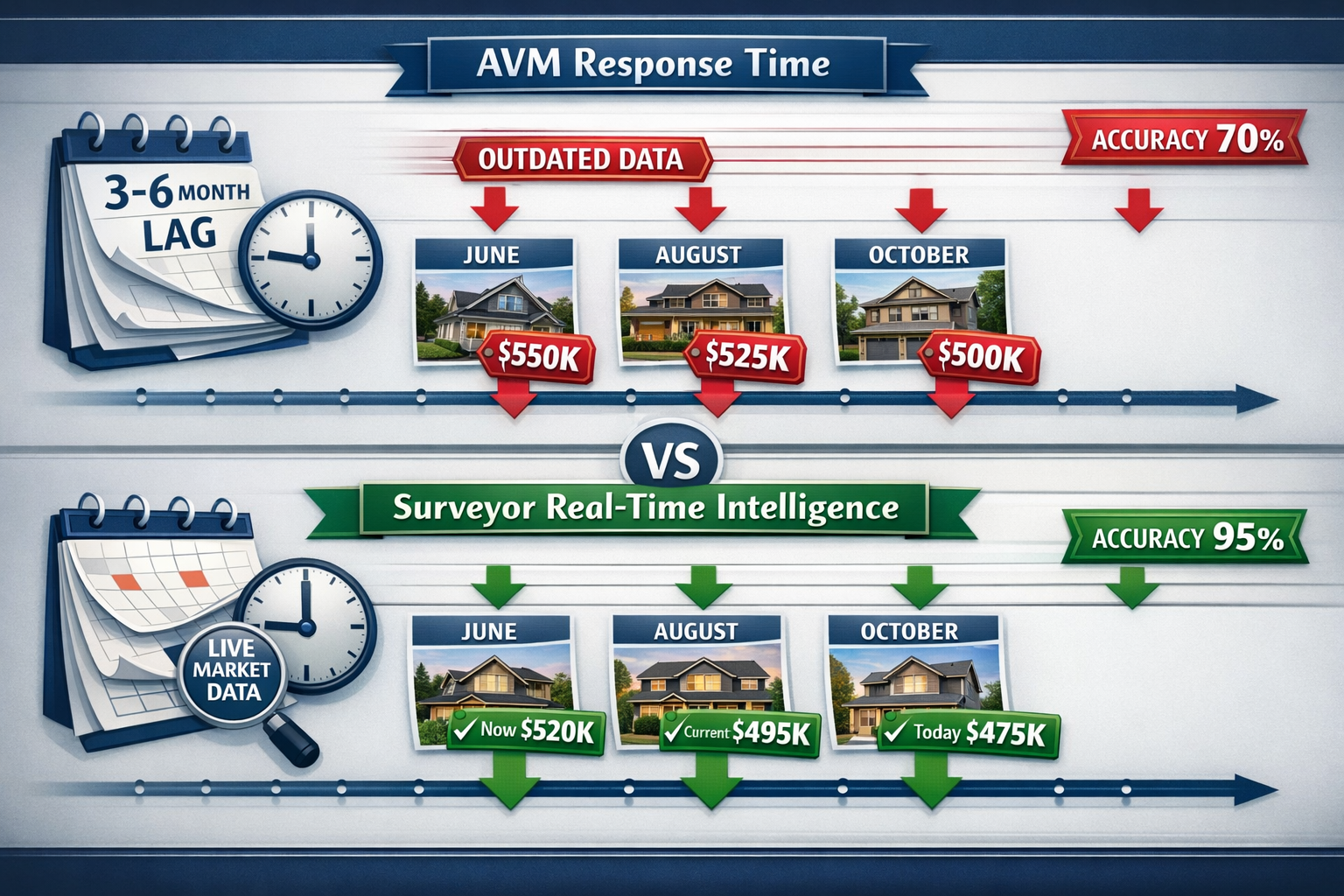
Real-Time Surveyor Insights vs. Automated Valuation Models: The Critical Advantage at Market Turning Points
The most significant performance gap between Real-Time Surveyor Insights vs. Automated Valuation Models emerges during market inflection points. RICS-qualified valuers provide substantially more accurate property value assessments during uncertain market periods compared to AVMs whose outputs remain anchored to historical data that lags at critical turning points [2].
Why AVMs Struggle During Market Volatility
Automated systems face inherent limitations when markets shift rapidly:
Historical data dependency: AVMs analyze completed transactions from 3-6 months prior, creating a significant lag when market sentiment changes quickly. In Q2 2026's cautious UK housing market, this delay means AVMs may still reflect Q4 2025 pricing dynamics.
Inability to capture sentiment: Algorithms cannot detect the hesitation in buyer behavior, the increased negotiation intensity, or the selective property type preferences that surveyors observe daily through hundreds of property visits [2].
Standardized adjustment factors: AVMs apply historical adjustment percentages for property features, missing the reality that certain amenities (home offices, outdoor spaces) may command dramatically different premiums during market transitions.
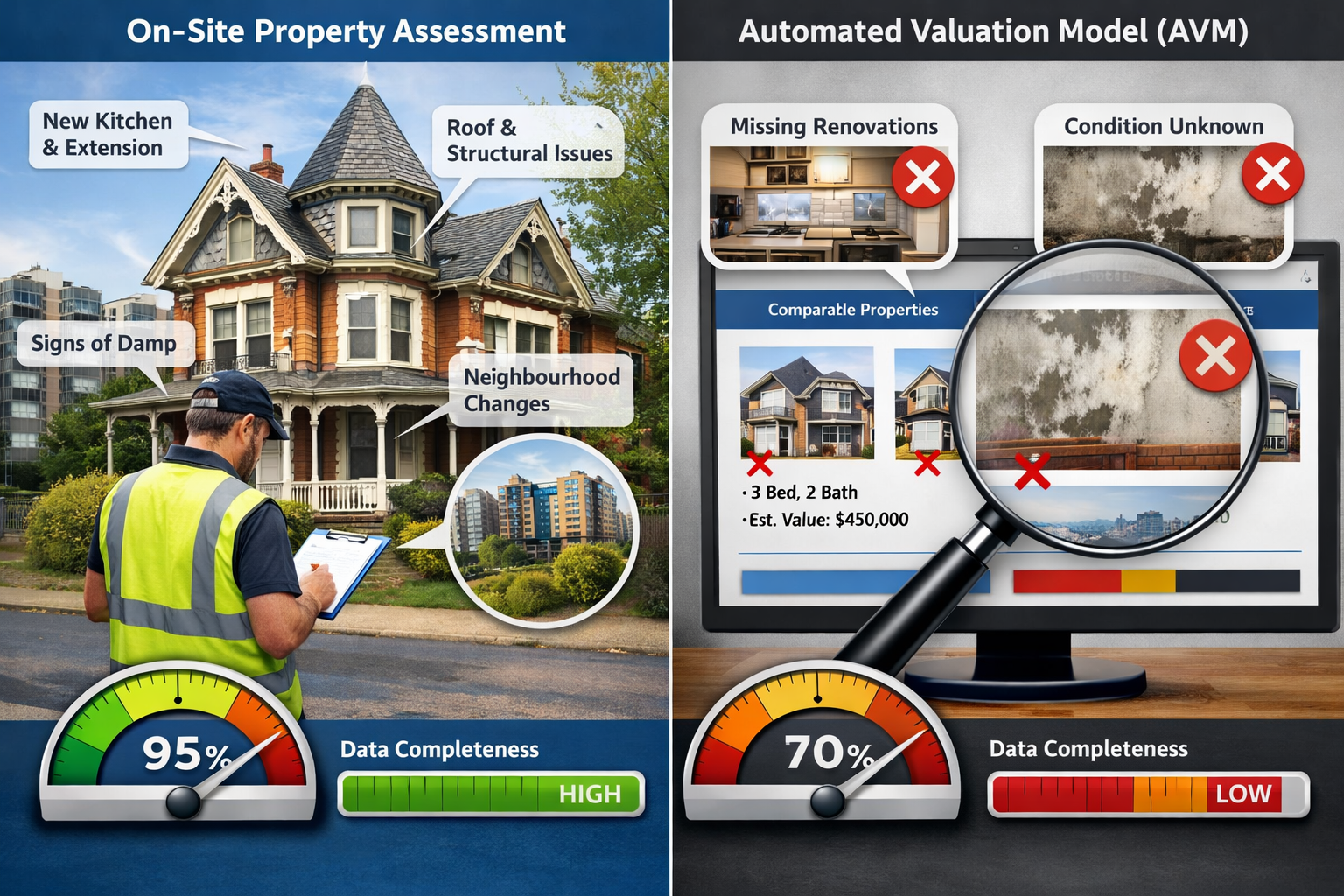
Data completeness gaps: Even with advanced data integration, AVMs cannot account for recent property repairs, emerging damp issues, or neighborhood deterioration visible only through physical inspection [5].
The Surveyor's Real-Time Intelligence Network
Professional surveyors maintain continuous market pulse through:
Daily property exposure: Countrywide's network conducts hundreds of UK home visits daily, creating an unmatched real-time intelligence system revealing shifts in consumer sentiment and pricing sensitivity before they appear in transaction data [2].
Immediate pattern recognition: Experienced chartered surveyors detect emerging trends across property types, identifying which segments show resilience and which face pricing pressure weeks before statistical models confirm the shift.
Localized market knowledge: While AVMs apply regional adjustment factors, surveyors understand micro-market dynamics—the specific streets gaining favor, the developments affecting property desirability, the infrastructure changes influencing values.
Physical condition assessment: A Level 2 survey reveals structural issues, maintenance needs, and property condition factors that dramatically impact value but remain invisible to automated systems until they affect future sale prices.
"RICS-qualified surveyors integrate real-time market intelligence and physical property insights, while AVMs rely on historical data and statistical models—a gap that widens during market turning points." [1]
When AVMs Excel and When Surveyors Become Essential
Understanding the optimal application of each valuation method enables strategic decision-making. The question isn't whether Real-Time Surveyor Insights vs. Automated Valuation Models are superior in absolute terms, but rather which approach best serves specific valuation scenarios.
Ideal AVM Use Cases
Automated valuation models deliver maximum value in these situations:
High-volume portfolio screening 📊: Lenders and investors managing thousands of properties benefit from AVMs' ability to process valuations instantly, identifying outliers requiring detailed review.
Standard property types: Modern AVMs perform exceptionally well for conventional homes with abundant comparable sales data in active markets [3]. Well-performing AVMs in these conditions achieve median absolute errors in the 3-7% range for high-confidence properties [5].
Initial pricing guidance: AVMs provide useful starting points for property valuation discussions, establishing baseline expectations before detailed analysis.
Risk stratification: Financial institutions use AVMs to categorize properties by confidence level, directing surveyor resources toward higher-risk or lower-confidence valuations.
Speed-critical decisions: When time constraints prevent physical inspections, AVMs offer immediate estimates for preliminary decision-making [3].
When Surveyor Expertise Becomes Non-Negotiable
Professional surveyor involvement proves essential for:
Unique or complex properties 🏛️: Period properties, listed buildings, or architecturally distinctive homes require nuanced assessment that AVMs cannot provide. Comparative market analyses conducted by property surveyors prove more precise for these property types [3].
Market transition periods: During Q2 2026's uncertain market conditions with flat headline prices masking localized volatility, surveyor intelligence outperforms algorithmic predictions anchored to historical patterns [1].
High-value transactions: When valuation accuracy directly impacts six or seven-figure decisions, the cost of professional building surveyor services becomes negligible compared to potential valuation errors.
Properties with condition issues: Structural defects, damp problems, or deferred maintenance require physical inspection to assess repair costs and value impact accurately.
Renovation or development potential: Assessing a property's development possibilities, planning permission likelihood, or post-renovation value demands human judgment and local regulatory knowledge.
Dispute resolution: When valuations face legal scrutiny or property disputes arise, courts and arbitrators require professionally qualified surveyor reports with defendable methodologies.
The Emerging Hybrid Model
Progressive lenders and property professionals increasingly adopt hybrid approaches combining both methods:
- Initial AVM screening identifies standard properties with high confidence scores
- Automated risk flagging highlights properties requiring human review
- Selective surveyor validation applies professional assessment to flagged properties
- Continuous model calibration uses surveyor findings to improve AVM accuracy over time
This tiered approach optimizes cost efficiency while maintaining valuation accuracy where it matters most. UK residential mortgage lenders are moving toward wider AVM adoption, though implementation remains uneven and emerging from historically low adoption levels [6].
The Data Quality Challenge: Why Even Advanced AVMs Miss Critical Details
Despite impressive technological advances, Automated Valuation Models face persistent data quality challenges that human surveyors readily overcome. The accuracy of any AVM heavily depends on the completeness and quality of underlying data—a dependency that creates systematic blind spots [5].
Common Data Gaps AVMs Cannot Bridge
Unreported improvements: Property owners frequently complete renovations without obtaining building permits. A homeowner who installs a new kitchen, converts a loft, or adds a conservatory without proper documentation creates a data void. AVMs processing only official records miss these value-adding improvements entirely.
Property condition deterioration: While AVMs may access initial construction quality data, they cannot detect progressive deterioration. A property experiencing rising damp, roof deterioration, or subsidence issues maintains its original data profile in AVM systems until the problems become severe enough to affect sale prices.
Micro-market shifts: AVMs apply regional or neighborhood-level adjustment factors, missing street-specific changes. When a particular road becomes more desirable due to new transport links, school catchment changes, or environmental improvements, surveyors detect the shift immediately while AVMs wait for transaction data to confirm the trend.
Qualitative factors: The "feel" of a neighborhood, the quality of nearby retail offerings, the character of neighboring properties, and the general maintenance standards of surrounding homes significantly influence value but resist quantification in AVM algorithms.
Special property features: Unique architectural details, exceptional views, superior build quality, or bespoke design elements command premiums that standardized algorithms struggle to assess accurately.
How Surveyors Fill Information Gaps
Professional home inspection processes systematically address these data limitations:
Physical verification ✅: Surveyors confirm actual property condition, identifying discrepancies between official records and current reality.
Renovation quality assessment: Beyond detecting improvements, surveyors evaluate workmanship quality—distinguishing between professional installations and substandard DIY work that may reduce rather than enhance value.
Comparable selection refinement: While AVMs apply algorithmic comparable selection, surveyors exercise professional judgment to identify truly comparable properties, adjusting for factors algorithms miss.
Forward-looking analysis: Experienced surveyors assess not just current condition but maintenance trajectories, identifying properties likely to require significant expenditure or those benefiting from recent comprehensive refurbishment.
The Bias Question: Objectivity vs. Judgment
An often-cited advantage of AVMs is their elimination of subjective human judgment and "gut feelings," using only real estate data and mathematical patterns [3]. This objectivity appears attractive, particularly given evidence that approximately 90% of traditional appraisals align with or exceed contract prices—suggesting potential appraiser bias toward agreed figures [3].
However, this framing oversimplifies a complex trade-off between standardization and expertise:
The Case for Algorithmic Objectivity
AVMs offer genuine advantages in bias reduction:
- Demographic neutrality: Algorithms don't adjust valuations based on buyer or seller characteristics
- Consistency: The same property inputs generate identical outputs regardless of external pressures
- Transparency: Modern AVMs provide confidence scores and comparable property data supporting valuations
- Pressure immunity: Automated systems don't face pressure to "hit the number" from transaction parties
The Value of Professional Judgment
Yet what critics label "bias" often represents legitimate professional expertise:
Market timing knowledge: Surveyors understand when comparable sales occurred relative to market cycles, adjusting for conditions algorithms treat uniformly.
Property-specific intelligence: A surveyor's assessment that a property merits premium pricing due to exceptional renovation quality or unique features isn't bias—it's informed professional judgment.
Risk identification: Conservative valuations reflecting identified structural concerns or market headwinds represent prudent professional practice, not systematic bias.
Contextual understanding: Recognizing that a £500,000 property in one neighborhood offers different value proposition than an identical property at the same price elsewhere requires human judgment, not algorithmic standardization.
The optimal approach acknowledges both perspectives: AVMs provide valuable bias-checking baselines, while surveyor expertise adds contextual intelligence that raw data cannot capture.
Navigating 2026's Volatile Market: Strategic Valuation Decisions
The unique market conditions of 2026 create an environment where Real-Time Surveyor Insights vs. Automated Valuation Models performance gaps widen significantly. Understanding how to deploy each approach strategically delivers competitive advantage.
Current UK Market Dynamics Favoring Surveyor Intelligence
Q2 2026 presents several characteristics that amplify surveyor value:
Flat headline prices masking volatility 📉: National statistics showing minimal price movement conceal significant regional and property-type variations that surveyors detect through daily market exposure [2].
Cautious buyer sentiment: Consumer hesitation and increased negotiation intensity create pricing uncertainty that historical AVM data cannot capture until transaction patterns confirm the shift.
Property type divergence: Different segments (apartments vs. houses, urban vs. suburban, period vs. modern) show varying resilience, requiring granular assessment beyond algorithmic categorization.
Emerging pricing sensitivity: Buyers' willingness to pay premiums for specific features fluctuates rapidly during uncertain periods, demanding real-time intelligence rather than historical adjustment factors.
Strategic Valuation Framework for 2026
Property professionals should apply this decision framework:
| Scenario | Recommended Approach | Rationale |
|---|---|---|
| Standard property, active market, routine transaction | AVM with confidence score review | Cost-efficient, adequate accuracy for low-risk scenarios |
| Standard property, market uncertainty, high-value transaction | AVM + surveyor validation | Hybrid approach balances efficiency with risk mitigation |
| Unique property, any market condition | Professional surveyor assessment | Complexity exceeds AVM capability regardless of market conditions |
| Portfolio screening (100+ properties) | AVM with surveyor sampling | Volume demands automation; sampling validates accuracy |
| Market turning point, any property | Surveyor-led with AVM reference | Real-time intelligence critical; AVM provides bias check |
| Dispute or legal context | RICS surveyor formal valuation | Professional standards and defensibility required |
Cost-Benefit Analysis in Practice
While AVMs cost pennies per valuation compared to £300-£1,500+ for professional surveys, the calculation shifts when considering potential consequences:
Mortgage lending: A 5% valuation error on a £400,000 property represents £20,000 in potential exposure—far exceeding surveyor fees.
Investment decisions: Purchasing based on inflated AVM valuations or missing opportunities due to conservative automated estimates costs multiples of professional assessment fees.
Risk management: The reputational and regulatory costs of systematic valuation errors in lending portfolios dwarf the incremental cost of appropriate surveyor involvement.
For real estate assessment in 2026's uncertain environment, the question isn't whether to use surveyors, but rather how to deploy their expertise most effectively alongside automated tools.
The Future: Integration Rather Than Replacement
The evolution of property valuation isn't moving toward Real-Time Surveyor Insights vs. Automated Valuation Models as competing alternatives, but rather toward sophisticated integration of both approaches.
Emerging Technological Enhancements
Next-generation systems are bridging traditional gaps:
AI-enhanced condition assessment: Computer vision analyzing property photos and satellite imagery to detect condition issues, though still requiring surveyor verification for accuracy.
Real-time data integration: Modern AVMs increasingly access near-real-time market data, reducing (though not eliminating) the historical lag problem.
Confidence scoring sophistication: Advanced systems provide granular confidence metrics, clearly identifying when human validation becomes essential.
Localized model training: Machine learning systems trained on specific geographic markets show improved accuracy for local property nuances.
The Enduring Value of Human Expertise
Despite technological advances, certain surveyor capabilities remain irreplaceable:
Tacit knowledge: Experienced professionals develop intuitive understanding of market dynamics and property quality that resists codification in algorithms.
Adaptive judgment: Surveyors adjust assessment approaches based on unique circumstances, regulatory changes, and emerging market patterns faster than model retraining cycles.
Stakeholder communication: Professional surveyors explain valuation rationale, address concerns, and provide advisory services beyond numeric outputs.
Ethical accountability: RICS-qualified professionals operate under professional standards and disciplinary frameworks that algorithmic systems cannot replicate.
Building Optimal Valuation Processes
Leading organizations are implementing integrated approaches:
- Automated first-pass screening using AVMs for initial property assessment
- Risk-based escalation protocols triggering surveyor involvement based on property characteristics and market conditions
- Continuous feedback loops where surveyor findings improve AVM accuracy over time
- Technology-enabled surveyor efficiency using surveying technology to enhance rather than replace professional assessment
- Transparent methodology documentation explaining when and why each approach applies
This integration acknowledges that both AVMs and surveyors offer distinct value propositions optimized for different scenarios.
Conclusion: Making Informed Valuation Decisions in 2026's Uncertain Market
The debate surrounding Real-Time Surveyor Insights vs. Automated Valuation Models: Why Human Expertise Drives Accuracy in Volatile 2026 Markets ultimately reveals that both approaches serve essential but different purposes. While modern AVMs achieve impressive accuracy for standard properties in stable markets, the uncertain conditions of Q2 2026 create an environment where surveyor expertise delivers superior accuracy precisely when it matters most.
Key strategic takeaways for property professionals navigating 2026's market:
✅ Deploy AVMs strategically for high-volume screening, standard properties, and initial pricing guidance where speed and cost efficiency provide clear advantages.
✅ Prioritize surveyor expertise during market turning points, for unique properties, in high-value transactions, and whenever physical condition assessment proves critical.
✅ Embrace hybrid approaches that combine automated efficiency with selective human validation, optimizing both cost and accuracy.
✅ Recognize data limitations inherent in even advanced AVMs, particularly regarding unreported improvements, condition deterioration, and real-time market sentiment shifts.
✅ Value real-time intelligence that hundreds of daily property visits provide, creating market awareness that historical data models cannot match during periods of rapid change.
Actionable Next Steps
For property professionals seeking optimal valuation accuracy in 2026:
- Assess your valuation needs using the strategic framework provided, matching approach to property characteristics and market conditions
- Establish clear protocols defining when AVM screening suffices and when surveyor involvement becomes essential
- Build surveyor relationships with qualified chartered surveyors who maintain active market intelligence networks
- Review AVM confidence scores critically, escalating low-confidence valuations for professional assessment
- Monitor market conditions continuously, increasing surveyor utilization during periods of heightened uncertainty
- Document methodology transparently, explaining valuation approach rationale to stakeholders and regulators
The property professionals who thrive in 2026's volatile market won't be those who choose between technology and expertise, but rather those who strategically integrate both—deploying AVMs where they excel while leveraging surveyor intelligence where human judgment and real-time market knowledge drive superior accuracy.
In an environment where market conditions can shift faster than transaction data reflects, the surveyor's ability to observe, analyze, and interpret real-time market dynamics represents not merely an alternative to automated valuation, but rather an essential complement ensuring accuracy when stakes are highest.
References
[1] Navigating Uncertainty In Spring 2026 Valuations How Rics Real Time Surveyor Data Outperforms Automated Valuation Models – https://nottinghillsurveyors.com/blog/navigating-uncertainty-in-spring-2026-valuations-how-rics-real-time-surveyor-data-outperforms-automated-valuation-models
[2] Navigating A Cautious Uk Housing Market In 2026 And Why Surveying Insight Matters More Than Ever Ison – https://www.mortgagesolutions.co.uk/better-business/business-skills/2026/04/15/navigating-a-cautious-uk-housing-market-in-2026-and-why-surveying-insight-matters-more-than-ever-ison/
[3] Cma Vs Automated Valuation Models – https://batchdata.io/blog/cma-vs-automated-valuation-models
[4] Best Ai Tools For Real Estate – https://www.v7labs.com/blog/best-ai-tools-for-real-estate
[5] Automated Valuation Models In How Avms Work Their Limits And What They Mean For Your Mortgage – https://www.amerisave.com/glossary/automated-valuation-models-in-how-avms-work-their-limits-and-what-they-mean-for-your-mortgage
[6] Pwc Avm Benchmarking Survey 2026 – https://www.pwc.co.uk/industries/financial-services/understanding-regulatory-developments/pwc-avm-benchmarking-survey-2026.html