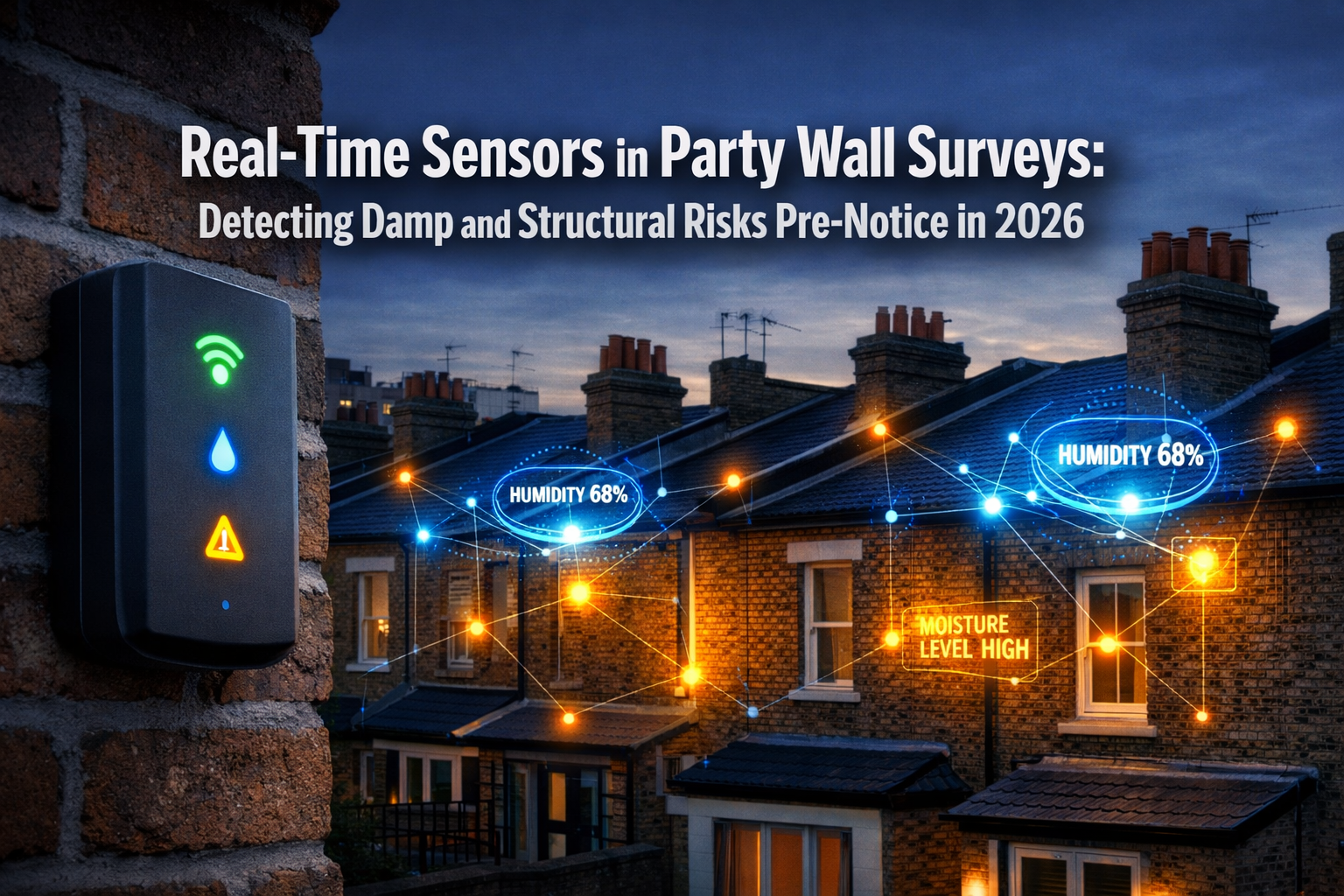
Over 40% of party wall disputes in London stem from disagreements about pre-existing conditions versus new damage caused by construction works. This single statistic reveals why Real-Time Sensors in Party Wall Surveys: Detecting Damp and Structural Risks Pre-Notice in 2026 has become the most significant technological advancement in property surveying this decade. As urban density increases and construction projects multiply across shared boundaries, the traditional approach of visual inspections and static photographs no longer provides sufficient evidence to protect either building owners or their neighbors.
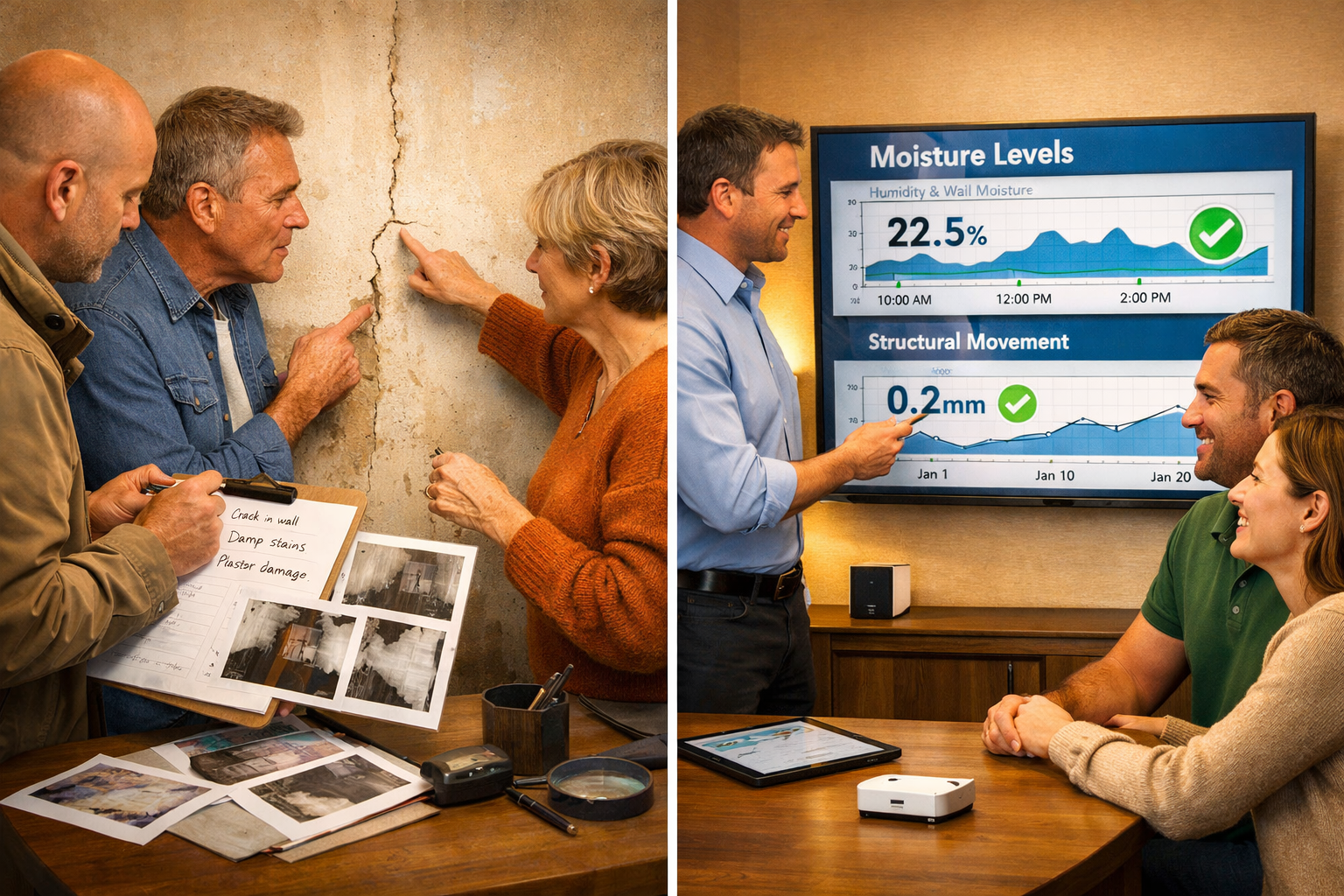
The integration of continuous monitoring technology into party wall surveys transforms how surveyors document baseline conditions and track changes throughout construction phases. In 2026, these sensor systems deliver unprecedented accuracy in detecting moisture intrusion, structural movement, and environmental changes that could escalate into costly disputes or serious property damage.
Key Takeaways
✅ Real-time sensors provide continuous baseline data that eliminates disputes about pre-existing conditions versus construction-related damage in party wall scenarios
✅ Humidity and air quality monitoring detects hidden damp issues weeks before visible signs appear, protecting both properties during excavation and building works
✅ Digital schedules of condition with sensor validation reduce dispute resolution time by up to 60% compared to traditional photographic evidence alone
✅ Automated alert systems notify surveyors and building owners immediately when moisture levels or structural movement exceed safe thresholds
✅ Cost-effective deployment in 2026 makes sensor technology accessible for standard residential party wall projects, not just commercial developments
Understanding Real-Time Sensors in Party Wall Surveys: Detecting Damp and Structural Risks Pre-Notice in 2026
The Evolution of Party Wall Documentation
Traditional party wall surveys have relied on visual inspections, photographs, and written descriptions to create schedules of condition. While these methods establish a record of existing defects, they capture only a single moment in time. Real-Time Sensors in Party Wall Surveys: Detecting Damp and Structural Risks Pre-Notice in 2026 represents a fundamental shift toward continuous monitoring that captures dynamic changes in building conditions.
The technology encompasses several sensor types working in concert:
- 🌡️ Temperature and humidity sensors that track moisture levels in walls, floors, and ceilings
- 📊 Structural movement monitors detecting subsidence, settlement, or vibration-induced shifts
- 💨 Air quality sensors identifying ventilation issues that contribute to condensation and mold
- 💧 Direct moisture meters measuring water content in building materials
- 📱 Wireless connectivity enabling real-time data transmission to cloud-based dashboards
According to recent industry analysis, surveying firms are increasingly adopting technology solutions that provide early property insights and reduce delays in complex assessments [2]. This trend accelerates in 2026 as sensor costs decrease and data interpretation software becomes more sophisticated.
How Sensor Technology Enhances Schedules of Condition
A schedule of condition documents the state of adjoining properties before construction begins under the Party Wall Act 1996. Traditional schedules include photographs, written descriptions, and sometimes crack monitoring. Real-time sensors augment these records with quantifiable, time-stamped data that proves invaluable when disputes arise.
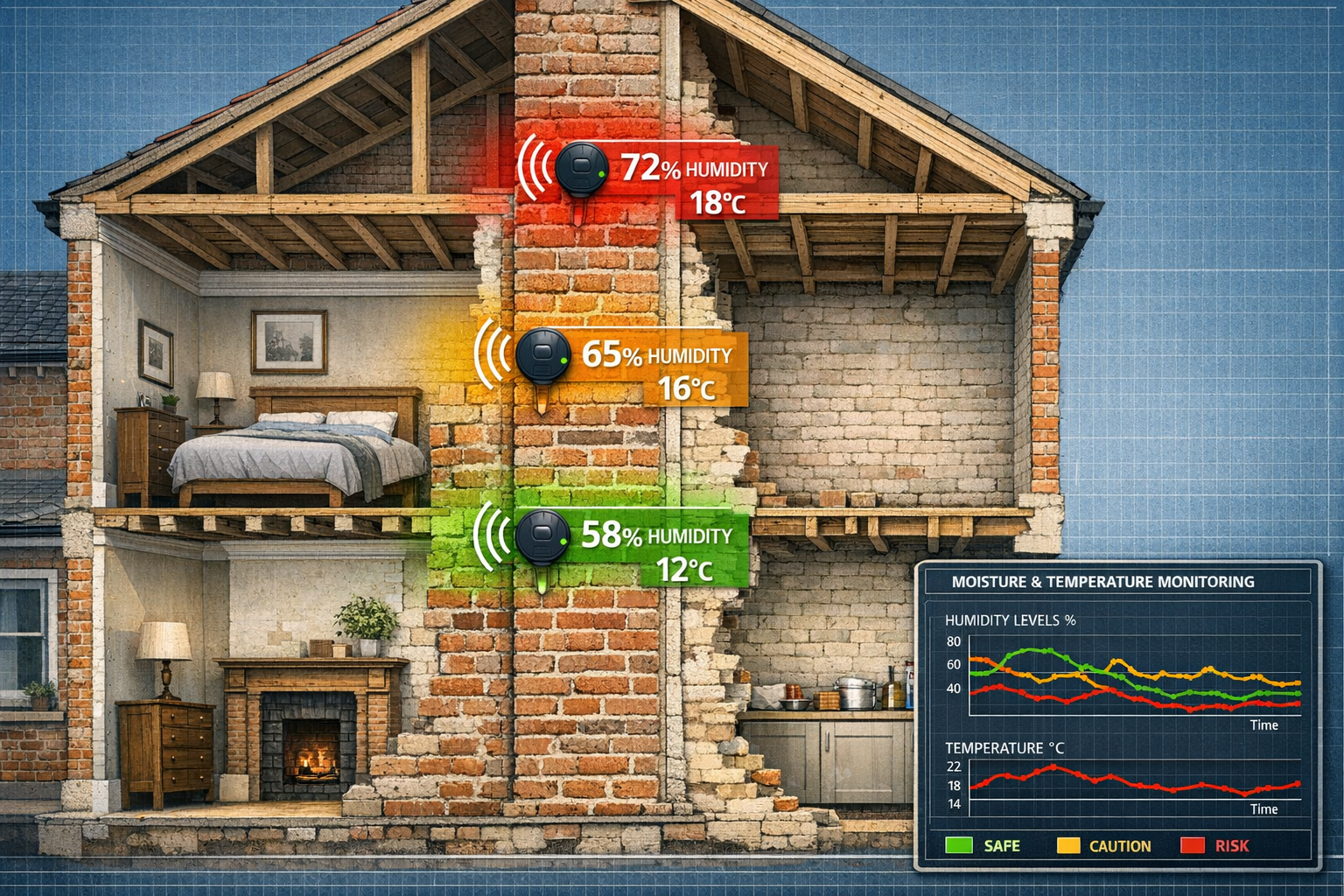
Key advantages of sensor-enhanced schedules:
| Traditional Method | Sensor-Enhanced Method |
|---|---|
| Single-point-in-time documentation | Continuous baseline monitoring |
| Subjective visual assessments | Objective numerical data |
| Delayed detection of developing issues | Immediate alerts for threshold breaches |
| Limited evidence for dispute resolution | Comprehensive data logs with timestamps |
| Reactive problem identification | Proactive risk management |
The sensors typically remain in place from the pre-notice survey stage through project completion, creating an unbroken chain of environmental and structural data. This continuous record proves particularly valuable when damp surveys reveal moisture problems that owners claim resulted from neighboring construction work.
Pre-Notice Detection: Identifying Hidden Risks
One of the most powerful applications of Real-Time Sensors in Party Wall Surveys: Detecting Damp and Structural Risks Pre-Notice in 2026 occurs during the pre-notice phase—before formal party wall notices are even served. Sensors installed during preliminary assessments frequently uncover hidden defects that would otherwise be attributed to subsequent construction activities.
Common pre-existing issues detected by sensors:
- Rising damp showing elevated moisture levels at floor-wall junctions
- Penetrating damp from defective flashings or pointing failures
- Condensation patterns indicating inadequate ventilation
- Structural movement from historical subsidence or settlement
- Hidden leaks from plumbing or roofing defects
Understanding damp survey costs helps property owners budget for comprehensive assessments that include sensor deployment. The investment in baseline monitoring typically represents 15-25% of total survey costs but can prevent disputes costing tens of thousands of pounds.
Technology Implementation in High-Density Urban Projects
Sensor Deployment Strategies for Party Wall Scenarios
High-density urban environments present unique challenges for party wall works. Terraced properties, semi-detached houses, and converted flats share multiple boundaries where construction activities can affect several properties simultaneously. Real-Time Sensors in Party Wall Surveys: Detecting Damp and Structural Risks Pre-Notice in 2026 addresses these complexities through strategic sensor placement and networked monitoring.
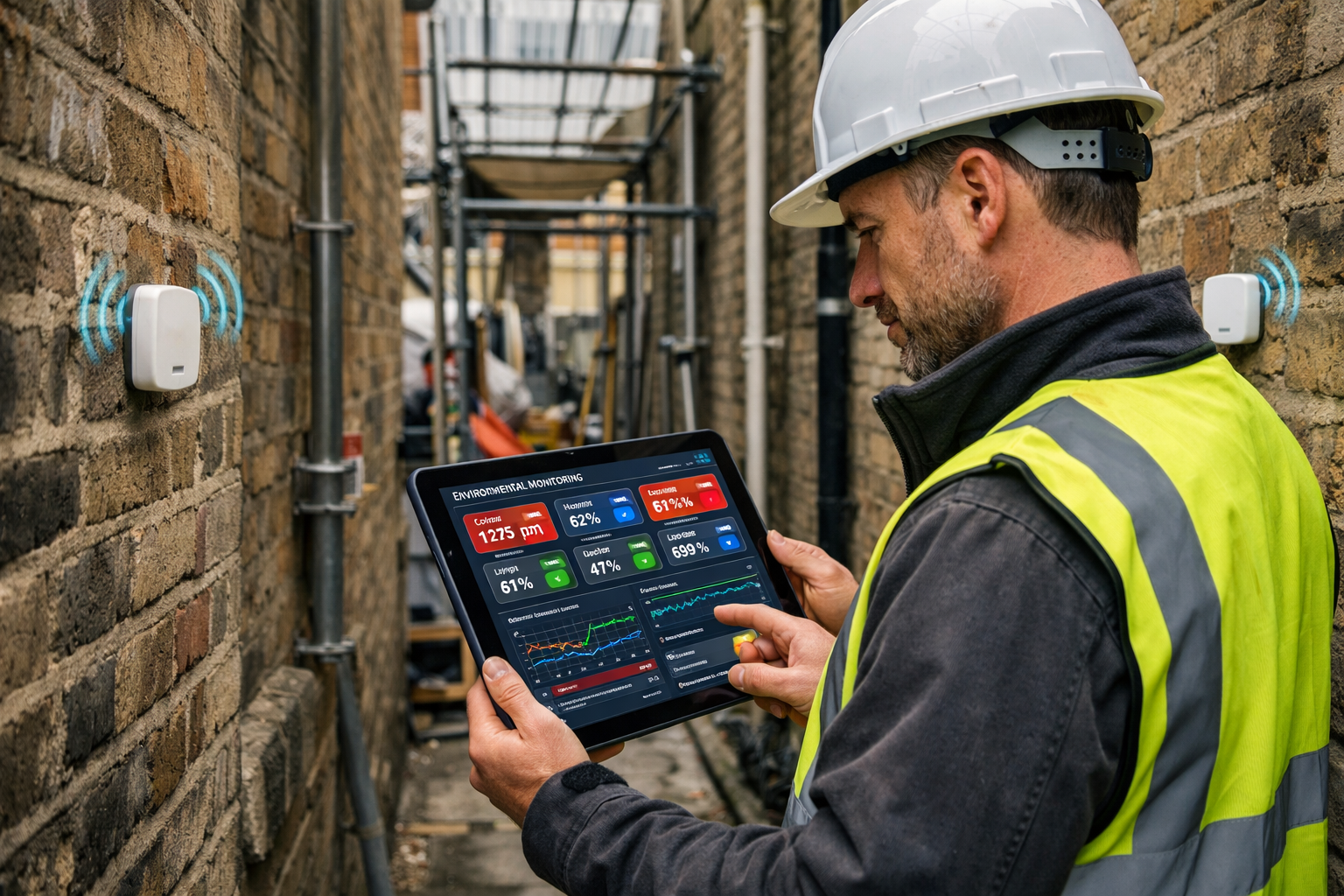
Optimal sensor placement zones:
- Upper floor party walls where roof work or loft conversions create vibration and potential water ingress
- Below ground level monitoring excavation impacts and groundwater changes
- Chimney breasts and flues tracking moisture from removed or altered heating systems
- Bathroom and kitchen walls where plumbing alterations affect shared structures
- Foundation areas detecting settlement from nearby excavation or piling works
Modern sensor systems use mesh networking, allowing multiple devices to communicate and create comprehensive coverage across complex property layouts. When one sensor detects an anomaly, the system cross-references data from adjacent sensors to determine whether the issue is localized or affecting multiple areas.
Industry experts note that surveying trends in 2026 emphasize adaptable technology solutions that don't require overcommitment to expensive infrastructure [4]. Wireless sensor networks align perfectly with this approach, offering scalable deployment that matches project scope and budget.
Data Interpretation and Alert Management
The value of sensor technology depends entirely on proper data interpretation and timely response to alerts. Real-Time Sensors in Party Wall Surveys: Detecting Damp and Structural Risks Pre-Notice in 2026 systems incorporate sophisticated algorithms that distinguish between normal environmental fluctuations and genuine risk indicators.
Alert threshold examples:
- 📈 Relative humidity exceeding 65% for more than 48 consecutive hours
- 💧 Moisture content in timber exceeding 20% indicating active decay risk
- 📉 Temperature differentials greater than 5°C between adjacent rooms suggesting insulation failure
- 🔴 Structural movement exceeding 2mm within a 7-day period
- ⚠️ Air quality degradation with VOC levels indicating mold growth
Professional party wall surveyors configure alert parameters based on property type, construction materials, and planned works. The system sends notifications via email, SMS, or mobile app, ensuring that all parties receive immediate warning when conditions deteriorate.
Case Study: Preventing Damp Disputes in London Basement Conversions
Basement conversions represent the highest-risk category for party wall disputes, particularly regarding damp and water ingress. A recent London project demonstrates how sensor technology prevented what would have been a protracted legal dispute.
Project details:
- Victorian terraced house with basement excavation and underpinning
- Three adjoining properties sharing party walls
- Pre-existing damp issues in neighboring property (undetected by visual survey)
Sensor deployment:
- 12 humidity sensors across three properties
- 6 structural movement monitors on party walls
- 4 moisture meters in basement areas
- Continuous monitoring from 4 weeks pre-construction through 6-month completion
Results:
The sensor data revealed that the neighboring property had elevated humidity levels (68-72%) and moisture content in floor joists (22-24%) before excavation began. Without this evidence, the building owner would likely have faced claims that their basement work caused the damp problem. The sensors provided irrefutable proof of pre-existing conditions, saving an estimated £35,000 in dispute resolution costs and remedial work claims.
This scenario illustrates why expert party wall advice increasingly includes recommendations for sensor-based monitoring on high-risk projects.
Reducing Disputes Through Objective Evidence and Continuous Monitoring
The Legal and Practical Value of Sensor Data
When party wall disputes escalate to formal proceedings or court action, the quality of evidence becomes paramount. Real-Time Sensors in Party Wall Surveys: Detecting Damp and Structural Risks Pre-Notice in 2026 provides evidence that meets rigorous legal standards while being accessible to non-technical parties.
Legal advantages of sensor evidence:
✅ Objective and quantifiable – removes subjective interpretation disputes
✅ Time-stamped records – establishes precise chronology of events
✅ Continuous data – eliminates gaps in documentation
✅ Tamper-evident – blockchain-verified data logs prevent manipulation
✅ Expert-validated – professionally calibrated equipment with certification
Courts and arbitrators increasingly favor sensor data over photographic evidence alone because it provides context and progression rather than isolated snapshots. When party wall agreements are disputed, sensor logs can demonstrate whether damage occurred gradually over time or suddenly coincided with specific construction activities.
Cost-Benefit Analysis for 2026 Projects
Property owners and developers naturally question whether sensor deployment justifies the additional expense. The 2026 cost structure for sensor-enhanced party wall surveys makes the technology increasingly accessible for standard residential projects.
Typical cost breakdown:
| Survey Component | Traditional Cost | Sensor-Enhanced Cost |
|---|---|---|
| Initial schedule of condition | £800-£1,200 | £800-£1,200 |
| Sensor hardware (rental, 6 months) | £0 | £400-£600 |
| Installation and calibration | £0 | £200-£300 |
| Data monitoring service | £0 | £150-£250 |
| Final report and data analysis | £300-£500 | £400-£600 |
| Total | £1,100-£1,700 | £1,950-£2,950 |
The incremental cost of £850-£1,250 represents approximately 50-75% more than traditional surveys. However, this investment must be weighed against potential dispute costs:
- Average party wall dispute resolution: £8,000-£15,000
- Legal proceedings if disputes escalate: £25,000-£50,000+
- Remedial work claims (often unfounded): £10,000-£40,000
Even preventing a single minor dispute delivers a return on investment exceeding 600%. For projects involving multiple adjoining properties or high-risk works like excavation and underpinning, sensor monitoring becomes financially prudent rather than optional.
Understanding party wall agreement costs helps property owners budget appropriately for comprehensive protection.
Integration with Building Information Modeling (BIM)
Advanced surveying practices in 2026 integrate sensor data with Building Information Modeling systems, creating comprehensive digital twins of properties undergoing party wall works. This integration enhances the value of Real-Time Sensors in Party Wall Surveys: Detecting Damp and Structural Risks Pre-Notice in 2026 by contextualizing sensor readings within three-dimensional building models.
BIM integration benefits:
- 🏗️ Visual representation of sensor locations and readings within 3D models
- 📊 Historical data overlays showing how conditions changed throughout construction phases
- 🔍 Predictive analytics identifying areas at risk based on similar project patterns
- 📱 Stakeholder access allowing all parties to view real-time conditions through web interfaces
- 📋 Automated reporting generating compliance documentation for building control
The convergence of sensor technology, BIM, and cloud-based collaboration platforms represents the future of party wall surveying. Research indicates that technology adoption for early property insight continues accelerating as firms recognize the competitive advantages and risk reduction benefits [2].
Regulatory Compliance and Professional Standards in 2026
RICS Guidelines and Sensor Technology
The Royal Institution of Chartered Surveyors (RICS) has updated guidance for 2026 to address the growing use of sensor technology in property surveys. While sensors are not yet mandatory for party wall surveys, RICS surveyors increasingly incorporate them into best practice protocols, particularly for high-risk projects.
RICS recommendations for sensor use:
- Calibration verification – sensors must have current calibration certificates
- Data security – monitoring systems must comply with GDPR and data protection requirements
- Professional interpretation – raw sensor data requires expert analysis and contextualization
- Disclosure requirements – all parties must be informed about sensor deployment and data collection
- Record retention – sensor data should be retained for minimum 6 years post-project completion
Professional surveyors working in London and surrounding areas maintain expertise in both traditional assessment methods and emerging sensor technologies. Those seeking party wall surveyor quotes should inquire about sensor monitoring capabilities and experience with data-driven dispute prevention.
Data Privacy and Neighbor Relations
Deploying sensors in residential properties raises legitimate privacy concerns that must be addressed transparently. Real-Time Sensors in Party Wall Surveys: Detecting Damp and Structural Risks Pre-Notice in 2026 systems collect environmental data only—temperature, humidity, structural movement—not personal information or surveillance data.
Privacy protection measures:
- ✅ Clear consent obtained from all affected property owners
- ✅ Sensor placement limited to structural elements and party walls
- ✅ No audio, video, or personal data collection capabilities
- ✅ Secure, encrypted data transmission and storage
- ✅ Access restricted to authorized surveyors and property owners
Transparent communication about sensor deployment often improves neighbor relations rather than creating friction. When all parties understand that sensors protect everyone's interests by establishing objective baseline conditions, cooperation typically increases. This collaborative approach aligns with the fundamental purpose of party wall agreements—facilitating necessary works while protecting all parties' property rights.
Future Developments and Industry Trends
The trajectory of sensor technology in party wall surveys points toward even more sophisticated capabilities emerging beyond 2026. Industry analysis suggests several developments on the near horizon:
Emerging technologies:
- 🤖 AI-powered predictive analytics that forecast potential issues before they develop
- 🛰️ Satellite-based ground movement monitoring complementing on-site sensors
- 📡 5G-enabled real-time video inspection of inaccessible areas during construction
- 🔬 Nano-sensors embedded in building materials during construction for permanent monitoring
- ⚡ Energy-harvesting sensors eliminating battery replacement requirements
The land surveying industry broadly is experiencing rapid technological advancement, with total stations, GPS systems, and laser scanning technologies becoming increasingly sophisticated and accessible [3]. These developments in general surveying practice influence party wall survey methodologies as professionals adopt cross-disciplinary innovations.
Looking ahead, the integration of sensor technology with artificial intelligence and machine learning will enable truly predictive party wall surveys—identifying potential problems weeks or months before they manifest as visible damage. This proactive approach represents the ultimate goal of Real-Time Sensors in Party Wall Surveys: Detecting Damp and Structural Risks Pre-Notice in 2026 and beyond.
Conclusion
Real-Time Sensors in Party Wall Surveys: Detecting Damp and Structural Risks Pre-Notice in 2026 represents more than incremental improvement in surveying practice—it fundamentally transforms how property owners, developers, and neighbors navigate shared boundary construction projects. By providing continuous, objective monitoring of humidity, structural movement, and environmental conditions, sensor technology eliminates the primary source of party wall disputes: disagreement about whether damage existed before works commenced or resulted from construction activities.
The evidence is compelling: sensor-enhanced surveys reduce dispute resolution time by up to 60%, prevent unfounded damage claims worth tens of thousands of pounds, and create collaborative relationships between neighbors rather than adversarial confrontations. As costs continue decreasing and capabilities expand, sensor deployment will transition from optional enhancement to standard practice for responsible party wall surveys.
Actionable Next Steps
For property owners planning construction work affecting party walls:
- Request sensor-enhanced surveys when obtaining quotes from party wall surveyors
- Budget appropriately by allocating an additional £850-£1,250 for sensor monitoring
- Communicate proactively with neighbors about the protective benefits of objective monitoring
- Review data regularly through surveyor-provided dashboards to stay informed about conditions
- Retain comprehensive records including sensor data logs for future reference
For neighbors affected by adjoining construction:
- Advocate for sensor deployment when party wall notices are served
- Understand your rights to request enhanced monitoring on high-risk projects
- Engage qualified surveyors with expertise in both traditional methods and sensor technology
- Document concerns about pre-existing conditions that sensors can verify
- Maintain cooperative dialogue recognizing that sensors protect all parties equally
The future of party wall surveying lies in technology that serves transparency, fairness, and dispute prevention. By embracing Real-Time Sensors in Party Wall Surveys: Detecting Damp and Structural Risks Pre-Notice in 2026, the construction industry takes a significant step toward more harmonious urban development where shared boundaries strengthen communities rather than dividing them.
References
[1] Future Land Surveying 2026 – https://haller-blanchard.com/future-land-surveying-2026/
[2] Technology For Early Property Insight In 2026 Building Surveys Reducing Delays In Complex Valuations – https://nottinghillsurveyors.com/blog/technology-for-early-property-insight-in-2026-building-surveys-reducing-delays-in-complex-valuations
[3] Navigating The 2026 Land Survey Equipment Boom Total Stations Gps And Laser Scanners Reviewed – https://nottinghillsurveyors.com/blog/navigating-the-2026-land-survey-equipment-boom-total-stations-gps-and-laser-scanners-reviewed
[4] 2026 Surveying Trends How Survey Firms Are Adapting Without Overcommitting – https://munsonedsurvey.com/blogs/news/2026-surveying-trends-how-survey-firms-are-adapting-without-overcommitting