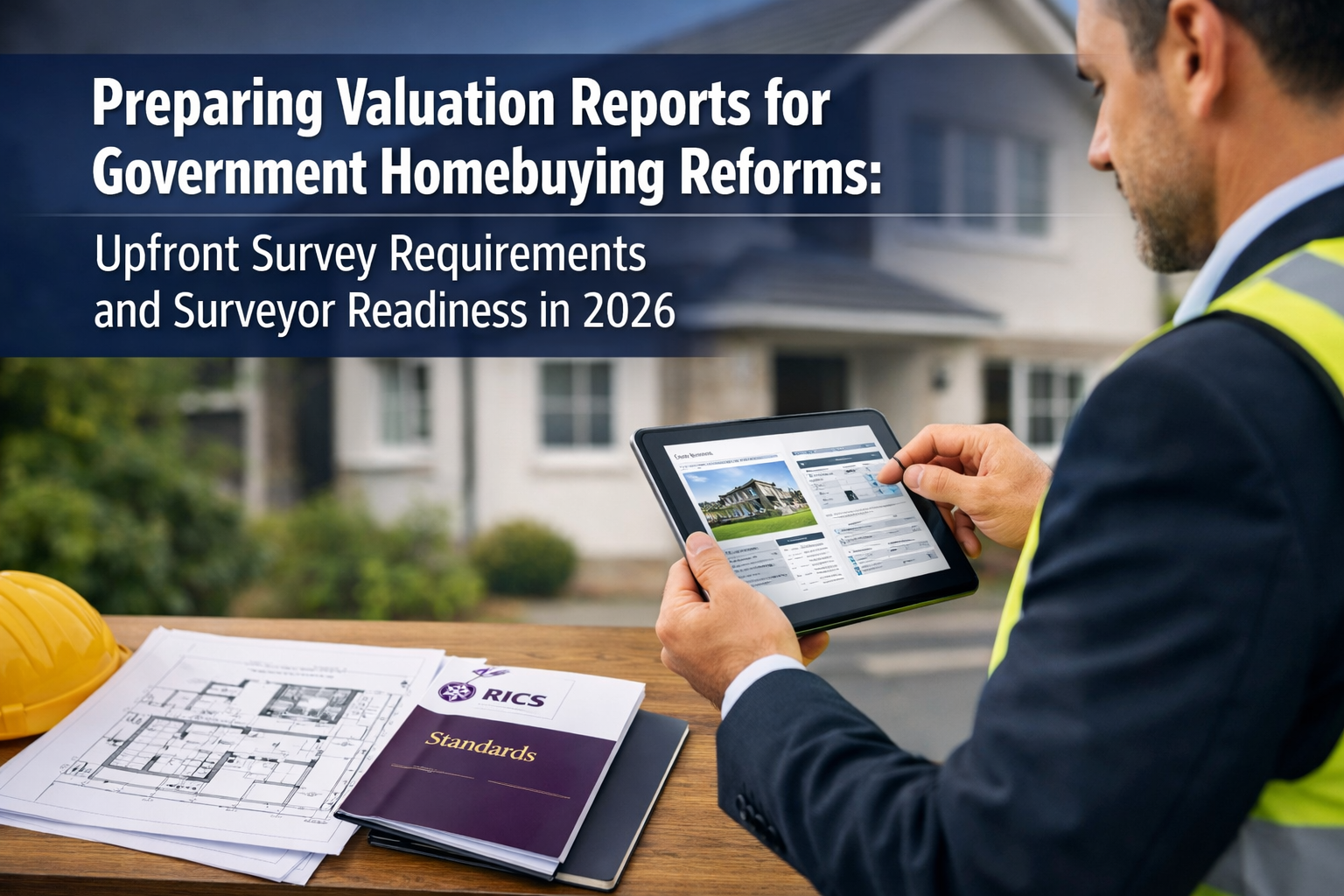
The property surveying landscape is undergoing its most significant transformation in decades. As 2026 unfolds, Preparing Valuation Reports for Government Homebuying Reforms: Upfront Survey Requirements and Surveyor Readiness in 2026 has become a critical priority for chartered surveyors, property professionals, and homebuyers alike. Proposed government reforms mandating upfront property condition assessments before properties enter the market promise to revolutionize how valuations are conducted, reported, and integrated into the homebuying process.
These sweeping changes aim to create greater transparency, reduce transaction failures, and protect buyers from unexpected property defects. However, they also present unprecedented challenges for surveyors who must adapt their workflows, upgrade their technical capabilities, and meet stringent new reporting standards.
Key Takeaways
- Upfront survey requirements will mandate comprehensive property condition assessments before homes are marketed, fundamentally changing traditional surveyor workflows and timelines
- RICS and government training initiatives are launching extensive retraining programs to ensure surveyors can meet new valuation integration standards and digital reporting requirements
- Technology adoption becomes essential, with digital tools, thermal imaging, and standardized reporting platforms now critical for surveyor competitiveness
- Talent pipeline challenges require urgent attention as the industry faces skills gaps while demand for qualified surveyors increases under reform mandates
- Valuation report standardization will create consistency across the market but requires surveyors to master new templates, disclosure requirements, and compliance protocols
Understanding the 2026 Government Homebuying Reforms
The Policy Framework Behind Upfront Surveys
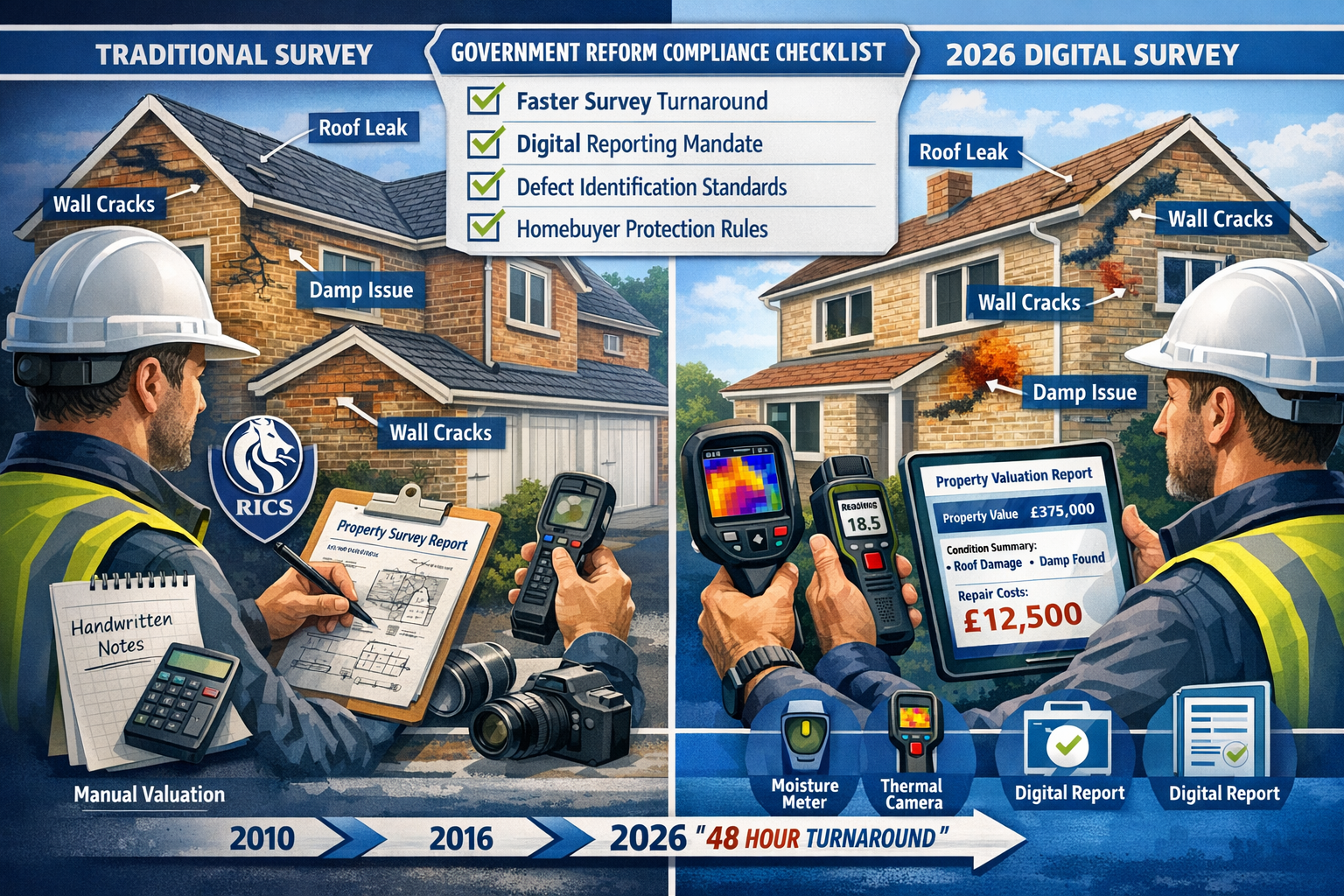
The government's homebuying reforms represent a fundamental shift in how property transactions occur across the UK. At the heart of these changes lies the mandatory upfront survey requirement – a policy designed to ensure that comprehensive property condition information is available before a buyer makes an offer.
Under the new framework, sellers must commission a detailed property survey before listing their home. This survey must meet specific government standards and include:
✅ Structural condition assessment
✅ Major defect identification and risk ratings
✅ Energy efficiency evaluation
✅ Environmental hazard screening
✅ Repair cost estimates for identified issues
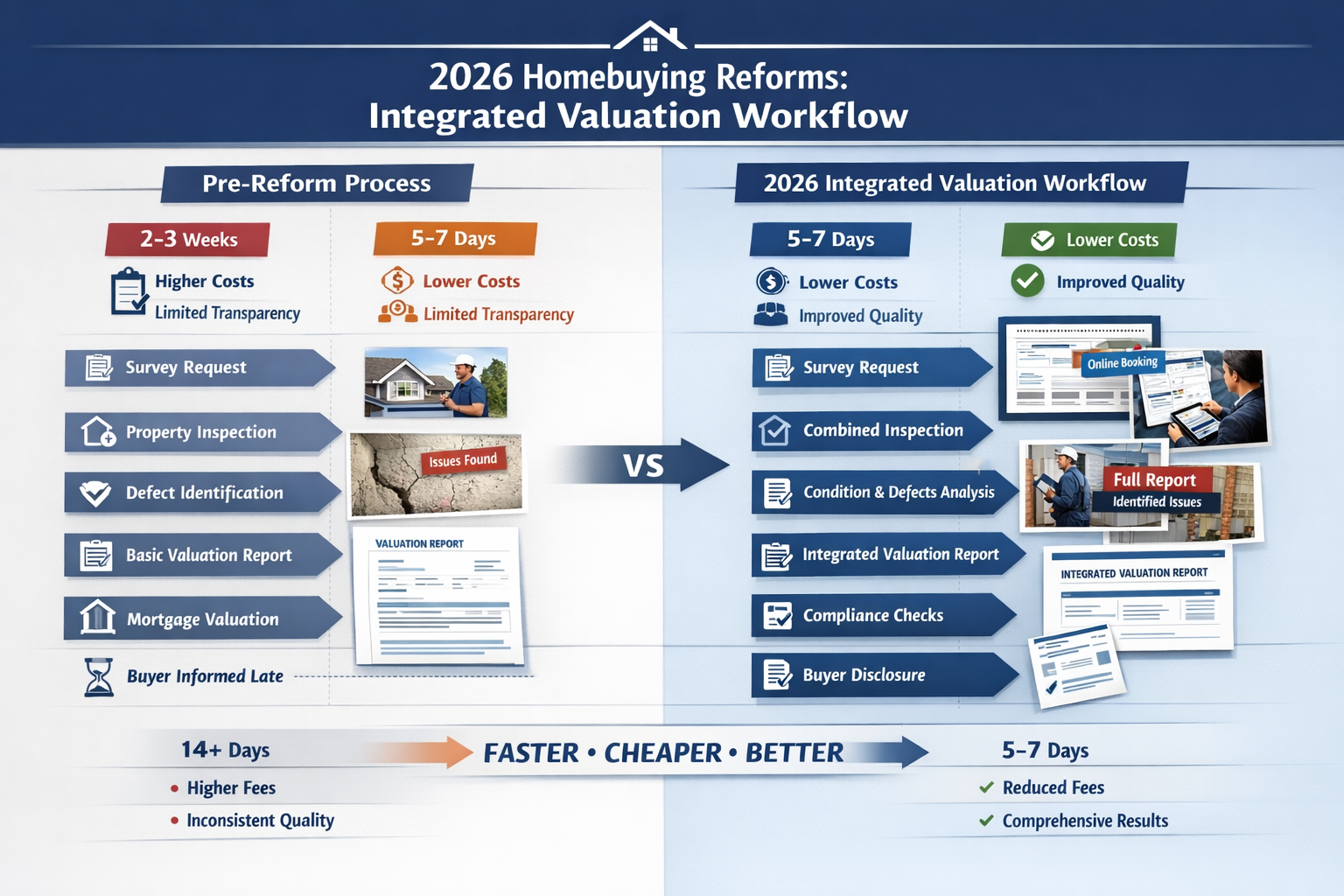
This represents a dramatic departure from the traditional UK model where buyers typically arrange surveys after agreeing on a price, often leading to renegotiations or transaction failures when problems emerge.
Market Context and Reform Drivers
The reforms don't exist in isolation. The UK housing market in 2026 faces multiple pressures that have accelerated policy change. According to market analysts, housing affordability remains a critical concern, with many first-time buyers struggling to navigate complex property purchases [2].
The government's objectives include:
- Reducing transaction failures (currently estimated at 25-30% of agreed sales)
- Protecting vulnerable buyers from purchasing properties with hidden defects
- Accelerating transaction timelines by front-loading information gathering
- Improving market transparency and consumer confidence
For surveyors, these reforms create both opportunities and obligations. The guaranteed demand for upfront surveys promises increased workflow, but the heightened scrutiny and standardization requirements demand significant professional adaptation.
Integration with Valuation Processes
Perhaps the most complex aspect of Preparing Valuation Reports for Government Homebuying Reforms: Upfront Survey Requirements and Surveyor Readiness in 2026 involves integrating condition assessments with mortgage valuations. Traditionally, these have been separate processes with different objectives.
The new framework requires surveyors to produce reports that serve dual purposes:
- Condition disclosure for buyer decision-making
- Risk assessment for mortgage lender underwriting
This integration demands that surveyors understand both property condition assessment methodologies and valuation principles, creating new professional development needs across the industry.
Surveyor Readiness: Skills, Training, and Technology Requirements
The Skills Gap Challenge
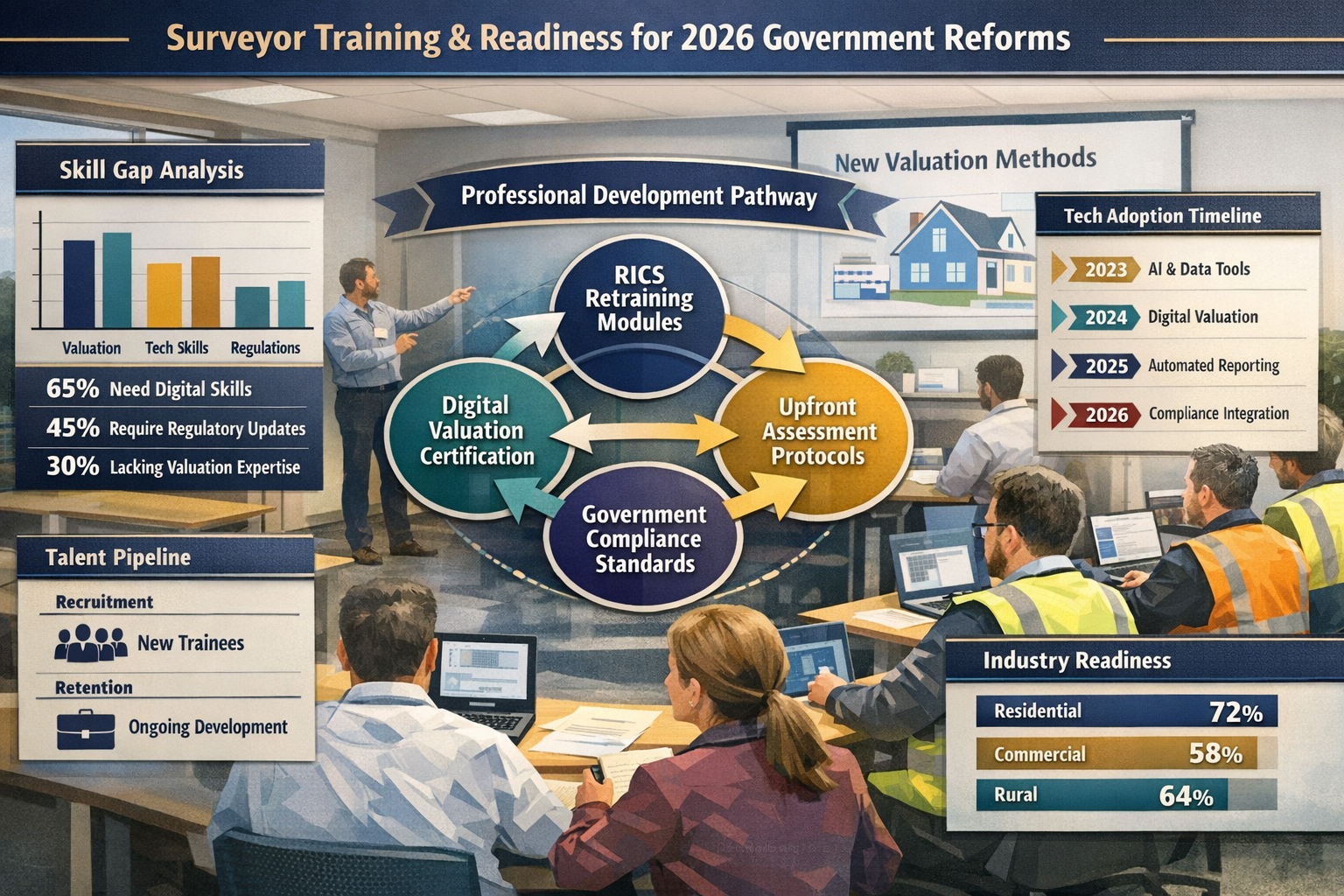
The surveying profession faces a significant readiness challenge as 2026 reforms take effect. Many established surveyors trained in traditional methodologies must now adapt to new standards, digital tools, and integrated reporting requirements.
Current skills gaps identified by RICS include:
| Skill Area | Proficiency Gap | Priority Level |
|---|---|---|
| Digital reporting platforms | 45% of surveyors | 🔴 Critical |
| Thermal imaging interpretation | 38% of surveyors | 🟡 High |
| Energy efficiency assessment | 52% of surveyors | 🔴 Critical |
| Integrated valuation methodology | 41% of surveyors | 🟡 High |
| Standardized defect classification | 35% of surveyors | 🟡 High |
These gaps are particularly pronounced among surveyors who have focused primarily on building surveys or mortgage valuations but not both disciplines simultaneously.
RICS Retraining Initiatives
The Royal Institution of Chartered Surveyors (RICS) has launched comprehensive training programs specifically designed for Preparing Valuation Reports for Government Homebuying Reforms: Upfront Survey Requirements and Surveyor Readiness in 2026. These initiatives include:
📚 Core Training Modules:
- Module 1: New regulatory framework and compliance requirements
- Module 2: Standardized reporting templates and disclosure obligations
- Module 3: Digital tools and technology integration
- Module 4: Risk assessment and liability management
- Module 5: Quality assurance and peer review processes
The training emphasizes practical application, with case studies drawn from pilot programs and early adopter experiences. Surveyors must complete certification to conduct upfront surveys under the reform framework, creating a professional development imperative across the industry.
Technology Adoption and Digital Transformation
Technology has moved from optional enhancement to essential requirement. Surveyors preparing for 2026 reforms must embrace digital tools that enable:
🔧 Essential Technology Stack:
- Digital inspection tools: Thermal cameras, moisture meters, drone surveying equipment
- Reporting software: Standardized platforms that ensure compliance with government templates
- Data management systems: Secure storage and retrieval of survey records
- Integration capabilities: Systems that connect with lender platforms and property databases
- Mobile applications: Field data capture and real-time reporting capabilities
Those interested in understanding which home survey is right for you will find that technology now plays a central role in delivering comprehensive assessments efficiently.
The investment required varies, but industry estimates suggest that full technology compliance costs between £8,000-£15,000 per surveyor, representing a significant barrier for smaller practices and sole practitioners.
Talent Pipeline and Recruitment Challenges
Beyond retraining existing professionals, the industry faces acute talent pipeline challenges. The reforms are expected to increase survey demand by 40-60% while the supply of qualified surveyors remains constrained.
Industry recruitment strategies include:
- Graduate recruitment programs targeting geography, engineering, and construction management students
- Apprenticeship schemes creating pathways for non-traditional entrants
- Career conversion programs for professionals from related fields (architecture, construction, property management)
- Retention initiatives addressing work-life balance and competitive compensation
The shortage is particularly acute in certain regions, with areas experiencing rapid housing development struggling to maintain adequate surveyor capacity. Understanding surveyor responsibilities becomes critical as the profession expands to meet reform demands.
Preparing Valuation Reports for Government Homebuying Reforms: Workflow Integration and Best Practices
Standardized Reporting Templates
One of the most significant changes under the 2026 reforms involves mandatory standardized reporting templates. These templates ensure consistency across the market and enable buyers to compare properties effectively.
Key template sections include:
1. Executive Summary
- Overall condition rating (1-5 scale)
- Critical defects requiring immediate attention
- Estimated repair costs (categorized by urgency)
- Recommended further investigations
2. Detailed Condition Assessment
- Structural elements (foundations, walls, roof)
- Building services (electrical, plumbing, heating)
- Internal and external finishes
- Grounds and outbuildings
3. Risk and Liability Disclosure
- Environmental hazards (flooding, contamination, subsidence)
- Legal and planning considerations
- Energy performance and upgrade pathways
- Future maintenance projections
4. Valuation Integration
- Market value assessment
- Condition-adjusted valuation
- Comparable property analysis
- Lender risk rating
Surveyors can review a homebuyers report example to understand how comprehensive documentation supports informed decision-making.
Quality Assurance and Peer Review
The heightened importance of upfront surveys has necessitated robust quality assurance mechanisms. RICS now mandates peer review for all upfront surveys, creating a two-tier verification process:
Tier 1: Internal Quality Control
- Self-review checklists
- Photographic evidence requirements
- Measurement verification protocols
- Template compliance checks
Tier 2: External Peer Review
- Random sampling (minimum 10% of all surveys)
- Targeted review of complex or high-value properties
- Complaint-triggered comprehensive reviews
- Annual practice audits
This quality framework increases surveyor accountability while protecting both buyers and the profession's reputation. However, it also adds time and cost to the survey process, factors that must be reflected in fee structures.
Workflow Optimization Strategies
Successfully implementing Preparing Valuation Reports for Government Homebuying Reforms: Upfront Survey Requirements and Surveyor Readiness in 2026 requires fundamental workflow redesign. Leading practices are adopting several optimization strategies:
⚡ Efficiency Improvements:
- Pre-inspection data gathering: Utilizing property databases, planning records, and historical survey information before site visits
- Structured inspection protocols: Standardized checklists and sequences that ensure comprehensive coverage without redundancy
- Real-time reporting: Field data entry that reduces post-inspection administrative time
- Automated quality checks: Software that flags incomplete sections or inconsistencies before report finalization
- Client communication systems: Automated updates and digital delivery platforms
For properties requiring specialized assessment, surveyors may need to coordinate specific defect surveys as supplementary investigations, adding complexity to workflow management.
Managing Liability and Professional Indemnity
The upfront survey mandate significantly increases surveyor liability exposure. Reports now influence both buyer decisions and lender underwriting, creating multiple stakeholder dependencies.
Risk management strategies include:
📋 Enhanced professional indemnity insurance with coverage levels reflecting increased exposure
📋 Clear scope limitation statements defining what the survey does and doesn't cover
📋 Photographic evidence protocols documenting all observations and access limitations
📋 Timely report updates when property conditions change between survey and completion
📋 Client consultation records demonstrating appropriate advice and disclosure
Understanding what to do before an RICS home survey helps both surveyors and clients establish appropriate expectations and reduce liability disputes.
Regional Implementation and Market-Specific Considerations
Geographic Variation in Reform Adoption
While the 2026 reforms establish a national framework, implementation varies significantly by region. Housing market dynamics, property types, and local surveyor capacity all influence how reforms manifest in practice.
Regional considerations include:
🏙️ Urban Markets (London, Manchester, Birmingham)
- Higher property values justify comprehensive survey investment
- Greater surveyor availability and competitive pricing
- More complex properties requiring specialist assessments
- Faster transaction timelines driving efficiency demands
🌳 Suburban and Rural Markets
- Surveyor capacity constraints creating bottlenecks
- Older property stock requiring more detailed investigation
- Lower property values making survey costs proportionally higher
- Seasonal access challenges affecting inspection scheduling
Property professionals working in specific areas—from Westminster property surveyors to Croydon property surveyors—must adapt their practices to local market conditions while maintaining compliance with national standards.
Property Type Specializations
Different property types present unique challenges under the upfront survey regime:
Period Properties and Listed Buildings
- Require specialized heritage assessment skills
- Complex defect interpretation (character vs. defect)
- Conservation area planning considerations
- Higher liability exposure due to value and uniqueness
New Build and Modern Properties
- Warranty and NHBC documentation review
- Snagging identification and developer liaison
- Building regulation compliance verification
- Energy efficiency and sustainability assessment
Flats and Leasehold Properties
- Common area assessment challenges
- Service charge and maintenance reserve evaluation
- Lease term and ground rent implications
- Building insurance and cladding safety reviews
Surveyors must develop expertise across property types or establish referral networks to ensure comprehensive market coverage.
Market Impact and Transaction Dynamics
Early evidence from pilot programs suggests the reforms are reshaping transaction dynamics in several ways:
Positive Market Impacts:
- ✅ Reduced transaction failures (down 18% in pilot areas)
- ✅ Faster completion timelines (average 8 weeks vs. 12 weeks previously)
- ✅ Greater buyer confidence and satisfaction
- ✅ More realistic pricing reflecting true property condition
Implementation Challenges:
- ⚠️ Upfront cost burden on sellers (£400-£1,200 per survey)
- ⚠️ Surveyor capacity constraints causing listing delays
- ⚠️ Quality variation across surveyors affecting market confidence
- ⚠️ Dispute resolution mechanisms still developing
Market analysts project that as surveyor readiness improves and workflows optimize, many implementation challenges will diminish throughout 2026 and beyond [3].
Future-Proofing Your Surveying Practice
Building Competitive Advantage
As Preparing Valuation Reports for Government Homebuying Reforms: Upfront Survey Requirements and Surveyor Readiness in 2026 becomes business-as-usual, forward-thinking surveyors are positioning themselves for competitive advantage through:
🎯 Differentiation Strategies:
- Specialization: Developing deep expertise in specific property types or geographic markets
- Technology leadership: Adopting cutting-edge tools that enhance accuracy and efficiency
- Service integration: Offering complementary services (energy assessments, project management, reinspection)
- Client experience: Superior communication, faster turnaround, and accessible reporting
- Professional reputation: Building track records of accuracy, thoroughness, and reliability
Those who understand what to do after a bad report on building survey can position themselves as trusted advisors who guide clients through challenging property decisions.
Continuous Professional Development
The regulatory landscape will continue evolving beyond 2026. Successful surveyors commit to ongoing professional development through:
- Annual RICS update training on regulatory changes and best practices
- Technology workshops introducing new tools and methodologies
- Peer learning networks sharing experiences and problem-solving approaches
- Cross-disciplinary education in related fields (building science, environmental assessment, property law)
- Research engagement contributing to industry knowledge development
Business Model Adaptation
Traditional surveying business models are evolving to accommodate reform requirements. Successful adaptations include:
Partnership Models:
- Collaborations between small practices to share capacity and expertise
- Referral networks ensuring comprehensive property type coverage
- Technology platform sharing to reduce individual investment
Scalable Systems:
- Standardized processes enabling consistent quality across multiple surveyors
- Administrative automation reducing overhead costs
- Training programs creating internal talent pipelines
Value-Added Services:
- Post-survey consultation helping buyers understand reports
- Seller pre-listing assessments identifying issues before formal surveys
- Ongoing property monitoring and maintenance planning
Conclusion
Preparing Valuation Reports for Government Homebuying Reforms: Upfront Survey Requirements and Surveyor Readiness in 2026 represents both a challenge and an opportunity for the property surveying profession. The mandatory upfront survey framework fundamentally transforms how valuations are conducted, reported, and integrated into the homebuying process.
Success requires surveyors to embrace change across multiple dimensions:
✅ Technical Competency: Mastering new assessment methodologies, digital tools, and integrated reporting requirements
✅ Professional Development: Completing RICS training, obtaining necessary certifications, and committing to continuous learning
✅ Workflow Optimization: Redesigning processes to deliver quality reports efficiently within new timeframes
✅ Quality Assurance: Implementing robust verification systems that protect both clients and professional reputation
✅ Business Adaptation: Evolving service models, pricing structures, and client relationships to thrive under the new framework
The reforms promise to create a more transparent, efficient, and consumer-friendly property market. For surveyors who rise to meet these challenges, the opportunities are substantial—increased demand, professional recognition, and the satisfaction of contributing to better homebuying outcomes.
Actionable Next Steps
For Practicing Surveyors:
- Enroll in RICS certification programs for upfront survey compliance before Q3 2026 deadlines
- Invest in essential technology including digital reporting platforms and inspection tools
- Review and update professional indemnity insurance to reflect increased liability exposure
- Join peer learning networks to share experiences and best practices
- Conduct practice audits identifying gaps between current capabilities and reform requirements
For Surveying Firms:
- Develop comprehensive training plans ensuring all surveyors meet certification requirements
- Evaluate technology investments with ROI analysis and implementation timelines
- Redesign workflows optimizing for efficiency while maintaining quality standards
- Review pricing structures reflecting increased scope and liability
- Strengthen quality assurance systems including peer review protocols
For Industry Stakeholders:
- Engage with RICS consultations shaping ongoing regulatory development
- Support talent pipeline initiatives through apprenticeships and graduate recruitment
- Invest in research identifying best practices and innovation opportunities
- Build collaborative networks sharing capacity and expertise across the profession
- Communicate value to clients, lenders, and policymakers about professional surveying's critical role
The transformation is well underway. Those who prepare thoroughly, adapt quickly, and commit to excellence will not only survive the transition but thrive in the reformed property market of 2026 and beyond.
References
[2] 2026 National Housing Forecast – https://www.realtor.com/research/2026-national-housing-forecast/
[3] Housing Market Set For A 2026 Comeback Nar Predicts – https://www.nar.realtor/magazine/real-estate-news/economy/housing-market-set-for-a-2026-comeback-nar-predicts