

As the UK government intensifies its push to meet ambitious housing targets in 2026, office-to-residential conversions have emerged as a critical solution to the nation's housing crisis. With thousands of underutilized commercial properties earmarked for transformation into residential units, particularly across London and other major cities, expert party wall surveyors face unprecedented challenges navigating complex urban retrofits. Party Wall Surveys for UK Office-to-Resi Conversions in 2026: RICS Protocols Amid Housing Targets have become essential knowledge for developers, building owners, and adjoining property stakeholders alike. 🏢➡️🏠
The conversion boom brings unique complications that traditional residential party wall work rarely encounters: commercial-grade structural systems, shared service cores, multiple adjoining owners, and regulatory frameworks designed for office use. Understanding how RICS protocols apply specifically to these conversions can mean the difference between smooth project delivery and costly disputes.
Key Takeaways
- Office-to-residential conversions require specialized party wall surveys that address unique structural, acoustic, and fire safety challenges not present in standard residential work
- RICS protocols for 2026 emphasize comprehensive schedules of condition documenting existing commercial infrastructure before conversion work begins
- Multiple adjoining owners in mixed-use buildings create complex notification requirements under the Party Wall etc. Act 1996
- Acoustic insulation upgrades to meet residential building regulations often trigger party wall procedures for existing shared structures
- Early surveyor engagement (ideally 3-4 months before planned works) prevents delays in conversion projects with tight housing delivery deadlines
Understanding Party Wall Surveys for UK Office-to-Resi Conversions in 2026
What Makes Office Conversions Different?
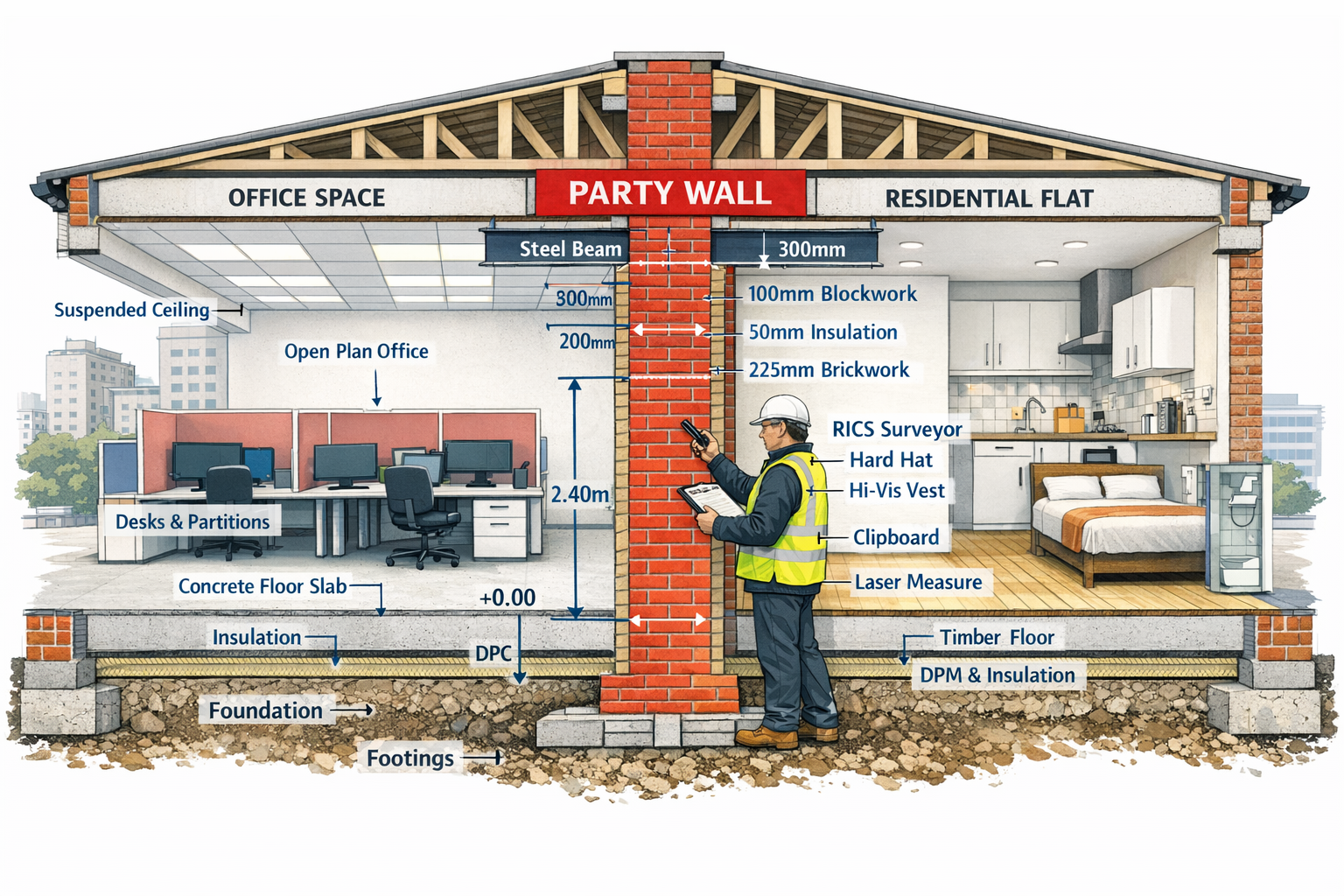
Office-to-residential conversions present fundamentally different party wall challenges compared to standard residential projects. Commercial buildings typically feature:
Structural Differences:
- Larger floor plates with fewer load-bearing walls
- Commercial-grade floor slabs designed for office loads (not residential layouts)
- Centralized core systems serving multiple tenancies
- Steel or concrete frame construction rather than traditional masonry
Occupancy Complexities:
- Multiple commercial tenants who may remain during phased conversions
- Mixed-use buildings with retail at ground level
- Shared service risers and plant rooms
- Different ownership structures (freehold, leasehold, commonhold)
These factors mean that party wall agreements must address scenarios rarely encountered in typical residential extensions or loft conversions.
The Party Wall etc. Act 1996 in Conversion Context
The Party Wall Act 1996 applies to office-to-residential conversions in several key ways:
| Section | Relevance to Conversions | Common Triggers |
|---|---|---|
| Section 1 | New walls on boundary lines | Rare in conversions; mainly applies if subdividing units |
| Section 2 | Works to existing party walls | Most common – modifications to shared walls between units |
| Section 6 | Excavation near adjoining buildings | Relevant for basement conversions or foundation work |
Critical Point: Even internal reconfiguration work can trigger party wall procedures if it affects shared structural elements, fire compartmentation, or acoustic barriers between separately owned units.
RICS Standards and Professional Guidance
The Royal Institution of Chartered Surveyors (RICS) provides the professional framework that governs party wall surveying practice in 2026. RICS surveyors must adhere to:
✅ RICS Guidance Note on Party Wall Legislation and Procedure – Updated regularly to reflect case law and best practices
✅ Professional Standards and Guidance – Ethical requirements for impartiality and competence
✅ Conflict of Interest Protocols – Particularly important in multi-unit conversions where multiple parties are involved
For office-to-resi projects specifically, RICS guidance emphasizes:
- Comprehensive pre-works surveys documenting existing conditions in commercial buildings
- Clear communication with all affected parties, including commercial tenants
- Detailed specifications for acoustic and fire performance upgrades
- Phasing considerations for occupied buildings
RICS Protocols for Party Wall Surveys in Office-to-Resi Conversions
The Pre-Conversion Assessment Process
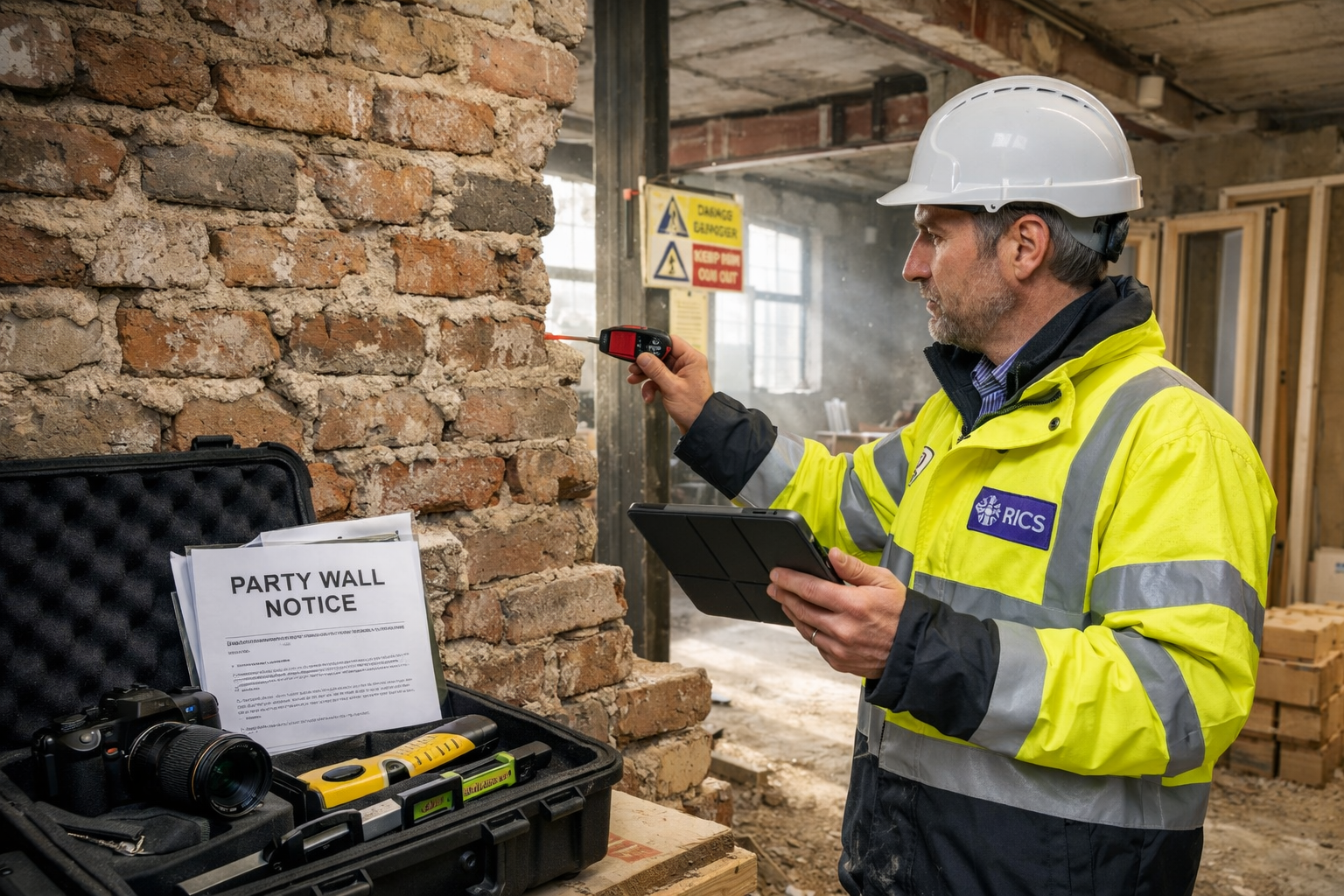
Before any conversion work begins, RICS protocols require a thorough assessment that goes beyond standard residential party wall surveys:
Step 1: Building Ownership and Occupancy Mapping 📋
- Identify all legal interests in the building (freeholders, leaseholders, tenants)
- Map party walls, party structures, and shared services
- Determine which works fall under Party Wall Act jurisdiction
- Identify any non-residential occupiers who require different notice procedures
Step 2: Structural and Services Investigation
A qualified surveyor should conduct:
- Structural assessment of existing party walls and floors
- Identification of shared service runs (HVAC, plumbing, electrical)
- Fire compartmentation review
- Acoustic performance baseline measurements
Step 3: Schedule of Condition Preparation
This critical document must capture:
- Photographic evidence of all party walls and adjacent structures
- Crack mapping and structural defect documentation
- Finishes and decorative condition in adjoining properties
- Existing acoustic and vibration characteristics
Expert Insight: "In office conversions, we often find that existing party walls were never designed for residential acoustic standards. The schedule of condition must document baseline noise transmission so that improvement works can be properly specified and post-conversion performance verified." – Senior RICS Party Wall Surveyor
Notice Procedures and Timeframes
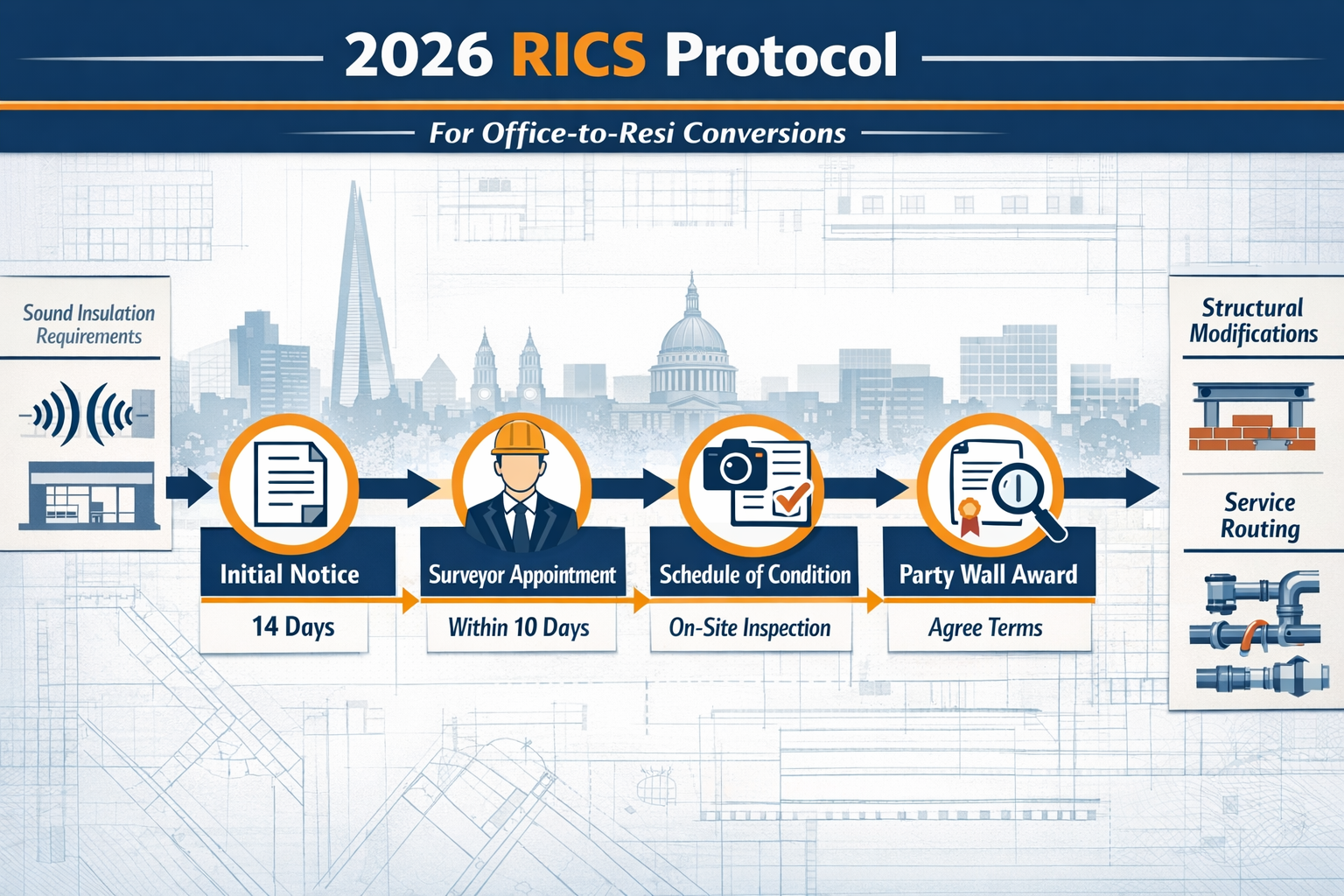
Party Wall Surveys for UK Office-to-Resi Conversions in 2026: RICS Protocols Amid Housing Targets require strict adherence to statutory notice periods:
Party Structure Notice (Section 2 works):
- Minimum 2 months' notice required before work commences
- Must describe the proposed works in sufficient detail
- Should include drawings showing party wall modifications
- Served on all adjoining owners (not just occupiers)
Notice of Adjacent Excavation (Section 6 works):
- Minimum 1 month's notice for excavations within 3-6 meters
- Includes structural calculations if required
- May be relevant for basement conversions
Critical Timing Consideration: In 2026's competitive conversion market, developers often underestimate notice periods. With housing targets driving urgency, starting the party wall process 3-4 months before planned construction is advisable to avoid delays.
Common Pitfalls in Conversion Projects
❌ Inadequate Adjoining Owner Identification
Office buildings may have complex ownership structures. Missing even one leaseholder can invalidate the entire process and halt works.
❌ Underspecified Acoustic Upgrades
Failing to detail how party walls will achieve residential Building Regulations (Approved Document E) standards leads to disputes and rework.
❌ Ignoring Existing Tenants' Rights
Commercial tenants remaining during conversion have legal protections. Party wall procedures must account for their interests.
❌ Insufficient Schedule of Condition
Commercial buildings often have existing defects. Without comprehensive documentation, building owners face liability for pre-existing issues.
❌ Delayed Surveyor Appointments
When adjoining owners don't respond to notices within 14 days, the building owner must appoint a surveyor on their behalf – adding time and cost.
Understanding party wall agreement costs upfront helps developers budget appropriately for these professional services.
Navigating Housing Targets and Regulatory Pressures in 2026
Government Housing Initiatives and Conversion Incentives
The UK government's 2026 housing targets have created significant pressure to accelerate office-to-residential conversions. Key policy drivers include:
Permitted Development Rights (PDR):
- Extended rights allowing certain office conversions without full planning permission
- However: PDR does NOT exempt projects from Party Wall Act requirements
- Many developers mistakenly believe simplified planning means simplified party wall procedures
Local Authority Housing Targets:
- London boroughs and major cities have ambitious annual housing delivery numbers
- Conversions count toward these targets, creating political pressure for rapid approvals
- This urgency can lead to rushed party wall processes – a recipe for disputes
Building Safety Act Implications:
While primarily focused on high-rise residential buildings, the Building Safety Act 2022's principles influence conversion projects:
- Enhanced accountability for building work quality
- Stricter documentation requirements
- Greater scrutiny of fire safety measures in party wall modifications
Balancing Speed with Compliance
The tension between housing delivery urgency and proper party wall procedures creates challenges for all stakeholders:
For Developers:
- Pressure to compress timelines conflicts with statutory notice periods
- Early engagement with party wall surveyors is essential
- Building contingency time into project schedules prevents costly delays
For Adjoining Owners:
- May face pressure to expedite consent
- Should resist waiving rights to proper surveys and awards
- Can request accelerated surveyor appointments without compromising protection
For Surveyors:
- Must maintain professional standards despite timeline pressures
- Cannot ethically shortcut RICS protocols to meet commercial deadlines
- Should clearly communicate realistic timeframes to all parties
Acoustic and Fire Safety Upgrades
One of the most significant party wall considerations in office-to-resi conversions involves upgrading existing party structures to meet residential standards:
Acoustic Performance Requirements:
Office buildings typically have minimal acoustic separation between units because noise tolerance differs in commercial environments. Residential conversions must achieve:
- Airborne sound insulation: Minimum 45 dB DnT,w (often higher for quality developments)
- Impact sound insulation: Maximum 62 dB L'nT,w for separating floors
- Service noise control: Residential standards for plumbing, HVAC
Achieving these standards often requires:
- Adding mass to existing party walls (plasterboard layers, acoustic boards)
- Installing resilient bars or independent stud frames
- Upgrading floor constructions with acoustic underlays
- Isolating service penetrations
Each of these interventions may constitute party wall works requiring notices, surveys, and awards.
Fire Safety Compartmentation:
Converting office space to residential use changes fire safety requirements:
- Residential units require 60-minute fire resistance between dwellings
- Existing office party walls may not meet this standard
- Upgrading fire protection affects party structures
- Service penetrations through party walls require proper fire stopping
Regulatory Note: Building Control approval and Party Wall Act compliance are separate processes. Both must be satisfied, and they often overlap in conversion projects.
Case Study: London Office Block Conversion
Project: 1960s six-story office building in Central London converted to 24 residential flats
Party Wall Challenges:
- 18 separate adjoining owners (mix of commercial and residential)
- Existing party walls between office suites required acoustic upgrading
- Shared central core with multiple service risers
- Basement car park conversion to cycle storage required excavation work
RICS Protocol Application:
- Pre-conversion survey took 3 weeks, documenting all party structures
- Notice service to 18 owners with detailed specifications
- Three surveyors appointed (building owner's, two agreed surveyors for groups of adjoining owners)
- Party wall awards issued within 6 weeks, specifying acoustic performance targets
- Phased works allowed occupied commercial units to remain during conversion
- Post-completion inspections verified no damage to adjoining properties
Outcome: Despite complexity, proper RICS protocol adherence prevented disputes and the project completed on schedule, delivering 24 new homes toward local housing targets.
Practical Guidance for Stakeholders
For Building Owners and Developers
Early Planning Checklist: ✓
- Engage RICS party wall surveyor before submitting planning/building control applications
- Map all party structures and identify all adjoining owners (including leaseholders)
- Commission structural assessment of existing party walls
- Budget for acoustic and fire safety upgrades to party structures
- Allow minimum 3-4 months for party wall process in project timeline
- Prepare detailed specifications for conversion works affecting party structures
- Consider appointing a single agreed surveyor if multiple adjoining owners consent
Cost Considerations:
Party wall surveyor costs for office-to-resi conversions typically include:
- Building owner's surveyor fees: £2,500-£8,000+ depending on complexity
- Adjoining owner's surveyor fees: £1,500-£5,000 per owner (building owner pays)
- Schedule of condition surveys: £500-£2,000 per adjoining property
- Party wall award preparation: Included in surveyor fees
- Dispute resolution (if required): Additional costs
Large conversion projects with multiple adjoining owners can easily exceed £50,000 in total party wall costs – a necessary budget line that developers sometimes overlook.
For Adjoining Owners
Protecting Your Interests: 🛡️
- Respond to notices promptly – You have 14 days to consent or dissent
- Appoint your own surveyor – Don't rely on the building owner's surveyor to protect your interests
- Ensure comprehensive schedule of condition – This is your protection against damage claims
- Request acoustic performance guarantees – Conversion works should not worsen your living/working environment
- Understand your rights – The building owner pays reasonable surveyor fees and makes good any damage
Red Flags to Watch For:
- Vague work descriptions in notices
- Pressure to consent without surveyor advice
- Inadequate schedule of condition (poor photos, missing areas)
- No specification for acoustic/fire performance
- Unrealistic work schedules that may cause excessive disruption
For RICS Surveyors
Best Practices for Conversion Projects:
📌 Competence and Specialization
- Office-to-resi conversions require understanding of both commercial construction and residential building regulations
- Consider partnering with acoustic consultants for complex upgrades
- Maintain CPD in building pathology, acoustic design, and fire safety
📌 Impartiality and Conflicts
- In multi-unit buildings, carefully assess potential conflicts of interest
- Consider whether acting as agreed surveyor is appropriate
- Document independence clearly in appointment letters
📌 Detailed Awards
- Specify performance standards (acoustic dB ratings, fire resistance periods)
- Include testing protocols for post-completion verification
- Address phasing and access requirements for occupied buildings
- Set realistic timescales that account for material procurement and specialist trades
📌 Communication
- Regular updates to all parties during works
- Prompt response to concerns about noise, dust, or access
- Clear documentation of any variations to original scope
Emerging Trends and Future Considerations
Technology Integration
Party wall surveying in 2026 increasingly leverages technology:
Digital Documentation:
- 360° photography for comprehensive condition records
- Drone surveys for external party walls and roof structures
- Laser scanning for precise dimensional records
- Cloud-based document sharing for all parties
Acoustic Testing:
- Pre- and post-conversion sound transmission measurements
- Verification that upgrades meet specified performance
- Evidence-based dispute resolution
Project Management Platforms:
- Real-time work progress tracking
- Automated notifications to adjoining owners
- Digital party wall awards with version control
Sustainability and Retrofit Considerations
Office-to-resi conversions align with sustainability goals by reusing existing building stock. Party wall considerations include:
- Thermal upgrades to party walls (though typically not required between heated spaces)
- Service integration for modern heat pumps and ventilation systems
- Embodied carbon benefits of retention versus demolition
- Circular economy principles in material selection
Legal Developments
Party wall law continues to evolve through case precedents. Recent trends affecting conversions:
- Service of notices – Courts clarifying requirements for valid service in multi-occupancy buildings
- Scope of works – Definitions of what constitutes "work to a party wall" versus permitted internal alterations
- Damage claims – Standards of proof for pre-existing versus conversion-caused defects
Staying current with case law is essential for RICS surveyors practicing in this specialized field.
Conclusion
Party Wall Surveys for UK Office-to-Resi Conversions in 2026: RICS Protocols Amid Housing Targets represent a critical intersection of housing policy, construction practice, and property law. As the UK pursues ambitious housing delivery goals, office-to-residential conversions will continue accelerating, bringing thousands of new homes to market while presenting unique party wall challenges.
Key Success Factors:
✅ Early engagement – Begin party wall processes 3-4 months before planned construction
✅ RICS-qualified surveyors – Ensure professional competence in conversion-specific challenges
✅ Comprehensive documentation – Detailed schedules of condition protect all parties
✅ Clear specifications – Acoustic and fire performance standards must be explicit
✅ Stakeholder communication – Regular updates prevent misunderstandings and disputes
Actionable Next Steps:
For developers planning conversions:
- Contact a qualified party wall surveyor during feasibility stage
- Commission structural and acoustic assessments of existing party structures
- Build realistic timelines and budgets that account for party wall procedures
- Consider appointing specialists with conversion project experience
For adjoining owners receiving notices:
- Seek independent surveyor advice within the 14-day response period
- Ensure thorough schedule of condition before works commence
- Request clear specifications for acoustic and structural protection
- Understand that reasonable professional fees are covered by the building owner
For surveyors:
- Maintain specialized knowledge of residential building regulations
- Develop templates and protocols specific to conversion projects
- Build networks with acoustic consultants and structural engineers
- Stay current with housing policy developments affecting conversion activity
The 2026 conversion boom presents both opportunities and challenges. By adhering to RICS protocols, respecting statutory procedures under the Party Wall etc. Act 1996, and maintaining professional standards, surveyors can facilitate smooth project delivery while protecting all stakeholders' interests. As office buildings transform into much-needed homes, proper party wall surveying ensures these conversions succeed without creating new problems for adjoining owners or compromising building quality.
The path forward requires balancing housing delivery urgency with procedural rigor – a challenge that RICS-qualified party wall surveyors are uniquely positioned to navigate. 🏗️✅