


As the UK government accelerates its push toward net zero emissions, heat pump installations have become central to meeting Energy Performance Certificate (EPC) upgrade requirements. However, property owners and retrofit installers face a critical challenge that's often overlooked: navigating the complexities of Party Wall Surveys for UK Heat Pump Installations: RICS Compliance Strategies Amid 2026 Net Zero Mandates. With thousands of terraced and semi-detached properties requiring heat pump retrofits, understanding party wall obligations has never been more important.
The 2026 landscape presents unique challenges. Government funding initiatives are driving unprecedented demand for heat pump installations, yet many homeowners remain unaware that mounting external units on or near shared boundaries triggers legal obligations under the Party Wall etc. Act 1996. This article provides party wall surveyors, property owners, and retrofit installers with essential checklists for notices, awards, and dispute avoidance using the latest RICS guidance.
Key Takeaways
- 🏠 Heat pump installations on shared walls require formal party wall notices under the Party Wall etc. Act 1996, with specific procedures that must be followed to avoid legal disputes
- 📋 RICS compliance strategies for 2026 emphasize pre-installation surveys, detailed schedules of condition, and vibration/noise impact assessments to protect both building and adjoining owners
- ⚡ Government net zero mandates are accelerating heat pump demand, making party wall survey expertise essential for successful retrofit projects
- 🤝 Early neighbor engagement and proper documentation prevent costly disputes and project delays, with professional party wall surveyors playing a crucial mediation role
- ✅ Comprehensive compliance checklists covering notices, awards, and post-installation monitoring ensure legal protection and maintain neighborly relations
Understanding Party Wall Obligations for Heat Pump Installations
The intersection of renewable energy mandates and property law creates a complex regulatory landscape. When installing air source heat pumps on terraced or semi-detached properties, building owners must understand their obligations under the Party Wall etc. Act 1996.
What Triggers Party Wall Requirements?
Heat pump installations typically trigger party wall procedures in several scenarios:
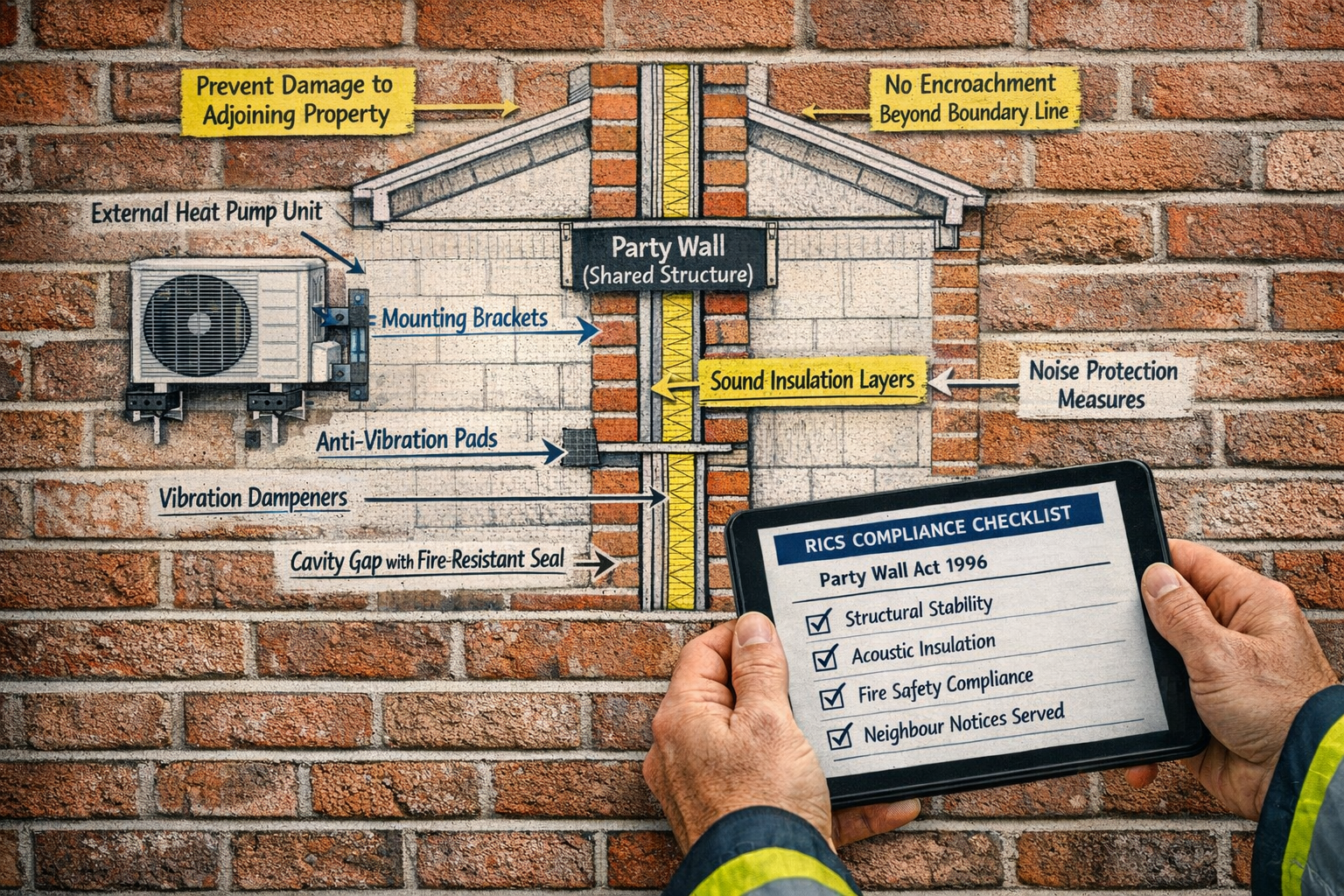
Direct Wall Penetration: When fixing mounting brackets or drilling into a party wall to secure the outdoor unit, this constitutes "notifiable work" under Section 2 of the Act. Even minor fixings require proper notices.
Proximity to Boundaries: Installing units within three or six meters of a party structure (depending on foundation depth) may trigger Section 6 requirements, particularly if excavation is needed for ground source systems or substantial bases.
Vibration and Structural Impact: Air source heat pumps generate vibration during operation. While RICS guidance on domestic heat pumps addresses installation considerations[1], party wall surveyors must assess potential structural transmission through shared walls.
Sound Transmission Concerns: Noise from compressor units can travel through party walls, creating potential nuisance issues that party wall awards should address proactively.
The Legal Framework in 2026
The Party Wall etc. Act 1996 remains the primary legislation governing shared boundary work in England and Wales. Understanding this framework is essential for party wall agreement compliance.
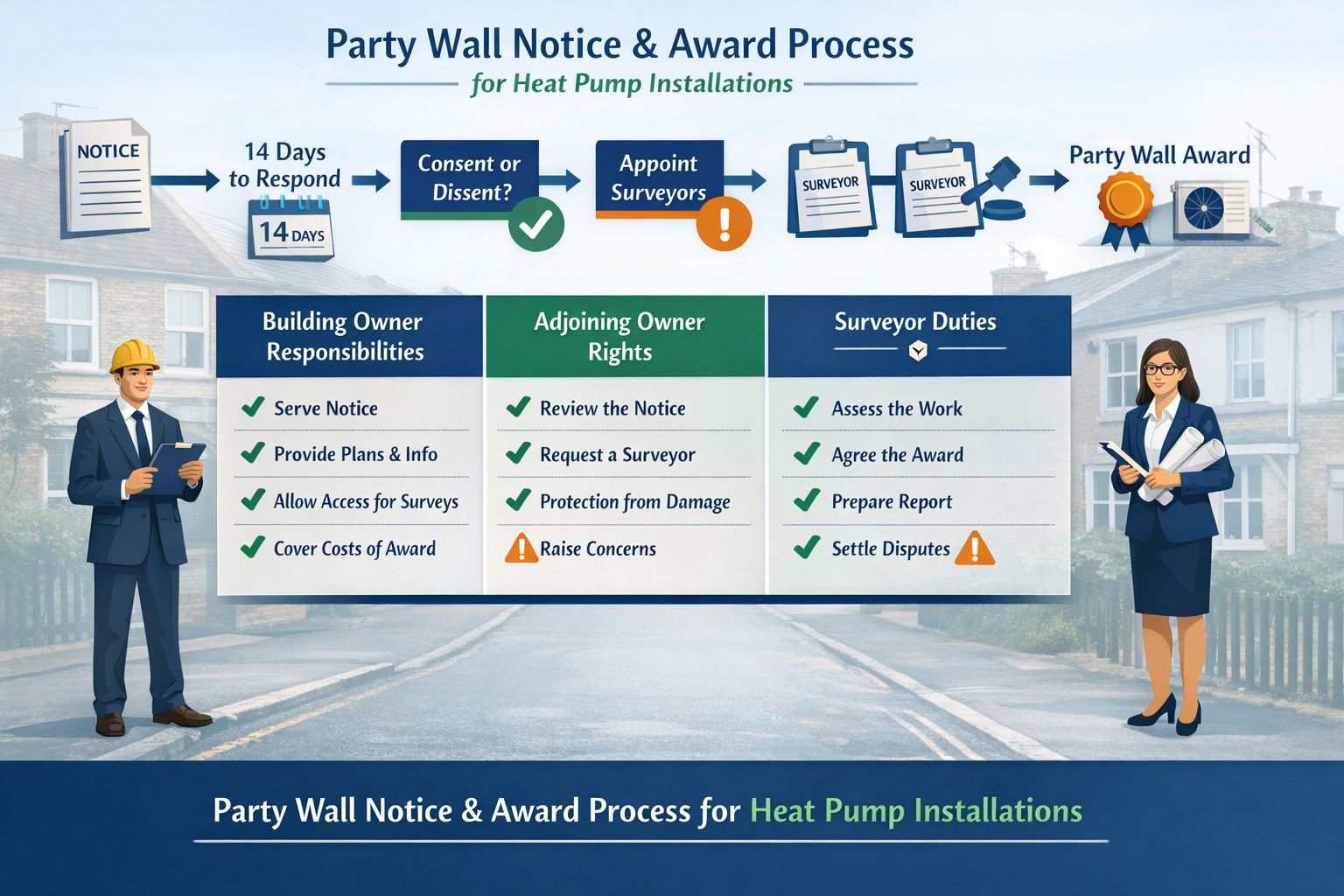
Building Owner Responsibilities include:
- Serving proper notice at least two months before work begins
- Appointing a qualified party wall surveyor
- Bearing all reasonable costs of the party wall procedure
- Ensuring work complies with the agreed award conditions
Adjoining Owner Rights include:
- Receiving proper notice with sufficient technical detail
- Appointing their own surveyor or agreeing to a single "Agreed Surveyor"
- Having their property protected through schedules of condition
- Receiving compensation for any damage caused
The 2026 net zero mandates have not changed these fundamental obligations, but they've increased the volume of cases requiring expert navigation. Understanding how the Party Wall Act 1996 applies to heat pump projects is crucial for compliance.
RICS Compliance Strategies for Heat Pump Party Wall Surveys
The Royal Institution of Chartered Surveyors (RICS) provides professional standards that govern party wall surveying practice. While specific 2026 protocols for heat pump installations are still emerging, established RICS principles apply directly to these retrofit projects.
Pre-Installation Survey Requirements
Before any heat pump installation begins, comprehensive surveys must document existing conditions. This protects all parties and establishes baseline evidence.
Schedule of Condition Documentation forms the cornerstone of party wall protection. A detailed schedule of condition should include:
| Documentation Element | Purpose | Best Practice |
|---|---|---|
| Photographic Evidence | Visual record of pre-existing condition | High-resolution images with date stamps, multiple angles |
| Crack Mapping | Document existing structural movement | Measured widths, locations marked on floor plans |
| Decorative Condition | Record interior finishes | Room-by-room assessment of walls, ceilings, floors |
| External Wall Assessment | Baseline for vibration impact | Mortar condition, brick integrity, existing defects |
Professional surveyors should conduct these surveys jointly or exchange detailed reports to ensure agreement on pre-existing conditions.
Technical Assessment Protocols
RICS-compliant party wall surveys for heat pump installations require specific technical assessments beyond standard party wall work.
Structural Load Analysis: Mounting brackets for outdoor units can impose significant loads on party walls. Surveyors must assess:
- Wall construction type and load-bearing capacity
- Appropriate fixing methods for the specific masonry
- Distribution of weight across the wall structure
- Potential for long-term degradation from cyclical loading
Vibration Impact Assessment: Heat pumps generate operational vibration that can transmit through shared structures. Assessment should include:
- Baseline vibration measurements before installation
- Specification of vibration dampening requirements
- Acceptable operational limits in the party wall award
- Monitoring protocols for post-installation verification
Acoustic Considerations: Sound transmission through party walls presents a common dispute risk. RICS guidance on domestic air source heat pumps emphasizes proper installation practices[4], and party wall awards should specify:
- Maximum permissible noise levels at the party wall
- Required sound insulation measures
- Operating hour restrictions if necessary
- Remediation procedures if noise complaints arise
The Party Wall Award Process
The party wall award is the legal document that governs the work. For heat pump installations, awards should contain specific provisions:
Technical Specifications:
- Exact location and dimensions of the heat pump unit
- Mounting method and fixing details
- Vibration dampening specifications
- Sound insulation requirements
Working Methods:
- Access arrangements for installation
- Protection measures for adjoining property
- Working hours and duration
- Dust and noise control procedures
Monitoring and Remediation:
- Post-installation inspection schedule
- Procedures for addressing damage claims
- Dispute resolution mechanisms
- Maintenance access provisions
Professional party wall surveyors ensure these awards balance the building owner's right to install necessary heat pumps with the adjoining owner's right to protection from damage and nuisance.
Navigating 2026 Net Zero Mandates and Party Wall Compliance
The UK government's commitment to net zero has created unprecedented demand for heat pump installations. The Warm Homes Plan includes significant funding for heat pump manufacturing and installation[2], but this acceleration brings party wall compliance challenges.
Government Policy Impact on Retrofit Projects
EPC Upgrade Requirements: Many landlords and homeowners face pressure to improve EPC ratings, with heat pumps offering an effective solution. However, rushing installations without proper party wall notice procedures creates legal and practical risks.
Funding Timeline Pressures: Government grant schemes often have strict completion deadlines. Building owners must factor in the minimum two-month party wall notice period when planning installations. Failure to do so can jeopardize funding or create disputes.
Increased Installation Volume: The goal of 70% local UK production by 2035[5] signals massive scaling of heat pump installations. This volume increase makes standardized party wall procedures essential for efficient project delivery.
Common Compliance Pitfalls and Solutions
Understanding frequent mistakes helps property owners and installers avoid costly errors.
❌ Pitfall 1: Assuming Heat Pumps Don't Trigger Party Wall Requirements
Many property owners believe external equipment doesn't require party wall procedures. This misconception leads to:
- Invalid installations that adjoining owners can legally challenge
- Retrospective party wall procedures that delay projects
- Potential removal orders if disputes escalate
✅ Solution: Always consult a qualified party wall surveyor before planning heat pump installations on properties with shared boundaries. Early assessment prevents problems.
❌ Pitfall 2: Inadequate Notice Details
Generic party wall notices that don't specify heat pump technical details often get rejected, requiring re-service and additional delays.
✅ Solution: Notices should include:
- Detailed specifications of the heat pump model
- Exact mounting location with measurements
- Technical drawings showing fixing methods
- Installation timeline and working methods
❌ Pitfall 3: Ignoring Vibration and Noise Issues
Failing to address operational impacts in party wall awards leads to post-installation disputes that can require expensive remediation.
✅ Solution: Party wall awards should specify:
- Pre-agreed noise level limits
- Vibration dampening requirements
- Monitoring procedures
- Clear remediation obligations if problems arise
❌ Pitfall 4: DIY Party Wall Procedures
Property owners attempting to handle party wall matters without professional guidance frequently make procedural errors that invalidate the process.
✅ Solution: Engage qualified RICS party wall surveyors who understand both the Party Wall Act and heat pump installation requirements. Professional fees are modest compared to dispute costs.
Best Practice Checklist for Building Owners
Property owners planning heat pump installations should follow this compliance checklist:
Phase 1: Pre-Planning (3-4 months before installation)
- ✅ Engage qualified party wall surveyor
- ✅ Conduct preliminary site assessment
- ✅ Identify all adjoining owners
- ✅ Review property deeds for additional restrictions
- ✅ Confirm heat pump specifications with installer
Phase 2: Notice Period (2-3 months before installation)
- ✅ Serve comprehensive party wall notices
- ✅ Provide technical drawings and specifications
- ✅ Allow 14-day response period for adjoining owners
- ✅ Appoint surveyors if dissent received
- ✅ Conduct pre-installation condition surveys
Phase 3: Award Preparation (1-2 months before installation)
- ✅ Agree detailed schedule of condition
- ✅ Specify technical installation requirements
- ✅ Define monitoring and remediation procedures
- ✅ Finalize party wall award
- ✅ Ensure all parties receive signed copies
Phase 4: Installation and Post-Completion
- ✅ Provide adjoining owners with installation schedule
- ✅ Implement protection measures specified in award
- ✅ Conduct post-installation condition survey
- ✅ Address any damage claims promptly
- ✅ Maintain records for future reference
This systematic approach ensures compliance while maintaining positive neighbor relations—essential for the long-term success of heat pump installations.
Dispute Avoidance and Resolution Strategies
Even with careful planning, party wall disputes can arise during heat pump installations. Professional surveyors employ proven strategies to prevent and resolve conflicts.
Proactive Communication Approaches
Early Neighbor Engagement: The most effective dispute prevention begins before formal notices. Building owners should:
- Discuss plans informally with neighbors
- Explain the benefits of heat pump installations
- Address concerns about noise and visual impact
- Demonstrate commitment to protecting their property
This goodwill often prevents formal dissent and creates cooperative relationships that benefit both parties.
Transparent Information Sharing: Providing neighbors with comprehensive information reduces anxiety and objections. Share:
- Technical specifications showing noise levels
- Installation timelines and working methods
- Contact information for the project team
- Examples of successful similar installations
Professional Mediation: When concerns arise, experienced party wall surveyors act as neutral mediators, finding solutions that satisfy both building and adjoining owners.
Technical Solutions for Common Concerns
Noise Mitigation: Modern heat pumps operate quietly, but perception matters. Solutions include:
- Acoustic enclosures or screening
- Strategic positioning away from bedroom windows
- High-quality vibration dampening mounts
- Timer controls limiting night operation
Visual Impact: Adjoining owners sometimes object to the appearance of heat pump units. Address this through:
- Sympathetic positioning considering sight lines
- Color matching to building materials
- Screening with appropriate landscaping
- Compact unit selection for minimal visual intrusion
Structural Protection: Demonstrate commitment to protecting the adjoining property through:
- Professional installation by certified engineers
- High-quality fixings appropriate to wall construction
- Regular monitoring during and after installation
- Insurance-backed guarantees for peace of mind
When Disputes Require Formal Resolution
Despite best efforts, some disputes require formal procedures under the Party Wall Act.
The Third Surveyor Mechanism: When building owner and adjoining owner surveyors cannot agree, they appoint a third surveyor whose decision is binding. This provides:
- Expert independent judgment
- Faster resolution than court proceedings
- Cost-effective dispute settlement
- Preservation of neighbor relationships
Appeal Rights: Either party can appeal party wall awards to the County Court within 14 days. However, courts generally uphold awards made by qualified surveyors following proper procedures.
Enforcement Options: If building owners proceed without proper party wall procedures, adjoining owners can:
- Seek injunctions to stop work
- Claim damages for any harm caused
- Require retrospective party wall procedures
- Recover legal costs from the building owner
These consequences make proper compliance far more cost-effective than shortcuts.
Integration with Broader Property Survey Requirements
Heat pump party wall surveys don't exist in isolation. They integrate with broader property assessment and compliance requirements.
Relationship to Other Survey Types
Property owners often need multiple survey types when planning heat pump installations:
Building Surveys: A comprehensive building survey assesses the overall structural condition and may identify party wall issues requiring attention before heat pump installation.
Homebuyer Surveys: For properties being purchased, a RICS Homebuyer Survey can flag potential party wall complications that affect heat pump feasibility.
Condition Surveys: Detailed condition assessments document property status before major work, complementing party wall schedules of condition.
Understanding how these surveys interconnect ensures comprehensive property protection and compliance.
Coordinating with Building Control and Planning
Heat pump installations may require:
Building Regulations Approval: While many heat pump installations fall under permitted development, building control notification ensures compliance with structural, electrical, and safety standards.
Planning Permission: In conservation areas or listed buildings, planning permission may be required alongside party wall procedures.
MCS Certification: Microgeneration Certification Scheme compliance is essential for government incentives and ensures quality installations that minimize party wall risks.
Coordinating these requirements with party wall procedures creates efficient project delivery without regulatory conflicts.
Future Outlook: Party Wall Practice in the Net Zero Era
As the UK accelerates toward net zero targets, party wall surveying practice continues to evolve.
Emerging Trends and Considerations
Standardization of Heat Pump Protocols: Industry bodies are developing standardized party wall procedures specifically for heat pump installations, streamlining the process while maintaining protection.
Technology Integration: Digital tools for condition surveys, including 3D scanning and drone photography, enhance documentation quality and reduce disputes.
Increased Professional Specialization: As heat pump installations proliferate, party wall surveyors are developing specialized expertise in renewable energy retrofit projects.
Regulatory Evolution: While the Party Wall Act 1996 remains unchanged, interpretation and best practices adapt to new building technologies and net zero imperatives.
Preparing for Increased Demand
The heat pump installation surge requires:
Professional Capacity Building: More RICS-qualified surveyors with heat pump expertise to meet demand.
Installer Training: Retrofit installers need party wall awareness to advise clients properly and avoid project delays.
Public Education: Property owners require better understanding of party wall obligations to plan installations realistically.
Streamlined Procedures: Industry development of efficient processes that maintain protection while reducing administrative burden.
These developments will shape party wall practice throughout the 2026-2030 period as net zero mandates drive unprecedented retrofit activity.
Conclusion
Party Wall Surveys for UK Heat Pump Installations: RICS Compliance Strategies Amid 2026 Net Zero Mandates represent a critical intersection of environmental policy, property law, and professional surveying practice. As government initiatives accelerate heat pump adoption to meet EPC requirements and net zero targets, understanding party wall obligations becomes essential for property owners, retrofit installers, and professional surveyors.
The key to successful heat pump installations on properties with shared boundaries lies in early planning, comprehensive surveys, and professional guidance. By following RICS compliance strategies—including detailed schedules of condition, technical impact assessments, and properly drafted party wall awards—building owners protect themselves legally while maintaining positive neighbor relations.
Actionable Next Steps
For property owners planning heat pump installations:
- Engage a qualified party wall surveyor at least three months before your planned installation date to assess requirements and timeline
- Discuss your plans informally with neighbors before serving formal notices to build goodwill and address concerns early
- Ensure your heat pump installer understands party wall requirements and can provide necessary technical specifications for notices
- Budget for party wall costs including surveyor fees, condition surveys, and any required mitigation measures
- Maintain comprehensive documentation throughout the process to protect against future disputes
For retrofit installers and contractors:
- Develop party wall awareness as part of your standard heat pump installation process
- Partner with qualified party wall surveyors to provide clients with seamless service
- Build party wall timelines into your project planning to avoid delays and customer dissatisfaction
- Specify appropriate vibration dampening and acoustic measures as standard to minimize dispute risks
The convergence of net zero mandates and party wall law creates challenges, but with proper professional guidance and systematic compliance approaches, heat pump installations can proceed smoothly while protecting all parties' interests. As we move further into 2026 and beyond, party wall expertise will become increasingly valuable in delivering the UK's renewable energy transformation.
For expert assistance with party wall surveys for your heat pump installation project, consult with RICS-qualified professionals who understand both the technical requirements of modern heat pumps and the legal framework protecting shared boundaries.
References
[1] Domestic Air Source Heat Pumps – https://www.rics.org/consumer-guides/domestic-air-source-heat-pumps
[2] How The Warm Homes Plan Will Affect Retrofit Installers In 2026 – https://www.hiesscheme.org.uk/2026/03/05/how-the-warm-homes-plan-will-affect-retrofit-installers-in-2026/
[3] Party Wall Surveys For Life Sciences Lab Conversions Rics Protocols In 2026 Infrastructure Boom – https://nottinghillsurveyors.com/blog/party-wall-surveys-for-life-sciences-lab-conversions-rics-protocols-in-2026-infrastructure-boom
[4] Domestic Air Source Heat Pumps – https://www.rics.org/consumer-guides/domestic-air-source-heat-pumps
[5] How The Warm Homes Plan Will Affect Retrofit Installers In 2026 – https://www.hiesscheme.org.uk/2026/03/05/how-the-warm-homes-plan-will-affect-retrofit-installers-in-2026/