

Northern England is experiencing an unprecedented housing boom in 2026, with property prices surging at rates that dwarf the stagnating southern markets. As construction cranes dot the skylines of Manchester, Leeds, Liverpool, and Newcastle, party wall surveyors face surging demand from developers and homeowners navigating the complexities of shared boundaries. Understanding Party Wall Surveys for Northern England Housing Boom: Minimising Disputes in High-Growth Regions 2026 has become essential for anyone involved in property development, renovation, or purchase in these affordable hotspots.
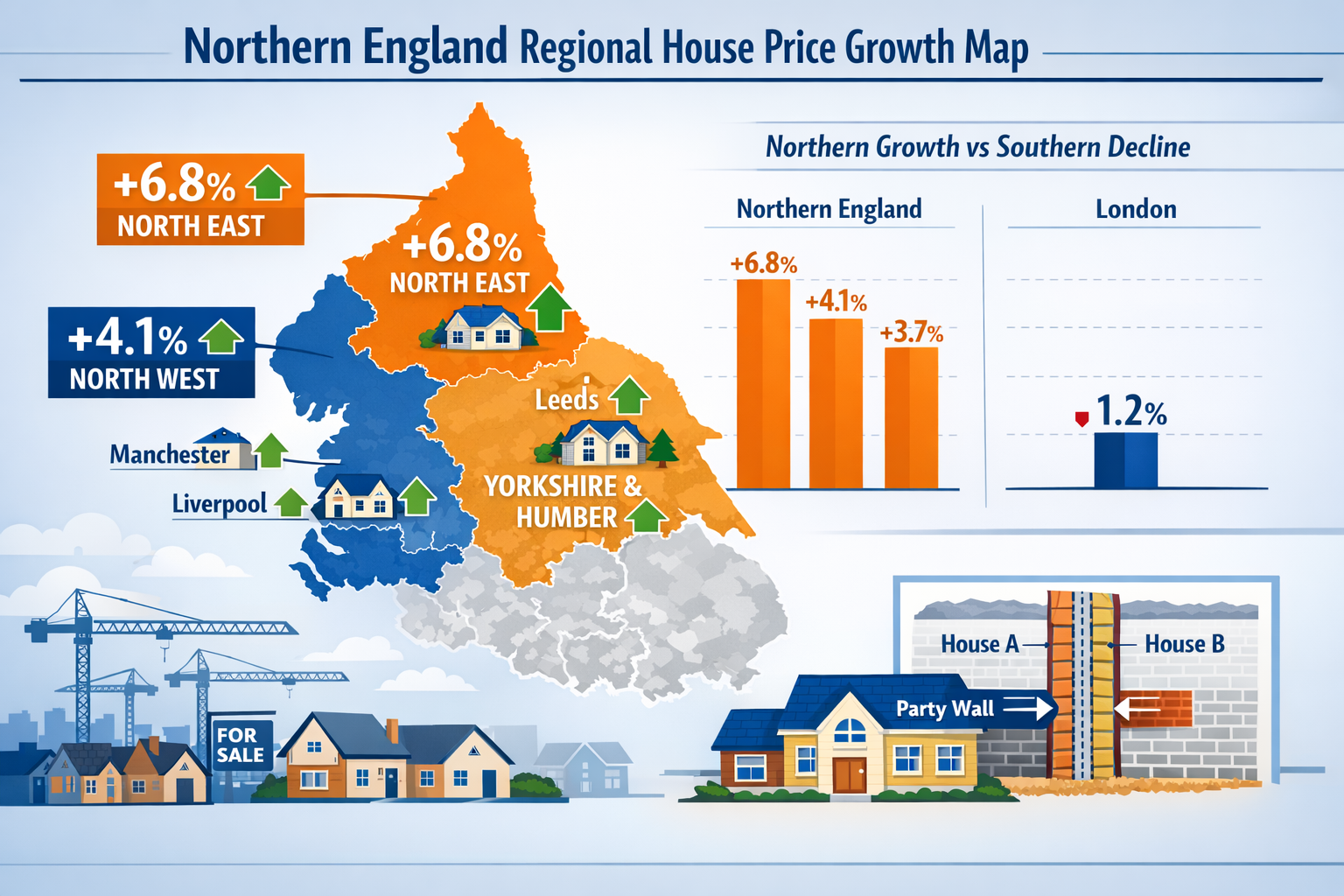
The North East England leads the charge with an impressive +6.8% annual house price growth, while the North West follows closely at +4.1%[1]. This dramatic growth, combined with increased construction activity in urban centres, creates a perfect storm for potential party wall disputes. Property owners undertaking extensions, loft conversions, and basement excavations must navigate the Party Wall etc. Act 1996 to avoid costly legal battles and project delays.
This comprehensive guide provides checklists, case studies, and expert strategies for ensuring compliant party wall surveys amid Northern England's rapid development. Whether you're a homeowner planning renovations, a developer managing multiple projects, or a property professional advising clients, understanding the intricacies of party wall procedures in these high-growth regions is crucial for success in 2026.
Key Takeaways
✅ Northern England's housing boom is driving unprecedented demand for party wall surveys, with the North East (+6.8%) and North West (+4.1%) significantly outpacing southern regions[1]
✅ Proper party wall procedures can prevent disputes costing thousands in legal fees and project delays, particularly critical in densely-packed terraced housing common across Northern England
✅ Early surveyor appointment and comprehensive schedules of condition are essential in high-growth markets where construction activity is concentrated
✅ Understanding regional variations in property types and construction methods helps surveyors deliver more accurate assessments and minimize neighbour conflicts
✅ 2026 forecasts predict continued northern growth, making party wall compliance an ongoing priority for developers and homeowners in these regions[3]
Understanding the Northern England Housing Boom in 2026
Regional Growth Patterns Reshaping the Property Market
The stark north-south divide in UK property markets has never been more pronounced than in 2026. While London experiences a -1.2% annual decline and the South East manages only +1.0% growth, Northern England regions are witnessing remarkable appreciation[1]. This shift represents a fundamental restructuring of the UK housing market, driven by improved affordability, remote work flexibility, and significant infrastructure investment.
Yorkshire & Humber contributes to this northern surge with +3.7% annual growth, creating a corridor of opportunity stretching from the North East coast through to the North West's major urban centres[1]. The average property price in the North West stands at £216,741, offering exceptional value compared to London's inflated market[1].
Several factors drive this unprecedented growth:
- 🏗️ Levelling Up initiatives directing government investment toward northern infrastructure
- 💼 Corporate relocations to Manchester, Leeds, and other northern hubs
- 🏠 Affordability advantages attracting first-time buyers and young families
- 📈 Wage growth outpacing house prices at the strongest level since late 2015[3]
- 🏦 Falling interest rates with Bank of England cuts anticipated throughout 2026[1][3]
Construction Activity Surge in Urban Centres
Construction activity is surging across urban centres in the Northern Powerhouse regions, with Manchester and Birmingham highlighted as particular hotspots[2][4]. This building boom encompasses both new-build developments and extensive renovation projects on existing Victorian and Edwardian terraced housing stock.
The estate agent inventory has reached a 10-year high, creating a price-sensitive market where developers and homeowners are eager to maximize property values through extensions and improvements[1]. This creates ideal conditions for party wall work, as property owners seek to add value through:
- Loft conversions in terraced properties
- Rear and side extensions maximizing footprint
- Basement excavations creating additional living space
- Structural alterations modernizing heritage properties
Understanding building walls on property lines becomes critical in these densely-populated urban areas where properties share boundaries.
Why Party Wall Surveys Matter More Than Ever
In high-growth regions experiencing rapid development, party wall disputes can derail projects and cost thousands in legal fees. The concentration of terraced housing across Northern England—a legacy of industrial-era urban planning—means that most construction work involves shared walls, foundations, or boundaries.
The Party Wall etc. Act 1996 provides a legal framework for managing building work that affects party walls, party structures, and excavations near neighbouring properties. However, many homeowners and even some developers remain unaware of their obligations under the Act, leading to:
- ⚠️ Project delays from retrospective compliance requirements
- 💰 Increased costs from rushed surveyor appointments
- ⚖️ Legal disputes with neighbours over damage claims
- 📋 Insurance complications when work proceeds without proper notices
Professional party wall surveys provide protection for all parties by documenting pre-existing conditions, ensuring compliance with building regulations, and establishing clear procedures for resolving disagreements. For more information on the legal framework, explore resources on the Party Wall Act.
Party Wall Surveys for Northern England Housing Boom: Regional Considerations
Unique Characteristics of Northern England Properties
Northern England's housing stock presents distinct challenges for party wall surveyors that differ significantly from southern markets. Understanding these regional variations is essential for Party Wall Surveys for Northern England Housing Boom: Minimising Disputes in High-Growth Regions 2026.
Victorian and Edwardian terraced housing dominates many Northern England neighbourhoods, particularly in cities like Manchester, Liverpool, Leeds, and Newcastle. These properties typically feature:
- Solid brick party walls (9-inch or 13.5-inch thickness)
- Shared chimney breasts often removed in one property but not the other
- Cellar spaces with potential for excavation and conversion
- Stone foundations requiring careful assessment before underpinning
- Traditional lime mortar construction susceptible to movement
The age and construction methods of these properties mean that party wall surveyors must possess expertise in heritage building techniques. Modern assessment approaches must be adapted to account for settlement patterns, historic alterations, and the interaction between traditional materials and contemporary building methods.
Back-to-back housing, while less common today, still exists in certain Northern England areas, presenting unique party wall challenges where properties share not just side walls but also rear walls. These configurations require particularly careful survey work and comprehensive schedules of condition.
Common Party Wall Works in High-Growth Areas
The types of building work triggering party wall procedures in Northern England reflect both the regional housing stock and current market trends. Understanding these common scenarios helps surveyors prepare appropriate documentation and anticipate potential issues.
Most Frequent Party Wall Works:
| Work Type | Frequency | Key Considerations |
|---|---|---|
| Loft Conversions | Very High | Roof alterations, party wall height changes, structural loading |
| Rear Extensions | Very High | Foundation excavations, party wall exposure, drainage |
| Basement Conversions | High | Underpinning, excavation within 3-6 meters, structural stability |
| Chimney Breast Removal | Medium | Shared structures, load redistribution, neighbour impact |
| Side Return Extensions | Medium | Boundary walls, foundation depths, access issues |
Loft conversions represent the most common party wall work in Northern England terraced properties, as homeowners seek to maximize space without the costs associated with moving. These projects typically involve:
- Raising party walls to comply with fire regulations
- Installing steel beams that may bear on party walls
- Creating dormer windows affecting shared roof structures
- Addressing party wall insulation and soundproofing
Basement excavations are increasingly popular in high-value urban areas where land prices justify the investment. These complex projects require careful management of:
- Excavation within 3 meters (deeper than neighbouring foundations)
- Excavation within 6 meters (cutting a line at 45 degrees from neighbour's foundation)
- Temporary support systems during construction
- Groundwater management and drainage
For comprehensive property assessments that may identify party wall considerations, consider reviewing information about RICS building surveys.
Navigating Regional Building Practices and Regulations
Northern England's local planning authorities often have specific requirements that interact with party wall procedures. Surveyors must understand how planning permission, building regulations, and party wall compliance intersect to provide comprehensive advice.
Conservation areas are prevalent in Northern England cities, protecting Victorian and Edwardian streetscapes. Work in these areas may require:
- Additional planning permissions beyond party wall notices
- Heritage impact assessments
- Specific materials and construction methods
- Enhanced documentation of existing conditions
Building control departments in northern authorities may have established relationships with party wall surveyors and expectations about documentation standards. Surveyors operating across multiple local authorities must adapt their practices to meet varying regional requirements.
The competitive market conditions in Northern England mean that project timelines are often tight, with developers and homeowners eager to capitalize on rising property values. Party wall surveyors must balance thoroughness with efficiency, ensuring compliance without unnecessary delays.
Understanding boundary wall rules becomes particularly important in Northern England, where dense urban development creates complex boundary situations.
Essential Party Wall Survey Procedures for Minimising Disputes
The Complete Party Wall Survey Process
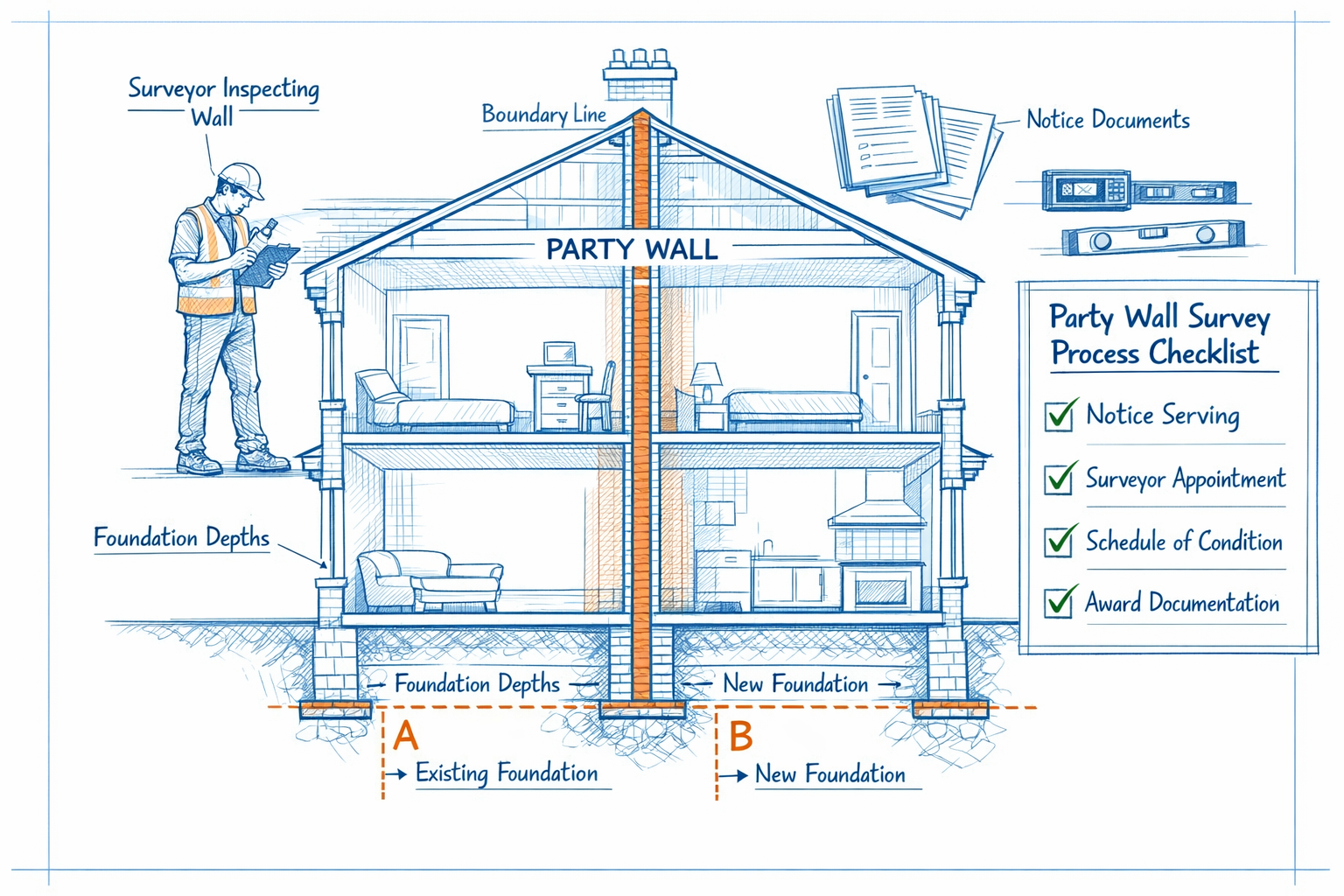
Implementing comprehensive party wall procedures from project inception minimizes disputes and ensures smooth construction progress. This systematic approach protects building owners, adjoining owners, and contractors throughout the development process.
Step 1: Initial Assessment and Planning 🔍
Before serving any notices, building owners should:
- Conduct a preliminary assessment of proposed works
- Identify all adjoining owners who may be affected
- Determine which sections of the Party Wall Act apply
- Establish realistic project timelines accounting for notice periods
- Budget for party wall surveyor fees and potential awards
Step 2: Serving Party Wall Notices 📬
The Party Wall Act requires specific notices depending on work type:
- Party Structure Notice: For work directly to a party wall (minimum 2 months' notice)
- Line of Junction Notice: For new walls on boundaries (minimum 1 month's notice)
- Notice of Adjacent Excavation: For excavations near neighbours (minimum 1 month's notice)
Notices must include:
- Detailed descriptions of proposed works
- Plans and sections showing party wall involvement
- Proposed start date
- Building owner's contact information
Step 3: Surveyor Appointment 👷
Following notice service, three scenarios may occur:
- Consent: Adjoining owner agrees to works (rare but ideal)
- Dissent or No Response: Party wall surveyors must be appointed
- Dispute: Formal surveyor selection process begins
Building owners and adjoining owners may:
- Appoint the same surveyor (Agreed Surveyor) – most cost-effective
- Each appoint their own surveyor – more formal but provides independent representation
- Allow the building owner's surveyor to act if no response received
Understanding party wall agreement costs helps property owners budget appropriately for professional services.
Step 4: Schedule of Condition 📸
The schedule of condition represents the most critical dispute prevention tool. This comprehensive document records:
- Detailed photographic evidence of adjoining property
- Descriptions of existing defects, cracks, and damage
- Measurements and technical assessments
- Video documentation for complex properties
- Dated and witnessed evidence
A thorough schedule of condition protects both parties by establishing a baseline for assessing any construction-related damage. In Northern England's older housing stock, pre-existing settlement, historic alterations, and aging materials make comprehensive documentation essential.
Step 5: Party Wall Award 📋
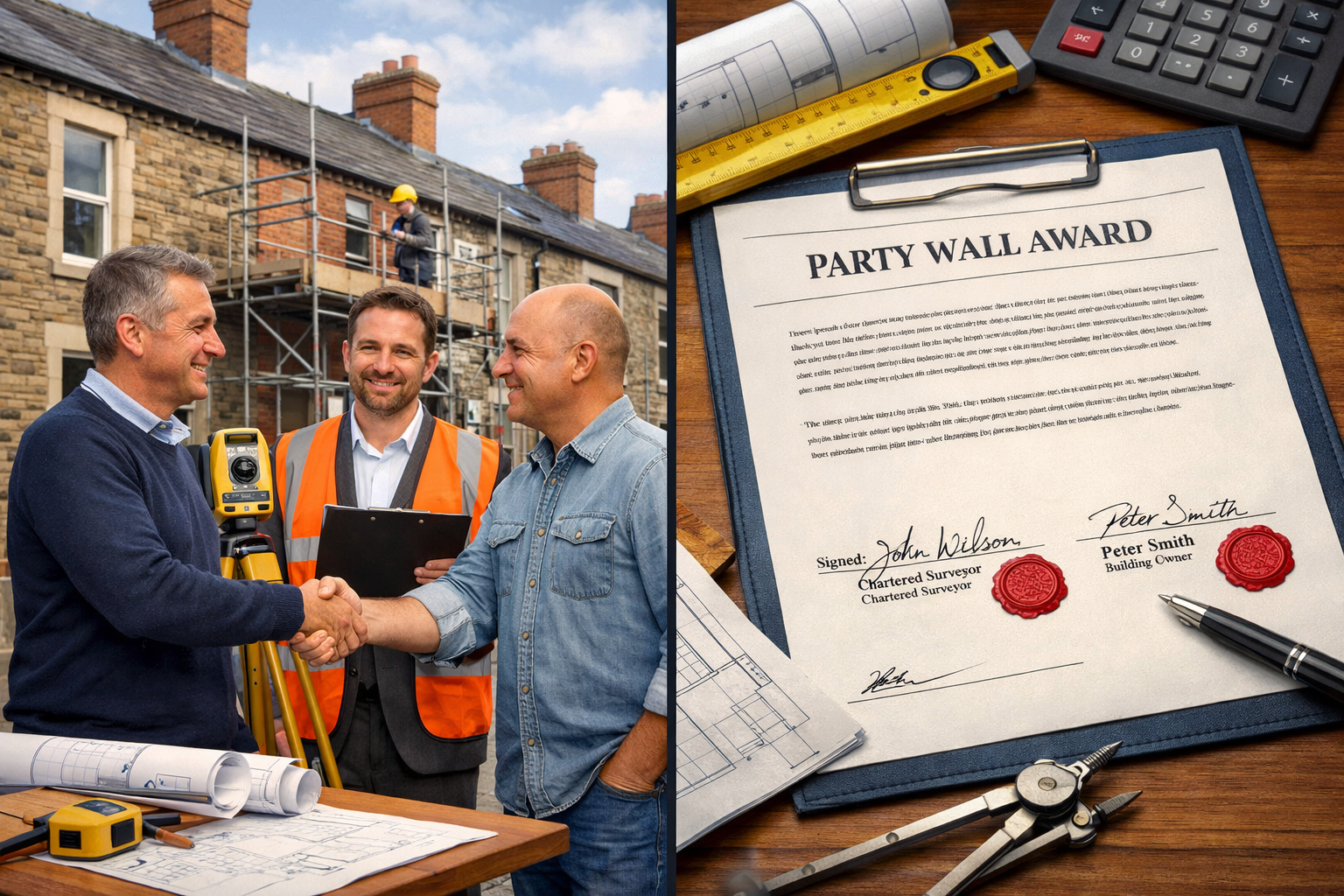
Surveyors prepare a Party Wall Award documenting:
- Detailed description of proposed works
- Rights and responsibilities of both parties
- Access arrangements for construction
- Working hours and noise limitations
- Damage resolution procedures
- Cost allocation for surveyor fees
The Award becomes a legally binding document once served on both parties, providing a clear framework for managing the construction process.
Step 6: Construction Monitoring 🏗️
During construction, party wall surveyors may:
- Conduct site inspections at key stages
- Monitor compliance with Award conditions
- Address concerns raised by adjoining owners
- Document any incidents or variations
- Facilitate communication between parties
For complex projects, monitoring surveys provide ongoing assessment of structural movement and construction impact.
Step 7: Post-Construction Assessment ✅
Following work completion:
- Final inspection comparing current condition to schedule
- Assessment of any construction-related damage
- Negotiation of remedial works or compensation
- Closure documentation releasing parties from obligations
- Archive of all documentation for future reference
Critical Checklist for Compliant Party Wall Surveys
Pre-Notice Checklist:
✅ Identify all adjoining owners (including leaseholders and freeholders)
✅ Determine applicable notice types for proposed works
✅ Prepare detailed plans and specifications
✅ Calculate appropriate notice periods (2 months for party structures, 1 month for excavations)
✅ Budget for surveyor fees and potential delays
✅ Review party wall surveyor costs to understand pricing structures
Notice Service Checklist:
✅ Complete all required information on notice forms
✅ Include comprehensive plans and sections
✅ Serve notices to all identified adjoining owners
✅ Maintain proof of service (recorded delivery recommended)
✅ Document service dates for timeline tracking
✅ Prepare for potential questions or concerns from neighbours
Surveyor Selection Checklist:
✅ Verify surveyor qualifications and experience
✅ Confirm knowledge of Northern England property types
✅ Check professional indemnity insurance coverage
✅ Review previous party wall award examples
✅ Establish fee structures and payment terms
✅ Confirm availability to meet project timelines
Schedule of Condition Checklist:
✅ Photograph all rooms in adjoining property
✅ Document external elevations and boundaries
✅ Record pre-existing cracks, settlement, and defects
✅ Measure and describe significant features
✅ Video record complex or detailed areas
✅ Date and witness all documentation
✅ Provide copies to all parties
Award Preparation Checklist:
✅ Describe works in precise technical detail
✅ Specify access requirements and limitations
✅ Define working hours and noise restrictions
✅ Establish damage assessment procedures
✅ Allocate surveyor fee responsibilities
✅ Include dispute resolution mechanisms
✅ Serve Award on all parties with explanation
Construction Phase Checklist:
✅ Notify neighbours of construction start date
✅ Conduct pre-commencement site inspection
✅ Monitor key construction stages
✅ Address neighbour concerns promptly
✅ Document any variations or incidents
✅ Maintain communication between all parties
✅ Conduct interim inspections as required
Post-Construction Checklist:
✅ Compare final condition to original schedule
✅ Identify any construction-related damage
✅ Photograph completed works and boundaries
✅ Negotiate remedial works if necessary
✅ Prepare closure documentation
✅ Archive all records for future reference
✅ Obtain final sign-off from all parties
Common Pitfalls and How to Avoid Them
Failure to Serve Proper Notice ⚠️
The most common mistake is proceeding with work without serving notices or serving incomplete notices. This can result in:
- Injunctions halting construction
- Retrospective compliance costs
- Damaged neighbour relationships
- Legal liability for any damage
Solution: Engage a party wall surveyor during project planning, before any notices are required. Professional guidance ensures proper identification of affected parties and comprehensive notice preparation.
Inadequate Schedule of Condition 📸
Rushed or incomplete schedules of condition create disputes when construction damage is alleged. In Northern England's older properties, distinguishing new damage from pre-existing defects becomes critical.
Solution: Allocate sufficient time and resources for comprehensive documentation. Professional photographers and detailed written descriptions provide robust evidence. Video walkthroughs add additional protection for complex properties.
Poor Communication with Neighbours 🗣️
Many disputes arise from communication breakdowns rather than actual construction issues. Neighbours who feel ignored or disrespected are more likely to raise objections and complaints.
Solution: Maintain proactive communication throughout the process. Explain procedures clearly, address concerns promptly, and provide regular updates on construction progress. Personal meetings before serving notices can build goodwill and understanding.
Underestimating Project Timelines ⏰
Party wall procedures add minimum notice periods to project timelines. Failure to account for these can delay construction starts and increase costs.
Solution: Incorporate party wall timelines into project planning from the outset. Allow 3-4 months from initial assessment to construction commencement for complex projects involving multiple neighbours.
Inadequate Surveyor Expertise 🎓
Not all surveyors possess specialist party wall knowledge or experience with Northern England's unique property types. Generalist surveyors may miss critical issues or provide incomplete advice.
Solution: Select surveyors with demonstrated party wall expertise and regional experience. Verify qualifications, review previous awards, and confirm understanding of Victorian/Edwardian construction methods. For broader property assessments, consider RICS homebuyer surveys alongside party wall work.
Case Studies: Party Wall Surveys for Northern England Housing Boom Success Stories
Case Study 1: Manchester Terraced House Loft Conversion
Background:
A homeowner in Manchester's Chorlton neighbourhood planned a loft conversion on a mid-terrace Victorian property. The project required raising the party walls by 1.2 meters to achieve required head height and installing steel beams bearing on both party walls.
Challenges:
- Three adjoining owners (both sides and rear access)
- One neighbour initially opposed to works
- Tight construction timeline to capitalize on market growth
- Pre-existing settlement cracks in neighbouring properties
- Complex roof structure with shared valleys
Party Wall Survey Approach:
The building owner appointed an experienced party wall surveyor early in the planning process, three months before the intended construction start. The surveyor:
- Conducted preliminary assessments of all three adjoining properties
- Prepared comprehensive notices with detailed plans
- Facilitated a meeting between the building owner and concerned neighbour
- Acted as Agreed Surveyor for two consenting neighbours
- Worked with the third neighbour's appointed surveyor
Schedule of Condition:
Extensive photographic documentation revealed pre-existing cracks in the concerned neighbour's property, including:
- Historic settlement in rear extension
- Ceiling cracks from roof movement
- External brick cracking from ground movement
This documentation proved critical when the neighbour later alleged construction damage.
Outcome:
✅ Party Wall Award prepared within 6 weeks of notice service
✅ Construction proceeded on schedule
✅ Post-construction inspection confirmed no new damage
✅ Pre-existing cracks documented in schedule protected building owner from false claims
✅ Professional surveyor involvement prevented potential £15,000+ legal dispute
Key Lesson:
"Early surveyor appointment and comprehensive schedules of condition are essential in Northern England's older housing stock, where pre-existing defects are common. The investment in professional party wall surveys prevented what could have been a costly legal battle."
Case Study 2: Leeds Multi-Property Development
Background:
A developer acquired a block of five terraced properties in Leeds' Hyde Park area for conversion into high-specification apartments. The project involved:
- Rear extensions on all five properties
- Basement excavations under three properties
- Structural alterations to create open-plan layouts
- New party wall openings for fire escapes
Challenges:
- Multiple adjoining owners on both sides (10+ parties)
- Mixed ownership (owner-occupiers and landlords)
- Excavations within 3 meters of neighbouring foundations
- Phased construction over 18 months
- High-value properties requiring careful damage prevention
Party Wall Survey Approach:
The developer engaged a specialist party wall surveying firm with experience in multi-property developments. The approach included:
- Comprehensive site assessment identifying all affected parties
- Coordinated notice service to all 10+ adjoining owners
- Appointment of single Agreed Surveyor where possible
- Detailed excavation assessments for basement works
- Phased Award preparation aligned with construction stages
Schedule of Condition:
The surveying team conducted detailed schedules on all adjoining properties, including:
- Professional photography of interiors and exteriors
- Crack width measurements using precision gauges
- Video documentation of complex architectural features
- Structural assessments identifying vulnerable areas
- Baseline monitoring for properties adjacent to excavations
Outcome:
✅ All party wall procedures completed before construction commencement
✅ Zero construction delays from party wall issues
✅ One minor settlement incident detected early through monitoring
✅ Remedial works completed promptly under Award provisions
✅ Total party wall costs: £28,000 (0.8% of £3.5M project value)
✅ Estimated savings from dispute prevention: £100,000+
Key Lesson:
"For multi-property developments in high-growth regions, professional party wall management represents excellent value. The systematic approach prevented delays that would have cost far more than the surveyor fees, while protecting the developer from potential damage claims."
Case Study 3: Newcastle Basement Excavation Dispute Resolution
Background:
A homeowner in Newcastle's Jesmond area commenced basement excavation without serving party wall notices. The neighbouring property experienced:
- New cracking in ground floor walls
- Door alignment issues
- External wall movement visible to naked eye
The neighbour threatened legal action, halting construction and creating a hostile dispute.
Challenges:
- Work already commenced without compliance
- Actual structural damage to neighbouring property
- Breakdown in neighbour relationship
- Potential injunction and legal costs
- Need for retrospective compliance and remediation
Party Wall Survey Approach:
Both parties appointed independent surveyors to resolve the dispute. The surveyors:
- Conducted immediate structural assessment of damaged property
- Engaged structural engineer to evaluate excavation impact
- Prepared retrospective schedule of condition (limited value)
- Reviewed available evidence (photos, previous surveys)
- Negotiated remedial works and compensation
Resolution:
The surveyors determined that:
- Excavation had undermined neighbouring foundation
- Temporary support systems were inadequate
- Damage was construction-related, not pre-existing
- Immediate remedial works required before proceeding
Outcome:
⚠️ Construction halted for 8 weeks during assessment and remediation
⚠️ Building owner paid £42,000 for underpinning neighbour's property
⚠️ Additional £18,000 in surveyor and legal fees
⚠️ Relationship with neighbour permanently damaged
⚠️ Total cost of non-compliance: £60,000+ and 8-week delay
Comparative Analysis:
Had proper party wall procedures been followed:
✅ Surveyor fees: £3,500
✅ Proper excavation support: £8,000
✅ No damage, no delay, good neighbour relations
✅ Total savings: £48,500+ and 8 weeks
Key Lesson:
"This case demonstrates the critical importance of party wall compliance before commencing work. The building owner's attempt to save time and money by avoiding procedures resulted in costs 17 times higher than proper compliance would have required. In Northern England's high-growth market, shortcuts create expensive problems."
For guidance on resolving property boundary issues, review information about boundary dispute costs.
Strategic Considerations for 2026 and Beyond
Adapting to Continued Northern Growth
The 2026 forecasts predict modest but continued growth across the UK, with Halifax expecting 1-3% and Nationwide predicting 2-4% annual appreciation[3]. Northern England is positioned to outperform these national averages, maintaining the growth momentum established in recent years.
Market Drivers Supporting Continued Growth:
- 📉 Interest rate reductions throughout 2026 improving mortgage affordability[1][3]
- 💰 Wage growth outpacing house prices creating improved affordability ratios[3]
- 🏗️ Infrastructure investment in Northern Powerhouse regions[2]
- 🏢 Corporate relocations establishing northern hubs
- 🏠 Relative affordability compared to southern markets
This sustained growth environment means that construction activity will remain elevated throughout 2026 and beyond. Party wall surveyors should anticipate:
- Increasing demand for services in high-growth areas
- More complex multi-property developments
- Greater scrutiny from adjoining owners aware of rising property values
- Enhanced documentation requirements as properties increase in value
- Potential for more sophisticated dispute resolution mechanisms
Technology and Innovation in Party Wall Surveys
Digital documentation tools are transforming party wall survey practices, offering enhanced accuracy and efficiency:
3D Laser Scanning 📡
Advanced surveying equipment can create:
- Precise three-dimensional models of properties
- Accurate measurements without physical contact
- Detailed records of complex architectural features
- Baseline data for post-construction comparison
- Visual presentations for non-technical audiences
Drone Photography 🚁
Unmanned aerial vehicles provide:
- Safe access to difficult roof areas
- Comprehensive external elevation documentation
- Comparative imagery showing construction progress
- Cost-effective alternative to scaffolding for inspections
Digital Crack Monitoring 📊
Electronic monitoring systems offer:
- Continuous measurement of crack movement
- Real-time alerts for significant changes
- Objective data distinguishing construction impact from seasonal movement
- Evidence-based dispute resolution
- Reduced need for frequent site visits
Cloud-Based Documentation ☁️
Digital platforms enable:
- Secure storage and sharing of schedules of condition
- Collaborative access for multiple surveyors
- Version control and audit trails
- Efficient communication with all parties
- Reduced paper documentation and environmental impact
Professional Development and Expertise
As Northern England's housing boom continues, specialist party wall expertise becomes increasingly valuable. Surveyors operating in high-growth regions should:
Develop Regional Knowledge 🏘️
- Study Victorian and Edwardian construction methods
- Understand local building practices and materials
- Build relationships with local planning authorities
- Network with regional construction professionals
- Maintain awareness of area-specific challenges
Pursue Professional Qualifications 🎓
- Faculty of Party Wall Surveyors (FPWS) membership
- Royal Institution of Chartered Surveyors (RICS) accreditation
- Continuing professional development in specialist areas
- Training in heritage building assessment
- Legal updates on Party Wall Act interpretation
Build Technical Capabilities 🔧
- Master digital documentation technologies
- Develop structural assessment skills
- Enhance negotiation and mediation abilities
- Improve communication with non-technical audiences
- Expand knowledge of construction methods and materials
For those seeking professional surveyor services, understanding what surveyors do provides valuable context for their role in property transactions.
Future Regulatory Developments
The Party Wall etc. Act 1996 has remained largely unchanged for nearly three decades, but discussions about potential reforms are ongoing. Surveyors should monitor:
Potential Legislative Changes:
- Clarification of notice requirements for specific work types
- Enhanced enforcement mechanisms for non-compliance
- Updated fee structures and cost allocation provisions
- Digital notice service provisions
- Alternative dispute resolution requirements
Building Regulations Integration:
- Closer alignment between party wall and building control processes
- Enhanced structural safety requirements for excavations
- Improved coordination between different regulatory frameworks
- Streamlined approval processes for compliant projects
Environmental Considerations:
- Sustainability requirements for party wall works
- Energy efficiency standards for alterations
- Heritage conservation integration
- Climate adaptation measures for older properties
Staying informed about regulatory developments ensures that party wall surveyors can provide current, compliant advice to clients navigating Northern England's dynamic property market.
Conclusion: Protecting Investments in Northern England's Growth Markets
The Party Wall Surveys for Northern England Housing Boom: Minimising Disputes in High-Growth Regions 2026 represents a critical intersection of legal compliance, professional expertise, and market opportunity. As the North East achieves +6.8% annual growth, the North West reaches +4.1%, and Yorkshire & Humber contributes +3.7%[1], property owners and developers must navigate party wall procedures with precision and professionalism.
The case studies presented demonstrate that professional party wall surveys deliver exceptional value by preventing disputes that can cost tens of thousands of pounds and cause months of delay. In Northern England's competitive market, where construction timelines directly impact profitability and property values continue rising, the relatively modest investment in proper party wall procedures represents prudent risk management.
Actionable Next Steps
For Homeowners Planning Renovations: 🏠
- Consult a party wall surveyor during initial project planning, before finalizing designs
- Budget appropriately for surveyor fees (typically £1,000-£3,500 for standard residential projects)
- Allow sufficient time for notice periods and Award preparation (minimum 2-3 months)
- Maintain good neighbour relations through proactive communication and transparency
- Ensure comprehensive schedules of condition to protect against unfounded damage claims
For Property Developers: 🏗️
- Integrate party wall procedures into project timelines from the outset
- Engage specialist surveyors with multi-property development experience
- Budget 0.5-1.5% of project value for party wall costs on complex developments
- Implement systematic processes for managing multiple adjoining owners
- Consider technology solutions for enhanced documentation and monitoring
For Property Professionals: 📋
- Educate clients about party wall requirements during transaction processes
- Recommend early surveyor engagement for properties with development potential
- Include party wall considerations in property assessments and valuations
- Build referral networks with qualified party wall surveyors
- Stay informed about regional market trends and regulatory developments
For Party Wall Surveyors: 👷
- Develop specialist expertise in Northern England property types and construction methods
- Invest in technology to enhance documentation accuracy and efficiency
- Build regional networks with construction professionals and local authorities
- Pursue continuing education on Party Wall Act interpretation and best practices
- Market services in high-growth areas experiencing elevated construction activity
The Path Forward
Northern England's housing boom shows no signs of slowing in 2026, with mortgage approvals near pre-pandemic levels[3] and affordability improving to the strongest level since late 2015[3]. This sustained growth creates ongoing demand for professional party wall services as homeowners and developers seek to maximize property values through extensions, conversions, and improvements.
The investment in proper party wall procedures pays dividends through:
- ✅ Dispute prevention saving thousands in legal costs
- ✅ Project protection avoiding construction delays
- ✅ Relationship preservation maintaining good neighbour relations
- ✅ Legal compliance meeting statutory obligations
- ✅ Value maximization enabling development to proceed smoothly
As Northern England continues its transformation into a dynamic, high-growth property market, understanding and implementing comprehensive party wall surveys becomes essential for anyone involved in property development, renovation, or professional advisory services. The systematic approaches, checklists, and case studies presented in this guide provide a roadmap for navigating party wall procedures successfully in 2026's competitive environment.
The Party Wall Surveys for Northern England Housing Boom: Minimising Disputes in High-Growth Regions 2026 is not merely a compliance exercise—it represents a strategic investment in project success, neighbour relations, and long-term property value protection. Those who embrace professional party wall management will find themselves well-positioned to capitalize on Northern England's exceptional growth opportunities while minimizing the risks that can derail even the most promising development projects.
References
[1] House Price Forecast – https://hoa.org.uk/advice/guides-for-homeowners/i-am-buying/house-price-forecast/
[2] Valuation Surveys For Northern Powerhouse Properties Capturing 2026 Growth In Manchester And Birmingham – https://nottinghillsurveyors.com/blog/valuation-surveys-for-northern-powerhouse-properties-capturing-2026-growth-in-manchester-and-birmingham
[3] House Prices Start 2026 On A Cautious Note What Buyers Should Know – https://arnoldandbaldwin.co.uk/insights/house-prices-start-2026-on-a-cautious-note-what-buyers-should-know
[4] Party Wall Surveys Amid 2026 Construction Boom Handling Disputes In High Demand Uk Housing Markets – https://nottinghillsurveyors.com/blog/party-wall-surveys-amid-2026-construction-boom-handling-disputes-in-high-demand-uk-housing-markets
[5] Valuing Northern England Properties In 2026 Surveyor Tactics For Outpacing Southern Affordability Pressures – https://nottinghillsurveyors.com/blog/valuing-northern-england-properties-in-2026-surveyor-tactics-for-outpacing-southern-affordability-pressures