
The UK construction landscape is experiencing a dramatic transformation in 2026. Modular housing projects are surging across recovery markets, delivering homes at unprecedented speed. Yet this offsite construction revolution brings a critical challenge: how do traditional party wall procedures adapt when prefabricated units arrive on-site in hours rather than months? For surveyors, developers, and adjoining owners, understanding Party Wall Surveys for Modular Housing Projects: RICS Protocols in 2026's Offsite Construction Surge has become essential to avoiding costly disputes and compliance failures.
As modular construction accelerates to meet housing demand, party wall agreements must evolve. The compressed timelines, precision-engineered boundaries, and rapid installation methods of offsite builds require surveyors to rethink established protocols. This article explores how RICS-qualified professionals navigate party wall surveys in the modular era, addressing boundary disputes, notification procedures, and compliance strategies that protect all parties in high-volume development markets.
Key Takeaways
- Modular construction timelines compress traditional party wall notification periods, requiring proactive surveyor engagement weeks before unit delivery
- RICS protocols remain the authoritative framework, but surveyors must adapt procedures for prefabricated boundary interfaces and rapid installation
- Boundary disputes in modular projects often stem from precision tolerances and foundation connections, demanding early technical assessments
- Notification procedures must account for offsite manufacturing schedules, with party wall notices issued during fabrication phases
- Chartered surveyors play a critical role in mediating between modular developers and adjoining owners, ensuring compliance with the Party Wall etc. Act 1996
Understanding Party Wall Surveys for Modular Housing Projects in 2026
The Modular Construction Boom and Party Wall Implications
The construction industry has witnessed remarkable growth in modular housing adoption throughout 2026. These offsite construction methods deliver completed dwelling units to sites within days, fundamentally altering traditional building timelines. However, the Party Wall etc. Act 1996 was drafted during an era of conventional brick-and-mortar construction[2].
Modular housing projects present unique party wall considerations:
- Accelerated installation schedules that compress standard notification periods
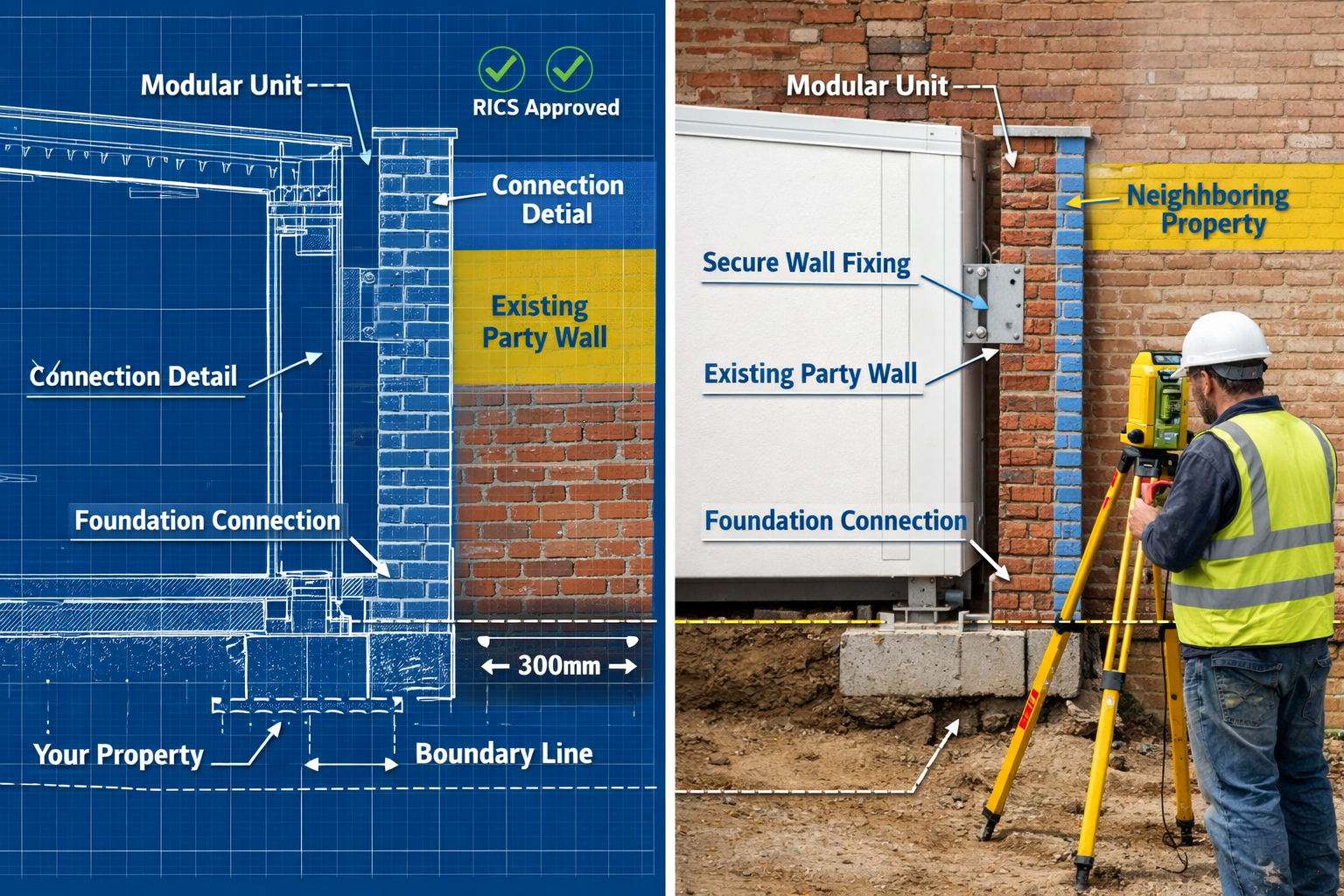
- Precision-engineered boundaries requiring millimeter-accurate party wall alignments
- Foundation systems that must integrate with existing structures
- Crane operations affecting adjoining properties during unit placement
- Pre-fabricated party wall elements manufactured offsite
The Royal Institution of Chartered Surveyors (RICS) provides comprehensive guidance on party wall legislation and procedures[2], emphasizing the need for qualified professionals to manage these complex interactions. While RICS standards have evolved to address modern construction methods, what does a party wall surveyor do remains fundamentally unchanged: protecting the interests of both building owners and adjoining owners.
RICS Protocols: The Foundation of Professional Practice
RICS consumer guides stress that party wall matters should be handled by chartered surveyors with specialist knowledge[3][5]. In 2026, these protocols provide the essential framework for managing modular housing projects, even as construction methods evolve.
Core RICS principles for party wall surveys include:
✅ Proper notification to adjoining owners before works commence
✅ Accurate schedules of condition documenting pre-existing property states
✅ Independent surveyor appointments ensuring impartial dispute resolution
✅ Detailed party wall awards specifying work scope and protective measures
✅ Professional indemnity insurance protecting all parties
The RICS guidance documents emphasize that the Party Wall etc. Act 1996 applies to various scenarios, including building on or at boundaries, excavating near neighboring properties, and working on existing party structures[5]. For modular projects, these situations often occur simultaneously as prefabricated units are positioned precisely at property lines.
How Modular Construction Differs from Traditional Builds
Understanding the distinctions between modular and traditional construction is crucial for surveyors conducting party wall assessments in 2026. Recent industry analysis highlights key differences in cost, speed, and methodology[9].
Traditional Construction Characteristics:
- Sequential on-site building phases
- Extended construction timelines (months to years)
- Gradual boundary impacts
- Multiple inspection opportunities
- Flexible scheduling for party wall works
Modular Construction Characteristics:
- Parallel offsite manufacturing and site preparation
- Compressed installation timelines (days to weeks)
- Concentrated boundary impacts during crane operations
- Limited post-delivery modification options
- Rigid scheduling requiring advance party wall resolution
These differences demand that surveyors adapt their approach. The party wall agreement costs may vary based on project complexity, but the compressed timelines of modular builds often require expedited surveyor services.
Party Wall Survey Procedures for Modular Housing Projects: RICS Protocols in 2026
Early Notification Strategies for Offsite Construction
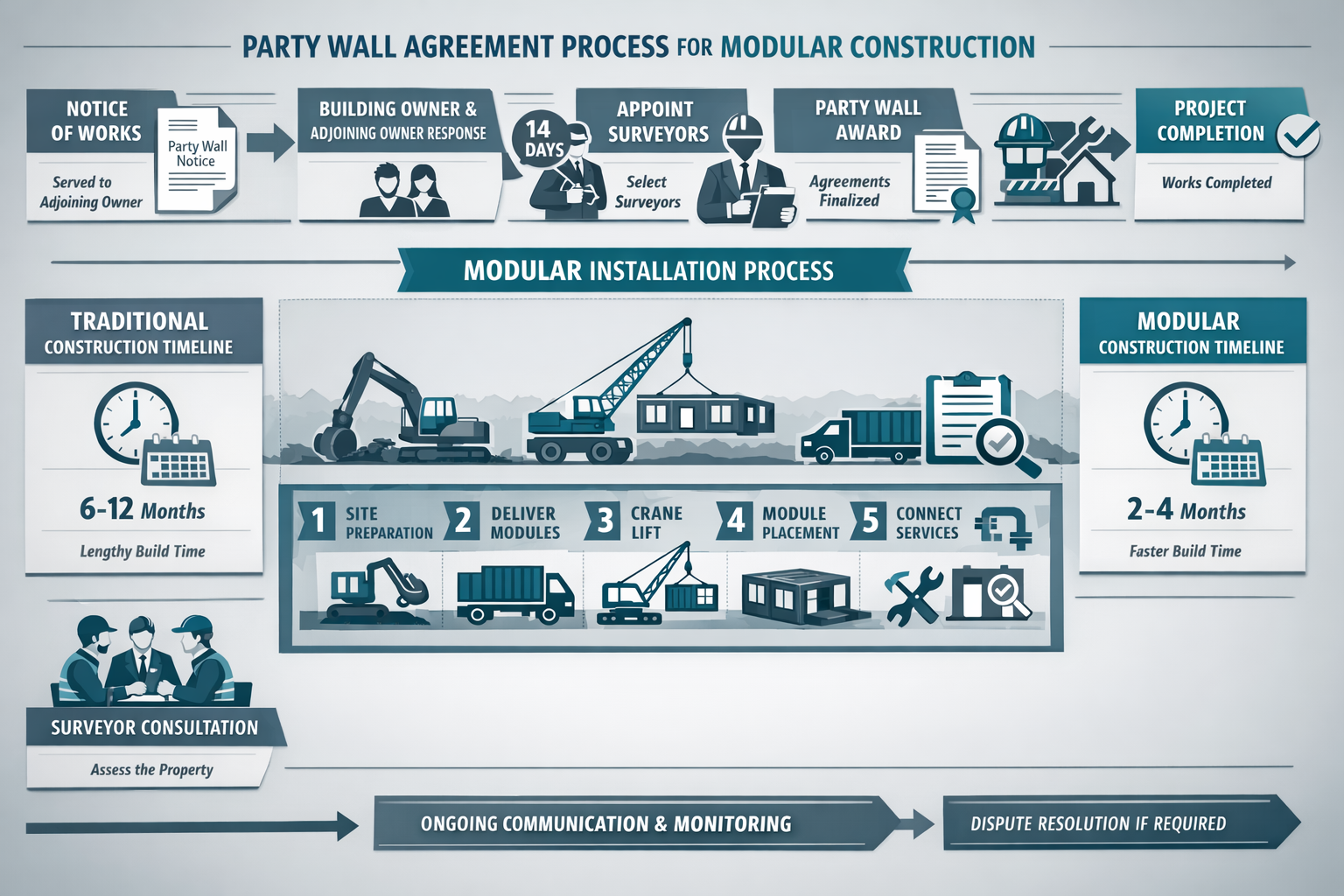
The Party Wall etc. Act 1996 requires building owners to serve notice on adjoining owners at least two months before starting work on a party wall or boundary[2][5]. However, modular construction introduces a critical timing challenge: manufacturing begins weeks before site delivery.
Recommended notification timeline for modular projects:
| Project Phase | Timeline | Party Wall Action |
|---|---|---|
| Design completion | Week 0 | Initial boundary assessment |
| Manufacturing start | Week 2-4 | Serve party wall notices |
| Site preparation | Week 6-8 | Complete schedules of condition |
| Module delivery | Week 10-12 | Final pre-installation inspections |
| Installation | Week 12-13 | Monitor works and boundary impacts |
| Completion | Week 14+ | Post-installation condition surveys |
Proactive surveyors recognize that party wall notices must be served during the offsite manufacturing phase, not when modules arrive on-site. This approach provides adjoining owners with adequate time to respond and appoint surveyors, even as the building owner's units are being fabricated hundreds of miles away.
RICS training materials emphasize the fundamentals of party wall procedures[4], which remain constant regardless of construction method. The key adaptation for modular projects is anticipating the compressed on-site timeline and initiating procedures earlier in the development process.
Conducting Schedules of Condition in High-Volume Developments
A schedule of condition documents the existing state of adjoining properties before construction begins. This critical record protects both building and adjoining owners by establishing baseline conditions. In modular housing developments, where multiple units may be installed across a site within days, surveyors face the challenge of documenting numerous adjoining properties efficiently.
Best practices for modular project schedules of condition:
🏠 Comprehensive photographic documentation with timestamped digital images
📋 Detailed written descriptions of structural elements, finishes, and existing defects
📏 Crack monitoring using precise measurement tools for vulnerable areas
🎥 Video walkthroughs capturing overall property conditions
🔍 Specific attention to party walls, boundary structures, and foundations
The volume of properties requiring assessment in large modular developments demands systematic approaches. Many chartered surveyors now employ digital survey tools and standardized templates to ensure consistency while maintaining the thoroughness RICS standards require.
When receiving a party wall notice, adjoining owners should understand their rights to appoint their own surveyor to prepare independent schedules of condition. This protection becomes particularly important in high-volume modular developments where multiple properties may be affected simultaneously.
Drafting Party Wall Awards for Prefabricated Construction
The party wall award is the legal document that governs how works proceed, specifying the scope of work, timing, and protective measures. For modular housing projects, awards must address unique considerations that traditional construction documents may not anticipate.
Essential elements of modular construction party wall awards:
- Crane operation zones and temporary access requirements
- Foundation connection methods for modular units at boundaries
- Vibration limits during installation and ground preparation
- Working hours compressed into intensive installation periods
- Noise management during rapid assembly operations
- Emergency procedures if modules require repositioning
- Post-installation monitoring periods and inspection rights
RICS guidance emphasizes that party wall awards must be specific, practical, and enforceable[2]. Surveyors drafting awards for modular projects should consult with the developer's technical team to understand the precise installation methodology, as this directly impacts adjoining properties.
The award should also address insurance requirements and specify which party bears responsibility for any damage occurring during the accelerated installation process. Given the compressed timelines, awards often include expedited dispute resolution procedures to address issues without delaying critical installation windows.
Managing Boundary Disputes in Modular Developments
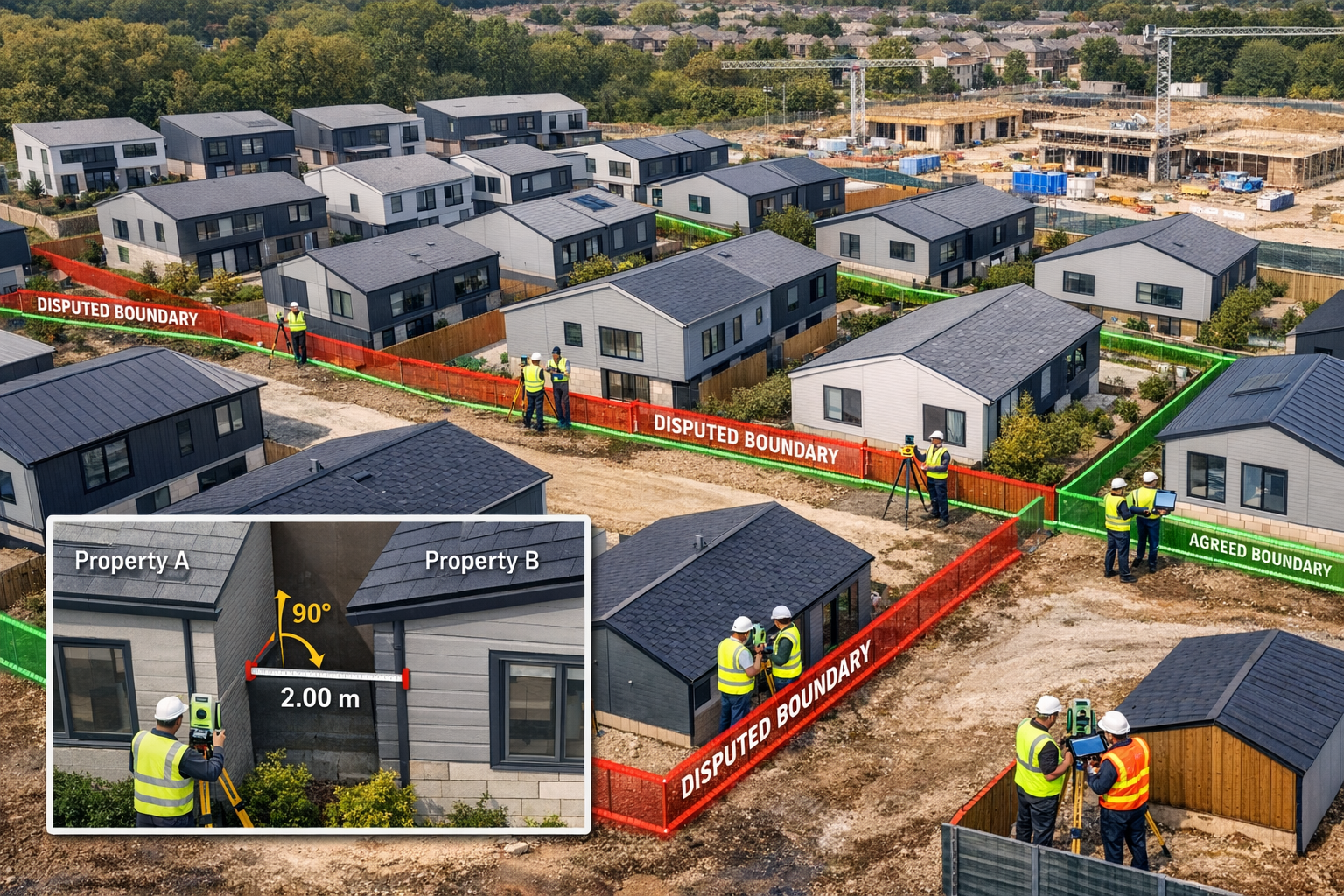
Boundary disputes represent one of the most common challenges in modular housing projects. The precision-engineered nature of prefabricated units means that even small discrepancies in property lines can prevent proper installation or create encroachments.
Common boundary dispute scenarios in modular construction:
⚠️ Foundation encroachment where modular unit bases extend beyond property lines
⚠️ Eaves overhang from prefabricated roof structures
⚠️ Access disputes during crane operations and delivery
⚠️ Fence and boundary wall removal or modification requirements
⚠️ Drainage connections crossing property boundaries
RICS-qualified surveyors play a crucial mediation role in resolving these disputes before they escalate. The expert party wall surveyor brings technical knowledge and impartiality to assess whether proposed works comply with legal requirements while respecting adjoining owners' rights.
In 2026's high-volume recovery markets, surveyors increasingly recommend pre-development boundary surveys using precise GPS and laser measurement technology. This proactive approach identifies potential conflicts during the design phase, when modular units can still be modified offsite, rather than discovering issues during installation when costly delays become inevitable.
Compliance with RICS Standards and the Party Wall Act
The Party Wall etc. Act 1996 provides the statutory framework governing party wall matters in England and Wales[2][5]. RICS professional standards require chartered surveyors to operate within this legal framework while upholding their duties to clients and maintaining professional ethics.
Key compliance requirements for modular housing surveyors:
- Proper notification procedures following statutory timelines
- Independent professional judgment when acting as agreed surveyor
- Accurate record-keeping of all communications and decisions
- Transparent fee structures disclosed to appointing parties
- Professional indemnity insurance meeting RICS minimum requirements
- Continuing professional development in party wall matters
The RICS consumer guide emphasizes that party wall surveyors must act impartially, even when appointed by one party[3]. This independence becomes particularly important in modular developments where commercial pressures to accelerate installation may conflict with proper protective procedures.
Understanding party wall surveyor responsibilities helps both building owners and adjoining owners recognize the professional standards governing these appointments. In 2026, as modular construction scales rapidly, maintaining these standards ensures that accelerated building methods don't compromise legal protections.
Practical Strategies for Surveyors in 2026's Modular Housing Surge
Adapting Traditional Protocols to Offsite Construction Realities
The surge in modular housing throughout 2026 requires surveyors to adapt established RICS protocols to new construction realities. While the fundamental principles remain unchanged, their application demands flexibility and forward-thinking.
Surveyor adaptation strategies:
💡 Early engagement with developers during design phases
💡 Technical collaboration with modular manufacturers on boundary details
💡 Batch processing of multiple party wall notices for large developments
💡 Digital documentation systems for efficient record management
💡 Stakeholder education about modular construction implications
Experienced surveyors recognize that modular projects require proactive rather than reactive approaches. Waiting until modules are ready for delivery leaves insufficient time for proper party wall procedures. Instead, surveyors should integrate into project teams during planning stages, identifying party wall implications before manufacturing begins.
The updated RICS home survey standards taking effect in mid-2026[1] reflect the profession's commitment to evolving practices. While these standards primarily address residential surveys rather than party wall matters specifically, they demonstrate RICS's responsiveness to changing construction methods and consumer needs.
Technology Tools for Modern Party Wall Surveys
Technology has transformed how surveyors conduct party wall assessments in 2026. Digital tools enhance accuracy, efficiency, and documentation quality—critical advantages in high-volume modular developments.
Essential technology for modern party wall surveyors:
📱 Mobile survey apps with integrated photography and annotation
🎯 Laser measurement devices for precise boundary documentation
🖥️ Digital award templates ensuring consistency and completeness
☁️ Cloud-based document management for secure record storage
📊 Project management software tracking multiple concurrent surveys
🤝 Video conferencing for remote consultations with adjoining owners
These tools don't replace professional judgment but enhance surveyors' ability to manage the compressed timelines and multiple stakeholders characteristic of modular housing projects. The surveying technology available in 2026 enables more thorough documentation in less time, a crucial capability when multiple modular units require simultaneous party wall assessments.
Cost Considerations and Fee Structures
Understanding party wall surveyor fees helps all parties budget appropriately for modular housing projects. The compressed timelines and potential for multiple simultaneous assessments can affect cost structures.
Typical fee components for modular project party wall surveys:
- Initial consultation and notice preparation: £300-£600 per property
- Schedule of condition: £400-£800 per adjoining property
- Party wall award drafting: £600-£1,200 per award
- Site monitoring visits: £200-£400 per visit
- Dispute resolution services: £150-£300 per hour
- Post-completion inspections: £300-£600 per property
For large modular developments affecting multiple adjoining properties, developers should anticipate aggregate costs that reflect the scale of party wall involvement. However, these expenses represent essential risk management, preventing far costier disputes and construction delays.
The London party wall surveyor costs may vary based on property values and complexity, but the fundamental principle remains: proper party wall procedures protect all parties' interests and ultimately save money by preventing disputes.
Case Study Insights: Modular Developments in 2026
Real-world examples from 2026's modular housing surge illustrate how effective party wall management enables successful projects:
Urban Infill Development (London):
A 12-unit modular development in a dense urban area required party wall agreements with 18 adjoining properties. The developer engaged RICS surveyors during the design phase, six months before module delivery. Early notification and comprehensive schedules of condition enabled smooth installation over three days, with no disputes arising.
Suburban Expansion Project (Southeast England):
A 50-home modular development faced initial resistance from adjoining owners concerned about rapid construction impacts. The appointed surveyors conducted community information sessions, explaining party wall protections and the installation process. Transparent communication and detailed awards addressing specific concerns resulted in full cooperation and successful project completion.
Terraced Housing Redevelopment (Midlands):
A modular replacement project for aging terraced houses involved complex party wall scenarios with shared walls on both sides of each unit. Surveyors coordinated simultaneous surveys, creating standardized awards adapted to each property's specific conditions. The systematic approach enabled efficient processing while maintaining individual property protections.
These examples demonstrate that Party Wall Surveys for Modular Housing Projects: RICS Protocols in 2026's Offsite Construction Surge succeed when surveyors combine traditional professional standards with adaptive strategies for modern construction methods.
Building Owner and Adjoining Owner Rights
Understanding respective rights and responsibilities ensures smoother party wall processes in modular developments.
Building Owner Responsibilities:
- Serve proper notice within statutory timeframes
- Appoint qualified RICS surveyors
- Bear costs of party wall procedures
- Provide detailed work specifications
- Ensure contractors follow award conditions
- Repair any damage caused by works
Adjoining Owner Rights:
- Receive proper notification before works
- Appoint their own surveyor at building owner's expense
- Have property condition documented before works
- Receive party wall awards specifying protections
- Access dispute resolution if disagreements arise
- Claim compensation for any damage
The expert party wall advice available from RICS-qualified professionals helps both parties navigate these rights and responsibilities, particularly important in modular projects where compressed timelines can create pressure to bypass proper procedures.
Future-Proofing Party Wall Practice for Continued Modular Growth
The modular housing surge of 2026 shows no signs of slowing. Surveyors preparing for continued growth should consider:
🔮 Specialized training in modular construction methods and their party wall implications
🔮 Industry partnerships with modular manufacturers and developers
🔮 Template development for common modular scenarios while maintaining customization
🔮 Professional networks sharing best practices for offsite construction party walls
🔮 Regulatory engagement contributing to potential guidance updates
RICS continues to develop training resources, including specialized courses on party wall fundamentals[4], ensuring surveyors maintain competency as construction methods evolve. The profession's commitment to standards and continuing education positions chartered surveyors as essential facilitators of the modular housing revolution.
Conclusion
Party Wall Surveys for Modular Housing Projects: RICS Protocols in 2026's Offsite Construction Surge represents a critical intersection of traditional legal protections and innovative construction methods. As modular housing accelerates across the UK's recovery markets, RICS-qualified surveyors provide the essential expertise to navigate compressed timelines, precision boundary requirements, and multi-party stakeholder management.
The fundamental principles of party wall practice remain constant: proper notification, accurate condition documentation, fair awards, and impartial professional judgment. However, their application to modular construction demands proactive engagement, technical understanding of offsite manufacturing, and adaptive strategies that respect both statutory requirements and commercial realities.
For building owners embarking on modular housing projects, early surveyor engagement—ideally during design phases—prevents costly delays and disputes. For adjoining owners receiving party wall notices related to modular developments, understanding your rights to independent surveyor appointment ensures your property interests receive proper protection.
Next Steps
For Building Owners Planning Modular Projects:
- Engage RICS-qualified party wall surveyors during project design
- Identify all potentially affected adjoining properties early
- Serve party wall notices during offsite manufacturing phases
- Budget appropriately for comprehensive party wall procedures
- Maintain open communication with adjoining owners throughout
For Adjoining Owners Receiving Modular Project Notices:
- Respond promptly to party wall notices (within 14 days)
- Consider appointing your own RICS surveyor for independent advice
- Ensure thorough schedules of condition document your property
- Review party wall awards carefully before works commence
- Monitor works and report any concerns immediately to your surveyor
For Surveyors Adapting to Modular Construction:
- Pursue specialized training in offsite construction methods
- Develop efficient systems for high-volume developments
- Build relationships with modular manufacturers and developers
- Invest in technology tools enhancing documentation and efficiency
- Share knowledge with professional networks to advance best practices
The modular housing surge of 2026 presents both challenges and opportunities for party wall practice. By combining RICS's established professional standards with adaptive strategies for modern construction, surveyors ensure that accelerated building methods enhance rather than compromise the legal protections that serve all property owners. Whether you're developing modular housing, adjoining a modular project, or surveying these innovative developments, understanding party wall protocols in this new construction era protects interests, prevents disputes, and enables the housing delivery that communities need.
References
[1] The New Rics Home Survey Standard Explained – https://www.surveymerchant.com/blog/the-new-rics-home-survey-standard-explained
[2] Party Wall Legislation And Procedure – https://www.rics.org/profession-standards/rics-standards-and-guidance/sector-standards/building-surveying-standards/party-wall-legislation-and-procedure
[3] Rics Consumer Guide Party Walls – https://www.ricsfirms.com/residential/legal-issues/party-walls/rics-consumer-guide-party-walls/
[4] Party Walls The Fundamentals – https://www.rics.org/training-events/online-training/on-demand/party-walls-the-fundamentals
[5] Party Walls – https://www.rics.org/consumer-guides/party-walls
[9] Modular Vs Traditional Construction In 2026 Cost Speed Roi Compared – https://www.s2amodular.com/2026/01/30/modular-vs-traditional-construction-in-2026-cost-speed-roi-compared/