


The United Kingdom's data centre sector is experiencing unprecedented growth in 2026, driven by surging demand for artificial intelligence workloads and cloud computing capacity. As London prepares to receive 180MW of new supply this year—the second-highest on record—developers face a critical challenge that extends beyond power availability and cooling systems[1]. The expansion of these mission-critical facilities often involves complex construction works adjacent to existing buildings, making Party Wall Surveys for Data Centre Expansions: Securing Agreements in UK's 2026 Tech Infrastructure Boom an essential component of project success. 🏗️
With vacancy rates projected to fall to just 5.9% by the end of 2026, the pressure to deliver new capacity quickly has never been greater[1]. However, rushing through party wall procedures can lead to costly disputes, project delays, and legal complications that undermine even the most carefully planned developments.
Key Takeaways
- Record-breaking expansion: London's data centre market will add 373MW of combined supply in 2025-2026, more than double the previous two-year period, creating unprecedented party wall challenges[1]
- Specialized requirements: Data centre construction involves unique considerations including deep excavations for cooling systems, heavy floor loadings for AI infrastructure, and vibration-sensitive equipment near shared boundaries
- Proactive compliance: Early engagement with party wall agreement procedures prevents disputes and accelerates project timelines in high-stakes tech infrastructure developments
- Geographic expansion: New growth areas in North London, Oxfordshire, Hertfordshire, and Essex mean party wall issues are emerging in previously untested locations[1]
- Rapid resolution protocols: Specialized checklists and surveyor-led processes enable swift agreement completion without compromising adjoining owner protections
Understanding the 2026 Data Centre Construction Landscape
The Scale of UK Tech Infrastructure Growth
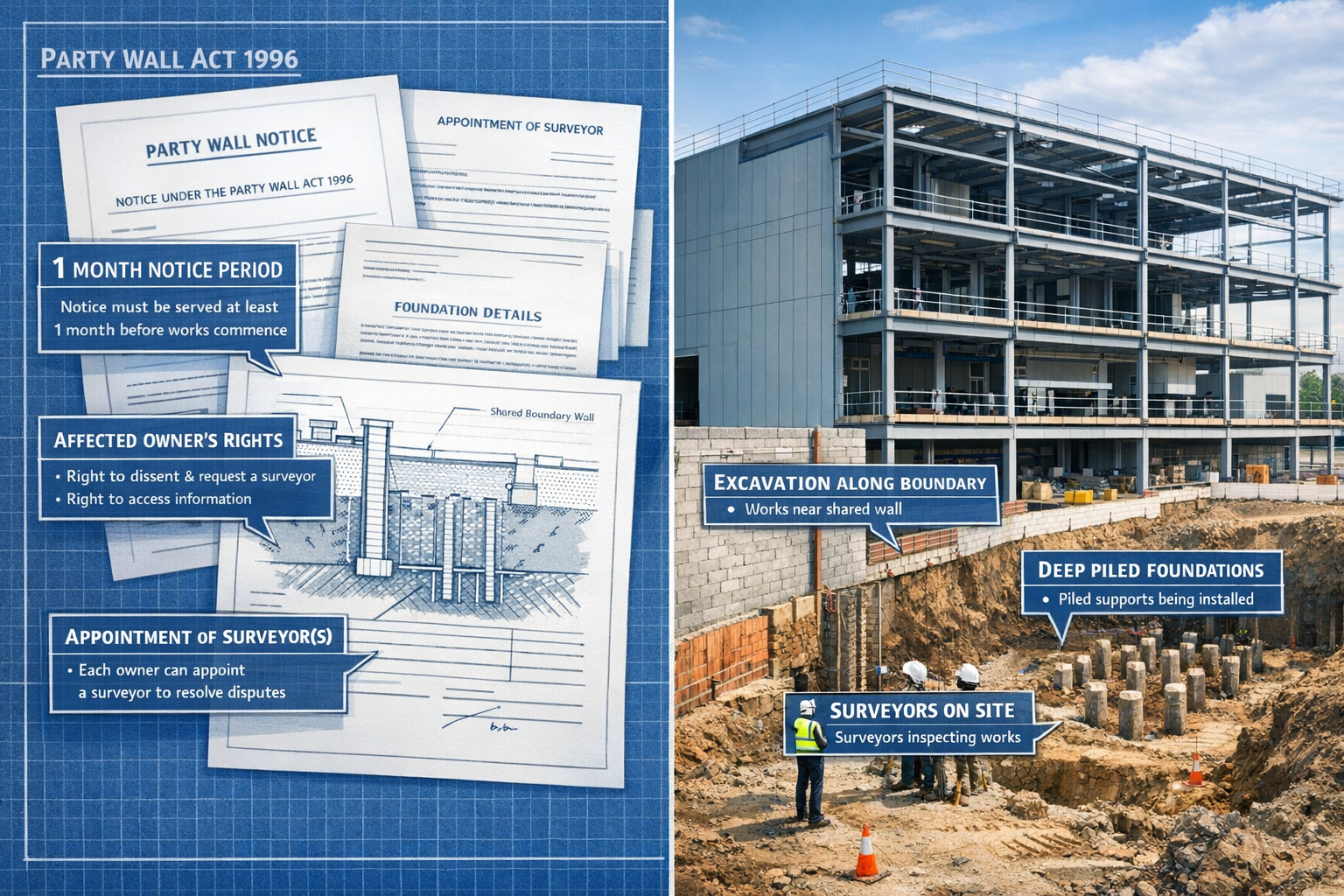
The data centre boom transforming the United Kingdom in 2026 represents far more than incremental capacity additions. London alone accounts for over 80% of UK national data centre supply, establishing it as the dominant market cluster in Europe[1]. This concentration creates unique challenges for developers working in established areas like Slough and Hayes/Park Royal, where available land is scarce and most new facilities must be constructed adjacent to existing buildings.
Key market dynamics include:
- Hyperscaler dominance: Major cloud providers and neoclouds are driving demand for high-density AI workloads that require specialized infrastructure[1]
- Power constraints: Traditional clusters are reaching electrical grid capacity limits, forcing expansion into new geographic areas[1]
- Government support: AI growth zones in Culham (Oxfordshire), Teesside, Newcastle, and North/South Wales will support up to 500MW capacity per location[1]
- Technology evolution: Liquid cooling systems for GPU compute services require different building configurations than traditional air-cooled facilities[1]
Why Party Wall Surveys Matter for Data Centre Projects
Data centre construction presents distinctive challenges that make party wall compliance particularly complex. Unlike residential or standard commercial developments, these facilities require:
Deep excavations for underground cooling infrastructure and power distribution systems that can extend several meters below ground level, potentially affecting neighbouring foundations.
Exceptional floor loadings to support dense server racks and battery backup systems, often requiring reinforced foundations that interface with shared structural elements.
Vibration management for cooling equipment, generators, and HVAC systems operating 24/7 in close proximity to party walls.
Continuous construction schedules where delays translate directly into lost revenue opportunities in a market where take-up is forecast to reach 189MW in 2026, exceeding new supply for the fifth consecutive year[1].
Understanding when you need a party wall agreement becomes critical in this context, as the technical complexity and financial stakes far exceed typical construction scenarios.
Party Wall Act 1996: Application to Data Centre Developments
Triggering Works in Tech Infrastructure Projects
The Party Wall etc. Act 1996 governs building works that affect shared boundaries, and data centre expansions typically trigger multiple provisions simultaneously. Developers must understand which aspects of their projects fall under the Act's jurisdiction.
Section 1 – New Party Walls on the Line of Junction:
When constructing a new data centre on previously undeveloped land adjacent to existing properties, building directly on or astride the boundary line requires formal party wall procedures.
Section 2 – Works to Existing Party Walls:
Modifications to existing shared walls—such as installing vibration dampening systems, reinforcing structures to support additional loads, or creating penetrations for services—all require notices and agreements.
Section 6 – Excavation and Construction Near Neighbouring Buildings:
This provision is particularly relevant for data centres, as it covers:
- Excavations within 3 meters of a neighbouring structure that go deeper than its foundations
- Excavations within 6 meters that meet specific depth criteria relative to neighbouring foundations
Given that modern data centres often require substantial below-ground infrastructure for cooling systems and power distribution, Section 6 frequently applies even when no direct work occurs on shared walls.
Notice Requirements and Timelines
The Act establishes strict notice periods that developers must observe, regardless of project urgency or market pressures. For data centre expansions in 2026's competitive environment, these timelines require careful integration into project schedules.
| Notice Type | Minimum Notice Period | Applies To |
|---|---|---|
| Party Structure Notice | 2 months | Works to existing party walls or structures |
| Line of Junction Notice | 1 month | New walls built on boundary lines |
| Adjacent Excavation Notice | 1 month | Excavations within 3m or 6m of neighbouring buildings |
Critical timing considerations:
⏰ Start counting early: Notice periods begin when the adjoining owner receives the notice, not when it's sent. Use tracked delivery methods to establish receipt dates.
📋 Include comprehensive details: Notices must specify the nature of proposed works, start dates, and technical particulars. Vague descriptions invite disputes and restart the clock.
🔄 Account for consent periods: Adjoining owners have 14 days to respond. Silence constitutes dissent and triggers the surveyor appointment process.
For developers working with party wall agreement surveyors in London, early engagement ensures notices contain sufficient technical detail to withstand scrutiny while maintaining project momentum.
Appointing Surveyors for High-Stakes Projects
When adjoining owners dissent or fail to respond to party wall notices—a common occurrence in data centre projects where technical complexity creates uncertainty—the Act requires surveyor appointments to resolve matters.
Three appointment scenarios exist:
-
Agreed Surveyor: Both parties consent to a single surveyor acting impartially (rare in high-value tech infrastructure projects)
-
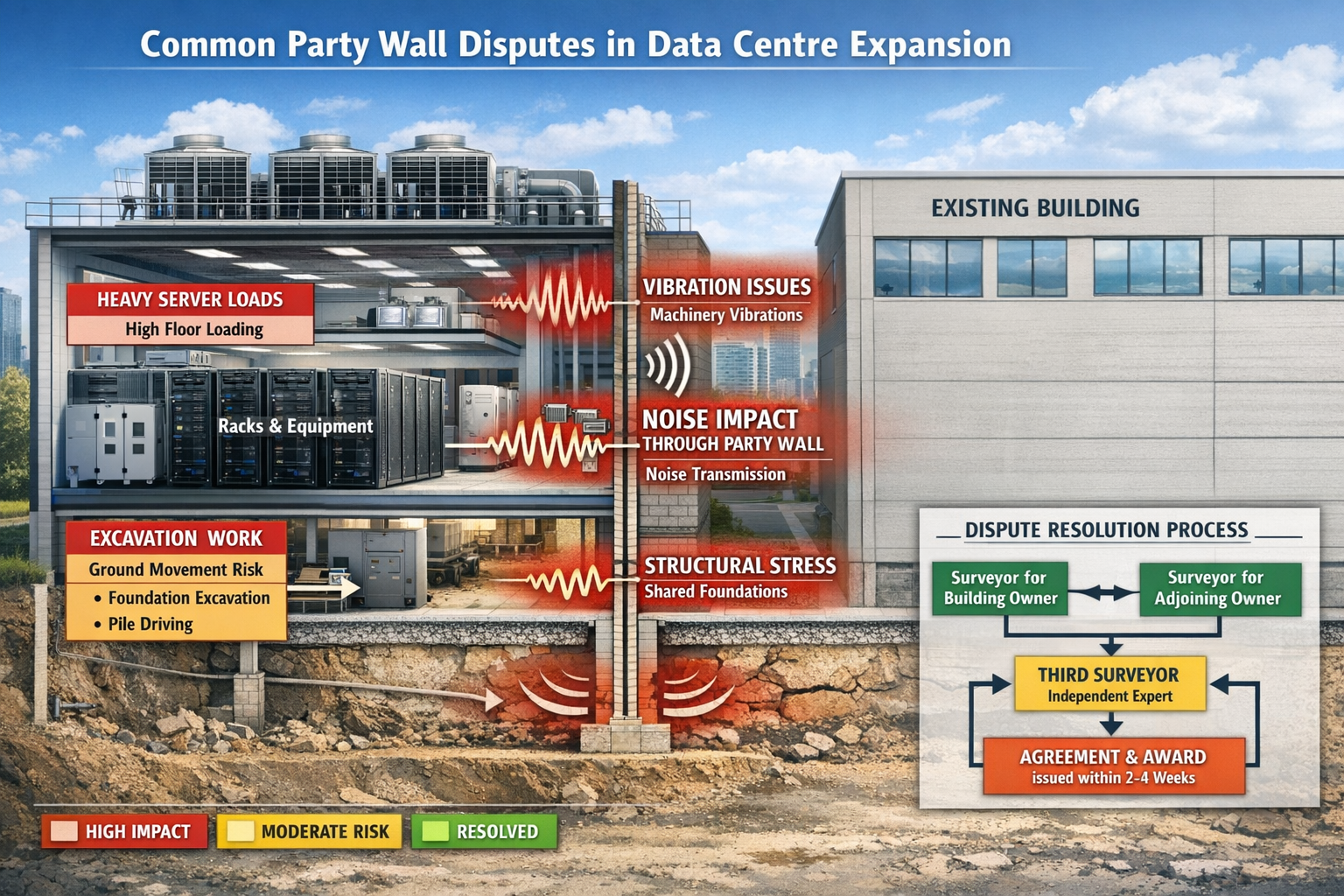
Two Surveyors: Each party appoints their own surveyor, who then work collaboratively to produce a party wall award
-
Third Surveyor: The two appointed surveyors select a third surveyor to resolve any disagreements between them
For data centre developments, the two-surveyor approach typically provides the best balance of protection and efficiency. Building owners can appoint specialists familiar with tech infrastructure requirements, while adjoining owners select surveyors focused on protecting their interests.
Surveyor selection criteria for data centre projects:
✅ Technical expertise: Understanding of high-density floor loadings, vibration impacts, and cooling system infrastructure
✅ Commercial awareness: Recognition of time-sensitive nature of tech infrastructure delivery and market pressures
✅ Dispute resolution skills: Ability to negotiate practical solutions that protect all parties while enabling project progression
✅ Local knowledge: Familiarity with specific challenges in emerging data centre clusters beyond traditional London locations[1]
Developers should budget appropriately for surveyor fees, as party wall agreement costs can vary significantly based on project complexity and the number of affected properties.
Specialized Checklists for Data Centre Party Wall Procedures
Pre-Notice Planning Checklist
Before issuing formal party wall notices, data centre developers should complete comprehensive preparation to minimize disputes and accelerate approvals.
🔍 Boundary Investigation:
- Obtain up-to-date title plans showing precise boundary locations
- Commission measured surveys to identify all shared walls and structures
- Identify all properties within 6 meters of planned excavations
- Document existing conditions of neighbouring properties photographically
- Review Land Registry records for ownership details of all affected parties
📐 Technical Documentation:
- Prepare detailed construction drawings showing relationship to party walls
- Specify excavation depths and proximity to neighbouring foundations
- Document floor loading calculations and structural requirements
- Detail vibration management systems and operational noise levels
- Outline construction methodology and timeline
🤝 Stakeholder Engagement:
- Identify all adjoining owners (including tenants with relevant interests)
- Conduct informal pre-notice discussions where possible
- Explain project benefits and community impact
- Address initial concerns before formal procedures begin
- Establish communication protocols for construction phase
⚖️ Legal Preparation:
- Engage solicitors familiar with tech infrastructure projects
- Review lease terms for any additional requirements beyond statutory obligations
- Confirm insurance coverage for party wall-related risks
- Prepare contingency plans for dispute scenarios
- Budget for surveyor fees and potential award costs
Notice Drafting and Service Checklist
Properly drafted notices form the foundation of smooth party wall procedures. For data centre projects with unique technical requirements, precision matters.
📝 Notice Content Requirements:
- Building owner's name and address clearly stated
- Adjoining owner's name and address verified as current
- Precise description of proposed works using technical terminology
- Specific start date (must be at least notice period away)
- Detailed drawings and specifications attached
- Clear statement of rights under the Act
- Contact information for queries and responses
📬 Service Methods:
- Use recorded delivery or courier with signature confirmation
- Serve on all relevant parties (owners, long leaseholders, tenants)
- Maintain proof of service documentation
- Follow up with courtesy copies via email (not legally sufficient alone)
- Diarise response deadline dates (14 days from receipt)
🔧 Data Centre-Specific Inclusions:
- Cooling system specifications and vibration dampening measures
- Power infrastructure details and electromagnetic shielding
- 24/7 operational requirements and noise management
- Emergency access provisions during construction
- Post-completion monitoring protocols
When receiving a party wall notice as an adjoining owner, understanding these technical elements helps inform appropriate responses.
Dispute Resolution and Award Preparation Checklist
When adjoining owners dissent or fail to respond, the surveyor-led dispute resolution process begins. For data centre projects operating under tight timelines, efficient progression through this phase is essential.
👥 Surveyor Appointment Phase:
- Appoint qualified surveyor within 10 days of dissent/deemed dissent
- Provide surveyor with comprehensive project documentation
- Facilitate adjoining owner's surveyor appointment
- Confirm both surveyors' acceptance in writing
- Establish communication protocols between surveying team
- Agree third surveyor selection process if needed
🔍 Survey and Assessment Phase:
- Conduct joint inspection of party walls and affected areas
- Prepare detailed condition schedules with photographs
- Assess construction methodology and potential impacts
- Evaluate proposed protective measures and monitoring
- Identify any modifications needed to protect adjoining property
- Calculate reasonable timeframes for work completion
📋 Award Drafting Phase:
- Specify exact scope of permitted works
- Detail construction methodology and hours of operation
- Establish monitoring and inspection protocols
- Define notice requirements for work commencement
- Set out dispute resolution procedures during construction
- Clarify responsibility for damage repairs
- Specify surveyor fee allocation
✍️ Award Finalization:
- Both surveyors sign and date the award
- Serve award on both building and adjoining owners
- Explain appeal rights (14 days to County Court)
- Obtain acknowledgment of receipt from all parties
- Distribute copies to project team and contractors
- File award with project documentation
Expert Insight: "In data centre projects, the party wall award should address not just construction impacts but also operational considerations like continuous cooling system operation and emergency maintenance access. This forward-thinking approach prevents disputes after project completion." — Senior Party Wall Surveyor
Construction Phase Compliance Checklist
The party wall award creates obligations that extend throughout the construction period and beyond. Data centre developers must maintain rigorous compliance to avoid disputes that could delay facility commissioning.
🚧 Pre-Commencement:
- Provide required notice of work commencement (typically 7-14 days)
- Arrange pre-commencement meeting with surveyors if specified
- Confirm monitoring equipment installation
- Brief contractors on party wall obligations and restrictions
- Establish incident reporting procedures
📊 During Construction:
- Conduct monitoring as specified in award (vibration, movement, noise)
- Maintain photographic records of work progression
- Provide regular updates to adjoining owners and surveyors
- Report any unexpected conditions or deviations immediately
- Facilitate surveyor inspections as required
- Document compliance with construction methodology
🔧 Incident Management:
- Investigate any damage claims immediately
- Document conditions thoroughly with photographs
- Engage surveyors to assess causation
- Implement temporary protective measures if needed
- Maintain communication with affected parties
- Execute repairs promptly per award terms
✅ Completion:
- Conduct final joint inspection with surveyors
- Compare post-construction conditions to baseline schedules
- Address any identified damage or defects
- Obtain surveyor confirmation of satisfactory completion
- Settle any outstanding surveyor fees
- Archive all party wall documentation for future reference
Those seeking expert party wall advice can benefit from engaging specialists who understand the unique pressures of tech infrastructure delivery timelines.
Emerging Challenges in New Data Centre Clusters
Geographic Expansion Beyond Traditional Locations
As London's established data centre clusters in Slough and Hayes/Park Royal reach capacity constraints, developers are expanding into new geographic areas where party wall expertise may be less developed[1]. This geographic shift creates unique challenges for securing agreements efficiently.
New growth areas include:
North London: Industrial areas being repurposed for tech infrastructure, often involving conversion of existing buildings with complex shared wall arrangements
Oxfordshire (Culham): Government-designated AI growth zone where greenfield development may involve agricultural land boundaries and rights-of-way considerations[1]
Hertfordshire: Suburban locations where data centres adjoin residential properties, requiring heightened sensitivity to neighbour concerns
London Docklands and Essex: Waterfront locations offering cooling advantages but presenting unique foundation challenges in areas with varied soil conditions[1]
In these emerging clusters, developers may encounter:
- Adjoining owners unfamiliar with data centre construction requirements
- Local surveyors lacking experience with high-density tech infrastructure
- Planning authorities still developing policies for tech facility integration
- Community concerns about noise, visual impact, and property values
Strategic approaches for new locations:
💡 Early community engagement: Host information sessions explaining data centre operations and addressing concerns before formal notices
💡 Educational materials: Provide clear, accessible explanations of party wall procedures and neighbour protections
💡 Specialist surveyor networks: Engage London-based experts willing to work in new geographic areas
💡 Precedent development: Document successful approaches that can be replicated across multiple projects in emerging clusters
AI Infrastructure and Specialized Building Requirements
The shift toward AI workloads is fundamentally changing data centre design requirements, with direct implications for party wall procedures. Modern facilities serving AI applications differ substantially from traditional data centres[1].
Key technical differences:
Higher power densities: AI compute requires dramatically more electrical power per square meter, necessitating enhanced power distribution infrastructure that may impact shared structural elements
Increased floor loadings: Dense GPU server configurations create heavier floor loads, requiring deeper foundations and stronger structural support near party walls
Liquid cooling systems: Neoclouds are adopting liquid cooling to manage GPU heat output, introducing new piping infrastructure, pumps, and potential leak risks near shared boundaries[1]
Continuous high-intensity operation: AI training workloads run 24/7 at maximum capacity, creating sustained vibration and noise that differs from variable traditional workloads
Party wall implications:
These technical requirements translate into specific considerations for party wall awards:
- Structural monitoring: More comprehensive vibration and movement monitoring during construction and initial operation
- Acoustic insulation: Enhanced soundproofing measures for party walls adjacent to cooling equipment
- Emergency protocols: Clear procedures for addressing cooling system leaks or failures that could affect adjoining properties
- Access provisions: Arrangements for emergency maintenance access that may require entry to neighbouring land
Developers should work with surveyors who understand these specialized requirements and can draft awards that address AI-specific infrastructure needs while protecting adjoining owner interests.
Multi-Party Scenarios in Dense Urban Environments
London's dominance as a data centre hub means new facilities are often constructed in dense urban environments with multiple adjoining properties[1]. Managing party wall procedures across numerous stakeholders simultaneously requires sophisticated coordination.
Common multi-party scenarios:
🏢 Industrial estate developments: New data centres surrounded by multiple commercial occupiers, each with different operational sensitivities
🏘️ Mixed-use boundaries: Tech facilities adjacent to residential, commercial, and industrial properties with varying concerns and priorities
🏗️ Phased developments: Expansion projects where early phases become "adjoining owners" for later phases, creating internal party wall requirements
Coordination strategies:
Centralized communication: Establish single point of contact for all party wall matters to ensure consistency
Standardized documentation: Develop template notices and information packages that can be customized for each adjoining owner
Staggered timelines: Sequence notice service to manage surveyor appointment and award preparation efficiently
Collective meetings: Where appropriate, host group sessions to address common concerns (while respecting individual negotiation rights)
Relationship management: Assign dedicated personnel to maintain ongoing dialogue with each affected party
For those dealing with adjoining properties in complex urban settings, professional coordination becomes essential to prevent procedural delays.
Best Practices for Rapid Yet Compliant Agreement Completion
Proactive Engagement Strategies
The most successful data centre developers in 2026's competitive market recognize that party wall compliance shouldn't be treated as a regulatory hurdle but rather as an opportunity to build positive stakeholder relationships.
Pre-formal engagement approaches:
Informal neighbour consultations: Before serving formal notices, meet with adjoining owners to explain the project, address concerns, and gauge receptiveness
Technical briefings: Offer detailed presentations on construction methodology, protective measures, and operational characteristics to build confidence
Site visits: Invite adjoining owners to visit similar completed facilities to demonstrate professional standards and dispel misconceptions
Early surveyor involvement: Engage party wall surveyors during design phase to identify potential issues before commitments are made
Benefits of proactive engagement:
- Reduced likelihood of dissent or disputes
- Faster surveyor appointment and award preparation
- More collaborative problem-solving approach
- Enhanced community relations supporting future expansions
- Lower overall transaction costs
Selecting the Right Professional Team
The complexity of Party Wall Surveys for Data Centre Expansions: Securing Agreements in UK's 2026 Tech Infrastructure Boom demands a specialized professional team with relevant expertise.
Key team members:
Party Wall Surveyor: Should have demonstrable experience with:
- Large-scale commercial and industrial projects
- Vibration-sensitive construction scenarios
- High-value dispute resolution
- Tech sector understanding
Structural Engineer: Must provide:
- Detailed foundation design considering party wall constraints
- Vibration analysis and mitigation strategies
- Floor loading calculations for AI infrastructure
- Monitoring protocol specifications
Legal Counsel: Should offer:
- Party Wall Act 1996 expertise
- Commercial property transaction experience
- Dispute resolution and litigation capabilities
- Tech sector commercial awareness
Project Manager: Needs to coordinate:
- Party wall timeline integration with construction schedule
- Stakeholder communication across multiple parties
- Compliance monitoring during construction
- Documentation and record-keeping
When seeking surveyor advice, developers should prioritize professionals who understand both the technical requirements of data centre construction and the commercial pressures of the 2026 market environment.
Leveraging Technology for Efficiency
Modern technology tools can significantly accelerate party wall procedures while improving accuracy and reducing disputes.
Digital solutions for party wall management:
📱 Document management systems: Centralized platforms for storing notices, awards, correspondence, and condition surveys accessible to all authorized parties
📷 Photographic condition surveys: High-resolution imaging, 360-degree photography, and drone surveys creating comprehensive baseline records
📊 Monitoring technology: Real-time vibration sensors, crack monitoring systems, and automated reporting reducing manual inspection requirements
🗓️ Timeline management tools: Automated tracking of notice periods, response deadlines, and compliance milestones
💬 Communication platforms: Secure portals enabling transparent information sharing between building owners, adjoining owners, and surveyors
Implementation considerations:
While technology offers efficiency gains, it must be deployed thoughtfully:
- Ensure all parties have necessary access and technical capability
- Maintain paper documentation as legal backup
- Respect privacy and data protection requirements
- Use technology to enhance, not replace, personal communication
- Train project teams on proper system utilization
Cost Management and Budgeting
Understanding and managing party wall costs is essential for data centre projects operating under tight financial constraints and investor scrutiny.
Typical cost components:
| Cost Category | Typical Range (per property) | Factors Affecting Cost |
|---|---|---|
| Building Owner's Surveyor | £2,000 – £8,000 | Project complexity, number of affected properties |
| Adjoining Owner's Surveyor | £1,500 – £6,000 | Paid by building owner per the Act |
| Third Surveyor (if required) | £3,000 – £10,000 | Dispute complexity, time required |
| Condition Surveys | £500 – £2,000 | Property size, documentation detail |
| Monitoring Equipment | £1,000 – £5,000 | Technology sophistication, duration |
| Legal Fees | £2,000 – £15,000 | Dispute likelihood, complexity |
For large data centre projects with multiple adjoining properties, total party wall costs can easily reach £50,000-£200,000 or more.
Cost optimization strategies:
✅ Negotiate agreed surveyor arrangements where relationships permit
✅ Batch multiple properties with single surveyor where appropriate
✅ Invest in thorough upfront documentation to minimize disputes
✅ Use technology to reduce manual monitoring and inspection costs
✅ Build realistic contingencies into project budgets (15-25% of estimated costs)
Those researching property survey expenses should recognize that party wall costs represent essential risk management investments, not optional expenditures.
Case Study: Successful Data Centre Expansion in North London
Project Background
A major hyperscaler planned a 45MW data centre expansion in North London, one of the emerging growth areas identified in 2026 market forecasts[1]. The site, previously an industrial warehouse, was bounded by:
- An active logistics facility to the north (shared wall)
- A residential apartment building to the east (within 6m of excavations)
- A vacant commercial property to the south (shared wall)
- A public highway to the west
The project required:
- Demolition of existing structure
- Excavation to 4.5m depth for cooling infrastructure
- Construction of new 3-story facility with high-density floor loading
- Installation of external cooling units along party wall boundaries
Party Wall Strategy Implementation
Phase 1 – Pre-Notice Engagement (Months 1-2)
The developer conducted informal meetings with all three adjoining owners, presenting:
- Project overview and community benefits (local employment, infrastructure investment)
- Construction methodology and protective measures
- Preliminary timeline and communication protocols
- Opportunity to ask questions and raise concerns
This engagement revealed that the residential building residents were primarily concerned about construction noise and dust, while the logistics operator worried about vibration impacts on their racking systems.
Phase 2 – Formal Notices (Month 3)
Comprehensive party wall notices were served including:
- Detailed architectural and structural drawings
- Vibration analysis and mitigation specifications
- Construction phase management plan
- Monitoring protocol proposals
The logistics operator consented to the works. The residential building and vacant property owners dissented, triggering surveyor appointments.
Phase 3 – Surveyor Engagement (Months 4-5)
The developer appointed an experienced party wall surveyor with data centre expertise. The residential building appointed a surveyor focused on protecting occupier interests. The vacant property owner's surveyor specialized in commercial properties.
Joint inspections were conducted, comprehensive condition schedules prepared, and negotiations held on:
- Enhanced acoustic barriers along residential boundary
- Continuous vibration monitoring with automated alerts
- Restricted construction hours near residential building
- Access provisions for ongoing inspections
Phase 4 – Award Preparation (Month 6)
Two party wall awards were prepared and served, each addressing specific property concerns while enabling project progression. The awards included:
- Detailed work specifications and construction methodology
- Vibration limits and monitoring requirements
- Weekly progress reports to adjoining owners
- Expedited dispute resolution procedures
- Clear damage assessment and repair protocols
Phase 5 – Construction Compliance (Months 7-18)
Throughout construction:
- Real-time vibration monitoring data was shared via secure portal
- Monthly surveyor inspections confirmed compliance
- One minor crack in the residential building was promptly investigated, determined to be pre-existing per condition schedule, and monitored
- Weekly email updates maintained transparent communication
Outcomes and Lessons Learned
The project achieved practical completion on schedule with no party wall disputes or litigation. Key success factors included:
✅ Early engagement that built trust and identified concerns before formal procedures
✅ Specialist surveyor selection ensuring technical understanding and commercial pragmatism
✅ Transparent communication throughout all phases
✅ Technology deployment for real-time monitoring and information sharing
✅ Realistic budgeting that treated party wall costs as essential, not discretionary
Total party wall costs: £47,000 across three properties
Time from initial notice to final award: 6 months
Construction delays attributable to party wall issues: Zero
This case demonstrates that even complex data centre projects in emerging locations can achieve efficient party wall compliance through professional management and stakeholder respect.
Regulatory Considerations and Future Outlook

Interaction with Planning and Building Control
Party wall procedures operate independently from planning permission and building control approval, but effective coordination across all three regulatory frameworks is essential for data centre projects.
Key distinctions:
Planning permission addresses land use, visual impact, and community considerations
Building control ensures structural safety and building regulation compliance
Party wall procedures protect specific adjoining owner interests in boundary works
Coordination requirements:
Developers should ensure that:
- Party wall notices reflect planning-approved designs (changes require new notices)
- Building control structural calculations align with party wall award specifications
- Timeline coordination prevents regulatory approvals expiring during party wall procedures
- All three processes inform and support each other rather than creating conflicts
The 2026 Market Context and Time Pressures
The extraordinary demand dynamics characterizing the UK data centre market in 2026 create intense pressure to accelerate project delivery. With take-up forecast to exceed new supply for the fifth consecutive year and vacancy rates at record lows, every month of delay represents significant lost revenue[1].
Market pressure implications:
Developers may be tempted to:
- Rush party wall procedures or skip steps
- Pressure surveyors for faster award preparation
- Minimize protective measures to reduce costs
- Commence work before awards are finalized
These approaches invariably backfire, leading to:
- Injunctions halting construction
- Costly litigation and damages
- Reputational damage affecting future projects
- Strained relationships with local authorities and communities
The sustainable approach recognizes that:
"Proper party wall compliance is not an obstacle to rapid delivery—it's the foundation that enables it. Projects that invest in thorough procedures proceed smoothly, while those that cut corners face delays that dwarf any time initially saved."
Emerging Trends and Adaptations
As Party Wall Surveys for Data Centre Expansions: Securing Agreements in UK's 2026 Tech Infrastructure Boom becomes increasingly prevalent, several trends are emerging:
Standardization initiatives: Industry bodies are developing template awards and procedures specific to data centre construction, potentially accelerating future projects
Specialist surveyor networks: Professional associations are creating data centre-focused practice groups sharing expertise and best practices
Technology integration: Digital platforms specifically designed for party wall management in tech infrastructure projects are gaining adoption
Insurance products: Specialized party wall insurance covering dispute costs and delay risks is becoming more widely available
Regulatory evolution: While the Party Wall Act 1996 remains unchanged, case law and professional guidance continue to evolve based on data centre project experiences
Looking ahead, developers who invest in building party wall expertise and positive stakeholder relationships will gain competitive advantages in securing sites and delivering projects efficiently in the UK's booming tech infrastructure market.
Conclusion
The explosive growth of the UK's data centre sector in 2026—with London alone receiving 180MW of new supply and vacancy rates falling to historic lows—creates unprecedented opportunities and challenges for developers[1]. As facilities expand into new geographic clusters and adopt advanced AI infrastructure with higher power densities and specialized cooling systems, the complexity of Party Wall Surveys for Data Centre Expansions: Securing Agreements in UK's 2026 Tech Infrastructure Boom has never been greater[1].
Success in this high-stakes environment requires recognizing that party wall compliance is not a regulatory burden to be minimized but rather a critical risk management process that protects project timelines, budgets, and stakeholder relationships. The specialized checklists, best practices, and strategies outlined in this article provide a roadmap for securing agreements efficiently while maintaining full legal compliance.
Actionable Next Steps
For data centre developers and project managers:
- Conduct early boundary assessments during site selection to identify party wall requirements before commitments are made
- Engage specialist surveyors with demonstrable data centre experience during design phase, not after construction is planned
- Implement proactive neighbour engagement before serving formal notices to build relationships and identify concerns
- Develop comprehensive budgets that treat party wall costs as essential project components with appropriate contingencies
- Establish robust compliance systems for monitoring and documenting adherence to party wall awards throughout construction
- Build institutional knowledge by documenting lessons learned and developing standardized approaches for future projects
For adjoining owners receiving party wall notices from data centre developers:
- Seek professional advice from experienced party wall surveyors who understand tech infrastructure projects
- Respond within statutory timeframes to preserve rights and ensure proper protection
- Engage constructively with developers while ensuring legitimate interests are protected
- Document existing conditions thoroughly to establish baseline for future damage assessments
- Understand your rights under the Act and ensure awards provide appropriate protections
The UK's position as Europe's leading data centre market depends on the industry's ability to deliver new capacity rapidly while maintaining positive relationships with communities and neighbouring property owners. By treating party wall procedures as opportunities for professional stakeholder engagement rather than obstacles to overcome, developers can contribute to sustainable growth that benefits all parties.
As the tech infrastructure boom continues through 2026 and beyond, those who master the specialized requirements of party wall agreement assistance for data centre projects will be best positioned to capitalize on this extraordinary market opportunity. 🚀
References
[1] Data Centres – https://www.cbre.co.uk/insights/books/uk-real-estate-market-outlook-2026/data-centres
[2] Party Wall Surveys Amid 2026 Construction Boom Handling Disputes In High Demand Uk Housing Markets – https://nottinghillsurveyors.com/blog/party-wall-surveys-amid-2026-construction-boom-handling-disputes-in-high-demand-uk-housing-markets