
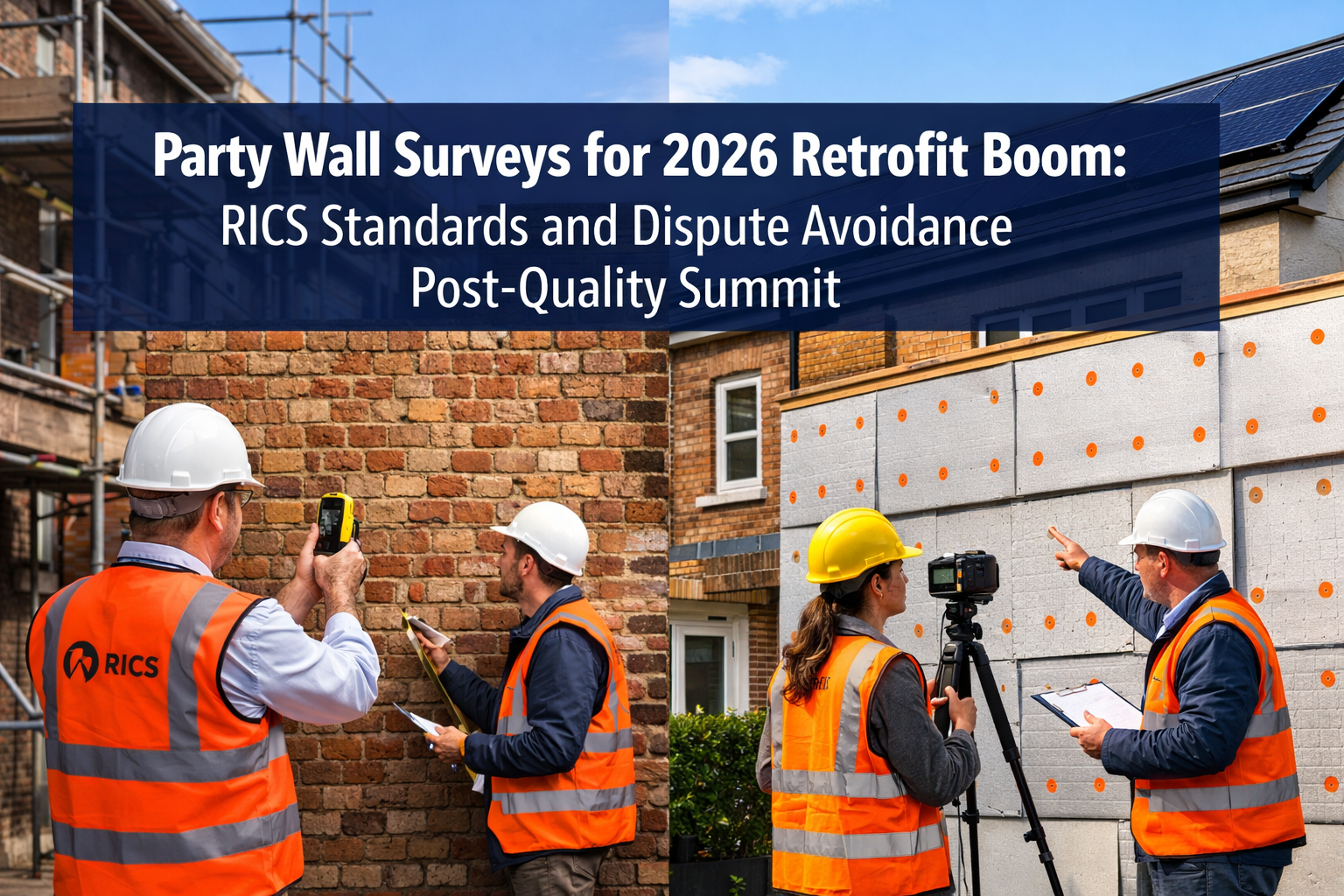
The construction landscape across the United Kingdom is experiencing a significant transformation in 2026, driven by ambitious energy efficiency targets and government incentives for property retrofitting. As homeowners and developers rush to upgrade existing properties with improved insulation, renewable energy systems, and structural modifications, party wall surveys have emerged as a critical component of successful project delivery. The Party Wall Surveys for 2026 Retrofit Boom: RICS Standards and Dispute Avoidance Post-Quality Summit brings together decades of professional guidance with contemporary challenges, creating a comprehensive framework for navigating shared property boundaries during this unprecedented wave of renovation activity.
With flat new construction rates but soaring retrofit demand, understanding the intersection of RICS professional standards and party wall legislation has never been more important. Property owners, surveyors, and contractors must work together to ensure that improvement works proceed smoothly while protecting the interests of all parties involved.
Key Takeaways
✅ RICS standards provide essential guidance for party wall surveyors managing the 2026 retrofit boom, with updated procedures addressing modern construction techniques and energy efficiency installations.
✅ Proper party wall procedures prevent costly disputes by establishing clear documentation, condition schedules, and communication protocols before renovation work begins.
✅ The retrofit boom creates unique party wall challenges including external wall insulation, solar panel installations, and structural modifications that require specialist surveying expertise.
✅ Early engagement with expert party wall surveyors significantly reduces project delays and neighbour conflicts during retrofit projects.
✅ Post-Quality Summit guidance emphasizes dispute avoidance through transparent processes, comprehensive condition surveys, and adherence to the Party Wall etc. Act 1996 framework.
Understanding the 2026 Retrofit Boom and Party Wall Implications
The construction industry in 2026 faces a unique paradox: while new build activity remains relatively flat, renovation and retrofit projects are experiencing unprecedented growth. This surge stems from multiple converging factors including government energy efficiency mandates, rising energy costs, and increased awareness of environmental sustainability. For property surveyors and homeowners alike, this shift has profound implications for party wall procedures.
The Scale of Retrofit Activity
Industry forecasts indicate that retrofit activity in 2026 will exceed previous years by substantial margins, with particular concentration in urban areas where terraced and semi-detached properties share party walls. The demand for energy-efficient upgrades—including external wall insulation, loft conversions with enhanced thermal performance, and basement excavations for additional living space—all trigger party wall considerations under the Party Wall etc. Act 1996.
According to recent construction sector analysis, the retrofit boom is particularly pronounced in London and other major metropolitan areas where property values justify significant investment in upgrades [4]. This concentration of activity in densely built environments means that party wall surveys have become an essential part of project planning rather than an afterthought.
Why Retrofit Projects Trigger Party Wall Requirements
Many homeowners embarking on retrofit projects are surprised to discover that their planned improvements require formal party wall procedures. The most common retrofit works that engage the Party Wall Act include:
- External wall insulation (EWI) systems that extend beyond the property boundary or affect shared walls
- Loft conversions requiring structural alterations to party walls or roof structures
- Basement excavations within three or six meters of neighbouring foundations
- Solar panel installations that require structural modifications to shared roof structures
- Window and door replacements in party walls
- Structural reinforcement for energy efficiency improvements
Each of these common retrofit scenarios requires careful assessment by qualified professionals who understand both the technical requirements of modern construction and the legal framework governing shared boundaries.
RICS Standards as the Professional Foundation
The Royal Institution of Chartered Surveyors (RICS) maintains comprehensive professional standards that govern how party wall surveyors conduct their work. The RICS Party Wall Legislation and Procedure standard, most recently reissued in May 2023, provides the authoritative guidance for surveyors navigating disputes and agreements under the Act [2].
These standards establish clear expectations for:
- Professional conduct and impartiality
- Documentation and record-keeping requirements
- Communication protocols with all parties
- Technical assessment methodologies
- Award preparation and dispute resolution
For property owners undertaking retrofit projects, engaging RICS surveyors ensures that party wall procedures meet professional standards and provide robust legal protection for all parties involved.
Party Wall Surveys for 2026 Retrofit Boom: RICS Standards and Professional Obligations
The convergence of the 2026 retrofit boom with established RICS professional standards creates both opportunities and challenges for building surveyors. Understanding the specific obligations that RICS members must fulfill when conducting party wall surveys ensures that retrofit projects proceed with appropriate safeguards and dispute avoidance mechanisms.
The RICS Framework for Party Wall Surveyors
RICS building surveying standards establish a comprehensive framework that governs every aspect of party wall work [6]. These standards complement the statutory requirements of the Party Wall etc. Act 1996 by adding professional obligations that exceed basic legal compliance.
Key professional obligations include:
| Obligation | Description | Retrofit Application |
|---|---|---|
| Impartiality | Surveyors must act fairly between building owner and adjoining owner | Critical when assessing impact of EWI or structural modifications |
| Competence | Surveyors must possess appropriate technical knowledge | Essential for evaluating modern retrofit techniques and materials |
| Documentation | Comprehensive records of all inspections, communications, and decisions | Protects all parties if disputes arise during or after works |
| Timeliness | Adherence to statutory timeframes and prompt responses | Prevents project delays in fast-moving retrofit schedules |
| Transparency | Clear explanation of processes, rights, and obligations | Reduces anxiety and misunderstandings between neighbours |
Conducting Pre-Works Condition Surveys
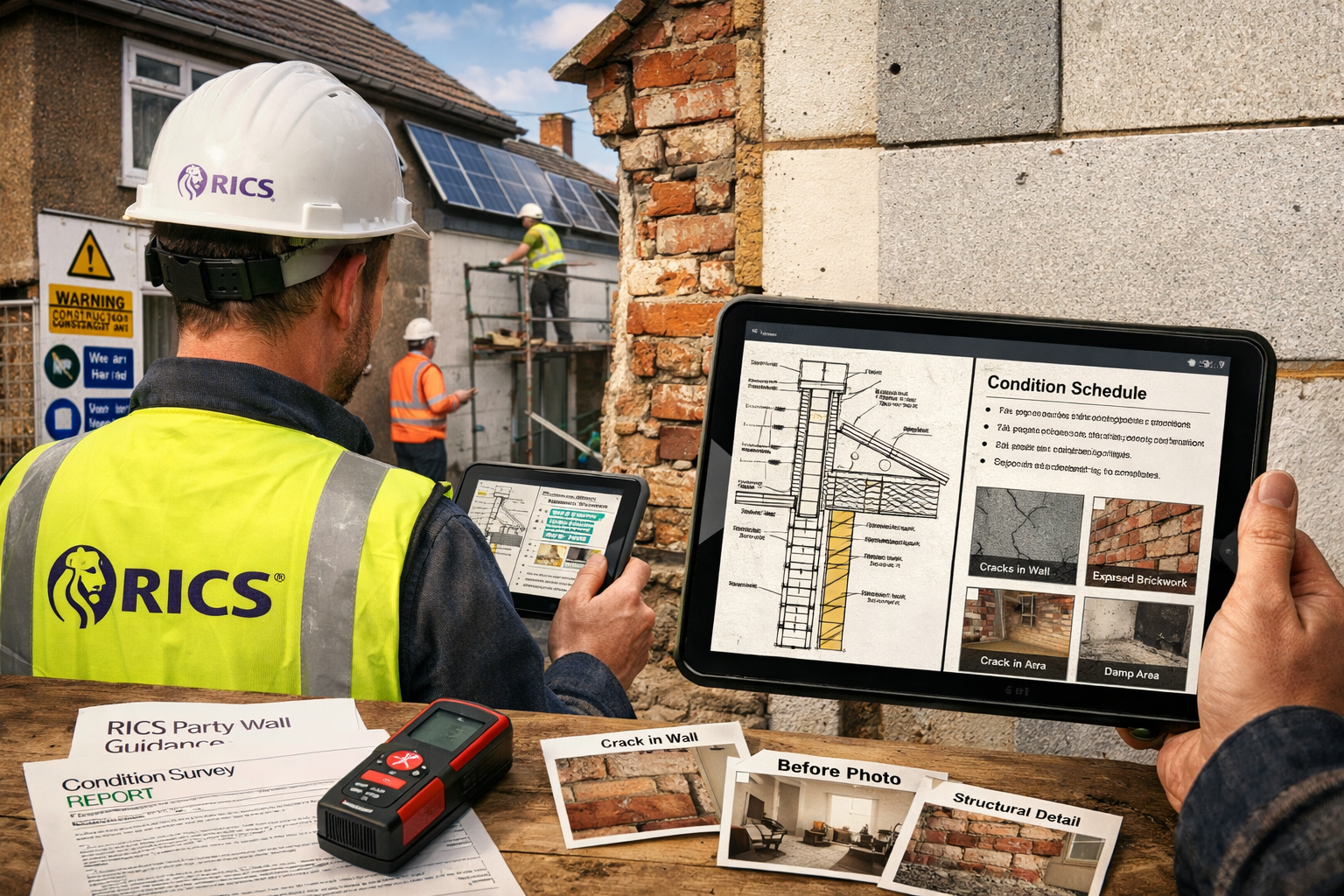
One of the most critical elements of party wall procedure for retrofit projects is the schedule of condition. This detailed photographic and written record documents the state of neighbouring properties before any work commences, providing essential evidence if damage claims arise later.
For retrofit projects, condition surveys must pay particular attention to:
🔍 Existing crack patterns that might be exacerbated by vibration or structural loading
🔍 Moisture levels in walls that could be affected by new insulation or waterproofing
🔍 Structural elements that will be impacted by excavation or loading changes
🔍 Decorative finishes vulnerable to vibration from drilling or construction activity
🔍 External features including render, brickwork, and architectural details
The expert party wall advice provided during this stage can prevent misunderstandings about the cause of any defects that appear during or after construction.
The Party Wall Award Process
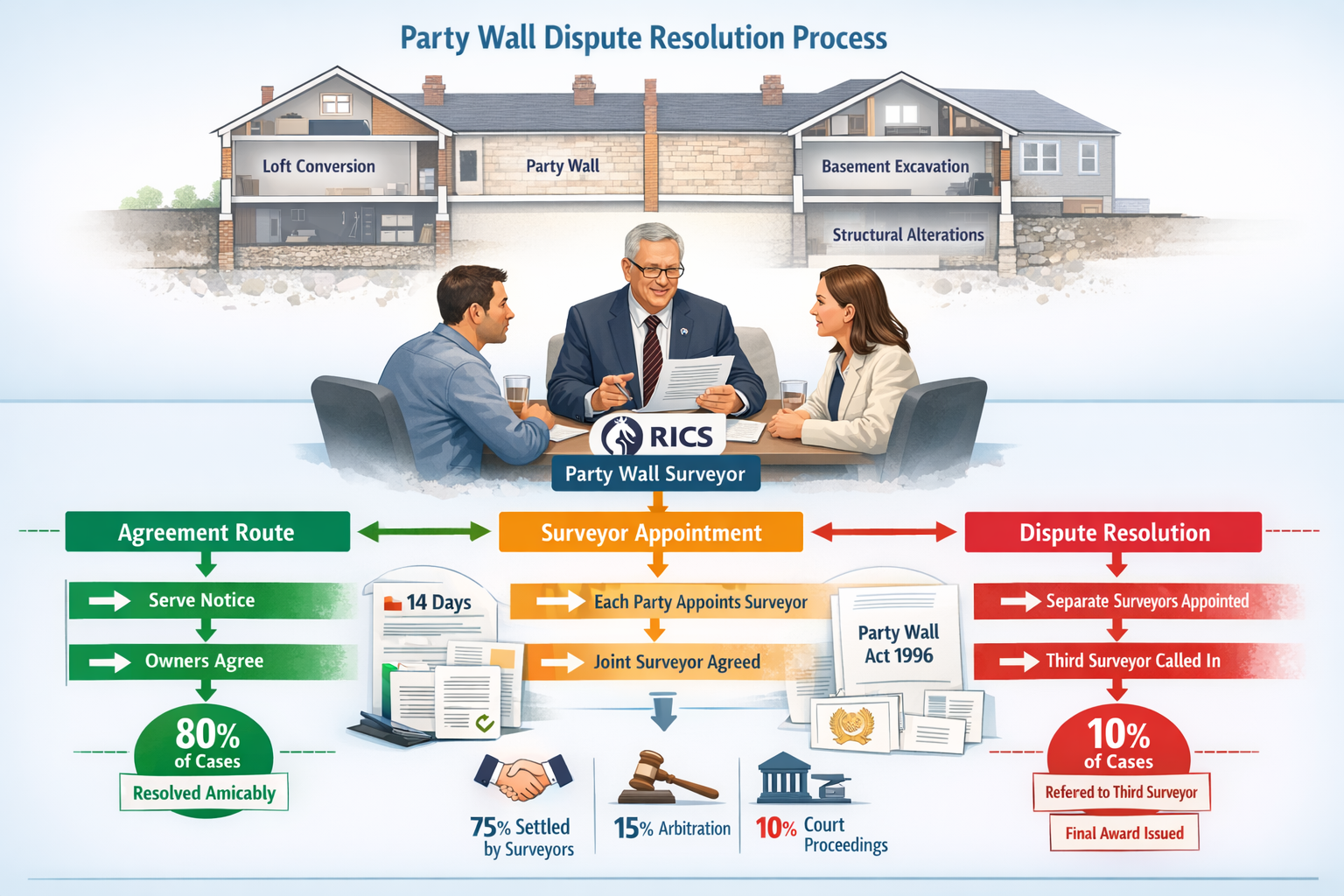
When agreement cannot be reached between neighbours, or when the adjoining owner appoints their own surveyor, the formal award process begins. The party wall award is a legal document that sets out precisely what work will be undertaken, how it will be executed, and what protections are in place for the adjoining owner.
For retrofit projects in 2026, awards increasingly address modern construction techniques that weren't contemplated when the Act was drafted in 1996. RICS guidance helps surveyors navigate these contemporary scenarios [2].
A comprehensive party wall award for a retrofit project typically includes:
✅ Detailed description of the proposed works with technical specifications
✅ Schedule of condition documenting pre-works state of adjoining properties
✅ Working hours and access arrangements
✅ Protection measures for adjoining properties
✅ Monitoring arrangements for vibration, noise, or structural movement
✅ Dispute resolution procedures if issues arise during works
✅ Cost allocation for surveyor fees and any necessary remedial works
RICS Home Survey Standards and Party Wall Integration
While the RICS Home Survey Standard launched in June 2021 primarily addresses residential property inspections for purchase purposes [1], it establishes important principles that inform party wall practice. The emphasis on clear communication, standardized reporting, and professional competence translates directly to party wall work.
Surveyors conducting RICS property valuations increasingly encounter properties mid-retrofit or with planned improvement works. Understanding how party wall procedures intersect with property valuation and condition assessment has become essential professional knowledge.
Dispute Avoidance Through Professional Standards
The Post-Quality Summit emphasis on dispute avoidance reflects a broader industry recognition that prevention is far more effective than resolution. RICS standards promote several key practices that minimize conflict:
Early engagement: Initiating party wall procedures well before construction commencement allows time for questions, concerns, and negotiations.
Clear communication: Using plain language to explain technical matters and legal rights reduces misunderstandings.
Comprehensive documentation: Thorough photographic and written records protect all parties from unfounded claims.
Professional impartiality: Independent surveyors who maintain neutrality build trust and facilitate agreement.
Technical competence: Surveyors with deep knowledge of both traditional and modern construction methods provide authoritative guidance.
For property owners planning retrofit projects, understanding these professional standards provides confidence that their surveyor will navigate complex situations with appropriate expertise and ethical conduct.
Practical Dispute Avoidance Strategies for Retrofit Projects
The Party Wall Surveys for 2026 Retrofit Boom: RICS Standards and Dispute Avoidance Post-Quality Summit highlights that while robust procedures and professional standards provide the framework for successful party wall management, practical implementation determines actual outcomes. Retrofit projects present unique challenges that require proactive dispute avoidance strategies.
Pre-Project Neighbour Engagement
The single most effective dispute avoidance strategy is early and transparent communication with neighbours. Before formal party wall notices are served, informal discussions can address concerns, explain benefits, and build goodwill.
Effective pre-project engagement includes:
💬 Personal meetings to explain the planned retrofit works and their purpose
💬 Visual materials showing what the completed project will look like
💬 Timeline information so neighbours can plan around disruption
💬 Contact details for the project manager and party wall surveyor
💬 Explanation of rights under the Party Wall Act without legal jargon
This human-centered approach, while not replacing formal procedures, significantly reduces the likelihood of disputes arising from fear, misunderstanding, or feeling excluded from the process.
Selecting the Right Party Wall Surveyor
The choice of party wall surveyor profoundly impacts project success. For retrofit projects involving modern construction techniques, specialist expertise becomes particularly important. Property owners should consider:
Professional qualifications: RICS membership ensures adherence to professional standards and ethical conduct. Engaging party wall surveyor responsibilities that are clearly understood and professionally executed provides essential protection.
Retrofit experience: Surveyors familiar with external wall insulation, solar installations, and energy efficiency modifications understand the specific challenges these works present.
Local knowledge: Understanding regional construction practices and common building types helps surveyors anticipate issues.
Communication skills: The ability to explain technical matters clearly to non-specialists reduces anxiety and builds trust.
Availability: Responsive surveyors who address concerns promptly prevent small issues from escalating.
When considering London party wall surveyor costs, property owners should recognize that experienced professionals provide value that far exceeds their fees through dispute avoidance and efficient project progression.
Managing Common Retrofit-Specific Challenges
Certain retrofit scenarios create predictable party wall challenges that proactive management can address:
External Wall Insulation (EWI) Systems
EWI installations frequently raise concerns about:
- Boundary encroachment when insulation extends beyond the property line
- Aesthetic impact on neighbouring properties
- Water management and potential damp issues
- Fire safety considerations for shared walls
Addressing these concerns requires technical expertise in modern insulation systems combined with clear communication about building regulations compliance and long-term benefits.
Loft Conversions and Roof Alterations
Retrofit loft conversions often involve party wall issues including:
- Party wall height increases for headroom
- Structural modifications to shared roof structures
- Sound insulation requirements between properties
- Access arrangements for construction
Detailed technical specifications in the party wall award, combined with high-quality workmanship, prevent disputes about noise transmission or structural integrity.
Basement Excavations and Underpinning
Basement excavations for additional living space trigger some of the most complex party wall scenarios:
- Foundation proximity requiring careful excavation sequencing
- Structural monitoring of neighbouring properties
- Vibration management during excavation
- Waterproofing to prevent damp migration
These projects benefit enormously from experienced surveyors who can specify appropriate protection measures and monitoring protocols.
Documentation and Evidence Management
Comprehensive documentation provides essential protection if disputes arise despite best efforts at prevention. Modern party wall practice increasingly employs:
📸 Photographic schedules of condition with time-stamped digital images
📸 Video walkthroughs of neighbouring properties before works commence
📸 Structural monitoring data from crack gauges or vibration sensors
📸 Daily site logs recording activities and any incidents
📸 Communication records documenting all interactions with neighbours
This evidence base, while requiring investment in time and resources, provides invaluable protection against unfounded damage claims and supports rapid resolution of legitimate concerns.
The Role of Building Regulations and Planning Permission
While party wall procedures operate independently of building regulations and planning permission, successful retrofit projects require coordination across all regulatory frameworks. Surveyors who understand these intersections help property owners navigate complex compliance requirements.
For example, external wall insulation may require:
- Planning permission in conservation areas or for listed buildings
- Building regulations approval for fire safety and thermal performance
- Party wall procedures for boundary encroachment or structural modifications
Coordinating these separate processes prevents delays and ensures comprehensive legal compliance. Understanding legal requirements across all relevant frameworks demonstrates professional competence.
Handling Disputes When They Arise
Despite best efforts at prevention, some disputes inevitably occur. RICS standards provide clear guidance on dispute resolution procedures that maintain professional relationships while protecting legal rights [3].
When disputes arise, effective management includes:
⚖️ Immediate acknowledgment of the concern without admission of liability
⚖️ Independent assessment by qualified professionals
⚖️ Evidence-based evaluation using pre-works condition records
⚖️ Proportionate remediation addressing actual damage rather than perceived issues
⚖️ Clear communication throughout the resolution process
The party wall award mechanism provides a structured framework for resolving disagreements without resorting to litigation, saving time, money, and neighbourly relationships.
Insurance and Risk Management
Comprehensive insurance coverage provides additional protection for retrofit projects. Property owners should ensure:
🛡️ Contractor's liability insurance covers party wall damage
🛡️ Professional indemnity insurance for party wall surveyors
🛡️ Building owner's insurance includes renovation cover
🛡️ Legal expenses insurance for dispute resolution if required
Understanding insurance coverage before work commences prevents unpleasant surprises if claims arise.
Emerging Trends and Future Developments
The Party Wall Surveys for 2026 Retrofit Boom: RICS Standards and Dispute Avoidance Post-Quality Summit represents a snapshot of current best practice, but the field continues to evolve. Several emerging trends are shaping the future of party wall surveying in the context of property retrofitting.
Digital Technology in Party Wall Surveys
Modern surveying increasingly employs digital tools that enhance accuracy and efficiency:
3D laser scanning creates precise records of existing conditions
Drone photography documents external features and roof conditions
Digital collaboration platforms facilitate communication between surveyors, contractors, and property owners
Building Information Modeling (BIM) integrates party wall considerations into comprehensive project planning
Automated monitoring systems track structural movement or vibration in real-time
These technologies, while requiring investment in equipment and training, provide unprecedented accuracy and documentation quality that supports dispute avoidance.
Climate Change and Retrofit Intensity
The drive toward net-zero carbon emissions will intensify retrofit activity beyond 2026, creating sustained demand for party wall expertise. Future retrofit projects may involve:
🌱 Heat pump installations requiring structural modifications
🌱 Advanced ventilation systems penetrating party walls
🌱 Battery storage systems in basements or lofts
🌱 Green roofs and walls on shared structures
🌱 Whole-building retrofit packages combining multiple interventions
Surveyors who develop expertise in these emerging technologies will be well-positioned to serve the growing retrofit market.
Regulatory Evolution
While the Party Wall etc. Act 1996 provides the statutory framework, regulatory guidance continues to evolve. RICS standards adapt to address contemporary challenges, with recent updates reflecting modern construction practices and dispute resolution approaches [5].
Future regulatory developments may address:
- Digital service of notices replacing paper-based processes
- Standardized award templates for common retrofit scenarios
- Enhanced protection for heritage buildings undergoing retrofit
- Accelerated procedures for minor works
- Environmental impact assessment integration with party wall procedures
Staying current with these developments requires ongoing professional development and engagement with industry bodies.
The Quality Summit Legacy
While specific details of the Quality Summit referenced in current discussions remain limited in public documentation, the emphasis on quality standards and dispute avoidance reflects broader industry priorities. The summit approach—bringing together practitioners, regulators, and stakeholders to develop best practice guidance—represents an effective model for addressing emerging challenges.
Key themes emerging from quality-focused industry discussions include:
✨ Standardization of procedures across different regions and property types
✨ Competency frameworks ensuring surveyors possess appropriate knowledge
✨ Consumer protection through clear explanations of rights and processes
✨ Efficiency improvements reducing delays and costs
✨ Sustainability integration aligning party wall procedures with environmental goals
These themes will likely shape party wall practice for years to come, influencing both RICS standards and statutory frameworks.
Cross-Border Considerations
The Party Wall etc. Act 1996 applies only in England and Wales, with Scotland and Northern Ireland operating under different frameworks. As retrofit activity intensifies across the United Kingdom, understanding these jurisdictional differences becomes increasingly important for surveyors working across regions.
Professional bodies including RICS provide guidance on regional variations, ensuring that surveyors maintain appropriate competence regardless of location.
The Economic Impact of Effective Party Wall Management
Efficient party wall procedures contribute significantly to project economics. Research indicates that disputes can add months to project timelines and thousands of pounds to costs through delays, legal fees, and remediation work [4].
Conversely, well-managed party wall processes:
💰 Reduce project delays through early issue identification
💰 Minimize legal costs by avoiding formal dispute resolution
💰 Protect property values by preventing damage and maintaining good neighbour relations
💰 Enable project financing by demonstrating comprehensive risk management
💰 Support planning applications by showing stakeholder engagement
For the retrofit boom to achieve its full potential in improving energy efficiency and housing quality, effective party wall management must be recognized as an essential component of project success rather than a bureaucratic obstacle.
Integrating Party Wall Surveys with Broader Property Assessment
The Party Wall Surveys for 2026 Retrofit Boom: RICS Standards and Dispute Avoidance Post-Quality Summit exists within a broader ecosystem of property assessment and surveying services. Understanding how party wall procedures integrate with other professional services helps property owners plan comprehensive retrofit projects.
Relationship with Structural Surveys
Party wall surveys focus specifically on shared boundaries and the impact of proposed works on neighbouring properties. However, they often intersect with broader structural surveys that assess overall building condition.
For retrofit projects, a comprehensive structural survey might identify:
🔨 Load-bearing capacity limitations affecting loft conversion feasibility
🔨 Foundation condition relevant to basement excavation planning
🔨 Existing structural movement that party wall works might exacerbate
🔨 Hidden defects that could complicate planned improvements
🔨 Building regulation compliance issues requiring remediation
Coordinating party wall procedures with structural assessment ensures that all technical considerations are addressed before work commences.
Boundary Disputes and Party Wall Issues
While party wall procedures operate under specific statutory frameworks, they sometimes intersect with broader boundary disputes. Clarity about property boundaries is essential before serving party wall notices or undertaking works that might encroach on neighbouring land.
Professional surveyors can provide boundary dispute resolution services that establish clear property lines before retrofit work begins, preventing confusion and potential legal challenges.
Monitoring Surveys During Retrofit Works
For complex retrofit projects involving significant structural work, ongoing monitoring surveys provide additional protection. Monitoring surveys track structural movement, crack development, or settlement during construction, providing early warning of potential issues.
This proactive approach allows rapid intervention if problems develop, preventing minor issues from escalating into major disputes or structural damage.
Specific Defect Surveys
If damage occurs during retrofit works, specific defect surveys provide detailed technical assessment of the nature, extent, and cause of defects. These surveys support insurance claims, dispute resolution, or remediation planning.
The pre-works schedule of condition provides essential baseline data for these assessments, enabling surveyors to distinguish between pre-existing conditions and construction-related damage.
The Value of Comprehensive Professional Advice
Property owners planning significant retrofit projects benefit enormously from comprehensive professional advice that addresses all relevant considerations. Why choose RICS surveyors becomes clear when considering the breadth of expertise and professional standards they bring to complex projects.
RICS members operate under strict professional standards, maintain appropriate insurance, engage in continuing professional development, and adhere to ethical codes that protect consumer interests [7].
Case Studies: Lessons from the 2026 Retrofit Boom
Examining real-world scenarios from the 2026 retrofit boom illustrates how party wall procedures operate in practice and highlights the value of professional expertise and dispute avoidance strategies.
Case Study 1: External Wall Insulation in Victorian Terrace
Scenario: A homeowner in a Victorian terrace planned to install external wall insulation to improve energy efficiency and reduce heating costs. The insulation system would extend approximately 150mm beyond the existing wall surface, encroaching on the boundary with neighbouring properties on both sides.
Party Wall Approach: The building owner engaged a qualified party wall surveyor who:
- Served appropriate notices under the Party Wall Act
- Prepared detailed technical specifications for the insulation system
- Conducted comprehensive schedules of condition for both neighbouring properties
- Explained the benefits and minimal impact of the works to neighbours
- Prepared party wall awards with clear protection measures
Outcome: One neighbour consented to the works, while the other appointed their own surveyor. The two surveyors worked collaboratively to prepare an agreed award that addressed concerns about aesthetics, water management, and potential damp issues. Works proceeded smoothly with no disputes, and the monitoring inspection confirmed no damage to neighbouring properties.
Lessons: Early professional engagement, clear communication, and comprehensive documentation enabled a potentially contentious project to proceed without conflict.
Case Study 2: Loft Conversion with Party Wall Modifications
Scenario: A semi-detached property owner planned a loft conversion requiring modifications to the party wall, including raising the wall height by 600mm to achieve adequate headroom and installing steel beams that would be supported on the party wall.
Party Wall Approach: The appointed surveyor:
- Identified all works requiring party wall procedures
- Coordinated with the structural engineer to minimize party wall impact
- Prepared detailed structural specifications and construction methodology
- Conducted extensive pre-works photographic survey
- Specified vibration monitoring during construction
Outcome: The neighbouring owner initially expressed concerns about structural safety and noise transmission. The party wall surveyor arranged a meeting with the structural engineer who explained the design approach and building regulations compliance. Enhanced sound insulation was specified in the award, exceeding minimum requirements. Post-completion inspection confirmed excellent workmanship and no damage to the neighbouring property.
Lessons: Technical expertise combined with willingness to exceed minimum standards built trust and prevented disputes despite initial concerns.
Case Study 3: Basement Excavation Dispute and Resolution
Scenario: A basement excavation project for a terraced property proceeded without proper party wall procedures. Midway through construction, the neighbour noticed cracks appearing and raised concerns about structural damage.
Party Wall Approach: An independent party wall surveyor was appointed retrospectively to:
- Assess the nature and cause of the observed cracking
- Review the excavation methodology and foundation protection measures
- Compare current condition against available pre-existing photographs
- Recommend remedial measures and ongoing monitoring
Outcome: The investigation revealed that some cracking was pre-existing (visible in estate agent photographs from the property's previous sale), while other cracks resulted from inadequate temporary support during excavation. The building owner funded remedial works including crack repair and foundation stabilization. A formal party wall award was prepared to govern completion of the works.
Lessons: Retrospective party wall procedures are far more expensive and stressful than proper advance planning. The lack of a comprehensive schedule of condition complicated damage assessment and increased costs.
Practical Guidance for Property Owners
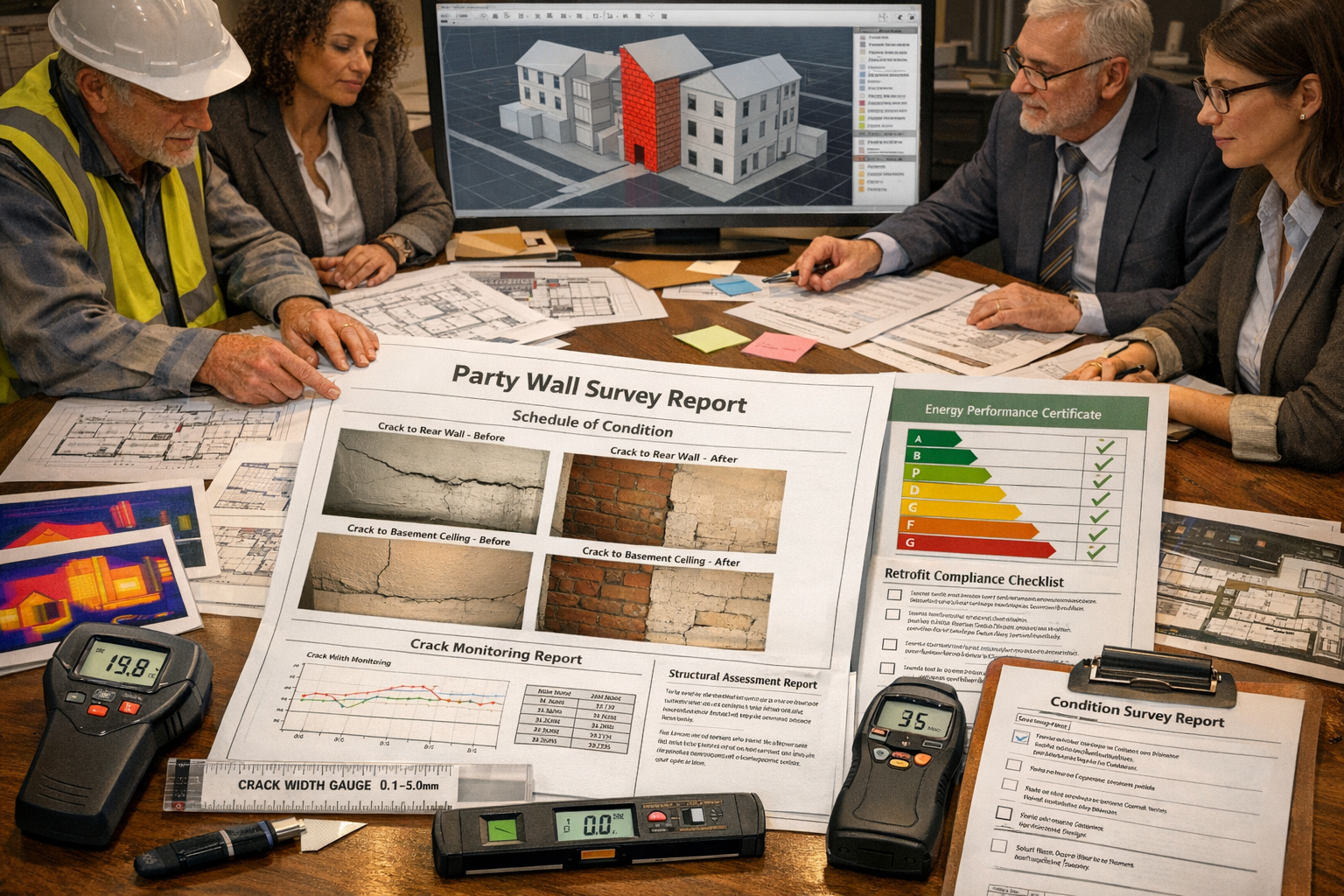
For property owners planning retrofit projects in 2026 and beyond, understanding party wall requirements and best practices is essential for project success. This practical guidance distills key recommendations into actionable steps.
Step 1: Identify Party Wall Requirements Early
Before finalizing retrofit plans, determine whether party wall procedures will be required. Common triggers include:
- Works directly to a party wall (cutting into, building on, or modifying)
- Excavations within 3 meters of a neighbouring building if going deeper than its foundations
- Excavations within 6 meters if cutting through the 45-degree plane of neighbouring foundations
- New walls at or astride the boundary line
Consulting with construction projects specialists early in planning prevents costly redesigns later.
Step 2: Engage Professional Surveyors
Select a qualified party wall surveyor with:
✓ RICS membership and appropriate professional indemnity insurance
✓ Specific experience with retrofit projects and modern construction techniques
✓ Local knowledge of building types and common issues
✓ Clear fee structure and scope of services
✓ Strong communication skills and dispute resolution experience
Professional fees represent a small fraction of total project costs but provide invaluable protection and expertise.
Step 3: Communicate with Neighbours
Before serving formal notices, discuss planned works with neighbours:
- Explain the purpose and benefits of the retrofit project
- Describe the work methodology and expected timeline
- Address concerns and answer questions
- Provide contact information for ongoing communication
- Emphasize commitment to minimizing disruption
This human approach builds goodwill and reduces the likelihood of formal disputes.
Step 4: Serve Proper Notices
Party wall notices must be served at least two months before work commences (or one month for certain works). Notices should include:
📋 Clear description of proposed works
📋 Planned commencement date
📋 Contact information for the building owner and surveyor
📋 Explanation of the neighbour's rights under the Act
Professional surveyors ensure notices meet statutory requirements and are properly served.
Step 5: Complete Schedules of Condition
Comprehensive photographic and written records of neighbouring properties before work commences provide essential protection. These should document:
- External elevations from multiple angles
- Internal rooms adjacent to party walls
- Existing cracks, stains, or defects
- Decorative condition
- Structural elements
Time-stamped digital photography provides reliable evidence if disputes arise.
Step 6: Obtain Party Wall Awards
If neighbours appoint their own surveyor or dissent from the proposed works, a formal party wall award is required. This legal document should specify:
- Detailed work descriptions
- Protection measures for neighbouring properties
- Working hours and access arrangements
- Monitoring procedures
- Dispute resolution mechanisms
Awards provide legal authority to proceed and protect all parties' interests.
Step 7: Execute Works Professionally
During construction, maintain high standards:
🏗️ Employ qualified, insured contractors
🏗️ Adhere to specifications in the party wall award
🏗️ Minimize noise, dust, and disruption
🏗️ Maintain open communication with neighbours
🏗️ Address concerns promptly
🏗️ Keep detailed site records
Professional execution prevents issues and demonstrates commitment to responsible construction.
Step 8: Complete Post-Works Inspections
After construction completion, the party wall surveyor should:
- Inspect neighbouring properties for any damage
- Compare condition against pre-works schedules
- Address any legitimate concerns
- Prepare final documentation
- Facilitate resolution of any outstanding issues
This formal closure provides peace of mind for all parties.
The Broader Context: Retrofit Policy and Market Drivers
The Party Wall Surveys for 2026 Retrofit Boom: RICS Standards and Dispute Avoidance Post-Quality Summit exists within a broader policy and market context that shapes retrofit activity and party wall demand.
Government Policy and Retrofit Incentives
Government policies driving the 2026 retrofit boom include:
🏛️ Energy Performance Certificate (EPC) requirements for rental properties
🏛️ Grant schemes supporting insulation and renewable energy installations
🏛️ Building regulations mandating improved energy efficiency for renovations
🏛️ Net-zero targets creating long-term retrofit demand
🏛️ Stamp duty incentives for energy-efficient properties
These policies create sustained market demand for retrofit services, with corresponding party wall implications.
Market Economics of Retrofitting
Rising energy costs make retrofit investments increasingly attractive:
- External wall insulation can reduce heating costs by 30-40%
- Solar panels provide long-term energy cost savings
- Improved properties command premium sale and rental values
- Green mortgages offer favorable financing terms
- Government grants reduce upfront investment requirements
These economic drivers ensure continued retrofit activity beyond 2026, creating sustained demand for party wall expertise.
Skills and Capacity Challenges
The retrofit boom creates capacity challenges across the construction sector:
- Shortage of qualified party wall surveyors with retrofit expertise
- Limited contractor capacity for specialist retrofit techniques
- Training requirements for new construction methods
- Quality assurance challenges with rapid market growth
Addressing these capacity constraints requires investment in professional development and industry training initiatives.
Conclusion: Navigating the 2026 Retrofit Boom Successfully
The Party Wall Surveys for 2026 Retrofit Boom: RICS Standards and Dispute Avoidance Post-Quality Summit represents the convergence of ambitious energy efficiency goals, established legal frameworks, and evolving professional standards. As property owners across the United Kingdom undertake essential retrofit improvements, understanding party wall requirements and best practices becomes critical for project success.
Key principles for successful party wall management include:
🎯 Early engagement with professional surveyors and neighbours
🎯 Comprehensive documentation through schedules of condition and photographic records
🎯 Professional expertise from RICS-qualified surveyors with retrofit experience
🎯 Clear communication explaining technical matters in accessible language
🎯 Adherence to standards following RICS guidance and statutory requirements
🎯 Proactive dispute avoidance through transparency and fair dealing
🎯 Quality execution employing qualified contractors and maintaining high standards
The retrofit boom presents both challenges and opportunities. Property owners who approach party wall requirements as an essential component of responsible project delivery—rather than a bureaucratic obstacle—will find that proper procedures protect their interests, maintain good neighbour relations, and enable successful project completion.
Actionable Next Steps
For property owners planning retrofit projects:
-
Assess party wall requirements for your planned works as early as possible in project planning
-
Engage qualified professionals including expert party wall surveyors with retrofit experience
-
Communicate proactively with neighbours before serving formal notices
-
Budget appropriately for party wall surveyor fees, typically a small percentage of total project costs
-
Allow sufficient time for party wall procedures in your project schedule (minimum 2-3 months)
-
Maintain comprehensive records throughout the process
-
Prioritize quality in both professional advice and construction execution
For surveyors and construction professionals:
-
Develop retrofit expertise through continuing professional development and practical experience
-
Stay current with RICS standards updates and industry best practices
-
Invest in technology that enhances documentation quality and efficiency
-
Build collaborative relationships with other professionals in the retrofit ecosystem
-
Emphasize dispute avoidance through clear communication and comprehensive procedures
-
Contribute to industry development by sharing knowledge and participating in professional forums
The 2026 retrofit boom represents a critical opportunity to improve the United Kingdom's housing stock, reduce carbon emissions, and enhance energy security. Effective party wall management—grounded in RICS professional standards and focused on dispute avoidance—enables this essential work to proceed smoothly, protecting the interests of building owners, neighbours, and the broader community.
By understanding the intersection of statutory requirements, professional standards, and practical project delivery, all stakeholders can contribute to successful retrofit outcomes that benefit individual properties and advance national sustainability goals.
References
[1] The New Rics Home Survey Standard Explained – https://www.surveymerchant.com/blog/the-new-rics-home-survey-standard-explained
[2] Party Wall Legislation And Procedure – https://www.rics.org/profession-standards/rics-standards-and-guidance/sector-standards/building-surveying-standards/party-wall-legislation-and-procedure
[3] Party Wall Agreement – https://hoa.org.uk/advice/guides-for-homeowners/i-am-improving/party-wall-agreement/
[4] Party Wall Surveys Amid 2026 Construction Boom Handling Disputes In High Demand Uk Housing Markets – https://nottinghillsurveyors.com/blog/party-wall-surveys-amid-2026-construction-boom-handling-disputes-in-high-demand-uk-housing-markets
[5] The Evolution Of Surveying Decisive Milestones In Rics Standards – https://www.adamjoseph.co.uk/the-evolution-of-surveying-decisive-milestones-in-rics-standards
[6] Building Surveying Standards – https://www.rics.org/profession-standards/rics-standards-and-guidance/sector-standards/building-surveying-standards
[7] Home Survey Standards – https://www.rics.org/profession-standards/rics-standards-and-guidance/sector-standards/building-surveying-standards/home-surveys/home-survey-standards