
Northern England is experiencing a construction renaissance in 2026, with loft conversions leading the charge in creating valuable living space across terraced properties. As Manchester, Leeds, Newcastle, and Sheffield witness unprecedented buyer confidence and development activity, Party Wall Surveys for 2026 Loft Conversions in Northern Growth Markets: RICS Protocols in High-Demand Regions have become essential safeguards for homeowners navigating complex neighbour relationships and legal requirements. This surge in construction demand has created a parallel increase in party wall surveyor appointments, making professional guidance more critical than ever.
The combination of rising property values, limited housing stock, and the appeal of adding extra bedrooms without relocating has transformed loft conversions into one of the most popular home improvement projects across Northern growth markets. However, the very nature of terraced housing—with shared party walls separating properties—means that even straightforward loft projects require careful legal navigation under the Party Wall Act 1996.
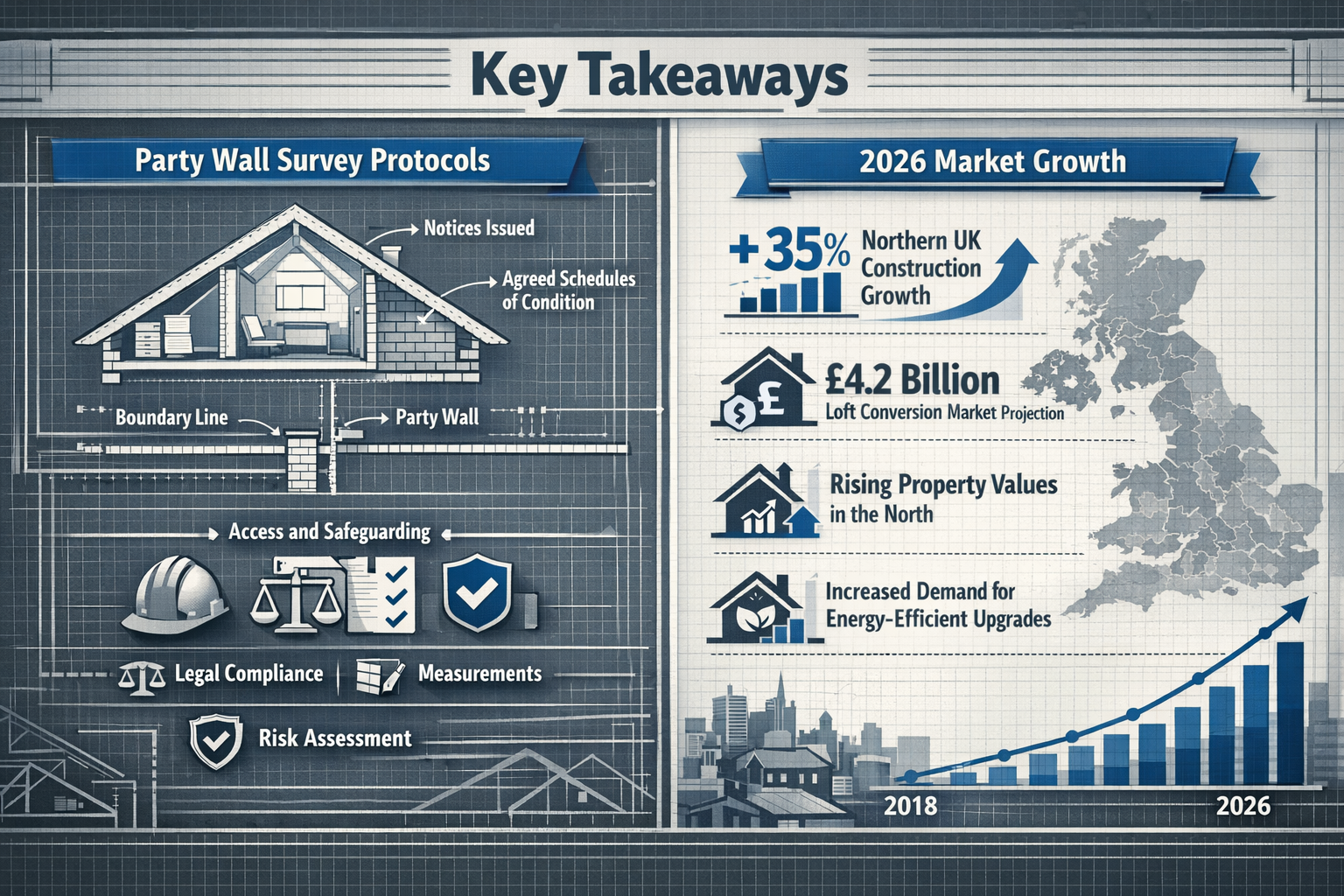
Key Takeaways
- ✅ Mandatory Notice Period: Loft conversions affecting party walls require a Party Structure Notice served at least 2 months before work begins, regardless of Permitted Development status[3]
- 📋 RICS Professional Standards: Only MRICS or FRICS chartered surveyors should be appointed under the Party Wall Act to ensure professional credibility and proper dispute resolution[1]
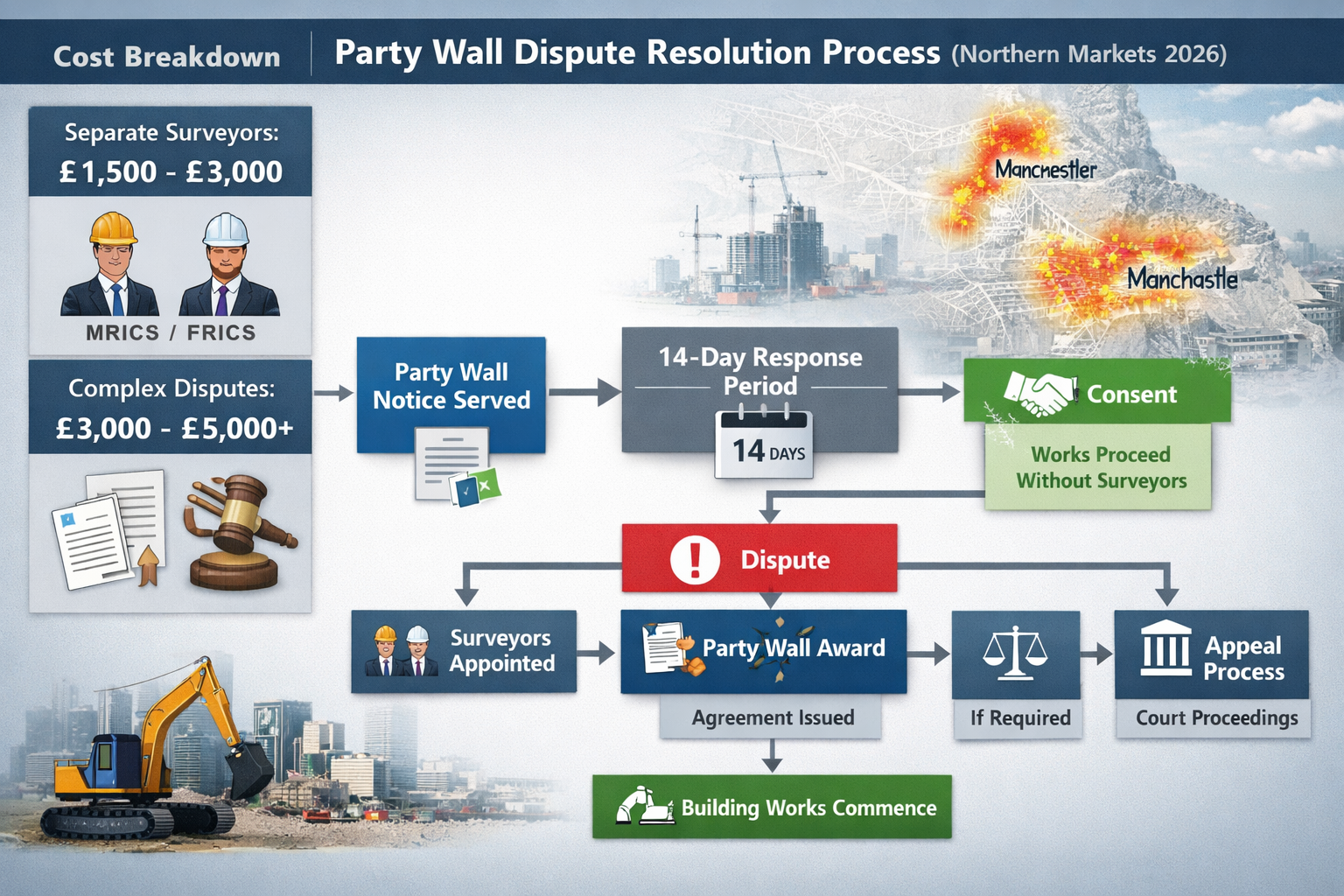
- ⏰ 14-Day Response Window: Neighbours have 14 days to respond to party wall notices; non-response automatically triggers a dispute requiring formal surveyor appointment[4]
- 💰 Cost Transparency: Separate surveyor appointments typically cost £1,500-£3,000, while complex disputes requiring a third surveyor can reach £3,000-£5,000+[3]
- 🏗️ 2026 Market Context: Northern England's construction boom has increased party wall surveyor demand, making early planning and professional engagement essential for project success[2]
Understanding Party Wall Requirements for Loft Conversions in Northern Markets
What Triggers Party Wall Act Obligations?
Loft conversions in terraced properties across Northern England almost invariably trigger Party Wall Act requirements. The legislation applies when construction work affects a party wall (the shared wall between two properties), a party structure (including party floors and ceilings), or involves excavation within specified distances of neighbouring buildings.
For typical loft conversions, the following scenarios require party wall procedures:
- Steel beam installation through or bearing on the party wall
- Raising the party wall to accommodate increased ceiling height
- Cutting into the party wall for structural support or ventilation
- Adding insulation or soundproofing that affects the party wall structure
- Dormer windows that require party wall modifications
- Hip-to-gable conversions extending the roofline along the party wall
The Party Wall Act 1996 provides a framework for preventing and resolving disputes between neighbours undertaking building work. Importantly, these obligations exist independently of planning permission or Permitted Development rights[4]. Many homeowners mistakenly believe that if their loft conversion qualifies as Permitted Development, they can bypass party wall requirements—this is incorrect and can lead to costly legal disputes.
The Northern Growth Market Context in 2026
Northern England's property markets have experienced remarkable transformation in 2026. Cities like Manchester, Leeds, and Newcastle are attracting significant investment, with terraced housing stock seeing substantial value appreciation. This economic vitality has created ideal conditions for loft conversions as homeowners seek to maximize their property's potential without relocating.
The construction boom has brought challenges alongside opportunities. Party wall surveyor demand has increased substantially across these high-demand regions, with RICS-qualified professionals managing complex disputes and ensuring legal compliance[2]. The density of terraced housing in Northern cities means that multiple adjacent properties may be undertaking loft conversions simultaneously, creating intricate scenarios where several party wall agreements intersect.
RICS Standards and Professional Credibility
The Royal Institution of Chartered Surveyors (RICS) sets the professional standards for party wall surveyors in the UK. RICS recommends that only chartered surveyors with the designation MRICS (Member of RICS) or FRICS (Fellow of RICS) be appointed as surveyors under the Party Wall Act[1]. This professional credibility ensures that surveyors possess:
- 🎓 Rigorous technical training and qualifications
- 📜 Adherence to RICS professional conduct standards
- ⚖️ Impartiality and ethical obligations
- 🔍 Comprehensive understanding of construction techniques
- 📊 Experience with dispute resolution procedures
Choosing RICS surveyors provides homeowners with confidence that their party wall matters will be handled professionally, reducing the risk of protracted disputes or invalid awards that could jeopardize construction timelines.
The Party Wall Notice Process for 2026 Loft Conversions in Northern Growth Markets
Serving the Party Structure Notice
The formal party wall process begins with serving a Party Structure Notice to all affected adjoining owners. For loft conversions, this notice must be served at least 2 months before works commence[3]. The notice remains valid for 12 months, providing flexibility for project scheduling.
The Party Structure Notice must include:
- Detailed description of proposed works including structural modifications
- Drawings and specifications showing how the party wall will be affected
- Proposed start date for construction
- Building owner's contact information and surveyor details (if already appointed)
In Northern growth markets where construction activity is high, serving notices promptly is essential. Delays in the notice period can push back project start dates, potentially causing contractors to move to other jobs or creating seasonal construction challenges.
The 14-Day Response Period
Once the Party Structure Notice is served, adjoining owners have 14 days to respond[4]. They have three options:
Option 1: Consent ✅
The neighbour provides written consent to the proposed works. This represents the simplest outcome, though consent doesn't eliminate the building owner's obligations to prevent damage or compensate for any losses caused by the works.
Option 2: Dissent ❌
The neighbour formally objects to the works or specific aspects of the proposal. This triggers a dispute requiring the appointment of party wall surveyors.
Option 3: No Response 🔇
If the neighbour doesn't respond within 14 days, this is deemed dissent and automatically triggers a dispute[4]. This is a common scenario in 2026's busy Northern markets where residents may be traveling, overwhelmed with correspondence, or simply unfamiliar with party wall procedures.
Appointing Party Wall Surveyors
When a dispute arises (whether through active dissent or deemed dissent), the Party Wall Act requires the formal appointment of surveyors. There are two appointment structures:
Agreed Surveyor Approach 🤝
Both parties agree to appoint a single surveyor to act impartially for both sides. This is typically more cost-effective and streamlined, with the agreed surveyor's fees split between the parties or paid by the building owner.
Separate Surveyor Approach ⚖️
Each party appoints their own surveyor, and these two surveyors work together to produce the party wall award. If the surveyors cannot agree on specific matters, they appoint a third surveyor to resolve the disagreement. This approach provides each party with dedicated representation but increases costs.
Understanding party wall agreement costs is essential for budgeting. Separate surveyor appointments typically cost £1,500-£3,000, while complex disputes requiring a third surveyor can reach £3,000-£5,000+[3]. In Northern growth markets where property values are rising but remain more affordable than London, these costs represent a significant but necessary investment in legal compliance.
The building owner is generally responsible for paying both surveyors' reasonable fees, though this can be negotiated. For guidance on typical costs, review information about London party wall surveyor costs, which provides useful benchmarks applicable to Northern markets.
The Party Wall Award
The surveyor(s) prepare a Party Wall Award—a legally binding document that sets out:
- 📋 Detailed description of the permitted works
- 🏗️ Construction methods and timing restrictions
- 📸 Schedule of condition documenting the neighbour's property before works
- 🛡️ Security for expenses (if required)
- 💰 Allocation of surveyor fees
- ⚠️ Provisions for damage resolution and compensation
The award protects both parties by creating clear expectations and documentation. The schedule of condition is particularly important, providing photographic and written evidence of the neighbour's property state before construction begins. This prevents disputes about whether cracks, damage, or other issues were caused by the loft conversion works.
In 2026's active Northern construction markets, party wall awards have become increasingly detailed, addressing concerns about noise, vibration, dust control, and working hours—all critical considerations in densely populated terraced areas.
RICS Protocols and Best Practices for Party Wall Surveys for 2026 Loft Conversions in Northern Growth Markets
Pre-Construction Planning and Communication
Successful party wall processes in Northern growth markets begin long before formal notices are served. Early communication with neighbours about loft conversion plans can prevent misunderstandings and build goodwill. While not legally required, informal discussions help neighbours understand the project scope, timeline, and potential temporary inconveniences.
Best practices for pre-construction engagement include:
- 🗣️ Personal conversations explaining the project benefits and addressing concerns
- 📅 Timeline transparency about construction phases and expected completion
- 👷 Contractor introduction to establish professional relationships
- 📞 Contact information for addressing issues during construction
- 🏡 Property value discussion highlighting how improvements benefit the neighbourhood
This approach is particularly effective in Northern terraced communities where long-term neighbour relationships are valued. Building owners who invest time in communication often find the formal party wall process proceeds more smoothly.
Schedule of Condition: Critical Documentation
The schedule of condition represents one of the most important elements of the party wall award. RICS protocols emphasize thorough documentation of the adjoining owner's property before works commence. This typically includes:
- 📸 Comprehensive photography of all rooms, particularly those adjacent to the party wall
- 📝 Written descriptions of existing defects, cracks, or damage
- 📏 Measurements and crack monitoring where appropriate
- 🎥 Video walkthroughs for complex properties
- 🗂️ Documentation of external features and boundaries
In 2026's Northern markets, where many terraced properties are Victorian or Edwardian with existing settlement cracks and historical movement, detailed schedules of condition are essential. They provide clear evidence distinguishing pre-existing conditions from any damage potentially caused by loft conversion works.
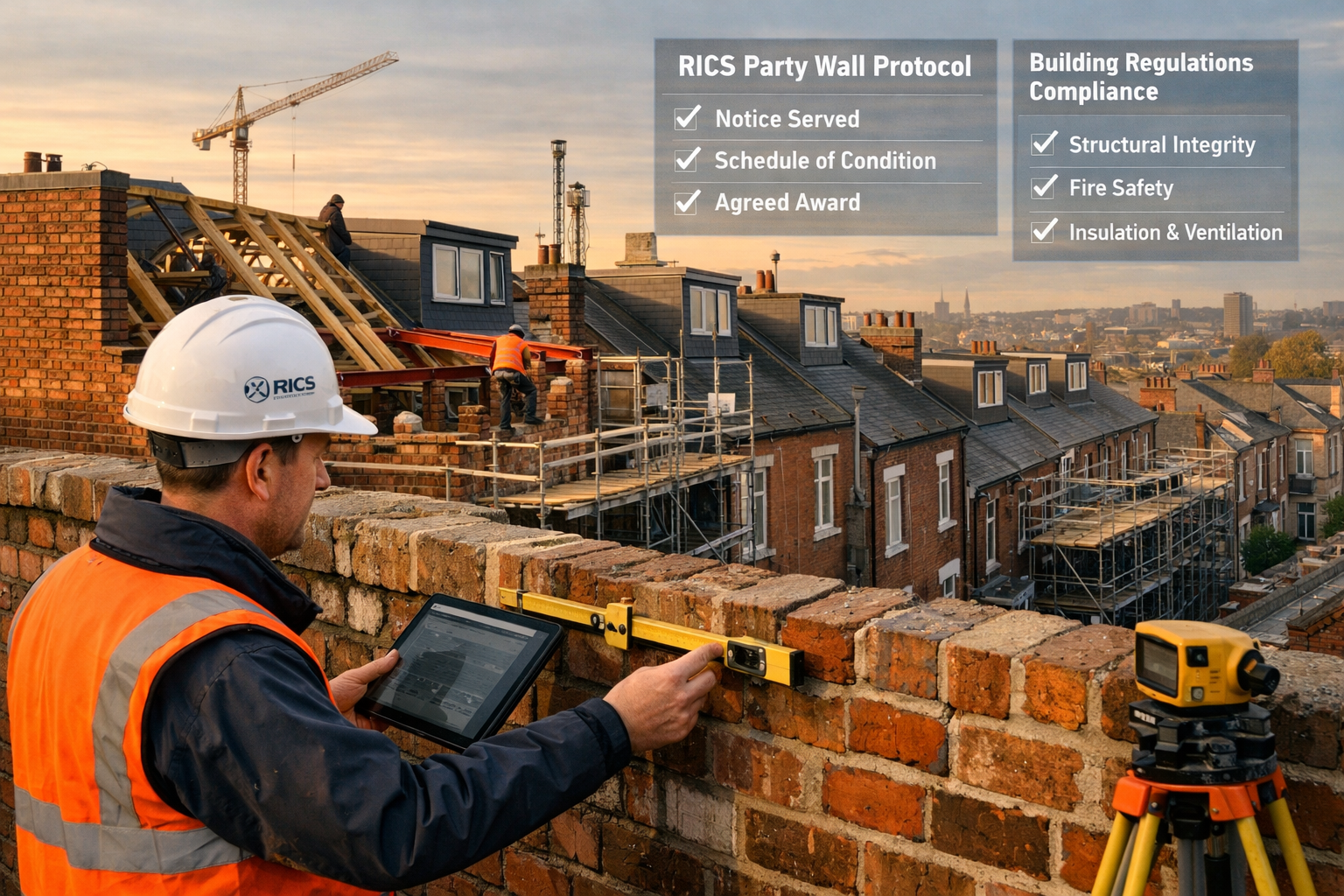
Professional surveyors use specialized equipment including crack width gauges, moisture meters, and high-resolution cameras to create comprehensive records. This documentation protects both the building owner (from unfounded damage claims) and the adjoining owner (by establishing baseline conditions for comparison).
Construction Phase Monitoring
RICS protocols recommend ongoing monitoring during construction, particularly for works involving significant structural alterations. Party wall surveyors may conduct:
- 🔍 Periodic site inspections to verify compliance with the award
- 📊 Crack monitoring using tell-tales or digital measurement
- 🏗️ Construction method review ensuring adherence to approved specifications
- 🔊 Noise and vibration assessment if concerns arise
- 🛠️ Remedial work oversight if minor damage occurs
In high-demand Northern regions where multiple construction projects may be occurring simultaneously on the same street, monitoring helps identify whether any damage results from the specific loft conversion or from cumulative effects of multiple projects.
Dispute Resolution and Third Surveyor Appointments
Despite best efforts, some party wall matters escalate to require third surveyor involvement. This occurs when the two appointed surveyors cannot agree on specific aspects of the award. The third surveyor acts as an arbitrator, making binding decisions to resolve the disagreement.
Third surveyor appointments are more common in 2026's Northern growth markets due to:
- 🏘️ Complex multi-property scenarios with overlapping party walls
- 💎 Rising property values increasing financial stakes
- 🔨 Innovative construction techniques requiring specialist assessment
- ⚖️ Precedent-setting cases in developing legal areas
The third surveyor's decision is final and binding, providing definitive resolution. However, this process adds time and cost, making early agreement between the initial surveyors preferable.
For comprehensive guidance on the party wall process, homeowners should review party wall agreement guides that explain each stage in detail.
Regional Considerations for Northern England's High-Demand Construction Markets
Manchester Metropolitan Area
Manchester's property market has experienced exceptional growth in 2026, with terraced properties in areas like Didsbury, Chorlton, and Levenshulme seeing substantial loft conversion activity. The city's Victorian and Edwardian housing stock presents specific party wall challenges:
- Shared chimney stacks requiring careful structural assessment
- Historic construction methods with lime mortar and soft bricks
- Previous modifications creating non-standard party wall configurations
- Conservation area restrictions affecting external alterations
Manchester's construction boom has created high demand for RICS surveyors familiar with local building characteristics and planning requirements. Homeowners benefit from engaging surveyors with specific experience in Manchester's terraced housing stock.
Leeds and West Yorkshire
Leeds represents another Northern growth market where loft conversions are transforming property values. Areas including Headingley, Chapel Allerton, and Roundhay feature dense terraced housing ideal for loft expansion. Specific considerations include:
- Stone construction in some older properties requiring specialist knowledge
- Varied ceiling heights affecting structural beam requirements
- Mixed-use areas where residential and commercial properties share party walls
- Student housing density creating complex multi-occupancy scenarios
The West Yorkshire construction sector in 2026 has seen increased professionalization, with more homeowners recognizing the value of early surveyor engagement to prevent disputes.
Newcastle and the North East
Newcastle's property renaissance has brought renewed attention to Tyneside flats and terraced housing in areas like Jesmond, Gosforth, and Heaton. The North East presents unique party wall considerations:
- Tyneside flat configurations with unusual party wall arrangements
- Solid fuel heating history affecting chimney breast removal considerations
- Coastal exposure requiring enhanced weatherproofing at party wall junctions
- Regional construction traditions influencing structural approaches
Newcastle's 2026 construction market benefits from a strong community of RICS surveyors who understand regional building characteristics and can navigate the specific challenges of North East housing stock.
Sheffield and South Yorkshire
Sheffield's terraced housing, particularly in areas like Nether Edge, Crookes, and Walkley, has seen significant loft conversion activity. The city's topography creates additional party wall considerations:
- Sloping sites affecting party wall heights and structural loads
- Stone and brick combinations requiring careful assessment
- Historic mining activity necessitating foundation considerations
- Varied property ages creating mixed construction methods on single streets
Sheffield homeowners in 2026 are increasingly aware of party wall requirements, with local construction professionals emphasizing early surveyor engagement as standard practice.
Common Challenges and Solutions in 2026 Northern Markets
Challenge 1: Neighbour Non-Engagement
Problem: Neighbours failing to respond to party wall notices within the 14-day period, creating deemed dissent and requiring surveyor appointments even when no actual objection exists.
Solution: Proactive communication before serving formal notices, using multiple contact methods (hand delivery, recorded mail, email), and clearly explaining the notice requirements and response options. Some building owners in Northern markets are successfully using informal information sheets alongside formal notices to improve response rates.
Challenge 2: Cost Concerns
Problem: Adjoining owners worried about being liable for surveyor fees or construction costs, leading to defensive objections.
Solution: Clear communication that the building owner typically covers reasonable surveyor fees and that the party wall process protects the adjoining owner at no cost to them. Transparency about the award's protective function helps reduce anxiety-driven objections.
For detailed information about typical costs, homeowners can review party wall surveyor cost guidance to set realistic budgets.
Challenge 3: Construction Timing Pressures
Problem: The 2-month notice period conflicting with contractor availability or seasonal construction preferences.
Solution: Early planning that incorporates the notice period into project timelines. Successful 2026 Northern market projects typically begin the party wall process 3-4 months before desired construction start dates, allowing buffer time for potential disputes or surveyor scheduling.
Challenge 4: Multiple Adjacent Properties
Problem: Loft conversions in mid-terrace properties affecting both neighbours, requiring coordination of multiple party wall processes.
Solution: Simultaneous notice service to all affected parties, potentially using an agreed surveyor approach to streamline the process. Some Northern homeowners successfully negotiate joint site visits and coordinated schedules of condition to reduce duplication and costs.
Challenge 5: Previous Informal Agreements
Problem: Neighbours who previously completed work without formal party wall procedures expecting reciprocal informality, creating tension when proper procedures are followed.
Solution: Respectful explanation that formal procedures protect all parties and create proper documentation. Emphasizing that the Party Wall Act is statutory law, not optional, helps neighbors understand the necessity of compliance regardless of past practices.
Understanding what to do when receiving a party wall notice helps both building owners and adjoining owners navigate the process professionally.
Integration with Building Regulations and Planning Requirements
Building Regulations Independence
Party wall procedures operate independently from Building Regulations approval, but both are typically required for loft conversions. Building Regulations ensure:
- 🔥 Fire safety including escape routes and fire resistance
- 🏗️ Structural integrity of new construction
- ⚡ Electrical safety and compliance
- 🔊 Sound insulation between properties
- 🌡️ Thermal performance and energy efficiency
- 🪜 Staircase design and headroom requirements
In 2026's Northern markets, Building Control departments have become increasingly sophisticated in their requirements, particularly regarding sound insulation in terraced properties. The party wall award and Building Regulations approval work together to ensure safe, compliant construction.
Permitted Development Considerations
Many loft conversions qualify as Permitted Development, avoiding formal planning permission requirements. However, Permitted Development rights do not eliminate Party Wall Act obligations[4]. This is a critical distinction that confuses many homeowners.
Permitted Development for loft conversions typically allows:
- ✅ Volume increases up to 40 cubic meters (terraced houses) or 50 cubic meters (detached/semi-detached)
- ✅ Roof height increases up to specified limits
- ✅ Rear dormers (but not front-facing in most cases)
- ✅ Roof lights and windows within parameters
Even when these Permitted Development criteria are met, any work affecting party walls still requires proper notice and awards under the Party Wall Act. The two regulatory frameworks serve different purposes and must both be satisfied.
Conservation Areas and Listed Buildings
Northern growth markets include numerous conservation areas and listed buildings where additional restrictions apply. In these contexts:
- 🏛️ Conservation area consent may be required for external alterations
- 📜 Listed building consent governs work to listed structures
- 🎨 Design restrictions affect dormer styles and materials
- 👁️ Enhanced scrutiny from local planning authorities
Party wall procedures in conservation contexts require surveyors with specific experience in heritage construction methods and materials. The party wall award must align with conservation requirements while protecting both parties' interests.
Future-Proofing Your Loft Conversion: 2026 and Beyond
Sustainable Construction Methods
Northern England's 2026 construction sector increasingly emphasizes sustainability, affecting loft conversion approaches:
- ♻️ Recycled and sustainable materials reducing environmental impact
- 🌡️ Enhanced insulation exceeding minimum Building Regulations standards
- ☀️ Solar panel integration on new roof structures
- 💧 Rainwater harvesting incorporated into roof design
- 🌬️ Natural ventilation strategies reducing mechanical systems
Party wall awards in progressive Northern markets are beginning to address sustainability considerations, particularly where enhanced insulation or renewable energy systems affect party wall structures or create new interfaces between properties.
Technology Integration
Modern party wall surveys leverage technology for improved accuracy and documentation:
- 📱 Digital schedules of condition with cloud-based photo storage
- 🎯 Laser measurement for precise crack monitoring
- 🤖 3D scanning creating detailed property records
- 📊 Vibration monitoring providing objective construction impact data
- 💻 Digital award delivery streamlining documentation
RICS surveyors operating in 2026's Northern markets increasingly offer these technological enhancements, providing clients with comprehensive digital records that can be accessed years later if questions arise.
Market Value Considerations
Properly executed loft conversions with complete party wall compliance add significant value to Northern properties. In 2026's growth markets:
- 💰 ROI typically ranges from 15-25% on conversion costs
- 🏠 Additional bedroom premium particularly strong in family-oriented areas
- 📈 Future sale facilitation through complete documentation
- ⚖️ Legal clarity attracting confident buyers
Conversely, loft conversions completed without proper party wall procedures create legal liabilities that can:
- ❌ Complicate property sales requiring retrospective awards
- ⚠️ Trigger neighbour claims years after completion
- 📉 Reduce property value due to legal uncertainties
- 🔍 Fail conveyancing searches creating transaction delays
The investment in proper RICS surveyor engagement represents insurance against these risks while maximizing the conversion's value contribution.
Conclusion
Party Wall Surveys for 2026 Loft Conversions in Northern Growth Markets: RICS Protocols in High-Demand Regions represent an essential component of successful home improvement projects across Manchester, Leeds, Newcastle, Sheffield, and surrounding areas. As Northern England's construction boom continues, professional party wall management has evolved from optional formality to critical project requirement.
The key principles for successful party wall navigation include:
-
Early Planning: Begin the party wall process 3-4 months before desired construction start dates, allowing adequate time for the 2-month notice period and potential dispute resolution.
-
RICS Professional Engagement: Appoint MRICS or FRICS chartered surveyors who understand Northern market conditions and regional construction characteristics[1].
-
Transparent Communication: Engage neighbours early with clear, respectful communication about project plans, timelines, and the protective nature of party wall procedures.
-
Comprehensive Documentation: Ensure thorough schedules of condition are prepared, protecting both building and adjoining owners through detailed pre-construction records.
-
Budget Realism: Allocate £1,500-£5,000+ for party wall surveyor fees depending on project complexity, recognizing this as essential project cost rather than optional expense[3].
-
Regulatory Integration: Coordinate party wall procedures with Building Regulations approval and planning requirements, understanding that each serves distinct purposes.
-
Long-Term Perspective: Recognize that proper party wall compliance protects property value, facilitates future sales, and prevents costly retrospective disputes.
The 2026 Northern construction landscape offers exceptional opportunities for homeowners to add value and living space through loft conversions. The region's terraced housing stock, rising property values, and strong buyer confidence create ideal conditions for these projects. However, success requires professional navigation of party wall requirements using RICS protocols and qualified surveyors.
Actionable Next Steps
For homeowners planning loft conversions in Northern growth markets:
✅ Consult an RICS surveyor before finalizing construction plans to understand specific party wall requirements for your property
✅ Review project timelines to incorporate the minimum 2-month notice period plus buffer time for potential disputes
✅ Engage neighbours informally before serving formal notices to build understanding and cooperation
✅ Obtain multiple quotes from RICS-qualified party wall surveyors to understand cost ranges and service offerings
✅ Coordinate with architects and contractors to ensure party wall awards align with construction methods and Building Regulations requirements
✅ Document everything maintaining comprehensive records of all communications, notices, and agreements
The investment in professional party wall management pays dividends through smoother construction processes, protected neighbour relationships, and enhanced property value. As Northern England's growth markets continue their 2026 trajectory, homeowners who embrace RICS protocols and professional surveyor guidance will maximize their loft conversion success while maintaining the legal compliance and community relationships that underpin long-term property enjoyment.
For expert guidance on party wall matters, contact qualified RICS surveyors who understand the specific challenges and opportunities of Northern England's dynamic 2026 construction market.
References
[1] Party Walls – https://www.rics.org/consumer-guides/party-walls
[2] Party Wall Surveys Amid 2026 Construction Boom Handling Disputes In High Demand Uk Housing Markets – https://nottinghillsurveyors.com/blog/party-wall-surveys-amid-2026-construction-boom-handling-disputes-in-high-demand-uk-housing-markets
[3] Party Wall Agreement Loft Conversion – https://www.houseup.co.uk/news/party-wall-agreement-loft-conversion
[4] Party Wall Notice For Loft Conversions – https://www.houricanassociates.com/party-wall-news/party-wall-notice-for-loft-conversions/