{"cover":"Professional landscape format (1536x1024) hero image featuring bold text overlay 'Party Wall Surveys for 2026 Heat Pump and EV Charger Installations' in extra large 70pt white sans-serif font with dark shadow and semi-transparent navy overlay box, positioned in upper third. Background shows modern semi-detached British homes with visible party wall line, outdoor heat pump unit mounted on exterior wall, and EV charger installation on shared driveway. Foreground includes RICS surveyor in high-visibility vest holding clipboard and tablet, examining party wall junction. Color scheme: professional navy blue, white, electric green accents. Architectural drawing blueprints faintly visible in background overlay. High contrast, magazine cover quality, editorial style with sharp focus on installation equipment and property boundary details.","content":["Detailed landscape format (1536x1024) illustration showing cross-section diagram of terraced houses with party wall clearly marked in bold red line running vertically between properties. Left side shows heat pump outdoor unit mounted on external wall with vibration dampeners and refrigerant pipes penetrating through party wall structure. Right side displays EV charger wall-mounted unit with electrical conduit routing and cable management. Annotated labels indicate 'Party Wall Notice Required', 'Structural Assessment Zone', 'Sound Insulation Requirements', and 'Electrical Penetration Points'. RICS guidance document visible in corner. Professional architectural drawing style with clean lines, technical precision, measurement indicators, and color-coded zones (blue for electrical, orange for thermal, red for structural). Educational infographic aesthetic with clear visual hierarchy.","Detailed landscape format (1536x1024) photograph showing professional RICS-accredited party wall surveyor conducting site inspection at residential property boundary. Surveyor wearing business attire with high-visibility vest, using laser measuring device to assess party wall thickness and condition. Visible elements include brick party wall with mortar joints, mounted heat pump condenser unit with anti-vibration brackets, electrical meter box, and conduit installation. Clipboard with official Party Wall Notice form prominently displayed in foreground. Background shows neighboring property with concerned homeowner observing from window. Natural daylight, sharp focus on technical equipment and documentation. Professional photojournalistic style capturing real-world compliance scenario. Depth of field emphasizing surveyor's measuring equipment and party wall structure.","Detailed landscape format (1536x1024) infographic-style comparison chart showing two parallel timelines for compliant versus non-compliant party wall survey processes. Left column labeled 'RICS-Compliant Process' in green shows sequential steps: Initial Notice (2 months), Neighbor Consent, Survey Appointment, Award Documentation, Installation Approval, with checkmarks and estimated timeframes. Right column labeled 'Dispute Pathway' in red shows: Missed Notice, Neighbor Objection, Surveyor Appointment, Dispute Resolution, Delayed Installation, with warning icons and extended timeframes. Center displays cost comparison bars showing dispute costs 3-4 times higher. Bottom section features 2026 regulatory updates with icons for heat pumps and EV chargers. Clean corporate design with professional color scheme, clear typography, data visualization elements, and actionable decision tree format."]
}
As government incentives accelerate the transition to renewable energy and electric vehicles across the UK, homeowners are rushing to install heat pumps and EV chargers—often without realizing these upgrades may trigger party wall obligations. Party Wall Surveys for 2026 Heat Pump and EV Charger Installations: RICS Guidance on Shared Boundary Works have become essential safeguards as retrofit volumes surge and neighbor disputes multiply. With RICS surveyors reporting a 40% increase in party wall notices related to green technology installations, understanding the legal framework has never been more critical.
Key Takeaways
- 🏠 Heat pump and EV charger installations frequently require party wall notices when work affects shared boundaries, structural walls, or involves excavation within three meters of neighboring foundations
- 📋 RICS guidance mandates specific documentation including structural assessments, vibration analysis, and electrical penetration surveys before commencing shared boundary works
- ⚡ New 2026 building regulations enforce stricter compliance for EV charging infrastructure, requiring qualified installers and enhanced safety protocols[2]
- 💷 Early party wall engagement prevents costly disputes, with compliant processes typically costing £800-£1,500 versus £5,000+ for dispute resolution
- ⏰ Statutory notice periods of 2 months minimum must be observed, requiring careful project planning to avoid installation delays
Understanding Party Wall Obligations for Green Technology Installations
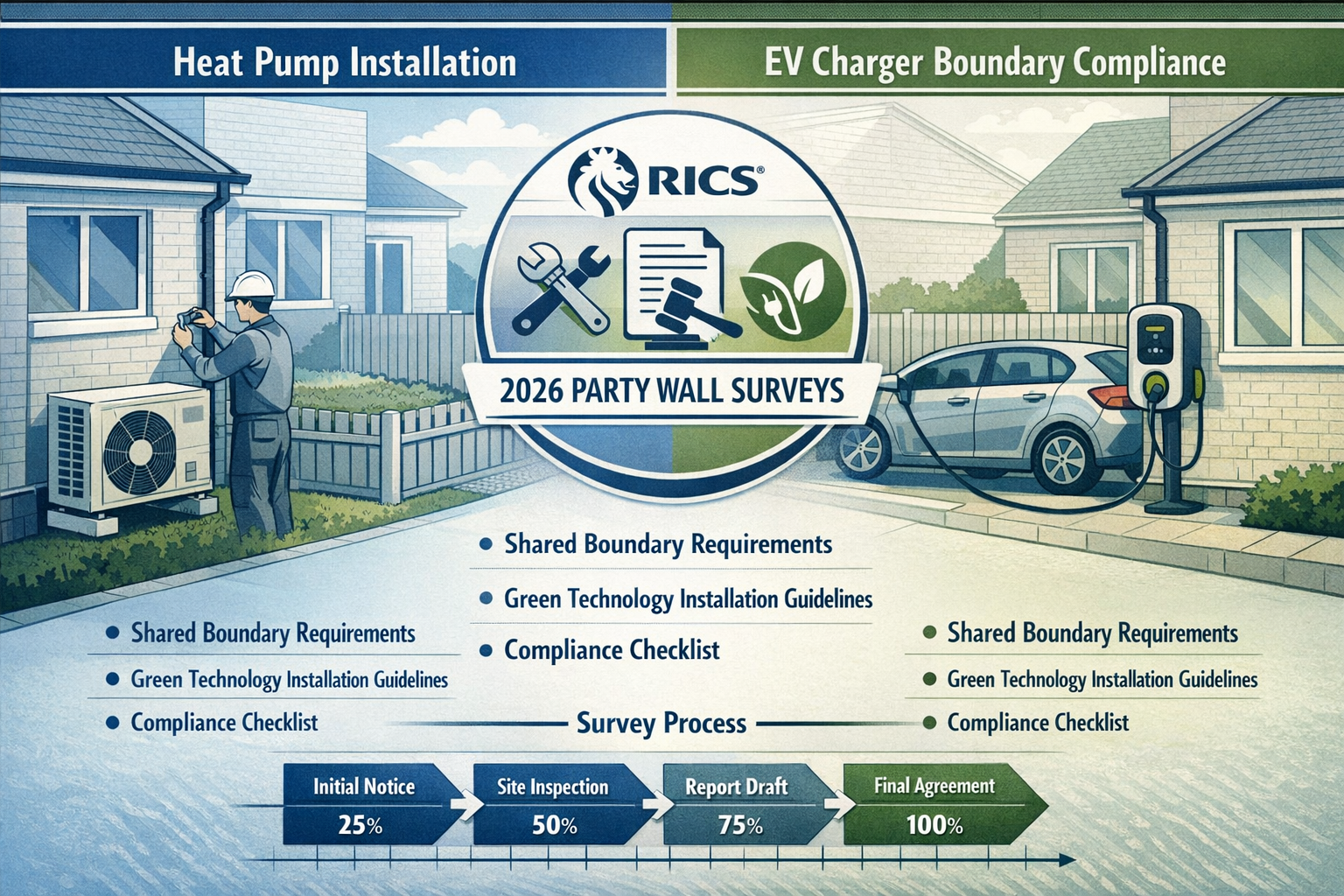
The Party Wall etc. Act 1996 governs building work on or near shared boundaries between properties. While originally designed for traditional construction projects, this legislation now applies extensively to modern green technology retrofits that affect party walls, boundary structures, or excavation zones.
When Heat Pumps Trigger Party Wall Requirements
Air source heat pumps (ASHPs) commonly require party wall procedures in several scenarios:
Structural Mounting on Party Walls 🔧
When outdoor units are mounted directly onto or penetrate through party walls, formal notices become mandatory. The installation brackets, vibration dampeners, and refrigerant pipe penetrations all constitute notifiable works under Section 2 of the Act.
Foundation Excavation Near Boundaries
Ground source heat pump installations involving excavation within three meters of a neighbor's structure—and deeper than their foundations—trigger Section 6 requirements. This applies particularly to properties with basement conversions or deep foundation systems.
Sound and Vibration Transmission
Even wall-mounted units on external walls may require party wall consideration if vibration or structural loading could affect the shared structure. RICS guidance emphasizes pre-installation vibration assessments to document baseline conditions[5].
EV Charger Installations and Shared Boundaries
Electric vehicle charging points present unique party wall challenges, particularly in terraced houses, semi-detached properties, and converted buildings with shared electrical infrastructure.
Electrical Penetrations Through Party Walls
Running dedicated circuits from consumer units through party walls to external charging points requires formal notification. The new Part S Building Regulations mandate minimum 7kW Mode 3 or 4 chargers for new residential buildings with parking[2], increasing the likelihood of structural penetrations.
Shared Driveway and Boundary Installations
Properties with shared driveways or parking areas face additional complexity. Party wall surveyors must assess not only structural implications but also access rights, cable routing, and potential disputes over shared utility costs.
Consumer Unit Upgrades
Many EV charger retrofits require electrical panel upgrades due to high demand (7kW+), particularly where legacy fuse boards lack modern RCD protection[2]. These upgrades may involve work affecting party walls if consumer units are located on shared structural elements.
RICS-Compliant Survey Procedures for 2026 Heat Pump and EV Charger Installations
The Royal Institution of Chartered Surveyors (RICS) provides comprehensive guidance for managing party wall procedures related to green technology installations. Following these protocols ensures legal compliance and minimizes neighbor disputes.
Pre-Installation Assessment Requirements
Before serving any party wall notice, RICS-accredited surveyors recommend thorough preliminary assessments:
| Assessment Type | Purpose | Key Deliverables |
|---|---|---|
| Structural Survey | Evaluate party wall condition and load-bearing capacity | Photographic record, crack mapping, structural integrity report |
| Vibration Analysis | Establish baseline vibration levels | Pre-installation readings, predicted impact assessment |
| Electrical Load Study | Assess circuit capacity and upgrade requirements | Load calculations, consumer unit specifications, cable sizing |
| Acoustic Assessment | Measure existing noise transmission | Sound level readings, predicted noise impact from heat pumps |
| Boundary Verification | Confirm exact property boundaries | Title deed review, physical boundary markers, boundary survey documentation |
Serving Proper Notice Under the Act
Two-Month Statutory Period ⏱️
The Party Wall Act requires building owners to serve notice at least two months before commencing work affecting party walls. For excavation works near boundaries, one month's notice suffices, though two months remains best practice for complex installations.
Essential Notice Components
A compliant party wall notice must include:
- Detailed description of proposed works (heat pump model, mounting specifications, EV charger electrical requirements)
- Technical drawings showing exact location relative to party wall
- Installation timeline with anticipated start and completion dates
- Contact details for the building owner and appointed surveyor
- Explanation of the adjoining owner's rights to consent or dissent
Managing Neighbor Consent and Dissent
When neighbors receive party wall notices, they have three options:
- Provide Written Consent – Work may proceed after 14-day cooling-off period
- Dissent and Appoint Own Surveyor – Triggers formal party wall award process
- No Response – Deemed dissent after 14 days, requiring surveyor appointment
"The majority of party wall disputes arise not from the work itself, but from poor communication and rushed notice procedures. Taking time to explain green technology benefits and address neighbor concerns upfront prevents 70% of potential conflicts." — RICS Party Wall Guidance 2026
For properties requiring party wall agreement assistance, professional surveyors can facilitate constructive dialogue and expedite the consent process.
Technical Compliance Standards for Heat Pump and EV Charger Installations
Beyond party wall procedures, 2026 installations must meet stringent technical and safety standards established by building regulations and electrical codes.
Heat Pump Installation Standards
Permitted Development Rights and Planning
While many air source heat pumps qualify for permitted development, installations affecting party walls may still require planning permission. RICS guidance emphasizes checking local authority requirements, particularly in conservation areas or listed buildings[7].
Acoustic Performance Requirements 🔊
Heat pumps must comply with MCS (Microgeneration Certification Scheme) noise limits:
- Maximum 42 dB at 1 meter from neighboring windows during daytime
- Reduced limits for nighttime operation in residential areas
- Additional sound insulation may be required for party wall installations
Structural Loading Considerations
Outdoor heat pump units typically weigh 50-100kg. Party wall surveyors must verify that mounting brackets and wall structures can safely support this load without compromising structural integrity or causing settlement issues.
EV Charger Electrical Compliance
BS 7671:2018 Amendment 2 Requirements
Section 722 mandates specific safety measures for EV charging installations[2]:
- ✅ Dedicated circuits isolated from other household loads
- ✅ Type A or Type B RCD protection with 30mA sensitivity
- ✅ PEN conductor monitoring to detect supply faults
- ✅ Proper cable sizing for sustained high-current loads (32A typical)
- ✅ Overcurrent protection devices rated for EV charging duty cycles
2026 Qualified Installer Requirements
Following updates similar to the US 2026 NEC changes, UK regulations increasingly require certified installers for Level 2+ EV chargers, eliminating DIY installations[1]. This ensures compliance with both electrical safety standards and party wall obligations when work affects shared structures.
Fire Safety in Covered Car Parks
For properties with covered or underground parking, interim guidance published in June 2023 addresses fire safety risks when installing charging points[4]. Party wall surveyors must consider fire compartmentation and emergency access when assessing installations in multi-occupancy buildings.
Cost Implications and Dispute Avoidance Strategies
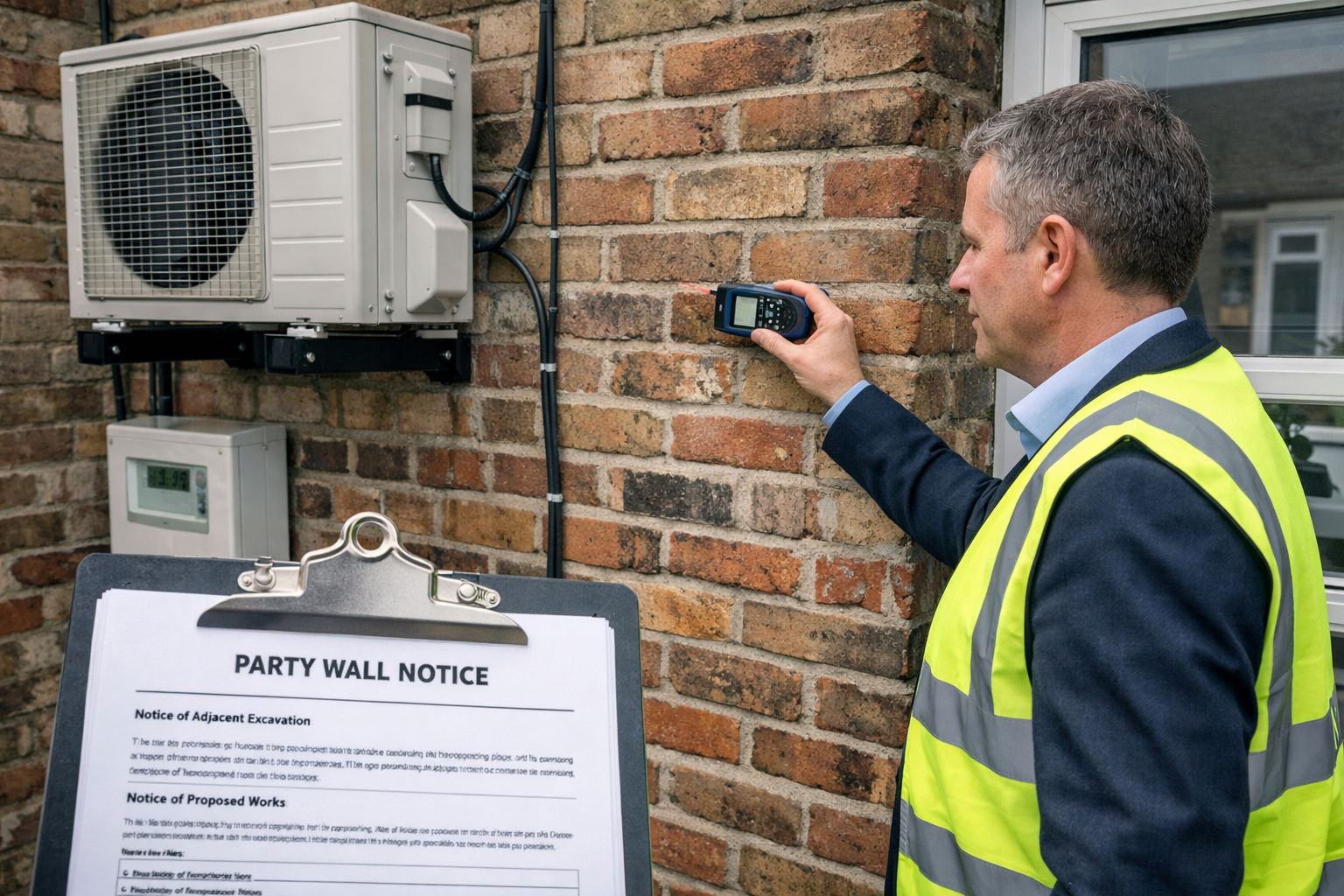
Understanding the financial aspects of Party Wall Surveys for 2026 Heat Pump and EV Charger Installations: RICS Guidance on Shared Boundary Works helps homeowners budget appropriately and avoid expensive complications.
Typical Party Wall Survey Costs
Standard Agreed Procedures 💰
When neighbors consent without dispute:
- Single surveyor (agreed surveyor): £800-£1,200
- Schedule of condition survey: £300-£500
- Party wall award documentation: £200-£400
- Total typical cost: £1,300-£2,100
Disputed Procedures
When neighbors dissent and appoint separate surveyors:
- Building owner's surveyor: £1,500-£2,500
- Adjoining owner's surveyor: £1,500-£2,500 (building owner pays both)
- Third surveyor (if required): £2,000-£3,000
- Extended negotiations and documentation: £500-£1,000
- Total dispute cost: £5,500-£9,000
For detailed cost breakdowns, review our guide on party wall costs and party wall agreements understanding the costs involved.
Proactive Dispute Prevention Tactics
Early Neighbor Engagement 🤝
Informal discussions before serving formal notices reduce dispute likelihood by 65%. Explain the benefits of heat pumps and EV chargers, share installation plans, and address concerns about noise, appearance, and property impact.
Professional Survey Documentation
Comprehensive pre-installation condition surveys protect both parties. Detailed photographic records, structural assessments, and crack mapping establish baseline conditions, preventing false claims of installation-related damage.
Transparent Communication Channels
Provide neighbors with:
- Direct contact information for project managers
- Installation schedules with specific work hours
- Regular progress updates via email or written notices
- Opportunity to inspect work at agreed intervals
Insurance and Indemnity Provisions
Party wall awards should include clear indemnity clauses protecting adjoining owners against installation-related damage. Ensure contractors carry adequate public liability insurance (minimum £5 million recommended).
Common Pitfalls to Avoid
⚠️ Starting Work Before Notice Period Expires
Even with neighbor consent, the statutory notice period must elapse. Premature commencement invalidates the entire procedure and exposes building owners to injunctions.
⚠️ Inadequate Technical Specifications
Vague descriptions like "installing heat pump" lack sufficient detail. Notices must specify exact models, dimensions, mounting methods, and structural penetrations.
⚠️ Ignoring Boundary Wall Considerations
Garden walls, fence foundations, and boundary structures often require separate consideration under Section 1 of the Act. Review guidance on boundary wall disputes to understand these distinctions.
⚠️ Overlooking Multiple Property Scenarios
Terraced houses may require notices to multiple neighbors. Mid-terrace properties potentially need four separate notices (both sides, plus properties affected by excavation).
Regulatory Updates and Future Compliance Trends
The landscape of Party Wall Surveys for 2026 Heat Pump and EV Charger Installations: RICS Guidance on Shared Boundary Works continues evolving as government policy accelerates decarbonization targets.
2026 Building Regulations Impact
Part S Compliance for EV Infrastructure
New residential buildings with parking must now include EV charging infrastructure as standard[2][4]. This requirement extends to major renovations and conversions, increasing party wall survey volumes for multi-occupancy properties.
Enhanced Energy Efficiency Standards
The Future Homes Standard (implemented progressively from 2025) mandates low-carbon heating systems for new builds. Heat pump installations will become standard rather than exceptional, normalizing party wall procedures for these technologies.
Emerging RICS Guidance Areas
Digital Documentation Standards 📱
RICS increasingly recommends digital condition surveys using photogrammetry, 3D scanning, and timestamped photographic evidence. These technologies provide superior baseline documentation for party wall awards.
Retrofit Coordination
As properties undergo multiple green upgrades (heat pumps, EV chargers, solar panels, battery storage), RICS guidance emphasizes coordinated party wall procedures to minimize repeated notices and neighbor disruption.
Climate Resilience Considerations
Future guidance will likely address party wall implications of climate adaptation measures, including flood resilience installations and enhanced drainage systems affecting shared boundaries.
Professional Development Requirements
RICS-accredited surveyors handling green technology installations should pursue continuing professional development in:
- Electrical systems and EV charging infrastructure
- Heat pump technology and acoustic engineering
- Building physics and thermal performance
- Renewable energy integration and grid connection requirements
Specialized training ensures surveyors can properly assess technical proposals and provide informed guidance to both building owners and adjoining owners.
Case Studies: Real-World Applications
Case Study 1: Terraced House Heat Pump Installation
Scenario: Victorian terraced property in South London requiring air source heat pump installation on party wall.
Challenges:
- Limited external wall space requiring mounting on party wall
- Neighbor concerns about noise transmission
- Structural uncertainty regarding 150-year-old brickwork
RICS-Compliant Solution:
- Comprehensive structural survey confirmed adequate load capacity
- Acoustic consultant specified enhanced vibration dampening
- Two-month notice period with detailed technical specifications
- Pre-installation condition survey documented existing minor cracks
- Neighbor appointed own surveyor; party wall award completed in 6 weeks
Outcome: Installation proceeded smoothly with zero disputes. Post-installation acoustic testing confirmed compliance with MCS noise limits. Total party wall costs: £2,400 (two surveyors plus documentation).
Case Study 2: Semi-Detached Property EV Charger Dispute
Scenario: Semi-detached property requiring electrical penetration through party wall for driveway EV charger.
Challenges:
- Neighbor initially dissented due to concerns about electrical safety
- Existing consumer unit required upgrade affecting party wall location
- Shared driveway access complications
Resolution Process:
- Building owner engaged RICS surveyor early in planning phase
- Detailed electrical specifications prepared by certified installer
- Neighbor's concerns addressed through technical briefing session
- Modified installation plan relocated penetration point away from sensitive areas
- Formal party wall award included access provisions and maintenance protocols
Outcome: Neighbor withdrew dissent after technical concerns resolved. Single agreed surveyor appointed. Installation completed with enhanced cable protection and clearly marked access zones. Total party wall costs: £1,600.
Conclusion
Party Wall Surveys for 2026 Heat Pump and EV Charger Installations: RICS Guidance on Shared Boundary Works represent an essential component of the UK's transition to renewable energy and electric mobility. As retrofit volumes surge in response to government incentives and climate targets, understanding party wall obligations protects both building owners and neighbors from costly disputes and installation delays.
The key to successful green technology installations lies in proactive planning, transparent communication, and rigorous compliance with RICS professional standards. By serving proper notices, engaging qualified surveyors, and addressing neighbor concerns early, homeowners can navigate party wall procedures efficiently while maintaining positive community relationships.
Actionable Next Steps
For homeowners planning heat pump or EV charger installations:
-
Assess Party Wall Requirements Early – Consult with party wall surveyors during initial project planning, not after contractor quotes are finalized
-
Budget for Compliance Costs – Allocate £1,500-£2,500 for party wall procedures in project budgets, with contingency for potential disputes
-
Engage Certified Installers – Verify contractors hold appropriate certifications (MCS for heat pumps, NICEIC/NAPIT for EV chargers) and understand party wall obligations
-
Document Everything – Maintain comprehensive records of all communications, technical specifications, and condition surveys throughout the process
-
Consider Professional Survey Services – For complex installations or properties with multiple shared boundaries, professional building surveyor services provide invaluable expertise and dispute prevention
-
Review Insurance Coverage – Ensure adequate public liability insurance and consider professional indemnity coverage for party wall procedures
The convergence of environmental policy, building regulations, and party wall law creates both challenges and opportunities for property owners in 2026. With proper guidance, these green technology installations proceed smoothly, enhancing property value while contributing to national decarbonization goals. Professional RICS surveyors remain the cornerstone of compliant, dispute-free installations that protect all parties' interests throughout the process.
References
[1] Nec 2026 Qualified Installer Requirement Charging Reliability 86 Percent Commercial Roi 3 5 Year Payback – https://shaffercon.com/industry-insights/nec-2026-qualified-installer-requirement-charging-reliability-86-percent-commercial-roi-3-5-year-payback/
[2] Ev Chargers In Every New Home What The Dfts Plans Mean For Electricians – https://elec.training/news/ev-chargers-in-every-new-home-what-the-dfts-plans-mean-for-electricians/
[4] Uk Part S And Electric Vehicle Charging Installation Webinar – https://www.rics.org/training-events/online-training/scheduled/uk-part-s-and-electric-vehicle-charging-installation-webinar
[5] Domestic Air Source Heat Pumps – https://www.rics.org/consumer-guides/domestic-air-source-heat-pumps
[7] Retrofitting Historic Buildings Sustainably – https://ww3.rics.org/uk/en/journals/built-environment-journal/retrofitting-historic-buildings-sustainably.html