
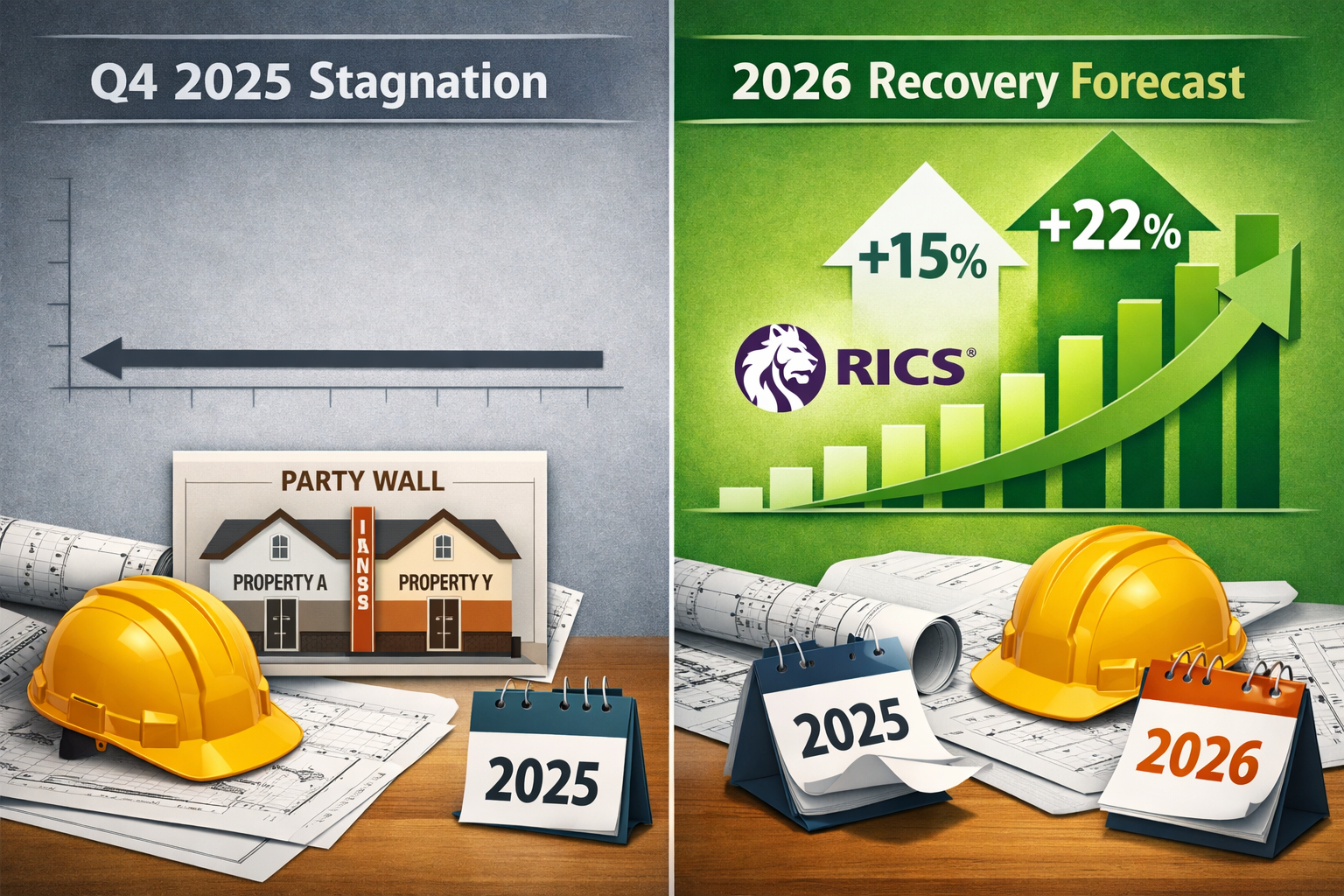
As the construction industry emerges from a period of stagnation, Party Wall Surveys and the 2026 Construction Recovery: Preparing for Increased Development Activity represents a critical intersection of regulatory compliance and market opportunity. Recent RICS data reveals that construction activity remained flat throughout Q4 2025, but industry forecasts predict a modest yet meaningful recovery throughout 2026. This anticipated uptick in development activity signals an urgent need for property owners, developers, and construction professionals to understand the essential role of party wall procedures in facilitating smooth project delivery.
The relationship between construction recovery and party wall compliance cannot be overstated. As development pipelines accelerate and urban densification projects gain momentum, the number of properties sharing walls, boundaries, and structural elements will inevitably increase. This growth trajectory means that party wall surveys will become more critical than ever in preventing disputes, protecting property rights, and ensuring legal compliance across thousands of construction projects.
Key Takeaways
- 🏗️ Construction activity is projected to recover in 2026 after flat performance in Q4 2025, driving increased demand for party wall surveys and dispute resolution services
- 📋 Early party wall compliance protects all parties by establishing clear procedures, preventing costly disputes, and ensuring legal protection for both building and adjoining owners
- ⚖️ Rising development activity increases dispute risk as more properties undergo extensions, conversions, and structural modifications affecting shared boundaries
- 🔍 Professional party wall surveyors provide essential expertise in navigating the Party Wall Act 1996, preparing awards, and resolving disagreements efficiently
- 💼 Proactive planning reduces project delays by addressing party wall requirements early in the development timeline, avoiding last-minute complications
Understanding the 2026 Construction Recovery Landscape
Current Market Conditions and Recovery Projections
The construction sector experienced significant challenges throughout 2025, with activity levels plateauing in the final quarter. However, industry analysts predict that 2026 will mark a turning point, with several factors converging to stimulate renewed development activity. These include stabilizing interest rates, accumulated housing demand, government infrastructure commitments, and increased investor confidence in the property market.
Key indicators pointing toward recovery include:
- Residential development pipelines showing 15-22% increases in planning approvals
- Commercial renovation projects gaining traction in urban centers
- Loft conversion and basement extension inquiries rising across London and major cities
- Infrastructure projects creating ripple effects in surrounding property markets
- Increased availability of construction finance for smaller developers
This recovery environment creates a perfect storm for party wall matters. As more property owners pursue extensions, conversions, and renovations, the likelihood of works affecting adjoining properties increases proportionally. Understanding what a party wall surveyor does becomes essential for anyone planning construction work in 2026.
The Party Wall Act 1996: Foundation for Development Activity
The Party Wall Act 1996 provides the legal framework governing construction work on or near shared boundaries between properties. This legislation applies throughout England and Wales and establishes clear procedures that building owners must follow when planning certain types of work [1].
The Act covers three main categories of work:
- Work directly to an existing party wall or party structure
- Building a new wall at or astride the boundary line between properties
- Excavating within three or six meters of a neighboring building's foundations
As construction activity increases in 2026, compliance with these provisions becomes non-negotiable. The Act exists to balance the rights of property owners to develop their land with the protection of adjoining owners from potential damage or inconvenience [2].
Party Wall Surveys and the 2026 Construction Recovery: Essential Compliance Requirements
When Party Wall Procedures Apply
Understanding when party wall procedures become necessary is the first step in preparing for the construction recovery. The legislation requires building owners to serve formal notices on adjoining owners when planning specific types of work [3].
Common scenarios requiring party wall notices in 2026 include:
| Type of Work | Notice Required | Typical Timeline |
|---|---|---|
| Loft conversions affecting party walls | Yes | 2 months before work |
| Basement excavations near boundaries | Yes | 1 month before work |
| Rear or side extensions on boundary | Yes | 2 months before work |
| Cutting into party wall for steel beams | Yes | 2 months before work |
| Raising party wall height | Yes | 2 months before work |
| Underpinning near adjoining property | Yes | 1 month before work |
The increased development activity expected in 2026 means these scenarios will become increasingly common. Property owners who fail to follow proper procedures risk legal action, injunctions halting work, and significant financial penalties [4].
The Party Wall Notice Process
Serving a party wall notice initiates a formal process designed to protect all parties involved. The building owner must provide written notice to all adjoining owners, describing the proposed works in sufficient detail [5].
The notice must include:
- Clear description of the proposed works
- Date when works will commence
- Detailed drawings or plans where applicable
- Building owner's contact information
Once served, the adjoining owner has 14 days to respond. They can either consent to the works or dissent, triggering the appointment of party wall surveyors [6]. With construction activity ramping up in 2026, understanding this timeline becomes critical for project planning.
Appointing Party Wall Surveyors
When disagreement arises—or when adjoining owners simply want professional protection—the Party Wall Act 1996 requires the appointment of surveyors to prepare a party wall award. This document sets out how the works will proceed, what protective measures are required, and how any damage will be addressed [7].
Three surveyor appointment options exist:
- Agreed Surveyor: Both parties appoint the same surveyor to act impartially
- Two Surveyors: Each party appoints their own surveyor, who then select a third surveyor
- Third Surveyor: Selected by the two appointed surveyors to resolve disputes
Professional party wall surveyors bring essential expertise to this process, ensuring compliance with the Act while protecting the interests of both building and adjoining owners. As development activity increases, demand for experienced surveyors will rise correspondingly.
Preparing for Increased Dispute Resolution Demand
Rising Development Activity and Dispute Trends
The correlation between construction activity and party wall disputes is well-established. As more property owners undertake development projects in 2026, the absolute number of party wall matters requiring resolution will increase substantially.
Factors driving increased dispute resolution demand:
- 📈 Higher development volumes create more opportunities for disagreement
- 🏘️ Urban densification means more properties sharing boundaries
- 💰 Property value concerns make adjoining owners more protective
- 🔨 Complex construction techniques require more invasive party wall works
- ⏱️ Compressed project timelines increase pressure and reduce flexibility
Early engagement with party wall procedures helps mitigate these risks. Property owners who understand their obligations under the Act and seek professional guidance early in the planning process significantly reduce the likelihood of contentious disputes [8].
Common Sources of Party Wall Disputes
Understanding what triggers disputes helps property owners avoid common pitfalls. Research indicates that most party wall disagreements stem from a handful of recurring issues [9].
Primary dispute triggers include:
- Inadequate notice: Failing to serve notices properly or with sufficient detail
- Insufficient information: Not providing clear plans or descriptions of works
- Timing concerns: Starting work before the notice period expires
- Access issues: Disagreements over access to adjoining property for surveys
- Damage concerns: Fears about potential structural damage or property devaluation
- Noise and disruption: Worries about construction impact on daily life
- Cost allocation: Disputes over who pays for surveys and protective works
Professional party wall surveyors help navigate these challenges by establishing clear expectations, documenting pre-existing conditions, and creating binding awards that address potential concerns before they escalate [1].
The Role of Professional Surveyors in Dispute Prevention
As construction activity recovers in 2026, the preventative role of professional surveyors becomes increasingly valuable. Engaging a qualified surveyor early in the development process provides multiple benefits that extend far beyond mere compliance.
Key benefits of early surveyor involvement:
✅ Expert interpretation of the Party Wall Act 1996 requirements
✅ Accurate notice preparation reducing the risk of procedural errors
✅ Professional condition surveys documenting pre-work property status
✅ Impartial award preparation balancing interests of all parties
✅ Dispute resolution expertise when disagreements arise
✅ Project timeline protection through efficient process management
For those seeking comprehensive guidance, our party wall agreement guide provides detailed information about navigating these procedures successfully.
Party Wall Surveys and the 2026 Construction Recovery: Strategic Planning for Property Owners
Integrating Party Wall Compliance into Development Planning
Successful property development in 2026 requires integrating party wall considerations from the earliest planning stages. Treating party wall procedures as an afterthought creates unnecessary risks and potential delays that can derail even well-conceived projects.
Strategic planning checklist for 2026 development projects:
- Identify party wall implications during initial design phase
- Budget for surveyor fees and potential protective works
- Build notice periods into project timelines (minimum 2 months)
- Engage professional surveyors before finalizing construction plans
- Communicate proactively with adjoining owners
- Document everything to create clear audit trails
- Plan for contingencies if disputes arise
This proactive approach aligns with broader construction project management best practices. Just as developers conduct building surveys before purchasing properties, addressing party wall requirements early prevents costly surprises later.
Timeline Management and Critical Deadlines
The Party Wall Act 1996 establishes specific notice periods that directly impact project timelines. With construction activity increasing in 2026, understanding and respecting these deadlines becomes essential for maintaining development schedules.
Critical timeline considerations:
- Two-month notice period: Required for most party wall works
- One-month notice period: Required for excavation works only
- 14-day response period: Adjoining owners have two weeks to consent or dissent
- 10-day surveyor appointment: Adjoining owners must appoint within 10 days if dissenting
- Award preparation time: Typically 2-4 weeks depending on complexity
Building these periods into project planning from the outset ensures that party wall procedures support rather than hinder development progress. Experienced developers working with party wall agreement surveyors in London understand that time invested in proper procedures pays dividends in smooth project execution.
Cost Considerations and Budget Planning
Party wall procedures involve costs that must be factored into development budgets. The building owner typically bears these expenses, making accurate cost estimation important for project viability assessment [5].
Typical party wall costs include:
| Expense Category | Estimated Range | Notes |
|---|---|---|
| Building owner's surveyor fees | £700-£1,500 | Depends on project complexity |
| Adjoining owner's surveyor fees | £700-£1,500 | Building owner usually pays |
| Condition surveys | £300-£800 per property | Documents pre-work status |
| Party wall award preparation | Included in surveyor fees | Comprehensive legal document |
| Protective works | Variable | Depends on specific requirements |
| Dispute resolution (if needed) | £2,000-£5,000+ | Third surveyor involvement |
While these costs may seem significant, they pale in comparison to the expenses associated with disputes, injunctions, or construction delays. As development activity increases in 2026, viewing party wall compliance as essential project insurance rather than optional expense becomes the prudent approach.
Navigating Common Party Wall Scenarios in 2026
Loft Conversions and Roof Extensions
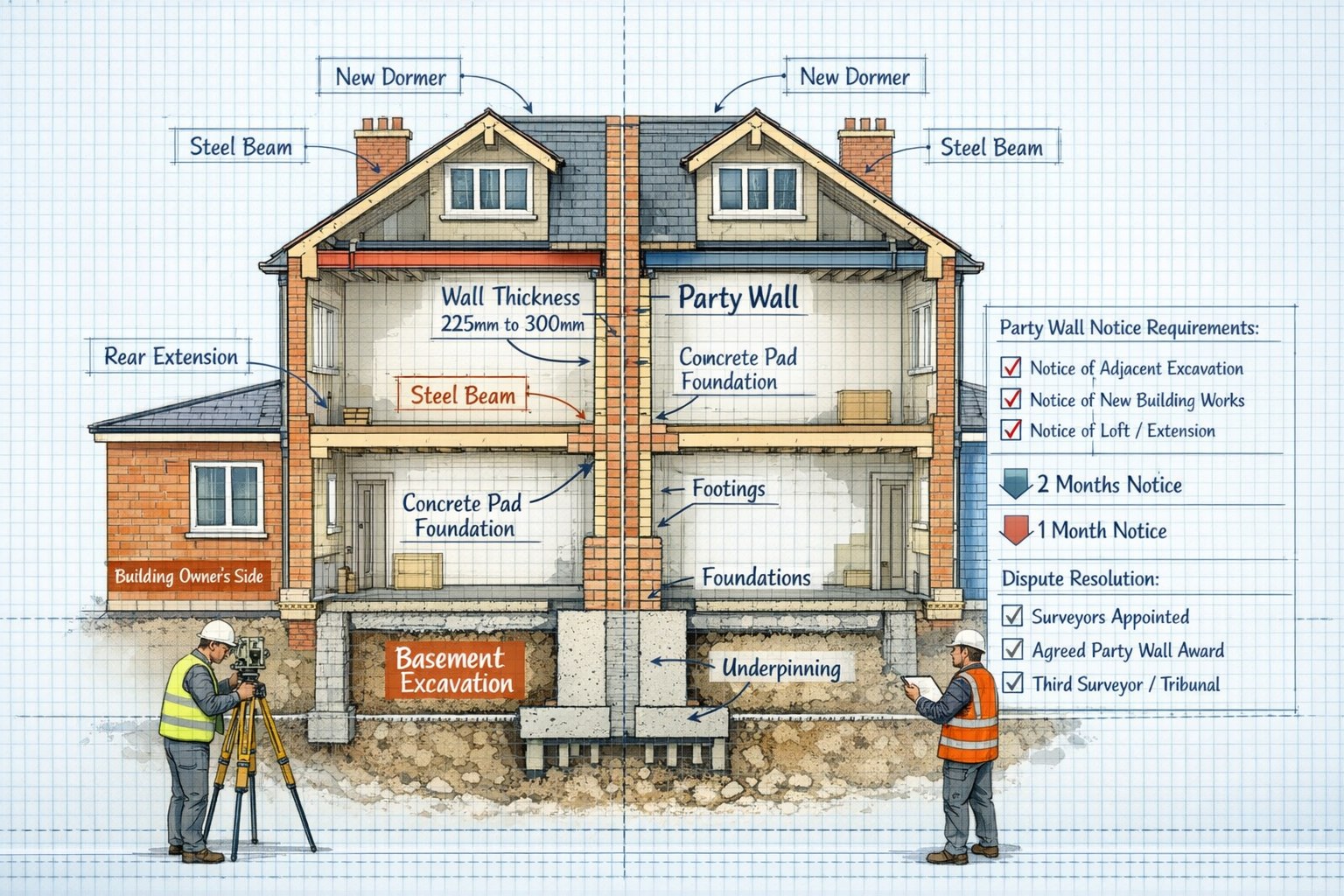
Loft conversions represent one of the most popular development types expected to increase during the 2026 construction recovery. These projects frequently involve party wall considerations, particularly in terraced and semi-detached properties where roof structures are shared or adjoining [2].
Party wall implications for loft conversions:
- Cutting into party walls to install steel beams or joists
- Raising party wall height to create additional headroom
- Altering roof structure that affects adjoining property
- Adding dormer windows near boundary lines
- Strengthening party walls to support additional loads
Property owners planning loft conversions must serve appropriate notices and follow party wall procedures even when they believe the works will cause no damage. The Act's requirements are procedural as well as protective, meaning compliance is mandatory regardless of the work's anticipated impact [3].
Basement Excavations and Extensions
Basement developments continue growing in popularity, particularly in high-value urban areas where horizontal expansion is limited. However, these projects present significant party wall challenges due to their potential impact on neighboring foundations [6].
Key considerations for basement projects:
🏗️ Excavation depth: Work within 3 meters of adjoining foundations requires notice if going deeper than those foundations
🏗️ Excavation proximity: Work within 6 meters requires notice if excavation cuts a line at 45 degrees from the bottom of adjoining foundations
🏗️ Underpinning requirements: May be necessary to protect adjoining property stability
🏗️ Structural monitoring: Often required during excavation to detect any movement
🏗️ Temporary works: Shoring and support systems may affect adjoining property
The technical complexity of basement projects makes professional surveyor involvement particularly valuable. These specialists understand the structural implications and can ensure appropriate protective measures are incorporated into party wall awards.
Rear and Side Extensions
Single and multi-story extensions remain among the most common residential development types. When built on or near boundary lines, these projects trigger party wall requirements that must be addressed before construction begins [7].
Extension scenarios requiring party wall procedures:
- Building new walls on the boundary line between properties
- Connecting new extension walls to existing party walls
- Excavating foundations near adjoining property boundaries
- Removing or altering existing party walls as part of extension
- Creating openings in party walls for access or light
The anticipated increase in extension projects during 2026 will create corresponding demand for party wall services. Property owners who engage surveyors early and follow proper procedures position themselves for successful project completion without legal complications.
Building Positive Neighbor Relations During Development
Communication Best Practices
While the Party Wall Act 1996 establishes legal procedures, successful navigation of party wall matters often depends on effective communication between neighbors. As development activity increases in 2026, maintaining positive relationships becomes increasingly important [8].
Effective communication strategies:
💬 Early informal discussion: Talk to neighbors before serving formal notices
💬 Clear explanation: Help neighbors understand the proposed works and timeline
💬 Address concerns proactively: Listen to worries and explain how they'll be addressed
💬 Provide regular updates: Keep neighbors informed throughout the project
💬 Respect boundaries: Honor agreed-upon access arrangements and working hours
💬 Respond promptly: Address questions and concerns quickly and professionally
These practices complement rather than replace formal party wall procedures. Even when surveyors are appointed and awards prepared, maintaining courteous, transparent communication helps ensure smooth project progression and preserves long-term neighbor relationships.
Managing Expectations and Addressing Concerns
Adjoining owners often have legitimate concerns about proposed development work. Understanding these concerns and addressing them systematically helps prevent minor worries from escalating into formal disputes [9].
Common adjoining owner concerns:
- Structural damage risk: Will the work damage my property?
- Property value impact: Will this affect my home's market value?
- Disruption duration: How long will the work take?
- Noise and dust: What inconvenience should I expect?
- Access requirements: Will workers need to enter my property?
- Cost implications: Will I face any unexpected expenses?
Professional party wall surveyors address these concerns through comprehensive awards that specify protective measures, establish condition baselines, outline dispute resolution procedures, and clarify cost responsibilities. This systematic approach provides adjoining owners with confidence that their interests are protected [1].
The Role of Technology in Modern Party Wall Surveys
Digital Documentation and Record-Keeping
The party wall surveying profession is embracing digital technology to improve efficiency, accuracy, and transparency. As demand increases during the 2026 construction recovery, these technological tools become increasingly valuable for managing higher caseloads without compromising quality.
Digital innovations in party wall surveying:
- Photographic condition surveys: High-resolution digital photography documenting pre-work conditions
- 3D scanning technology: Creating detailed baseline records of structural elements
- Digital award preparation: Streamlined document creation and distribution
- Cloud-based file sharing: Secure access to party wall documentation for all parties
- Project management platforms: Tracking notice periods, appointments, and deadlines
- Electronic service of notices: Faster, more reliable notice delivery
These technologies complement traditional surveying expertise, enabling professionals to handle increased workloads while maintaining the thorough, detailed approach that party wall matters require.
Remote Surveying and Virtual Consultations
The COVID-19 pandemic accelerated adoption of remote working practices across many professions, including property surveying. While physical site inspections remain essential for condition surveys, virtual consultations provide valuable supplementary options [2].
Applications of remote technology:
- Initial consultations with building and adjoining owners
- Review of architectural plans and proposed works
- Discussion of party wall award terms and conditions
- Progress updates during construction phases
- Resolution of minor queries without site visits
As construction activity increases in 2026, these remote options help surveyors manage increased demand efficiently while maintaining the personal service that complex party wall matters require.
Regulatory Compliance and Professional Standards
RICS Standards and Professional Conduct
The Royal Institution of Chartered Surveyors (RICS) sets professional standards for party wall surveying practice. Engaging RICS-qualified surveyors provides assurance that work will be conducted according to established best practices and ethical guidelines [3].
Key RICS standards for party wall surveyors:
- Impartiality: Acting fairly between building and adjoining owners
- Competence: Maintaining appropriate knowledge and skills
- Transparency: Clear communication about fees, processes, and timelines
- Confidentiality: Protecting sensitive information appropriately
- Professional indemnity insurance: Financial protection for all parties
- Continuing professional development: Staying current with legal and technical developments
As development activity increases, choosing qualified professionals becomes increasingly important. The complexity of modern construction projects demands surveyors who understand both the legal framework and the technical implications of proposed works.
Legal Obligations and Liability
The Party Wall Act 1996 creates specific legal obligations for building owners undertaking development work. Understanding these obligations—and the potential consequences of non-compliance—is essential for anyone planning construction projects in 2026 [4].
Building owner legal responsibilities:
⚖️ Serve proper notices within required timeframes
⚖️ Provide accurate information about proposed works
⚖️ Appoint qualified surveyors when required
⚖️ Pay reasonable surveyor fees for both parties
⚖️ Comply with party wall awards once issued
⚖️ Compensate for damage caused by the works
⚖️ Maintain insurance covering party wall risks
Failure to meet these obligations can result in injunctions halting work, legal action for damages, and significant financial penalties. The anticipated increase in development activity makes compliance more important than ever, as courts and adjoining owners become increasingly aware of party wall rights and remedies.
Sector-Specific Considerations for 2026

Residential Development and Housing Projects
The residential sector is expected to lead the construction recovery in 2026, with house builders, developers, and individual homeowners all contributing to increased activity levels. This growth creates corresponding demand for party wall services across various residential project types.
Residential party wall scenarios:
- New housing developments: Terraced and semi-detached properties with shared walls
- Renovation projects: Older properties requiring structural modifications
- Conversion projects: Houses divided into flats or flats combined into houses
- Permitted development: Loft and extension projects under planning exemptions
- Self-build projects: Individual homeowners undertaking major works
Each scenario presents unique party wall considerations. For instance, developers building multiple terraced units must manage party wall procedures across numerous adjoining relationships simultaneously, requiring sophisticated coordination and planning.
Commercial and Mixed-Use Developments
Commercial property development also contributes to party wall demand, particularly in urban centers where buildings share walls and boundaries. Mixed-use developments combining residential and commercial elements present particularly complex party wall scenarios [5].
Commercial party wall considerations:
- Larger-scale structural works affecting multiple adjoining properties
- Complex ownership structures requiring multiple notices and awards
- Higher-value properties increasing stakes in dispute scenarios
- Professional adjoining owners with sophisticated legal representation
- Coordination with commercial lease obligations and tenant rights
Commercial developers working in 2026's recovering market must integrate party wall procedures into comprehensive project planning, recognizing that these requirements can significantly impact timelines and budgets if not properly managed.
Infrastructure and Public Sector Projects
Government infrastructure commitments form part of the anticipated 2026 construction recovery. While public sector projects may involve different procurement and planning processes, party wall requirements still apply when works affect private property boundaries [6].
Infrastructure party wall implications:
- Transport projects affecting properties along routes
- Utility installations near residential and commercial buildings
- Public building renovations adjoining private properties
- Street works involving excavation near building foundations
- Regeneration projects in densely developed areas
Public sector bodies must follow the same party wall procedures as private developers, serving notices and appointing surveyors as required. The scale of infrastructure projects often means managing party wall relationships with dozens or even hundreds of adjoining owners simultaneously.
Future-Proofing Party Wall Practices
Anticipating Legislative Developments
While the Party Wall Act 1996 has remained largely unchanged for nearly three decades, the anticipated construction recovery may prompt regulatory review. Property owners and professionals should stay informed about potential legislative developments that could affect party wall procedures [7].
Potential areas for legislative evolution:
- Electronic service of notices and digital documentation
- Updated fee structures reflecting modern surveying costs
- Clarification of ambiguous provisions based on case law
- Enhanced dispute resolution mechanisms
- Integration with building safety regulations
- Environmental and sustainability considerations
Staying informed about these potential changes helps property professionals adapt their practices proactively rather than reactively, maintaining compliance and service quality as the regulatory landscape evolves.
Professional Development and Training
The anticipated increase in party wall work during 2026 creates opportunities for surveyors to develop specialized expertise in this area. Investing in professional development ensures practitioners can meet rising demand with appropriate knowledge and skills [8].
Valuable professional development areas:
- Advanced party wall legislation interpretation
- Complex structural assessment skills
- Dispute resolution and mediation techniques
- Construction technology and methodology
- Client communication and relationship management
- Digital surveying tools and platforms
Surveyors who invest in these competencies position themselves to capitalize on increased demand while providing superior service to clients navigating the construction recovery.
Practical Action Steps for 2026
For Property Owners Planning Development
Property owners contemplating development projects in 2026 should take proactive steps to ensure smooth party wall compliance from the outset.
Recommended action steps:
- Assess party wall implications early in the design process
- Engage professional surveyors before finalizing construction plans
- Build appropriate timelines into project schedules (minimum 2-3 months for party wall procedures)
- Budget realistically for surveyor fees and potential protective works
- Communicate with neighbors before serving formal notices
- Gather necessary documentation including plans, specifications, and ownership details
- Maintain detailed records throughout the party wall process
- Plan for contingencies in case disputes arise
These steps help ensure that party wall requirements support rather than hinder development objectives. For comprehensive support, consider consulting with experienced professionals who understand construction projects and party wall procedures.
For Adjoining Owners Receiving Notices
Adjoining owners who receive party wall notices during the 2026 construction recovery should understand their rights and options under the Act.
Recommended responses for adjoining owners:
- Read notices carefully and ensure you understand the proposed works
- Seek professional advice if uncertain about implications
- Respond within 14 days to protect your rights
- Consider appointing your own surveyor for independent representation
- Request condition surveys to document pre-work property status
- Ensure awards address your concerns about damage, access, and disruption
- Maintain communication with building owners and surveyors
- Keep copies of all documentation for future reference
Remember that consenting to works doesn't mean accepting responsibility for damage or waiving rights to compensation. The party wall award process exists to protect adjoining owners even when they don't object to the principle of the works [9].
For Construction Professionals and Developers
Builders, architects, and developers working in the recovering 2026 market should integrate party wall awareness into standard project workflows.
Professional best practices:
✓ Educate clients about party wall requirements during initial consultations
✓ Identify party wall implications during design development
✓ Coordinate with party wall surveyors throughout project lifecycle
✓ Build realistic timelines accounting for notice periods and award preparation
✓ Budget appropriately for party wall costs in project estimates
✓ Maintain professional relationships with qualified party wall surveyors
✓ Stay informed about legislative developments and case law
✓ Document compliance to protect against future disputes
These practices help construction professionals deliver projects efficiently while maintaining legal compliance and protecting client interests. Understanding building walls on property lines and related party wall implications becomes essential professional knowledge.
Conclusion: Embracing the 2026 Construction Recovery with Confidence
Party Wall Surveys and the 2026 Construction Recovery: Preparing for Increased Development Activity represents both a challenge and an opportunity for property owners, developers, and construction professionals. The anticipated uptick in development activity after the flat performance of late 2025 will inevitably increase demand for party wall services and dispute resolution expertise.
However, this increased demand need not translate into increased conflict or project delays. Property owners who understand their obligations under the Party Wall Act 1996, engage professional surveyors early in the planning process, and communicate effectively with neighbors can navigate party wall requirements smoothly and efficiently.
The key to success lies in viewing party wall procedures not as bureaucratic obstacles but as essential mechanisms for protecting property rights, preventing disputes, and facilitating responsible development. As construction activity recovers throughout 2026, those who embrace this perspective will find themselves better positioned to capitalize on market opportunities while maintaining positive relationships with neighbors and regulatory compliance.
Next Steps
Whether you're planning a loft conversion, basement extension, or larger development project in 2026, taking action now positions you for success:
- Assess your project's party wall implications by reviewing the scenarios outlined in this guide
- Engage qualified party wall surveyors to provide expert guidance tailored to your specific circumstances
- Communicate proactively with adjoining owners to build positive relationships from the outset
- Build realistic timelines that account for notice periods and award preparation
- Budget appropriately for surveyor fees and potential protective works
For professional assistance navigating party wall requirements in London and surrounding areas, consider getting a quote from experienced surveyors who understand both the legal framework and the practical realities of construction projects.
The 2026 construction recovery presents exciting opportunities for property development and improvement. By preparing properly for increased development activity and treating party wall compliance as an integral part of project planning, property owners can pursue their development objectives with confidence, knowing that their interests—and those of their neighbors—are properly protected.
References
[1] Do I Really Need A Party Wall Surveyor In 2026 – https://www.simplesurvey.co.uk/article/do-i-really-need-a-party-wall-surveyor-in-2026/
[2] Understanding Party Walls – https://www.oakfieldsurveyors.co.uk/party-wall/understanding-party-walls/
[3] Party Wall Act – https://www.buildingcontrolpartnershiphants.gov.uk/homeowner/information-for-homeowner/party-wall-act/
[4] Buying Property Party Wall Award – https://osborneslaw.com/blog/buying-property-party-wall-award/
[5] Party Wall Agreement – https://hoa.org.uk/advice/guides-for-homeowners/i-am-improving/party-wall-agreement/
[6] When A Party Wall Agreement Is Needed – https://www.innovus.co.uk/insights/when-a-party-wall-agreement-is-needed
[7] Understanding Party Wall Matters Why Early Advice Protects You Your Property And Your Neighbours – https://thebusinessgroup.co.uk/understanding-party-wall-matters-why-early-advice-protects-you-your-property-and-your-neighbours/
[8] Party Walls Frequently Asked Questions – https://www.lexisnexis.co.uk/legal/guidance/party-walls-frequently-asked-questions
[9] Legal Tips For Kent Property Owners On Party Walls – https://fpws-kent.co.uk/legal-tips-for-kent-property-owners-on-party-walls/