


As the UK property market shows signs of recovery in 2026, institutional landlords and savvy buy-to-let investors are capitalizing on renewed demand by expanding their portfolios through strategic property extensions. With construction activity rebounding after years of subdued development, understanding Party Wall Notices in 2026 Market Recovery: Timing Strategies for Buy-to-Let Extension Projects has become critical for maximizing returns while maintaining compliance. The timing of party wall procedures can mean the difference between capturing peak rental demand and missing crucial market windows—making this knowledge essential for property professionals navigating today's competitive landscape.
Key Takeaways
- ⏰ Timing is critical: Party wall notices must be served 2-12 months before construction begins, requiring careful coordination with market recovery cycles and rental demand peaks
- 💷 Budget appropriately: Surveyor fees typically range from £750-£1,800 per neighbour, with total party wall costs averaging £1,000-£2,000 for standard buy-to-let extensions
- 📋 Plan for delays: The complete party wall agreement process takes 2-4 months from notice to resolution, potentially extending to 6+ months if disputes arise
- 🏗️ Extensions require compliance: Most rear, side, loft, and basement extensions affecting party walls fall under the Party Wall Act 1996 in England and Wales
- 📈 Market advantage: Strategic timing of party wall procedures during market recovery can optimize rental void periods and capture institutional investment opportunities
Understanding Party Wall Notices in 2026 Market Recovery: Timing Strategies for Buy-to-Let Extension Projects
The 2026 property market recovery presents unique opportunities for buy-to-let landlords seeking to enhance property values through extensions. However, the Party Wall Act 1996 creates specific legal obligations that must be carefully timed to align with market conditions.
What Constitutes a Party Wall Notice?
A party wall notice is a formal legal document served under the Party Wall Act 1996 when proposed building works will affect:
- Party walls (shared walls between adjoining properties)
- Party structures (shared floors or ceilings in flats)
- Boundary walls built astride property lines
- Excavations within 3-6 meters of neighbouring structures
For buy-to-let extensions, the most common scenarios requiring party wall agreements include:
✅ Rear extensions extending beyond the neighbour's rear wall
✅ Side extensions built on or near boundary lines
✅ Loft conversions requiring structural alterations to party walls
✅ Basement extensions involving excavation near neighbouring foundations
The 2026 Market Recovery Context
Institutional investors have demonstrated renewed confidence in the buy-to-let sector throughout 2026, driven by:
- Rising rental demand from demographic shifts and housing shortages
- Stabilizing interest rates following previous volatility
- Government incentives for quality rental accommodation
- Subdued new-build supply creating opportunities for extension-based value creation
This environment makes strategic property extensions particularly attractive, but the 2-12 month advance notice requirement for party wall procedures demands forward planning that accounts for market timing.
Critical Timing Considerations for Buy-to-Let Extensions
Successfully navigating Party Wall Notices in 2026 Market Recovery: Timing Strategies for Buy-to-Let Extension Projects requires understanding multiple overlapping timelines.
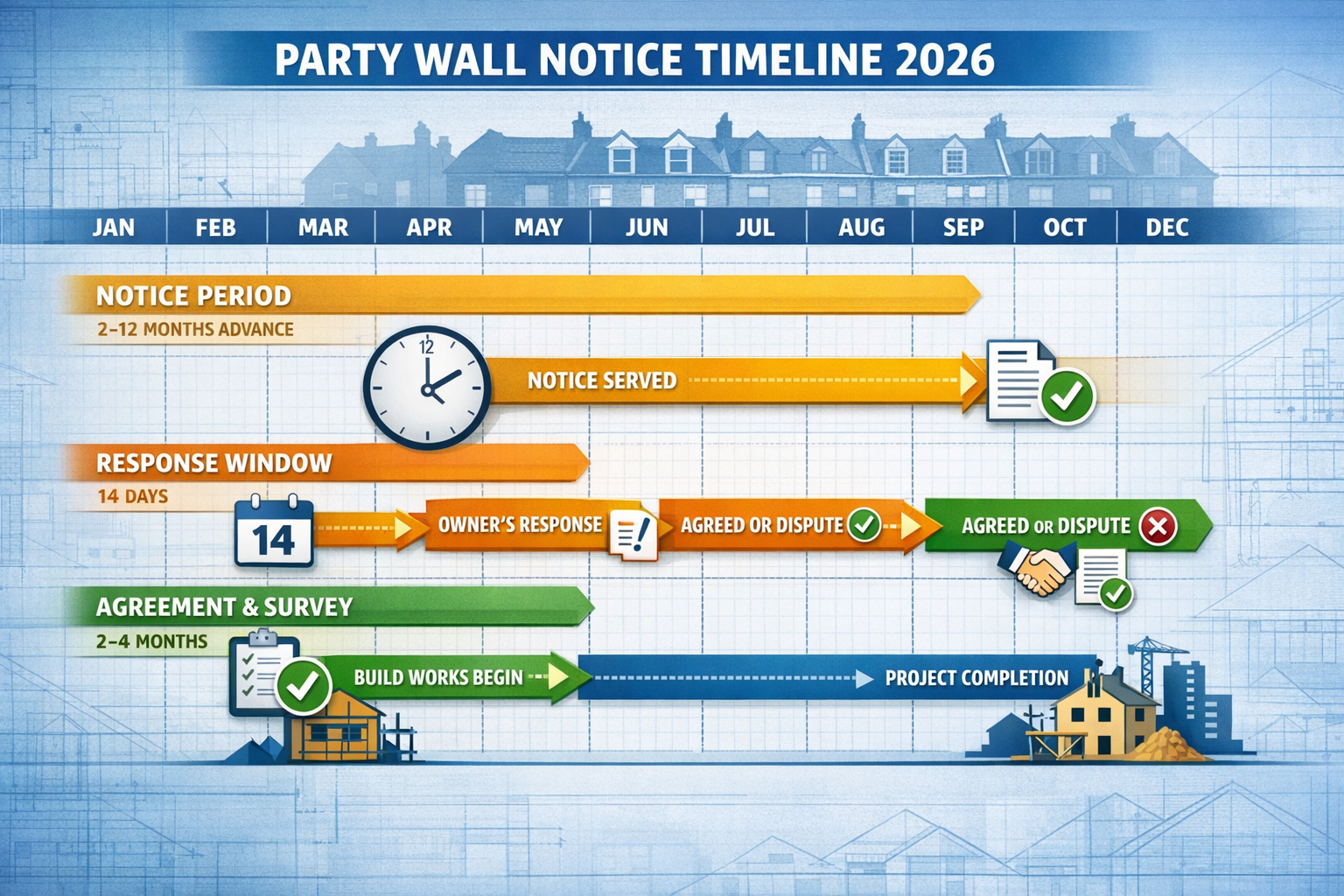
The Party Wall Notice Timeline Breakdown
| Phase | Duration | Key Actions |
|---|---|---|
| Pre-Notice Planning | 1-2 months | Design finalization, cost estimates, surveyor selection |
| Notice Service | Day 1 | Formal Party Wall Notice served to neighbours |
| Response Period | 14 days | Neighbours consent or dissent in writing |
| Agreement Process | 2-4 months | Surveyor appointments, schedules of condition, award preparation |
| Construction Window | Varies | Actual building works commence |
⚠️ Critical Insight: The earliest construction can legally begin is 2 months after serving notice, but practical timelines typically extend to 3-5 months when accounting for surveyor scheduling and agreement finalization.
Aligning Party Wall Timelines with Rental Market Cycles
Smart buy-to-let investors coordinate party wall procedures with rental demand patterns:
🏆 Optimal Strategy for 2026:
- Serve notices in January-February for summer completion (peak rental season)
- Target void periods between tenancies for disruptive works
- Avoid December-January notice service (holiday delays in responses)
- Consider academic calendars for student accommodation extensions
Example Timeline for Summer 2026 Completion:
- January 2026: Serve party wall notices
- January-February: 14-day response period + surveyor appointments
- February-April: Agreement process and party wall surveyor assessments
- May-July: Construction phase
- August 2026: Completion and re-letting at peak demand
This approach minimizes rental void periods while capturing the strongest letting market of the year.

Cost Management and Financial Planning
Understanding party wall costs is essential for accurate buy-to-let investment appraisals in 2026.
Party Wall Surveyor Fees in 2026
The building owner (landlord undertaking extensions) typically bears all party wall costs, including:
Surveyor Fee Structure:
- Agreed surveyor (both parties use same surveyor): £750-£1,200
- Separate surveyors (each party appoints own): £1,000-£1,800 per surveyor
- Third surveyor (dispute resolution): Additional £800-£1,500
💡 Cost-Saving Tip: Propose an agreed surveyor in your initial notice to potentially halve surveyor costs, though neighbours retain the right to appoint their own representative.
Total Party Wall Budget for Buy-to-Let Extensions
For a typical rear or side extension project affecting one neighbouring property:
| Cost Component | Range | Notes |
|---|---|---|
| Your surveyor fees | £750-£1,800 | Mandatory if neighbour dissents |
| Neighbour's surveyor fees | £750-£1,800 | You pay both surveyors |
| Schedule of condition | £200-£400 | Photographic documentation |
| Party wall award preparation | Included | Within surveyor fees |
| Remedial works (if damage occurs) | Variable | Contingency: 2-5% of build costs |
| Total typical cost | £1,500-£4,000 | For standard single-neighbour scenario |
Multi-Property Scenarios: Terraced houses or flats may require notices to multiple neighbours, multiplying costs accordingly. A mid-terrace extension affecting both adjacent properties could incur £3,000-£8,000 in party wall expenses.
ROI Considerations in Market Recovery
When evaluating extension projects during the 2026 market recovery, factor party wall costs into your investment analysis:
Example ROI Calculation:
- Extension cost: £45,000
- Party wall expenses: £2,500
- Total investment: £47,500
- Rental increase: £250/month (£3,000/year)
- Property value increase: £60,000
- Net gain: £12,500 + ongoing rental premium
The relatively modest party wall costs (typically 2-5% of total project costs) rarely undermine the financial viability of well-planned extensions in the recovering market.
Navigating the Party Wall Agreement Process
Efficient management of the party wall agreement process minimizes delays that could compromise market timing.
Step 1: Pre-Notice Preparation (1-2 Months Before)
Before serving formal notices, complete:
✓ Architectural designs finalized with structural engineer input
✓ Planning permission secured (if required)
✓ Building regulations approval obtained
✓ Contractor selection and preliminary scheduling
✓ Neighbour communication (informal courtesy discussion)
Pro Tip: Informal pre-notice conversations with neighbours can significantly smooth the formal process. Explain your plans, timeline, and commitment to minimizing disruption.
Step 2: Serving the Party Wall Notice
Three types of notices exist under the Party Wall Act:
- Party Structure Notice: For works directly to party walls/structures (2-month advance)
- Line of Junction Notice: For new walls on boundary lines (1-month advance)
- Adjacent Excavation Notice: For excavations near neighbours (1-month advance)
Service Requirements:
- Must be in writing with specific work descriptions
- Include drawings and technical specifications
- Served to all affected neighbours
- Delivered by hand, registered post, or recorded delivery
Consider engaging expert party wall advice for complex scenarios involving multiple notices or properties.
Step 3: The 14-Day Response Period
After receiving your notice, neighbours have 14 days to respond in one of three ways:
✅ Consent: Written agreement allows work to proceed without surveyors (rare in practice)
❌ Dissent: Written refusal triggers the surveyor appointment process
⏰ No response: Silence after 14 days constitutes deemed dissent, requiring surveyors
Reality Check: Most neighbours either dissent or don't respond, making surveyor involvement the norm rather than exception. This isn't necessarily adversarial—it's simply the standard protective mechanism.
Step 4: Surveyor Appointments and Party Wall Award (2-4 Months)
Once dissent occurs (actual or deemed):
Surveyor Selection Options:
- Agreed Surveyor: Both parties consent to one impartial surveyor
- Two Surveyors: Each party appoints their own; surveyors may appoint a third if they disagree
- Building Owner Appoints for Non-Responding Neighbour: After 10 days of no appointment
The Party Wall Award Process:
📋 Schedule of Condition: Surveyors document the existing condition of both properties through photographs and written descriptions, establishing baseline for any future damage claims
📐 Technical Review: Assessment of proposed works, structural implications, and protective measures
📝 Award Preparation: Formal document detailing permitted works, timing, access arrangements, and dispute resolution procedures
⏱️ Timeline: Typically 6-10 weeks from surveyor appointments to final award
Important: Construction cannot legally commence until the party wall award is finalized and served to all parties.
Strategic Timing for Different Extension Types
Different extension types present unique timing considerations within Party Wall Notices in 2026 Market Recovery: Timing Strategies for Buy-to-Let Extension Projects.
Rear Extensions
Party Wall Implications: Required when extending beyond the neighbour's rear building line or within 3 meters of their foundation.
Optimal 2026 Timing Strategy:
- Serve notices in winter months (January-March)
- Target completion for summer letting season (July-August)
- Minimize garden disruption during peak outdoor months
- Coordinate with construction projects scheduling
Timeline: 5-7 months from notice to completion for typical single-storey rear extension
Loft Conversions
Party Wall Implications: Nearly always require party wall procedures for semi-detached or terraced properties due to structural alterations to shared roof structures.
Optimal 2026 Timing Strategy:
- Less weather-dependent than ground-floor extensions
- Can proceed during winter months with proper weatherproofing
- Serve notices in spring (March-April) for autumn completion (September-October)
- Capture post-summer rental market refresh
Timeline: 6-9 months from notice to completion including planning and building control
Basement Extensions
Party Wall Implications: Most complex, requiring adjacent excavation notices and extensive structural assessments.
Optimal 2026 Timing Strategy:
- Longest party wall agreement process (3-5 months typical)
- Serve notices in early winter (November-December)
- Target spring/summer construction when ground conditions optimal
- Allow 8-12 month total timeline
Timeline: 8-12 months from notice to completion; most demanding of all extension types
Side Extensions
Party Wall Implications: Often require line of junction notices for new walls on boundaries.
Optimal 2026 Timing Strategy:
- Relatively straightforward party wall process (2-3 months)
- Serve notices in late winter (February-March)
- Complete by early summer (June-July)
- Ideal for properties with narrow side access
Timeline: 4-6 months from notice to completion
Risk Mitigation and Dispute Prevention
Proactive risk management protects both project timelines and neighbour relationships.
Common Party Wall Disputes and Prevention
🚫 Dispute Trigger 1: Inadequate Communication
Prevention: Maintain open dialogue throughout the process. Provide regular updates, respond promptly to concerns, and demonstrate respect for neighbour's property and peace.
🚫 Dispute Trigger 2: Damage to Neighbouring Property
Prevention: Ensure comprehensive schedule of condition documentation. Engage reputable contractors with appropriate insurance. Monitor works closely for any signs of structural movement or damage.
🚫 Dispute Trigger 3: Excessive Noise and Disruption
Prevention: Establish and communicate reasonable working hours (typically 8am-6pm weekdays, limited weekend work). Provide advance notice of particularly disruptive activities.
🚫 Dispute Trigger 4: Unauthorized Scope Changes
Prevention: Obtain additional party wall consent before materially altering approved works. Don't assume minor changes are acceptable without surveyor review.
When Disputes Arise
If conflicts emerge despite precautions:
- Engage surveyors immediately: They serve as neutral mediators
- Document everything: Written records of all communications and site conditions
- Consider third surveyor: If your appointed surveyors cannot agree
- Legal recourse: County Court appeals available but costly (£3,000-£10,000+)
The vast majority of party wall procedures conclude amicably when managed professionally. Understanding party wall surveyor responsibilities helps set appropriate expectations.
Institutional Landlord Strategies for 2026
Large-scale buy-to-let investors are adopting sophisticated approaches to party wall management in the 2026 recovery.
Portfolio-Wide Party Wall Planning
Institutional Advantage: Economies of scale through:
- Preferred surveyor relationships: Negotiated rates for multiple properties
- Standardized procedures: Template notices and documentation
- Dedicated project managers: Coordinating multiple simultaneous extensions
- Legal support: In-house expertise for complex scenarios
Best Practice: Develop a 12-18 month rolling extension pipeline, staggering party wall notices to optimize resource allocation and capture seasonal rental demand across the portfolio.
Technology Integration
Forward-thinking landlords leverage:
- Project management software: Tracking notice deadlines and surveyor milestones
- Digital documentation: Cloud-based storage of awards, schedules, and correspondence
- Tenant communication platforms: Automated updates during construction phases
- Financial modeling tools: ROI analysis incorporating party wall costs and timing variables
Compliance and Reputation Management
In the competitive 2026 market, institutional investors recognize that professional party wall management:
✨ Protects brand reputation with neighbours and communities
✨ Minimizes legal risks and associated costs
✨ Maintains tenant satisfaction through organized, considerate construction
✨ Supports ESG objectives via responsible property development
Regulatory Landscape in 2026
The Party Wall Act 1996 remains the primary legislative framework, but contextual factors in 2026 include:
Geographic Considerations
England and Wales: Full Party Wall Act 1996 application
Scotland: Common law principles govern party wall matters; no statutory framework equivalent to England/Wales
Northern Ireland: Common law approach similar to Scotland
Implication for Investors: Multi-jurisdiction portfolios require different legal strategies. This article focuses primarily on England and Wales where the Act applies.
Building Regulations Updates
While the Party Wall Act itself hasn't changed, related building regulations continue evolving:
- Energy efficiency standards: Extensions must meet current Part L requirements
- Structural safety: Part A compliance increasingly scrutinized
- Fire safety: Enhanced requirements following building safety reforms
Ensure extension designs satisfy both party wall requirements AND current building regulations to avoid costly mid-project modifications.
Planning Permission Interaction
Party wall procedures operate independently from planning permission, but timing coordination is essential:
Sequential Approach:
- Secure planning permission first (if required)
- Then serve party wall notices
- Obtain party wall awards
- Finally commence construction
Rationale: Serving party wall notices before planning approval risks wasted surveyor fees if planning is refused or requires significant design changes.
Practical Checklist for Buy-to-Let Landlords
Use this comprehensive checklist to navigate Party Wall Notices in 2026 Market Recovery: Timing Strategies for Buy-to-Let Extension Projects:
Pre-Notice Phase (2-3 Months Before)
- Finalize extension designs with architect/engineer
- Obtain planning permission (if required)
- Secure building regulations approval in principle
- Select and brief main contractor
- Identify all affected neighbours
- Have informal discussions with neighbours
- Research and shortlist party wall surveyors
- Calculate total budget including party wall costs
- Determine optimal construction timing for rental market
- Review tenant lease terms regarding access and disruption
Notice Service Phase (Day 1)
- Prepare compliant party wall notices with technical details
- Include all necessary drawings and specifications
- Serve notices via recorded delivery or hand delivery with receipt
- Retain proof of service for all notices
- Diarize 14-day response deadline
- Notify your contractor of party wall timeline
Response and Agreement Phase (Weeks 2-16)
- Monitor for neighbour responses within 14 days
- Appoint your party wall surveyor upon dissent/no response
- Facilitate neighbour's surveyor appointment if needed
- Cooperate fully with schedule of condition process
- Review draft party wall award carefully
- Clarify any ambiguous terms before finalizing
- Ensure all parties receive final signed award
- Provide copy to your contractor
Construction Phase (Months 3-9)
- Commence only after award finalized
- Brief contractor on party wall obligations and restrictions
- Maintain communication with neighbours throughout
- Document any issues or damage immediately
- Allow surveyor access for monitoring visits
- Adhere to agreed working hours and conditions
- Address neighbour concerns promptly and professionally
Post-Completion Phase
- Arrange final surveyor inspection
- Address any identified damage or defects
- Obtain completion certificates from surveyors
- Archive all party wall documentation
- Update property records and insurance
- Photograph completed works for portfolio records
Conclusion
Successfully navigating Party Wall Notices in 2026 Market Recovery: Timing Strategies for Buy-to-Let Extension Projects requires a sophisticated understanding of legal obligations, market dynamics, and strategic timing. As institutional investors demonstrate renewed confidence in the buy-to-let sector, property extensions offer compelling opportunities to enhance rental yields and capital values—but only when party wall procedures are managed proactively and professionally.
The key success factors include:
⏰ Strategic Timing: Serving notices 5-7 months before target completion dates, aligned with peak rental demand periods
💰 Comprehensive Budgeting: Allocating £1,500-£4,000 for typical party wall costs as a standard component of extension ROI analysis
🤝 Proactive Communication: Maintaining positive neighbour relationships through transparency and consideration
📋 Professional Expertise: Engaging experienced party wall surveyors and professional surveyor services early in the planning process
📈 Market Awareness: Coordinating construction timelines with 2026 recovery dynamics to maximize rental income and minimize void periods
Next Steps for Buy-to-Let Investors
- Assess your portfolio: Identify properties with extension potential in the current market recovery
- Develop a timeline: Work backward from optimal completion dates to determine notice service timing
- Engage professionals: Consult with architects, structural engineers, and party wall surveyors
- Budget comprehensively: Include all party wall costs in your investment appraisal
- Communicate early: Begin informal neighbour discussions before formal notices
- Monitor the market: Stay informed about rental demand trends to optimize timing
The 2026 market recovery presents a window of opportunity for strategic buy-to-let extensions. By mastering party wall procedures and timing strategies, investors can capitalize on rising rental demand while maintaining full legal compliance and positive community relationships. The landlords who succeed will be those who recognize that professional party wall management isn't an obstacle to overcome—it's a critical component of responsible, profitable property investment.
For guidance on your specific extension project, consider consulting with expert party wall advisors who understand both the legal requirements and the commercial realities of the 2026 buy-to-let market.