


{"cover":"Professional landscape format (1536x1024) hero image with bold text overlay 'Party Wall Essentials for 2026 UK Data Centre Edge Builds: Surveys Amid AI-Driven Demand Surge' in extra large 72pt white sans-serif font with dark shadow and semi-transparent navy overlay box, positioned in upper third. Background shows modern compact edge data centre facility with server racks visible through glass walls, adjacent brick building sharing party wall, construction equipment nearby, UK urban setting. Foreground includes architectural blueprints and surveying equipment. Color scheme: deep blue, white, metallic silver accents. High contrast, magazine cover quality, editorial style with professional architectural photography aesthetic, sharp focus on shared wall boundary.","content":["Detailed landscape format (1536x1024) illustration showing Party Wall Act 1996 compliance workflow for data centre edge builds. Split-screen composition: left side displays formal Section 2 notice document with '2-month minimum notice period' highlighted in bold text, calendar showing timeline markers, right side shows compact edge data centre building cross-section with shared party wall clearly marked in red outline, adjacent property owner consultation depicted. Include flowchart arrows connecting notice service to surveyor appointment to agreement stages. Professional architectural drawing style with clean lines, UK regulatory documentation aesthetic, blue and grey color palette, technical precision.","Detailed landscape format (1536x1024) technical illustration of schedule of condition documentation for high-vibration data centre works. Central focus on party wall with detailed condition markings, cracks measured and photographed, annotation callouts showing pre-construction state. Surrounding elements include surveyor with laser measurement tools, vibration monitoring equipment attached to wall, thermal imaging camera display, detailed photographic evidence grid. Split view showing 'before construction' baseline condition versus monitoring points. Include clipboard with RICS-standard condition report template, professional surveying equipment. Color scheme: white, grey, safety orange highlights, technical blueprint aesthetic.","Detailed landscape format (1536x1024) infographic showing AI-driven demand surge impact on UK edge data centre construction 2026. Central UK map with multiple edge data centre location pins in urban areas, heat map overlay showing concentration in London and major cities. Bar chart displaying year-over-year growth in edge facility construction permits, upward trending arrow showing 300% increase. Pie chart breaking down party wall notice triggers: excavation works 40%, structural alterations 35%, infrastructure installations 25%. Include icons representing AI servers, cooling systems, power infrastructure. Modern tech aesthetic with electric blue, white, dark grey color scheme, data visualization clarity, professional business intelligence style."]
}

The explosive growth of artificial intelligence is reshaping the UK's digital infrastructure landscape. As AI workloads demand lower latency and faster processing speeds, compact edge data centres are springing up in urban areas across the country—often in tight quarters alongside existing buildings. This unprecedented construction boom brings a critical challenge: navigating Party Wall Act compliance when building high-powered, vibration-intensive facilities mere metres from neighbouring properties. Understanding Party Wall Essentials for 2026 UK Data Centre Edge Builds: Surveys Amid AI-Driven Demand Surge has become essential for developers, property owners, and surveyors alike.
Key Takeaways
- 📋 Section 2 notices require a minimum 2-month advance notice period for works affecting existing party walls in data centre projects
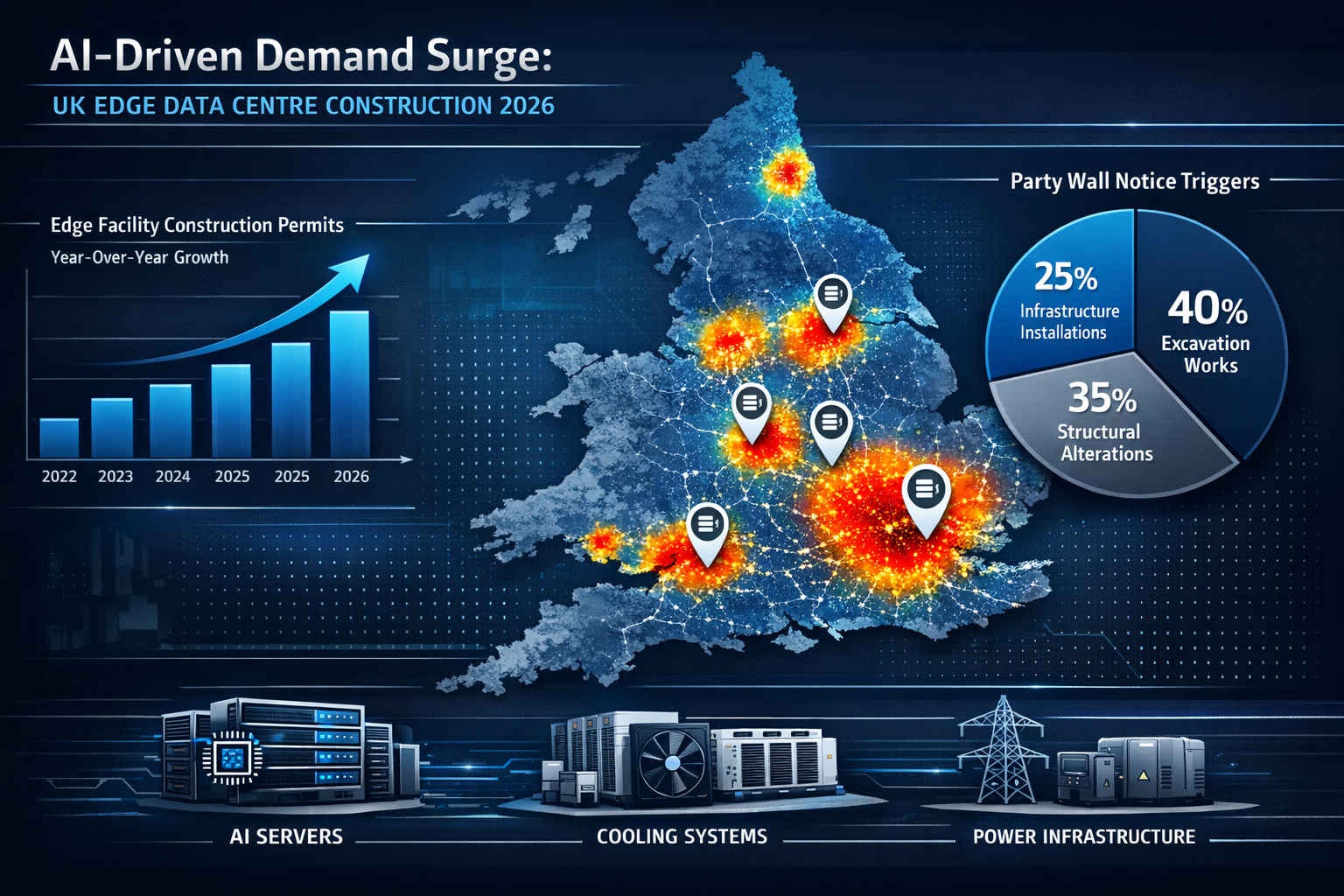
- 🏗️ Excavation and structural works near shared boundaries are primary triggers for Party Wall Act compliance in edge facility construction
- 📸 Schedules of condition documenting pre-construction property states are critical for high-vibration data centre equipment installations
- ⚖️ Party wall compliance operates within an integrated regulatory framework alongside planning, building control, and environmental requirements
- 🤝 Early engagement with neighbouring property owners and professional party wall surveyors prevents costly construction delays
Understanding the 2026 Edge Data Centre Construction Boom
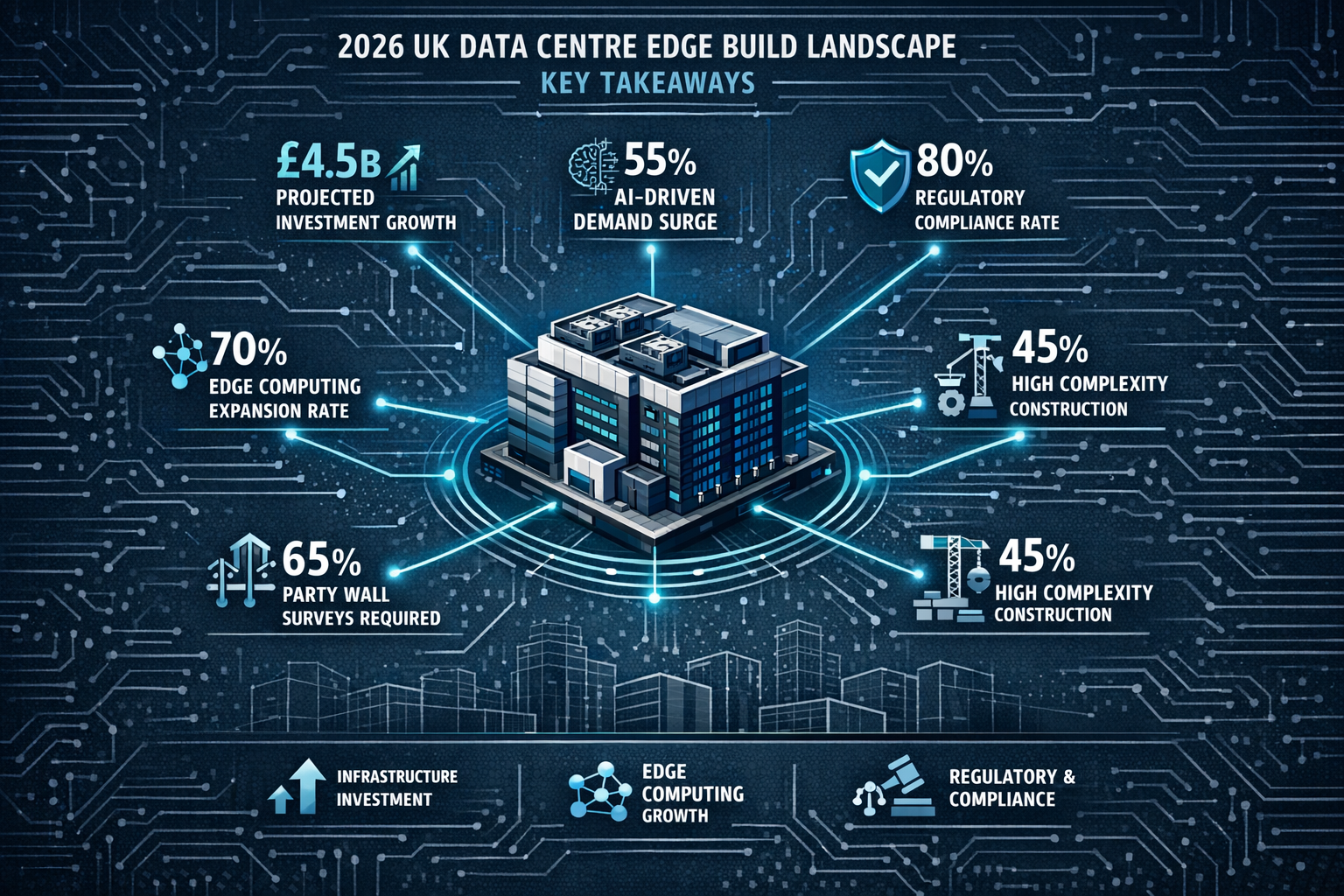
The demand for edge computing infrastructure has reached unprecedented levels in 2026. Unlike traditional centralised data centres located in remote areas, edge facilities are deliberately positioned in urban and suburban locations to reduce latency for AI applications, autonomous vehicles, and real-time data processing.
Why Edge Facilities Create Party Wall Challenges
Edge data centres typically occupy compact urban sites where space comes at a premium. These facilities often share boundaries with:
- Commercial office buildings
- Residential apartment blocks
- Industrial warehouses
- Retail properties
- Mixed-use developments
The proximity to neighbouring structures means that virtually every edge data centre construction project will trigger Party Wall Act requirements. Developers cannot simply purchase land and begin building—they must navigate complex legal obligations to adjacent property owners.
The AI Investment Surge
Investment in UK data centre infrastructure has surged dramatically, with edge facilities representing the fastest-growing segment. This growth stems from:
✅ AI model deployment requiring distributed computing power
✅ 5G network rollout demanding local processing capabilities
✅ Autonomous vehicle systems needing ultra-low latency
✅ Smart city initiatives generating massive data volumes
✅ Cloud gaming and AR/VR applications requiring instant response times
This investment wave means more construction projects, more shared boundaries, and consequently, more party wall considerations than ever before.
Party Wall Act Requirements for Edge Data Centre Projects
The Party Wall etc. Act 1996 governs construction work affecting shared walls, boundaries, and excavations near neighbouring properties throughout England and Wales. For data centre edge builds, compliance is not optional—it's a legal requirement that can halt projects if ignored.
Primary Triggers for Party Wall Notices
Data centre construction typically activates multiple sections of the Act:
Section 1: New Building on the Boundary Line
When constructing a new edge facility directly on or astride the boundary line with a neighbouring property, developers must serve notice under Section 1. This applies even when the new building doesn't physically touch the adjacent structure.
Section 2: Work to Existing Party Walls
Any modifications to an existing shared wall—including structural alterations, cutting into the wall for services, or increasing loads—require a Section 2 notice with a minimum 2-month notice period[2]. This extended timeline is crucial for project planning.
Section 6: Excavation and Foundation Work
Excavation work constitutes a key trigger for Party Wall Act compliance in data centre expansion projects[2]. Section 6 applies when:
- Excavating within 3 metres of a neighbouring building's foundation and going deeper than that foundation
- Excavating within 6 metres of a neighbouring structure and cutting a line at 45 degrees downward from the bottom of their foundation
Given that edge data centres require substantial foundations to support heavy equipment loads and often need deep excavations for cooling systems and cable runs, Section 6 compliance is almost universal.
Notice Periods and Timing Considerations
Proper timing is essential for party wall compliance. Understanding the duties of a party wall surveyor helps developers plan realistic construction schedules.
| Notice Type | Minimum Notice Period | Typical Application |
|---|---|---|
| Section 1 (New Wall on Boundary) | 1 month | New edge facility construction |
| Section 2 (Existing Party Wall) | 2 months | Modifications to shared structures |
| Section 6 (Excavation) | 1 month | Foundation and basement works |
Critical Planning Insight: Developers should add 3-4 months to project timelines to accommodate party wall processes, including notice periods, potential disputes, and surveyor appointments.
Integrated Regulatory Management
Party wall compliance in 2026 data centre projects operates as part of a broader integrated regulatory management framework rather than in isolation[1]. Developers must coordinate:
- Planning permission applications and approvals
- Building control compliance for structural integrity
- Environmental permits for cooling systems and noise
- Electrical safety certifications for high-voltage equipment
- Fire safety requirements for critical infrastructure
- Party wall agreements with adjacent owners
This integrated approach prevents situations where party wall agreements conflict with planning conditions or building regulations, streamlining the overall approval process.
Schedules of Condition: Critical Protection for High-Vibration Works
Edge data centres present unique challenges due to the high-vibration equipment they house. Server racks, cooling systems, backup generators, and uninterruptible power supplies all generate vibrations that can potentially affect neighbouring structures. This makes comprehensive schedules of condition absolutely essential.
What is a Schedule of Condition?
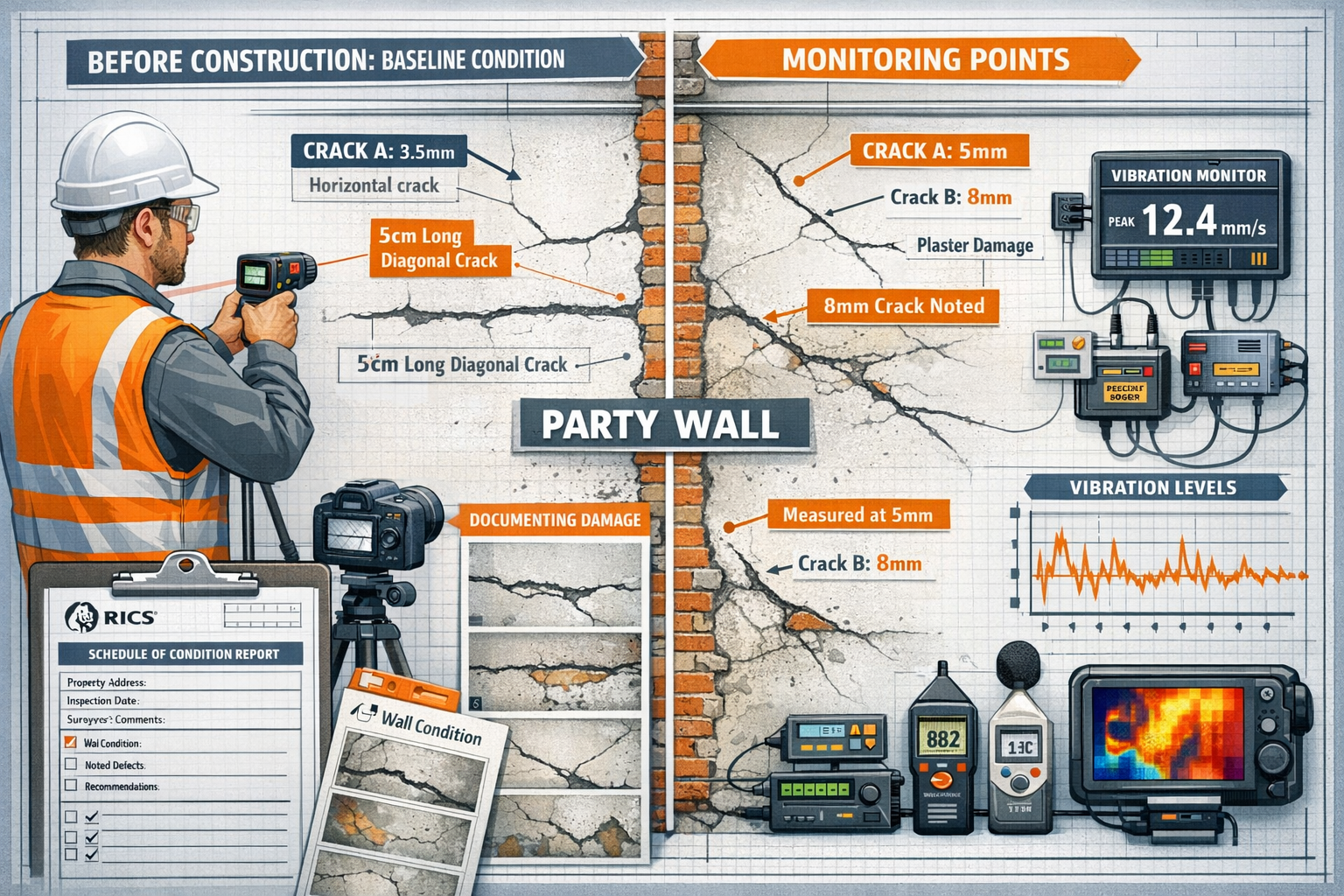
A schedule of condition is a detailed photographic and written record documenting the existing state of neighbouring properties before construction begins. This baseline evidence protects both the building owner and the developer by:
📸 Establishing pre-construction condition with dated photographs
📝 Recording existing defects like cracks, settlement, or dampness
🔍 Identifying vulnerable areas that require monitoring
⚖️ Providing legal evidence if disputes arise post-construction
💰 Protecting against unfounded claims for pre-existing damage
Components of a Comprehensive Schedule
For data centre projects involving high-vibration works near shared boundaries, schedules of condition should include:
External Documentation:
- Detailed photographs of all elevations facing the construction site
- Close-up images of existing cracks, defects, or settlement
- Measurements of crack widths using calibrated gauges
- Condition of roofing, chimneys, and drainage systems
- State of boundary walls, fences, and paving
Internal Documentation:
- Room-by-room photographic surveys
- Ceiling and wall crack mapping
- Floor level measurements
- Condition of decorative finishes
- Plasterwork and joinery condition
Technical Assessments:
- Structural observations by qualified surveyors
- Identification of pre-existing structural movements
- Assessment of building materials and construction methods
- Notation of previous repairs or alterations
Vibration Monitoring Protocols
Given the high-vibration nature of data centre operations, many party wall agreements now include ongoing vibration monitoring provisions:
During Construction Phase:
- Baseline vibration readings before works commence
- Continuous monitoring during piling and excavation
- Real-time alerts if vibration thresholds are exceeded
- Regular reporting to appointed surveyors
During Operational Phase:
- Initial commissioning vibration assessments
- Periodic monitoring of equipment-generated vibrations
- Protocols for addressing complaints
- Maintenance schedules to minimize vibration transmission
Legal Protection Through Documentation
The schedule of condition serves as crucial legal protection. Without this baseline documentation, developers may face claims for damage that existed before construction began. In 2026's litigious environment, the relatively modest cost of a comprehensive schedule—typically £500-£1,500 depending on property size—represents excellent insurance against potentially expensive disputes.
Navigating the Party Wall Agreement Process for Data Centre Builds
Successfully managing party wall requirements requires understanding the formal agreement process and the roles of various parties involved.
The Three-Surveyor Approach
The Party Wall Act provides for a three-surveyor system that ensures impartiality:
- Building Owner's Surveyor – Appointed by the developer/data centre owner
- Adjoining Owner's Surveyor – Appointed by the neighbouring property owner
- Agreed Surveyor – A single surveyor acting for both parties (if both agree)
For complex data centre projects, the three-surveyor approach is often preferable as it provides checks and balances. However, this increases costs, with party wall surveyor fees in London typically ranging from £700-£1,400 per surveyor depending on project complexity.
The Party Wall Award
Once surveyors are appointed and the property inspected, they prepare a Party Wall Award—a legally binding document that:
✔️ Describes the proposed works in detail
✔️ Sets out the rights and responsibilities of each party
✔️ Specifies working hours and access arrangements
✔️ Details protective measures and monitoring requirements
✔️ Establishes dispute resolution procedures
✔️ Allocates costs between parties
The Award must be served on all parties and can only be challenged through the courts within 14 days of service.
Common Challenges in Data Centre Projects
Edge data centre builds face specific party wall challenges:
Access Requirements
Data centres require ongoing access for maintenance, equipment replacement, and emergency repairs. Awards should clearly define perpetual access rights rather than just construction-phase access.
Noise and Operating Hours
Unlike typical construction projects that end, data centres operate 24/7. Agreements must address:
- Construction noise during build-out
- Operational noise from cooling systems and generators
- Emergency maintenance access at unsociable hours
- Backup generator testing schedules
Structural Loading
Server equipment creates significant floor loads. Where facilities share party walls with adjacent buildings, structural engineers must verify that increased loading won't affect the shared structure. The Award should reference these engineering assessments.
Cooling and Drainage
Edge facilities generate substantial heat requiring sophisticated cooling systems. Party wall agreements should address:
- Installation of cooling equipment on or near shared walls
- Drainage of condensate water
- Potential thermal effects on adjacent structures
- Noise from cooling fans and pumps
Dispute Resolution Mechanisms
Despite best efforts, disputes sometimes arise. The Party Wall Act 1996 provides a structured dispute resolution process:
- Surveyor Negotiation – Appointed surveyors attempt to resolve differences
- Third Surveyor Determination – The pre-appointed third surveyor makes binding decisions
- Appeal to County Court – Either party can appeal within 14 days
- Alternative Dispute Resolution – Mediation or arbitration may be specified in the Award
Best Practice: Include detailed dispute resolution clauses in the original Award, specifying timelines and procedures to prevent construction delays.
Cost Considerations and Financial Planning
Understanding the financial implications of party wall compliance helps developers budget accurately for edge data centre projects.
Direct Party Wall Costs
| Cost Component | Typical Range | Notes |
|---|---|---|
| Building Owner's Surveyor | £700-£1,400 | Depends on project complexity |
| Adjoining Owner's Surveyor | £700-£1,400 | Building owner typically pays |
| Third Surveyor (if appointed) | £800-£1,600 | For dispute resolution |
| Schedule of Condition | £500-£1,500 | Per neighbouring property |
| Vibration Monitoring Equipment | £2,000-£5,000 | Installation and ongoing monitoring |
| Legal Review of Awards | £500-£2,000 | Recommended for complex projects |
Total Estimated Range: £5,200-£13,900 per neighbouring property affected
For an edge data centre with three adjacent properties, total party wall costs could reach £25,000-£40,000 or more.
Indirect Costs and Timeline Impacts
Beyond direct fees, party wall processes create indirect costs:
⏱️ Timeline Delays – 2-4 month notice periods delay construction starts
🏗️ Design Modifications – Awards may require changes to foundation designs
🔧 Enhanced Protective Measures – Additional underpinning or vibration isolation
📋 Administrative Burden – Project management time coordinating compliance
⚖️ Dispute Resolution – Potential legal costs if disagreements arise
Cost Recovery and Allocation
Under the Party Wall Act, the building owner (developer) typically bears all costs associated with the party wall process, including:
- Their own surveyor's fees
- The adjoining owner's surveyor's fees
- The third surveyor's fees (if appointed)
- The cost of the Award preparation
- Schedules of condition
- Any remedial works required
This cost allocation should be factored into project budgets from the outset. Attempting to negotiate cost-sharing with adjoining owners rarely succeeds and can damage relationships.
Practical Recommendations for Developers and Property Owners
Successfully navigating Party Wall Essentials for 2026 UK Data Centre Edge Builds: Surveys Amid AI-Driven Demand Surge requires proactive planning and professional expertise.
For Data Centre Developers
1. Engage Early with Neighbours
Don't wait until formal notices are required. Early informal discussions with adjoining owners can:
- Build goodwill and trust
- Identify concerns before they become objections
- Allow time to modify designs if needed
- Demonstrate professionalism and respect
2. Appoint Experienced Surveyors
Choose surveyors with specific data centre experience who understand:
- High-vibration equipment implications
- 24/7 operational requirements
- Critical infrastructure cooling needs
- Electrical and mechanical service installations
Finding the best local surveyor with relevant expertise is crucial.
3. Comprehensive Schedules of Condition
Invest in thorough baseline documentation for all neighbouring properties. The modest upfront cost provides substantial protection against future claims.
4. Build Contingency into Timelines
Add 3-4 months to project schedules to accommodate party wall processes. Attempting to rush compliance creates conflicts and potential legal challenges.
5. Coordinate with Other Approvals
Ensure party wall compliance aligns with planning permissions, building control approvals, and environmental permits through integrated project management.
For Neighbouring Property Owners
1. Understand Your Rights
Familiarize yourself with the Party Wall Act provisions and your legal protections. You have the right to:
- Appoint your own surveyor (at the developer's expense)
- Have your property's condition documented
- Receive formal notice of proposed works
- Object to works and have disputes resolved
2. Appoint Your Own Surveyor
Don't rely on the developer's surveyor alone. Your appointed surveyor represents your interests and ensures:
- Adequate protective measures
- Fair Award terms
- Proper condition documentation
- Ongoing monitoring provisions
3. Document Everything
Keep copies of all notices, correspondence, and agreements. Photograph your property independently before works commence.
4. Raise Concerns Early
If you have specific concerns about vibration, noise, or structural impacts, communicate them clearly during the Award preparation phase rather than after construction begins.
5. Consider Long-Term Implications
Data centres operate indefinitely. Ensure the Award addresses ongoing operational issues, not just construction-phase impacts.
Future Trends: Party Wall Considerations in the Evolving Data Centre Landscape
As we progress through 2026 and beyond, several emerging trends will shape party wall considerations for edge data centre development.
Increasing Density and Vertical Builds
Land scarcity in urban areas is driving vertical data centre designs—multi-storey facilities that maximize computing power per square metre. These vertical builds create new party wall challenges:
- Shared walls across multiple floors
- Greater structural loading on party walls
- More complex vibration transmission patterns
- Increased cooling requirements affecting adjacent properties
Modular and Prefabricated Construction
The industry is moving toward modular data centre construction with prefabricated units. While this accelerates build times, it doesn't eliminate party wall requirements. Developers must still:
- Serve proper notices for foundation works
- Document adjoining property conditions
- Obtain Awards before installation
- Address ongoing operational impacts
Enhanced Monitoring Technology
Technological advances are improving party wall compliance through:
🔬 IoT Vibration Sensors – Continuous real-time monitoring with cloud-based reporting
📱 Mobile Documentation Apps – Instant photographic evidence with GPS and timestamp data
🤖 AI-Powered Damage Detection – Automated identification of new cracks or structural changes
📊 Blockchain Record-Keeping – Immutable records of condition assessments and agreements
Sustainability and Shared Infrastructure
The push toward sustainability is creating opportunities for shared infrastructure between data centres and adjacent buildings:
- Waste heat recovery systems warming neighbouring properties
- Shared backup power generation
- Combined cooling solutions
- Integrated renewable energy installations
These shared systems require carefully drafted party wall agreements addressing long-term operational relationships, maintenance responsibilities, and cost-sharing arrangements.
Regulatory Evolution
While the Party Wall Act 1996 remains the governing legislation, its application to modern data centre infrastructure continues to evolve through case law and professional guidance. Staying current with expert party wall advice ensures compliance with emerging interpretations and best practices.
Conclusion
The intersection of AI-driven demand surge and urban edge data centre construction has elevated party wall compliance from a routine legal formality to a critical project success factor. Party Wall Essentials for 2026 UK Data Centre Edge Builds: Surveys Amid AI-Driven Demand Surge encompasses far more than simply serving notices—it requires comprehensive understanding of high-vibration works, detailed condition documentation, integrated regulatory management, and proactive stakeholder engagement.
Key success factors include:
✅ Early planning with 3-4 month timelines for party wall processes
✅ Professional expertise from surveyors experienced in data centre projects
✅ Comprehensive documentation through detailed schedules of condition
✅ Proactive communication with neighbouring property owners
✅ Integrated compliance coordinating party wall, planning, and building control requirements
✅ Ongoing monitoring for vibration and structural impacts during construction and operation
Actionable Next Steps
For Developers Planning Edge Data Centre Projects:
- Conduct boundary analysis identifying all properties requiring party wall notices
- Engage qualified surveyors with data centre infrastructure experience at project inception
- Budget appropriately for £25,000-£40,000+ in party wall costs for typical urban sites
- Develop neighbour engagement plans before formal notice requirements
- Integrate party wall timelines into overall project schedules with adequate contingency
For Property Owners Adjacent to Proposed Data Centres:
- Seek professional advice immediately upon receiving party wall notices
- Appoint your own surveyor to protect your interests (at developer's expense)
- Document your property independently with photographs and written records
- Understand long-term implications of 24/7 data centre operations next door
- Engage constructively with the process while protecting your legal rights
The 2026 AI-driven boom in edge computing infrastructure shows no signs of slowing. As more compact, high-powered data centres emerge in urban locations across the UK, mastering party wall essentials becomes increasingly critical for all stakeholders. Whether you're a developer racing to meet market demand or a property owner suddenly adjacent to critical digital infrastructure, understanding and properly navigating the Party Wall Act framework protects investments, prevents disputes, and ensures successful project outcomes.
The complexity of modern data centre construction demands expertise. Don't navigate these waters alone—engage experienced professionals who understand both the technical requirements of edge computing facilities and the legal nuances of party wall compliance.
References
[1] Party Wall Surveys For Data Centre Expansions In The Uk Ai Boom Rics Guidance And Case Studies From 2026 Projects – https://nottinghillsurveyors.com/blog/party-wall-surveys-for-data-centre-expansions-in-the-uk-ai-boom-rics-guidance-and-case-studies-from-2026-projects
[2] Party Wall Surveys For Data Centre Expansions Navigating Agreements In The 2026 Investment Surge – https://nottinghillsurveyors.com/blog/party-wall-surveys-for-data-centre-expansions-navigating-agreements-in-the-2026-investment-surge
[3] Party Wall Act Essentials For 2026 Uk Renewable Energy Retrofits Solar Panels And Heat Pumps On Shared Walls – https://nottinghillsurveyors.com/blog/party-wall-act-essentials-for-2026-uk-renewable-energy-retrofits-solar-panels-and-heat-pumps-on-shared-walls