
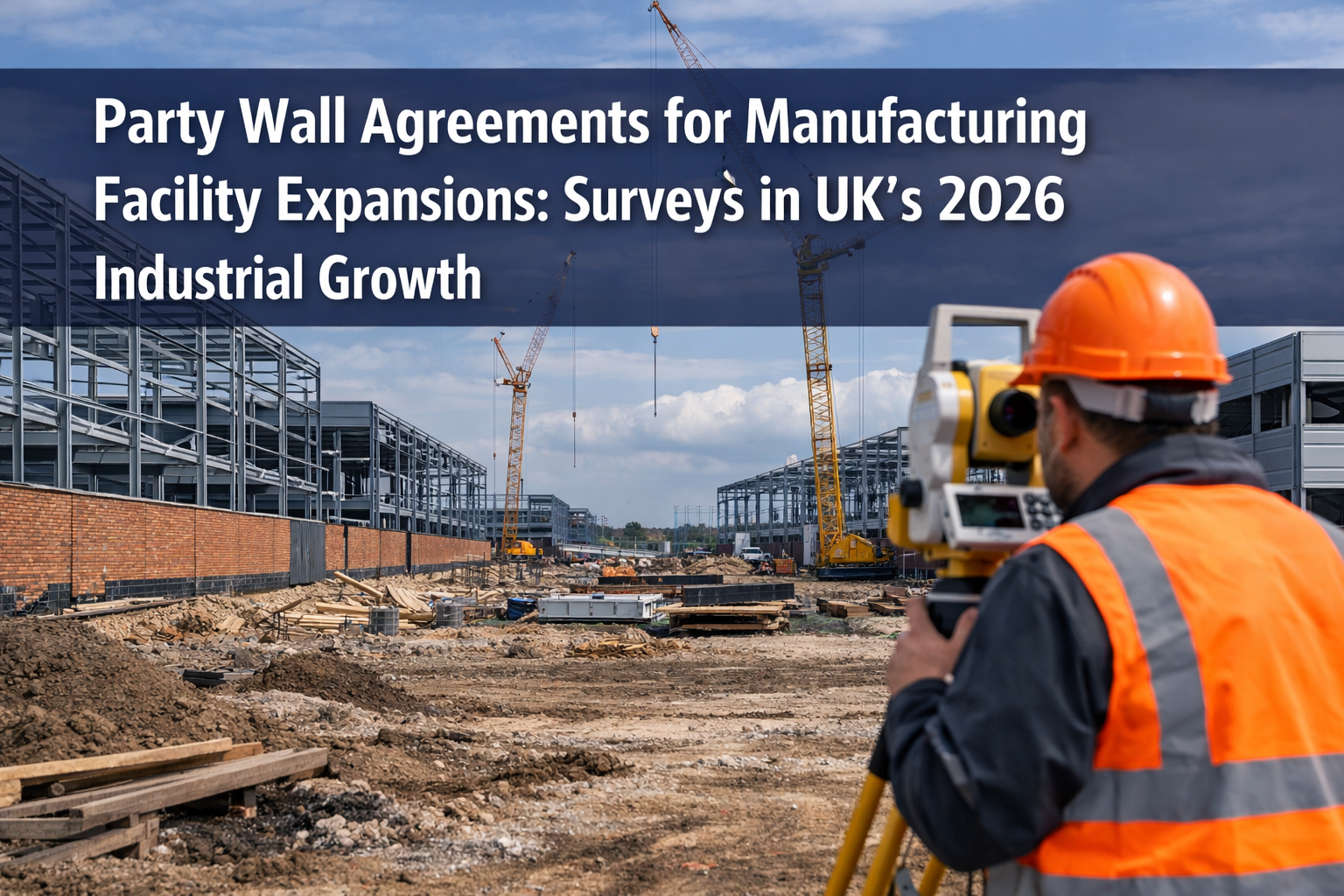
The UK's manufacturing sector is experiencing unprecedented expansion in 2026, with brownfield sites across industrial estates becoming prime locations for facility growth. As manufacturers race to increase production capacity and modernize operations, one critical legal requirement often catches businesses off guard: party wall agreements. When industrial properties share boundary walls with neighboring facilities, the Party Wall etc. Act 1996 mandates specific protocols that can make or break expansion timelines. Understanding Party Wall Agreements for Manufacturing Facility Expansions: Surveys in UK's 2026 Industrial Growth is no longer optional—it's essential for avoiding costly disputes and project delays.
Key Takeaways
- 🏭 Manufacturing expansions on brownfield sites typically involve shared boundary walls requiring formal party wall agreements under the 1996 Act
- ⚖️ Proper party wall surveys conducted before construction can prevent disputes, legal challenges, and project delays averaging 3-6 months
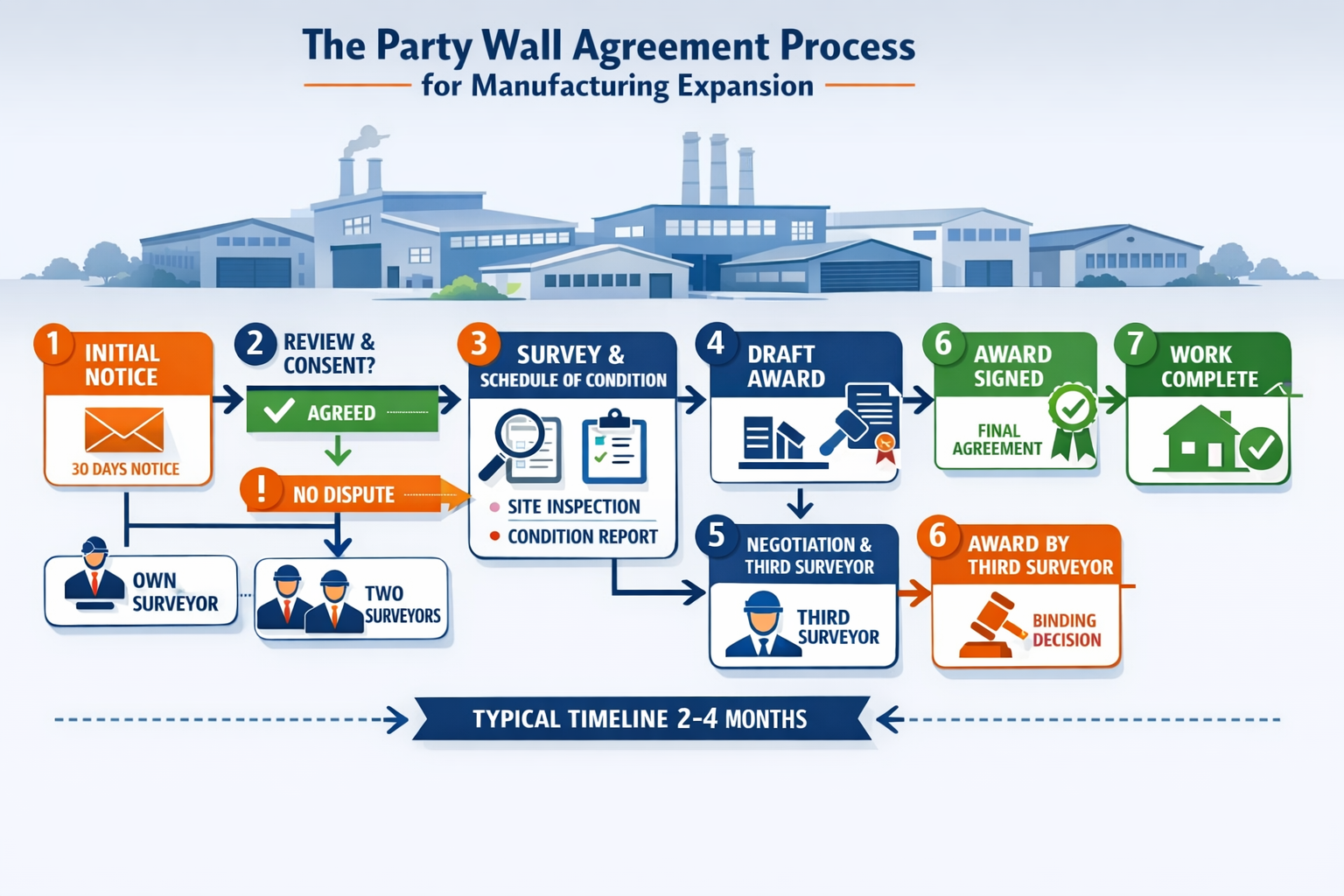
- 📋 The party wall process involves serving notices, appointing surveyors, creating schedules of condition, and obtaining party wall awards before work begins
- 💼 Industrial-scale projects face unique challenges including structural loads, vibration concerns, and multiple adjoining owners on shared industrial estates
- ✅ Proactive compliance with party wall requirements protects both building owners and neighboring manufacturers from financial and operational risks
Understanding Party Wall Agreements for Manufacturing Facility Expansions
What Makes Manufacturing Expansions Different?
Manufacturing facility expansions present unique challenges compared to residential party wall matters. While homeowners typically deal with single adjoining properties during loft conversions or extensions, industrial expansions often involve:
- Multiple adjoining owners sharing walls across industrial estates
- Heavier structural loads from machinery and equipment installations
- Vibration and noise concerns affecting neighboring operations
- Larger-scale excavations for foundations and underground utilities
- Complex ownership structures including freeholders, leaseholders, and tenants
The Party Wall Act 1996 applies equally to commercial and residential properties, but the stakes are considerably higher in manufacturing contexts. A single day of delayed production can cost manufacturers thousands of pounds, making dispute avoidance paramount.
The Legal Framework in 2026
The Party Wall etc. Act 1996 remains the cornerstone legislation governing shared boundary work in England and Wales. The Act covers three main types of work relevant to manufacturing expansions:
- Building on or at the boundary line between properties
- Work to an existing party wall or structure
- Excavation within 3-6 meters of a neighboring building's foundation
In 2026, the UK construction sector is navigating significant policy shifts including enhanced building safety regulations and planning reforms[1]. These changes intersect with party wall requirements, creating a more complex regulatory environment for manufacturers planning expansions.
"The construction boom of 2026 has intensified the need for proper party wall procedures, with disputes rising in high-demand markets where expansion projects are concentrated."[4]
The Party Wall Survey Process for Industrial Properties
Step 1: Initial Assessment and Planning
Before serving any notices, manufacturing facility owners should conduct a thorough assessment:
Pre-Survey Checklist:
- ✅ Identify all party walls and shared boundaries
- ✅ Determine ownership status of walls (party wall vs. boundary wall)
- ✅ Locate all adjoining owners (including tenants with relevant rights)
- ✅ Review existing leases and covenants
- ✅ Assess the scope of proposed work
- ✅ Calculate notice periods (minimum 2 months for most work)
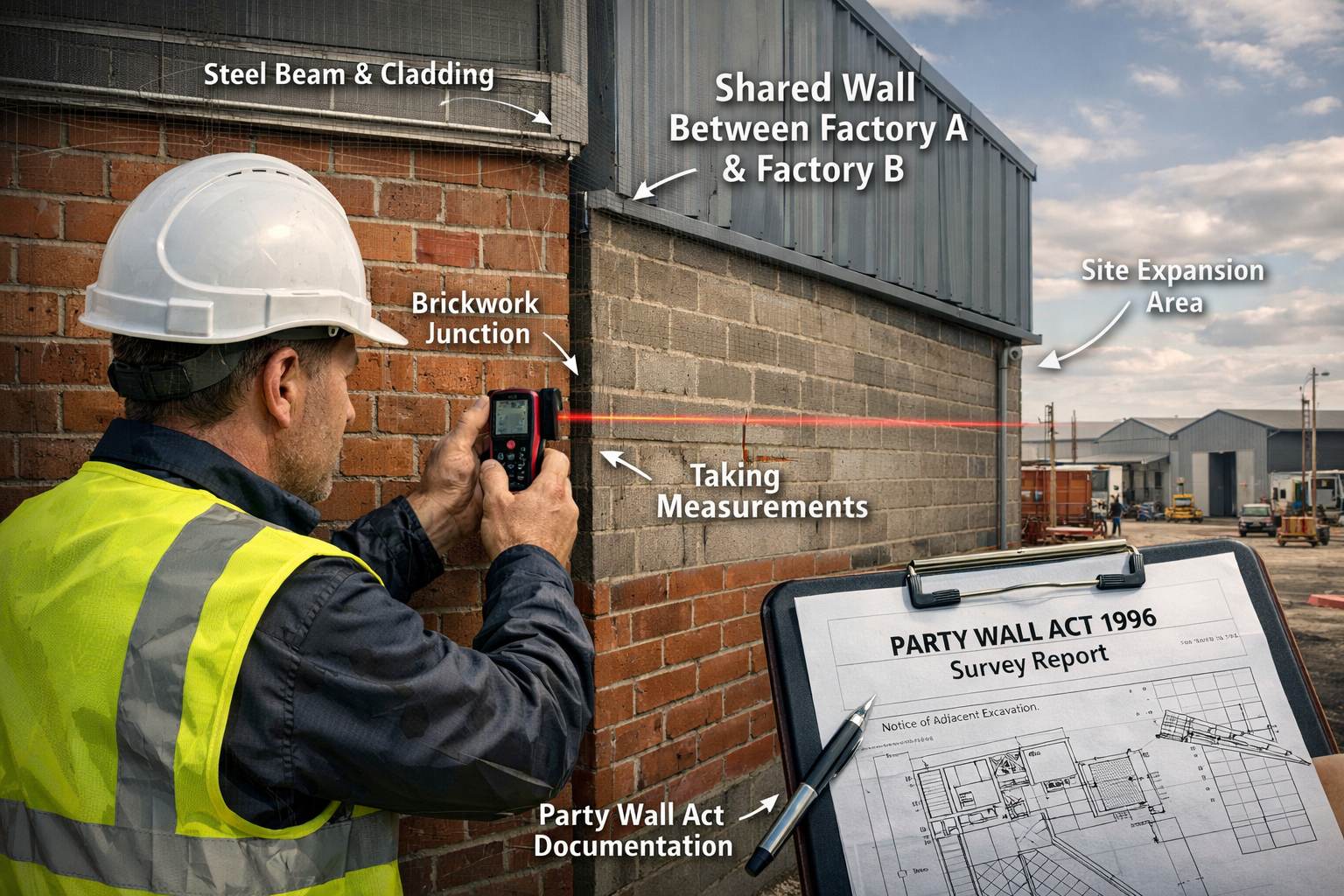
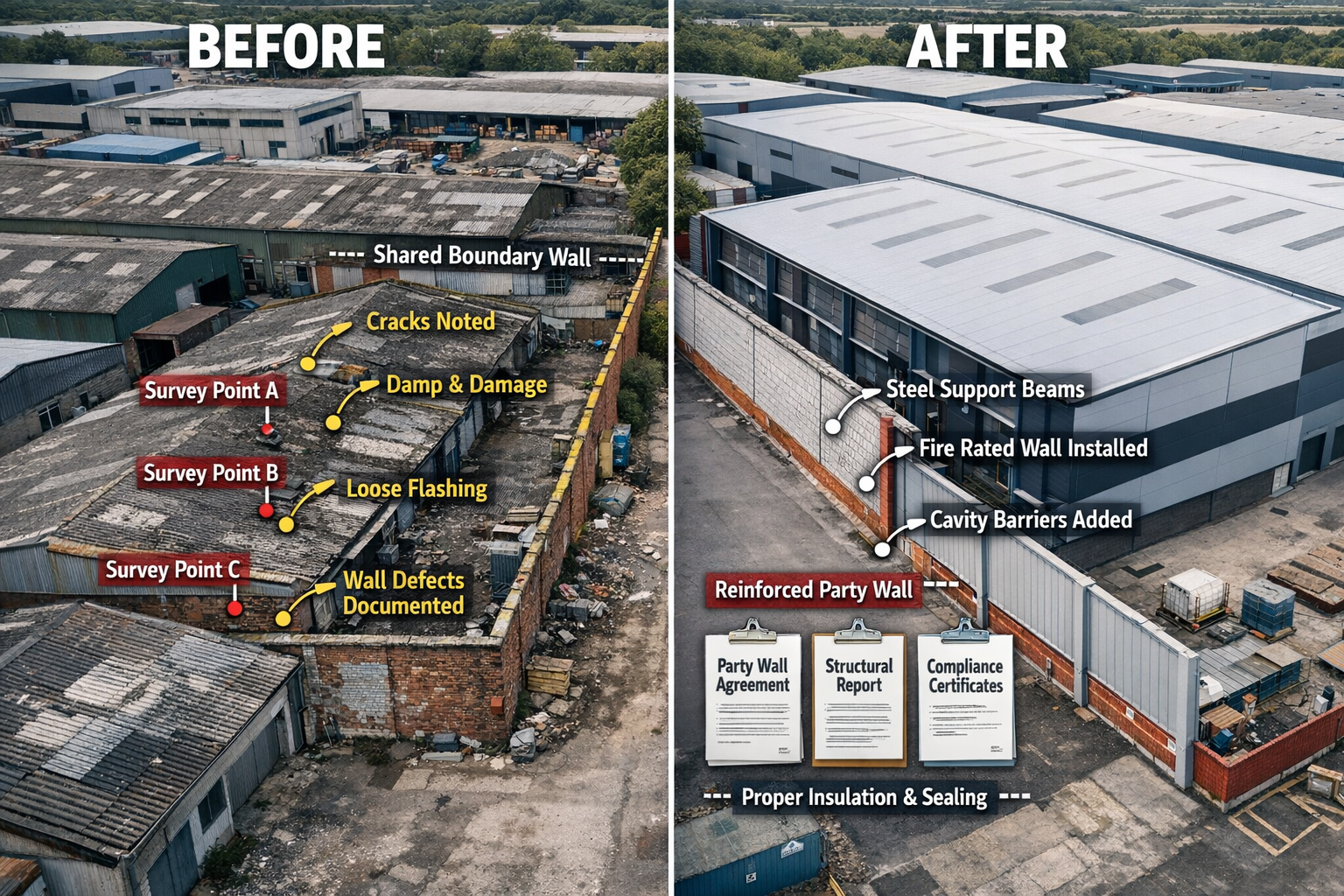
A schedule of condition is essential at this stage. This detailed photographic and written record documents the existing state of adjoining properties before any work commences, protecting both parties from spurious damage claims.
Step 2: Serving Party Wall Notices
The building owner must serve appropriate party wall notices to all adjoining owners. For manufacturing expansions, this typically involves:
Notice Types:
| Notice Type | When Required | Notice Period |
|---|---|---|
| Party Structure Notice | Work to existing party wall | 2 months |
| Line of Junction Notice | Building on boundary line | 1 month |
| Notice of Adjacent Excavation | Excavation within 3-6m of neighbor's structure | 1 month |
The notice must include:
- Detailed description of proposed work
- Start date for construction
- Technical drawings and specifications
- Contact information for the building owner
In industrial contexts, notices should be particularly detailed regarding:
- Expected vibration levels from machinery installation
- Foundation depth and load-bearing calculations
- Temporary support requirements
- Working hours and access arrangements
Step 3: Appointing Party Wall Surveyors
Once notices are served, adjoining owners have 14 days to respond. They can either:
- Consent to the work (no party wall award needed, though still advisable)
- Dissent or fail to respond (triggers the surveyor appointment process)
When surveyors are required, three appointment options exist:
Surveyor Appointment Options:
🔹 Agreed Surveyor – Both parties appoint a single surveyor (most cost-effective)
🔹 Two Surveyors – Each party appoints their own surveyor (most common for complex industrial work)
🔹 Third Surveyor – Appointed to resolve disputes between the two surveyors
For manufacturing facility expansions, appointing two surveyors is often recommended due to the technical complexity and higher financial stakes. The building owner typically bears the reasonable costs of both surveyors.
Step 4: Conducting the Party Wall Survey
Professional surveyors will conduct comprehensive inspections of both properties. For industrial facilities, surveys typically examine:
Industrial Party Wall Survey Components:
- Structural integrity of shared walls and foundations
- Load-bearing capacity for proposed expansion
- Existing defects (cracks, settlement, moisture issues)
- Machinery mounting points and vibration isolation
- Underground services and utilities
- Access routes for construction equipment
- Fire separation and safety compliance
Surveyors may commission specialist reports, including structural surveys for complex loading scenarios or damp surveys if moisture ingress is a concern.
Step 5: The Party Wall Award
After completing surveys and negotiations, the appointed surveyor(s) issue a Party Wall Award—a legally binding document that:
✅ Describes the work to be undertaken
✅ Specifies how and when work will be executed
✅ Sets out protective measures and safeguards
✅ Establishes dispute resolution procedures
✅ Allocates costs and expenses
✅ Includes the schedule of condition
The award must be served on both parties, who have 14 days to appeal to the County Court. Once the appeal period expires without challenge, work can commence in accordance with the award's terms.
Party Wall Agreements for Manufacturing Facility Expansions: Surveys in UK's 2026 Industrial Growth Challenges
Brownfield Site Complexities
The UK's 2026 industrial growth is heavily concentrated on brownfield redevelopment sites—previously developed land being repurposed for modern manufacturing. These sites present unique party wall challenges:
Brownfield-Specific Issues:
- Historical construction methods with unknown foundation depths
- Multiple ownership changes creating unclear boundary records
- Contaminated land requiring special excavation protocols
- Existing easements and rights of way affecting access
- Mixed-use developments with residential properties adjacent to industrial units
When dealing with legal requirements for boundary walls on brownfield sites, historical records may be incomplete or contradictory. Professional surveyors must often conduct extensive research through Land Registry documents, historical planning applications, and site investigations.
Managing Multiple Adjoining Owners
Industrial estates typically feature multiple units sharing party walls. A single manufacturing expansion might affect:
- Direct neighbors sharing the party wall
- Properties within excavation notice distance
- Tenants with protected rights
- Freeholders and superior landlords
- Utility companies with equipment on boundaries
Best Practice for Multiple Owners:
- Create a stakeholder matrix identifying all affected parties
- Serve notices simultaneously to maintain consistent timelines
- Coordinate surveyor appointments to streamline the process
- Hold joint meetings where multiple parties share concerns
- Maintain detailed communication logs for dispute prevention
Vibration and Structural Loading Concerns
Manufacturing equipment generates vibration and structural loads far exceeding residential scenarios. Party wall awards for industrial expansions must address:
Vibration Management:
- Baseline vibration monitoring before work commences
- Maximum permissible vibration levels during construction
- Ongoing monitoring during operation
- Vibration isolation measures for machinery
- Remediation procedures if damage occurs
Structural Loading:
- Load calculations for shared walls
- Reinforcement requirements
- Foundation underpinning specifications
- Temporary support during construction
- Long-term settlement monitoring
Surveyors may require specialist input from structural engineers to ensure party walls can safely accommodate increased loads without compromising adjoining properties.
Timeline Pressures and Commercial Realities
Manufacturing businesses face intense pressure to complete expansions quickly. Market demands, equipment delivery schedules, and customer commitments create tight timelines. However, the party wall process cannot be rushed:
Typical Timeline for Manufacturing Expansion:
| Phase | Duration | Key Activities |
|---|---|---|
| Pre-notice assessment | 2-4 weeks | Identify boundaries, locate owners, prepare notices |
| Notice period | 1-2 months | Statutory waiting period after serving notices |
| Surveyor appointment | 1-2 weeks | Adjoining owner response and surveyor selection |
| Survey and award | 4-8 weeks | Site inspections, negotiations, award preparation |
| Appeal period | 2 weeks | Statutory period before work commences |
| Total minimum | 4-5 months | From initial planning to construction start |
Many manufacturers underestimate this timeline, leading to costly delays. Starting the party wall process early—ideally during the planning application phase—is crucial for maintaining project schedules.
Dispute Avoidance Strategies for Industrial Party Wall Matters
Proactive Communication
The single most effective dispute prevention strategy is early, transparent communication with adjoining owners. Before formal notices are served:
📞 Initial Contact: Arrange face-to-face meetings with neighboring business owners
📋 Information Sharing: Provide detailed project information and timelines
🤝 Relationship Building: Understand neighbors' concerns and operational requirements
💡 Problem Solving: Address potential issues before they become disputes
Manufacturing businesses often share suppliers, customers, or industry associations with their neighbors. Leveraging these existing relationships can facilitate smoother party wall processes.
Comprehensive Schedules of Condition
A thorough schedule of condition is essential insurance against future disputes. For industrial properties, schedules should include:
Schedule of Condition Best Practices:
- High-resolution photographs of all relevant areas (internal and external)
- Video documentation of machinery, production lines, and sensitive equipment
- Detailed written descriptions of existing defects and conditions
- Measurements and dimensions of cracks, settlement, or other issues
- Date-stamped evidence with witness signatures
- Digital copies stored securely by both parties
The schedule protects building owners from exaggerated damage claims while giving adjoining owners confidence that legitimate damage will be recognized and remedied.
Clear Award Terms
Ambiguous party wall awards are a primary source of disputes. For manufacturing expansions, awards should explicitly address:
✅ Working hours and restrictions during sensitive production periods
✅ Access arrangements for construction vehicles and equipment
✅ Noise and dust control measures
✅ Emergency contact procedures for urgent issues
✅ Monitoring protocols for vibration, settlement, and structural movement
✅ Damage remediation procedures and timelines
✅ Completion criteria and sign-off requirements
The more specific the award, the less room for interpretation and disagreement during construction.
Professional Surveyor Selection
Choosing experienced party wall surveyors with industrial and commercial expertise is crucial. Residential-focused surveyors may lack the technical knowledge required for manufacturing facility expansions.
Surveyor Selection Criteria:
🎓 Qualifications: RICS-accredited with relevant commercial experience
🏭 Industrial Knowledge: Understanding of manufacturing processes and equipment
⚖️ Legal Expertise: Familiarity with commercial lease structures and rights
🔧 Technical Skills: Ability to assess structural loads, vibration, and specialized construction
💬 Communication: Clear explanations for business owners and stakeholders
📊 Track Record: Proven success in similar industrial projects
Understanding what a surveyor does in party wall contexts helps building owners make informed selection decisions.
The Role of Building Regulations and Safety Compliance
Integration with Building Safety Act 2026
The Building Safety Act continues to evolve in 2026, with new developments affecting how construction projects are regulated[3]. While party wall agreements are separate from building control approval, the two processes intersect:
Party Wall and Building Safety Overlap:
- Structural calculations required for both processes
- Fire safety considerations for party walls
- Competent person requirements for construction work
- Documentation and record-keeping standards
- Inspection and compliance verification
Manufacturers should coordinate party wall surveyors with building control officers to ensure consistent technical specifications and avoid duplicated efforts.
Planning Reforms and Industrial Development
Recent planning reforms have aimed to accelerate development, particularly for employment-generating projects like manufacturing facilities[5]. However, these reforms don't bypass party wall requirements:
Planning vs. Party Wall:
| Aspect | Planning Permission | Party Wall Agreement |
|---|---|---|
| Purpose | Land use authorization | Neighbor protection |
| Authority | Local planning authority | Private surveyors |
| Timeline | 8-13 weeks typical | 4-5 months minimum |
| Appeals | Planning Inspectorate | County Court |
| Costs | Application fees | Building owner pays |
Planning approval does not grant permission to proceed without party wall compliance. Both processes must be completed before construction begins.
Wall Construction Codes and Standards
Party wall construction for industrial facilities must comply with wall construction codes and building regulations including:
- Structural stability requirements (Approved Document A)
- Fire resistance standards for party walls (Approved Document B)
- Sound insulation between industrial units (Approved Document E)
- Moisture resistance and damp-proofing (Approved Document C)
- Energy efficiency for heated manufacturing spaces (Approved Document L)
Party wall awards should reference relevant building regulations to ensure construction work meets all legal requirements.
Cost Considerations for Party Wall Agreements in Manufacturing Expansions
Direct Party Wall Costs
The building owner bears the reasonable costs of the party wall process, including:
Typical Cost Components:
💰 Surveyor fees: £1,500-£5,000+ per surveyor (depending on project complexity)
💰 Adjoining owner's surveyor: Similar fees, paid by building owner
💰 Schedule of condition: £500-£2,000 for comprehensive documentation
💰 Specialist reports: £1,000-£5,000 for structural or vibration assessments
💰 Legal fees: £500-£3,000 if disputes require legal input
💰 Monitoring costs: £500-£2,000 for vibration and settlement monitoring
Total typical range: £5,000-£25,000 for straightforward projects, potentially £50,000+ for complex multi-party industrial expansions.
While these costs may seem substantial, they represent a small fraction of total expansion costs and provide essential protection against disputes that could cost hundreds of thousands in delays and legal fees.
Indirect Costs of Non-Compliance
Failing to follow proper party wall procedures creates far greater financial risks:
Non-Compliance Consequences:
⚠️ Injunctions: Court orders stopping work immediately
⚠️ Delay costs: Lost production, idle equipment, extended financing
⚠️ Damage claims: Unlimited liability for structural damage to adjoining properties
⚠️ Legal fees: Significantly higher than proactive compliance costs
⚠️ Relationship damage: Ongoing tensions with neighboring businesses
⚠️ Reputation harm: Industry perception of unprofessional conduct
A single injunction halting construction for weeks can cost manufacturers far more than the entire party wall process.
Cost Recovery and Allocation
Party wall awards specify how costs are allocated. Generally:
- Building owner pays for surveyors, awards, and protective measures
- Adjoining owner pays for betterments (improvements beyond necessary work)
- Shared costs for work benefiting both properties (e.g., rebuilding a defective party wall)
In some cases, manufacturers can negotiate cost-sharing arrangements with adjoining owners who benefit from improved party wall structures or enhanced fire separation.
Case Studies: Party Wall Agreements for Manufacturing Facility Expansions
Case Study 1: Food Processing Plant Expansion
Scenario: A food processing manufacturer needed to expand their facility by 40% on a brownfield industrial estate in the Midlands. The expansion required building against a shared boundary wall with a packaging company.
Challenges:
- Strict hygiene requirements for food processing
- Adjoining owner concerned about vibration from new machinery
- Existing party wall in poor condition with historic settlement
- Tight timeline for equipment installation
Solution:
- Appointed experienced commercial party wall surveyors
- Conducted comprehensive structural assessment revealing wall required rebuilding
- Negotiated cost-sharing (60% building owner, 40% adjoining owner) for wall reconstruction
- Implemented vibration monitoring with clear threshold limits
- Scheduled noisy construction work during adjoining owner's non-production hours
Outcome: Project completed on schedule with no disputes. Improved party wall benefited both parties, and the proactive approach built positive relationships for future collaboration.
Case Study 2: Automotive Parts Manufacturer Excavation
Scenario: An automotive parts manufacturer needed to excavate for new underground utilities within 4 meters of a neighboring precision engineering facility's foundations.
Challenges:
- Precision engineering requires vibration-free environment
- Unknown foundation depth of 1960s-era neighboring building
- Multiple tenants in adjoining building with different concerns
- Contaminated soil requiring special handling
Solution:
- Conducted trial pit investigations to determine foundation depths
- Appointed third-party vibration specialist to establish baseline and monitoring protocols
- Served notices to freeholder and all tenants with relevant rights
- Designed excavation methodology minimizing vibration (sheet piling instead of percussion piling)
- Created detailed schedule of condition including precision equipment calibration records
Outcome: Excavation completed without exceeding vibration thresholds. Continuous monitoring data provided confidence to all parties. No damage claims resulted.
Case Study 3: Pharmaceutical Manufacturing Clean Room Addition
Scenario: A pharmaceutical manufacturer needed to add a clean room facility requiring building on the boundary line of their industrial unit.
Challenges:
- Extremely tight contamination control requirements
- Adjoining owner's concerns about dust and particles during construction
- Complex ownership structure with superior landlord and multiple leaseholders
- Building regulations requiring enhanced fire separation
Solution:
- Coordinated party wall process with building control approval
- Specified construction methodology with sealed work areas and HEPA filtration
- Scheduled work during adjoining owner's planned shutdown period
- Designed party wall with 2-hour fire resistance exceeding minimum requirements
- Provided adjoining owner with temporary air quality monitoring equipment
Outcome: Construction completed without contamination incidents. Enhanced fire wall benefited both parties. Coordinated approach minimized disruption and maintained regulatory compliance.
Future Trends: Party Wall Agreements for Manufacturing Facility Expansions in 2026 and Beyond
Increasing Industrial Development Pressure
The UK's manufacturing sector continues to grow in 2026, driven by:
- Reshoring initiatives bringing production back to the UK
- Green technology manufacturing (batteries, solar, wind components)
- Advanced manufacturing (robotics, AI-integrated production)
- Life sciences expansion (pharmaceuticals, medical devices)
This growth intensifies pressure on available industrial land, making brownfield redevelopment and facility expansions increasingly common. Party wall matters will become more frequent and complex as industrial estates densify.
Technology in Party Wall Surveys
Emerging technologies are transforming how party wall surveys are conducted:
Technological Innovations:
🤖 3D laser scanning for precise dimensional surveys and defect mapping
📱 Digital documentation with cloud-based schedule of condition platforms
📊 Vibration monitoring with real-time alerts and automated reporting
🛰️ Drone surveys for roof and high-level inspections
🔍 Thermal imaging for detecting hidden defects and moisture issues
These technologies improve accuracy, reduce survey time, and provide more compelling evidence if disputes arise.
Sustainability and Party Wall Considerations
As manufacturers pursue net-zero targets, expansions increasingly incorporate:
- Enhanced insulation in party walls
- Renewable energy installations (solar panels, heat pumps)
- Green roofs affecting party wall structures
- Rainwater harvesting requiring drainage modifications
Party wall awards must address these sustainable features, ensuring they don't compromise structural integrity or create issues for adjoining owners.
Legislative Developments
While the Party Wall Act 1996 remains unchanged, related legislation continues evolving:
- Building Safety Act implementation affecting structural work[3]
- Planning reforms potentially accelerating industrial development[5]
- Environmental regulations affecting construction methods
- Fire safety requirements for party walls in commercial buildings
Manufacturers must stay informed about how these regulatory changes intersect with party wall obligations.
Practical Recommendations for Manufacturers Planning Expansions
Start Early
The most critical recommendation: begin the party wall process as early as possible. Ideally:
📅 12 months before construction: Initial boundary assessment and owner identification
📅 9 months before: Preliminary discussions with adjoining owners
📅 6 months before: Serve party wall notices
📅 4-5 months before: Complete surveyor appointments and awards
📅 Construction start: All party wall matters resolved
This timeline allows for unexpected complications without derailing the overall project schedule.
Assemble the Right Team
Successful party wall management requires coordinated expertise:
Essential Team Members:
- Party wall surveyor with industrial experience
- Structural engineer for load calculations and design
- Project manager coordinating all compliance activities
- Legal advisor familiar with commercial property law
- Construction contractor understanding party wall obligations
Ensure all team members understand their party wall responsibilities and communicate effectively.
Document Everything
Comprehensive documentation protects all parties:
✍️ All communications with adjoining owners (emails, meeting notes, letters)
✍️ Photographic and video evidence of existing conditions
✍️ Survey reports and technical assessments
✍️ Party wall notices, consents, and awards
✍️ Construction monitoring data (vibration, settlement, etc.)
✍️ Completion inspections and sign-offs
Store documentation securely and maintain backups. These records may be essential if disputes arise years after construction.
Maintain Positive Relationships
Party wall processes can strain business relationships, but they don't have to:
🤝 Transparency: Share information proactively and honestly
🤝 Respect: Acknowledge neighbors' legitimate concerns
🤝 Flexibility: Accommodate reasonable requests where possible
🤝 Communication: Provide regular updates throughout construction
🤝 Responsiveness: Address issues promptly and professionally
Remember that adjoining owners may become important business partners, suppliers, or customers. Protecting these relationships is as important as legal compliance.
Consider Professional Indemnity Insurance
While not legally required, professional indemnity insurance for party wall work provides additional protection. Some policies cover:
- Legal defense costs if disputes arise
- Damage claims up to policy limits
- Professional fees for dispute resolution
- Loss of income during construction delays
Discuss coverage options with insurance brokers familiar with industrial construction risks.
Conclusion: Navigating Party Wall Agreements for Manufacturing Facility Expansions in 2026
As the UK's industrial sector experiences robust growth in 2026, manufacturing facility expansions are becoming increasingly common across brownfield sites and industrial estates. Understanding and properly implementing Party Wall Agreements for Manufacturing Facility Expansions: Surveys in UK's 2026 Industrial Growth is essential for protecting business interests, maintaining positive neighbor relationships, and ensuring projects proceed smoothly.
The party wall process—though sometimes perceived as bureaucratic—serves a vital purpose: protecting property rights while enabling necessary development. By following proper procedures, manufacturers can:
✅ Avoid costly disputes that delay projects and damage relationships
✅ Protect against damage claims through comprehensive schedules of condition
✅ Ensure structural safety for both their facility and adjoining properties
✅ Maintain legal compliance with the Party Wall etc. Act 1996
✅ Build positive relationships with neighboring businesses
Next Steps for Manufacturing Facility Owners
If you're planning a manufacturing facility expansion in 2026, take these immediate actions:
- Assess your boundaries: Identify all party walls and potential adjoining owners
- Consult specialists: Engage experienced party wall surveyors with industrial expertise
- Review your timeline: Incorporate 4-5 months minimum for party wall processes
- Budget appropriately: Allocate £5,000-£50,000+ depending on project complexity
- Start conversations: Contact adjoining owners early to build positive relationships
- Document conditions: Commission comprehensive schedules of condition before work begins
- Coordinate compliance: Align party wall requirements with planning and building control
The complexity of party wall matters for industrial properties demands professional expertise. Don't attempt to navigate this process without qualified surveyors who understand both the legal requirements and the technical challenges of manufacturing facility construction.
For comprehensive guidance on party wall procedures, review our complete guide to the Party Wall Act 1996. If you're concerned about existing structural issues that might complicate party wall matters, consider a specific defect survey to identify and address problems proactively.
The UK's 2026 industrial growth presents tremendous opportunities for manufacturing businesses. By approaching party wall agreements professionally and proactively, manufacturers can capitalize on these opportunities while protecting their investments and maintaining the collaborative relationships that drive industrial success.
References
[1] Uk Construction 2026 What Are The Policy Shifts And Developments You Need To Know – https://gowlingwlg.com/fr/insights-resources/articles/2026/uk-construction-2026-what-are-the-policy-shifts-and-developments-you-need-to-know
[2] Party Wall Agreement – https://hoa.org.uk/advice/guides-for-homeowners/i-am-improving/party-wall-agreement/
[3] Building Safety Act 2026 Key Developments And What To Expect – https://www.rwkgoodman.com/info-hub/building-safety-act-2026-key-developments-and-what-to-expect/
[4] Party Wall Surveys Amid 2026 Construction Boom Handling Disputes In High Demand Uk Housing Markets – https://nottinghillsurveyors.com/blog/party-wall-surveys-amid-2026-construction-boom-handling-disputes-in-high-demand-uk-housing-markets
[5] Planning Reforms – https://www.homebuilding.co.uk/news/planning-reforms
[7] The Benefits Of Party Wall Agreements In Kent For – https://fpws-kent.co.uk/the-benefits-of-party-wall-agreements-in-kent-for/