


As institutional landlords pour billions into portfolio expansion and refurbishment projects across England and Wales in 2026, Party Wall Act Compliance for Institutional Landlord Extensions and Refurbishments: Managing Agreements in 2026's Professional Investor Boom has emerged as a critical operational requirement. With professional investors now controlling significant portions of the residential rental market, understanding party wall obligations isn't just good practice—it's essential for protecting investments, maintaining neighbour relations, and avoiding costly legal disputes that can derail multi-unit development projects.
The surge in institutional property investment has created unprecedented demand for extensions, conversions, and refurbishments. However, many professional landlords underestimate the complexity of party wall legislation when scaling operations across multiple properties. A single mishandled notice can trigger delays, disputes, and financial penalties that cascade across entire portfolios.
Key Takeaways
- 📋 Institutional landlords must serve formal written notice 2 months before party wall works and 1 month before excavations, with strict compliance requirements across all portfolio properties
- 🤝 Professional neighbour negotiation strategies reduce dispute rates by up to 70%, protecting project timelines and investor relationships in multi-unit developments
- 📊 Party Wall Awards provide legal protection and cost certainty, documenting agreed procedures, access rights, and compensation frameworks for large-scale refurbishment projects
- ⚖️ Party wall compliance operates independently from planning permission and building regulations, requiring separate processes that institutional landlords must coordinate effectively
- 💼 Appointing experienced party wall surveyors early in project planning prevents delays, particularly critical for institutional investors managing simultaneous works across multiple properties
Understanding the Party Wall Act Framework for Institutional Investors
The Party Wall etc. Act 1996 applies exclusively to England and Wales, establishing a statutory framework that governs construction work on or near boundaries between properties[2][3]. For institutional landlords managing extensive portfolios, this legislation creates both obligations and protections that must be systematically integrated into project management processes.
What Qualifies as Party Wall Works?
Notifiable works under the Act include several categories particularly relevant to institutional refurbishment projects:
- Building on or astride the boundary line between properties
- Working directly on an existing party wall, including structural alterations, damp proof course insertion, or cutting into the wall
- Excavating within 3 meters of a neighbouring building where the work goes deeper than the neighbour's foundations
- Excavating within 6 meters where the work extends below a 45-degree angle from the bottom of the neighbour's foundations[2]
For institutional landlords undertaking loft conversions, basement excavations, or structural modifications across multiple units, these categories frequently apply. The Act requires formal written notice to all adjoining properties before commencing qualifying works[1].
Critical Notice Periods and Timelines
Timing compliance represents a significant challenge for institutional investors coordinating works across portfolios. The Act mandates specific notice periods:
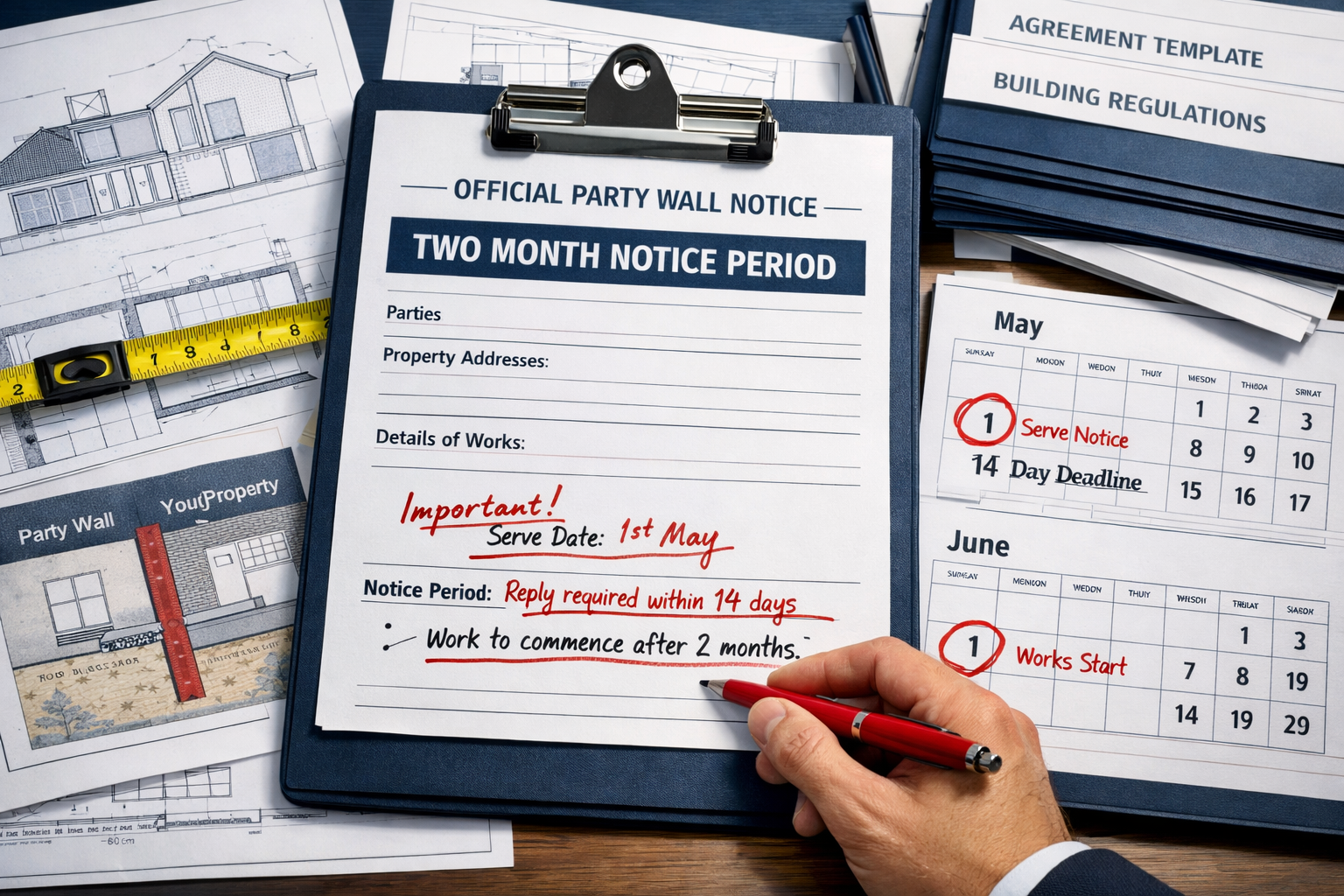
- 2 months' notice for works affecting a party wall or constructing on the boundary line[2]
- 1 month's notice for excavation work near neighbouring properties[2]
These periods cannot be shortened without neighbour consent, meaning institutional landlords must build substantial lead times into project schedules. For investors planning simultaneous refurbishments across multiple properties, staggered notice serving becomes essential to maintain workflow efficiency.
Independence from Other Regulatory Requirements
A common misconception among institutional investors is that planning permission or building regulations approval satisfies party wall obligations. In reality, party wall compliance operates as a completely separate legal requirement[1][3]. Professional landlords must coordinate three distinct processes:
- Planning permission applications (where required)
- Building regulations approval
- Party wall agreements with all affected neighbours
Failure to recognize this independence has derailed numerous institutional projects, with works halted mid-construction when party wall non-compliance emerges.
Party Wall Notice Requirements for Large-Scale Landlord Projects
Institutional landlords must approach party wall notices with the same systematic rigor applied to other compliance areas. The notice process, while straightforward in principle, becomes complex when managing multiple properties and diverse neighbour relationships.
Serving Formal Notices: Documentation Standards
The Party Wall Act requires written notice containing specific information about proposed works. For institutional landlords, professional documentation standards are essential:
Required notice elements include:
- Detailed description of the proposed works
- Precise location and extent of works
- Expected start date
- Clear identification of the building owner (institutional landlord)
- Plans and drawings showing the scope of works
- Contact information for the building owner's surveyor (if appointed)
Professional investors should develop standardized notice templates reviewed by legal counsel, ensuring consistency across portfolio properties while meeting statutory requirements[5]. This systematization reduces administrative burden and minimizes compliance errors.
Managing Multiple Adjoining Owners
Institutional projects frequently involve multiple adjoining owners, each requiring separate notices and potentially separate agreements. Consider a terraced property conversion where works affect neighbours on both sides—each relationship must be managed independently.
Best practices for institutional landlords:
✅ Create comprehensive neighbour registers documenting all adjoining owners, contact details, and property ownership structures
✅ Serve notices simultaneously across all affected properties to maintain consistent timelines
✅ Assign dedicated project coordinators responsible for tracking responses and managing relationships
✅ Implement digital tracking systems monitoring notice periods, response deadlines, and agreement status across portfolios
For professional investors, the administrative complexity multiplies with portfolio size. A landlord undertaking refurbishments on 20 terraced properties might manage 40+ separate party wall relationships simultaneously.
Neighbour Response Scenarios and Implications
After receiving notice, adjoining owners have three possible responses, each triggering different procedures:
| Response Type | Timeframe | Institutional Landlord Action Required |
|---|---|---|
| Consent | Within 14 days | Obtain written confirmation; proceed with works |
| Dissent | Within 14 days | Appoint party wall surveyors; prepare Party Wall Award |
| No Response | After 14 days | Treat as dissent; initiate surveyor appointment process[1] |
The "no response" scenario proves particularly challenging for institutional investors. Many neighbours simply ignore notices, creating deemed dissent that requires formal Party Wall Award procedures even when no actual dispute exists[1].
Escalation to Party Wall Awards
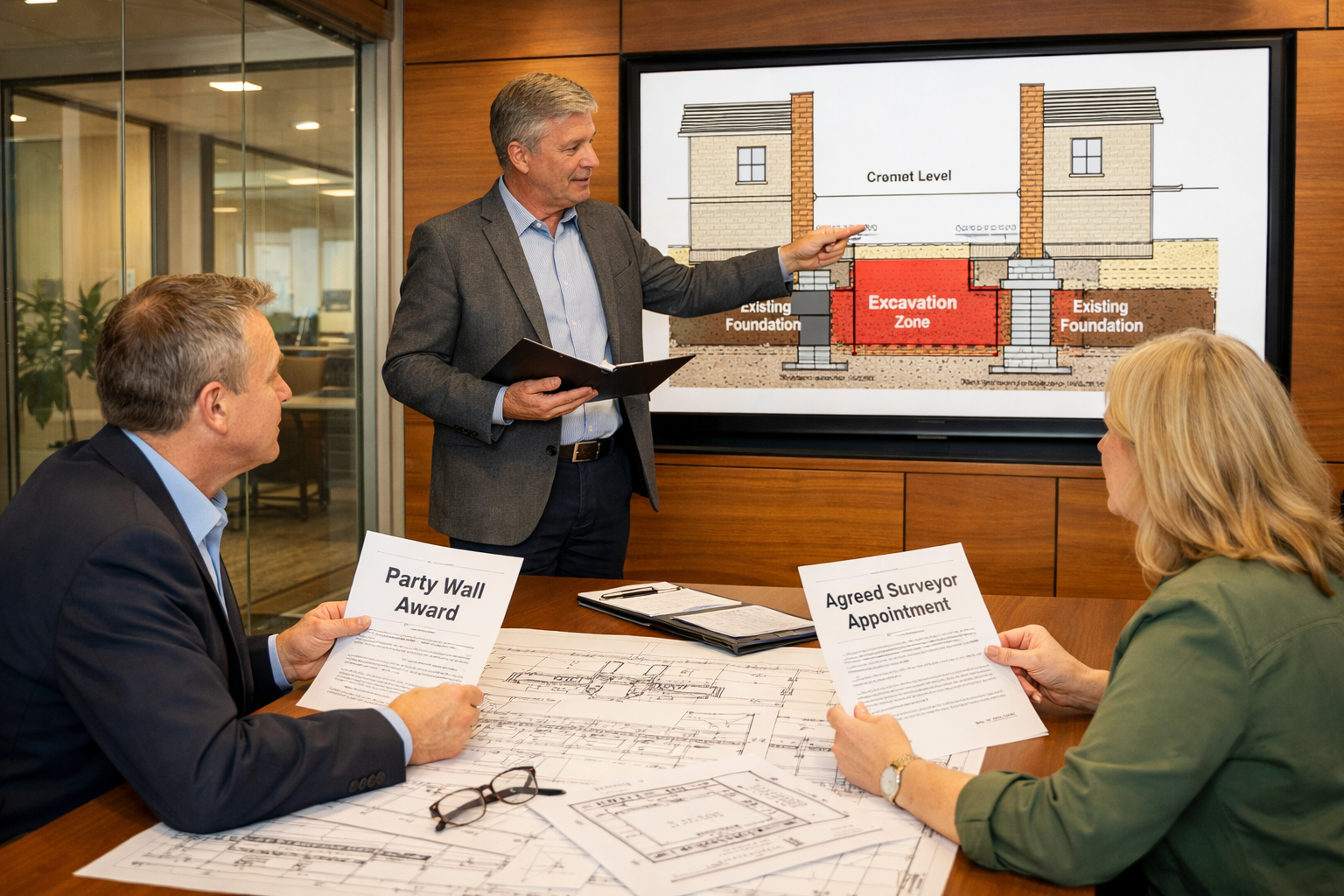
When a neighbour dissents or fails to respond, the Act requires appointment of party wall surveyors to prepare a Party Wall Award—a legally binding document that must be in place before works commence[1]. This process involves:
- Surveyor appointment: Either an Agreed Surveyor (acting for both parties) or separate surveyors for each party
- Property inspection: Detailed condition surveys documenting pre-works status
- Award preparation: Formal document specifying work procedures, access rights, timing, and protections
- Cost allocation: Determining who pays surveyor fees (typically the building owner)
For institutional landlords, Award procedures add both time and cost to projects. Professional investors should budget £700-£2,500 per Award depending on complexity, with higher costs for contentious situations requiring separate surveyors[5].
Neighbour Negotiation Strategies for Professional Investors
Institutional landlords with sophisticated stakeholder management approaches achieve significantly better party wall outcomes than those treating it as purely a legal compliance exercise. Proactive neighbour engagement reduces dispute rates, accelerates timelines, and protects long-term investor reputation.
Pre-Notice Consultation: The Institutional Advantage
Professional investors should initiate neighbour contact before serving formal notices. This pre-notice consultation phase allows landlords to:
- Explain project benefits including property value enhancement for the wider area
- Address concerns proactively before they crystallize into formal objections
- Establish communication channels for ongoing project updates
- Demonstrate professionalism distinguishing institutional operators from amateur landlords
"Institutional landlords who invest in pre-notice neighbour consultation see dispute rates drop by up to 70% compared to those who simply serve statutory notices without prior engagement."
This consultation might include neighbourhood meetings, written project summaries, or individual discussions with immediate neighbours. For large-scale portfolio refurbishments, some institutional investors appoint community liaison officers dedicated to stakeholder management.
Addressing Common Neighbour Concerns
Professional landlords should anticipate and prepare responses to recurring concerns:
🏗️ Noise and disruption: Provide detailed schedules, commit to reasonable working hours, offer direct contact for issues
🏠 Property damage risks: Explain protective measures, reference insurance coverage, commit to comprehensive condition surveys
⏰ Project duration: Provide realistic timelines, explain how party wall compliance actually protects neighbour interests
💰 Cost implications: Clarify that neighbours bear no costs for standard party wall procedures (building owner pays surveyor fees)
🔍 Access requirements: Discuss access needs transparently, offer flexible scheduling, commit to minimizing intrusion
Institutional landlords with standardized communication materials addressing these concerns demonstrate professionalism that builds neighbour confidence.
Building Long-Term Stakeholder Relationships
For institutional investors holding properties long-term, party wall interactions represent relationship-building opportunities. Professional landlords should:
- Maintain detailed records of all neighbour interactions, agreements, and commitments
- Follow through on commitments without exception, building trust for future projects
- Provide regular updates throughout construction, not just at statutory milestones
- Address issues immediately when neighbours raise concerns during works
- Conduct post-completion follow-up ensuring neighbour satisfaction and addressing any residual issues
These practices distinguish professional institutional operators from transactional developers, creating goodwill that facilitates future projects across portfolios.
Party Wall Award Documentation for Multi-Unit Institutional Projects
For institutional landlords managing complex refurbishment programs, Party Wall Awards provide essential legal protection and operational clarity. Understanding Award content, procedures, and strategic implications enables professional investors to manage risk effectively.
Award Content and Legal Status
A Party Wall Award is a legally binding document prepared by appointed surveyors under the Act[6]. For institutional projects, Awards typically include:
Core Award Components:
- Detailed work descriptions specifying exactly what the building owner may undertake
- Access rights and limitations defining when and how contractors may access adjoining property
- Protective measures required to safeguard neighbour interests
- Condition schedules documenting pre-works property status with photographs
- Dispute resolution procedures for issues arising during works
- Cost allocation specifying who pays surveyor fees and under what circumstances
Awards provide institutional landlords with legal authority to proceed with notified works, even where neighbours object. This protection proves invaluable for professional investors requiring certainty around project timelines and feasibility.
Appointing Party Wall Surveyors: Strategic Considerations
Institutional landlords face an important strategic decision: appointing an Agreed Surveyor (acting for both parties) or separate surveyors for each party.
Agreed Surveyor advantages:
- Lower costs (single surveyor fee instead of two)
- Faster Award preparation
- Simpler communication and coordination
- Appropriate for straightforward, non-contentious works
Separate surveyor advantages:
- Clear advocacy for building owner interests
- Essential for complex or contentious situations
- Provides neighbour with independent representation
- May be required if neighbour insists
Professional investors should maintain relationships with experienced party wall surveyors who understand institutional project requirements. When selecting surveyors, consider:
✓ Experience with similar institutional projects and multi-unit developments
✓ Professional qualifications including RICS membership and party wall specialization
✓ Reputation for balanced, practical approaches rather than adversarial positioning
✓ Capacity to handle multiple concurrent Awards across portfolio properties
✓ Clear fee structures and transparent cost management
For guidance on finding qualified professionals, institutional landlords should prioritize surveyors with demonstrated expertise in commercial and multi-unit residential projects.
Managing Award Costs Across Portfolios
Party wall surveyor fees represent a significant cost consideration for institutional investors undertaking portfolio-wide refurbishments. Typical cost structures include:
- Agreed Surveyor fees: £700-£1,500 for straightforward Awards
- Separate surveyor fees: £1,500-£2,500+ per Award (building owner pays both surveyors in most cases)
- Complex or disputed Awards: £3,000-£5,000+ where extensive negotiation required
For an institutional landlord refurbishing 50 terraced properties, party wall costs could reach £75,000-£125,000 across the portfolio. Professional investors should:
- Budget appropriately incorporating party wall costs into project feasibility analysis
- Negotiate volume arrangements with preferred surveyor firms for portfolio-wide work
- Track costs systematically identifying cost drivers and optimization opportunities
- Factor timeline implications recognizing that Award preparation adds 4-8 weeks to project schedules
Condition Surveys and Damage Protection
A critical Award component is the condition survey documenting the adjoining property's pre-works status. For institutional landlords, these surveys provide essential protection against spurious damage claims.
Professional surveyors conduct detailed inspections, photographing and documenting:
- Existing cracks, defects, or structural issues
- Decorative condition throughout affected areas
- External building condition near work zones
- Any pre-existing damage or deterioration
This documentation establishes a baseline. If neighbours later claim works caused damage, the condition survey provides objective evidence of pre-existing conditions. For institutional investors managing multiple simultaneous projects, comprehensive condition surveys represent crucial risk management.
Should wall cracking or other issues arise during works, the Award framework provides clear procedures for assessment, responsibility determination, and remediation—protecting both parties' interests.
Coordinating Party Wall Compliance with Building Regulations and Planning
Institutional landlords must orchestrate party wall compliance alongside other regulatory requirements. This coordination challenge intensifies for professional investors managing portfolio-wide refurbishment programs.
The Three-Track Compliance Framework
Professional projects require simultaneous management of three distinct regulatory tracks:
Track 1: Planning Permission
- Required for material changes to building use or external appearance
- Managed through local planning authorities
- Timeline: 8-13 weeks for standard applications
- No direct relationship to party wall requirements
Track 2: Building Regulations
- Required for structural, fire safety, and building performance compliance
- Managed through local authority building control or approved inspectors
- Timeline: Ongoing throughout construction
- Independent from party wall procedures
Track 3: Party Wall Compliance
- Required for qualifying works affecting boundaries or adjoining properties
- Managed through statutory notice procedures and surveyor appointments
- Timeline: 2-3 months minimum from initial notice to works commencement
- Operates independently from planning and building regulations[1][3]
Institutional landlords should implement integrated project management systems tracking all three compliance tracks, ensuring none falls through administrative gaps.
Sequencing Considerations for Portfolio Projects
Professional investors should carefully sequence compliance activities:
- Preliminary design and feasibility (Weeks 1-4)
- Planning permission application if required (Weeks 5-18)
- Party wall notice serving (Weeks 8-16, overlapping with planning)
- Building regulations submission (Weeks 16-20)
- Party Wall Award finalization (Weeks 16-24)
- Construction commencement (Week 24+)
This sequencing allows party wall procedures to progress during planning determination periods, minimizing overall timeline impact. However, institutional landlords should avoid commencing party wall procedures before securing planning permission for works requiring it—changing plans mid-process may necessitate re-serving notices.
Professional Team Coordination
Successful institutional projects require coordination among multiple professional advisors:
- Architects and designers developing compliant schemes
- Planning consultants managing local authority applications
- Party wall surveyors handling neighbour agreements
- Building control inspectors ensuring regulatory compliance
- Project managers coordinating overall delivery
- Legal advisors reviewing contracts and dispute risks
Professional investors should establish clear communication protocols ensuring all team members understand party wall implications of design decisions. A structural modification that seems minor from an architectural perspective might trigger significant party wall complications.
Risk Management and Dispute Prevention for Institutional Portfolios
Professional landlords must approach party wall compliance as a risk management discipline, not merely a legal formality. Systematic risk identification and mitigation strategies protect investment returns and project timelines.
Common Party Wall Disputes and Prevention
Institutional landlords should anticipate and proactively address common dispute triggers:
Dispute Type 1: Inadequate Notice
- Risk: Neighbours claim insufficient information or notice period
- Prevention: Use comprehensive notice templates; serve well ahead of minimum periods; provide detailed plans
Dispute Type 2: Access Disagreements
- Risk: Neighbours refuse access required for works
- Prevention: Discuss access needs during pre-notice consultation; offer flexible scheduling; document agreements in Award
Dispute Type 3: Damage Claims
- Risk: Neighbours attribute pre-existing damage to works
- Prevention: Comprehensive condition surveys; photographic documentation; professional surveyor involvement
Dispute Type 4: Work Scope Creep
- Risk: Actual works exceed notified scope, invalidating agreements
- Prevention: Detailed work specifications; change control procedures; immediate re-notification if scope changes
Dispute Type 5: Timeline Disputes
- Risk: Works extend beyond anticipated periods, frustrating neighbours
- Prevention: Realistic timeline communication; regular progress updates; prompt completion
For institutional investors, systematic dispute prevention reduces both direct costs (legal fees, delays) and indirect costs (reputation damage, neighbour relationship deterioration).
Insurance Considerations
Professional landlords should ensure appropriate insurance coverage for party wall-related risks:
- Public liability insurance covering damage to adjoining properties during works
- Professional indemnity insurance for appointed surveyors
- Contractor insurance with adequate limits for multi-unit projects
- Legal expenses insurance covering dispute resolution costs
Institutional investors should review insurance adequacy with brokers experienced in construction and property development risks, ensuring coverage aligns with portfolio-wide exposure.
Documentation and Record-Keeping Systems
Comprehensive documentation provides essential protection for institutional landlords. Professional investors should maintain:
📁 Centralized party wall registers tracking all notices, agreements, and Awards across portfolios
📁 Digital document repositories storing all correspondence, plans, photographs, and legal documents
📁 Timeline tracking systems monitoring notice periods, response deadlines, and Award milestones
📁 Neighbour interaction logs documenting all communications and commitments
📁 Condition survey archives preserving baseline evidence for all affected properties
These systems prove invaluable when disputes arise months or years after project completion, providing clear evidence of proper procedures and agreements.
Technology and Innovation in Party Wall Management for 2026
As institutional investment in residential property accelerates through 2026, technology solutions are emerging to streamline party wall compliance at portfolio scale.
Digital Notice Platforms
Professional landlords increasingly adopt digital platforms that:
- Automate notice generation from standardized templates
- Track delivery and receipt providing compliance evidence
- Monitor response deadlines alerting project managers to deemed dissent situations
- Centralize documentation creating searchable archives across portfolios
- Generate compliance reports for investor and regulatory reporting
These platforms reduce administrative burden while improving compliance consistency—critical advantages for institutional operators managing hundreds of properties.
Portfolio-Wide Compliance Dashboards
Sophisticated institutional landlords implement compliance dashboards providing real-time visibility into party wall status across entire portfolios. These systems display:
- Properties with active party wall procedures
- Notice periods and critical deadlines
- Neighbour response status
- Surveyor appointment and Award progress
- Cost tracking against budgets
- Risk flags requiring management attention
Dashboard visibility enables proactive management, preventing compliance failures that could cascade across multiple projects.
Surveyor Network Management
Professional investors benefit from maintaining preferred surveyor networks—panels of qualified professionals who understand institutional requirements and can handle portfolio-wide work. Benefits include:
- Consistent quality and approach across properties
- Volume pricing arrangements reducing per-project costs
- Capacity assurance for simultaneous projects
- Established working relationships streamlining procedures
- Knowledge transfer improving outcomes over time
Leading institutional landlords formalize these relationships through framework agreements, creating strategic partnerships rather than transactional engagements.
Conclusion: Strategic Party Wall Compliance for Institutional Success
As professional investors continue expanding portfolios and upgrading properties throughout 2026, Party Wall Act Compliance for Institutional Landlord Extensions and Refurbishments: Managing Agreements in 2026's Professional Investor Boom has evolved from a niche legal requirement to a core operational capability. Institutional landlords who approach party wall compliance strategically—investing in professional expertise, systematic processes, and proactive neighbour engagement—achieve significantly better outcomes than those treating it as a mere formality.
The Act's requirements, while straightforward in principle, become complex at portfolio scale. Professional investors must serve timely notices, manage diverse neighbour relationships, coordinate surveyor appointments, and integrate party wall procedures with broader project management frameworks. Success requires dedicated resources, experienced professional advisors, and robust systems tracking compliance across multiple simultaneous projects.
Most importantly, institutional landlords should recognize party wall compliance as an investment in stakeholder relationships and risk management, not simply a cost of doing business. Professional operators who engage neighbours respectfully, communicate transparently, and fulfill commitments build reputations that facilitate future projects and distinguish them in an increasingly competitive market.
Actionable Next Steps for Institutional Landlords
For professional investors seeking to optimize party wall compliance:
✅ Audit current practices identifying gaps in notice procedures, documentation, or neighbour engagement
✅ Develop standardized templates and processes ensuring consistency across portfolio properties
✅ Build preferred surveyor relationships establishing partnerships with qualified professionals experienced in institutional projects
✅ Implement tracking systems monitoring compliance status, deadlines, and costs across all active projects
✅ Train project teams ensuring all staff understand party wall obligations and procedures
✅ Budget appropriately incorporating realistic party wall costs and timelines into feasibility analysis
✅ Engage neighbours proactively initiating consultation before serving formal notices
✅ Document comprehensively maintaining detailed records protecting against future disputes
By elevating party wall compliance from administrative task to strategic capability, institutional landlords protect investments, accelerate project delivery, and build sustainable competitive advantages in 2026's dynamic professional investor market. For additional guidance on property services and professional support, institutional investors should consult qualified surveyors and legal advisors experienced in large-scale portfolio management.
References
[1] Party Wall Act What You Need To Know – https://www.hollandgreen.co.uk/news/party-wall-act-what-you-need-to-know/
[2] Party Wall Agreement – https://hoa.org.uk/advice/guides-for-homeowners/i-am-improving/party-wall-agreement/
[3] Party Wall Agreements What You Need To Know – https://www.fmb.org.uk/find-a-builder/ultimate-guides-to-home-renovation/party-wall-agreements-what-you-need-to-know.html
[5] Party Wall Guide – https://www.squarepointsurveyors.co.uk/party-wall-guide/
[6] Party Walls Building Works – https://www.gov.uk/party-walls-building-works