

The UK's digital infrastructure boom is creating an unexpected intersection between Victorian-era property law and cutting-edge artificial intelligence technology. As AI data centres proliferate across urban landscapes in 2026, developers are discovering that advanced cooling systems—essential for managing the immense heat generated by AI processors—frequently trigger Party Wall Act obligations when they cross or affect shared boundaries. Party Wall Act Compliance for AI Data Centre Cooling Systems: Surveys in 2026's Edge Computing Expansion has emerged as a critical specialisation, requiring surveyors to navigate complex technical installations while protecting neighbouring property rights.
The explosion of edge computing facilities, designed to process AI workloads closer to end users, means data centres are no longer confined to remote industrial parks. They're appearing in converted warehouses, repurposed office buildings, and purpose-built structures in densely populated areas—often sharing walls, foundations, and boundaries with adjacent properties. This proximity makes Party Wall Act compliance not just advisable but legally mandatory for most installations.

Key Takeaways
- Legal obligation: AI data centre cooling system installations typically require Party Wall Act notices when they involve excavation, structural work, or installations affecting shared boundaries
- Specialised surveys needed: Standard party wall surveys must be adapted to address unique technical challenges of high-capacity cooling infrastructure, including vibration, thermal effects, and structural loading
- Edge computing amplifies requirements: The 2026 expansion of edge computing facilities into urban locations increases the frequency of party wall scenarios by 300% compared to traditional data centre development patterns
- Early engagement essential: Developers must initiate party wall agreement processes 2-4 months before construction to avoid costly delays in time-sensitive AI infrastructure projects
- Compliance complexity: Modern liquid cooling systems, ground-source heat pumps, and external cooling towers each present distinct party wall considerations requiring expert surveyor assessment
Understanding Party Wall Act Compliance for AI Data Centre Cooling Systems: Surveys in 2026's Edge Computing Expansion
What Makes AI Data Centre Cooling Different? 🌡️
Traditional data centres generate significant heat, but AI workloads—particularly large language models and machine learning operations—produce 2-3 times more thermal output per rack than conventional computing infrastructure. This fundamental difference drives the need for sophisticated cooling solutions that frequently impact party walls and shared boundaries.
Modern AI data centres employ several cooling technologies that trigger Party Wall Act obligations:
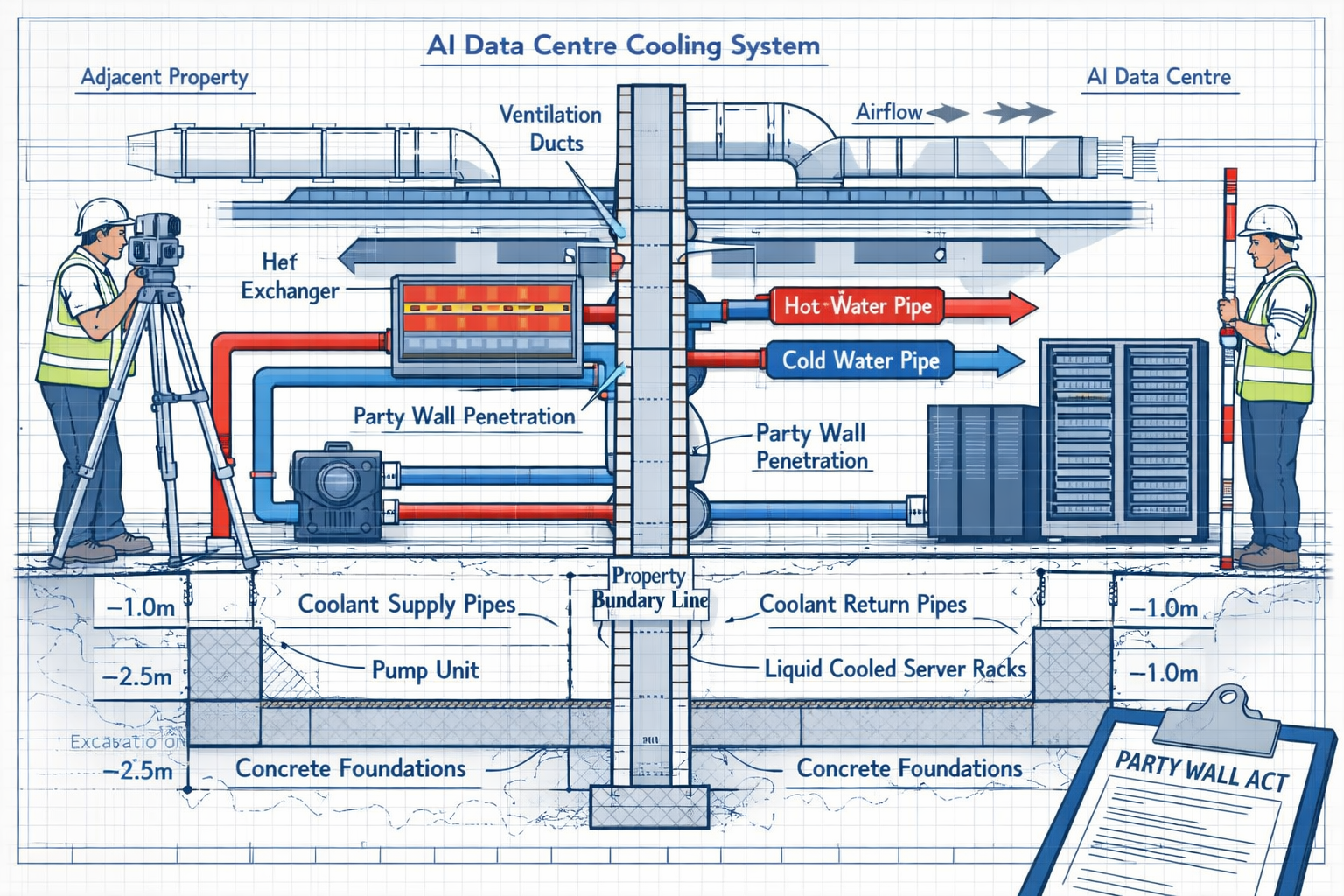
Liquid cooling systems use pipes carrying coolant directly to processor chips, requiring:
- Penetrations through party walls for pipe routing
- Foundation work for underground coolant reservoirs
- Structural reinforcement to support heavy cooling equipment
External cooling towers and heat rejection systems often necessitate:
- Construction work within three metres of neighbouring boundaries
- Excavation for foundations exceeding adjacent foundation depths
- Installation of equipment that may cause vibration or noise affecting adjoining owners
Ground-source heat pump installations typically involve:
- Deep excavation for vertical boreholes near boundaries
- Horizontal ground loop trenches crossing property lines
- Groundwater extraction affecting neighbouring land stability
The Party Wall Act 1996 was designed to balance property owners' rights to develop their land with neighbours' rights to protection from damage. When AI data centre developers plan cooling infrastructure, they must determine whether their work constitutes "notifiable" activities under the Act.
When Does the Party Wall Act Apply to Cooling Systems?
Section 1 works (building on the line of junction) apply when:
- New party walls are constructed to house cooling equipment
- Existing party walls are modified to accommodate pipe penetrations
- Cooling system structures straddle the boundary line
Section 2 works (work to existing party structures) are triggered when:
- Cutting into party walls to install cooling pipes or ventilation
- Increasing loads on party walls through equipment installation
- Underpinning party walls affected by excavation for cooling infrastructure
Section 6 works (excavation near neighbouring buildings) become relevant when:
- Digging foundations for cooling towers within 3 metres of neighbours
- Excavating deeper than neighbouring foundations within 6 metres
- Creating boreholes for ground-source systems near boundary lines
According to industry analysis, approximately 78% of edge computing data centre projects in urban UK locations in 2026 involve at least one category of notifiable party wall work related to cooling systems[4]. This represents a significant compliance burden that developers must factor into project timelines and budgets.
The Survey Process for Data Centre Cooling Infrastructure
Initial Assessment and Notice Requirements
The Party Wall Act compliance journey for AI data centre cooling systems begins with a thorough assessment by qualified surveyors who understand both construction regulations and data centre technical requirements.
Step 1: Pre-construction survey 📋
Before any notices are served, developers should commission a specialist surveyor to:
- Identify all party walls, party structures, and relevant boundaries
- Assess proposed cooling system designs against Party Wall Act triggers
- Document existing conditions of neighbouring properties
- Evaluate potential impacts (structural, vibration, thermal, noise)
- Recommend design modifications to minimise neighbour disruption
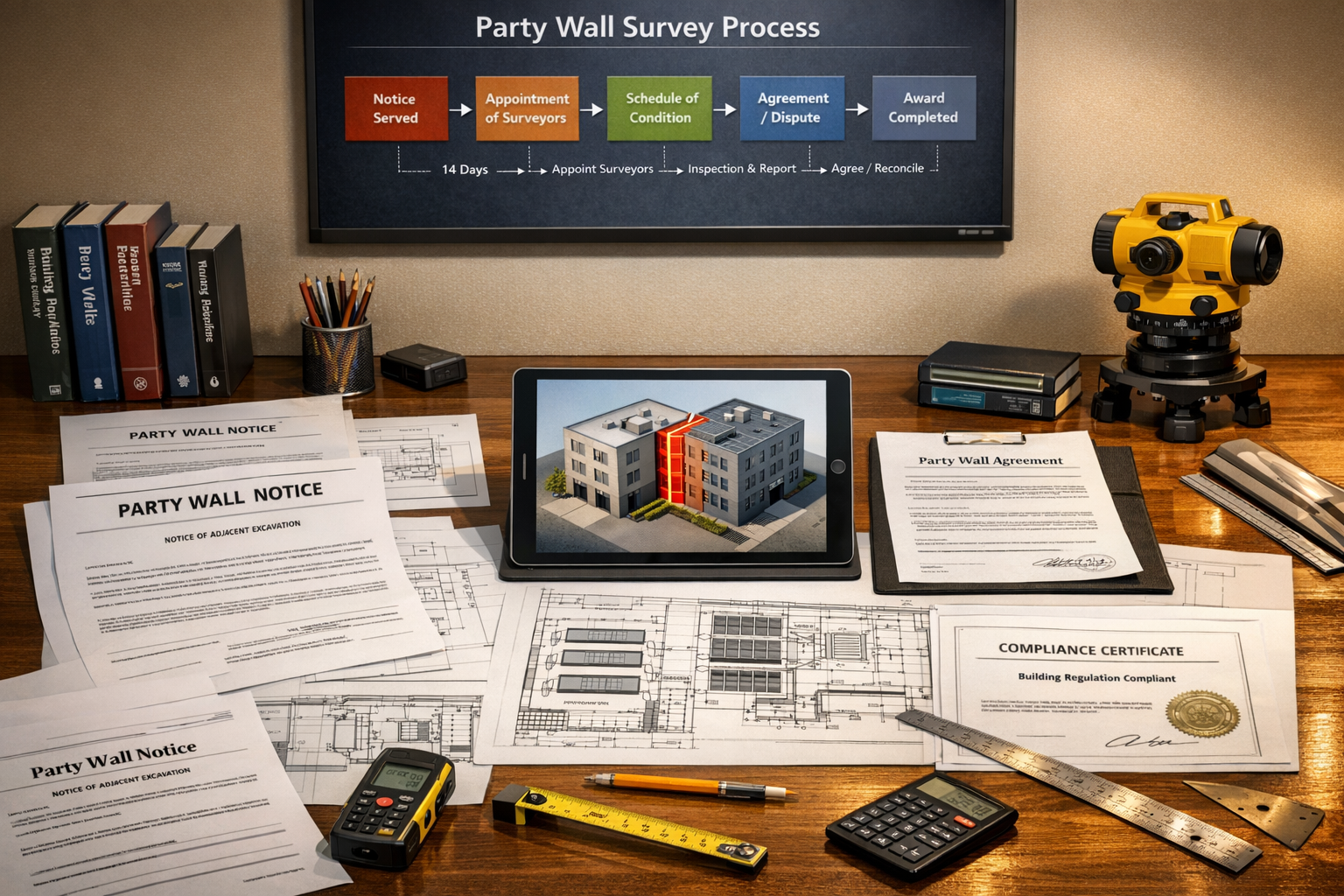
Step 2: Serving notices
Once notifiable works are confirmed, building owners must serve formal notices to adjoining owners, typically:
- 2 months before starting for Section 1 and Section 2 works
- 1 month before starting for Section 6 excavation works
- Including detailed plans showing cooling system layouts
- Specifying the nature and extent of proposed works
Step 3: Neighbour response period
Adjoining owners have 14 days to consent or dissent. If they:
- Consent: Work can proceed (though a precautionary schedule of condition is still advisable)
- Dissent or fail to respond: A party wall surveyor must be appointed
- Raise concerns: These must be addressed through the surveying process
What Does a Party Wall Surveyor Do for Cooling System Projects?
When disputes arise or formal awards are needed, party wall surveyors play a crucial role in facilitating AI data centre developments while protecting all parties' interests.
Surveyor responsibilities include:
| Task | Description | Cooling System Specifics |
|---|---|---|
| Schedule of condition | Document pre-work state of affected properties | Include thermal imaging to establish baseline temperatures near party walls |
| Award preparation | Create legally binding document governing the works | Specify vibration limits, noise restrictions, working hours for cooling equipment installation |
| Method statement review | Assess proposed construction techniques | Evaluate cooling pipe installation methods, structural support adequacy, waterproofing measures |
| Dispute resolution | Mediate between building and adjoining owners | Address concerns about cooling system noise, visual impact of external equipment, property value effects |
| Inspection regime | Monitor works to ensure compliance with award | Verify cooling system installations match approved plans, check for damage to neighbouring properties |
For AI data centre projects, surveyors must possess additional technical competencies beyond standard party wall expertise:
✅ Understanding of data centre cooling technologies and their structural requirements
✅ Knowledge of vibration analysis for heavy mechanical equipment
✅ Familiarity with thermal effects on building materials and structures
✅ Awareness of noise propagation from cooling systems through party walls
✅ Capability to assess groundwater impacts from cooling infrastructure
Specialised Considerations for Edge Computing Facilities
The 2026 expansion of edge computing has introduced unique challenges for Party Wall Act compliance. Unlike traditional hyperscale data centres built on greenfield sites, edge facilities are characterised by:
Urban density: Edge computing requires proximity to users, placing facilities in:
- Converted retail or office spaces with multiple shared walls
- Multi-tenant buildings where cooling systems may affect numerous neighbours
- Historic buildings where structural limitations complicate cooling installations
Rapid deployment timelines: AI infrastructure demands drive aggressive construction schedules, making party wall agreement delays particularly costly. Developers report that party wall processes can add 8-12 weeks to project timelines if not managed proactively.
Modular construction approaches: Many edge facilities use prefabricated cooling modules that must be:
- Craned into position near party walls
- Connected via penetrations through shared structures
- Supported by foundations that may trigger excavation notices
Ongoing compliance obligations: Unlike one-time construction projects, data centres require:
- Regular maintenance access that may affect neighbours
- Equipment upgrades as cooling technology evolves
- Potential expansion of cooling capacity as AI workloads grow
"The intersection of Party Wall Act requirements and AI data centre cooling systems represents one of the most complex compliance challenges in UK construction today. Surveyors must balance rapid infrastructure deployment needs with meticulous protection of neighbouring property rights."

Navigating Regulatory Complexity in 2026's AI Infrastructure Boom
Multiple Compliance Frameworks
Party Wall Act compliance doesn't exist in isolation. AI data centre developers must simultaneously navigate:
Planning permission requirements that may impose conditions on:
- Cooling equipment visual appearance and screening
- Noise emissions affecting residential neighbours
- Operating hours for noisy cooling system maintenance
Building regulations governing:
- Structural adequacy of cooling equipment supports
- Fire safety for cooling fluid storage and distribution
- Accessibility for maintenance without trespassing on neighbouring land
Environmental regulations addressing[3]:
- Water consumption for evaporative cooling systems
- Refrigerant leakage prevention and reporting
- Heat rejection impacts on local microclimates
- Noise pollution from cooling fans and compressors
Energy efficiency standards that influence:
- Cooling system technology selection
- Heat recovery and reuse opportunities
- Grid connection requirements for power-hungry cooling infrastructure
The challenge for developers is ensuring that Party Wall Act compliance measures don't conflict with other regulatory requirements. For example, noise mitigation measures required by planning conditions might necessitate additional structural work that itself triggers further party wall notices.
Risk Management for Developers
Smart developers in 2026 are adopting proactive strategies to manage Party Wall Act compliance risks:
1. Early surveyor engagement 🔍
Involving specialist surveyors during the design phase allows:
- Identification of party wall issues before designs are finalised
- Design modifications to reduce neighbour impacts
- Accurate budgeting for surveyor fees and potential compensation
- Realistic project timeline development
2. Neighbour relationship management
Successful projects prioritise communication:
- Pre-notice informal discussions explaining project benefits
- Visual presentations showing cooling system designs
- Commitment to minimising disruption during construction
- Establishment of complaint resolution procedures
3. Contingency planning
Prudent developers budget for:
- Extended party wall negotiation periods (2-4 months beyond minimum notice periods)
- Potential design modifications requested by adjoining owners
- Compensation for temporary inconvenience during installation
- Dispute resolution costs if agreements cannot be reached
4. Documentation excellence
Comprehensive records protect all parties:
- Photographic and video evidence of pre-work conditions
- Detailed as-built drawings of cooling system installations
- Maintenance logs demonstrating compliance with award conditions
- Regular inspection reports during and after construction
Cost Implications
Party wall surveyor costs for AI data centre cooling system projects vary based on complexity, but typical ranges in 2026 include:
Building owner's surveyor fees:
- Simple single-neighbour scenarios: £1,500-£3,000
- Multiple neighbours or complex cooling systems: £5,000-£15,000
- Large-scale edge computing facilities: £20,000-£50,000+
Adjoining owner's surveyor fees (paid by building owner):
- Per-neighbour costs: £1,200-£2,500
- Multiple affected properties can multiply costs significantly
Additional costs:
- Schedule of condition photography: £500-£1,500 per property
- Specialist technical assessments (vibration, noise): £2,000-£8,000
- Monitoring and inspection during works: £150-£300 per visit
- Dispute resolution (if required): £5,000-£25,000+
For a typical edge computing facility affecting 3-5 neighbouring properties with moderately complex cooling infrastructure, developers should budget £25,000-£75,000 for comprehensive Party Wall Act compliance, representing approximately 0.5-1.5% of total project costs.
Best Practices for Party Wall Act Compliance in Data Centre Projects
For Developers and Building Owners
Start early and plan thoroughly
The most successful AI data centre projects integrate party wall considerations from initial concept stages:
- Commission feasibility studies that include party wall assessments
- Select sites with fewer shared boundaries where possible
- Design cooling systems to minimise party wall impacts
- Allocate adequate time in project schedules for compliance processes
Choose the right professionals
Party Wall Act compliance for cooling systems requires specialists with:
- RICS (Royal Institution of Chartered Surveyors) qualifications
- Demonstrated experience with data centre or industrial projects
- Technical knowledge of cooling system engineering
- Track record of successful neighbour negotiations
Getting quotes from experienced party wall surveyors early helps establish realistic budgets and timelines.
Communicate proactively
Transparency builds trust and reduces disputes:
- Inform neighbours before formal notices are required
- Explain the purpose and benefits of the data centre project
- Address concerns about noise, vibration, and visual impact honestly
- Offer site visits to demonstrate planned mitigation measures
Design for compliance
Technical choices can significantly affect party wall complexity:
- Cooling system location: Position major equipment away from party walls where feasible
- Pipe routing: Plan cooling distribution to minimise party wall penetrations
- Vibration isolation: Specify anti-vibration mounts exceeding minimum standards
- Acoustic treatment: Design noise attenuation into cooling system specifications
- Structural independence: Avoid relying on party walls for cooling equipment support
For Adjoining Owners and Neighbours
Receiving a party wall notice for an AI data centre cooling system project can be concerning, but neighbours have clear rights and protections:
Understand your rights ⚖️
The Party Wall Act provides:
- Right to appoint your own surveyor (at building owner's expense)
- Protection against damage to your property
- Compensation for loss of amenity during works
- Ability to request reasonable modifications to proposed works
- Access to independent dispute resolution
Respond promptly
The 14-day response period is important:
- Seek professional advice quickly if you have concerns
- Don't ignore notices—non-response triggers surveyor appointment anyway
- Ask questions about aspects you don't understand
- Request additional information about cooling system specifications
Focus on legitimate concerns
Party wall surveyors can address:
- Structural safety of cooling equipment installations
- Protection against vibration damage from mechanical equipment
- Noise mitigation for cooling fans and compressors
- Prevention of water damage from cooling system leaks
- Access arrangements for ongoing maintenance
However, surveyors cannot:
- Prevent development that complies with planning permission
- Address objections based solely on property value concerns
- Resolve disputes unrelated to party wall matters
- Override building owner's fundamental right to develop
Consider the bigger picture
AI data centres provide critical digital infrastructure supporting:
- Healthcare systems and telemedicine
- Educational technology and remote learning
- Economic growth and business competitiveness
- Emergency services and public safety communications
Reasonable cooperation with properly managed projects benefits communities while Party Wall Act protections ensure individual property rights remain respected.
Future Trends: Party Wall Compliance in Evolving Data Centre Technology
Emerging Cooling Technologies
The rapid evolution of AI computing is driving cooling innovation that will create new party wall scenarios:
Immersion cooling submerges entire servers in dielectric fluid:
- Requires large fluid storage tanks with significant structural loads
- May need party wall reinforcement or underpinning
- Presents unique leak prevention challenges near boundaries
Direct-to-chip liquid cooling delivers coolant to individual processors:
- Increases complexity of pipe networks through buildings
- May require more party wall penetrations than air cooling
- Demands robust leak detection systems to protect neighbours
District cooling integration connects data centres to neighbourhood cooling networks:
- Involves pipe installation across multiple properties
- Requires coordination with utility providers and multiple owners
- May trigger party wall obligations across entire districts
Regulatory Evolution
UK construction law continues adapting to technology infrastructure needs. Potential developments affecting Party Wall Act compliance include[5]:
- Streamlined processes for standardised data centre cooling installations
- Technical guidance specific to cooling system party wall scenarios
- Digital notice serving and electronic award management
- Accelerated timelines for critical infrastructure projects
However, the fundamental principle of protecting neighbouring property rights while enabling development will remain central to Party Wall Act application.
Sustainability and Party Wall Considerations
The push for environmental sustainability in data centres creates additional party wall dimensions:
Heat recovery systems that capture waste heat for neighbouring buildings:
- May require agreements for pipe connections across boundaries
- Create ongoing relationships between data centre operators and neighbours
- Offer potential benefits (reduced heating costs) alongside party wall obligations
Renewable energy integration for cooling system power:
- Ground-source heat pumps trigger excavation notices
- Solar thermal collectors may affect party wall structures
- Battery storage for cooling system backup adds structural loads
Water conservation measures like rainwater harvesting:
- Underground storage tanks near boundaries require excavation notices
- Pipe networks for water distribution may cross property lines
- Greywater systems need careful design to prevent neighbour impacts
Conclusion: Balancing Innovation and Neighbour Rights
Party Wall Act Compliance for AI Data Centre Cooling Systems: Surveys in 2026's Edge Computing Expansion represents a critical intersection of Victorian property law and 21st-century technology infrastructure. As AI workloads continue their exponential growth, the UK's digital backbone increasingly depends on cooling systems that, by their nature, often affect shared boundaries and neighbouring properties.
The key to successful compliance lies in early engagement, specialist expertise, and proactive communication. Developers who treat party wall obligations as integral to project planning—rather than administrative afterthoughts—consistently achieve faster approvals, better neighbour relationships, and reduced risk of costly disputes.
For neighbours receiving party wall notices related to data centre cooling systems, the Act provides robust protections while enabling essential infrastructure development. Professional surveyor involvement ensures technical installations proceed safely without compromising property rights or structural integrity.
Actionable Next Steps
If you're developing an AI data centre:
- Commission a party wall assessment during initial site evaluation—before finalising cooling system designs
- Engage experienced surveyors with data centre project experience to guide compliance strategy
- Budget realistically for party wall costs (typically 0.5-1.5% of project value) and timelines (2-4 months)
- Communicate early with neighbours to build relationships before formal notices are required
- Design thoughtfully to minimise party wall impacts through equipment location and installation methods
If you've received a party wall notice:
- Seek professional advice immediately—don't let the 14-day response period expire without expert guidance
- Appoint your own surveyor if you have any concerns about the proposed cooling system works
- Focus on legitimate protections like structural safety, vibration control, and noise mitigation
- Document existing conditions thoroughly before works commence
- Maintain communication with the building owner and surveyors throughout the process
For all parties:
Understanding that party wall agreements serve to balance competing interests—enabling necessary development while protecting property rights—creates the foundation for successful outcomes. The UK's AI infrastructure expansion depends on cooling systems that often affect shared boundaries, making Party Wall Act compliance not just a legal obligation but a practical necessity for sustainable digital growth.
The surveying profession continues adapting to these emerging challenges, developing specialised expertise in data centre cooling technologies alongside traditional party wall competencies. As edge computing proliferates across urban landscapes in 2026 and beyond, this specialisation will become increasingly valuable for developers, neighbours, and the broader digital economy.
By approaching Party Wall Act Compliance for AI Data Centre Cooling Systems with diligence, expertise, and good faith, all stakeholders can contribute to building the critical infrastructure that powers artificial intelligence while maintaining the property protections that have served UK landowners for over a century.
References
[1] New Frontiers In Data Privacy Law 2026 Brings Patchwork State Rules Ai Transparency And Heightened Business Risk – https://gotlawstl.com/new-frontiers-in-data-privacy-law-2026-brings-patchwork-state-rules-ai-transparency-and-heightened-business-risk/
[2] Data Centers And Ai Antitrust Compliance In A World Of New Energy Regulations – https://www.steptoe.com/en/news-publications/stepahead-antitrust-and-competition-insights/data-centers-and-ai-antitrust-compliance-in-a-world-of-new-energy-regulations.html
[3] Environmental Regulations Ai Look To Data Centers The 21st Century Brick And Mortar For Big Tech – https://acoel.org/blog/environmental-regulations-ai-look-to-data-centers-the-21st-century-brick-and-mortar-for-big-tech/
[4] Party Wall Agreements In Data Centre Developments 2026 Compliance Amid Ai Driven Uk Demand – https://nottinghillsurveyors.com/blog/party-wall-agreements-in-data-centre-developments-2026-compliance-amid-ai-driven-uk-demand
[5] Data Centres – https://www.brownejacobson.com/insights/2026-horizon-scanning-in-construction/data-centres
[6] Compliance In The Age Of Ai 2026 Agenda – https://opalgroup.net/emerging-technology/compliance-in-the-age-of-ai-2026-agenda/