


In the dynamic world of property surveying, success depends not just on technical expertise but on the ability to anticipate market shifts before they happen. As 2026 unfolds with cautious optimism in the UK housing market, surveyors who can interpret economic indicators are positioning themselves to capture opportunities while competitors react too late. Understanding how employment trends, migration patterns, interest rates, and housing supply data interconnect provides the strategic advantage needed to forecast demand spikes, allocate resources efficiently, and build sustainable project pipelines.
Recent data from the Royal Institution of Chartered Surveyors (RICS) reveals compelling market signals that forward-thinking surveyors should monitor closely. New buyer enquiries improved significantly in January 2026, with the net balance rising to -15%, up from -21% in December 2025 and -29% in November 2025[1]. Meanwhile, twelve-month sales expectations surged to +35%, representing the strongest reading since December 2024[1]. These indicators suggest that surveyors who position themselves strategically now will benefit from accelerating demand throughout 2026.
Key Takeaways
- Economic indicators provide early warning signals for surveying demand shifts, allowing firms to adjust staffing, marketing, and resource allocation 3-6 months ahead of competitors
- Regional market divergence requires surveyors to monitor location-specific employment, migration, and affordability data rather than relying on national averages
- Interest rate trends and mortgage availability directly correlate with residential survey volumes, typically with a 2-3 month lag period
- Employment growth and migration patterns predict commercial and residential surveying opportunities 6-12 months in advance
- Multi-indicator analysis combining housing supply, demographic shifts, and economic confidence creates the most accurate demand forecasting models
Understanding Core Economic Indicators That Drive Surveying Demand
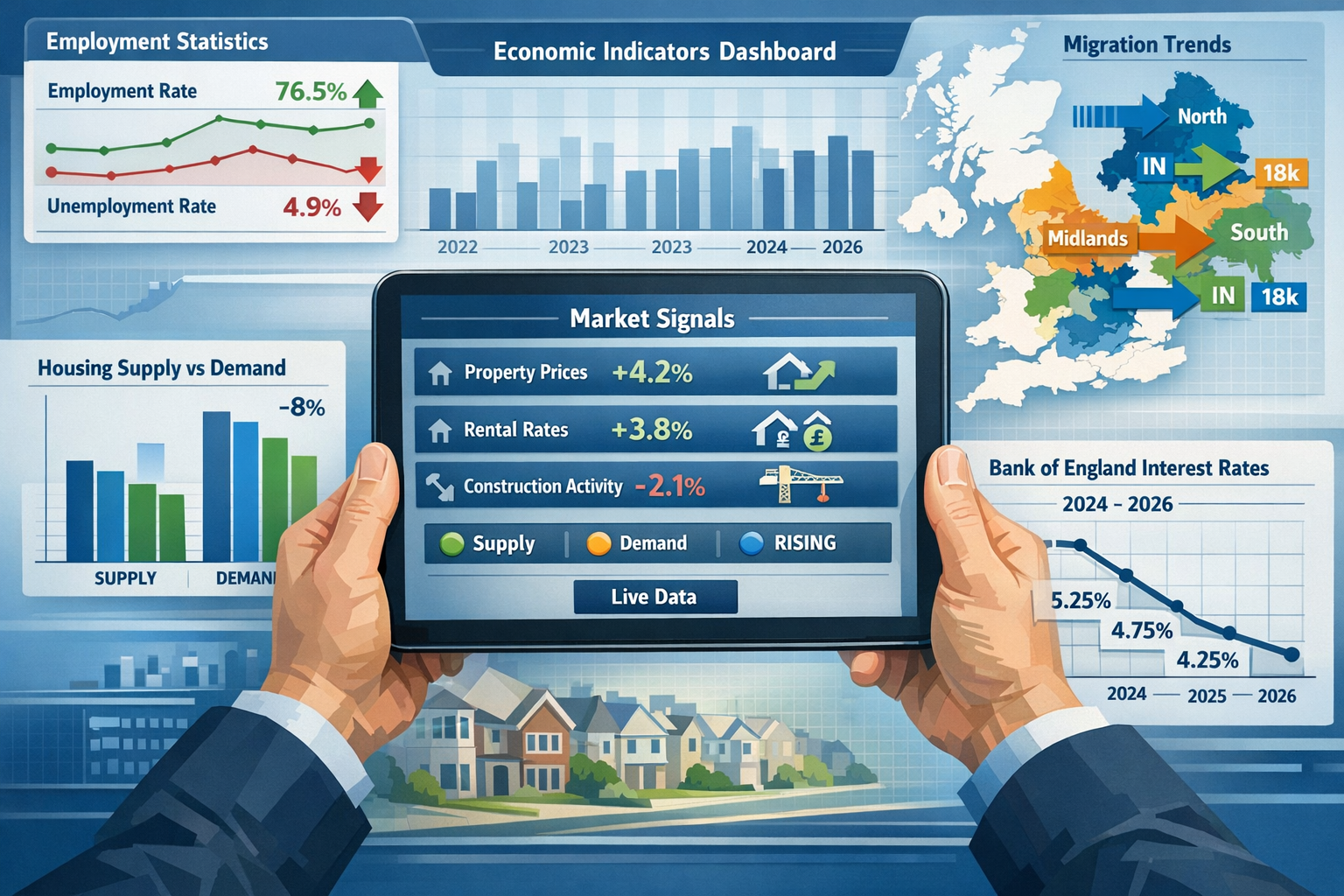
Economic indicators serve as the compass for navigating the surveying business landscape. Rather than reacting to market changes after they occur, successful surveying practices use leading indicators to anticipate shifts in client demand and adjust their business strategies accordingly.
Employment Trends and Job Market Signals
Employment statistics represent one of the most reliable predictors of surveying demand. When regional employment grows, several cascading effects benefit surveying professionals:
Direct Correlations:
- Rising employment → Increased household income → Higher homebuying capacity → More residential surveys
- Commercial expansion → New office/retail space requirements → Commercial building surveys
- Construction sector growth → Development projects → Structural surveys and valuations
The relationship typically follows a 3-6 month lag pattern. When employment data shows positive trends, surveyors can expect increased enquiries within one quarter. Conversely, employment contractions signal a coming slowdown in residential transactions and commercial development.
Key employment metrics to monitor include:
📊 Regional unemployment rates – Local data matters more than national averages
📊 Sector-specific employment growth – Construction, finance, and professional services sectors
📊 Wage growth trends – Higher wages increase purchasing power and property demand
📊 Job vacancy rates – High vacancies suggest economic confidence and future growth
For surveyors operating across multiple regions, comparing employment trends between areas helps identify where to focus marketing efforts and allocate professional surveyor services resources.
Interest Rates and Mortgage Market Dynamics
The Bank of England's monetary policy decisions create immediate ripple effects throughout the property market. Interest rate changes directly impact surveying workload through their influence on mortgage affordability and transaction volumes.
Understanding this relationship requires monitoring:
Primary Rate Indicators:
- Bank of England base rate decisions and forward guidance
- Average mortgage rates for 2-year and 5-year fixed products
- Mortgage approval volumes (released monthly)
- Lending criteria changes from major banks
When interest rates rise, mortgage costs increase, reducing affordability and dampening transaction volumes. The impact on surveying demand typically manifests within 2-3 months. Conversely, rate cuts or stability encourage market activity and increase survey instructions.
The current market environment shows signs of stabilization. House prices appear to be stabilising at the national level, with the net balance for prices over the past three months standing at -10%, improving steadily from a low of -19% in October 2025[1]. This stabilization, combined with expectations of more favorable mortgage conditions, suggests improving conditions for surveying professionals.
"There are early signs that market conditions may be improving after a challenging period, though any recovery is likely to be gradual." – Simon Rubinsohn, RICS Chief Economist[1][3]
Housing Supply and Development Pipeline Data
Supply-demand imbalances create surveying opportunities. Monitoring housing supply metrics helps surveyors anticipate where and when demand for their services will intensify.
Critical supply indicators include:
| Indicator | What It Reveals | Surveying Implications |
|---|---|---|
| Planning permissions granted | Future development activity | Upcoming new build surveys |
| Construction starts | Active building projects | Structural and progress inspections |
| Housing completions | Market supply levels | Valuation and snagging surveys |
| Land transactions | Development pipeline | Land surveys and feasibility studies |
When housing supply lags behind demand, property prices typically rise, stimulating market activity and increasing survey volumes. The lettings sector also provides important signals—tenant demand increased over the three months to January 2026 after two consecutive quarters of flat or negative readings[1]. This renewed rental market activity creates opportunities for surveyors to provide rental property valuations and condition assessments.
Supply constraints persist in the current market, with landlord instructions remaining firmly negative, pointing to continued upward pressure on rents in the short term and creating opportunities for surveyor involvement in rental property valuations[1].
Migration Patterns and Demographic Shifts
Population movement creates geographic pockets of heightened surveying demand. Migration data reveals where property market activity will concentrate, allowing surveyors to target their marketing and resource allocation strategically.
Key migration metrics to track:
✈️ Internal UK migration flows – Movement between regions and cities
✈️ International migration data – Net migration impacts housing demand
✈️ Age demographics of migrants – Younger populations drive rental demand
✈️ Economic migration patterns – Following job opportunities
Areas experiencing net population inflows typically see:
- Increased property transactions requiring homebuyer surveys
- Rising rental demand necessitating condition reports
- Development activity requiring building survey services
- Commercial expansion requiring valuation expertise
Conversely, regions with population outflows may experience declining survey volumes, signaling the need to diversify service offerings or expand into growing markets.
Market Signals for Surveyors: Reading Economic Indicators to Anticipate Client Demand and Project Pipelines in Practice
Theoretical understanding of economic indicators means little without practical application. Successful surveyors develop systematic approaches to monitoring, interpreting, and acting on market signals. This section explores how to translate economic data into actionable business strategies.
Building Your Economic Intelligence Dashboard
Creating a customized monitoring system ensures surveyors capture relevant market signals without information overload. The most effective approach involves:
1. Identify Your Key Markets
Define the geographic areas where your surveying practice operates or plans to expand. For firms serving London and surrounding areas, this might include tracking data for regions like Kensington, Fulham, Islington, and Romford.
2. Select Priority Indicators
Not all economic data carries equal weight for surveying businesses. Focus on:
- Leading indicators (predict future demand): mortgage approvals, planning permissions, employment trends
- Coincident indicators (confirm current conditions): transaction volumes, survey instructions
- Lagging indicators (validate past trends): house price indices, completion rates
3. Establish Data Sources
Reliable, timely information comes from:
- RICS monthly surveys and reports
- Office for National Statistics (ONS) housing and employment data
- Bank of England monetary policy updates
- Local authority planning databases
- UK Finance mortgage statistics
4. Create Review Rhythms
Systematic monitoring prevents reactive decision-making:
- Weekly: Mortgage rate changes, major economic announcements
- Monthly: RICS survey results, employment data, transaction volumes
- Quarterly: Regional market performance, business strategy adjustments
Regional Market Divergence: Why Location-Specific Analysis Matters
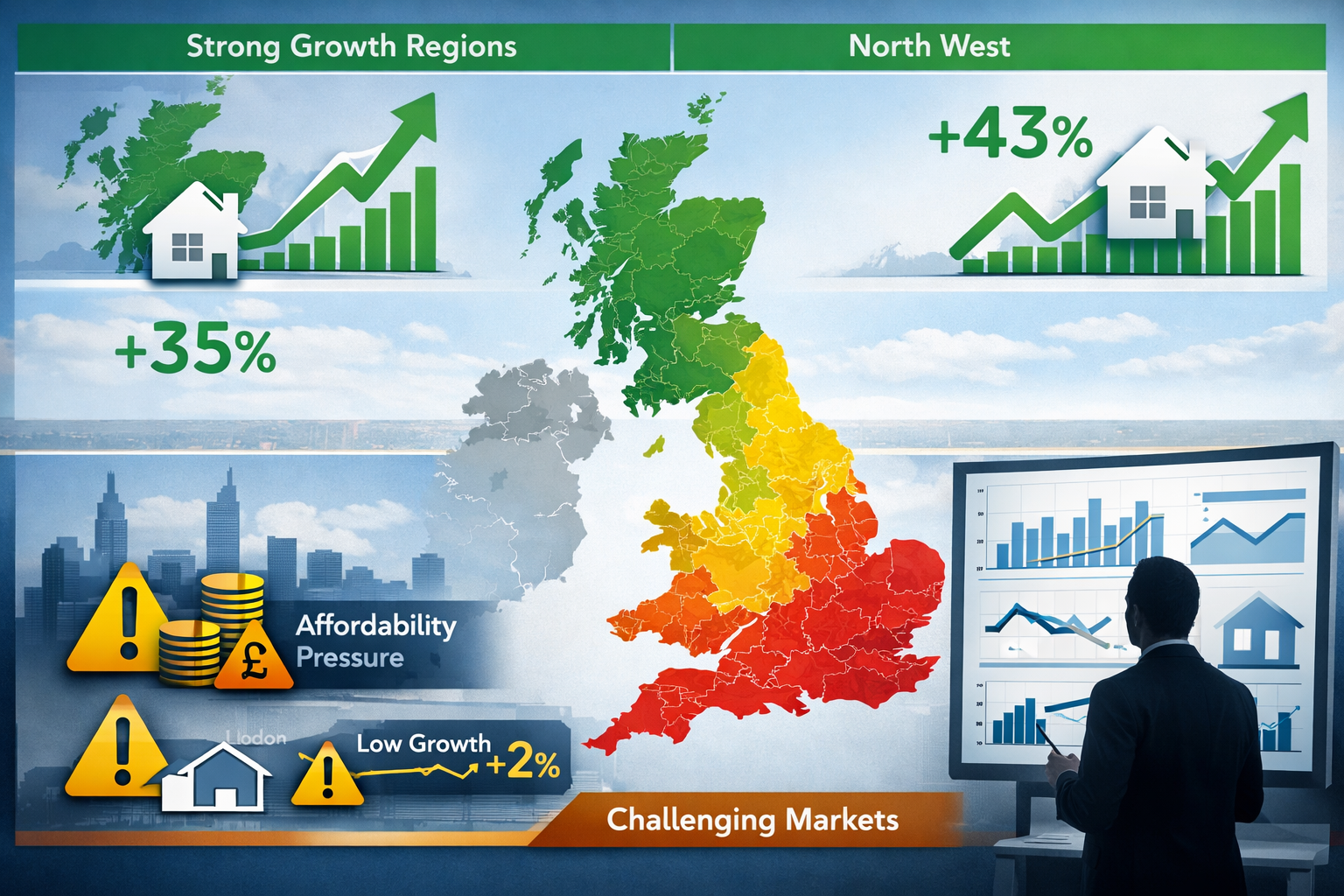
National economic averages mask critical regional variations that directly impact surveying demand. The current market demonstrates this clearly: regional performance diverges significantly, with price growth remaining strongest in Scotland and Northern Ireland, with upward trends also in the North West and North of England, while London, the South East, South West, and East Anglia lag behind due to affordability challenges[1].
Understanding Regional Dynamics:
Strong performing regions (Scotland, Northern Ireland, North West) exhibit:
- More positive buyer sentiment
- Higher transaction volumes
- Increased survey instructions
- Better price expectations
Challenging regions (London, South East, South West) face:
- Affordability constraints limiting buyer pools
- More cautious market sentiment
- Selective transaction activity
- Pressure on survey volumes
For surveyors, this divergence creates strategic choices:
💡 Expansion Strategy: Target resources toward growing regions
💡 Service Diversification: Offer specialized services in slower markets (e.g., damp surveys, condition reports)
💡 Client Education: Help clients understand local market conditions through data-driven insights
💡 Pricing Flexibility: Adjust fee structures based on regional market conditions
Surveyors serving areas like Ealing, Harrow, and Barnet should monitor how London's affordability challenges impact their specific submarkets, as conditions can vary significantly even within the capital.
Translating Economic Signals into Demand Forecasts
The most valuable skill surveyors can develop is converting economic indicators into accurate demand projections. This involves understanding lead times and correlation patterns.
Typical Lead Time Patterns:
| Economic Signal | Lead Time to Survey Demand | Strength of Correlation |
|---|---|---|
| Interest rate changes | 2-3 months | Very strong |
| Employment growth | 3-6 months | Strong |
| Planning permissions granted | 6-12 months | Moderate to strong |
| Migration trends | 6-18 months | Moderate |
| Wage growth | 4-8 months | Strong |
Current market signals suggest specific opportunities for 2026. Near-term sales expectations remain cautious, with a net balance of +4% for the next three months, suggesting surveyors should anticipate modest project intake in the immediate term[1][3]. However, twelve-month sales expectations surged to +35%, signaling strong confidence in surveyor demand acceleration throughout 2026[1][3].
Practical Forecasting Approach:
- Collect Current Indicator Readings: Gather latest data for your priority indicators
- Apply Historical Lead Times: Add appropriate lag periods to predict impact timing
- Weight by Correlation Strength: Give more emphasis to strongly correlated indicators
- Adjust for Regional Factors: Apply local market multipliers
- Create Range Scenarios: Develop optimistic, realistic, and conservative forecasts
This systematic approach enables surveyors to make informed decisions about staffing, marketing investment, and capacity planning.
Case Study: Applying Market Signals to Resource Allocation
Consider a surveying firm operating across multiple London boroughs in early 2026. By analyzing market signals, they observe:
Signal Analysis:
- Mortgage approvals trending upward (2-month lag → April-May demand increase)
- Employment growth strong in tech sector (6-month lag → summer demand spike)
- Planning permissions granted in specific boroughs (12-month lag → 2027 opportunities)
- Migration data shows inflows to outer London areas
Strategic Response:
- Hire additional surveyor for anticipated April-June workload increase
- Develop marketing campaign targeting tech professionals for May launch
- Establish relationships with developers in high-permission areas
- Expand service coverage to outer London growth areas like Hillingdon and Bexley
Result:
The firm captures increased demand as it materializes rather than scrambling to respond after competitors have already secured market share.
Strategic Business Planning Using Market Signals for Surveyors: Reading Economic Indicators to Anticipate Client Demand and Project Pipelines
Economic intelligence only creates value when translated into concrete business actions. Forward-thinking surveying practices integrate market signal analysis into their strategic planning processes, creating competitive advantages that compound over time.
Optimizing Marketing Spend Based on Demand Cycles
Marketing effectiveness multiplies when aligned with demand cycles. Rather than maintaining constant marketing intensity, sophisticated surveyors adjust their promotional activities based on economic indicators.
Demand Cycle Marketing Strategy:
Pre-Demand Phase (Indicators suggest demand increase in 3-6 months):
- Increase content marketing and SEO investment
- Build email nurture campaigns
- Establish referral partnerships
- Develop case studies and testimonials
Rising Demand Phase (Indicators confirm demand acceleration):
- Activate paid advertising campaigns
- Increase social media presence
- Launch targeted outreach to estate agents and solicitors
- Promote quick turnaround capabilities
Peak Demand Phase (Maximum market activity):
- Focus on conversion optimization
- Streamline booking processes
- Emphasize capacity and availability
- Premium pricing for expedited services
Declining Demand Phase (Indicators suggest slowdown):
- Shift to relationship building
- Offer value-added services
- Develop new service lines
- Focus on client retention
Current indicators suggest the UK market is transitioning from declining to rising demand phase. Agreed sales reached their least negative reading since June 2025, with a net balance of -9%, indicating strengthening transaction volumes despite ongoing subdued activity[1]. Surveyors should begin activating their rising demand marketing strategies now to capture the anticipated acceleration.
Staffing and Capacity Planning
Labor costs represent the largest expense for most surveying practices, making staffing decisions critical to profitability. Economic indicators enable more accurate workforce planning.
Capacity Planning Framework:
📈 Expansion Signals (Hire additional surveyors when):
- Multiple leading indicators show sustained positive trends
- 12-month demand forecasts exceed current capacity by 20%+
- Regional migration and employment data confirm growth
- Mortgage approval volumes rising for 3+ consecutive months
📉 Contraction Signals (Reduce capacity or avoid hiring when):
- Leading indicators turn negative across multiple metrics
- Interest rate increases dampening affordability
- Employment data showing regional weakness
- Transaction volumes declining for 2+ quarters
⚖️ Flexible Capacity Options:
- Associate surveyor networks for demand spikes
- Part-time specialists for specific survey types
- Technology investment to increase surveyor productivity
- Cross-training to maximize team flexibility
The current market presents a measured expansion opportunity. With twelve-month expectations at +35% but near-term expectations at only +4%[1][3], the optimal strategy involves preparing for growth without overcommitting immediately—perhaps securing associate relationships now while deferring permanent hires until Q2-Q3 2026.
Service Line Development and Diversification
Economic signals reveal not just demand volume but also which types of surveying services will experience the strongest growth. Strategic firms adjust their service mix accordingly.
Service Demand Indicators:
| Economic Condition | High-Demand Services | Strategic Focus |
|---|---|---|
| Rising residential market | Homebuyer reports, valuations | Streamline residential processes |
| Commercial expansion | Commercial building surveys | Develop commercial expertise |
| Rental market growth | Landlord condition reports | Target buy-to-let investors |
| Development activity | New build snagging, progress monitoring | Partner with developers |
| Market uncertainty | Detailed structural surveys | Emphasize risk mitigation value |
The current lettings market signal—tenant demand increased over the three months to January 2026[1][3]—suggests surveyors should strengthen their rental property service offerings, including condition reports, rental valuations, and landlord advisory services.
Diversification also provides resilience. When residential markets slow, surveyors with commercial, industrial, or specialist capabilities (such as party wall surveyor services) maintain more stable revenue streams.
Geographic Expansion Strategies
Regional market divergence creates geographic arbitrage opportunities for surveying firms willing to expand their coverage areas.
Expansion Decision Framework:
Step 1: Identify High-Growth Regions
- Analyze regional price expectations (currently strongest in Scotland, Northern Ireland, North West)[1]
- Review employment and migration trends
- Assess competition intensity
Step 2: Evaluate Market Entry Barriers
- Local market knowledge requirements
- Travel time and logistics
- Regulatory or licensing considerations
- Existing relationship networks
Step 3: Calculate Opportunity Cost
- Compare potential revenue in new region vs. deepening existing market penetration
- Consider marketing costs for brand establishment
- Assess resource allocation trade-offs
Step 4: Implement Phased Entry
- Begin with adjacent areas to existing coverage
- Establish virtual presence before physical expansion
- Partner with local professionals initially
- Build case studies and testimonials in new region
For London-based firms, the current market dynamics suggest opportunities in outer London boroughs and surrounding areas where affordability remains more favorable than central locations. Expanding coverage to areas like Wembley, Ilford, or Brentwood could capture demand from buyers priced out of more expensive areas.
Pricing Strategy Optimization
Economic indicators inform not just demand forecasting but also optimal pricing strategies that maximize revenue while remaining competitive.
Dynamic Pricing Considerations:
High Demand Periods:
- Premium pricing for expedited turnaround
- Standard pricing for normal timelines
- Reduced discounting
- Value-based pricing emphasis
Moderate Demand Periods:
- Competitive market-rate pricing
- Selective promotions for off-peak booking
- Package deals for multiple services
- Loyalty programs for repeat clients
Low Demand Periods:
- Strategic discounting to maintain volume
- Extended payment terms
- Added value services included
- Relationship-building pricing
The current market transition from challenging conditions toward gradual recovery[1][3] suggests a moderate demand pricing approach—maintaining competitive rates while preparing for the ability to reduce discounting as demand accelerates through 2026.
Building Client Relationships Through Market Insights
Surveyors who share economic intelligence with clients differentiate themselves as trusted advisors rather than transactional service providers. This relationship depth creates competitive moats and referral networks.
Value-Added Market Intelligence Sharing:
🔍 For Homebuyers: Explain how current market conditions affect property values and negotiation leverage
🔍 For Sellers: Provide data-driven insights on optimal listing timing
🔍 For Investors: Share rental market trends and yield expectations
🔍 For Developers: Offer market demand forecasts for project planning
For example, surveyors can help clients understand how to negotiate property prices using survey findings while also providing context about broader market conditions that affect negotiation success rates.
Regular market update communications—monthly newsletters, quarterly market reports, or social media insights—position surveyors as market experts and keep their services top-of-mind when clients need surveyor advice.
Technology Investment and Operational Efficiency
Economic forecasting also guides technology investment decisions that improve operational efficiency and capacity.
Technology ROI Evaluation:
When demand forecasts suggest sustained growth:
- Invest in survey report automation software
- Implement customer relationship management (CRM) systems
- Adopt drone technology for roof and large property inspections
- Develop online booking and payment systems
When demand forecasts suggest volatility or uncertainty:
- Focus on technologies that reduce per-survey costs
- Prioritize tools that increase surveyor productivity
- Delay major capital investments
- Emphasize flexible, subscription-based solutions
The anticipated gradual recovery throughout 2026[1][3] suggests a measured technology investment approach—implementing efficiency improvements that pay back within 12-18 months while avoiding large capital commitments until market acceleration confirms.
Risk Management and Scenario Planning
Sophisticated economic analysis acknowledges uncertainty and prepares for multiple potential futures rather than assuming a single outcome.
Scenario Planning Framework:
Optimistic Scenario (Probability: 30%)
- Rapid interest rate cuts stimulate strong demand
- Employment growth accelerates
- House prices rise 5-7% nationally
- Survey volumes increase 25-35%
Base Case Scenario (Probability: 50%)
- Gradual market recovery as forecast
- Modest interest rate reductions
- House prices rise 2-4% nationally
- Survey volumes increase 10-20%
Pessimistic Scenario (Probability: 20%)
- Economic headwinds delay recovery
- Interest rates remain elevated
- House prices flat to slightly negative
- Survey volumes increase 0-5%
For each scenario, develop contingency plans:
- Staffing adjustments required
- Marketing budget allocations
- Service mix changes
- Geographic focus shifts
- Cash flow management strategies
This preparation enables rapid response when market conditions clarify, minimizing disruption and maximizing opportunity capture.
Conclusion: Transforming Economic Intelligence into Competitive Advantage
The surveying profession stands at a pivotal moment in 2026. After navigating challenging market conditions through 2024-2025, early signals suggest improving conditions ahead, with twelve-month sales expectations reaching +35% and price expectations at +43%—the most positive since February 2025[1][3]. However, the recovery is likely to be gradual rather than explosive, requiring strategic patience and intelligent resource allocation.
Surveyors who master the art and science of reading market signals for surveyors: reading economic indicators to anticipate client demand and project pipelines will capture disproportionate market share during this recovery phase. The competitive advantages compound over time:
✅ Earlier response to demand shifts enables optimal staffing and capacity
✅ Better marketing timing maximizes return on promotional investment
✅ Strategic geographic positioning captures growth in high-potential regions
✅ Service mix optimization aligns offerings with emerging demand patterns
✅ Enhanced client relationships through value-added market intelligence
✅ Improved profitability through dynamic pricing and efficiency gains
The path forward requires commitment to systematic economic monitoring, disciplined analysis, and courageous strategic action. Start by implementing these immediate steps:
Actionable Next Steps
This Week:
- Identify the 3-5 economic indicators most relevant to your surveying practice
- Establish data sources and create a simple monitoring dashboard
- Review your current geographic coverage and identify potential expansion areas
This Month:
- Analyze the last 24 months of your survey instruction volumes against economic indicators to identify correlation patterns
- Develop demand forecasts for the next 12 months based on current indicator readings
- Adjust your marketing calendar to align with anticipated demand cycles
- Review your service offerings and identify gaps or opportunities based on market trends
This Quarter:
- Implement a formal quarterly market review process
- Create scenario plans for optimistic, base case, and pessimistic market conditions
- Build relationships with data sources and market intelligence providers
- Train your team on how economic conditions affect client needs and decision-making
- Develop client communication materials that share market insights and position your firm as a trusted advisor
This Year:
- Track the accuracy of your demand forecasts and refine your analytical approach
- Measure the ROI of market signal-driven decisions vs. reactive approaches
- Build a comprehensive economic intelligence capability as a core competency
- Share your market insights through content marketing to establish thought leadership
The surveying firms that thrive through 2026 and beyond won't be those with the most advanced equipment or the lowest prices. They'll be the practices that anticipate market shifts, position resources strategically, and guide clients through changing conditions with confidence grounded in economic intelligence.
The market signals are there—clear, measurable, and actionable. The question is whether your surveying practice will read them, interpret them, and act on them before your competitors do. The gradual recovery ahead rewards the prepared, the analytical, and the strategically bold.
For surveyors ready to transform their approach to business planning and client service, understanding surveyor duties extends beyond technical competence to include market intelligence and strategic foresight. Those who embrace this expanded professional role will find themselves not just surviving market cycles but thriving through them, building sustainable practices that deliver exceptional value to clients while achieving superior business outcomes.
The future belongs to surveyors who see beyond the properties they assess to understand the economic forces shaping the markets they serve. Start building that capability today.
References

[1] Uk Resi Survey Jan 2026 Report Shows Early Signs Market Recovery Despite Caution – https://www.rics.org/news-insights/uk-resi-survey-jan-2026-report-shows-early-signs-market-recovery-despite-caution
[2] Economic Market Outlook 2026 Beyond – https://www.silvercrestgroup.com/economic-market-outlook-2026-beyond/
[3] Green Shoots Emerge As Rics Signals Tentative Housing Market Recovery – https://propertyindustryeye.com/green-shoots-emerge-as-rics-signals-tentative-housing-market-recovery/
[4] Icapital Market Pulse Surveying The Software Space – https://icapital.com/insights/investment-market-strategy/icapital-market-pulse-surveying-the-software-space/