

Institutional landlords are pouring capital into buy-to-let portfolios at unprecedented rates in 2026, even as retail investors retreat from regulatory uncertainty. This bullish institutional appetite—driven by professional fund managers and corporate landlords—demands survey protocols that far exceed traditional homebuyer requirements. Level 3 Surveys for Institutional Buy-to-Let in Renewed 2026 Demand: Structural Protocols for Professional Landlord Portfolios have become the cornerstone of due diligence, particularly as Awaab's Law and the Renters' Rights Act impose strict property condition standards that can devastate portfolio yields if overlooked.
The stakes are clear: a single missed structural defect or compliance failure can transform a profitable acquisition into a financial liability. Professional landlords require comprehensive building assessments that identify not just immediate repairs but long-term maintenance trajectories, tenant safety compliance gaps, and hidden costs that impact yield calculations across entire portfolios.

Key Takeaways
- 🏢 Institutional investors dominate 2026 buy-to-let expansion while retail landlords exit, creating demand for comprehensive Level 3 Building Surveys that assess portfolio-scale risk
- 📋 Level 3 Surveys provide 20-30+ page reports covering structural movement, damp, timber decay, roof condition, and service installations—critical for professional landlord due diligence
- ⚖️ Awaab's Law and Renters' Rights Act compliance requires detailed property condition documentation that Level 3 protocols deliver, protecting institutional portfolios from regulatory penalties
- 🔍 Survey protocols extend beyond issue identification to include specialist investigations (structural engineers, damp specialists) and documentation review aligned with RICS January 2026 standards
- ⏱️ Rapid turnaround times (5-7 working days) enable institutional investors to maintain acquisition velocity while ensuring comprehensive risk assessment
Understanding Level 3 Building Surveys: The Institutional Standard
Level 3 Surveys represent the most comprehensive property inspection available under RICS guidelines, delivering detailed structural and condition assessments that institutional landlords require for portfolio expansion. Unlike basic valuation surveys or Level 2 Homebuyer Reports, Level 3 Surveys for Institutional Buy-to-Let in Renewed 2026 Demand: Structural Protocols for Professional Landlord Portfolios provide exhaustive analysis of building fabric, systems, and defects[2].
These surveys typically generate reports spanning 20 to 30 pages or more, documenting every accessible element of a property's condition. For institutional investors managing multiple acquisitions simultaneously, this depth proves essential for accurate risk modeling and capital allocation decisions.
Core Components of Level 3 Survey Protocols
Professional landlords rely on Level 3 Surveys to assess several critical building elements:
Structural Assessment 🏗️
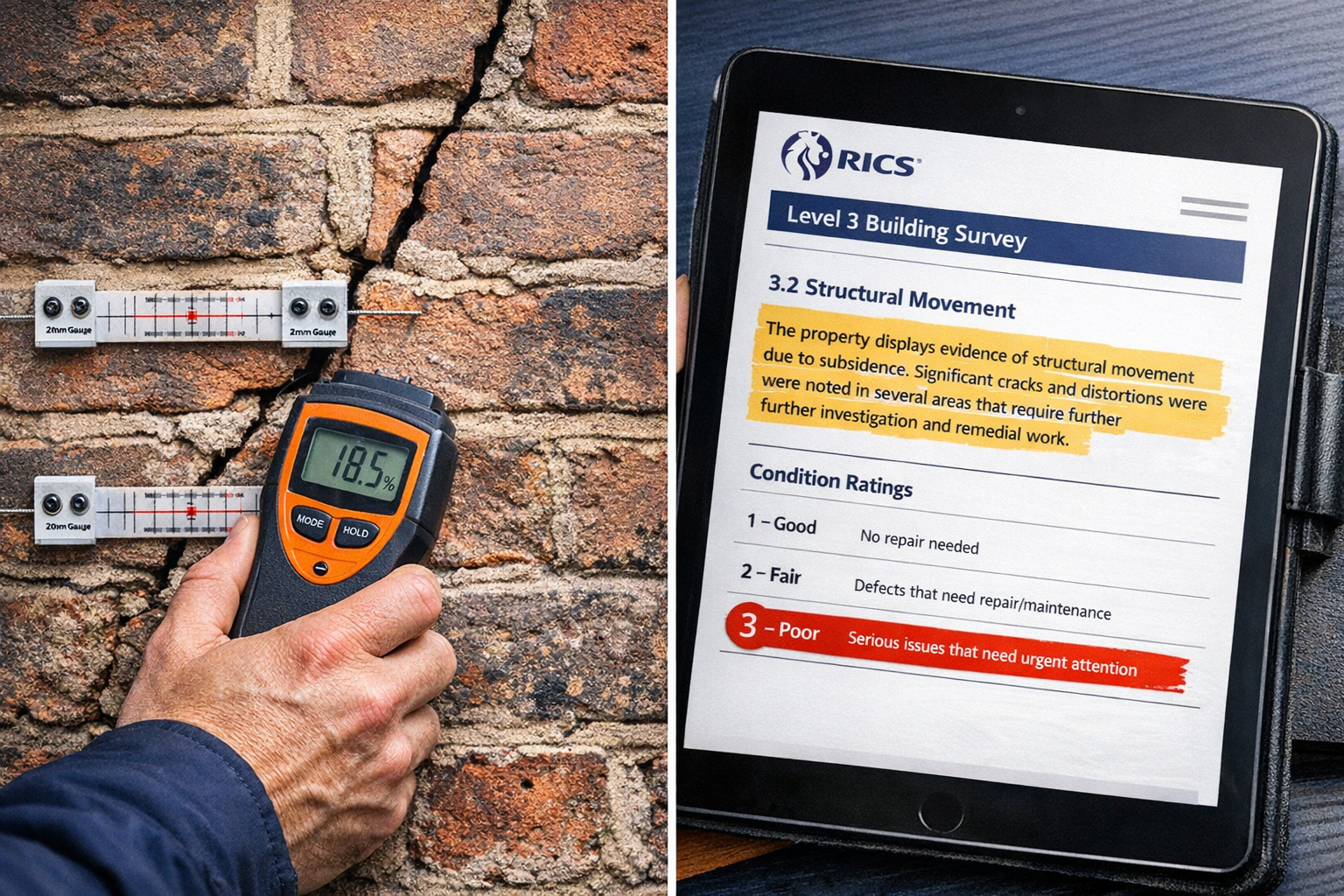
Surveyors evaluate foundations, walls, and load-bearing structures for subsidence, heave, settlement, and significant cracking. This structural movement analysis directly impacts long-term portfolio risk, as remedial work for foundation issues can exceed £50,000 per property[2]. Institutional investors use these findings to negotiate purchase prices or exclude high-risk properties entirely.
Roof Structure and Coverings 🏠
Detailed inspection of tiles, slates, felt, chimneys, and flashings identifies both visible defects and potential hidden issues. Professional landlords planning portfolio holds of 10+ years require accurate roof condition data to model replacement costs and maintenance reserves. A failing roof on a rental property not only generates immediate repair costs but also triggers tenant complaints and potential regulatory action under housing health and safety standards.
Damp, Timber, and Decay Analysis 💧
Rising damp, penetrating moisture, dry rot, and wood-boring insect infestation receive thorough assessment. These issues prove particularly critical for institutional portfolios concentrated in pre-1900 properties, where historic construction methods and materials increase vulnerability[2]. Undetected timber decay can compromise structural integrity and create health hazards that violate Awaab's Law requirements for mold and moisture management.
Building Services Inspection ⚡
While Level 3 Surveys do not include invasive testing of plumbing, electrical, or heating systems, surveyors provide visual condition assessments and identify obvious defects or safety concerns[2]. Professional landlords typically commission separate specialist reports for services based on Level 3 Survey recommendations, ensuring compliance with electrical safety regulations and gas safety certificates required for rental properties.
For more context on different survey types and their applications, see our complete guide to homebuyers surveys and structural assessments.
What Level 3 Surveys Explicitly Exclude
Understanding survey limitations proves as important as knowing what they cover. Level 3 Surveys for Institutional Buy-to-Let in Renewed 2026 Demand: Structural Protocols for Professional Landlord Portfolios explicitly exclude several elements[2]:
| Excluded Element | Institutional Implication | Required Follow-Up |
|---|---|---|
| Invasive checks (lifting floors, drilling walls) | Hidden defects remain undetected | Specialist opening-up surveys for suspect areas |
| Service testing (plumbing, electrics, gas) | Compliance status unknown | NICEIC electrical test, Gas Safe inspection |
| Repair cost estimates | Budget uncertainty | Quantity surveyor quotations |
| Property valuation | Investment appraisal incomplete | RICS Red Book valuation |
| Planning compliance verification | Unauthorized alterations unconfirmed | Local authority searches |
Professional landlords must budget for these supplementary investigations when Level 3 Surveys identify concerns requiring deeper analysis. This layered approach to due diligence protects institutional portfolios from acquisition of properties with concealed defects that could generate six-figure remediation costs.
Structural Protocols Tailored for Professional Landlord Portfolios
Institutional buy-to-let investors require survey protocols that extend far beyond identifying defects for traditional homebuyers. Level 3 Surveys for Institutional Buy-to-Let in Renewed 2026 Demand: Structural Protocols for Professional Landlord Portfolios must address portfolio-scale risk management, regulatory compliance, and yield optimization considerations that shape professional landlord decision-making in 2026[1][4].
Portfolio Risk Assessment and Acquisition Velocity
Professional landlords acquiring multiple properties quarterly need survey protocols that support rapid decision-making without compromising due diligence quality. Level 3 Surveys typically require 4-8 hours of on-site inspection depending on property size and complexity, with reports delivered within 5-7 working days[2]. This turnaround enables institutional investors to maintain acquisition velocity while ensuring comprehensive risk assessment.
Survey protocols for professional portfolios incorporate several specialized elements:
Standardized Condition Rating Systems 📊
Institutional investors benefit from consistent condition ratings across all portfolio acquisitions, enabling direct comparison between properties and data-driven capital allocation. RICS traffic light systems (Condition Rating 1-3) provide this standardization, with professional landlords often setting acquisition thresholds (e.g., no properties with Condition Rating 3 defects exceeding 10% of purchase price).
Maintenance Forecasting and Reserve Planning 💰
Beyond identifying current defects, institutional survey protocols require projections of major component replacement timelines. Professional landlords need to know when roofs, boilers, windows, and other capital items will require replacement to model cash flows and reserve requirements across 10-20 year hold periods.
Regulatory Compliance Screening ⚖️
Awaab's Law (2023) and the Renters' Rights Act (2024-2026 implementation) impose strict property condition standards for rental properties, particularly regarding damp, mold, and hazards under the Housing Health and Safety Rating System (HHSRS). Level 3 Survey protocols for institutional portfolios must explicitly identify compliance gaps that could trigger enforcement action or tenant compensation claims.
RICS January 2026 Documentation Standards
Recent RICS guidance emphasizes comprehensive documentation review before and after property inspections to corroborate survey findings[5]. For institutional landlords, this documentation protocol proves essential for several reasons:
- Title verification ensures no boundary disputes or easement issues that could affect property use or value
- Planning history review identifies unauthorized alterations that could require retrospective consent or removal
- Building control certificates confirm structural alterations meet regulatory standards
- Energy Performance Certificate analysis assesses compliance with Minimum Energy Efficiency Standards (MEES) for rental properties
Professional landlords incorporating these documentation protocols into Level 3 Survey instructions create defensible acquisition decisions that withstand investor scrutiny and regulatory review. Our property inspection guidance provides additional context for comprehensive assessment approaches.
Specialist Investigation Triggers
Level 3 Surveys for Institutional Buy-to-Let in Renewed 2026 Demand: Structural Protocols for Professional Landlord Portfolios must include clear triggers for commissioning specialist investigations[1]. Professional landlords establish protocols that automatically require additional reports when Level 3 Surveys identify:
Structural Movement Indicators 🔧
Cracks exceeding 5mm width, progressive movement patterns, or foundation settlement automatically trigger structural engineer assessments. Institutional investors cannot afford to acquire properties with ongoing structural issues that could generate unlimited remediation costs.
Damp and Timber Concerns 🪵
Any evidence of rising damp, penetrating moisture, dry rot, or wood-boring insect activity requires specialist damp and timber surveys with invasive testing. These investigations quantify the extent of decay and provide detailed remediation specifications. For detailed information on these assessments, review our damp and timber report pricing guide.
Service Installation Age and Condition ⚙️
Electrical installations over 25 years old, heating systems over 15 years old, or any visible safety concerns automatically require specialist testing and certification. Professional landlords cannot legally let properties without valid electrical and gas safety certificates, making these investigations non-negotiable.
Drainage and Groundwater Issues 🚰
Drainage defects, signs of groundwater ingress, or subsidence patterns suggesting drainage failure trigger CCTV drainage surveys. Undetected drainage collapse can cost £10,000-30,000 to repair and cause ongoing structural damage if left unaddressed.
Compliance Integration: Awaab's Law and Renters' Rights Act Requirements
The regulatory landscape for buy-to-let properties has transformed dramatically with Awaab's Law (implemented November 2023) and the phased rollout of the Renters' Rights Act throughout 2024-2026. Level 3 Surveys for Institutional Buy-to-Let in Renewed 2026 Demand: Structural Protocols for Professional Landlord Portfolios must explicitly address these compliance requirements to protect institutional investors from regulatory penalties and reputational damage[4].

Awaab's Law: Damp and Mold Standards
Named after two-year-old Awaab Ishak who died from prolonged exposure to mold in social housing, Awaab's Law imposes strict timelines for landlords to address damp and mold hazards:
- 14 days to investigate reported damp and mold issues
- 7 days to begin remedial work for emergency hazards
- 28 days to complete non-emergency repairs
For institutional landlords acquiring properties with existing damp or mold issues, Level 3 Surveys must provide sufficient detail to assess compliance risk and remediation costs. Professional portfolios cannot afford to acquire properties that will immediately trigger regulatory action upon tenant occupation.
Survey protocols should explicitly document:
✅ All visible signs of dampness, condensation, or mold growth
✅ Ventilation adequacy in kitchens, bathrooms, and bedrooms
✅ Thermal bridging or insulation deficiencies promoting condensation
✅ Roof, gutter, or drainage defects allowing water ingress
✅ Rising damp evidence requiring damp-proof course installation
Institutional investors use this data to calculate acquisition reserves for immediate remediation work, ensuring properties achieve Awaab's Law compliance before first tenant occupation.
Renters' Rights Act: Property Condition Standards
The Renters' Rights Act introduces several provisions affecting professional landlord portfolios:
Decent Homes Standard Extension 🏡
Previously applied only to social housing, decent homes standards are being extended to the private rented sector. Properties must be free from Category 1 hazards under HHSRS, have reasonable thermal comfort, and be in reasonable repair. Level 3 Surveys must assess compliance with these standards, as non-compliant properties face enforcement action and potential prohibition orders.
Awaab's Law Integration 🔍
The Act integrates Awaab's Law timelines into broader property condition obligations, creating a comprehensive regulatory framework for rental property standards. Professional landlords require survey protocols that map all identified defects against HHSRS categories and decent homes criteria.
Tenant Rights Strengthening ⚖️
Enhanced tenant rights to request repairs and escalate complaints to local authority enforcement create greater compliance pressure. Institutional portfolios with poor property condition face increased regulatory scrutiny and potential compensation claims from tenants experiencing health impacts from housing defects.
For professional landlords, these regulations transform Level 3 Surveys from optional due diligence into essential risk management tools. Acquiring properties without comprehensive condition assessment exposes institutional investors to unlimited compliance costs and reputational damage.
Building Survey Protocols for Regulatory Compliance
Professional landlords should instruct surveyors to provide explicit compliance assessments within Level 3 Survey reports:
| Compliance Area | Survey Assessment Required | Institutional Action |
|---|---|---|
| HHSRS Category 1 Hazards | Identify all potential Category 1 hazards (damp, excess cold, falls, etc.) | Commission Environmental Health assessment before acquisition |
| Electrical Safety | Visual condition assessment of consumer unit, wiring, and fixed installations | Commission NICEIC Electrical Installation Condition Report |
| Gas Safety | Visual assessment of gas appliances and pipework | Commission Gas Safe inspection and certification |
| Fire Safety | Assess means of escape, fire door condition, and detection systems | Commission Fire Risk Assessment for HMOs |
| Energy Efficiency | Review EPC rating and identify improvement opportunities | Budget for upgrades to achieve minimum EPC C rating |
Institutional investors incorporating these compliance protocols into Level 3 Survey instructions create defensible acquisition decisions that protect portfolio yields from regulatory penalties. Understanding what surveyors do and their responsibilities helps professional landlords set appropriate survey instructions.
Specialist Compliance Investigations
When Level 3 Surveys identify potential compliance gaps, professional landlords must commission specialist investigations to quantify risk and remediation costs:
Environmental Health HHSRS Assessments 🏥
Local authority environmental health officers or private consultants conduct formal HHSRS assessments, rating all hazards on a scale determining whether they constitute Category 1 (serious) or Category 2 (less serious) hazards. Professional landlords use these assessments to prioritize remediation work and ensure regulatory compliance before tenant occupation.
Asbestos Surveys ⚠️
Properties built before 2000 likely contain asbestos materials. The Control of Asbestos Regulations 2012 requires landlords to manage asbestos risks. Level 3 Surveys identify suspected asbestos-containing materials, triggering specialist asbestos surveys that provide management plans or removal specifications.
Lead Paint Testing 🎨
Pre-1960s properties often contain lead paint, particularly on windows and doors. While not currently regulated for residential lettings in the UK, professional landlords increasingly test for lead paint to manage potential future liability and tenant health concerns.
Property-Specific Survey Protocols: When Level 3 Becomes Essential
While all institutional buy-to-let acquisitions benefit from comprehensive surveys, certain property types make Level 3 Surveys for Institutional Buy-to-Let in Renewed 2026 Demand: Structural Protocols for Professional Landlord Portfolios absolutely essential rather than merely advisable[2].
Pre-1900 and Listed Properties
Victorian and Edwardian properties form a substantial portion of institutional buy-to-let portfolios, particularly in urban markets like London, Manchester, and Edinburgh. These properties present unique challenges:
Historic Construction Methods 🧱
Lime mortar, solid wall construction, and traditional timber framing require different maintenance approaches than modern buildings. Level 3 Surveys must assess whether historic fabric has been inappropriately repaired with modern materials (cement mortar, impermeable renders) that trap moisture and accelerate decay.
Listed Building Constraints 📜
Grade I, II*, and II listed properties face strict limitations on alterations and repairs. Professional landlords must understand these constraints before acquisition, as they directly impact maintenance costs and rental yields. Level 3 Surveys should identify any unauthorized alterations requiring listed building consent regularization.
Hidden Structural Issues 🔍
Period properties often conceal structural problems behind decorative finishes. Previous owners may have covered rather than repaired defects, creating time bombs for new owners. Comprehensive Level 3 Surveys with experienced surveyors familiar with historic construction prove essential for institutional investors.
Significantly Extended or Altered Properties
Properties with substantial extensions, loft conversions, or structural alterations require enhanced survey protocols:
Building Control Compliance Verification ✅
Professional landlords must verify that all structural alterations have appropriate building control certificates. Uncertified work can affect property value, mortgage ability, and insurance validity. Level 3 Surveys identify alterations requiring documentation review.
Structural Integrity Assessment 🏗️
Extensions and conversions can compromise original structural elements if poorly designed or executed. Level 3 Surveys must assess load transfer, foundation adequacy, and structural connections between old and new construction. For properties with concerning findings, our monitoring surveys can track structural movement over time.
Thermal Performance and Building Envelope 🌡️
Poorly executed extensions often create thermal bridges, condensation risks, and energy efficiency problems. Professional landlords require detailed assessment of insulation, ventilation, and building envelope continuity to ensure compliance with energy efficiency standards.
Properties in Poor or Unusual Condition
Institutional investors increasingly target value-add opportunities—properties requiring refurbishment to achieve market rents. These acquisitions demand comprehensive Level 3 Surveys to accurately model refurbishment costs:
Quantified Defect Assessment 📋
While Level 3 Surveys don't include repair cost estimates, they must provide sufficient detail for quantity surveyors to price remediation work accurately. Professional landlords cannot make informed acquisition decisions without reliable refurbishment cost data.
Phased Refurbishment Planning 📅
Institutional portfolios often refurbish properties in phases to manage cash flow. Level 3 Surveys should prioritize defects by urgency and impact, enabling professional landlords to plan phased work programs that maintain rental income while addressing critical issues.
Tenant-in-Situ Considerations 👥
Properties acquired with existing tenants require survey protocols that respect tenant rights while achieving comprehensive assessment. Professional landlords must balance thorough due diligence with tenant privacy and minimal disruption.
Institutional Survey Management: Streamlining Multi-Property Acquisitions
Professional landlords acquiring multiple properties simultaneously require streamlined survey management processes that maintain quality while achieving scale. Level 3 Surveys for Institutional Buy-to-Let in Renewed 2026 Demand: Structural Protocols for Professional Landlord Portfolios benefit from systematic approaches to surveyor selection, instruction, and report analysis[1][4].
Surveyor Panel Development
Institutional investors typically develop surveyor panels—pre-vetted professionals who understand portfolio requirements and deliver consistent quality:
RICS Qualification Verification 🎓
All panel surveyors must hold RICS AssocRICS or MRICS qualifications and maintain professional indemnity insurance adequate for institutional property values. Understanding why to choose RICS surveyors helps professional landlords establish appropriate selection criteria.
Local Market Expertise 📍
Professional landlords benefit from surveyors with deep knowledge of specific markets and property types. A surveyor experienced with Victorian terraces in Birmingham provides more valuable insights than a generalist unfamiliar with local construction methods and common defects.
Institutional Experience 🏢
Surveyors accustomed to working with professional landlords understand portfolio-scale considerations, regulatory compliance requirements, and the need for consistent reporting formats that enable direct property comparison.
Performance Metrics 📊
Institutional investors should track surveyor performance across multiple dimensions: report turnaround time, defect identification accuracy (verified through post-acquisition findings), regulatory compliance assessment quality, and communication responsiveness.
Standardized Survey Instructions
Professional landlords achieve consistency across portfolio acquisitions through standardized survey instruction templates that specify:
✅ Regulatory compliance assessment (HHSRS, Awaab's Law, energy efficiency)
✅ Specialist investigation triggers (structural engineer, damp specialist, drainage survey)
✅ Documentation review requirements (title, planning, building control, EPC)
✅ Report format and condition rating systems (RICS traffic light system)
✅ Turnaround time expectations (typically 5-7 working days)
✅ Photography requirements (comprehensive defect documentation)
✅ Access arrangements (tenant-occupied vs. vacant properties)
Standardized instructions ensure all portfolio properties receive equivalent scrutiny, enabling defensible acquisition decisions and consistent risk assessment.
Digital Survey Management Platforms
Forward-thinking institutional investors leverage technology to streamline survey management:
Centralized Survey Repository 📁
Digital platforms store all Level 3 Survey reports, specialist investigations, and compliance documentation in searchable databases. Professional landlords can instantly access historical survey data when properties require maintenance or disposal.
Automated Compliance Tracking ⚙️
Software platforms extract key data from survey reports—identified hazards, specialist investigation requirements, estimated component lifespans—and populate compliance tracking systems that alert portfolio managers to upcoming maintenance requirements.
Comparative Analytics 📈
Institutional investors analyze survey data across entire portfolios to identify patterns: common defects in specific property types, markets with higher structural risk, or surveyors who consistently identify issues missed by others.
Cost-Benefit Analysis: Level 3 Survey Investment Returns
Professional landlords must justify Level 3 Survey costs against portfolio returns. While comprehensive surveys represent upfront investment, they deliver substantial returns through risk mitigation and informed decision-making[4].
Direct Cost Savings
Avoided Acquisition of Defective Properties 💰
Level 3 Surveys identifying properties with structural issues, contamination, or compliance gaps prevent acquisition of assets that would generate negative returns. A single avoided acquisition of a property with £100,000+ undisclosed defects justifies dozens of survey fees.
Purchase Price Negotiation 💵
Detailed defect documentation from Level 3 Surveys provides leverage for purchase price renegotiation. Professional landlords routinely achieve 5-15% price reductions when surveys identify significant issues, directly offsetting survey costs.
Accurate Refurbishment Budgeting 📊
Comprehensive condition assessment enables accurate refurbishment cost modeling, preventing budget overruns that destroy value-add acquisition returns. Professional landlords report that detailed Level 3 Surveys reduce refurbishment cost variance from ±30% to ±10%.
Indirect Value Protection
Regulatory Compliance Assurance ⚖️
Level 3 Surveys identifying compliance gaps before acquisition prevent regulatory penalties, enforcement action, and tenant compensation claims that could exceed £50,000 per property. In 2026's heightened regulatory environment, compliance assurance proves invaluable.
Tenant Satisfaction and Retention 😊
Properties acquired with comprehensive condition assessment and pre-letting remediation work generate fewer tenant complaints, higher satisfaction, and longer tenancies. Professional landlords report 20-30% higher tenant retention rates in properties with pre-acquisition Level 3 Surveys compared to those without.
Portfolio Valuation Accuracy 📈
Institutional investors require accurate portfolio valuations for investor reporting, refinancing, and exit planning. Level 3 Surveys provide defensible condition data that supports valuations and reduces lender skepticism during refinancing processes. For properties requiring formal valuations, see our property valuation guidance.
Insurance Premium Optimization 🛡️
Comprehensive survey documentation demonstrating proactive risk management can reduce insurance premiums for professional landlord portfolios. Insurers reward institutional investors who demonstrate thorough due diligence and systematic maintenance planning.
Emerging Survey Technologies and 2026 Innovations
The survey profession continues evolving, with new technologies enhancing Level 3 Survey capabilities for institutional investors:
Thermal Imaging Integration 🌡️
Infrared cameras identify hidden moisture, insulation defects, and thermal bridges invisible to visual inspection. Professional landlords increasingly specify thermal imaging as standard for Level 3 Surveys, particularly for energy efficiency assessment and condensation risk evaluation.
Drone Roof Surveys 🚁
Unmanned aerial vehicles enable detailed roof inspection without expensive scaffolding or access equipment. Institutional investors benefit from comprehensive photographic documentation of roof condition at reduced cost and risk compared to traditional access methods.
3D Property Scanning 📸
Laser scanning technology creates detailed 3D models of properties, providing permanent records of property condition at acquisition. Professional landlords use these scans for future maintenance planning, refurbishment design, and condition comparison over time.
AI-Assisted Defect Identification 🤖
Emerging artificial intelligence tools analyze survey photographs to identify defects, classify severity, and suggest remediation approaches. While not replacing professional surveyor judgment, these tools enhance consistency and reduce report preparation time.
Conclusion: Building Resilient Institutional Portfolios Through Comprehensive Survey Protocols
Level 3 Surveys for Institutional Buy-to-Let in Renewed 2026 Demand: Structural Protocols for Professional Landlord Portfolios represent far more than regulatory box-ticking or risk mitigation—they form the foundation of successful institutional property investment in an increasingly complex regulatory environment. As professional landlords continue their bullish expansion into buy-to-let markets throughout 2026, comprehensive building surveys provide the detailed condition intelligence required for informed acquisition decisions, accurate financial modeling, and defensible portfolio management.
The convergence of Awaab's Law, the Renters' Rights Act, and heightened tenant expectations creates an environment where property condition directly impacts portfolio yields, regulatory compliance, and institutional reputation. Professional landlords who invest in thorough Level 3 Survey protocols—including specialist investigations, documentation review, and compliance assessment—build resilient portfolios capable of weathering regulatory change and delivering sustainable returns.
Actionable Next Steps for Professional Landlords
Immediate Actions ⚡
- Develop surveyor panels with RICS-qualified professionals experienced in institutional buy-to-let acquisitions
- Create standardized survey instructions specifying regulatory compliance assessment and specialist investigation triggers
- Implement digital survey management systems for centralized documentation and compliance tracking
Strategic Initiatives 🎯
- Review existing portfolio properties against Awaab's Law and Renters' Rights Act standards using Level 3 Survey protocols
- Establish acquisition thresholds based on condition ratings and compliance gap severity
- Integrate survey data into portfolio analytics for pattern identification and risk modeling
Continuous Improvement 📈
- Track surveyor performance across quality, turnaround time, and defect identification accuracy metrics
- Monitor regulatory developments and update survey protocols to address emerging compliance requirements
- Invest in survey technology including thermal imaging, drone surveys, and digital documentation platforms
For professional landlords seeking to implement these protocols, contact our experienced team to discuss tailored survey solutions for institutional portfolios. Our RICS-qualified surveyors understand the unique requirements of professional buy-to-let investors and deliver comprehensive Level 3 Surveys that support informed acquisition decisions and regulatory compliance.
The institutional buy-to-let market in 2026 rewards professional landlords who prioritize thorough due diligence and systematic risk management. Comprehensive Level 3 Survey protocols provide the foundation for building portfolios that deliver sustainable yields while meeting the highest standards of property condition and tenant welfare.
References
[1] Institutional And Professional Landlord Investment Surge 2026 Building Survey Standards For Portfolio Expansion – https://nottinghillsurveyors.com/blog/institutional-and-professional-landlord-investment-surge-2026-building-survey-standards-for-portfolio-expansion
[2] What Does A Level 3 Survey Include 2025 – https://surveymatch.co.uk/what-does-a-level-3-survey-include-2025/
[3] 2026 Alta Survey Standards Updates – https://www.hklaw.com/en/insights/publications/2026/03/2026-alta-survey-standards-updates
[4] Building Survey Protocols For Professional Landlord Acquisitions Assessing Yields In 2026s Bullish Buy To Let Recovery – https://nottinghillsurveyors.com/blog/building-survey-protocols-for-professional-landlord-acquisitions-assessing-yields-in-2026s-bullish-buy-to-let-recovery
[5] Modus By Rics January 2026 – https://www.rics.org/content/dam/ricsglobal/documents/to-be-sorted/MODUS-by-RICS-January-2026.pdf