
{"cover":"Professional landscape format (1536×1024) hero image with bold text overlay 'Level 3 Building Surveys for Office-to-Resi Conversions in 2026: Identifying Retrofit Risks in London Revivals' in extra large 72pt white sans-serif font with dark shadow and semi-transparent overlay box, positioned in upper third. Background shows dramatic split-screen composition: left side features a classic London commercial office building exterior with glass and steel facade, right side shows modern residential apartment interior with natural light. Color scheme: deep navy blue, white, warm orange accents. Include subtle overlay of architectural blueprint lines and survey inspection icons. High contrast, editorial quality, magazine cover aesthetic, professional surveying theme","content":["Landscape format (1536×1024) detailed cutaway architectural illustration showing a multi-story London office building mid-conversion, with transparent walls revealing internal structural elements including RAAC concrete planks highlighted in red, aging cladding systems marked with warning indicators, asbestos locations flagged with yellow markers, and surveyors with clipboards examining various floors. Include cross-section view showing floor-by-floor retrofit challenges, exposed MEP systems, and structural defects. Color-coded risk zones in red, amber, green. Technical blueprint aesthetic with measurement annotations, inspection notes, and defect callouts. Professional surveying documentation style with London skyline visible through windows","Landscape format (1536×1024) professional surveyor conducting detailed inspection inside a London office-to-residential conversion site, wearing hard hat and high-visibility vest, using thermal imaging camera to scan walls for moisture and insulation defects. Scene shows exposed building fabric with visible cladding samples, testing equipment including moisture meters and laser measuring devices on tripod, clipboard with detailed checklist, and laptop displaying building survey software. Background reveals building services being retrofitted including new plumbing risers and electrical conduits. Natural daylight streaming through large office windows, construction materials stacked nearby, dust sheets covering floors. Realistic documentary photography style emphasizing detailed inspection methodology","Landscape format (1536×1024) modern infographic-style comparison chart showing two parallel timelines: top timeline displays traditional office building lifecycle with declining value curve and obsolescence markers, bottom timeline shows successful residential conversion pathway with value recovery trajectory. Include visual elements: miniature 3D building models transforming from office to residential, regulatory approval checkpoints marked with green ticks, Building Safety Regulator gateway icons, cost breakdown pie charts, energy performance certificate ratings improving from E to B, and compliance milestone flags. Color scheme: professional blues and greens with red warning indicators for risk points. Clean, editorial financial publication aesthetic with data visualization elements and London property market context"]
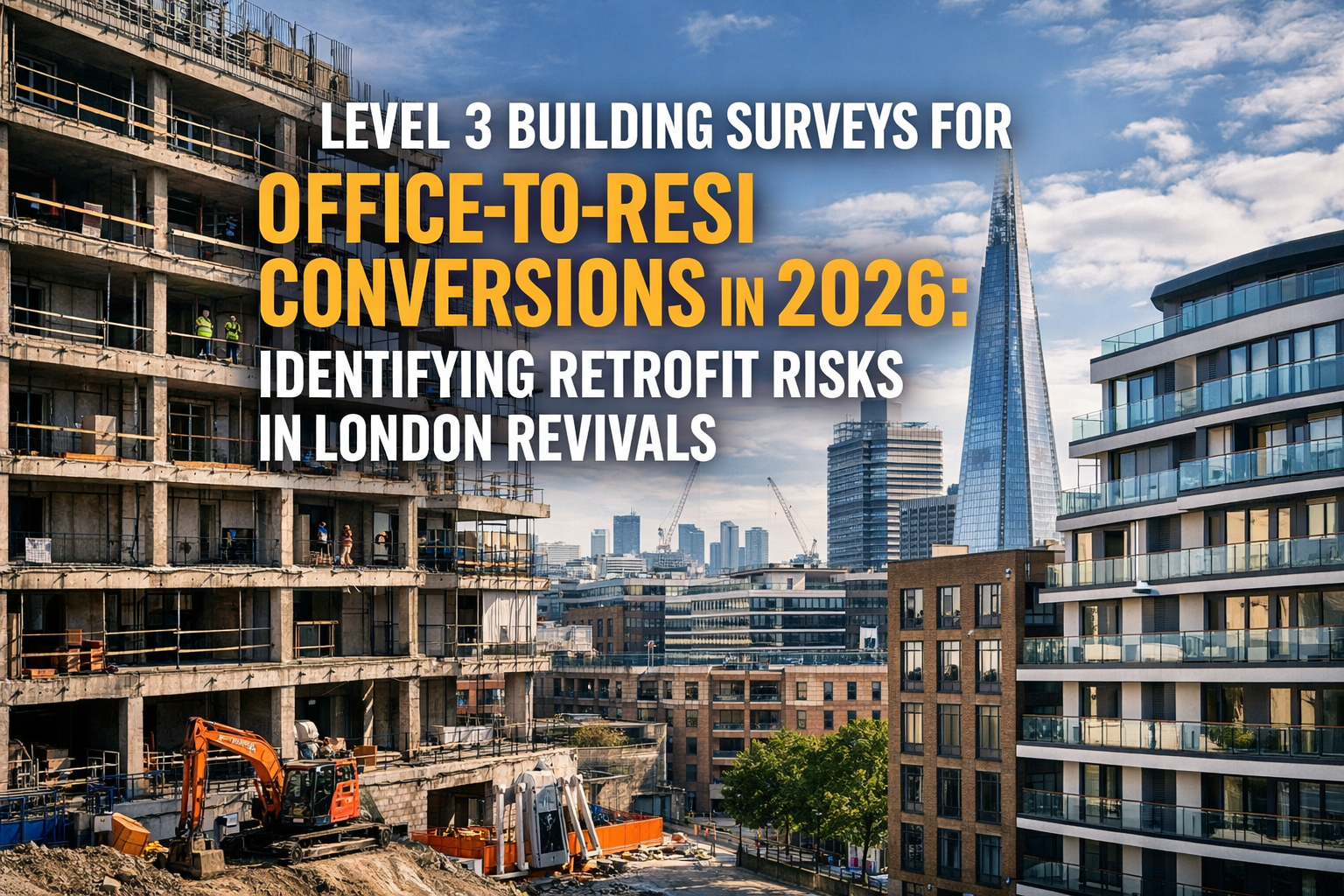
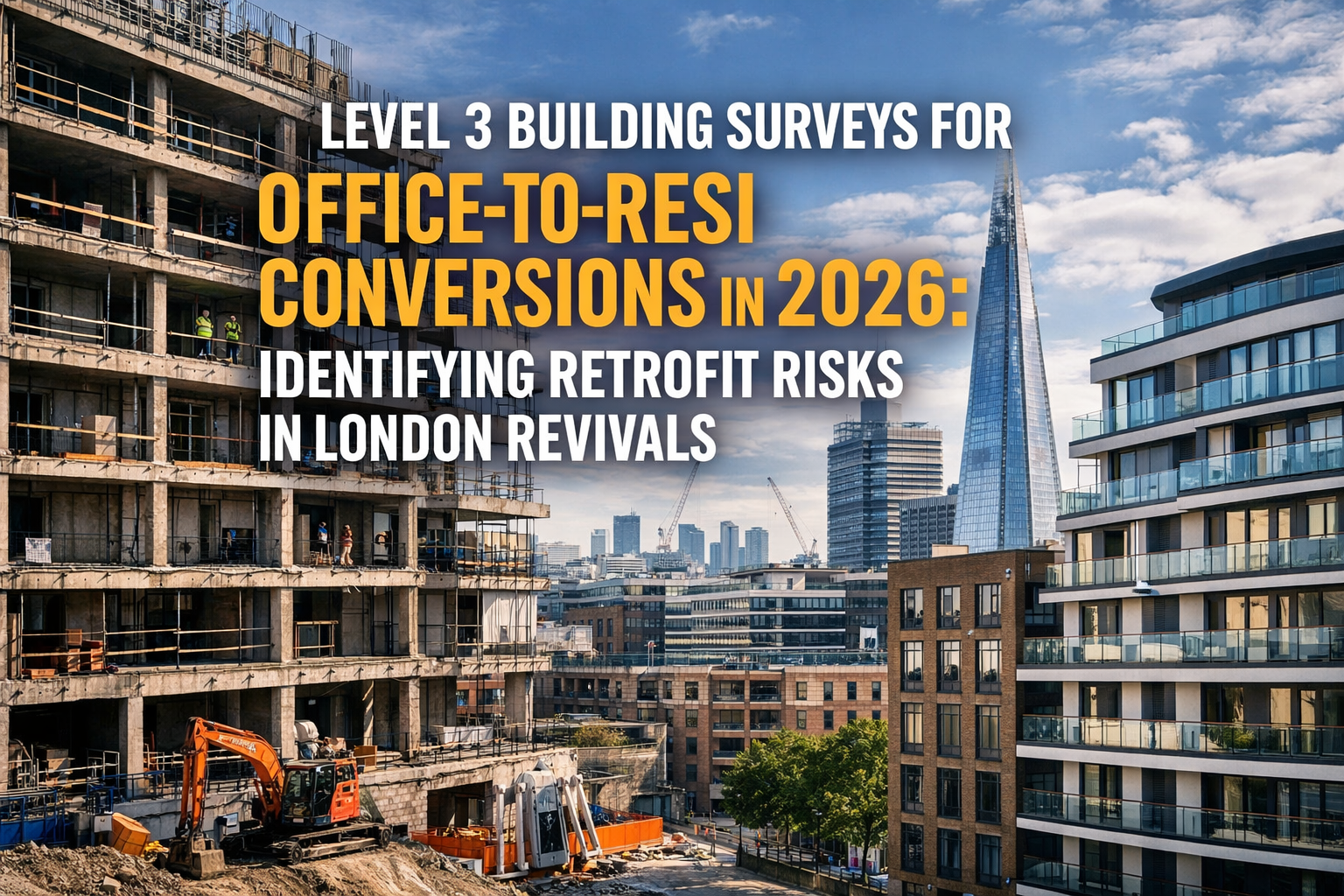
London's commercial property landscape is experiencing a dramatic transformation. With office values stabilizing and underpriced assets flooding the market, developers are seizing opportunities to convert redundant workspaces into residential units. However, these ambitious Level 3 Building Surveys for Office-to-Resi Conversions in 2026: Identifying Retrofit Risks in London Revivals reveal hidden dangers lurking beneath aging facades—from RAAC concrete to combustible cladding—that can derail even the most promising projects. 🏢➡️🏠
As of March 2026, regulatory changes have removed previous floorspace and vacancy restrictions, opening the floodgates for conversions of any size[1]. Yet this liberalization comes with heightened scrutiny on building safety, energy performance, and structural integrity. The stakes have never been higher for investors navigating London's office-to-residential revival.
Key Takeaways
- Regulatory landscape has shifted dramatically: Class MA Permitted Development Rights now allow commercial buildings of any size to convert without full planning permission, but Building Regulations approval remains mandatory[1][2]
- Hidden structural defects pose major financial risks: RAAC concrete, aging cladding systems, and asbestos require comprehensive Level 3 surveys to identify retrofit costs that can exceed £200-300 per square metre
- Building Safety Regulator oversight applies: Structures 18+ metres tall or 7+ storeys with multiple residential units face enhanced scrutiny and approval requirements before conversion work begins[2]
- Energy performance gaps threaten viability: Many 1960s-1990s office buildings require extensive envelope upgrades to meet residential thermal standards and EPC requirements
- Survey protocols must address conversion-specific risks: Standard residential surveys miss critical commercial building defects that impact habitability, compliance, and long-term maintenance costs
Understanding the 2026 Office-to-Residential Conversion Boom in London
The London property market has witnessed a 60% increase in commercial-to-residential conversion approvals over recent reporting periods, with the capital serving as the epicenter of this transformation[4]. This surge reflects multiple converging factors: hybrid working patterns reducing office demand, attractive residential values in prime locations, and streamlined regulatory pathways.
The New Permitted Development Framework
Since March 5, 2026, the Class MA Permitted Development Rights framework has fundamentally changed the conversion landscape. Previous restrictions on floorspace limits and vacancy requirements have been eliminated, allowing buildings of any size to pursue residential conversion without full planning permission[1]. This represents a significant departure from earlier regimes that capped eligible buildings at specific square footage thresholds.
However, developers must still submit a prior approval application that includes:
- Existing and proposed planning drawings
- Transport and highways impact assessments
- Contamination risk reports
- Flood risk analysis
- Noise impact assessments
- Adequate natural light verification[2]
Building Regulations: The Non-Negotiable Hurdle
While planning permission may be streamlined, Building Regulations approval remains mandatory for all conversions[3]. This separate approval process governs construction safety, structural integrity, fire safety, accessibility, and energy performance. For many aging office buildings, achieving compliance represents the most significant technical and financial challenge.
Buildings meeting the higher-risk criteria—18+ metres in height or 7+ storeys containing two or more residential units—must obtain Building Safety Regulator approval before commencing work[2]. This enhanced regime introduces additional gateway checks, competence requirements, and documentation obligations that extend project timelines and costs.
Why Level 3 Building Surveys for Office-to-Resi Conversions in 2026 Are Critical
Standard residential surveys—even comprehensive building surveys—are designed for traditional housing stock. They don't adequately address the unique defects, systems, and compliance challenges inherent in commercial buildings being repurposed for residential use.
What Makes Office Buildings Different
Commercial structures from the 1960s through 1990s—prime candidates for conversion due to their central locations and declining office values—were designed to entirely different standards than residential buildings:
| Aspect | Commercial Design | Residential Requirement |
|---|---|---|
| Floor Loading | 3.5-5.0 kN/m² (office use) | 1.5-2.0 kN/m² (residential) |
| Ceiling Heights | 2.4-2.7m with suspended ceilings | 2.3m minimum habitable rooms |
| Natural Light | Deep floor plates, artificial lighting | Daylight and sunlight to all habitable rooms[2] |
| Thermal Performance | Lower standards, mechanical systems | Enhanced U-values, reduced heat loss |
| Fire Compartmentation | Open plan, different escape routes | Residential compartmentation standards |
| Acoustic Separation | Minimal between floors | Stringent inter-unit sound insulation |
These fundamental differences mean that a thorough structural survey must evaluate not just current condition, but conversion feasibility and compliance pathway costs.
The RAAC Concrete Crisis
Reinforced Autoclaved Aerated Concrete (RAAC) has emerged as one of the most serious hidden defects in post-war commercial buildings. This lightweight concrete material, used extensively between 1950 and 1990, has a design life of just 30 years and is prone to sudden structural failure without warning.
Level 3 surveys must specifically identify:
- Presence of RAAC in floor slabs, roof decks, or structural panels
- Age and condition assessment of RAAC elements
- Load-bearing capacity for residential conversion
- Remediation requirements and associated costs
- Safety implications during construction phase
The discovery of RAAC can transform a viable conversion into an economically unviable project, with replacement costs potentially exceeding £500-800 per square metre of affected floor area.
Cladding and Building Safety Compliance
The post-Grenfell regulatory environment has intensified scrutiny on external wall systems. Many office buildings feature:
- Combustible cladding materials requiring removal and replacement
- Aluminum composite panels (ACM) with polyethylene cores
- High-pressure laminate (HPL) systems with fire performance concerns
- Inadequate cavity barriers and fire breaks
A comprehensive condition survey must include detailed cladding analysis, particularly for buildings exceeding 18 metres in height. Remediation costs can range from £150-400 per square metre of facade, representing millions of pounds for larger conversions.

Core Components of Level 3 Building Surveys for Office-to-Resi Conversions in 2026
A properly scoped Level 3 survey for office-to-residential conversion extends far beyond standard residential survey protocols. It must address conversion-specific risks that impact both project viability and long-term residential performance.
1. Structural Capacity and Integrity Assessment
Foundation and substructure evaluation forms the critical first layer of investigation:
- Load-bearing capacity for residential use patterns
- Settlement evidence and ongoing movement monitoring
- Ground conditions and contamination from previous industrial uses
- Basement waterproofing and tanking condition
- Pile integrity where applicable
Superstructure analysis must examine:
- Frame condition (steel, concrete, or composite)
- RAAC identification through visual inspection and records review
- Concrete carbonation and reinforcement corrosion
- Steel corrosion and fire protection integrity
- Floor slab deflection and vibration characteristics
- Lateral stability and bracing adequacy
2. Building Envelope Performance
The external envelope of office buildings rarely meets residential thermal and weatherproofing standards. Detailed assessment should cover:
Facade systems:
- Curtain walling condition and thermal performance
- Glazing U-values and air tightness
- Spandrel panel insulation
- Weatherproofing and water ingress evidence
- Cladding fire safety compliance
Roof structures:
- Waterproofing membrane condition and remaining life
- Insulation thickness and thermal bridging
- Drainage adequacy and ponding issues
- Plant room and services penetrations
- Parapet and upstand detailing
3. Services Infrastructure Suitability
Existing mechanical, electrical, and plumbing (MEP) systems in office buildings are fundamentally incompatible with residential requirements:
Critical evaluation areas:
- Vertical riser capacity for multiple residential units
- Water supply pressure and flow rates
- Drainage pipe sizing and falls
- Electrical distribution and metering infrastructure
- Gas supply availability and routing
- Ventilation and extract systems
- Lift capacity and fire-fighting lifts requirements
Most conversions require complete MEP replacement, with costs typically representing 25-35% of total conversion budgets. Surveys must identify retention potential versus wholesale replacement needs.
4. Hazardous Materials Survey
Commercial buildings, particularly those constructed before 2000, frequently contain hazardous materials requiring specialist removal:
- Asbestos: Insulation, ceiling tiles, floor tiles, pipe lagging
- Lead paint: Window frames, metalwork, decorative finishes
- PCBs: Electrical equipment, light fittings, sealants
- Mineral fibers: Ceiling voids, cavity insulation
A comprehensive building evaluation must include hazardous materials assessment with laboratory analysis, quantification, and removal cost estimates.
5. Fire Safety and Means of Escape
Residential fire safety requirements differ substantially from commercial standards:
- Compartmentation between units (60-minute fire resistance)
- Protected escape routes and travel distances
- Fire door specifications and self-closers
- Smoke detection and alarm systems
- Sprinkler requirements for buildings over 11 metres
- External wall fire performance
- Firefighting access and facilities
6. Energy Performance and Sustainability
Residential units must achieve minimum Energy Performance Certificate (EPC) ratings, typically Band C or better for new conversions. Assessment should include:
- Thermal imaging surveys to identify heat loss
- U-value calculations for existing envelope
- Heating system efficiency and zoning potential
- Renewable energy integration opportunities
- Ventilation heat recovery feasibility
- Glazing solar gain and overheating risk
Many 1980s-1990s office buildings have single-glazed curtain walling with U-values of 5.0-6.0 W/m²K, compared to residential requirements of 1.4-1.6 W/m²K. Envelope upgrades can consume 15-25% of conversion budgets.
Identifying and Quantifying Retrofit Risks: A Systematic Approach
Successful office-to-residential conversions depend on accurate risk identification and realistic cost forecasting during the survey phase. Under-estimation of retrofit requirements represents the primary cause of project failure or financial distress.
The Three-Tier Risk Classification System
Professional surveyors employ a structured risk classification approach:
🔴 Critical Risks (Project Viability Threats)
- RAAC concrete requiring complete replacement
- Combustible cladding on buildings >18m
- Inadequate structural capacity for residential loads
- Contaminated land requiring remediation
- Fundamental planning constraints (daylight, aspect)
- Building Safety Regulator rejection risks
🟡 Significant Risks (Major Cost Implications)
- Asbestos requiring extensive removal
- MEP systems requiring complete replacement
- Envelope thermal performance gaps
- Acoustic separation challenges
- Accessibility and Part M compliance
- Fire compartmentation upgrades
🟢 Manageable Risks (Standard Conversion Items)
- Internal reconfiguration and fit-out
- Minor drainage modifications
- Decorative repairs and finishes
- Window and door replacements
- Standard building services installations
Cost Benchmarking for Retrofit Elements
Based on 2026 London market data, typical retrofit costs include:
| Retrofit Element | Cost Range (£/m²) | Notes |
|---|---|---|
| RAAC replacement | £500-800 | Includes temporary works, structural engineering |
| Cladding remediation | £150-400 | Depends on height, access, material specification |
| Asbestos removal | £50-150 | Varies with type, location, accessibility |
| MEP complete replacement | £200-350 | All new services, distribution, controls |
| Envelope thermal upgrade | £180-280 | Over-cladding or curtain wall replacement |
| Fire compartmentation | £80-120 | Walls, doors, sealing, detection systems |
| Acoustic separation | £60-100 | Floor and wall treatments |
| Internal fit-out | £800-1,200 | Standard residential specification |
Due Diligence Documentation Requirements
A comprehensive Level 3 survey for conversion projects should deliver:
- Executive summary with viability opinion and critical risks
- Detailed defects schedule with photographic evidence
- Compliance gap analysis against Building Regulations Parts A-M
- Hazardous materials register with removal recommendations
- Energy performance assessment and upgrade pathway
- Cost estimate matrix for all identified retrofit works
- Programme implications including long-lead procurement items
- Specialist investigation recommendations (structural, MEP, fire engineering)
This documentation enables developers to make informed acquisition decisions and secure appropriate development finance. Many lenders now require expert building evaluation reports before advancing funds for conversion projects.

Regulatory Compliance Pathways for London Office-to-Resi Conversions
Navigating the regulatory landscape represents a critical success factor for conversion projects. The 2026 framework balances streamlined planning with enhanced building safety oversight.
Prior Approval Application Process
Even under Permitted Development Rights, developers must submit detailed prior approval applications addressing:
Transport and highways impact:
- Residential parking demand versus existing provision
- Cycle storage requirements (typically 1-2 spaces per unit)
- Refuse and recycling storage accessibility
- Servicing and delivery arrangements
Contamination risk assessment:
- Historical land use investigation
- Phase 1 desk study and site walkover
- Phase 2 intrusive investigation where risks identified
- Remediation strategy and validation
Flood risk and drainage:
- Environment Agency flood zone verification
- Surface water drainage strategy
- Sustainable drainage systems (SuDS) integration
- Thames Water capacity confirmation
Noise impact assessment:
- External noise levels at facade
- Internal noise standards (BS 8233:2014)
- Acoustic glazing and ventilation specifications
- Plant and services noise control
Adequate natural light verification:
- Daylight factor calculations for all habitable rooms
- Sunlight availability assessment
- Overshadowing analysis from adjacent buildings
- Compliance with national space standards[2]
Local planning authorities have 56 days to determine prior approval applications, though this can extend to 84 days with applicant agreement.
Building Regulations Approval Routes
Developers can pursue Building Regulations approval through two routes:
1. Local Authority Building Control (LABC)
- Direct application to borough building control department
- Staged inspections during construction
- Final certification upon completion
2. Approved Inspector Route
- Private sector building control provider
- Integrated design and compliance service
- May offer faster response times
For higher-risk buildings (18m+ or 7+ storeys), the Building Safety Regulator assumes control, requiring:
- Gateway 1: Planning gateway submission
- Gateway 2: Pre-construction phase approval
- Gateway 3: Completion certificate application
- Ongoing safety case documentation
- Competence demonstrations for all duty holders[2]
National Space Standards Compliance
All conversions must meet the Nationally Described Space Standard (NDSS), which mandates:
- 1-bed/2-person unit: 50m² minimum
- 2-bed/4-person unit: 70m² minimum
- 3-bed/5-person unit: 86m² minimum
- Bedroom minimum dimensions: 2.15m width for doubles
- Storage provision: 1.5-2.5m² depending on unit size
- Ceiling heights: 2.3m minimum for 75% of gross internal area
Deep floor plate office buildings often struggle to achieve compliant unit layouts while maintaining adequate natural light to all habitable rooms. This represents a fundamental viability constraint that surveys must address early in the due diligence process.
Case Study Insights: Common Retrofit Challenges in London Conversions
Real-world conversion projects reveal recurring patterns of hidden defects and compliance challenges that Level 3 surveys must anticipate.
The 1970s Concrete Frame Challenge
A recent conversion of a 12-storey 1972 office building in Southwark encountered multiple structural issues:
- RAAC floor planks discovered in levels 4-8, requiring complete replacement at £650/m²
- Carbonated concrete in external columns reducing cover to reinforcement
- Inadequate floor-to-floor heights (2.8m) limiting services distribution options
- Single-glazed curtain walling with U-values of 5.8 W/m²K
Total structural and envelope remediation costs exceeded initial estimates by 47%, compressing development margins significantly. A thorough pre-acquisition survey would have identified these risks and enabled accurate financial modeling.
The Cladding Remediation Dilemma
A prominent conversion in Westminster faced unexpected cladding challenges:
- ACM panels with PE core requiring complete removal (building height: 24m)
- Inadequate cavity barriers throughout external wall system
- Combustible insulation behind rainscreen panels
- Fire stopping defects at floor slab penetrations
Remediation costs reached £3.2 million for a 6,000m² building, equivalent to £533/m² of gross internal area. The project required Building Safety Regulator engagement and extended the programme by 14 months.
The MEP Infrastructure Trap
A conversion in the City of London revealed services challenges typical of 1980s office buildings:
- Asbestos-wrapped risers throughout the building core
- Inadequate drainage falls for residential bathroom layouts
- Single-phase electrical distribution requiring complete replacement
- No gas supply to building, necessitating new infrastructure
- Cooling towers and chillers requiring removal and disposal
The developer ultimately spent £285/m² on MEP works alone—nearly double the initial budget allocation.
Selecting the Right Survey Team for Conversion Projects
Not all chartered surveyors possess the specialized knowledge required for office-to-residential conversion assessments. Selecting the appropriate team is critical to project success.
Essential Competencies and Qualifications
Look for survey teams with:
Professional credentials:
- RICS Chartered Building Surveyors with commercial experience
- Structural engineers (IStructE or ICE members)
- MEP consultants with residential conversion expertise
- Fire safety engineers (IFE members)
- Environmental consultants for contamination and hazmat
Conversion-specific experience:
- Demonstrated track record on similar projects
- Understanding of Permitted Development regime
- Building Safety Regulator gateway process familiarity
- London borough planning authority relationships
Technical capabilities:
- Thermal imaging and moisture detection equipment
- Concrete testing and RAAC identification protocols
- Intrusive investigation methodologies
- BIM and 3D scanning for existing building capture
Survey Scope and Deliverables Specification
A properly scoped Level 3 conversion survey should include:
Stage 1: Desktop review (1-2 weeks)
- Historical planning and building control records
- Asbestos registers and previous surveys
- Structural drawings and calculations
- Building services drawings and specifications
- Environmental reports and contamination data
Stage 2: Non-intrusive inspection (2-3 days)
- External envelope assessment
- Internal spaces inspection
- Roof and basement access
- Services distribution review
- Photographic defects recording
Stage 3: Intrusive investigations (1-2 weeks)
- Concrete core sampling and testing
- RAAC identification inspections
- Asbestos sampling and analysis
- Services capacity testing
- Structural opening-up as required
Stage 4: Reporting and cost estimation (2-3 weeks)
- Comprehensive defects report
- Compliance gap analysis
- Retrofit cost estimate
- Programme implications
- Risk register and mitigation strategies
For those seeking building surveyors in London with conversion expertise, verify their portfolio includes comparable office-to-residential projects and request references from previous developer clients.
Financial Implications: Using Survey Findings to Negotiate and Mitigate Risk
Level 3 survey findings provide powerful negotiating leverage and risk management tools when properly deployed.
Purchase Price Negotiation Strategies
Detailed survey evidence of retrofit requirements enables data-driven price negotiations:
Cost-to-complete approach:
- Document all identified defects and compliance gaps
- Obtain specialist cost estimates for major elements
- Calculate total retrofit cost exposure
- Deduct from initial offer price or renegotiate terms
Research indicates that comprehensive building surveys can support price reductions averaging 5-15% for properties with significant defects. For conversion projects with RAAC or cladding issues, reductions of 20-30% may be justified.
Development Appraisal Refinement
Survey findings enable accurate development appraisal updates:
Revised cost inputs:
- Abnormal costs (RAAC, asbestos, cladding)
- Enhanced MEP replacement specifications
- Extended programme duration
- Additional professional fees
- Contingency allocation (typically 10-15% for conversions)
Value engineering opportunities:
- Unit mix optimization based on layout constraints
- Specification adjustments to maintain margins
- Phasing strategies to improve cash flow
- Value-add features to enhance sales values
Risk Transfer and Insurance
Survey documentation supports risk transfer mechanisms:
Professional indemnity insurance:
- Surveyor PI cover for negligent advice
- Typical limits: £1-5 million per claim
- Verify adequacy for project scale
Warranty products:
- Structural warranties for conversion works
- Latent defects insurance (10-12 years)
- Building Safety Regulator compliance warranties
Contractor risk allocation:
- Design-and-build contracts transfer design risk
- Fixed-price lump sum reduces cost overrun exposure
- Performance bonds and parent company guarantees
Future-Proofing Conversions: Sustainability and Long-Term Performance
Beyond immediate compliance, successful conversions must deliver long-term residential performance and sustainability.
Energy Performance Optimization
Achieving EPC Band B or better requires holistic envelope and systems upgrades:
Fabric-first approach:
- External wall insulation or over-cladding (U-value ≤0.18 W/m²K)
- High-performance glazing (U-value ≤1.2 W/m²K, g-value 0.4-0.5)
- Roof insulation enhancement (U-value ≤0.15 W/m²K)
- Air tightness improvements (≤5 m³/h/m² @ 50Pa)
Low-carbon systems:
- Air source heat pumps with underfloor heating
- Mechanical ventilation with heat recovery (MVHR)
- Solar PV arrays on roof areas
- LED lighting with daylight/occupancy controls
- Smart metering and energy monitoring
Embodied carbon considerations:
- Retention of existing structure reduces embodied carbon
- Specify low-carbon materials (timber, recycled content)
- Local sourcing to minimize transport emissions
- Whole-life carbon assessment and optimization
Operational Performance and Resident Satisfaction
Long-term success depends on residential performance quality:
Acoustic comfort:
- Inter-unit sound insulation (≥45dB DnT,w)
- Impact sound reduction (≤62dB L'nT,w)
- External noise mitigation for urban locations
- Services noise control (plant, lifts, drainage)
Thermal comfort:
- Overheating risk assessment and mitigation
- Adequate heating capacity for winter conditions
- Individual unit control and zoning
- Summer ventilation strategies
Indoor air quality:
- MVHR systems with adequate air change rates
- Low-VOC materials and finishes specification
- Moisture control and condensation prevention
- Pollutant filtration for urban environments
Building Management and Maintenance
Conversion projects create unique management challenges:
- Mixed-use scenarios: Retained commercial uses require separate management
- Service charge structures: Equitable cost allocation between uses
- Sinking funds: Adequate reserves for major works (cladding, plant replacement)
- Building Safety Act compliance: Ongoing safety case maintenance and resident engagement
- Defects liability: Clear contractor obligations and warranty coverage
Conclusion
Level 3 Building Surveys for Office-to-Resi Conversions in 2026: Identifying Retrofit Risks in London Revivals represent an essential investment for developers navigating London's transformation from commercial to residential uses. The liberalized Permitted Development framework has created unprecedented opportunities, but success demands rigorous due diligence to identify hidden defects that can destroy project viability.
RAAC concrete, combustible cladding, inadequate MEP infrastructure, and energy performance gaps pose significant financial and regulatory risks. A comprehensive Level 3 survey—conducted by specialists with conversion expertise—provides the foundation for accurate cost forecasting, informed acquisition decisions, and effective risk mitigation.
Actionable Next Steps
For developers and investors considering office-to-residential conversions:
- Engage conversion-specialist surveyors early in the acquisition process, before exchange of contracts
- Specify comprehensive survey scope including structural, services, environmental, and fire safety assessments
- Obtain specialist investigations for RAAC identification, cladding analysis, and hazardous materials
- Model multiple cost scenarios using survey findings, with adequate contingency provisions
- Verify regulatory pathway including Building Safety Regulator requirements for higher-risk buildings
- Secure appropriate insurance and warranty products based on identified risks
- Engage early with planning authorities to confirm prior approval requirements and constraints
The London office-to-residential conversion market offers compelling opportunities for those who approach projects with eyes wide open to retrofit risks. Comprehensive surveys transform uncertainty into manageable, quantified risks—enabling confident investment decisions and successful project delivery.
For expert guidance on building surveys and residential property advice tailored to conversion projects, consult with chartered surveyors who understand both commercial building pathology and residential performance requirements.
References
[1] Unlocking New Opportunities – https://www.cushmanwakefield.com/en/united-kingdom/insights/unlocking-new-opportunities
[2] How To Convert Offices Into Homes Without Planning Permission – https://urbanistarchitecture.co.uk/how-to-convert-offices-into-homes-without-planning-permission/
[3] Loft Conversions London Complete Guide 2026 – https://bhstudio.co.uk/blog/loft-conversions-london-complete-guide-2026
[4] directlinegroup.co.uk – https://www.directlinegroup.co.uk/en/news/brand-news/2024/25112024.html