
`

The UK rental market in 2026 presents a paradox that savvy landlords and investors are learning to navigate: while headline rent growth appears to be moderating nationally, the underlying dynamics of rising tenant demand and constrained property supply continue to create significant opportunities for those who understand the nuances of local markets. This complex landscape makes professional lettings market surveys more valuable than ever before.
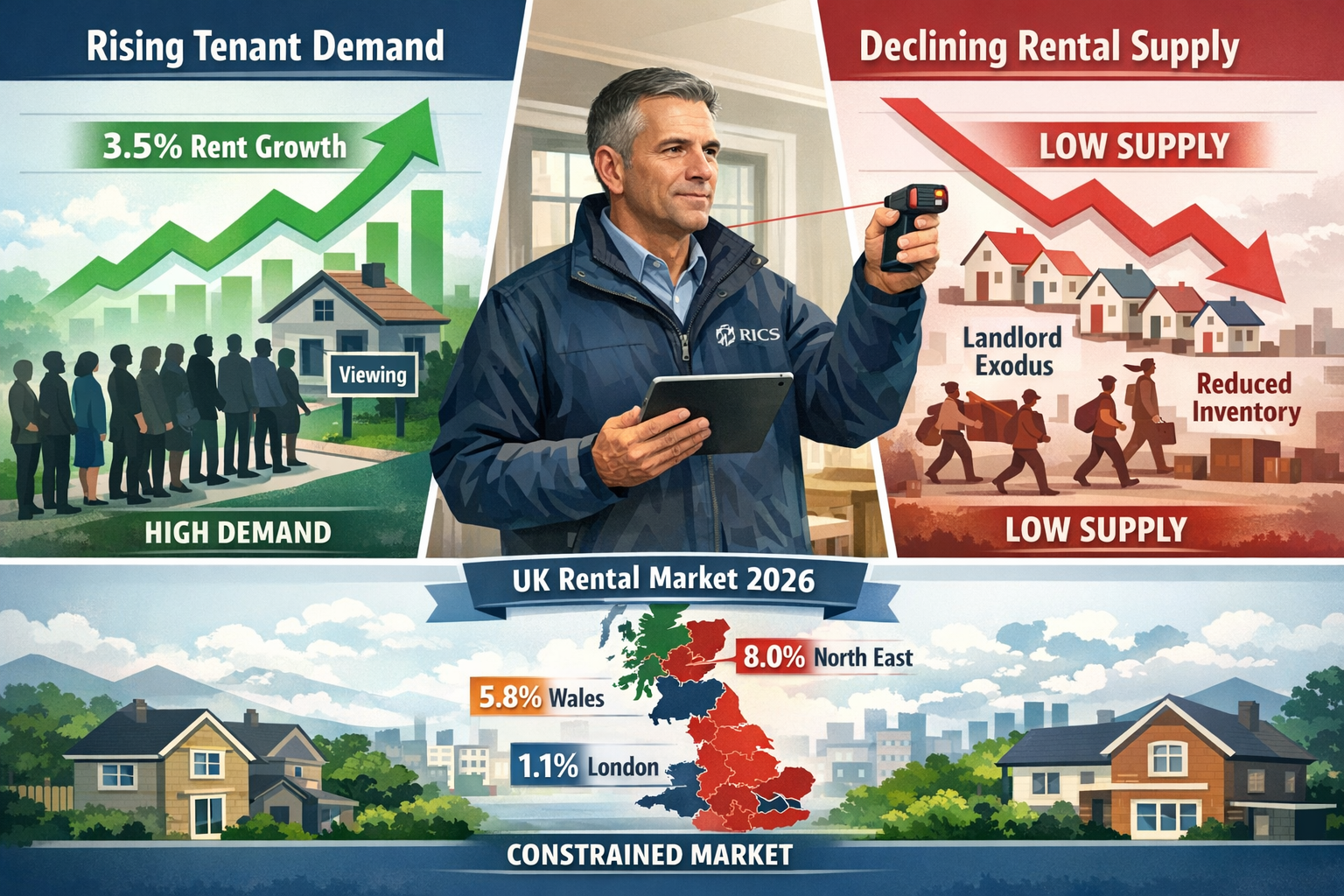
Lettings Market Surveys: Why Rising Tenant Demand and Constrained Supply Create Opportunities for Professional Rental Property Assessments in 2026 explores how the structural imbalance between supply and demand is reshaping the rental sector and creating distinct opportunities for property professionals who can deliver specialized assessment services. With average UK monthly private rents reaching £1,367—representing a 3.5% annual increase despite the slowdown—and extreme regional variations creating a "two-speed" market, landlords and investors need sophisticated guidance to maximize returns.[1]
The rental market is not cooling; it's resetting into stability after years of exceptional growth. This transition phase demands expert analysis to identify where opportunities lie, how to position properties competitively, and when to enter or expand within the lettings sector.
Key Takeaways
✅ National rent growth is moderating but remains above historical averages, with UK rents increasing 3.5% annually to £1,367 monthly in January 2026, down from 4.0% in December 2025.[1]
✅ Regional divergence creates assessment opportunities, with Wales showing 5.8% growth and the North East recording 8.0% inflation, while London experiences just 1.1% annual growth.[1]
✅ Supply constraints remain the structural driver of the market, with a record 66,587 new limited companies formed in 2025 to hold buy-to-let property, demonstrating continued investor confidence despite regulatory pressures.[2]
✅ Professional rental property assessments help landlords and investors navigate complex valuation scenarios, including the 2.8% premium on renewal rents versus new lettings and extreme local variations ranging from £549 to £3,640 monthly.[1][2]
✅ The 2026 forecast shows controlled positive growth of 2% nationally, indicating the market is transitioning from rapid acceleration to sustainable expansion rather than reversal.[4]
Understanding the Current Lettings Market Landscape in 2026
The Moderation Narrative: What the Numbers Really Tell Us
The headline story of 2026's rental market appears straightforward: rent growth is slowing. Average UK monthly private rents increased by 3.5% in the 12 months to January 2026, down from 4.0% in December 2025, marking the lowest annual growth rate since March 2022.[1] However, this surface-level interpretation misses the critical nuances that create opportunities for professional property assessments.
The market operates at what industry analysts describe as "two quite different speeds."[2] While rents are falling in parts of London and the South, growth continues robustly in the Midlands and North. This regional divergence leaves the national average broadly flat on new lettings, but renewal increases tell a different story—tenants renewing contracts saw rents rise by 2.8% year-on-year to £1,305 monthly.[2]
Even more striking, when London is excluded from renewal calculations, rents increased by 5.2% to £1,070 per month—nearly double the national average and significantly higher than new lettings growth.[2] This complexity in valuation scenarios makes professional property condition assessments essential for landlords seeking to optimize their rental strategies.
London's Dramatic Deceleration and What It Means
London's rental market provides perhaps the most dramatic illustration of how localized market dynamics require specialized assessment expertise. London rent inflation has slowed by 10.4 percentage points since November 2024, now standing at just 1.1% annual growth in January 2026, down from 2.1% in December 2025.[1][2]
Inner London has experienced 13 consecutive months of annual rent declines, creating opportunities for strategic investors who can identify undervalued properties in premium locations.[2] This represents a significant shift from the post-pandemic rental boom that saw London rents surge as workers returned to offices and international students resumed in-person study.
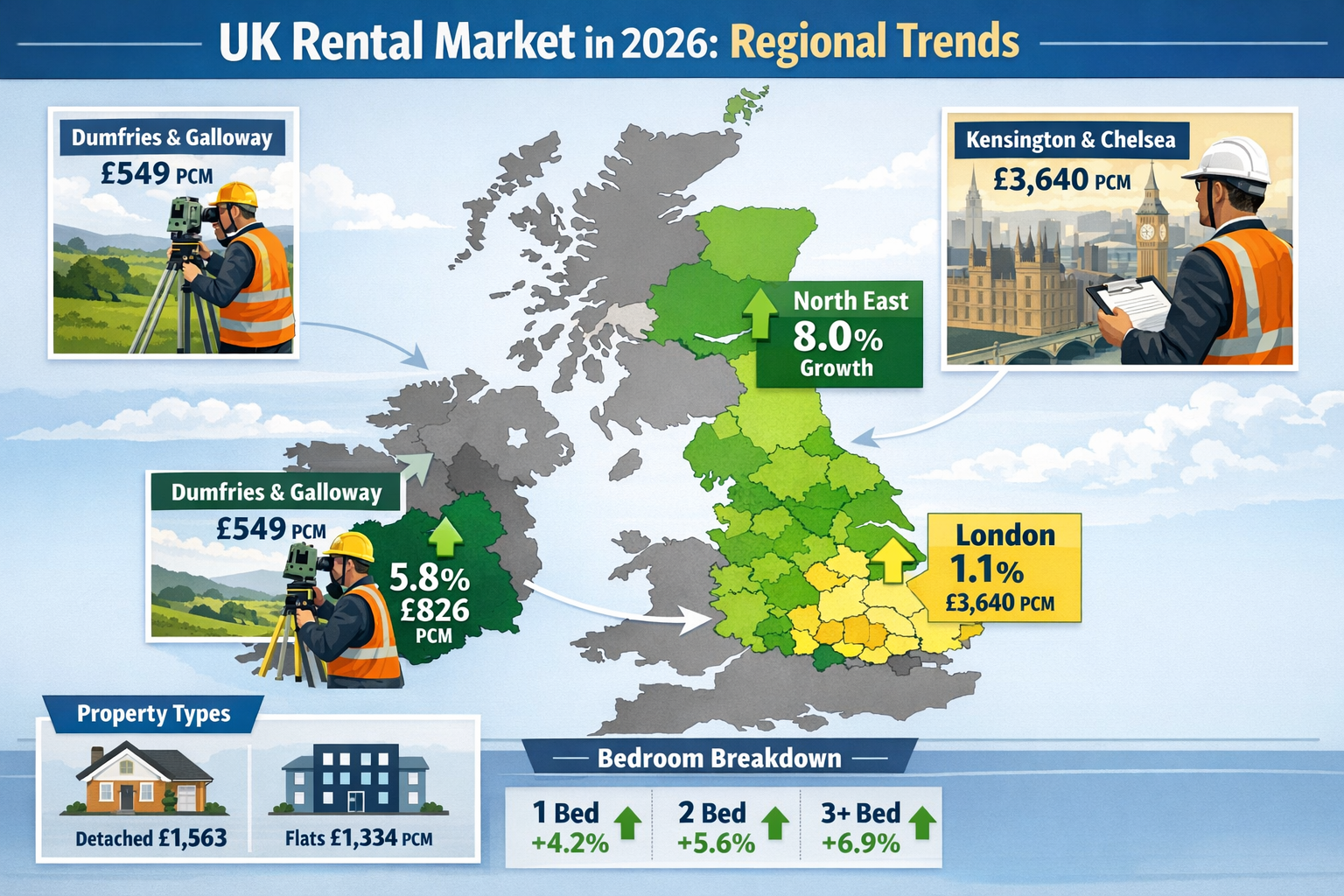
The extreme variation within London itself further demonstrates the need for granular market analysis. Average monthly rents range from modest levels in outer boroughs to £3,640 in Kensington and Chelsea—nearly seven times the national average.[1] Professional lettings market surveys help landlords and investors understand whether their properties are positioned competitively within these micro-markets and identify opportunities for repositioning or strategic improvements.
For those considering property investments across London property markets, understanding these local variations is critical to making informed decisions.
Regional Growth Champions: Where Opportunities Are Concentrated
While London moderates, other regions demonstrate the continued strength of tenant demand and the opportunities created by supply constraints. Wales recorded the strongest regional growth at 5.8%, with average monthly rents increasing £45 to £826.[1] The North East in England showed 8.0% inflation—the highest in England—versus London's 1.1%, highlighting significant yield disparities that professional assessments can help investors exploit.[1]
The North West posted the strongest increase at 3.0% for newly agreed rents, with specific markets like Preston, Lancaster, Blackpool, and Morecambe continuing to outperform national average yields.[4] These markets represent targeted opportunities for investor assessment and property positioning, particularly for those seeking higher yields than London and the South East can currently deliver.
This regional performance creates distinct opportunities for property valuation professionals who can help landlords understand how their properties compare to local and national benchmarks, and identify strategic improvements that can capture premium rents in high-growth markets.
Lettings Market Surveys: Why Rising Tenant Demand and Constrained Supply Create Opportunities for Professional Rental Property Assessments
The Supply Constraint Paradox: Why Landlord Exits Don't Mean Market Weakness
One of the most misunderstood aspects of the current lettings market is the relationship between landlord behavior and market fundamentals. Despite widespread media coverage of landlords exiting the sector due to regulatory pressures and tax changes, supply constraints remain the defining national factor in the rental market.[4]
The reality is more nuanced than simple exit narratives suggest. While some landlords are indeed leaving the sector, a record 66,587 new limited companies were formed to hold buy-to-let property in 2025—up 8% on the previous year and an extraordinary 363% higher than a decade ago.[2] This demonstrates that professional and corporate landlords continue to see significant opportunities in the rental sector, even as some individual landlords exit.
This structural shift from individual to corporate ownership creates opportunities for professional assessment services. Corporate landlords and serious investors demand comprehensive due diligence, detailed property inspection reports, and sophisticated market analysis before acquiring properties. They understand that professional surveys provide the foundation for informed investment decisions and effective property management.
The supply constraint dynamic works as follows:
📊 Demand Side Factors:
- Population growth continues to outpace housing construction
- Homeownership remains unaffordable for many, particularly first-time buyers
- Mortgage affordability pressures keep potential buyers in the rental market longer
- Immigration and internal migration create localized demand pressures
- Student populations and young professionals concentrate in specific urban markets
🏠 Supply Side Constraints:
- New build construction has not kept pace with household formation
- Planning restrictions limit development in high-demand areas
- Some landlords exit due to regulatory and tax changes
- Conversion of rental properties to owner-occupation or short-term lets
- Limited availability of suitable properties in desirable locations
This fundamental imbalance between supply and demand ensures that tenant demand remains structurally elevated across most regions, particularly outside the South East.[4] Professional lettings market surveys help landlords understand how these macro trends affect their specific properties and local markets.
Property Type and Specification: The Critical Variables in Rental Valuation
The rental market in 2026 demonstrates significant variations based on property type and size, creating distinct assessment categories that require specialized expertise. Detached properties command the highest average rent at £1,563 monthly, while flats and maisonettes are lowest at £1,334.[1]
Bedroom count creates even more dramatic variations:
- One-bedroom properties: £1,109 average monthly rent
- Two-bedroom properties: £1,290 average monthly rent
- Three-bedroom properties: £1,485 average monthly rent
- Four or more bedrooms: £2,037 average monthly rent[1]
These variations mean that landlords cannot rely on simple national or even regional averages to understand their property's rental potential. A professional assessment considers not just the property type and size, but also:
✨ Condition and presentation standards
✨ Energy efficiency ratings and compliance requirements
✨ Local amenities and transport connections
✨ Comparable properties in the immediate area
✨ Tenant demographics and preferences in the local market
✨ Potential for value-adding improvements
Professional surveyors who understand these nuances can provide landlords with actionable insights that go beyond simple rental valuations. For instance, a building survey might identify opportunities to reconfigure a property to add a bedroom, potentially increasing rental income by hundreds of pounds monthly while also improving the property's long-term capital value.
The Renewal Premium: Why Existing Tenants Pay More
One of the most striking features of the 2026 rental market is the significant premium on renewal rents compared to new lettings. Tenants renewing contracts saw rents rise by 2.8% year-on-year to £1,305 monthly, and excluding London, renewed rents increased by 5.2% to £1,070 per month.[2]
This creates a complex valuation scenario that professional assessments must navigate. The renewal premium exists for several reasons:
🔑 Tenant retention value: Good tenants represent significant value to landlords through reduced void periods, lower turnover costs, and minimized risk of property damage or rent arrears.
🔑 Market adjustment lag: Existing tenancies often reflect historical rental levels, and renewals allow landlords to adjust toward current market rates without the friction costs of tenant turnover.
🔑 Tenant switching costs: Moving is expensive and disruptive, giving landlords some pricing power with existing tenants who would prefer to stay if the increase is reasonable.
🔑 Relationship premium: Landlords often offer existing tenants better terms than new market entrants would receive, but still adjust rents upward to reflect current market conditions.
For landlords, understanding this dynamic is crucial to maximizing returns while maintaining good tenant relationships. Professional lettings market surveys can help landlords determine the optimal renewal rent increase—high enough to capture market value, but not so high that it triggers tenant turnover and the associated costs.
This is where choosing the right property assessment becomes critical. Different assessment types provide different insights, and landlords need guidance on which services will deliver the most value for their specific circumstances.
Professional Rental Property Assessment Opportunities in the 2026 Market
Pre-Acquisition Assessments: Due Diligence for Buy-to-Let Investors
The record formation of 66,587 new limited companies to hold buy-to-let property in 2025 demonstrates that sophisticated investors continue to see opportunities in the rental sector.[2] These professional investors understand that comprehensive pre-acquisition assessments are essential to making informed investment decisions.
A professional rental property assessment for potential buy-to-let investors should include:
1. Structural and Condition Survey
- Comprehensive inspection of the property's structural integrity
- Identification of defects, maintenance requirements, and potential issues
- Cost estimates for necessary repairs and improvements
- Assessment of compliance with rental property regulations
- Energy efficiency evaluation and improvement recommendations
2. Rental Market Analysis
- Comparable rental properties in the immediate area
- Current market rents for similar property types and sizes
- Vacancy rates and tenant demand indicators
- Seasonal variations and market trends
- Target tenant demographics and preferences
3. Investment Yield Calculation
- Gross and net rental yield projections
- Operating cost estimates (maintenance, insurance, management, compliance)
- Void period assumptions based on local market conditions
- Capital appreciation potential
- Total return on investment scenarios
4. Regulatory Compliance Assessment
- Energy Performance Certificate (EPC) requirements and costs to achieve compliance
- Electrical safety certification status
- Gas safety requirements
- Fire safety standards for HMOs or multi-unit properties
- Licensing requirements for the property type and location
5. Strategic Improvement Opportunities
- Value-adding modifications that could increase rental income
- Reconfiguration possibilities (adding bedrooms, creating en-suites)
- Modernization opportunities that appeal to target tenants
- Cost-benefit analysis of improvement investments
Professional surveyors who can deliver comprehensive pre-acquisition assessments position themselves as valuable partners to the growing cohort of corporate and professional landlords entering the market. These investors understand that the upfront cost of a thorough assessment is minimal compared to the potential costs of acquiring a problematic property or missing opportunities to maximize returns.
For investors considering properties across different regions, working with surveyors who have local market expertise provides additional value through insights into specific neighborhood dynamics and growth potential.
Portfolio Reviews: Optimizing Returns for Existing Landlords
Existing landlords with established portfolios face different challenges in the 2026 market. With regional variations creating "two-speed" markets and renewal premiums differing significantly from new lettings rates, portfolio optimization requires sophisticated analysis.[2]
Professional portfolio review services for existing landlords should address:
Strategic Property Positioning:
- Assessment of each property's competitive position in its local market
- Identification of properties that are underperforming relative to market potential
- Recommendations for repositioning or improvement investments
- Analysis of whether properties should be held, improved, or sold
Rental Pricing Optimization:
- Market-based rental valuations for each property
- Comparison of current rents to market rates
- Renewal pricing strategies that balance tenant retention and income optimization
- Identification of properties where rents are significantly below market potential
Maintenance and Improvement Planning:
- Condition assessments identifying deferred maintenance issues
- Prioritization of repairs and improvements based on ROI
- Compliance gap analysis and remediation planning
- Energy efficiency improvement opportunities
Risk Assessment and Mitigation:
- Identification of properties with elevated risk profiles
- Regulatory compliance status across the portfolio
- Tenant quality and arrears risk assessment
- Insurance adequacy and coverage gap analysis
The complexity of managing rental portfolios in 2026's divergent market makes professional assessment services increasingly valuable. Landlords who understand their portfolio's strengths, weaknesses, and optimization opportunities can make strategic decisions that significantly enhance returns.
Compliance and Regulatory Assessments: Navigating the Complex Legal Landscape
The regulatory environment for rental properties continues to evolve, creating both challenges and opportunities for professional surveyors. Landlords face an increasingly complex web of requirements covering energy efficiency, electrical safety, fire safety, and property standards.
Professional compliance assessments help landlords navigate this landscape by providing:
Energy Performance Certificate (EPC) Compliance:
- Current EPC rating assessment
- Identification of improvements needed to achieve required ratings
- Cost-benefit analysis of energy efficiency investments
- Guidance on available grants and incentives
- Timeline planning for compliance with future requirements
Electrical Safety Certification:
- Electrical Installation Condition Report (EICR) requirements
- Identification of electrical safety issues
- Remediation recommendations and cost estimates
- Compliance timeline guidance
Fire Safety Standards:
- Fire safety equipment requirements (alarms, extinguishers, blankets)
- Escape route assessment
- Fire door compliance for HMOs
- Furniture and furnishings fire safety standards
Property Licensing Requirements:
- Identification of whether properties require selective or mandatory licensing
- HMO licensing compliance assessment
- Application support and documentation preparation
The value of professional compliance assessments extends beyond simply avoiding penalties. Landlords who proactively address compliance issues can market their properties as high-quality, fully compliant homes that appeal to quality tenants willing to pay premium rents.
Moreover, compliance assessments often identify improvement opportunities that enhance both regulatory compliance and rental value. For example, upgrading insulation to improve EPC ratings also reduces tenant energy costs, making the property more attractive and potentially justifying higher rents.
Market Entry Strategy Assessments: Guiding New Landlords
The 363% increase in buy-to-let limited companies over the past decade demonstrates that new investors continue to enter the rental market despite challenges.[2] However, the complexity of the current market means that new landlords need expert guidance to avoid costly mistakes and identify genuine opportunities.
Professional market entry strategy assessments for new landlords should include:
Market Selection Guidance:
- Analysis of regional markets with strong fundamentals (Wales at 5.8% growth, North East at 8.0%)[1]
- Identification of local markets with favorable supply-demand dynamics
- Assessment of competition levels and market saturation
- Evaluation of capital appreciation potential alongside rental yields
Property Type and Specification Recommendations:
- Analysis of which property types and sizes offer best returns in target markets
- Tenant demographic analysis and preference mapping
- Identification of underserved market segments
- Guidance on optimal property specifications for target tenant groups
Financial Modeling and Viability Assessment:
- Realistic yield projections based on local market data
- Operating cost estimates specific to property type and location
- Financing options and structure recommendations
- Sensitivity analysis for various market scenarios
Operational Setup Guidance:
- Entity structure recommendations (individual ownership vs. limited company)
- Property management options (self-management vs. professional management)
- Insurance requirements and provider recommendations
- Systems and processes for effective landlord operations
Risk Management Framework:
- Identification of key risks in the target market and property type
- Mitigation strategies for common landlord challenges
- Tenant selection and screening best practices
- Legal protection and compliance framework
New landlords who invest in professional market entry assessments position themselves for success by avoiding common pitfalls and making informed decisions from the outset. The upfront investment in professional guidance typically pays for itself many times over through better property selection, optimal pricing strategies, and effective risk management.
For new landlords, understanding which survey type is right for their needs is an important first step in the assessment process.
Regional Market Analysis: Where Lettings Market Surveys Create Maximum Value
Wales and the North: High-Growth Markets Requiring Local Expertise
The stark regional variations in the 2026 rental market create distinct opportunities for professional surveyors with deep local market knowledge. Wales recorded the strongest regional growth at 5.8%, with average monthly rents increasing to £826, while the North East showed 8.0% inflation—the highest in England.[1]
These high-growth markets offer compelling opportunities for investors, but success requires understanding local nuances that national data cannot capture. Professional lettings market surveys in these regions provide value by:
Identifying Micro-Market Variations:
Even within high-growth regions, performance varies significantly by locality. Professional assessments identify which specific neighborhoods, property types, and tenant segments are driving growth, helping investors target their acquisitions strategically.
Understanding Growth Drivers:
Is growth driven by employment expansion, infrastructure investment, in-migration, or supply constraints? Understanding the underlying drivers helps assess sustainability and identify properties positioned to benefit most.
Competitive Positioning Analysis:
In rapidly growing markets, competition for quality properties intensifies. Professional assessments help landlords understand how to position their properties to capture premium rents and attract quality tenants.
Yield Optimization Strategies:
With gross yields in northern markets often significantly higher than London and the South East, professional guidance on maximizing net yields through cost management and strategic improvements delivers substantial value.
The North West's 3.0% increase for newly agreed rents, with markets like Preston, Lancaster, Blackpool, and Morecambe outperforming national averages, demonstrates the opportunities available to investors who understand local dynamics.[4] Professional surveyors who can provide granular local market intelligence position themselves as essential partners for investors targeting these high-growth markets.
London and the South East: Navigating Complexity in Moderating Markets
While London's 1.1% annual growth represents a dramatic deceleration from previous years, the capital remains the UK's largest and most valuable rental market.[1] The moderation creates different opportunities for professional assessment services focused on optimization and repositioning rather than simple growth capture.
Professional lettings market surveys in London and the South East provide value by:
Micro-Market Opportunity Identification:
With Inner London experiencing 13 consecutive months of annual rent declines while some outer boroughs maintain growth, identifying specific opportunity areas requires sophisticated local analysis.[2]
Repositioning Strategies:
In moderating markets, landlords need guidance on how to differentiate their properties to maintain occupancy and pricing power. Professional assessments identify improvement opportunities that appeal to target tenant segments.
Renewal vs. New Letting Optimization:
With renewal rents showing different dynamics than new lettings, landlords need sophisticated guidance on pricing strategies that balance tenant retention with income optimization.
Value-Add Investment Analysis:
Slower capital appreciation in moderating markets shifts focus to income optimization through strategic improvements. Professional assessments identify which improvements deliver the best ROI in terms of rental income enhancement.
The extreme variation in absolute rental levels—from modest amounts in outer boroughs to £3,640 in Kensington and Chelsea—means that generic advice is worthless.[1] Landlords need assessments that understand the specific dynamics of their property's micro-market and can provide tailored recommendations.
For landlords with properties in specific London boroughs, working with surveyors who have deep expertise in those areas—such as Camden property surveyors or Ealing property surveyors—provides additional value through hyper-local market intelligence.
The Midlands: The Goldilocks Zone of Balanced Growth
The Midlands represents what many analysts consider the "Goldilocks zone" of the UK rental market—not experiencing the extreme growth of Wales and the North, nor the moderation of London and the South East, but delivering steady, sustainable growth with attractive yields.
Professional lettings market surveys in the Midlands focus on:
Sustainable Growth Capture:
Identifying properties and locations positioned to benefit from steady, long-term growth rather than boom-and-bust cycles.
Institutional Investment Opportunities:
The Midlands increasingly attracts institutional investors seeking stable returns with lower volatility than London. Professional assessments help position properties to appeal to this investor class.
Affordability Advantage Analysis:
With rents significantly lower than London but growth rates healthy, the Midlands offers affordability advantages that appeal to both tenants and investors. Assessments identify how to leverage this positioning.
Infrastructure and Development Impact:
Major infrastructure projects like HS2 (despite modifications) and regional development initiatives create localized opportunities. Professional assessments identify properties positioned to benefit from these investments.
The balanced growth profile of the Midlands makes it attractive for both new landlords seeking steady returns and experienced investors diversifying portfolios. Professional assessment services that help investors understand and capitalize on this balanced growth dynamic create significant value.
Implementing Professional Lettings Market Survey Services: Practical Guidance
Service Packages and Pricing Strategies
Professional surveyors looking to capitalize on lettings market opportunities in 2026 should develop tiered service packages that address different client needs and budgets:
Basic Rental Valuation Package:
- Desktop analysis of comparable properties
- Market rent estimate with supporting data
- Brief market overview and trends
- Pricing: £200-£400 depending on property value and location
Standard Lettings Assessment Package:
- Property inspection and condition report
- Detailed rental valuation with comparables analysis
- Regulatory compliance overview
- Basic improvement recommendations
- Pricing: £500-£800 depending on property size and complexity
Comprehensive Investment Assessment Package:
- Full structural and condition survey
- Detailed rental market analysis and yield projections
- Regulatory compliance assessment with remediation plan
- Strategic improvement recommendations with ROI analysis
- Market positioning strategy
- Pricing: £1,200-£2,000 depending on property value and scope
Portfolio Optimization Package:
- Assessment of multiple properties (3+ properties)
- Comparative performance analysis across portfolio
- Prioritized improvement and investment recommendations
- Strategic hold/improve/sell guidance
- Pricing: £800-£1,500 per property with volume discounts
Market Entry Strategy Package:
- Market selection analysis and recommendations
- Property type and specification guidance
- Financial modeling and viability assessment
- Operational setup recommendations
- Risk management framework
- Pricing: £2,000-£3,500 depending on scope and complexity
Pricing should reflect the value delivered rather than simply time invested. A comprehensive assessment that helps an investor avoid a poor acquisition or identifies opportunities to increase rental income by £200 monthly delivers thousands of pounds of value annually, making even premium pricing highly attractive.
Marketing Professional Lettings Assessment Services
Professional surveyors should position lettings market assessment services as essential tools for informed decision-making rather than optional extras. Effective marketing strategies include:
Educational Content Marketing:
- Blog articles analyzing local market trends and opportunities
- Case studies demonstrating value delivered through professional assessments
- Market reports providing valuable data and insights
- Webinars and workshops for landlords and investors
Strategic Partnerships:
- Relationships with letting agents who can refer clients needing assessments
- Partnerships with mortgage brokers serving buy-to-let investors
- Connections with property investment networks and landlord associations
- Referral arrangements with solicitors and accountants serving property investors
Digital Marketing:
- Search engine optimization targeting keywords like "rental property assessment," "buy-to-let survey," and "lettings market analysis"
- Pay-per-click advertising targeting investors researching rental markets
- Social media content demonstrating expertise and market knowledge
- Email marketing to existing clients highlighting market opportunities
Thought Leadership:
- Commentary on rental market trends and data releases
- Contributions to property investment publications and websites
- Speaking engagements at landlord and investor events
- Professional credentials and memberships (RICS, etc.) prominently displayed
The key is positioning professional assessments as investments that deliver measurable returns through better decision-making, risk mitigation, and opportunity identification rather than costs to be minimized.
Technology and Tools for Efficient Service Delivery
Professional surveyors can enhance service quality and efficiency through strategic use of technology:
Data and Analytics Platforms:
- Rental market data services providing comparable property information
- Property price and rental trend databases
- Demographic and economic data for market analysis
- Mapping and visualization tools for geographic analysis
Inspection and Reporting Tools:
- Mobile inspection apps for efficient on-site data collection
- Photo and annotation tools for clear defect documentation
- Template-based reporting systems for consistent, professional deliverables
- Cloud-based systems for secure client access to reports
Financial Modeling Tools:
- Spreadsheet templates for yield calculations and scenario analysis
- Investment appraisal tools for ROI and NPV calculations
- Sensitivity analysis capabilities for risk assessment
- Presentation-ready output formats for client reports
Client Relationship Management:
- CRM systems for managing client relationships and follow-up
- Automated marketing and communication tools
- Client portal systems for document sharing and collaboration
- Feedback and review collection systems
Investment in appropriate technology enhances both service quality and profitability by enabling surveyors to deliver more comprehensive assessments more efficiently, while also improving client experience and satisfaction.
Understanding property survey expenses and how to manage them efficiently is crucial for maintaining profitability while delivering value.
The Future of Lettings Market Surveys: Trends and Opportunities Beyond 2026
Continued Market Fundamentals Supporting Demand
The 2026 forecast of 2% national rent growth indicates the market is transitioning from rapid acceleration to controlled, sustainable expansion.[4] This creates a stable environment for professional assessment services to flourish, as both landlords and investors need ongoing guidance to navigate evolving market conditions.
Several structural factors suggest sustained demand for professional lettings market surveys:
Persistent Supply-Demand Imbalance:
The fundamental shortage of rental properties relative to tenant demand shows no signs of resolution, ensuring continued upward pressure on rents in most markets and ongoing need for professional market analysis.
Increasing Regulatory Complexity:
The trend toward more stringent regulatory requirements for rental properties continues, creating growing demand for compliance assessments and guidance.
Professionalization of the Landlord Sector:
The shift from individual to corporate landlords accelerates demand for professional services, as these sophisticated investors expect comprehensive due diligence and ongoing portfolio management support.
Regional Market Divergence:
The "two-speed" market dynamic is likely to persist, with different regions experiencing different growth trajectories, increasing the value of local market expertise and analysis.
Economic Uncertainty:
Ongoing economic volatility and uncertainty about interest rates, inflation, and employment create demand for professional guidance to help investors navigate risk and identify opportunities.
Emerging Service Opportunities
Professional surveyors should anticipate and prepare for emerging service opportunities in the evolving lettings market:
ESG and Sustainability Assessments:
Growing tenant and investor focus on environmental, social, and governance factors creates demand for assessments of properties' sustainability credentials and improvement opportunities.
Technology Integration Assessments:
Evaluation of smart home technology, property management systems, and tenant experience platforms as differentiators in competitive markets.
Alternative Rental Models:
Assessment services for build-to-rent developments, co-living spaces, and other emerging rental property models that require specialized expertise.
Tenant Experience Optimization:
Beyond basic property condition, assessments that evaluate and recommend improvements to overall tenant experience, amenity provision, and service quality.
Climate Risk Assessment:
Evaluation of properties' exposure to climate-related risks (flooding, overheating, etc.) and recommendations for mitigation measures.
Professional surveyors who develop expertise in these emerging areas position themselves at the forefront of the evolving lettings market and create additional value streams beyond traditional assessment services.
Professional Development and Specialization
The complexity and sophistication of the lettings market in 2026 and beyond rewards professional surveyors who invest in continuous development and specialization:
Market Analysis Skills:
- Data analysis and interpretation capabilities
- Economic and demographic trend analysis
- Forecasting and scenario planning skills
- Comparative market analysis expertise
Regulatory Expertise:
- Deep understanding of rental property regulations
- Compliance assessment capabilities
- Staying current with evolving requirements
- Guidance on regulatory strategy and planning
Financial Analysis:
- Investment appraisal and yield calculation expertise
- Financial modeling and scenario analysis skills
- Understanding of landlord taxation and structuring
- ROI analysis for improvement investments
Specialization Opportunities:
- Geographic specialization in specific high-growth markets
- Property type specialization (HMOs, student housing, luxury rentals)
- Client segment specialization (institutional investors, portfolio landlords, new entrants)
- Service specialization (compliance, investment strategy, portfolio optimization)
Professional surveyors who develop deep expertise in specific aspects of the lettings market can command premium fees and attract clients seeking specialized knowledge rather than generic assessment services.
Maintaining professional credentials through organizations like RICS provides credibility and demonstrates commitment to professional standards.
Conclusion: Capitalizing on Lettings Market Opportunities Through Professional Assessment Services

Lettings Market Surveys: Why Rising Tenant Demand and Constrained Supply Create Opportunities for Professional Rental Property Assessments in 2026 demonstrates that the current rental market environment creates significant opportunities for professional surveyors who can deliver specialized assessment services to landlords and investors.
The fundamental dynamics driving these opportunities are clear:
✅ Structural supply-demand imbalance ensures continued upward pressure on rents in most markets, with tenant demand remaining elevated despite moderation in headline growth rates.[4]
✅ Regional divergence creates a "two-speed" market where Wales shows 5.8% growth and the North East 8.0%, while London experiences just 1.1%, requiring sophisticated local market analysis.[1]
✅ Professionalization of the landlord sector, with a record 66,587 new limited companies formed in 2025, demonstrates growing demand for professional services from sophisticated investors.[2]
✅ Complexity in valuation scenarios, including the 2.8% renewal premium and extreme local variations from £549 to £3,640 monthly, makes professional guidance essential for optimization.[1][2]
✅ Controlled positive growth forecast of 2% nationally in 2026 indicates sustainable market expansion rather than reversal, supporting ongoing investment and assessment activity.[4]
Actionable Next Steps for Professional Surveyors
Professional surveyors looking to capitalize on lettings market opportunities should take the following steps:
1. Develop Specialized Service Packages
Create tiered assessment offerings addressing different client needs, from basic rental valuations to comprehensive investment strategy assessments, with clear value propositions and pricing that reflects value delivered.
2. Build Local Market Expertise
Develop deep knowledge of specific geographic markets, understanding local supply-demand dynamics, tenant demographics, growth drivers, and competitive landscapes to provide insights that generic national data cannot deliver.
3. Invest in Technology and Tools
Implement data platforms, inspection tools, financial modeling capabilities, and client management systems that enhance service quality and delivery efficiency while improving client experience.
4. Establish Strategic Partnerships
Build relationships with letting agents, mortgage brokers, property investment networks, and other professionals who can refer clients needing assessment services, creating a steady flow of opportunities.
5. Demonstrate Expertise Through Content
Produce educational content, market analysis, case studies, and thought leadership that demonstrates expertise and attracts potential clients seeking professional guidance.
6. Pursue Continuous Professional Development
Invest in developing market analysis skills, regulatory expertise, financial analysis capabilities, and specialized knowledge that differentiates services and justifies premium pricing.
7. Monitor Market Evolution
Stay current with rental market trends, regulatory changes, emerging technologies, and evolving investor preferences to anticipate future service opportunities and adapt offerings accordingly.
The lettings market in 2026 presents a compelling opportunity landscape for professional surveyors who can deliver specialized assessment services that help landlords and investors navigate complexity, optimize returns, and manage risk. Those who position themselves as essential partners in rental property decision-making will find sustained demand for their expertise in the years ahead.
For surveyors ready to expand their service offerings into the lettings market, the time to act is now. The combination of rising tenant demand, constrained supply, regional divergence, and market professionalization creates ideal conditions for professional assessment services to deliver significant value—and capture appropriate returns for that value.
Whether working with property investors across London or expanding into high-growth regional markets, professional surveyors who develop lettings market expertise position themselves for success in one of the UK property market's most dynamic and opportunity-rich sectors.
References
[1] February2026 – https://www.ons.gov.uk/economy/inflationandpriceindices/bulletins/privaterentandhousepricesuk/february2026
[2] Rental Market Update – https://www.buyassociationgroup.com/en-gb/news/rental-market-update/
[4] Uk Rental Market Outlook 2026 National Trends North West Growth Analysis – https://www.farrellheyworth.co.uk/blog/uk-rental-market-outlook-2026-national-trends-north-west-growth-analysis/