
First impressions matter enormously in property transactions. When potential buyers pull up to a property for the first time, they form instant judgments about its condition and value—often before stepping through the front door. In 2026, new survey data from Bespoke Sign House reveals a striking reality: 66% of buyers reduce their offers due to damaged roofs and gutters, while 45% negotiate lower prices when they spot peeling paint. These kerb appeal deficiencies aren't merely cosmetic concerns—they're red flags that signal potential maintenance neglect and hidden structural issues.
Understanding kerb appeal deficiencies in building surveys: spotting roof damage, paint and driveway issues that cut buyer offers has become essential for both property surveyors and homebuyers navigating today's competitive market. This comprehensive guide explores how external visual assessments integrate into professional building surveys, the financial impact of common deficiencies, and practical strategies for identifying issues that significantly affect property valuations.

Key Takeaways
- 66% of buyers reduce offers when they identify damaged roofs or gutters during property viewings, making roof condition the single most influential kerb appeal factor
- Paint deterioration and driveway damage can reduce property offers by £15,000-£25,000 on average properties, with impacts varying by property value and local market conditions
- Level 3 building surveys now increasingly incorporate detailed external visual assessments to capture kerb appeal deficiencies that affect negotiating positions
- First-time buyers are particularly sensitive to visible external defects, as they often lack renovation budgets and seek move-in ready properties
- Professional surveyors can identify early-stage deficiencies that buyers might miss, providing leverage for price negotiations before issues escalate
Understanding Kerb Appeal Deficiencies in Building Surveys
Kerb appeal refers to the immediate visual impression a property creates from the street. While often dismissed as superficial, these external characteristics provide crucial insights into overall property maintenance and potential hidden defects. Professional building condition assessments increasingly recognize that external appearance correlates strongly with internal condition.
What Constitutes a Kerb Appeal Deficiency?
Kerb appeal deficiencies encompass any visible external feature that negatively impacts a property's perceived value or condition. These typically fall into three primary categories:
Structural and Roofing Issues 🏠
- Missing, slipped, or damaged roof tiles
- Deteriorating chimney stacks with loose pointing
- Sagging rooflines indicating structural movement
- Damaged or overflowing gutters and downpipes
- Fascia and soffit deterioration
Surface and Paint Deficiencies 🎨
- Peeling, flaking, or blistered exterior paint
- Faded or stained render and cladding
- Rotting window frames and door surrounds
- Rusted or corroded metalwork
- Algae, moss, or biological growth on surfaces
Hardstanding and Boundary Issues 🚗
- Cracked, sunken, or uneven driveways
- Damaged or displaced paving materials
- Poor drainage causing standing water
- Deteriorating boundary walls and fences
- Overgrown or neglected landscaping
When conducting a homebuyers survey, professional surveyors systematically document these deficiencies, assessing both their immediate visual impact and potential underlying causes.
The Psychology Behind Buyer Reactions
The 2026 Bespoke Sign House data reveals more than just statistics—it demonstrates fundamental psychological principles at work in property transactions. When buyers encounter visible defects, they:
- Extrapolate maintenance neglect across the entire property
- Overestimate repair costs due to lack of specialist knowledge
- Question seller transparency, wondering what else might be hidden
- Feel justified in aggressive negotiation, using visible defects as leverage
- Experience reduced emotional attachment to the property
This psychological response explains why relatively minor external defects can trigger disproportionate offer reductions. A £500 paint job might prompt a £5,000 price reduction simply because it signals broader maintenance concerns.
Spotting Roof Damage: The 66% Factor That Cuts Buyer Offers
Roof condition dominates kerb appeal assessments for good reason. As the primary weather protection system, roof defects signal potential water ingress, structural issues, and expensive repairs. The 66% figure from 2026 survey data underscores how critically buyers evaluate roof condition during property viewings.
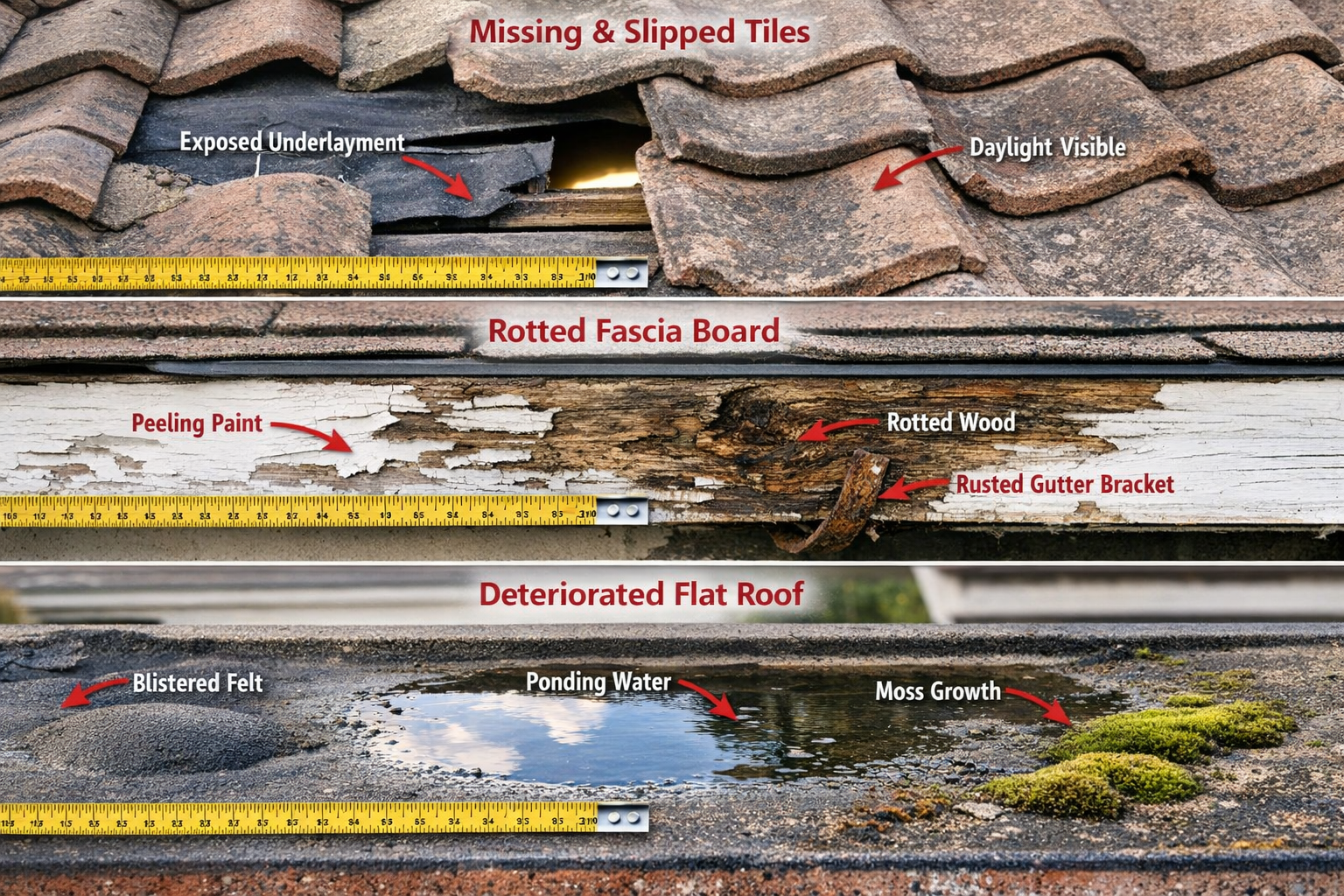
Common Roof Deficiencies Visible from Ground Level
Professional surveyors and informed buyers look for specific indicators when assessing roof condition from the kerb:
Tile and Slate Issues
- Slipped tiles: Visible gaps in the roof covering where tiles have moved from their original position
- Missing tiles: Obvious holes in the roof surface, often highlighted by contrasting underlayment
- Cracked or broken tiles: Visible damage that compromises weatherproofing
- Moss and lichen growth: Indicates moisture retention and potential tile deterioration
- Uneven rooflines: Suggests structural movement or rafter failure
Gutter and Drainage Problems
- Overflowing gutters: Staining on walls below indicates blocked or inadequate drainage
- Sagging gutters: Poor installation or bracket failure causing water to pool
- Vegetation growth: Plants growing from gutters signal long-term blockage and neglect
- Rust and corrosion: Particularly visible on cast iron or steel gutter systems
- Disconnected downpipes: Obvious gaps or damage to rainwater disposal systems
Chimney and Flashing Defects
- Leaning chimneys: Structural instability requiring immediate attention
- Deteriorating pointing: Eroded mortar between bricks allowing water penetration
- Missing chimney pots: Indicates maintenance neglect and potential water ingress
- Damaged lead flashing: Splits, tears, or inadequate coverage around chimney bases
- Staining below flashings: Evidence of active or historic water penetration
When buying a house in Wimbledon or London, roof condition becomes even more critical given the premium property values and potential repair costs in urban areas.
How Surveyors Document Roof Deficiencies
Professional building surveyors employ systematic approaches to document roof condition:
| Assessment Method | What It Reveals | Typical Cost Impact |
|---|---|---|
| Ground-level visual inspection | Obvious defects, general condition, maintenance level | Identifies issues warranting further investigation |
| Binocular examination | Detailed tile condition, flashing integrity, mortar condition | Reveals defects not visible to naked eye |
| Drone photography | Comprehensive roof coverage, inaccessible areas, overall condition | Provides documentary evidence for negotiations |
| Thermal imaging | Hidden moisture ingress, insulation deficiencies, active leaks | Identifies problems before visible damage appears |
| Close inspection (ladder access) | Detailed material condition, fixing adequacy, hidden defects | Most thorough assessment method |
The level of inspection varies depending on the survey type commissioned. A basic RICS survey typically includes ground-level assessment, while Level 3 Building Surveys may incorporate more detailed examination methods.
Translating Roof Defects into Negotiating Power
Understanding the financial implications of roof defects empowers buyers during price negotiations:
Minor Deficiencies (£2,000-£5,000 impact)
- Isolated missing or slipped tiles (under 10% of roof area)
- Gutter cleaning and minor repairs
- Repointing chimney stack
- Replacing damaged fascia boards
Moderate Deficiencies (£5,000-£15,000 impact)
- Extensive tile slippage requiring re-fixing
- Complete gutter and downpipe replacement
- Re-flashing around chimneys and abutments
- Partial roof covering replacement
Major Deficiencies (£15,000-£50,000+ impact)
- Complete roof re-covering required
- Structural repairs to roof timbers
- Chimney rebuilding or removal
- Comprehensive roof and rainwater system replacement
These figures represent typical 2026 costs for standard UK properties. Actual costs vary significantly based on property size, location, access difficulties, and material specifications.
Paint Deterioration and Cladding Issues: The 45% Reduction Factor
While less dramatic than roof damage, paint and cladding deficiencies significantly impact buyer perceptions. The 2026 data showing 45% of buyers reducing offers due to peeling paint reflects both aesthetic concerns and deeper maintenance anxieties.
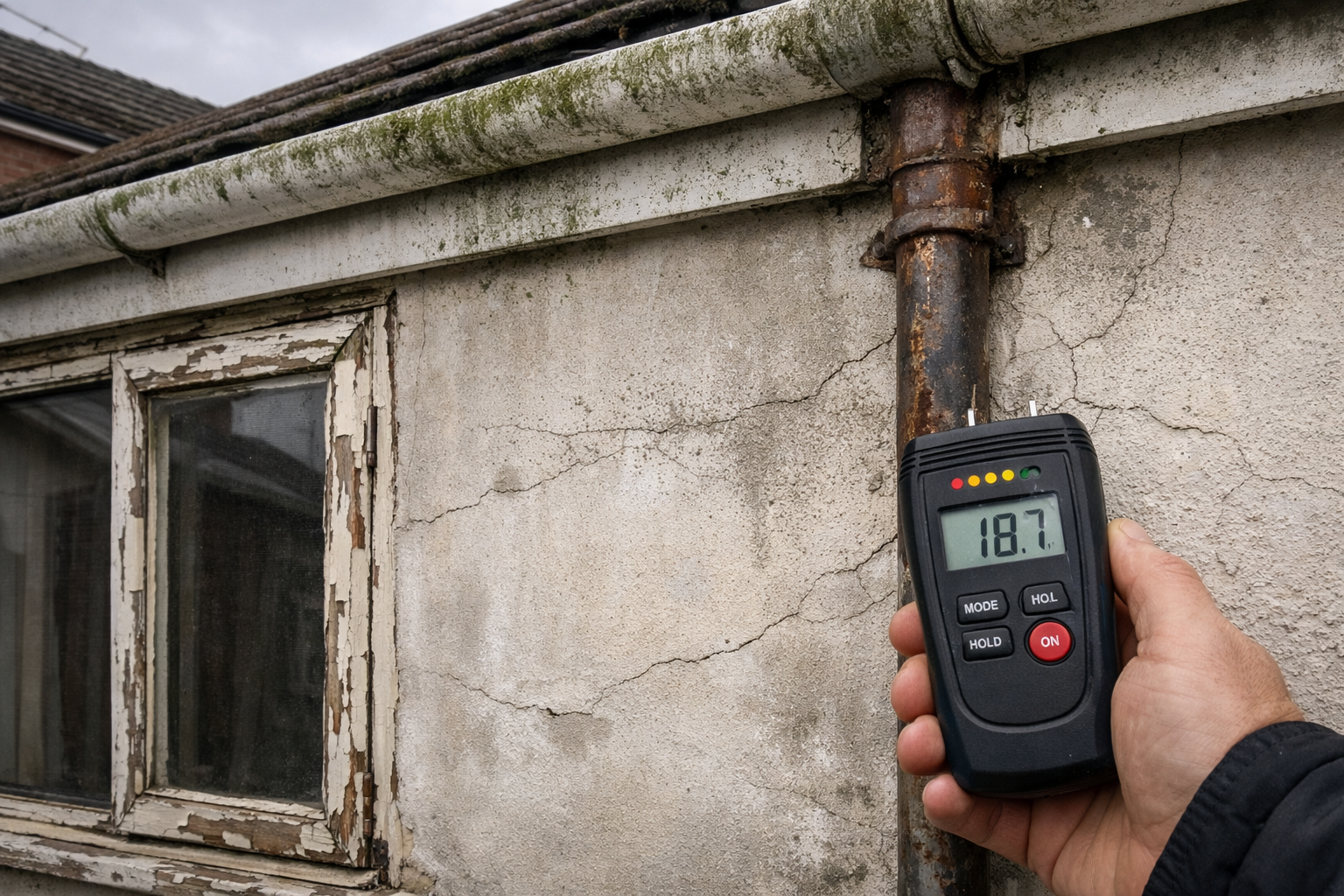
Identifying Paint and Cladding Deficiencies
Professional surveyors assess external decorative condition systematically, looking beyond surface appearance to identify underlying causes:
Paint Failure Patterns
- Peeling and flaking: Indicates poor surface preparation, moisture issues, or incompatible paint systems
- Blistering: Suggests moisture trapped beneath paint film or application over damp surfaces
- Chalking: Natural weathering that makes surfaces appear powdery and faded
- Cracking and alligatoring: Advanced paint failure requiring complete removal and repainting
- Staining and discoloration: May indicate biological growth, metal corrosion, or water penetration
Render and Cladding Problems
- Cracking: Hairline cracks are common, but wider cracks suggest structural movement
- Hollow areas: Render detachment from substrate, identified by tapping
- Staining patterns: Often indicate hidden moisture damage or failed damp-proof courses
- Biological growth: Algae, moss, and lichen indicating persistent dampness
- Spalling and erosion: Advanced deterioration requiring repair or replacement
Timber Element Deterioration
- Window frame rot: Particularly common in bottom rails and external sills
- Door deterioration: Swelling, splitting, or biological decay
- Fascia and soffit damage: Often overlooked but highly visible from street level
- Cladding failure: Weatherboarding, shiplap, or tile hanging showing decay
The Hidden Costs Behind Paint Deficiencies
Paint deterioration rarely exists in isolation. Professional surveyors investigate underlying causes that may substantially increase repair costs:
Surface-Level Issues (£3,000-£8,000)
- Preparation and repainting of external walls
- Window and door frame repainting
- Fascia and soffit redecoration
- Minor timber repairs before painting
Substrate Problems (£8,000-£20,000)
- Render repairs and re-rendering
- Timber replacement in windows or doors
- Damp-proof course installation or repair
- Treatment of underlying moisture issues
Structural Concerns (£20,000+)
- Wall tie failure requiring replacement
- Cavity wall insulation problems
- Significant structural movement requiring stabilization
- Complete re-cladding or external wall system replacement
When choosing the right home survey, buyers should consider whether external deficiencies warrant more detailed investigation beyond standard visual assessment.
Regional Variations in Paint and Cladding Standards
UK property markets show significant regional variation in external finish expectations:
London and Southeast 💷
- Higher maintenance standards expected
- Premium placed on pristine external appearance
- Paint defects trigger larger percentage reductions in high-value properties
- Period property buyers particularly sensitive to inappropriate modern materials
Northern Regions 🏭
- More pragmatic approach to external decoration
- Greater tolerance for weathering in traditional stone properties
- Focus on structural soundness over cosmetic appearance
- Lower absolute cost impact but similar percentage reductions
Coastal Areas 🌊
- Accelerated deterioration due to salt exposure
- Regular maintenance expected and factored into valuations
- Specialized coating systems required
- Paint failure viewed more seriously due to rapid progression
Driveway and Hardstanding Deficiencies: The Overlooked Value Killers
Driveways, paths, and hardstanding areas receive less attention in traditional building surveys, yet they significantly impact kerb appeal and can indicate serious underlying issues. These deficiencies often prove more expensive to remedy than buyers anticipate.
Common Driveway and Hardstanding Problems
Surface Deterioration
- Cracking in tarmac/asphalt: Indicates age, poor installation, or ground movement
- Sunken or uneven areas: Suggests inadequate sub-base preparation or ground settlement
- Potholes and surface breakdown: Advanced deterioration requiring resurfacing
- Edge deterioration: Lack of proper edging causing progressive failure
- Oil staining: Cosmetic issue but indicates poor maintenance culture
Block Paving Issues
- Sunken blocks: Sub-base failure or inadequate compaction during installation
- Displaced or missing blocks: Poor jointing or edge restraint failure
- Weed growth: Indicates maintenance neglect but relatively easy to remedy
- Staining and discoloration: Efflorescence, algae growth, or contamination
- Uneven surface: Installation defects or ground movement
Drainage Problems
- Standing water: Inadequate falls or blocked drainage systems
- Erosion patterns: Water flow causing progressive surface damage
- Blocked gullies: Maintenance issue but may indicate wider drainage problems
- Overflowing drains: Capacity issues or blockages in underground systems
- Staining on adjacent walls: Water splashing causing damp and deterioration
Financial Impact of Driveway Deficiencies
Driveway repairs represent significant unexpected costs for buyers:
| Deficiency Type | Typical Repair Cost (2026) | Buyer Offer Reduction |
|---|---|---|
| Minor crack repairs and resealing | £500-£1,500 | £2,000-£3,000 |
| Partial resurfacing (tarmac) | £2,000-£5,000 | £5,000-£8,000 |
| Complete driveway replacement | £5,000-£15,000 | £10,000-£25,000 |
| Block paving repairs | £1,500-£4,000 | £3,000-£7,000 |
| New block paving installation | £8,000-£20,000 | £15,000-£35,000 |
| Drainage system repairs | £2,000-£8,000 | £4,000-£12,000 |
These figures demonstrate why buyers typically reduce offers by significantly more than actual repair costs—they're compensating for inconvenience, uncertainty, and potential hidden problems.
Integrating Hardstanding Assessment into Building Surveys
Progressive surveyors now incorporate comprehensive external hardstanding assessment into Level 3 surveys, particularly for first-time buyers who may lack renovation experience or budgets. This assessment includes:
✅ Visual condition survey of all external paved areas
✅ Drainage adequacy assessment including falls and disposal systems
✅ Structural integrity evaluation identifying settlement or movement
✅ Material identification and remaining service life estimation
✅ Maintenance recommendations with priority ratings
✅ Cost estimates for remedial works
After your property offer has been accepted, commissioning a thorough survey that includes external areas provides crucial negotiating leverage if significant deficiencies are identified.
How Kerb Appeal Deficiencies Impact Different Buyer Demographics
Understanding how various buyer groups respond to kerb appeal deficiencies helps sellers and surveyors contextualize the 2026 survey findings.
First-Time Buyers: Maximum Sensitivity
First-time buyers demonstrate the highest sensitivity to visible defects:
- Limited renovation budgets mean they seek move-in ready properties
- Mortgage constraints reduce ability to absorb unexpected repair costs
- Lack of experience causes them to overestimate repair complexity and cost
- Risk aversion makes them wary of properties showing maintenance neglect
- Emotional factors play larger role in purchase decisions
For first-time buyers, kerb appeal deficiencies in building surveys: spotting roof damage, paint and driveway issues that cut buyer offers becomes particularly relevant, as these buyers are most likely to reduce offers or withdraw entirely when defects are identified.
Property Investors: Calculated Assessment
Investors approach kerb appeal deficiencies more analytically:
- Accurate cost estimation based on contractor relationships and experience
- Rental yield impact calculations factor in tenant expectations
- Renovation opportunity may actually increase property attractiveness
- Negotiating leverage used strategically to maximize returns
- Market positioning understanding of how improvements affect resale value
Investors typically reduce offers by closer to actual repair costs rather than the inflated amounts nervous first-time buyers apply.
Downsizers and Older Buyers: Convenience Priority
Older buyers and downsizers prioritize different factors:
- Move-in condition highly valued to avoid renovation stress
- Maintenance-free living makes them particularly sensitive to ongoing upkeep needs
- Physical limitations reduce ability to oversee or undertake improvements
- Time constraints mean they prefer properties requiring minimal work
- Quality expectations based on lifetime property experience
This demographic often withdraws from purchases rather than negotiating when significant kerb appeal deficiencies are identified.
Integrating External Visual Assessment into Professional Surveys
The 2026 data on buyer behavior has prompted evolution in professional surveying practice, with greater emphasis on comprehensive external assessment within standard survey protocols.
Level 3 Building Survey Enhancements
Modern Level 3 Building Surveys increasingly incorporate:
Enhanced External Photography 📸
- Systematic photographic record of all elevations
- Close-up images of identified defects
- Contextual shots showing defects in relation to property
- Annotated images highlighting specific concerns
- Comparison with historical imagery where available
Detailed Condition Matrices
- Element-by-element condition ratings
- Remaining service life estimates
- Maintenance priority classifications
- Cost estimate ranges for remedial works
- Impact assessment on property value
Kerb Appeal Impact Statements
- Specific commentary on visible defects affecting buyer perception
- Market context for identified deficiencies
- Negotiating position analysis
- Recommendations for pre-sale improvements (for sellers)
- Strategic advice for buyers on offer adjustments
Technology Integration in External Assessment
Professional surveyors in 2026 increasingly employ technology to enhance external assessments:
Drone Surveys 🚁
- Comprehensive roof coverage without access equipment
- High-resolution imagery of inaccessible areas
- Video walkthroughs for client review
- Historical comparison capabilities
- Cost-effective alternative to scaffolding access
Thermal Imaging 🌡️
- Identification of hidden moisture ingress
- Insulation deficiency detection
- Active leak identification
- Heat loss visualization
- Evidence for negotiation purposes
3D Scanning and Modeling 📐
- Precise dimensional records
- Settlement and movement detection
- Before/after comparison capabilities
- Integration with repair cost estimation
- Enhanced client communication tools
Strategic Responses to Identified Kerb Appeal Deficiencies
Both buyers and sellers benefit from understanding strategic responses when kerb appeal deficiencies are identified during building surveys.
For Buyers: Negotiation Strategies
When your survey identifies significant kerb appeal deficiencies:
1. Obtain Detailed Repair Quotations 💰
- Commission specialist contractor quotes for major defects
- Get multiple estimates for significant works
- Include detailed specifications in quotation requests
- Factor in VAT, access costs, and contingencies
- Use professional estimates rather than online calculators
2. Prioritize Deficiencies by Urgency ⚠️
- Immediate safety concerns (structural issues, dangerous roofs)
- Short-term problems (active leaks, rapid deterioration)
- Medium-term maintenance (paint, minor repairs)
- Long-term improvements (aesthetic upgrades, modernization)
3. Calculate Reasonable Offer Reductions 📊
- Use actual repair costs as baseline
- Add 10-20% contingency for unexpected complications
- Factor in inconvenience and temporary accommodation costs
- Consider market conditions and seller motivation
- Avoid excessive reductions that may offend sellers
4. Present Evidence Professionally 📋
- Provide survey report excerpts highlighting defects
- Include contractor quotations with detailed specifications
- Prepare written summary of proposed price adjustment
- Maintain respectful, business-like communication
- Be prepared to compromise on final figures
For Sellers: Pre-Sale Improvement Strategies
Sellers can minimize offer reductions by addressing kerb appeal deficiencies before marketing:
High-Impact, Low-Cost Improvements ✨
- Professional external cleaning (pressure washing)
- Gutter clearing and minor repairs (£200-£500)
- Repainting front door and window frames (£500-£1,500)
- Minor roof repairs (replacing missing tiles) (£300-£800)
- Driveway weed removal and cleaning (£200-£600)
Medium Investment, Substantial Returns 💡
- Complete external repaint (£3,000-£8,000)
- Driveway resurfacing or repairs (£2,000-£5,000)
- Comprehensive gutter replacement (£1,500-£3,000)
- Window frame replacement (if beyond repair) (£5,000-£15,000)
- Garden and boundary improvements (£1,000-£3,000)
Strategic Disclosure Approach 📢
- Obtain pre-sale survey to identify issues
- Complete critical repairs before marketing
- Provide documentation of completed works
- Price property realistically considering remaining defects
- Prepare repair cost estimates for disclosed issues
The Future of Kerb Appeal Assessment in Building Surveys
As buyer expectations evolve and technology advances, kerb appeal assessment within building surveys continues to develop.
Emerging Trends in 2026 and Beyond
Artificial Intelligence Integration 🤖
- Automated defect detection from property photographs
- Machine learning algorithms identifying patterns indicating hidden problems
- Predictive maintenance modeling based on visible condition
- Comparative market analysis incorporating condition factors
- Standardized condition scoring systems
Enhanced Client Communication 💬
- Interactive digital survey reports with embedded media
- Virtual property tours highlighting identified defects
- Real-time surveyor communication during inspections
- Video summaries explaining key findings
- Mobile-optimized reports for on-the-go access
Integrated Cost Estimation 📈
- Live contractor pricing data integration
- Regional cost variations automatically factored
- Material specification options with cost implications
- Maintenance scheduling and lifetime cost projections
- Negotiation scenario modeling
Professional Standards Evolution
Industry bodies including RICS continue refining standards for external property assessment:
- Mandatory photographic records for all external defects
- Standardized condition grading systems across survey types
- Enhanced competency requirements for surveyors
- Technology integration guidelines and best practices
- Client communication standards ensuring clarity and accessibility
Conclusion
Kerb appeal deficiencies in building surveys: spotting roof damage, paint and driveway issues that cut buyer offers represents far more than cosmetic concern in 2026's property market. The compelling data showing 66% of buyers reducing offers for roof damage and 45% for paint deterioration demonstrates that external property condition directly impacts transaction values and success rates.
Professional building surveys increasingly recognize the critical importance of comprehensive external assessment. For first-time buyers navigating their initial property purchase, understanding how visible defects correlate with hidden problems and affect negotiating positions provides essential protection against overpaying for properties with significant maintenance backlogs.
Key Actions for Property Buyers
✅ Commission appropriate survey levels that include detailed external assessment
✅ Review survey findings carefully, paying particular attention to kerb appeal deficiencies
✅ Obtain specialist quotations for significant repair works identified
✅ Negotiate confidently using evidence-based cost estimates
✅ Consider long-term implications of deferred maintenance
Key Actions for Property Sellers
✅ Conduct pre-sale condition assessment to identify potential buyer concerns
✅ Address high-impact, low-cost improvements before marketing
✅ Price realistically considering visible deficiencies
✅ Prepare documentation of completed maintenance and repairs
✅ Anticipate buyer concerns and prepare response strategies
The evolution of building survey practice to incorporate enhanced external assessment reflects market realities demonstrated by the 2026 survey data. Whether buying or selling property, understanding how kerb appeal deficiencies impact valuations and negotiations provides strategic advantage in today's competitive market.
For professional guidance on property surveys that comprehensively assess external condition and kerb appeal factors, consider consulting with experienced chartered surveyors who understand the critical connection between visible defects and property values. The investment in thorough pre-purchase assessment consistently proves worthwhile when it prevents costly surprises or secures significant price reductions on properties requiring remedial works.