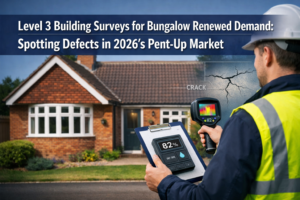
In 2026, property markets across the UK are experiencing what experts call a "flat but firm" condition—prices aren't climbing rapidly, but they're not collapsing either. This sideways movement creates unique challenges for chartered surveyors tasked with determining accurate property values. Understanding how surveyors value properties in a 'flat but firm' market: evidence, adjustments and red flags in 2026 has become essential for buyers, sellers, and lenders navigating this stabilised landscape.
Recent RICS market commentary highlights stabilising enquiries and regionally mixed price movements, making the surveyor's role more critical than ever. When markets surge or crash, trends are obvious. But in stable conditions, the difference between an accurate valuation and an overestimate can be subtle yet financially significant.
Key Takeaways
- Comparable evidence becomes more reliable in flat markets, as recent sales reflect current conditions without rapid price inflation or deflation
- Time adjustments are minimal but still necessary, as surveyors must account for micro-movements and regional variations even in sideways markets
- Condition and location factors carry greater weight when price trends are neutral, making detailed property inspection crucial
- Red flags are harder to spot in stable markets, requiring surveyors to scrutinise listing durations, multiple reductions, and comparable quality more carefully
- Valuation challenges become more defensible when supported by robust evidence and transparent adjustment methodology
Understanding the 'Flat but Firm' Market Condition in 2026
What Defines a Flat but Firm Market?
A flat but firm market describes conditions where property prices remain relatively stable over time, showing neither significant growth nor decline. In 2026, this pattern has emerged following years of volatility driven by interest rate changes, economic uncertainty, and shifting buyer sentiment.
Key characteristics include:
- 📊 Minimal year-on-year price changes (typically -1% to +2%)
- 🏘️ Regional variation with some areas showing modest growth while others experience slight declines
- ⚖️ Balanced supply and demand preventing dramatic price swings
- 💷 Stable transaction volumes indicating sustained market activity
- 🔒 Lender confidence maintaining mortgage availability
This environment differs significantly from boom markets where properties sell above asking price, or crash conditions where values plummet monthly. For surveyors, flat markets require precision rather than trend-following.
Why Valuation Accuracy Matters More in Stable Markets
When markets move sideways, small valuation errors have proportionally larger impacts. A £20,000 overvaluation in a rapidly rising market might correct itself within months. In a flat market, that same error could leave buyers in negative equity or prevent sales from completing.
Lenders particularly scrutinise valuations in stable conditions, as they cannot rely on future price growth to protect their security. This makes the surveyor's evidence-gathering and adjustment methodology subject to greater challenge.
How Surveyors Gather Comparable Evidence in Flat Markets
The Foundation: Selecting Appropriate Comparables
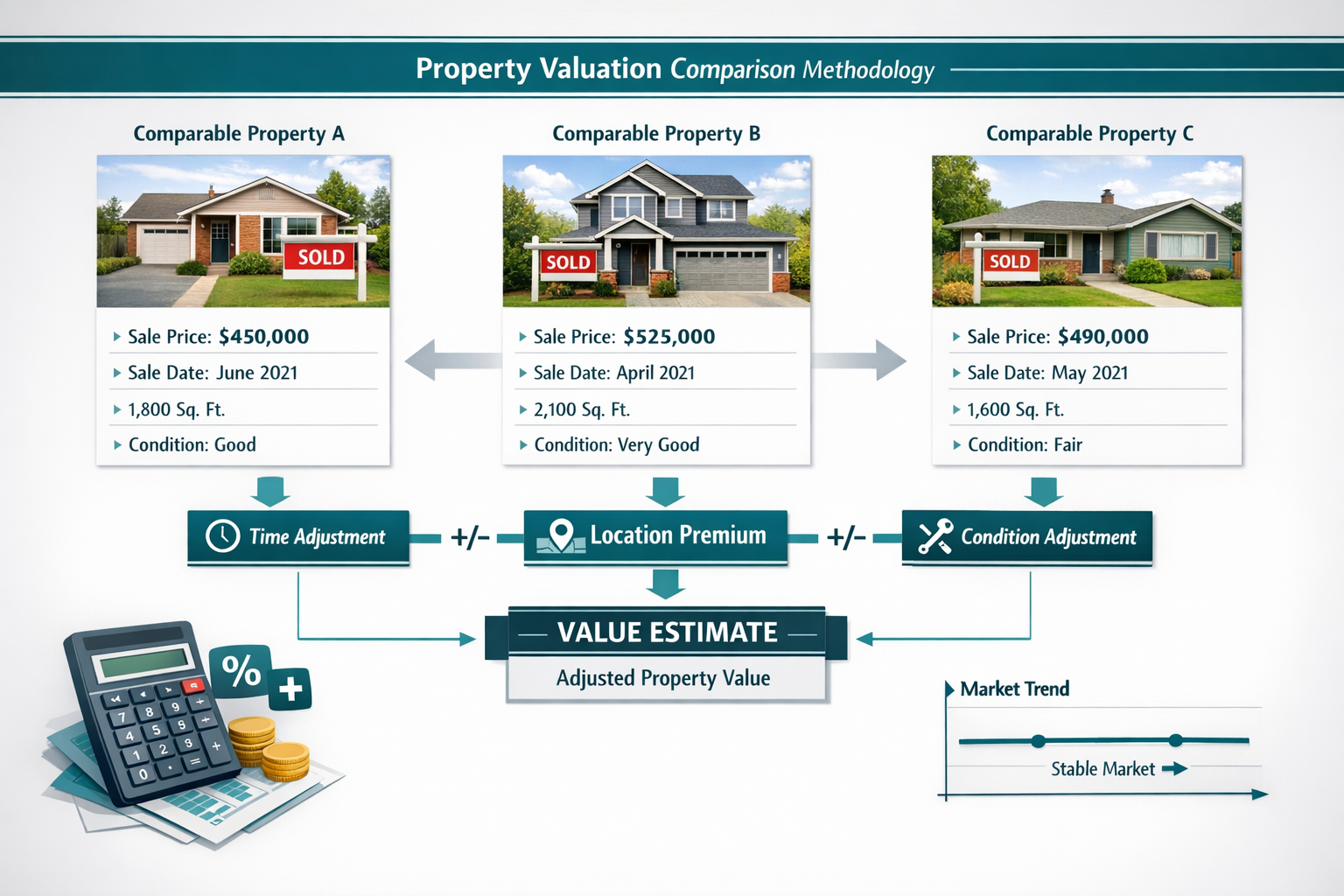
The valuation process begins with identifying comparable properties—similar homes that have recently sold in the same area. In a flat but firm market, this evidence becomes more reliable because recent sales accurately reflect current values [1].
Surveyors search for comparables matching:
- Property type (detached, semi-detached, terraced, flat)
- Size (square footage, number of bedrooms)
- Location (same neighbourhood or comparable area)
- Age and construction (Victorian, 1930s, modern build)
- Sale timing (ideally within 3-6 months)
Professional surveyors access multiple data sources including Land Registry records, local estate agent sales, and proprietary databases. The RICS Homebuyer Survey process incorporates this comparable analysis as a standard component.
Quality Over Quantity: Filtering Comparable Sales
Not all recent sales provide reliable evidence. Surveyors must filter out:
❌ Forced sales (repossessions, probate sales at below-market prices)
❌ Related party transactions (family sales that don't reflect open market value)
❌ Properties with significant defects not disclosed in sale data
❌ Sales with unusual terms (including fixtures, early completion incentives)
In flat markets, the quality of comparables matters more than the quantity. Three highly similar properties provide better evidence than ten loosely related sales [2].
Geographic Boundaries in Comparable Selection
Location remains paramount. A property in a desirable school catchment area may command a 10-15% premium over an identical home two streets away. Surveyors establish geographic boundaries based on:
- Postcode sectors and their market perceptions
- Transport links (proximity to stations, major roads)
- Local amenities (schools, parks, shopping)
- Neighbourhood character (conservation areas, new developments)
For properties in areas like Hillingdon or Harrow, surveyors must understand micro-market variations that persist regardless of overall market conditions.
Valuation Adjustments: How Surveyors Account for Differences
Time Adjustments in Sideways Markets
Even in flat markets, time adjustments account for subtle price movements between comparable sale dates and the valuation date. While these adjustments are minimal (often 0-2% annually), they demonstrate methodological rigour.
Surveyors consider:
- Regional market indices showing local price trends
- Property type-specific movements (flats vs houses may diverge)
- Seasonal variations (spring market vs winter sales)
- Economic indicators (interest rate changes, employment data)
In 2026's stable conditions, a property sold six months ago might require only a +0.5% time adjustment, compared to +3-5% in a rising market.
Condition Adjustments: The Critical Differentiator
When price trends are neutral, property condition becomes the primary value driver. Surveyors make adjustments based on:
| Condition Factor | Typical Adjustment Range |
|---|---|
| Kitchen quality | -£5,000 to +£15,000 |
| Bathroom modernisation | -£3,000 to +£8,000 per bathroom |
| Heating system | -£4,000 to +£6,000 |
| Windows (single to double glazing) | -£8,000 to +£12,000 |
| Roof condition | -£15,000 to +£25,000 if replacement needed |
| Structural issues | -10% to -30% depending on severity |
A comprehensive building survey identifies these condition factors, allowing surveyors to make evidence-based adjustments rather than estimates [3].
Size and Layout Adjustments
Square footage provides a baseline, but layout efficiency matters equally. Surveyors adjust for:
- Usable vs total space (narrow hallways, awkward room shapes)
- Extension quality (professional vs DIY additions)
- Garden size and orientation (south-facing gardens command premiums)
- Parking provision (garage, driveway, or on-street only)
A property with 1,200 sq ft of well-designed space may value higher than a poorly configured 1,300 sq ft comparable.
Location-Specific Adjustments
Within the same general area, micro-location factors require adjustment:
🚊 Transport accessibility (+3-7% for properties within 10-minute walk of stations)
🏫 School catchments (+5-15% for outstanding-rated primary schools)
🌳 Environmental factors (-5-10% for main road noise, +3-8% for park views)
🏗️ Development risk (-3-10% for properties near planned major construction)
Surveyors working in areas like Kingston or Camden develop detailed knowledge of these micro-market premiums and discounts.
Red Flags: Warning Signs in Flat Market Valuations
Overpricing in Stable Conditions
In flat markets, properties that remain unsold for extended periods signal overpricing. Surveyors investigate:
- ⏰ Listing duration (properties on market >6 months require scrutiny)
- 📉 Price reduction history (multiple reductions suggest initial overvaluation)
- 🔄 Re-listing patterns (withdrawn and re-marketed properties)
- 📊 Days on market vs area average (significantly longer indicates pricing issues)
A property listed at £500,000 for nine months with two price reductions suggests the market values it closer to £450,000-£475,000, regardless of the seller's expectations.
Comparable Quality Issues
Surveyors must identify when comparables don't truly match the subject property:
❗ Presentation differences (professionally staged vs occupied properties)
❗ Undisclosed improvements (recent renovations not visible in sale records)
❗ Tenure variations (leasehold vs freehold, lease length differences)
❗ Legal complications (restrictive covenants, right of way issues)
For flats, lease length dramatically affects value. Understanding how to buy a flat on a short lease helps surveyors make appropriate adjustments—often 10-20% reductions for leases below 80 years.
Market Manipulation Signals
Flat markets can incentivise artificial price support:
- 🏠 Developer buy-back schemes inflating new-build comparables
- 💰 Gifted deposits or cashback arrangements not reflected in sale prices
- 🤝 Related party sales at inflated values
- 📝 Off-market deals with undisclosed incentives
Experienced surveyors cross-reference multiple data sources and question anomalous sales that don't align with market patterns. What does a surveyor do includes this detective work to ensure valuation integrity.
Regional Divergence from National Trends
In 2026, regional variations create complexity within the overall flat market narrative:
- London zones showing -2% annual change
- Southeast commuter towns at +3% growth
- Northern cities experiencing +1% stability
- Coastal areas with -1% adjustments
Surveyors must avoid applying national "flat market" assumptions to local areas experiencing different conditions. Properties in Newham may follow different trajectories than those in Brent.
Defending Valuations: How Surveyors Justify Their Figures
Documentation and Evidence Trail
Professional surveyors create comprehensive documentation supporting their valuations:
📋 Comparable schedule listing all sales considered
📸 Photographic evidence of property condition
📐 Measurement records verifying floor areas
🔍 Adjustment calculations showing mathematical basis
📊 Market analysis demonstrating regional trends
This evidence trail allows surveyors to defend valuations when challenged by buyers, sellers, or lenders. The RICS property valuations process requires this level of documentation as a professional standard.
Responding to Valuation Challenges
When a valuation differs significantly from asking price or buyer expectations, surveyors must:
- Explain the methodology clearly and transparently
- Present comparable evidence with specific adjustments
- Address market context (flat conditions vs seller expectations)
- Identify property-specific factors affecting value
- Provide ranges where appropriate (e.g., £475,000-£490,000)
In stable markets, valuation ranges narrow compared to volatile conditions. A surveyor might provide a ±2% range in flat markets versus ±5% in rapidly moving markets.
The Role of Professional Indemnity
RICS-registered surveyors carry professional indemnity insurance protecting against valuation errors. This insurance requires:
- ✅ Adherence to RICS Valuation Standards (Red Book)
- ✅ Competence in the geographic area and property type
- ✅ Documented evidence supporting valuations
- ✅ Timely reporting and clear communication
Buyers and lenders can verify surveyor credentials and insurance coverage, providing additional confidence in flat market valuations where margins are tight.
Practical Implications for Property Buyers and Sellers
For Buyers: Using Valuation Intelligence
Understanding how surveyors work in flat markets helps buyers:
🎯 Identify overpriced properties before making offers
💪 Negotiate effectively using comparable evidence
🛡️ Avoid overpaying when lender valuations come in low
📋 Commission appropriate surveys matching property risk
When a homebuyers report reveals condition issues, buyers can use surveyor adjustments to justify reduced offers. Knowing how an RICS survey can help negotiate price provides leverage in stable markets.
For Sellers: Setting Realistic Expectations
Sellers benefit from understanding valuation methodology:
- 📊 Price competitively from the outset based on evidence
- 🔧 Address condition issues before marketing
- ⏱️ Avoid prolonged marketing that signals overpricing
- 💡 Present property optimally to maximise comparable alignment
In flat markets, initial pricing accuracy determines success. Properties priced 5-10% above market value may sit unsold for months, while accurately priced homes attract multiple viewings quickly.
For Lenders: Valuation Reliance
Mortgage lenders depend on accurate valuations to:
- Determine appropriate loan-to-value ratios
- Assess security adequacy for the loan amount
- Identify risk factors requiring additional scrutiny
- Protect against negative equity scenarios
In stable markets, lenders typically accept valuations within ±3% of purchase price without additional investigation. Larger discrepancies trigger reviews or require buyers to increase deposits.
The Future of Property Valuation in Stable Markets
Technology and Data Integration
2026 has seen increased integration of automated valuation models (AVMs) with traditional surveyor expertise. These hybrid approaches:
- 🤖 Use AI to identify comparable properties from vast databases
- 👨💼 Rely on surveyors to verify comparables and make adjustments
- 📈 Provide statistical confidence intervals alongside valuations
- 🔄 Update valuations as new market data emerges
However, human expertise remains essential for identifying red flags, assessing condition, and understanding micro-market nuances that algorithms miss.
Regulatory Developments
RICS continues refining valuation standards for stable market conditions, emphasising:
- Greater transparency in adjustment methodology
- Enhanced comparable verification requirements
- Clearer uncertainty communication when evidence is limited
- Stronger conflict of interest management
These developments protect consumers and maintain professional standards across the industry.
Conclusion
Understanding how surveyors value properties in a 'flat but firm' market: evidence, adjustments and red flags in 2026 empowers all parties in property transactions. In stable market conditions, valuation accuracy depends on rigorous comparable selection, transparent adjustment methodology, and careful identification of warning signs.
Surveyors gather evidence from recent sales, filter for quality and relevance, and make precise adjustments for time, condition, size, and location differences. Red flags including extended marketing periods, price reductions, and comparable quality issues require investigation to avoid overvaluation.
For buyers, this knowledge supports informed decision-making and effective negotiation. For sellers, it encourages realistic pricing and property presentation. For lenders, it provides confidence in security valuations.
Next Steps
✅ Commission a professional survey from RICS-registered surveyors before making purchase commitments
✅ Request comparable evidence supporting any valuation you receive
✅ Investigate properties with extended marketing periods or multiple price reductions
✅ Consider condition factors when comparing asking prices across similar properties
✅ Consult specialists for complex properties or unusual market conditions
In 2026's flat but firm market, valuation precision matters more than ever. Working with qualified surveyors who understand evidence-based methodology protects your financial interests whether buying, selling, or lending.
For expert valuation services and comprehensive property surveys, contact qualified professionals who can provide the detailed analysis your transaction deserves.
References
[1] Understanding The Different Methods Of Property Valuation – https://landsterling.com/understanding-the-different-methods-of-property-valuation/
[2] Valuation Survey – https://www.comparemymove.com/guides/surveying/valuation-survey
[3] Property Valuation Real Estate – https://waridrealty.com/property-valuation-real-estate/