


Buying a home built between the 1930s and 1970s offers character, established neighborhoods, and often more space than modern new-builds. Yet beneath the charm of bay windows, parquet floors, and generous gardens lurk hidden defects that can transform a dream purchase into a financial nightmare. Hidden Defects in 1930s–1970s UK Housing: What a Building Survey Should Reveal Before You Commit is not just a precaution—it's essential due diligence that protects buyers from structural failures, health hazards, and repair bills running into tens of thousands of pounds.

In 2026, the UK housing market continues to see strong demand for period properties, yet many buyers underestimate the complexity of aging building stock. From concrete cancer in 1970s estates to cavity wall tie failure in 1930s semi-detached homes, these defects often remain invisible during casual viewings. A competent RICS Building Survey conducted by a qualified professional becomes the critical tool for uncovering problems before legal commitment.
Key Takeaways
- Damp, subsidence, and timber decay represent the most common structural issues in 1930s housing, often requiring specialist remediation costing £5,000–£20,000 or more
- Concrete deterioration and asbestos hazards dominate 1960s–1970s properties, with asbestos removal alone averaging £1,500–£3,000 per room
- A Level 3 Building Survey provides the comprehensive inspection necessary to identify hidden defects that mortgage valuations and basic homebuyer reports routinely miss
- Regional variations significantly affect defect patterns, with clay soil subsidence particularly prevalent in areas like Birmingham and the Southeast
- Early detection through professional surveys enables informed negotiation, realistic budgeting, and prevents purchase of properties with catastrophic structural problems
Understanding the Construction Context: Why These Decades Matter
The 1930s Building Boom
The interwar period saw unprecedented suburban expansion across the UK, with approximately four million homes constructed between 1919 and 1939. These properties introduced semi-detached layouts, cavity wall construction, and bay windows that define British streetscapes today. However, construction standards varied enormously, and many cost-saving measures created long-term structural vulnerabilities.
Key characteristics of 1930s construction:
- 🏠 Cavity walls with basic or absent wall ties
- 🧱 Solid brick chimneys often without adequate damp-proof courses
- 🪵 Timber suspended floors vulnerable to decay
- 🏚️ Clay tile or slate roofs with limited sarking boards
- 💧 Rudimentary drainage systems using pitch fiber or clay pipes
Post-War Reconstruction (1940s–1950s)
Material shortages during and after World War II led to experimental construction methods and non-traditional building systems. Prefabricated concrete panels, steel frames, and innovative (but often problematic) designs emerged to address the housing crisis. Many of these systems have since been designated as defective under mortgage lending criteria.[6]
The 1960s–1970s Modernist Era
This period embraced system-built construction, flat roofs, concrete panel systems, and new materials that promised maintenance-free living. Unfortunately, many innovations proved fundamentally flawed, creating properties with inherent defects that worsen with age. Concrete deterioration, thermal bridging, and condensation issues plague thousands of homes from this era.[2]
Hidden Defects in 1930s–1970s UK Housing: Common Structural Problems by Decade
1930s Housing: The Classic Defects
Damp and Moisture Penetration
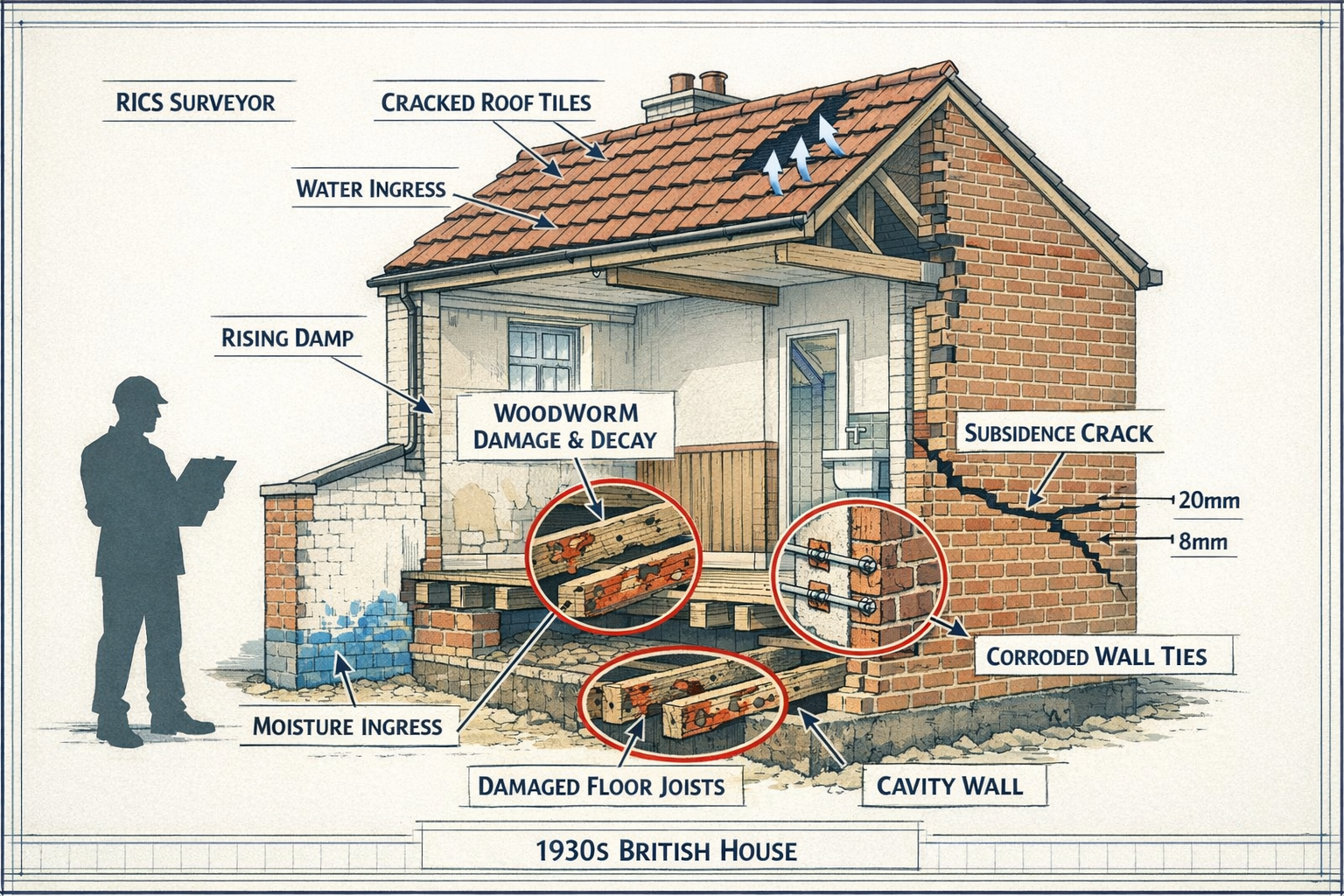
Damp and condensation are the most common issues in 1930s homes, particularly affecting ground floors and external walls where modern damp-proofing methods were absent.[1] Original properties often lack effective damp-proof courses (DPCs) or have DPCs that have failed after 90+ years of service.
Common damp manifestations include:
- Rising damp in ground floor walls causing plaster deterioration
- Penetrating damp through solid walls during driving rain
- Condensation in unventilated bathrooms and kitchens
- Chimney breast damp from defective flashings or porous brickwork
Professional damp surveys using electronic moisture meters and invasive testing can distinguish between different damp types—critical because remediation approaches vary dramatically. Misdiagnosis leads to inappropriate chemical injection treatments when the actual problem stems from defective guttering or bridged cavities.
Subsidence and Clay Soil Movement
Clay soil subsidence affects 1930s properties disproportionately, particularly in regions with shrinkable clay subsoils.[1] The combination of mature trees, prolonged dry periods, and shallow foundations creates the perfect conditions for differential settlement.
Warning signs include:
- Diagonal cracks wider than 3mm, especially near doors and windows
- Cracks that taper (wider at top or bottom)
- External and internal cracks that align through walls
- Doors and windows sticking or distorting in frames
- Visible steps in brickwork patterns
Subsidence investigations require monitoring over 12+ months, trial pit excavations, and structural engineer assessments. Repair costs frequently exceed £15,000–£40,000, and properties with subsidence history face insurance complications and reduced marketability.
Cavity Wall Tie Failure
Original 1930s cavity walls used galvanized steel wire ties spaced at approximately 900mm horizontally and 450mm vertically. After decades of exposure to moisture within the cavity, these ties corrode, expand, and crack the mortar beds—a process called "rust jacking."
Failed wall ties manifest as:
- Horizontal cracks following mortar bed lines
- Bulging or bowing of external brick leaves
- Rust staining on external brickwork
- Cavity debris and mortar snots bridging the gap
Remediation involves installing replacement stainless steel ties (typically 6–8 ties per square meter) at costs of £40–£80 per square meter of affected wall area. For a typical semi-detached house, total costs range from £3,000–£8,000.
Timber Decay and Woodworm
Timber decay and woodworm in structural elements require early identification, as damage to floors or roofs can become extremely expensive to repair if discovered late in the property-buying process.[1] Suspended timber ground floors, particularly in poorly ventilated sub-floor voids, suffer from wet rot (Coniophora puteana) when moisture content exceeds 20%.
A competent building survey must include:
- Lifting floor coverings to inspect joists and floorboards
- Probing timbers with a bradawl or screwdriver
- Checking sub-floor ventilation adequacy
- Inspecting roof timbers for beetle infestation and fungal decay
- Identifying active versus historic infestations
Treatment costs vary from £1,500 for localized woodworm treatment to £15,000+ for extensive floor joist replacement with associated making good.
1960s–1970s Housing: System-Built Challenges
Concrete Cancer (Spalling and Carbonation)
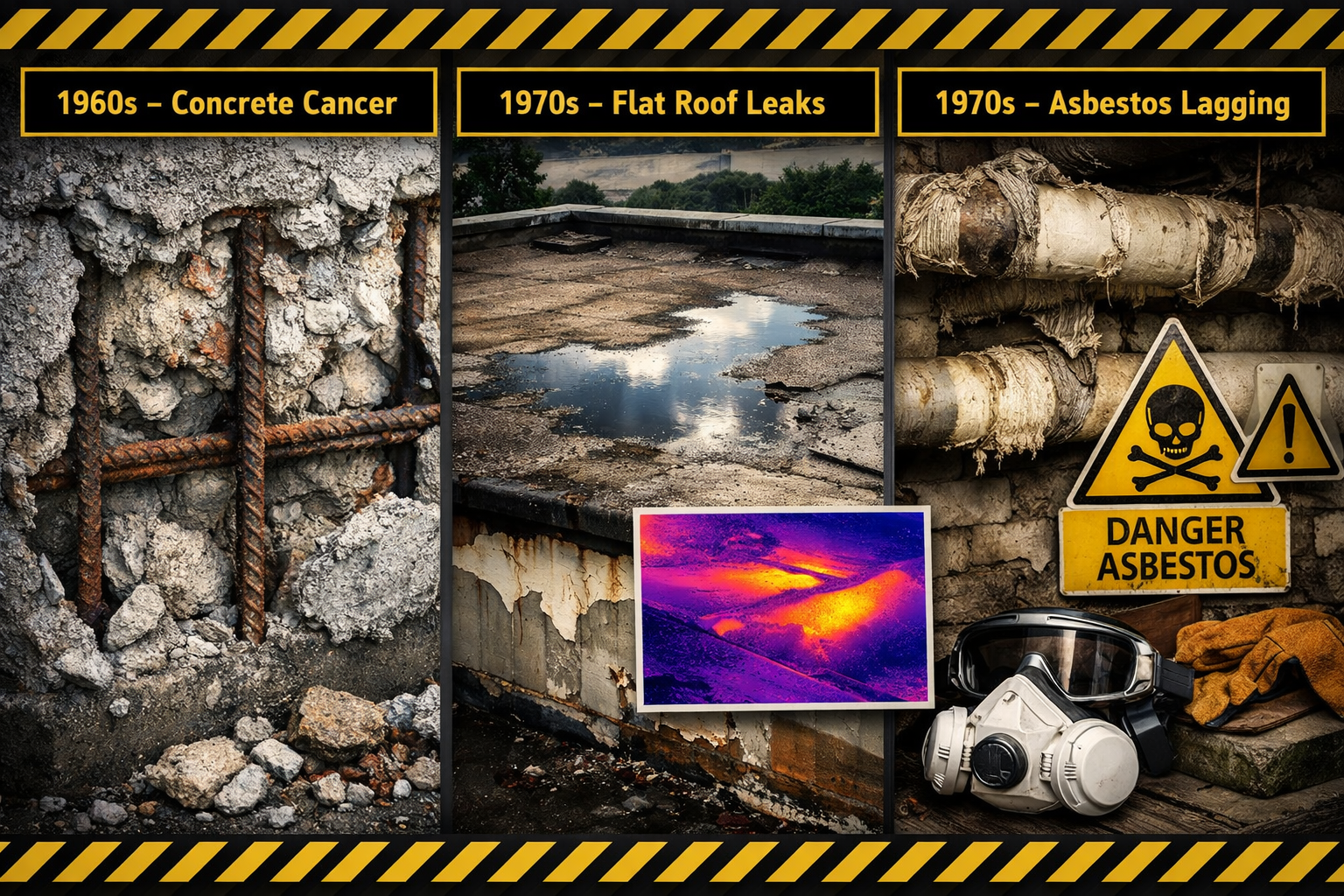
Concrete cancer (spalling) represents one of the most significant structural issues in 1970s properties, occurring when steel reinforcement within concrete rusts and causes cracks and surface deterioration requiring professional assessment.[2] This process, technically called carbonation, happens when carbon dioxide penetrates concrete and reduces alkalinity, allowing reinforcement corrosion.
Spalling indicators include:
- Rust staining on concrete surfaces
- Cracking parallel to reinforcement bars
- Concrete delamination and flaking
- Exposed corroded steel reinforcement
- Structural deflection in lintels or beams
Concrete repairs require specialist contractors using patch repairs, cathodic protection, or complete element replacement. Costs escalate quickly, with balcony repairs alone ranging from £8,000–£25,000 depending on extent and access.
Flat Roof Failures
Flat roofs in 1970s homes are notorious for leaks, as materials like bitumen felt have limited lifespans and deteriorate, leading to water ingress and interior damage.[2] Original three-layer felt roofs typically last 15–25 years, meaning most 1970s roofs have been replaced at least once—or should have been.
Common flat roof problems:
- Ponding water from inadequate falls
- Felt blistering and cracking
- Failed upstands and flashings
- Inadequate insulation causing condensation
- Structural timber decay from long-term leaks
Modern replacement options include EPDM rubber, GRP fiberglass, or high-performance felt systems costing £40–£90 per square meter installed. For a typical garage or extension roof of 20 square meters, budget £1,200–£2,500.
Asbestos: The Hidden Health Hazard
Asbestos exposure remains a critical health hazard in homes built between 1930s and mid-1970s, with asbestos-containing materials (ACMs) commonly found in:[3]
| Location | Asbestos Product | Risk Level |
|---|---|---|
| Boiler rooms | Pipe lagging (amosite) | High if damaged |
| Ceiling tiles | Textured coatings (chrysotile) | Low if undisturbed |
| Roof sheets | Cement corrugated sheets | Medium if weathered |
| Floor tiles | Vinyl asbestos tiles | Low if intact |
| Soffits/fascias | Asbestos cement boards | Medium if drilled |
Professional asbestos surveys (Management or Refurbishment/Demolition types) cost £200–£600 depending on property size. Removal costs vary dramatically based on material type, location, and quantity, ranging from £1,500 for small-scale encapsulation to £10,000+ for complete house clearance with licensed contractors.
Electrical and Plumbing Obsolescence
Properties from this era often retain original electrical installations with:
- Outdated fuse boxes lacking RCD protection
- Aluminum wiring (particularly 1960s) prone to connection failures
- Insufficient socket outlets for modern demands
- Lack of earthing in lighting circuits
- Deteriorated cable insulation
Complete rewiring costs £3,500–£6,000 for a three-bedroom property. Similarly, original plumbing may include lead pipes (health hazard), polybutylene pipes (prone to failure), or corroded galvanized steel requiring replacement.
What a Building Survey Should Reveal Before You Commit: The Level 3 Inspection

The Scope of a Comprehensive Building Survey
Understanding the difference between survey levels proves crucial when purchasing period properties. A homebuyers survey (Level 2) provides a traffic-light condition rating but includes significant limitations and exclusions. For properties built before 1980, particularly those with visible defects or non-standard construction, a Level 3 Building Survey (formerly Full Structural Survey) offers the comprehensive investigation necessary.
A competent Level 3 survey includes:
External inspection:
- ✅ Roof coverings, chimneys, and flashings (often using binoculars or drone photography)
- ✅ Rainwater goods, fascias, and soffits
- ✅ Wall construction, pointing, and render condition
- ✅ Windows, doors, and external joinery
- ✅ Drainage systems including manhole inspections
- ✅ Boundaries, outbuildings, and hard standings
Internal inspection:
- ✅ Roof spaces with particular attention to timber condition
- ✅ Ceilings, walls, and floor surfaces
- ✅ Lifting carpets and floor coverings where possible
- ✅ Testing services (basic functionality checks)
- ✅ Damp meter readings in multiple locations
- ✅ Chimney breasts and fireplaces
Specialist investigations:
- ✅ Recommendations for structural engineer referral
- ✅ Drainage CCTV survey recommendations
- ✅ Asbestos survey requirements
- ✅ Electrical installation condition reports
- ✅ Timber and damp specialist reports
Critical Areas for 1930s–1970s Properties
When commissioning a building survey for period housing, ensure your building surveyor specifically investigates:
Foundation and structural movement:
- Crack pattern analysis and monitoring recommendations
- Trial pit excavations if subsidence suspected
- Assessment of tree proximity and species
- Drainage condition affecting foundations
- Previous underpinning or structural repairs
Concealed timber elements:
- Sub-floor void access and ventilation
- Roof timber condition including purlin ends
- Embedded beam ends in external walls
- Window and door lintels
- Staircase structural timbers
Services and hazardous materials:
- Electrical installation age and safety
- Heating system condition and efficiency
- Asbestos likelihood and locations
- Lead paint and plumbing
- Radon risk in applicable areas
Case Study Examples
Case Study 1: 1935 Semi-Detached, Birmingham
Survey revealed diagonal cracking to rear elevation with maximum width of 8mm, tapering toward ground level. Investigation identified clay soil subsidence caused by mature oak tree 6 meters from property. Structural engineer recommended monitoring, tree management, and potential underpinning. Buyer negotiated £25,000 price reduction and obtained specialist subsidence insurance before proceeding.
Case Study 2: 1972 Concrete Panel House, Hull
Level 3 survey identified property as PRC (Precast Reinforced Concrete) construction with known structural defects. Further investigation revealed the system was designated defective for mortgage purposes. Buyer withdrew from purchase, avoiding unmortgageable property that would have been impossible to resell conventionally.
Case Study 3: 1938 Detached House, Surrey
Comprehensive survey uncovered extensive wet rot in ground floor joists affecting 60% of floor area, estimated repair cost £18,000. Additionally identified asbestos pipe lagging in basement and corroded cavity wall ties. Total remediation budget: £32,000. Armed with survey evidence, buyer renegotiated purchase price by £28,000 and proceeded with full understanding of required works.
Regional Variations and Local Risk Factors
Geographic Defect Patterns
Bradford has been identified as the UK region most in need of housing renovation according to a February 2026 report, with residents turning to the internet for renovation help more frequently than anywhere else in the country.[4] Regional factors significantly influence defect prevalence:
High subsidence risk areas:
- Southeast England (London, Essex, Kent)
- East Midlands (particularly clay soil regions)
- Parts of Birmingham and West Midlands
- Thames Valley and surrounding areas
Radon-affected regions:
- Cornwall and Devon
- Parts of Derbyshire and Northamptonshire
- Somerset and areas of Wales
- Specific postcode checks required
Industrial legacy issues:
- Former mining areas (settlement and contamination)
- Coastal regions (salt weathering and exposure)
- Flood risk zones requiring specialist surveys
- Areas with known ground contamination
Age-Related Defect Probability
Research indicates that Kingston upon Hull faces severe housing disrepair with 9 out of 10 disrepair scores, partly due to one in five residential buildings constructed before 1919, creating accumulated structural damage from old infrastructure.[4] Properties from different decades exhibit predictable defect patterns:
| Construction Period | Primary Defects | Survey Priority |
|---|---|---|
| 1930–1939 | Damp, subsidence, cavity wall ties | High |
| 1940–1949 | Non-traditional construction, material defects | Very High |
| 1950–1959 | Concrete defects, flat roofs, asbestos | High |
| 1960–1969 | System-build issues, concrete cancer, services | Very High |
| 1970–1979 | Flat roofs, asbestos, electrical obsolescence | High |
Preparing for Your Building Survey: Maximizing Value
Questions to Ask Your Surveyor
Before commissioning a survey, verify the surveyor's qualifications and experience:
- Are you RICS qualified with specific experience in pre-1980s housing?
- Will you personally conduct the inspection or delegate to junior staff?
- What access equipment will you use for roof and high-level inspection?
- Do you provide thermal imaging or moisture mapping?
- What is your policy on lifting floor coverings and accessing concealed spaces?
- How detailed is the photographic record in your reports?
- Do you provide repair cost estimates or contractor recommendations?
- What is your typical report turnaround time?
What to Do Before Your Survey
Maximize survey effectiveness by taking these preparatory steps:
- Ensure access: Confirm keys, access codes, and permission for all areas including loft, garage, and outbuildings
- Move furniture: Request current occupants move furniture from walls where possible
- Lift carpets: Particularly in older properties, arrange for corner lifting to inspect floors
- Provide documentation: Share any available plans, previous surveys, or building regulation certificates
- Highlight concerns: Inform surveyor of any specific issues noticed during viewings
- Arrange utilities: Ensure electricity and water are connected for service testing
Understanding Survey Limitations
Even comprehensive Level 3 surveys have inherent limitations:
⚠️ Surveyors cannot:
- Cause damage to access concealed areas
- Move heavy furniture or stored items
- Excavate to inspect foundations
- Test electrical installations comprehensively (requires separate EICR)
- Identify all asbestos without invasive sampling
- Guarantee absence of Japanese knotweed without seasonal visibility
Surveyors recommend further investigations when conditions prevent full assessment or when specialist expertise is required. These recommendations should be acted upon before exchange of contracts.
Acting on Survey Findings: Negotiation and Decision Making
Interpreting Condition Ratings
Modern RICS surveys use a three-tier condition rating:
- Condition 1 (Green): No repair currently needed, normal maintenance only
- Condition 2 (Amber): Defects requiring future repair or replacement, but not urgent
- Condition 3 (Red): Defects requiring urgent repair or significant expense
For 1930s–1970s properties, expect multiple Condition 2 and some Condition 3 ratings. The critical question becomes whether defects are manageable (requiring budgeted maintenance) or catastrophic (rendering the property unsuitable or unmortgageable).
Negotiation Strategies
Armed with survey evidence, buyers have several options:
Price reduction:
Request reduction equivalent to estimated repair costs, typically achieving 50–70% of quoted remediation expenses in negotiations. Major structural defects (subsidence, concrete cancer, extensive timber decay) provide strongest negotiation leverage.
Retention:
Agree purchase price but request solicitor holds retention fund until specific repairs completed by vendor. Useful for urgent roof repairs or damp treatment.
Vendor repairs:
Request vendor completes specified works before completion, with certification provided. Ensure adequate time allowed and specifications agreed in writing.
Walk away:
For properties with unmortgageable construction types, catastrophic structural failure, or repair costs exceeding 20–30% of purchase price, withdrawal may be the prudent decision. Survey fees represent excellent value when preventing disastrous purchases.
Creating a Remediation Plan
For properties you proceed with despite significant defects:
- Prioritize by urgency: Address water ingress, structural instability, and health hazards first
- Obtain multiple quotes: Secure at least three quotations for major works from qualified contractors
- Budget contingency: Add 20–30% to estimated costs for unforeseen complications
- Plan phasing: Spread major works over 2–5 years if not immediately critical
- Consider insurance: Ensure buildings insurance covers identified defects or obtain specialist policies
- Document everything: Maintain records of surveys, quotes, and completed works for future sale
Conclusion: Protecting Your Investment Through Informed Decisions
Hidden Defects in 1930s–1970s UK Housing: What a Building Survey Should Reveal Before You Commit represents the difference between a sound investment and a financial catastrophe. Properties from these decades offer character, space, and established locations, but they also harbor structural vulnerabilities, hazardous materials, and aging building fabric requiring expert assessment.
A comprehensive Level 3 Building Survey conducted by a qualified RICS surveyor provides the essential intelligence needed to:
✅ Identify hidden defects before legal commitment
✅ Negotiate fair purchase prices reflecting true property condition
✅ Budget realistically for immediate and future repairs
✅ Avoid unmortgageable or structurally compromised properties
✅ Plan remediation with appropriate specialist contractors
✅ Protect your family from health hazards like asbestos
Next Steps
If you're considering purchasing a 1930s–1970s property in 2026:
- Commission a Level 3 Building Survey from an experienced RICS surveyor familiar with period properties
- Request specialist investigations for asbestos, drainage, electrical, and structural concerns identified
- Review survey findings thoroughly with your surveyor before making decisions
- Obtain detailed quotations for all significant repair works identified
- Negotiate informed using concrete evidence from professional assessments
- Proceed confidently knowing the true condition and costs, or walk away from unsuitable properties
The modest investment in comprehensive surveying—typically £800–£1,500 for a Level 3 survey—pales against the £20,000–£50,000+ costs of undiscovered major defects. In the complex landscape of aging UK housing stock, professional expertise transforms risky speculation into informed decision-making, protecting both your financial investment and your family's safety for decades to come.
For properties requiring detailed assessment, consider consulting specialists who understand the unique challenges of period housing and can provide the thorough investigation these characterful but complex homes demand.
References
[1] The Most Common Survey Issues Found In Birminghams 1930s Homes – https://www.theupcoming.co.uk/2025/11/21/the-most-common-survey-issues-found-in-birminghams-1930s-homes/
[2] A Comprehensive Guide To Buying A 1970s Property In The Uk Typical Defects Hazards And Characteristics – https://flettons.com/a-comprehensive-guide-to-buying-a-1970s-property-in-the-uk-typical-defects-hazards-and-characteristics/
[3] When Was Asbestos Used In Homes – https://asbestos-surveys.org.uk/asbestos/when-was-asbestos-used-in-homes/
[4] Article – https://www.digitaljournal.com/life/the-poor-state-of-uk-housing-revealed-in-new-survey/article
[5] 10 Problems Affecting 1960s And 1970s Houses – https://edwinlake.co.uk/latest-news/10-problems-affecting-1960s-and-1970s-houses/
[6] Houses Of Non Traditional Construction Common Property Defects 6 – https://www.peterbarry.co.uk/blog/houses-of-non-traditional-construction-common-property-defects-6/