
When property prices stabilize but momentum remains weak, expert witnesses face a unique challenge. In 2026, defending valuations in legal disputes requires more than traditional appraisal methods—it demands a sophisticated understanding of regional disparities, micro-market dynamics, and the critical role of perception management. Expert Witness Valuations in Stabilising Markets: Building Credible Cases When Price Momentum Remains Weak has become a specialized skill set that combines rigorous methodology with strategic communication.
The current market environment presents distinct obstacles for valuation professionals. While stabilization suggests market recovery, weak price momentum creates uncertainty that opposing counsel can exploit. Expert witnesses must navigate these contradictions while maintaining credibility and adhering to RICS (Royal Institution of Chartered Surveyors) standards.

Key Takeaways
- 🎯 Micro-market analysis is essential in 2026, as regional disparities make broad market assessments unreliable for expert testimony
- 📊 Perception management has become as critical as technical accuracy, with valuation stability depending on stakeholder expectations
- ⚖️ Evidence standards require granular data, comparable analysis, and documented methodology that withstands cross-examination
- 🔍 Market perception studies provide early warning signals and strengthen expert witness credibility in stabilizing markets
- 📋 RICS protocols for expert witnesses demand independence, transparency, and clear communication of valuation uncertainty
Understanding the 2026 Market Context for Expert Witness Valuations
The Stabilization-Momentum Paradox
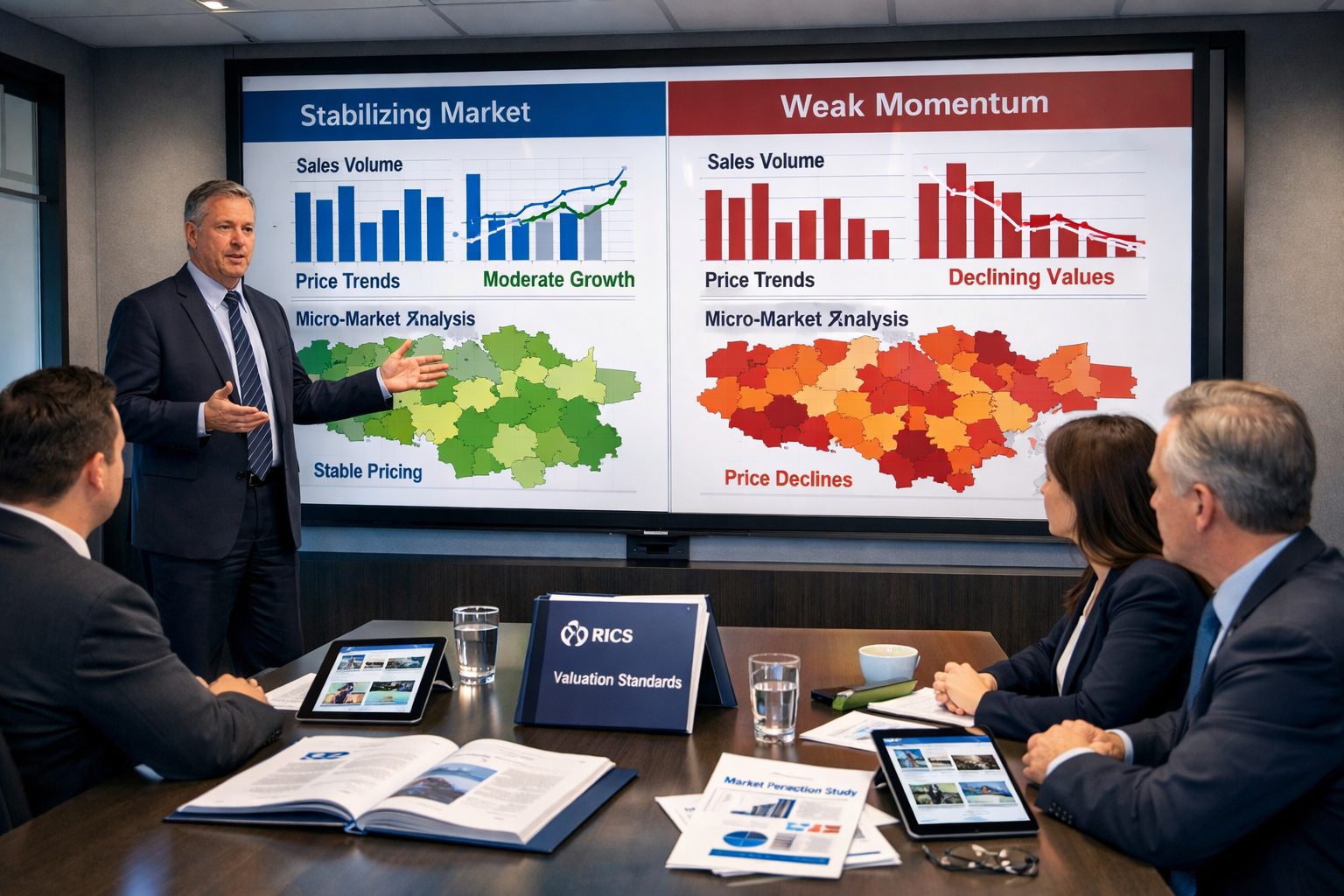
The property market in 2026 presents a paradox that complicates valuation work. Prices have stabilized across many regions, suggesting market equilibrium. However, weak price momentum indicates limited buyer confidence and transaction velocity. This creates fertile ground for valuation disputes.
Expert witnesses must explain this contradiction clearly. Stabilization doesn't equal strength—it often reflects a temporary balance between cautious buyers and reluctant sellers. When presenting property valuation evidence, professionals must distinguish between:
- Price stability (static values over time)
- Market strength (active transactions and buyer confidence)
- Momentum indicators (directional price movement)
- Regional variations (micro-market performance differences)
Regional Disparities Complicate Valuation Defense
In 2026, treating entire regions as homogeneous markets undermines expert credibility. Research shows that successful expert witnesses identify micro-markets with distinct characteristics—a shift toward more granular valuation approaches in stabilizing price environments [1].
Consider these regional factors:
| Factor | Impact on Valuation | Evidence Required |
|---|---|---|
| Local employment trends | High impact | Job growth data, major employer announcements |
| Infrastructure development | Medium-high impact | Transport projects, planning permissions |
| School catchment areas | Medium impact | Performance tables, enrollment trends |
| Neighborhood regeneration | Variable impact | Investment data, demographic shifts |
| Local market velocity | High impact | Transaction volumes, time-on-market statistics |
Expert witnesses who rely on broad regional data face challenges during cross-examination. Opposing counsel can easily highlight micro-market variations that contradict general trends. The solution lies in granular analysis that acknowledges local market nuances.
RICS Standards for Expert Witness Work in 2026
The RICS maintains rigorous standards for expert witness testimony. In valuation disputes, these protocols ensure independence and credibility:
✅ Overriding duty to the court (not to the instructing party)
✅ Transparency in methodology and assumptions
✅ Independence from commercial pressures
✅ Competence in the specific property type and market
✅ Clear communication of uncertainty and limitations
Professional surveyor services must demonstrate compliance with these standards throughout the valuation process. Documentation becomes critical—every assumption, adjustment, and comparable selection must be defensible under scrutiny.
Expert Witness Valuations in Stabilising Markets: Methodological Approaches That Withstand Scrutiny
The Comparable Sales Method in Weak Momentum Markets
The comparable sales approach remains fundamental to real estate appraisal, but weak momentum markets require careful comparable selection. Standard adjustments may not capture market psychology during stabilization periods.
Best practices for comparable analysis in 2026:
- Time adjustments: Document market conditions at each comparable sale date
- Transaction motivation: Identify forced sales, related-party transactions, or distressed circumstances
- Condition adjustments: Use detailed building survey data to justify physical condition differences
- Location micro-analysis: Quantify value differences within the same postal code
- Market exposure: Consider marketing period and price reductions as momentum indicators
Expert witnesses should avoid comparables from different market phases. A sale completed during rising momentum carries different weight than one during stabilization. This temporal sensitivity strengthens valuation credibility.
Income Capitalization in Uncertain Markets
For investment properties, income capitalization methods face unique challenges when momentum weakens. Cap rate selection becomes contentious, as small changes dramatically affect valuations.
Defending cap rate selection requires:
- Market-derived rates from recent comparable sales
- Investor survey data showing required returns in current conditions
- Risk premium analysis accounting for market uncertainty
- Sensitivity analysis demonstrating valuation ranges under different scenarios
Expert witnesses must explain why specific cap rates apply to the subject property. Generic industry surveys lack persuasive power—local market evidence and quantitative analysis provide stronger foundations for testimony.
The Cost Approach for Specialized Properties
When comparable sales are limited, the cost approach offers an alternative methodology. This proves particularly valuable for specialized properties or those in markets with low transaction volumes.
The cost approach involves:
- Replacement cost new (current construction costs)
- Physical depreciation (age and condition factors)
- Functional obsolescence (design inefficiencies)
- External obsolescence (market conditions and location factors)
In stabilizing markets with weak momentum, external obsolescence becomes the most subjective—and contentious—component. Expert witnesses must provide market evidence supporting any external obsolescence adjustments, rather than relying on professional judgment alone.
Hybrid Methodologies for Complex Valuations
Sophisticated expert witnesses employ hybrid approaches that combine multiple methodologies. This triangulation strengthens credibility by demonstrating consistent value indications across different analytical frameworks.
For example, valuing a mixed-use property might involve:
- Sales comparison for the residential component
- Income capitalization for commercial space
- Cost approach for specialized improvements
- Reconciliation explaining weight given to each method
The reconciliation process becomes critical testimony. Expert witnesses must articulate why certain methods receive more weight given market conditions, property characteristics, and data availability.
Building Credible Cases: Evidence Standards and Perception Management
Documentation That Survives Cross-Examination
Expert witness credibility depends on meticulous documentation. In 2026, delivering strong results alone is insufficient to protect valuations—professionals must manage expectations proactively [2].
Essential documentation includes:
📄 Engagement letter defining scope and limiting conditions
📄 Market analysis with data sources and collection dates
📄 Comparable selection criteria with rejection rationale
📄 Adjustment calculations with supporting evidence
📄 Assumption register documenting all valuation assumptions
📄 Limitation statements identifying data gaps or uncertainties
📄 Certification confirming RICS compliance and independence
This documentation serves dual purposes: it supports the valuation opinion and demonstrates professional competence. During cross-examination, well-organized documentation allows expert witnesses to respond confidently to challenges.
Managing Stakeholder Expectations in Stabilizing Markets
Valuation stability increasingly depends on perception management. Misalignment between forward-looking narratives and investor or market expectations can result in sharp valuation corrections even when fundamentals are sound [2].
Expert witnesses must address perception explicitly:
- Acknowledge market sentiment alongside objective data
- Explain divergence between market perception and property fundamentals
- Document stakeholder views through market perception studies
- Communicate uncertainty rather than false precision
Regular market perception studies have become essential for identifying how stakeholders interpret valuation drivers, allowing for progressive expectation adjustments rather than abrupt resets [2]. Expert witnesses who incorporate perception data demonstrate sophisticated understanding of market dynamics.
The Role of Market Perception Studies
Market perception studies provide early warning signals that strengthen expert testimony. These studies involve:
- Stakeholder interviews (buyers, sellers, agents, lenders)
- Sentiment analysis of market commentary and media coverage
- Transaction motivation research examining why deals occur or fail
- Forward-looking indicators capturing expectations about future values
When property evaluation incorporates perception data, expert witnesses can explain why market values may diverge from replacement cost or historical trends. This nuanced approach enhances credibility during testimony.
Addressing Uncertainty Without Undermining Credibility
Weak momentum markets inherently involve uncertainty. Expert witnesses face a delicate balance: acknowledging limitations while maintaining confidence in their opinions.
Effective uncertainty communication strategies:
- Quantify ranges rather than point estimates where appropriate
- Explain confidence levels based on data quality and market activity
- Distinguish facts from assumptions clearly throughout testimony
- Use sensitivity analysis to show how key variables affect conclusions
- Acknowledge alternative viewpoints and explain why they were rejected
This transparent approach paradoxically strengthens credibility. Courts and tribunals recognize that markets involve uncertainty—expert witnesses who pretend otherwise invite skepticism.
Expert Witness Valuations in Stabilising Markets: Practical Strategies for 2026 Disputes
Pre-Litigation Valuation Reviews
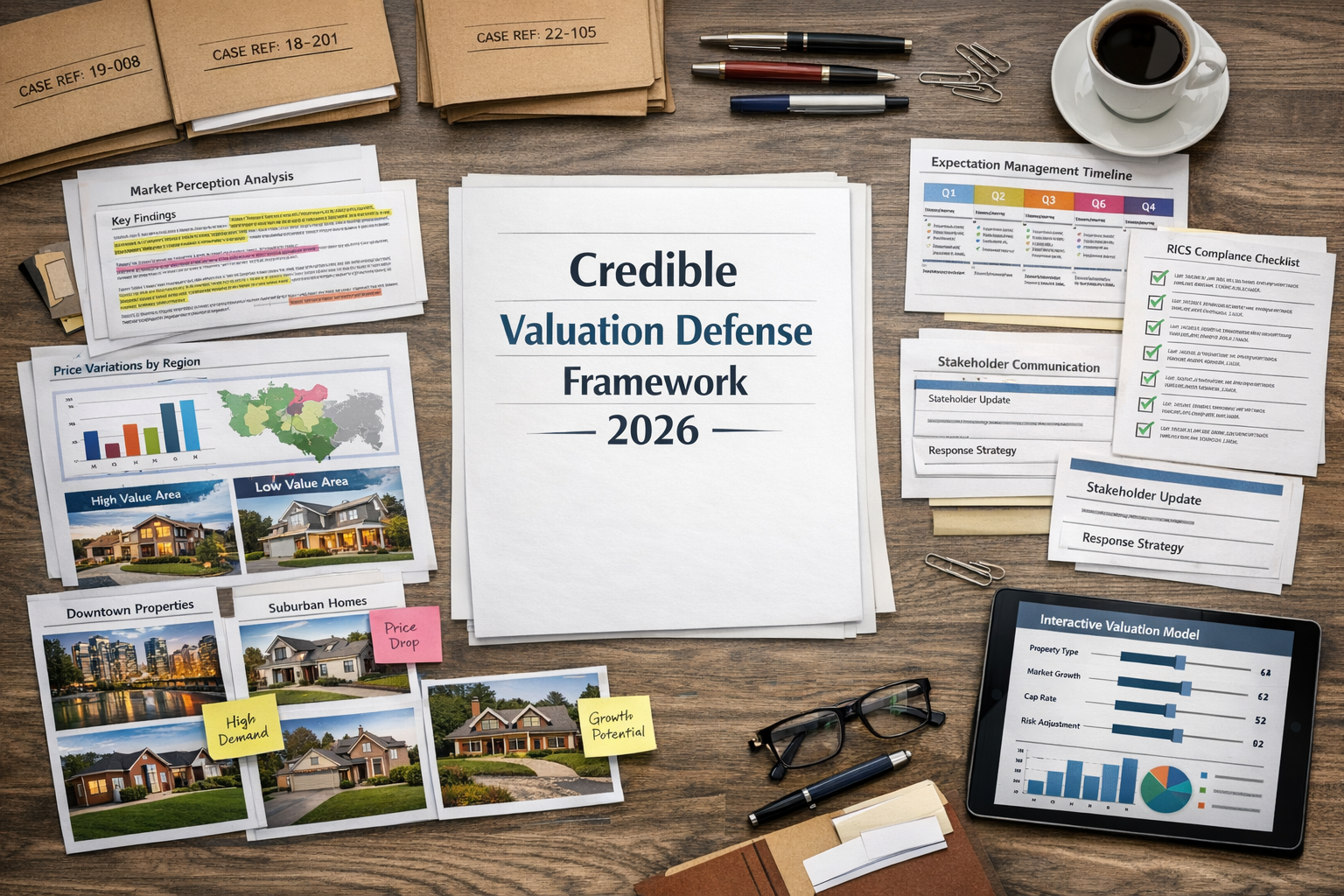
Smart expert witnesses conduct thorough pre-litigation reviews before accepting instructions. This involves:
🔍 Conflict checking (ensuring independence from all parties)
🔍 Competence assessment (confirming expertise in the property type and market)
🔍 Data availability review (identifying potential evidence gaps early)
🔍 Opposing expert prediction (anticipating counterarguments)
🔍 Fee structure clarity (avoiding commercial pressure on opinions)
Early identification of weaknesses allows expert witnesses to address them proactively or decline unsuitable instructions. This protects professional reputation and ensures compliance with surveyor responsibilities.
Collaboration With Legal Teams
Effective expert witnesses work collaboratively with instructing solicitors while maintaining independence. This relationship involves:
- Early case strategy discussions (without compromising independence)
- Evidence gap identification (highlighting additional data needs)
- Report drafting coordination (ensuring reports address legal issues)
- Cross-examination preparation (anticipating opposing counsel tactics)
- Joint expert meetings (when ordered by the court)
The key distinction: expert witnesses advise on valuation matters but never allow legal strategy to influence their professional opinions. This independence forms the foundation of expert credibility.
Responding to Opposing Expert Reports
When opposing experts present contradictory valuations, professional response requires careful analysis:
- Identify methodology differences (are different approaches justified?)
- Compare comparable selections (which properties provide better evidence?)
- Analyze adjustment calculations (are adjustments supported by market data?)
- Review assumption differences (are assumptions reasonable and disclosed?)
- Assess data quality (which expert used more reliable information?)
Rather than attacking opposing experts personally, focus on methodological critique. This professional approach enhances credibility while highlighting weaknesses in alternative valuations.
Preparing for Cross-Examination
Cross-examination represents the ultimate test of expert witness credibility. Preparation involves:
Technical preparation:
- Review all documentation thoroughly
- Recalculate key figures to ensure accuracy
- Prepare exhibits that clarify complex points
- Anticipate mathematical challenges to calculations
Communication preparation:
- Practice explaining technical concepts in plain language
- Develop analogies that clarify valuation principles
- Prepare concise responses to common challenges
- Maintain composure under aggressive questioning
Expert witnesses should remember their audience: judges and juries often lack property expertise. Clear communication matters as much as technical accuracy. Those who can explain complex valuation concepts in accessible terms gain significant advantage.
Leveraging Technology in Expert Testimony
In 2026, technology enhances expert witness effectiveness:
💻 Digital evidence presentation (interactive exhibits and visual aids)
💻 Data visualization tools (charts and graphs that clarify trends)
💻 Geographic information systems (mapping micro-market variations)
💻 Virtual property tours (when physical inspection is impractical)
💻 Automated comparable searches (ensuring comprehensive market coverage)
However, technology must enhance—not replace—professional judgment. Expert witnesses who over-rely on automated valuation models without critical analysis risk credibility damage during cross-examination.
Navigating Regional Variations in Expert Witness Valuations
London Market Considerations
The London property market presents unique challenges for expert witnesses. Extreme price variations exist within short distances, making micro-market analysis essential. London property surveyors must account for:
- Transport connectivity (proximity to Underground stations)
- Conservation areas (restrictions on alterations affecting value)
- Leasehold complications (ground rent and service charge impacts)
- International buyer influence (currency fluctuations and political factors)
Expert witnesses working in London should demonstrate familiarity with these local factors. Generic valuation approaches lack credibility in this sophisticated market.
Suburban and Regional Markets
Markets outside central London often show different dynamics during stabilization periods. Expert witnesses must understand:
- Commuter patterns (changing work-from-home trends affecting values)
- Local economic drivers (major employers and industry concentration)
- Housing supply dynamics (new development impact on existing values)
- Demographic trends (population growth or decline)
Building surveyors working across multiple regions should tailor their analysis to local conditions rather than applying uniform methodologies.
Specialized Property Types
Different property types require specialized expertise:
Residential properties:
- Emotional factors influence values beyond financial metrics
- Structural defects significantly impact value
- Renovation potential affects buyer perception
- School catchments create value premiums
Commercial properties:
- Lease terms dominate valuation
- Tenant quality affects investment appeal
- Market rent evidence requires careful analysis
- Obsolescence factors vary by property use
Development sites:
- Planning permission status critical
- Residual valuation methodology applies
- Construction project legal requirements affect feasibility
- Market timing assumptions become contentious
Expert witnesses should only accept instructions within their competence areas. Attempting to value unfamiliar property types undermines credibility and violates professional standards.
Common Pitfalls in Expert Witness Valuations
Over-Reliance on Automated Valuation Models
Automated Valuation Models (AVMs) provide useful screening tools but lack the nuance required for expert testimony. Common AVM limitations include:
❌ Inability to assess condition (assumes average condition)
❌ Limited comparable selection (algorithm-driven without professional judgment)
❌ Poor performance in unique properties (relies on standardized characteristics)
❌ Weak momentum market accuracy (trained on historical data patterns)
Expert witnesses who rely heavily on AVMs face devastating cross-examination. These tools should inform—not determine—professional opinions.
Insufficient Comparable Adjustment Documentation
Many valuation disputes center on comparable adjustments. Expert witnesses must document:
- Adjustment magnitude (percentage or absolute amount)
- Market evidence supporting the adjustment
- Calculation methodology (how the adjustment was derived)
- Consistency (similar adjustments for similar differences)
Vague statements like "adjusted for superior condition" lack persuasive power. Specific documentation such as "adjusted upward by £25,000 based on recent kitchen renovation costing £30,000, with 83% cost recovery typical in this market" demonstrates rigorous analysis.
Ignoring Market Psychology
Technical valuation accuracy means little if market psychology drives actual transaction prices. Expert witnesses must consider:
- Buyer sentiment (optimism or pessimism affecting offers)
- Seller motivation (urgency influencing acceptance of offers)
- Media narrative (how market coverage shapes perceptions)
- Economic outlook (employment and interest rate expectations)
In stabilizing markets with weak momentum, psychology often explains why technically sound valuations don't match transaction prices. Expert witnesses who ignore these factors appear out of touch with market realities.
Inadequate Independence Safeguards
Expert witnesses owe their primary duty to the court, not the instructing party. Common independence threats include:
⚠️ Contingent fees (payment dependent on case outcome)
⚠️ Commercial relationships (ongoing business with instructing party)
⚠️ Advocacy creep (adopting client's perspective unconsciously)
⚠️ Selective evidence (highlighting favorable data while ignoring contradictions)
Maintaining independence requires conscious effort and robust internal procedures. Expert witnesses should document their independence safeguards and disclose any potential conflicts promptly.
The Future of Expert Witness Valuations
Emerging Trends in 2026 and Beyond
The expert witness field continues evolving:
🔮 Increased data transparency (more market information publicly available)
🔮 Enhanced scrutiny (courts demanding higher evidence standards)
🔮 Technology integration (digital tools becoming standard practice)
🔮 Specialization (growing demand for niche property expertise)
🔮 International standards (convergence of valuation methodologies globally)
Expert witnesses who invest in continuous professional development maintain competitive advantage. The field rewards those who combine technical excellence with effective communication.
Professional Development for Expert Witnesses
Maintaining expertise requires ongoing investment:
- RICS continuing professional development (annual requirements)
- Court skills training (testimony and cross-examination techniques)
- Market research (staying current with local market conditions)
- Methodology updates (learning new analytical approaches)
- Technology proficiency (mastering relevant software and tools)
Real estate assessment professionals who aspire to expert witness work should seek mentorship from experienced practitioners. Court testimony skills develop through practice and feedback.
Conclusion
Expert Witness Valuations in Stabilising Markets: Building Credible Cases When Price Momentum Remains Weak demands a sophisticated blend of technical expertise, methodological rigor, and strategic communication. In 2026, the stabilization-momentum paradox creates unique challenges that require expert witnesses to move beyond traditional valuation approaches.
Success in this environment depends on several critical factors:
✓ Micro-market analysis that acknowledges regional disparities rather than relying on broad market generalizations
✓ Perception management that addresses stakeholder expectations alongside objective fundamentals
✓ Meticulous documentation that withstands aggressive cross-examination
✓ RICS compliance ensuring independence and professional standards
✓ Clear communication that makes complex valuation concepts accessible to non-experts
The expert witnesses who thrive in 2026 recognize that valuation credibility extends beyond technical accuracy. Market perception studies, stakeholder expectation management, and transparent communication of uncertainty have become as important as comparable analysis and adjustment calculations.
Actionable Next Steps
For property professionals seeking to strengthen their expert witness capabilities:
- Conduct a competence audit: Identify your areas of genuine expertise and decline instructions outside those boundaries
- Develop documentation systems: Create templates and checklists ensuring comprehensive evidence gathering
- Invest in market perception research: Build relationships with agents, buyers, and sellers to understand sentiment
- Pursue specialized training: Enroll in RICS expert witness courses and court skills workshops
- Build a comparable database: Maintain detailed records of transactions in your specialist markets
- Review recent case law: Study how courts have evaluated expert testimony in similar disputes
- Establish independence protocols: Implement procedures that safeguard your objectivity
The property market will continue evolving, but the fundamental principles of expert witness work remain constant: independence, competence, transparency, and clear communication. Those who master these principles while adapting to changing market conditions will find growing demand for their services.
Whether you're defending a property valuation in litigation or preparing for potential disputes, the strategies outlined in this guide provide a framework for building credible cases. In markets characterized by stabilization and weak momentum, this credibility becomes your most valuable asset—one that no amount of technical sophistication can replace.
For property owners and professionals facing valuation disputes, engaging qualified expert witnesses early in the process provides significant advantages. The right expert can identify weaknesses in opposing valuations, strengthen your position through rigorous analysis, and communicate complex concepts effectively to decision-makers.
As we progress through 2026, the property market will undoubtedly present new challenges. However, expert witnesses who combine technical excellence with strategic insight will continue to play an essential role in resolving valuation disputes fairly and efficiently. The future belongs to those who recognize that credible valuations require both science and art—objective analysis tempered by market understanding and communicated with clarity and confidence.
References
[1] Expert Witness Testimonies In 2026 Valuation Disputes Rics Strategies Amid Stabilising House Prices And Regional Divides – https://nottinghillsurveyors.com/blog/expert-witness-testimonies-in-2026-valuation-disputes-rics-strategies-amid-stabilising-house-prices-and-regional-divides
[2] Managing Expectations In 2026 Why Valuation Stability Depends On Perception Not Just Performance – https://www.ir-impact.com/2026/01/managing-expectations-in-2026-why-valuation-stability-depends-on-perception-not-just-performance/