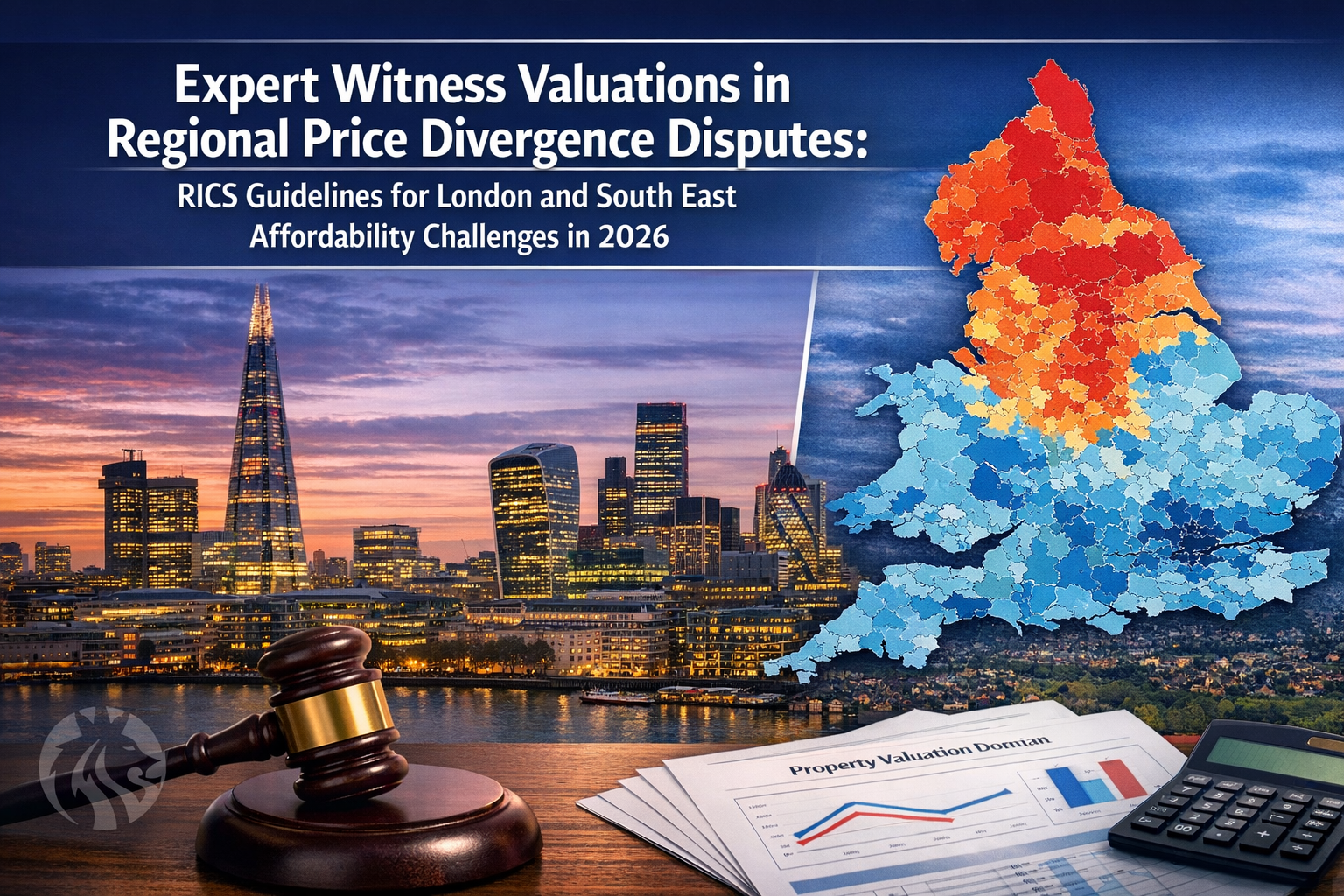
{"cover":"Professional landscape format (1536x1024) hero image featuring bold text overlay 'Expert Witness Valuations in Regional Price Divergence Disputes: RICS Guidelines for London and South East Affordability Challenges in 2026' in extra large 72pt white sans-serif font with dark shadow and semi-transparent navy overlay box, positioned in upper third. Background shows split-screen composition: left side displays iconic London skyline with Shard and financial district at dusk, right side shows regional UK property market heat map with contrasting colors showing price divergence between London/South East (cooler blues) and northern regions (warmer reds). Foreground includes subtle RICS logo watermark, professional courtroom gavel, and property valuation documents. Color scheme: deep navy, white, gold accents. High contrast, magazine cover quality, editorial style with financial sophistication.","content":["Detailed landscape format (1536x1024) illustration showing RICS expert witness professional in business attire examining dual property valuation reports side-by-side on modern glass desk. Left report displays London property with declining value graph trending downward, right report shows northern England property with ascending value curve. Background features transparent overlay of RICS 5th Edition standards document pages with highlighted sections on objectivity and tribunal duty. Include visual elements: magnifying glass over regional price data, digital tablet showing AI-assisted valuation tools, conflict of interest disclosure checklist, and scales of justice symbolizing impartiality. Color palette: professional navy, silver, white with accent highlighting. Clean, authoritative business aesthetic with legal precision.","Comprehensive landscape format (1536x1024) infographic-style image displaying detailed UK property market heat map for 2026 with clear regional price divergence patterns. Map shows London and South East in cooler blue/purple tones indicating slower growth, contrasted with northern regions (Manchester, Leeds, Newcastle) in warm orange/red showing higher appreciation rates. Overlay includes percentage growth indicators, affordability ratio calculations, and comparative price-per-square-foot metrics. Side panels show stacked bar charts comparing regional performance, median income-to-house-price ratios, and transaction volume trends. Include property icons, percentage symbols, upward/downward trend arrows, and data visualization elements. Professional financial reporting aesthetic with clear data hierarchy and RICS branding elements.","Detailed landscape format (1536x1024) conceptual illustration depicting expert witness valuation methodology for regional disputes. Central focus shows professional surveyor conducting comparative market analysis with multiple property photographs arranged in grid format, each labeled with location and valuation. Visual elements include: Red Book valuation standards checklist, regional market adjustment factors table, comparable sales evidence files, digital evidence management system interface, and AI-assisted analysis tools dashboard. Background features courtroom setting with witness stand, suggesting tribunal environment. Include visual representations of conflict disclosure forms, independence certification documents, and quality assurance protocols. Color scheme: authoritative charcoal, professional blue, white with gold accents. Legal-financial hybrid aesthetic with documentary precision and professional gravitas."]}
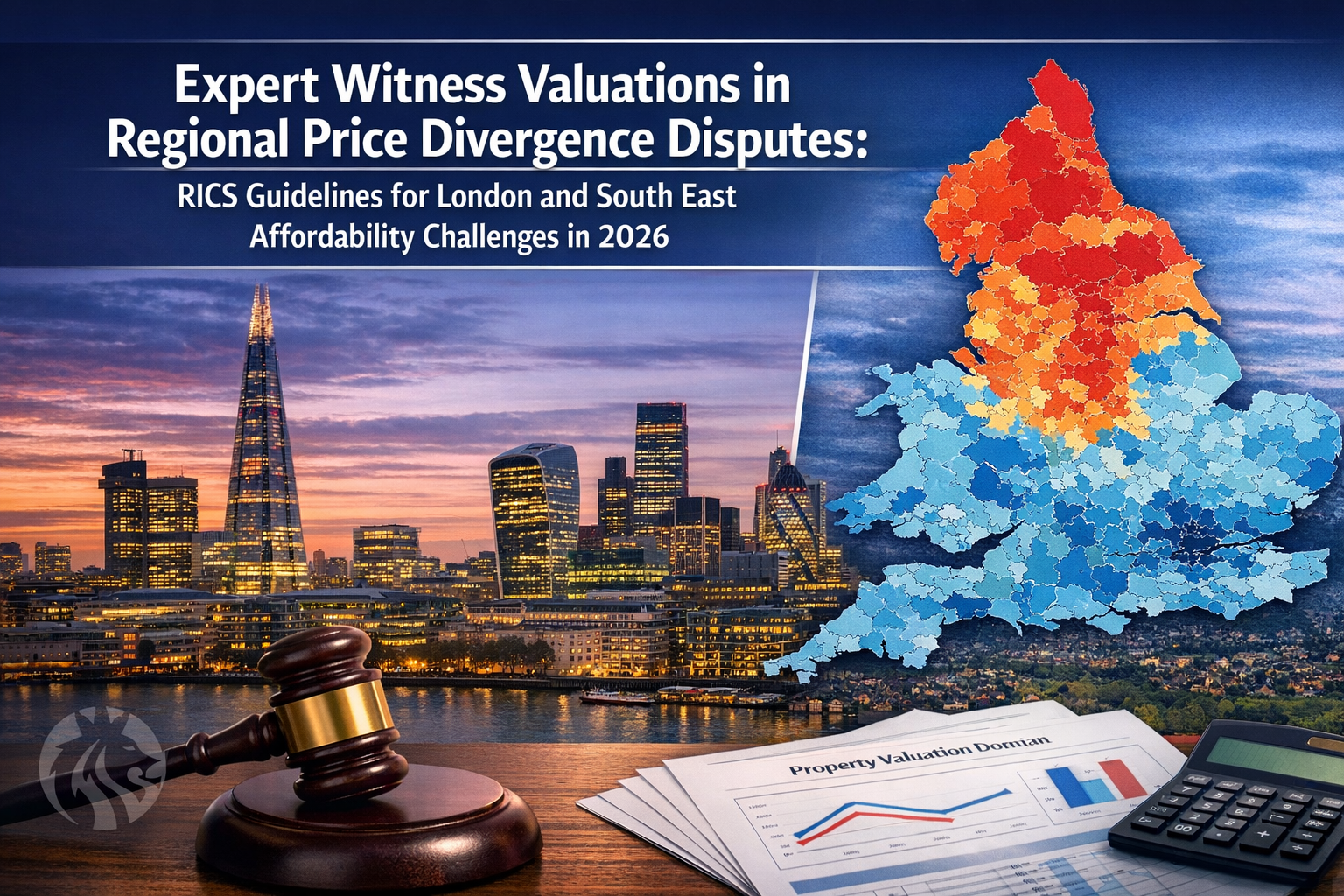
The UK property market in 2026 presents an unprecedented challenge for expert witnesses: while northern regions experience robust growth, London and the South East lag significantly behind national averages. This regional price divergence creates complex valuation disputes requiring sophisticated analysis and strict adherence to professional standards. Expert Witness Valuations in Regional Price Divergence Disputes: RICS Guidelines for London and South East Affordability Challenges in 2026 have become essential tools for navigating these turbulent market conditions, where traditional valuation methods may no longer provide adequate justification in tribunal settings.
As property professionals increasingly find themselves called to provide expert testimony in disputes arising from these regional disparities, understanding the latest RICS standards and their application to London and South East affordability challenges becomes critical. The stakes are high—incorrect valuations or inadequate expert evidence can result in significant financial consequences and professional liability.
Key Takeaways
- 🎯 RICS 5th Edition standards reinforce that expert witnesses owe their primary duty to the tribunal, not the instructing client, requiring complete independence and objectivity in all valuations[1]
- 📊 Regional price divergence between London/South East and northern regions necessitates sophisticated market-specific analysis and justification in expert witness reports
- 💡 Modern practice requirements now include provisions for AI use, digital evidence management, and enhanced conflict of interest disclosure protocols[1]
- ⚖️ Affordability challenges in London and South East markets require expert witnesses to provide contextual analysis beyond simple comparable sales data
- 🔍 Quality over advocacy remains paramount—expert witnesses must never act as advocates for their instructing party, regardless of fee arrangements[2]
Understanding RICS Expert Witness Standards for Regional Valuation Disputes

The Royal Institution of Chartered Surveyors (RICS) launched a comprehensive consultation on August 26, 2025, for the 5th edition of its expert witness standard—the first major update since 2014[1]. This timing proves particularly significant as the UK property market experiences dramatic regional divergence, with London and South East markets facing unique affordability pressures that complicate traditional valuation methodologies.
The Primary Duty Principle
At the heart of Expert Witness Valuations in Regional Price Divergence Disputes: RICS Guidelines for London and South East Affordability Challenges in 2026 lies a fundamental principle: the expert witness's primary duty is to the tribunal, not to the client[1]. This requirement becomes especially challenging when instructing parties have strong financial interests in particular valuation outcomes.
In regional price divergence disputes, this principle manifests in several practical ways:
- Objective market analysis that acknowledges both favorable and unfavorable market trends
- Transparent methodology that explains regional adjustment factors
- Balanced presentation of comparable evidence from different geographic areas
- Clear disclosure of market uncertainties and data limitations
Enhanced Conflict of Interest Requirements
The 5th edition includes significantly clearer requirements for identifying and disclosing conflicts of interest, with explicit explanation of legal consequences for non-compliance[1]. For valuers working in the London and South East markets, common conflict scenarios include:
| Conflict Type | Example | Disclosure Requirement |
|---|---|---|
| Prior relationship | Previously valued same property for opposing party | Full disclosure before accepting instruction |
| Financial interest | Holds property in same development | Decline instruction |
| Professional connections | Regular work for one party's solicitors | Disclose relationship and assess independence |
| Geographic specialization | Only values properties in specific London postcodes | Disclose potential bias toward local market knowledge |
When engaging RICS surveyors for expert witness work, parties should expect rigorous conflict checking procedures as standard practice.
Modern Practice Provisions
The updated standard recognizes contemporary challenges facing expert witnesses, including provisions for AI use, digital evidence, and new legal procedures[1]. In the context of regional price divergence disputes, these provisions address:
- 🤖 Artificial intelligence tools for comparable sales analysis and market trend identification
- 📱 Digital evidence management systems for organizing regional market data
- 💻 Virtual tribunal participation and remote evidence presentation
- 🔐 Data security protocols for sensitive valuation information
These technological considerations prove particularly relevant when analyzing London and South East markets, where big data analytics can reveal subtle pricing patterns invisible to traditional analysis methods.
Regional Price Divergence: London and South East Market Dynamics in 2026
The affordability crisis facing London and South East England in 2026 creates a complex backdrop for expert witness valuations. Understanding these regional dynamics is essential for providing credible, defensible expert evidence in property disputes.
The North-South Divide Intensifies
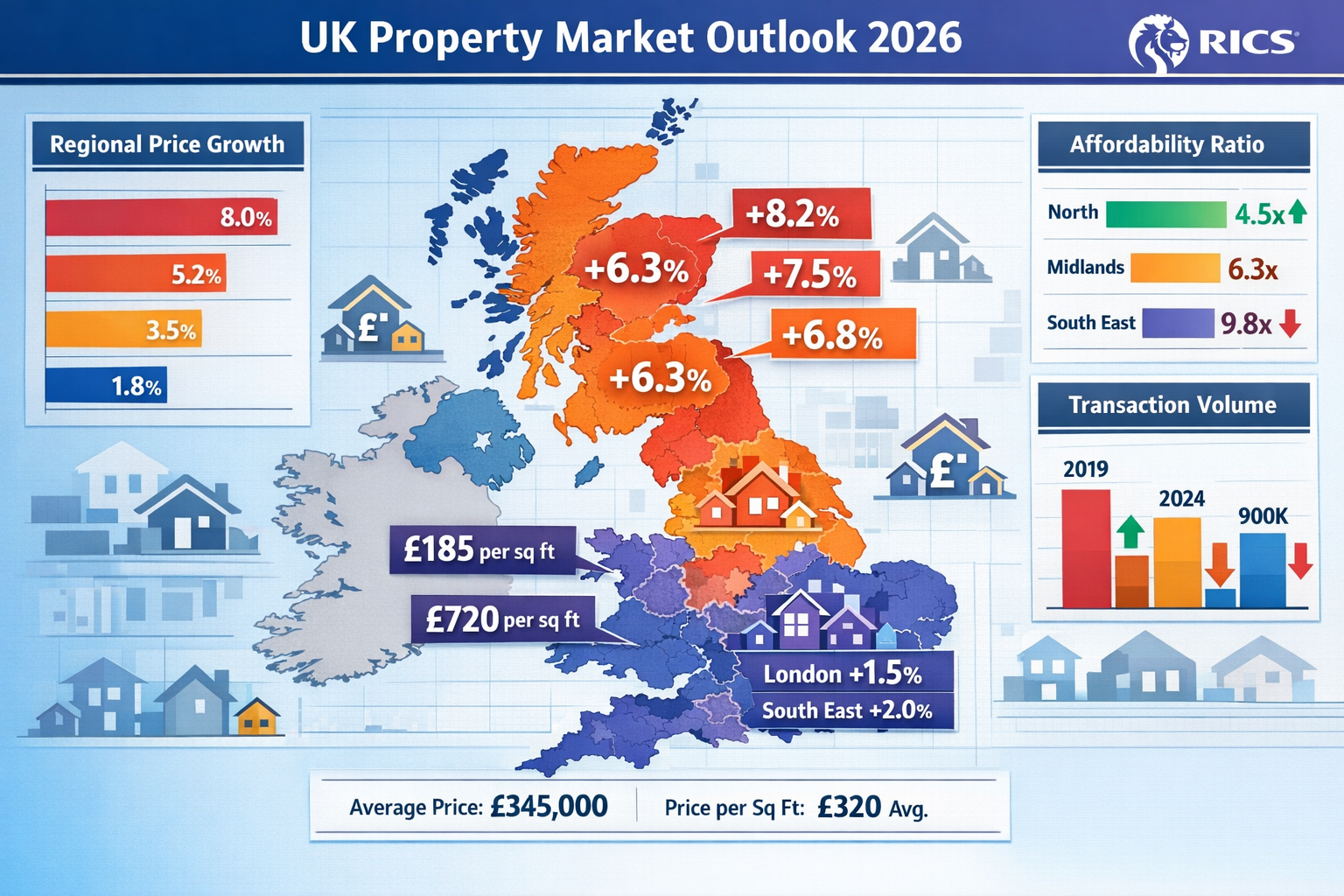
Current market data reveals a stark divergence between regional performance metrics. While northern cities experience robust price appreciation driven by improved infrastructure and remote working patterns, London and South East markets face headwinds from:
- Affordability constraints limiting first-time buyer access
- Stamp duty burdens disproportionately affecting higher-value properties
- Demographic shifts as younger professionals relocate to more affordable regions
- Economic uncertainty affecting financial services employment in the capital
For expert witnesses conducting property valuations, these factors require careful consideration when selecting comparable evidence and applying market adjustments.
Affordability Metrics and Expert Analysis
Expert witness valuations in regional price divergence disputes must address affordability challenges through quantitative analysis. Key metrics include:
Income-to-Price Ratios
- London average: 12-14x median household income
- South East average: 10-12x median household income
- Northern regions average: 5-7x median household income
Rental Yield Comparisons
- London prime areas: 2.5-3.5% gross yield
- South East commuter belt: 3.5-4.5% gross yield
- Northern cities: 5.0-7.0% gross yield
These disparities create valuation challenges when parties dispute whether a property's value reflects genuine market conditions or temporary distortions. Expert witnesses must provide sophisticated analysis that contextualizes individual property values within broader regional trends.
Market Segmentation Considerations
Expert Witness Valuations in Regional Price Divergence Disputes: RICS Guidelines for London and South East Affordability Challenges in 2026 require recognition that London and South East markets are not monolithic. Significant variation exists across:
- Geographic micro-markets (e.g., Knightsbridge vs. outer boroughs)
- Property types (prime central vs. suburban family homes)
- Price brackets (sub-£500k vs. £1m+ segments)
- Tenure types (freehold vs. leasehold properties)
Expert witnesses must demonstrate granular understanding of these segments when providing valuation evidence, avoiding overly broad generalizations about "the London market."
Applying RICS Standards to London and South East Valuation Challenges
Translating RICS expert witness standards into practical application for regional price divergence disputes requires methodological rigor and clear communication. The following framework helps expert witnesses navigate these complex assignments.
Comparable Evidence Selection and Adjustment
The cornerstone of defensible expert witness valuations remains appropriate comparable evidence. In markets experiencing regional divergence, this process becomes more nuanced:
Geographic Scope Decisions
When valuing a property in Richmond or Bromley, expert witnesses must determine:
- How wide a geographic net to cast for comparables
- Whether to include evidence from outperforming northern regions
- How to weight local vs. regional market trends
- When to adjust for micro-market variations
Temporal Considerations
Regional price divergence creates timing challenges:
- Markets moving at different speeds require careful date-of-valuation analysis
- Historical comparables may not reflect current regional trends
- Forward-looking adjustments must be justified and conservative
Adjustment Methodology
Expert witnesses should document adjustment factors for:
- Location premiums/discounts relative to regional averages
- Condition differences requiring specific defect surveys
- Size and specification variations
- Market conditions between comparable sale dates and valuation date
Red Book Compliance in Expert Witness Work
While expert witness valuations differ from standard Red Book valuations, RICS standards require adherence to core professional principles. Expert witnesses must:
✅ Maintain competence in the specific geographic market and property type
✅ Exercise independence from instructing party influence
✅ Provide objective opinions supported by market evidence
✅ Disclose limitations in available data or analysis
✅ Document methodology with sufficient detail for peer review
The global applicability of RICS standards means these principles apply worldwide while recognizing local legal differences[1], ensuring consistency whether the dispute involves London property or international assets.
Addressing Affordability Challenges in Expert Reports
Expert Witness Valuations in Regional Price Divergence Disputes: RICS Guidelines for London and South East Affordability Challenges in 2026 must explicitly address how affordability constraints affect market value. This requires:
Contextual Market Analysis
- Explanation of how income constraints limit buyer pools
- Analysis of mortgage availability at different price points
- Discussion of government intervention programs (Help to Buy, shared ownership)
- Assessment of investor vs. owner-occupier demand dynamics
Demand-Supply Considerations
- Quantification of housing shortage in specific London/South East sub-markets
- Analysis of planning constraints limiting new supply
- Evaluation of demographic trends affecting demand
- Assessment of competing regional markets drawing buyers away
Risk Factor Disclosure
Expert witnesses must acknowledge uncertainties:
"Regional price divergence creates valuation uncertainty. While comparable evidence supports the stated value, ongoing affordability pressures and economic uncertainty present downside risks to future price performance."
This balanced approach satisfies the objectivity requirement while providing useful guidance to tribunals.
Best Practices for Expert Witnesses in Regional Valuation Disputes
Successfully navigating Expert Witness Valuations in Regional Price Divergence Disputes: RICS Guidelines for London and South East Affordability Challenges in 2026 requires adherence to established best practices that maintain professional standards while addressing market complexities.
Report Structure and Content Requirements
Expert witness reports in regional price divergence disputes should follow a clear structure:
1. Executive Summary
- Concise statement of valuation opinion
- Brief explanation of regional market context
- Summary of key methodology choices
2. Instructions and Scope
- Clear statement of questions posed by tribunal or instructing party
- Confirmation of independence and absence of conflicts
- Acknowledgment of primary duty to tribunal[1]
3. Property Description
- Detailed physical description
- Location analysis within regional context
- Tenure details and any restrictions
4. Market Analysis
- Regional market trends affecting the subject property
- Affordability analysis specific to the sub-market
- Supply-demand dynamics
- Comparison with national and regional benchmarks
5. Valuation Methodology
- Explanation of approach (comparative, investment, residual)
- Comparable evidence with detailed analysis
- Adjustment rationale and calculations
- Alternative methodology consideration
6. Valuation Conclusion
- Clear statement of opinion
- Range or point estimate as appropriate
- Limitations and assumptions
- Sensitivity analysis for key variables
7. Supporting Documentation
- Comparable evidence schedules
- Market data sources
- Photographs and plans
- Relevant correspondence
Managing Client Expectations While Maintaining Independence
One of the most challenging aspects of expert witness work involves managing instructing party expectations while maintaining the independence required by RICS standards[2]. Expert witnesses must:
Set Clear Boundaries
- Explain at instruction stage that opinions cannot be guaranteed to favor the client
- Clarify that the expert witness role differs from advocacy
- Establish that reports may include adverse findings
Communicate Transparently
- Provide preliminary findings before finalizing reports
- Explain reasoning when conclusions differ from client expectations
- Offer opportunities for factual corrections without compromising independence
Document Independence
- Maintain written records of all instructions and communications
- Decline requests to modify opinions for tactical reasons
- Withdraw from instruction if independence becomes compromised
This approach protects both the expert witness's professional reputation and the integrity of the tribunal process.
Preparation for Cross-Examination
Expert witnesses providing valuations in regional price divergence disputes should anticipate rigorous cross-examination on:
Methodology Choices
- Why specific comparables were selected or rejected
- How regional adjustments were calculated
- Whether alternative methodologies would yield different results
Market Assumptions
- Basis for affordability impact assessments
- Justification for regional trend projections
- Treatment of market uncertainties
Professional Qualifications
- Experience in the specific geographic market
- Familiarity with regional price dynamics
- Previous expert witness experience
Thorough preparation includes:
- 📋 Reviewing all comparable evidence and supporting documentation
- 🎯 Anticipating weaknesses in analysis and preparing responses
- 💼 Practicing clear, concise explanations of technical concepts
- 📊 Preparing visual aids to illustrate regional market trends
- ⚖️ Understanding the legal context and issues in dispute
Leveraging Technology While Maintaining Professional Standards
The 5th edition RICS standards acknowledge the role of technology in modern expert witness practice[1]. When addressing London and South East affordability challenges, expert witnesses can utilize:
Data Analytics Tools
- Automated comparable sales databases
- Geographic information systems (GIS) for location analysis
- Statistical modeling for regional trend analysis
- AI-assisted market research and data synthesis
Digital Evidence Management
- Cloud-based document organization systems
- Secure client portals for information exchange
- Digital signature and authentication protocols
- Version control for report iterations
Presentation Technology
- Interactive market data visualizations
- Virtual property tours and inspection records
- Remote testimony platforms
- Digital exhibit management
However, expert witnesses must ensure technology enhances rather than replaces professional judgment. All AI-assisted analysis should be verified, and experts must be prepared to explain and defend technology-driven conclusions.
Continuing Professional Development
Given the rapidly evolving nature of regional property markets and RICS standards, expert witnesses must maintain current knowledge through:
- Regular review of RICS guidance updates and consultations
- Attendance at property market briefings and seminars
- Subscription to market data services covering London and South East regions
- Peer review and discussion with fellow expert witnesses
- Formal CPD programs addressing expert witness competencies
The RICS surveys framework provides a foundation, but expert witness work requires additional specialized knowledge and skills development.
Common Pitfalls and How to Avoid Them
Expert witnesses working on regional price divergence disputes face several common challenges that can undermine the credibility and effectiveness of their evidence.
Advocacy Creep
The Problem: Gradually shifting from objective analysis toward supporting the instructing party's position.
Warning Signs:
- Selective presentation of favorable comparables
- Downplaying market evidence that contradicts client's position
- Using language that suggests partisan support
- Modifying opinions based on client feedback rather than new evidence
Solutions:
- Regular self-assessment of independence and objectivity
- Peer review of reports before submission
- Clear documentation of all methodology decisions
- Willingness to provide opinions adverse to instructing party when evidence requires
RICS standards explicitly prohibit expert witnesses from acting as advocates[2], making this distinction critical to professional compliance.
Inadequate Regional Market Analysis
The Problem: Applying generic London market assumptions without recognizing sub-market variations.
Warning Signs:
- Using comparables from significantly different micro-markets
- Failing to account for transport infrastructure variations
- Ignoring local planning or development impacts
- Applying broad regional adjustments without justification
Solutions:
- Develop granular knowledge of specific London and South East sub-markets
- Utilize location-specific data from areas like Fulham, Chelsea, or Chiswick
- Document local market research and intelligence
- Consult with local agents and market participants
Insufficient Conflict Checking
The Problem: Failing to identify or disclose potential conflicts of interest.
Warning Signs:
- Accepting instructions without thorough conflict searches
- Dismissing minor connections as immaterial
- Failing to update conflict checks as matters develop
- Inadequate documentation of conflict analysis
Solutions:
- Implement robust conflict checking procedures before accepting instructions
- Maintain comprehensive databases of past clients and matters
- Err on the side of disclosure when conflicts are borderline
- Seek guidance from professional indemnity insurers when uncertain
The enhanced conflict disclosure requirements in the 5th edition RICS standards[1] make this area particularly important for compliance.
Over-Reliance on Automated Valuation Models
The Problem: Placing excessive weight on AVMs or algorithmic valuations in markets experiencing rapid change.
Warning Signs:
- Using AVM outputs without critical analysis
- Failing to verify AVM assumptions against market reality
- Inadequate explanation of AVM methodology to tribunals
- Insufficient comparable evidence beyond automated sources
Solutions:
- Treat AVMs as supporting evidence rather than primary methodology
- Understand and explain AVM limitations in regional divergence scenarios
- Supplement automated analysis with traditional comparable evidence
- Verify AVM outputs against market intelligence and transaction data
Inadequate Documentation
The Problem: Insufficient record-keeping to support opinions and defend methodology.
Warning Signs:
- Missing comparable evidence files
- Undocumented adjustment calculations
- Lack of market research sources
- Incomplete inspection notes
Solutions:
- Maintain comprehensive working files for all expert witness assignments
- Document all comparable selection and rejection decisions
- Preserve market research sources and data
- Create detailed inspection records and photographic evidence
- Implement quality assurance review procedures
Similar to the documentation requirements for homebuyers reports, expert witness files should withstand scrutiny and enable reconstruction of the analysis process.
Practical Case Studies: Regional Price Divergence Scenarios
Understanding how Expert Witness Valuations in Regional Price Divergence Disputes: RICS Guidelines for London and South East Affordability Challenges in 2026 apply in practice helps illustrate key principles.
Case Study 1: Divorce Settlement Valuation Dispute
Scenario: A divorcing couple disputes the value of their South East family home. The selling spouse's expert values the property at £850,000 based on comparable sales from 2024-2025. The buying spouse's expert values it at £775,000, arguing that regional market softening and affordability constraints have depressed values in 2026.
Key Issues:
- Temporal adjustment for changing market conditions
- Weight given to recent vs. historical comparables
- Treatment of affordability impact on buyer demand
- Selection of appropriate comparable properties
Expert Witness Approach:
- Analyze transaction volumes and price trends specific to the sub-market
- Consider both historical comparables and recent market evidence
- Assess affordability metrics and mortgage availability data
- Provide range estimate reflecting market uncertainty
- Maintain objectivity despite partisan instructions
Outcome: The tribunal accepted a mid-point valuation after expert witnesses met and agreed on comparable evidence, demonstrating the value of professional dialogue and objectivity.
Case Study 2: Compulsory Purchase Compensation
Scenario: A local authority acquires property for infrastructure development in outer London. The owner's expert witness argues for £1.2 million compensation based on comparable sales in more desirable neighboring areas. The authority's expert values the property at £950,000, citing the specific location's affordability challenges and limited demand.
Key Issues:
- Geographic scope of comparable evidence
- Adjustment for location differences within regional market
- Treatment of special purchaser considerations
- Impact of development potential and planning constraints
Expert Witness Approach:
- Define appropriate geographic search area for comparables
- Quantify location adjustments with supporting market evidence
- Analyze planning policy and development potential
- Consider impact of infrastructure project on local market
- Address affordability constraints specific to the location
Outcome: The expert witnesses' joint statement narrowed the valuation gap to £100,000, facilitating settlement and demonstrating the effectiveness of collaborative professional analysis.
Case Study 3: Leasehold Enfranchisement Dispute
Scenario: Leaseholders seeking to acquire the freehold of their London apartment building dispute the valuation. The freeholder's expert values the freehold interest at £2.5 million based on investment yields from prime central London. The leaseholders' expert values it at £1.8 million, arguing that regional market divergence has increased yields and reduced capital values.
Key Issues:
- Appropriate investment yield for the specific location and property type
- Treatment of regional market trends in investment valuations
- Comparable evidence from investment transactions
- Impact of leasehold reform legislation on valuations
Expert Witness Approach:
- Research investment transaction evidence across London sub-markets
- Analyze yield trends in different regional markets
- Consider legislative changes affecting leasehold investments
- Assess property-specific factors affecting investment appeal
- Provide sensitivity analysis showing impact of yield variations
Outcome: The tribunal accepted the leaseholders' expert's analysis of regional yield trends, resulting in a valuation closer to their position and highlighting the importance of current market evidence in rapidly changing conditions.
The Future of Expert Witness Valuations in Regional Markets
As Expert Witness Valuations in Regional Price Divergence Disputes: RICS Guidelines for London and South East Affordability Challenges in 2026 continue to evolve, several trends will shape professional practice in coming years.
Enhanced Data Analytics and AI Integration
The 5th edition RICS standards acknowledge the growing role of artificial intelligence in expert witness practice[1]. Future developments will likely include:
- Predictive modeling for regional market trends and price trajectories
- Machine learning algorithms identifying comparable properties across larger datasets
- Natural language processing analyzing market sentiment and news impacts
- Blockchain verification of transaction data and property histories
Expert witnesses will need to develop competence in these technologies while maintaining the professional judgment and critical analysis that distinguishes expert opinion from automated outputs.
Climate and Sustainability Considerations
Regional price divergence may increasingly reflect climate risks and sustainability factors:
- Flood risk variations across London and South East regions
- Energy performance requirements affecting property values
- Green space accessibility and environmental quality
- Climate adaptation infrastructure investments
Expert witnesses will need to incorporate environmental risk assessment into regional market analysis, potentially requiring additional technical expertise or collaboration with environmental specialists.
Regulatory and Policy Changes
Government interventions addressing affordability challenges will continue to impact regional markets:
- Planning reforms affecting housing supply in constrained markets
- Taxation changes targeting property investment or second homes
- Mortgage regulation affecting lending in high-price regions
- Social housing requirements in new developments
Expert witnesses must stay informed about policy developments and their market impacts, incorporating regulatory analysis into valuation opinions.
Professional Standards Evolution
RICS will continue updating standards to address emerging challenges. The consultation process for the 5th edition[1] demonstrates the organization's commitment to maintaining relevant, rigorous professional requirements. Future developments may include:
- Enhanced guidance on technology use and data security
- Clearer protocols for remote inspections and virtual evidence
- Expanded conflict of interest provisions
- Strengthened quality assurance requirements
- International harmonization of expert witness standards
Maintaining compliance with evolving standards requires ongoing professional development and engagement with RICS guidance updates.
Conclusion
Expert Witness Valuations in Regional Price Divergence Disputes: RICS Guidelines for London and South East Affordability Challenges in 2026 represent a critical intersection of professional standards, market analysis, and legal process. As regional property markets continue to diverge—with London and South East facing unique affordability pressures while northern regions experience growth—the demand for sophisticated, defensible expert witness valuations will only increase.
The updated RICS 5th edition standards provide a robust framework for expert witnesses, reinforcing core principles of independence, objectivity, and primary duty to the tribunal[1]. These standards, combined with deep understanding of regional market dynamics, enable expert witnesses to provide credible, valuable evidence in complex property disputes.
Key Success Factors
Expert witnesses navigating regional price divergence disputes should focus on:
✅ Unwavering independence from instructing party influence
✅ Rigorous methodology supported by comprehensive comparable evidence
✅ Regional market expertise specific to London and South East sub-markets
✅ Transparent analysis acknowledging uncertainties and limitations
✅ Professional development maintaining current knowledge of standards and markets
✅ Technology competence leveraging modern tools while exercising professional judgment
✅ Clear communication making complex analysis accessible to tribunals
Actionable Next Steps
For property professionals seeking to develop or enhance expert witness capabilities:
- Review RICS Standards: Study the 5th edition expert witness standard and participate in relevant CPD programs
- Develop Regional Expertise: Build detailed knowledge of specific London and South East sub-markets through ongoing market research
- Establish Protocols: Implement robust conflict checking, documentation, and quality assurance procedures
- Build Networks: Connect with fellow expert witnesses for peer review and professional support
- Invest in Technology: Evaluate and adopt appropriate data analytics and evidence management tools
- Seek Mentorship: Work with experienced expert witnesses to develop practical skills and judgment
- Engage with RICS: Participate in consultations and contribute to professional standards development
The complexity of regional price divergence disputes demands the highest standards of professional practice. By adhering to RICS guidelines, maintaining rigorous methodology, and prioritizing independence and objectivity, expert witnesses can provide invaluable service to tribunals while protecting their professional reputation and contributing to fair dispute resolution.
Whether you're a property professional considering expert witness work or a party seeking expert valuation services, understanding these principles and standards is essential. The London and South East markets will continue to present unique challenges, but with proper application of professional standards and deep market knowledge, expert witnesses can navigate these complexities effectively.
For those requiring expert valuation services or professional surveying support across London and the South East, engaging qualified RICS surveyors ensures compliance with the highest professional standards and access to the expertise necessary for credible, defensible valuations in this challenging market environment.
References

[1] Rics Launches Global Consultation On Updated Expert Witness Standard – https://www.rics.org/news-insights/rics-launches-global-consultation-on-updated-expert-witness-standard
[2] Expert Witness Valuations In 2026s Stabilizing Market Rics Standards For Mortgage Disputes And Property Disagreements – https://nottinghillsurveyors.com/blog/expert-witness-valuations-in-2026s-stabilizing-market-rics-standards-for-mortgage-disputes-and-property-disagreements
[3] Building Survey Quality Standards 2026 Navigating Rics Updates And Enhanced Home Inspection Requirements 4 – https://nottinghillsurveyors.com/blog/building-survey-quality-standards-2026-navigating-rics-updates-and-enhanced-home-inspection-requirements-4