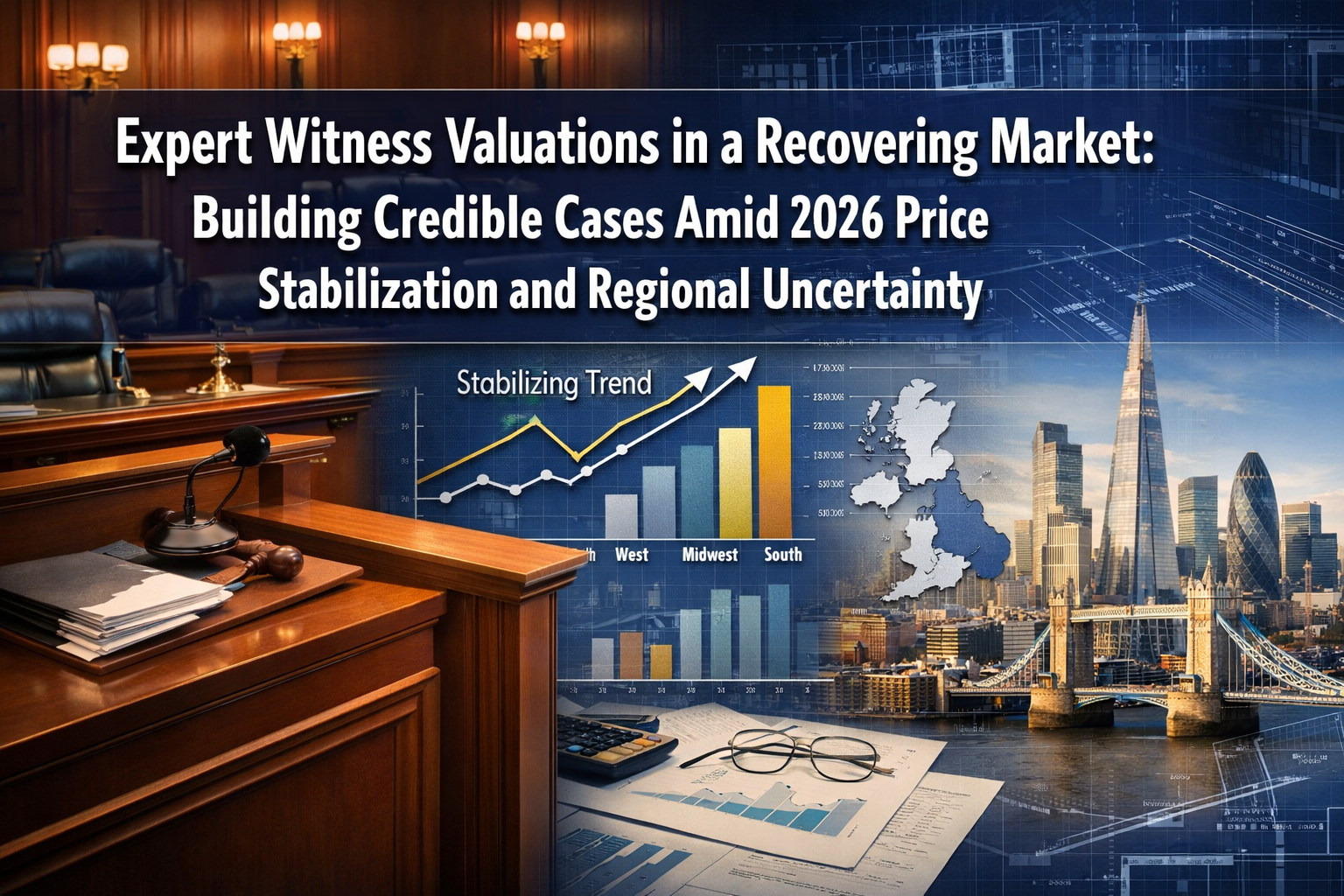
As the property market emerges from years of volatility, a new challenge confronts building surveyors and valuation professionals: defending property valuations in legal disputes when regional disparities create ambiguity about comparable evidence and market trends. Expert witness valuations in a recovering market: building credible cases amid 2026 price stabilization and regional uncertainty has become a critical competency for professionals navigating the complex intersection of property surveying, legal testimony, and market analysis.
The landscape of expert witness work in property valuation has transformed dramatically. With market stabilization creating uneven recovery patterns across different regions, surveyors must now construct defensible cases that account for localized variations while maintaining credibility under cross-examination. This challenge is particularly acute in London and surrounding areas, where property values have responded differently to economic recovery depending on location, property type, and local market conditions.
Key Takeaways
- Market stabilization in 2026 creates unique challenges for expert witnesses as regional disparities make comparable evidence selection more complex and subject to dispute
- Credible expert witness testimony requires integrated valuation methodologies, comprehensive documentation, and understanding of both local market nuances and broader economic trends
- Professional compensation for expert witness services ranges from £175 to £450 per hour, reflecting the specialized expertise required in complex litigation scenarios [1]
- Digital tools and analytics are reshaping how expert witnesses present evidence, with integrated valuation-testimony models becoming industry standard [3]
- Regional uncertainty demands thorough understanding of local market conditions, making partnerships with experienced building surveyors across London essential for credible testimony
Understanding the 2026 Market Recovery Context
The Uneven Nature of Property Market Stabilization
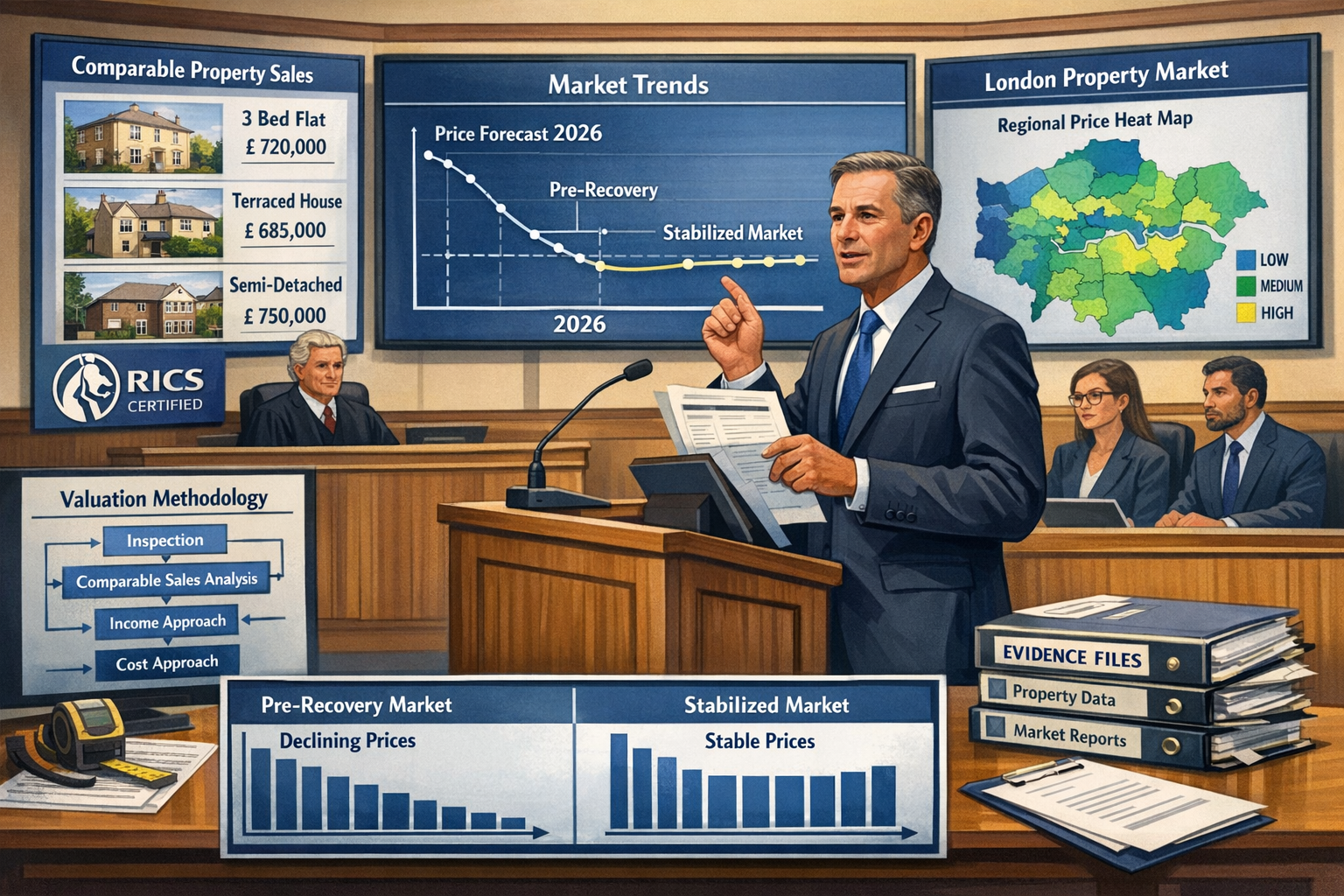
The real estate industry displays uneven performance heading into 2026, with significant variations across different sectors and geographic regions [7]. This inconsistency creates substantial challenges for expert witnesses who must defend valuation opinions in litigation contexts. Unlike periods of uniform market growth or decline, the current stabilization phase requires nuanced understanding of multiple simultaneous trends.
Key characteristics of the 2026 market recovery include:
- 📊 Price stabilization in prime London areas while peripheral regions continue adjustment
- 🏘️ Divergent performance between residential and commercial property sectors
- 🌍 Regional variations creating complex comparable selection challenges
- 📈 Emerging confidence in certain market segments alongside continued caution in others
- 💼 Increased litigation over valuations conducted during the volatile transition period
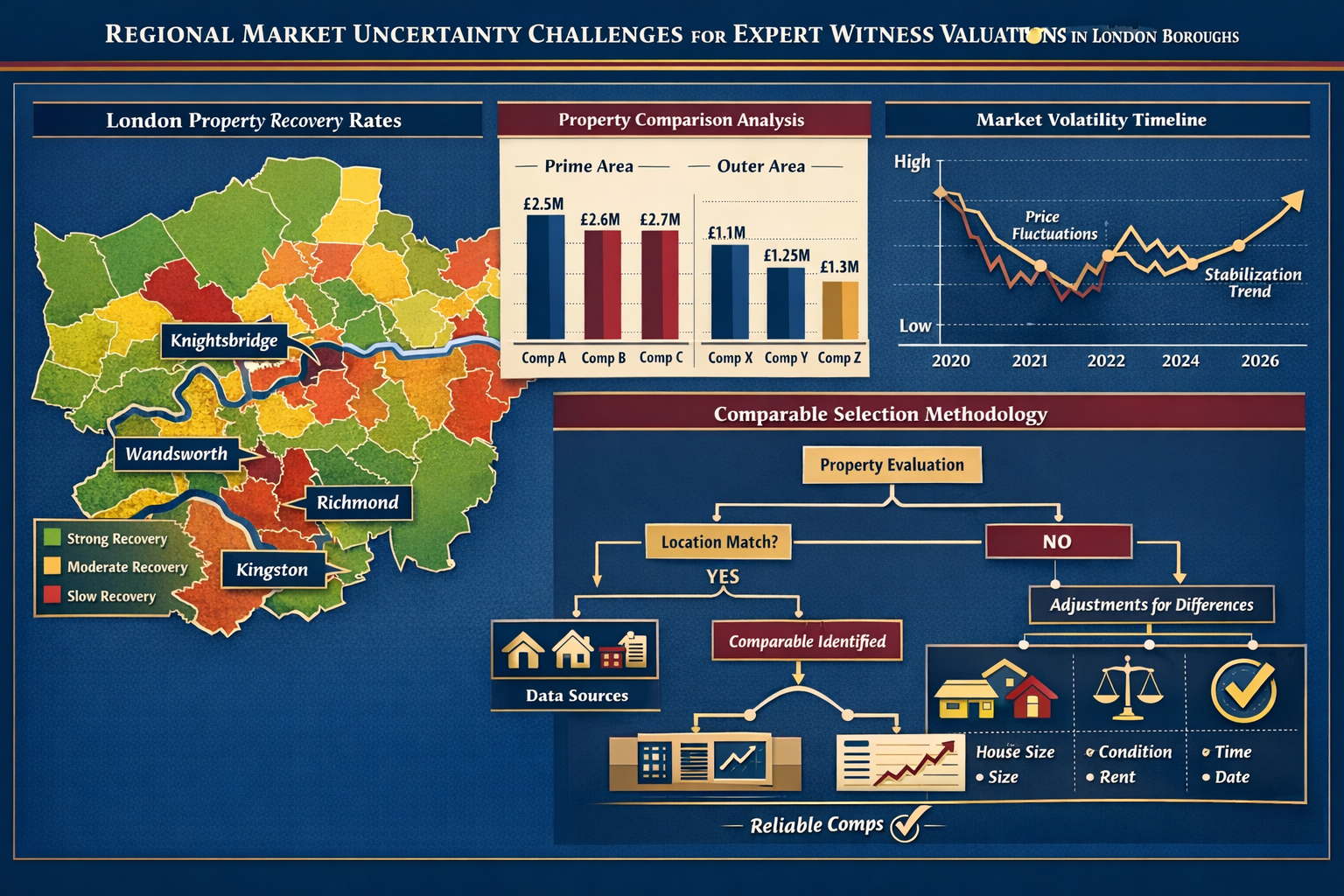
For building surveyors providing expert witness services, this environment demands exceptional attention to market segmentation and geographic specificity. A valuation that might be entirely defensible for a property in Knightsbridge could face significant challenges if the same methodology were applied to a comparable property in a different borough experiencing different recovery dynamics.
Why Expert Witness Disputes Are Increasing
The convergence of market stabilization and regional uncertainty has created fertile ground for valuation disputes. Several factors contribute to the increased demand for expert witness services in property valuation cases:
Complex litigation drivers include mortgage lending disputes, divorce settlements, partnership dissolutions, tax assessments, compulsory purchase compensation, and professional negligence claims [3]. Each scenario requires expert witnesses who can navigate not only the technical aspects of property valuation but also the legal standards for admissible evidence and credible testimony.
The Asia-Pacific region has emerged as the fastest-growing market for expert witness services, though North America remains the dominant region [3]. This global expansion reflects increasing sophistication in property markets worldwide and growing recognition of the value that qualified expert witnesses bring to complex disputes.
The Fundamentals of Expert Witness Valuations in a Recovering Market: Building Credible Cases Amid 2026 Price Stabilization and Regional Uncertainty
What Makes an Expert Witness Credible?
Credibility forms the cornerstone of effective expert witness testimony. In property valuation disputes, credibility derives from multiple sources that work together to establish the expert's authority and reliability.
Essential credibility factors include:
- Professional qualifications – RICS membership, specialized certifications, and relevant academic credentials
- Practical experience – Demonstrated expertise in the specific property type and geographic market
- Methodology transparency – Clear explanation of valuation approaches and assumption justification
- Independence – Freedom from conflicts of interest and objective analysis
- Communication skills – Ability to explain complex concepts clearly to non-technical audiences
The importance of professional credentials cannot be overstated. When providing expert testimony, RICS surveyors bring recognized professional standards that courts respect and opposing counsel find difficult to challenge. This professional foundation provides a platform for credible testimony that can withstand rigorous cross-examination.
Core Valuation Methodologies for Expert Testimony
Expert witnesses must command multiple valuation approaches and understand when each methodology provides the most defensible basis for opinion. In the context of 2026's recovering market, methodological selection becomes particularly critical.
Primary valuation approaches include:
| Methodology | Best Application | 2026 Recovery Considerations |
|---|---|---|
| Comparative Method | Residential properties with active comparable sales | Requires careful adjustment for timing and regional variations |
| Investment Method | Income-producing properties | Must account for changing yield expectations in stabilizing market |
| Residual Method | Development sites | Particularly sensitive to construction cost fluctuations and market timing |
| Profits Method | Specialized commercial properties | Requires detailed market recovery assumptions for revenue projections |
| Depreciated Replacement Cost | Unique properties without comparables | Less affected by market fluctuations but requires current cost data |
The comparative method remains the foundation for most residential property valuations, but the 2026 market environment demands exceptional care in comparable selection and adjustment. Expert witnesses must be prepared to defend why specific comparables were chosen, how adjustments were calculated, and why alternative comparables were rejected.
Understanding how building surveys influence price negotiations provides valuable context for expert witnesses, as survey findings often form the basis for valuation disputes that eventually require expert testimony.
The Role of Market Analysis in Building Defensible Cases
Comprehensive market analysis separates credible expert witness testimony from opinions vulnerable to successful challenge. In 2026's environment of price stabilization amid regional uncertainty, market analysis must address multiple dimensions simultaneously.
Critical market analysis components include:
- Temporal analysis – Understanding price movements over relevant time periods
- Geographic segmentation – Recognizing micro-market variations within broader regions
- Property type differentiation – Acknowledging performance differences between housing categories
- Supply and demand dynamics – Assessing inventory levels and buyer activity patterns
- Economic context – Incorporating employment, income, and financing condition trends
Expert witnesses must demonstrate command of both quantitative data (transaction volumes, price indices, days on market) and qualitative factors (buyer sentiment, market psychology, local development impacts). This comprehensive approach builds credibility by showing thorough analysis rather than selective data use.
Navigating Regional Uncertainty in Expert Witness Valuations
Understanding London's Micro-Markets in 2026
London's property market has never been monolithic, but the 2026 recovery has accentuated differences between micro-markets to an unprecedented degree. Expert witnesses must understand these variations to provide credible testimony about property values in specific locations.
Prime central London areas like Knightsbridge have experienced different recovery trajectories compared to outer London boroughs. Factors driving these variations include:
- 🏛️ International buyer activity returning at different rates across price points
- 🚇 Transportation infrastructure improvements affecting accessibility and desirability
- 🏗️ Development activity creating supply pressures in specific neighborhoods
- 🎓 Institutional presence (universities, hospitals, corporate headquarters) stabilizing demand
- 🌳 Environmental factors including green space access and air quality improvements
When providing expert testimony about valuations in areas like Wandsworth, Richmond, or Kingston, experts must demonstrate specific knowledge of local market conditions rather than relying on borough-wide or London-wide generalizations.
Selecting and Defending Comparable Evidence
The selection of comparable properties forms the most frequently challenged aspect of expert witness valuations. In a market characterized by regional uncertainty and uneven recovery, comparable selection demands exceptional rigor and defensibility.
Best practices for comparable selection include:
- Geographic proximity – Prioritize comparables within the same micro-market or demonstrably similar area
- Temporal relevance – Use recent transactions while adjusting appropriately for market movement
- Physical similarity – Match property type, size, condition, and features as closely as possible
- Transaction authenticity – Verify that comparables represent arm's length transactions
- Adjustment transparency – Document and justify all adjustments made to comparable values
Expert witnesses should anticipate challenges to comparable selection by preparing detailed justification for each comparable used and maintaining documentation about rejected alternatives. This preparation demonstrates thoroughness and builds credibility when explaining methodology under cross-examination.
The relationship between building survey findings and price negotiations becomes particularly relevant when survey results affect comparable transactions. Expert witnesses must understand how survey-driven price adjustments impact the reliability of comparables in valuation analysis.
Adjusting for Market Conditions and Timing
Market condition adjustments represent one of the most subjective aspects of property valuation, making them a frequent target for opposing counsel during cross-examination. In 2026's stabilizing but uncertain market, these adjustments require particularly careful consideration and documentation.
Key adjustment categories include:
- Time adjustments – Accounting for market appreciation or depreciation between comparable sale dates and valuation date
- Condition adjustments – Reflecting differences in property condition, often informed by building condition assessments
- Location adjustments – Quantifying value differences between specific streets or neighborhoods
- Size adjustments – Applying appropriate unit value changes for property size differences
- Feature adjustments – Valuing specific amenities, improvements, or deficiencies
Expert witnesses should maintain adjustment schedules that clearly show how each adjustment was calculated and what evidence supports the adjustment magnitude. This documentation transforms subjective judgment into defensible analysis supported by market evidence.
Building Credible Cases: Methodology and Documentation
Integrated Valuation-Testimony Models
The expert witness valuation market has evolved toward integrated valuation-testimony models that combine technical analysis with litigation strategy [3]. This approach recognizes that credible expert testimony requires more than accurate valuation—it demands presentation designed for legal contexts.
Components of integrated models include:
- 📋 Comprehensive documentation from initial engagement through final testimony
- 🔍 Anticipatory analysis addressing likely challenges before they arise
- 💻 Digital evidence tools enabling clear presentation of complex data
- 🤝 Collaboration protocols with instructing solicitors and barristers
- 📊 Visual communication materials that make technical concepts accessible
Major consulting firms including FTI Consulting, BRG, NERA, CRA, and the Big Four accounting firms have developed sophisticated integrated approaches that smaller practices can adapt to their contexts [3]. The key lies in viewing expert witness work as a distinct discipline requiring specialized skills beyond traditional valuation expertise.
For building surveyors, this integrated approach means connecting survey findings to valuation opinions in ways that withstand legal scrutiny. Understanding how Level 2 and Level 3 surveys provide different levels of detail helps expert witnesses match survey depth to the evidentiary requirements of specific cases.
Documentation Standards for Expert Witness Work
Thorough documentation separates defensible expert opinions from vulnerable testimony. In complex property valuation disputes, documentation serves multiple purposes: supporting the expert's analysis, demonstrating methodological rigor, and providing reference materials during cross-examination.
Essential documentation elements include:
- Engagement documentation – Clearly defining scope, assumptions, and limitations
- Research records – Comprehensive notes on market research and comparable investigation
- Calculation worksheets – Detailed showing of all mathematical computations
- Assumption registers – Explicit statement of all assumptions underlying the valuation
- Correspondence files – Complete record of communications with instructing parties
- Site inspection records – Detailed notes and photographs from property inspections
- Draft report archives – Maintaining versions to demonstrate analysis evolution
Expert witnesses should adopt the mindset that every document may be disclosed during litigation. This perspective encourages contemporaneous documentation that accurately reflects the analysis process rather than post-hoc rationalization of conclusions.
When conducting property assessments that may lead to expert witness testimony, surveyors should implement documentation protocols that exceed normal practice standards, recognizing the heightened scrutiny these valuations will face.
Leveraging Digital Tools and Analytics
The expert witness valuation market increasingly relies on digital evidence tools and analytics platforms that enhance both analysis quality and presentation effectiveness [3]. These technologies have become particularly valuable in 2026's complex market environment where demonstrating regional variations and market trends requires sophisticated data visualization.
Key digital tools include:
- 📱 Property data platforms – Comprehensive transaction databases with advanced filtering and analysis capabilities
- 📊 Statistical analysis software – Tools for regression analysis, trend identification, and adjustment calculation
- 🗺️ Geographic information systems – Mapping technologies that visualize market variations spatially
- 📈 Presentation software – Professional tools for creating compelling visual evidence
- 🔐 Secure collaboration platforms – Systems for sharing confidential information with legal teams
Expert witnesses should invest in technology that enables them to demonstrate rather than merely assert market conditions and valuation conclusions. Visual presentation of comparable locations, price trends, and adjustment calculations makes complex analysis accessible to judges and juries unfamiliar with property valuation technicalities.
Preparing for Cross-Examination and Challenges
Common Challenges to Valuation Methodology
Understanding the challenges expert witnesses typically face enables proactive preparation that strengthens credibility. In property valuation disputes arising from 2026's recovering market, certain challenges appear with particular frequency.
Typical methodological challenges include:
- ❓ Comparable selection bias – Allegations that comparables were cherry-picked to support predetermined conclusions
- ⏰ Timing appropriateness – Questions about whether comparable dates reflect market conditions at valuation date
- 📏 Adjustment magnitude – Challenges to the size and justification of adjustments applied to comparables
- 🎯 Geographic relevance – Disputes about whether comparables represent the same micro-market
- 📋 Assumption reasonableness – Questioning the validity of assumptions underlying the valuation
Effective expert witnesses anticipate these challenges during analysis and prepare detailed responses supported by market evidence. This preparation transforms potentially damaging cross-examination into opportunities to demonstrate thoroughness and expertise.
Defending Regional Market Analysis
In 2026's environment of regional uncertainty, defending geographic market analysis represents a critical competency for expert witnesses. Opposing counsel frequently challenge whether purported regional variations actually exist or whether experts have exaggerated local differences to justify preferred conclusions.
Defensive strategies include:
- Quantitative support – Presenting statistical evidence of price variations between areas
- Multiple data sources – Corroborating regional differences across independent data sets
- Local expertise – Demonstrating specific knowledge of the areas in question
- Comparable density – Showing sufficient transaction volume to support market segmentation
- Professional consensus – Referencing other experts and published analyses supporting regional distinctions
Expert witnesses should be prepared to explain why specific boundaries define micro-markets rather than appearing arbitrary. Factors like transportation corridors, school catchment areas, conservation zones, and historical development patterns provide objective justification for market segmentation.
Understanding local market dynamics in areas like Barnet, Notting Hill, or Stratford enables expert witnesses to provide specific, credible testimony about regional variations that withstands cross-examination.
Maintaining Professional Independence
Independence forms the bedrock of expert witness credibility. Courts expect experts to provide objective opinions based on professional analysis rather than advocacy for the party retaining them. Maintaining and demonstrating independence requires conscious effort throughout the expert witness engagement.
Independence safeguards include:
- 🔒 Clear engagement terms – Written agreements specifying that opinions will be independent and objective
- 💰 Fee structures – Hourly or fixed fees rather than contingent compensation tied to case outcomes
- 📝 Unbiased analysis – Following the same methodology regardless of which party retains the expert
- 🗣️ Honest opinions – Providing frank assessments even when unfavorable to the retaining party
- ⚖️ Professional duties – Recognizing that expert duties to the court supersede obligations to instructing parties
Expert witnesses should document independence through engagement letters, fee agreements, and consistent methodology application across different cases. This documentation provides evidence of objectivity when independence is challenged during cross-examination.
Industry Trends Shaping Expert Witness Valuations
The Growing Role of Global Expert Networks
The expert witness valuation market has seen significant growth in global expert networks that connect specialized professionals with legal teams worldwide [3]. These networks have particular relevance in 2026 as cross-border property investments and international litigation create demand for experts with multi-jurisdictional knowledge.
Network benefits include:
- 🌐 Access to specialized expertise – Connecting cases with experts having specific property type or market knowledge
- 🤝 Quality assurance – Network vetting processes that verify credentials and track record
- 📚 Knowledge sharing – Platforms for experts to exchange insights and best practices
- 💼 Business development – Efficient matching of expert capabilities with case requirements
- 🔄 Peer review – Informal consultation networks that strengthen analysis quality
For building surveyors seeking to develop expert witness practices, participation in professional networks provides access to training, mentorship, and case opportunities that accelerate capability development.
Compensation Trends and Fee Structures
Understanding compensation norms helps expert witnesses establish appropriate fee structures while maintaining independence. Expert witness hourly rates typically range from £175 to £450 per hour or higher depending on expertise level, case complexity, and geographic market [1].
Fee structure considerations include:
| Fee Component | Typical Approach | Best Practices |
|---|---|---|
| Initial consultation | Reduced rate or complimentary | Clear time limits to prevent scope creep |
| Research and analysis | Standard hourly rate | Detailed time tracking with task descriptions |
| Report preparation | Standard hourly rate | Estimates provided before substantial work |
| Deposition testimony | Premium hourly rate | Minimum charges for scheduling blocks |
| Trial testimony | Premium daily rate | Preparation time charged separately |
| Travel time | Reduced hourly rate | Clear policies established at engagement |
Expert witnesses should establish written fee agreements at engagement commencement, specifying rates for different activities, billing cycles, payment terms, and expense reimbursement policies. This clarity prevents misunderstandings and demonstrates professional practice standards.
Regulatory and Professional Standards Evolution
The expert witness landscape continues to evolve as regulatory enforcement and professional standards bodies refine requirements for expert testimony [3]. Building surveyors providing expert witness services must stay current with these developments to maintain credibility and compliance.
Key regulatory trends include:
- 📜 Enhanced disclosure requirements – Increasing demands for transparency about expert qualifications and potential conflicts
- 🎓 Continuing education mandates – Professional development requirements specific to expert witness work
- 🔍 Methodology standards – Greater specificity about acceptable valuation approaches in litigation contexts
- ⚖️ Ethical guidelines – Refined standards addressing expert independence and objectivity
- 📋 Report format requirements – Standardization of expert report structure and content
Professional organizations including RICS continue to develop guidance specific to expert witness work, recognizing that litigation contexts create unique professional obligations beyond standard valuation practice.
Practical Strategies for Building Surveyors
Developing Expert Witness Capabilities
Building surveyors seeking to develop expert witness capabilities should approach this specialization strategically, recognizing that effective expert testimony requires skills beyond technical competence in property surveying and valuation.
Capability development pathway:
- Foundation building – Establish strong technical credentials through RICS qualification and specialized certifications
- Experience accumulation – Develop deep knowledge of specific property types or geographic markets
- Legal education – Study civil procedure, evidence rules, and expert witness obligations
- Communication training – Practice explaining technical concepts to non-technical audiences
- Mentorship – Shadow experienced expert witnesses to observe effective testimony techniques
- Initial cases – Accept smaller cases to develop skills before pursuing complex litigation
- Continuous improvement – Seek feedback and refine approach based on experience
The 33rd Annual National Expert Witness Conference scheduled for May 2-3, 2026, in Clearwater Beach, Florida, represents one of many professional development opportunities available to experts seeking to enhance their capabilities [6].
Connecting Survey Work to Expert Testimony
Building surveyors possess inherent advantages in expert witness work because comprehensive property surveys provide foundational evidence for valuation opinions. Understanding how to leverage survey findings in expert testimony strengthens credibility and defensibility.
Survey-to-testimony connections include:
- 🏗️ Condition documentation – Using building condition assessments to support adjustment calculations
- 🔧 Defect quantification – Translating survey findings into financial impacts on property value
- 📐 Measurement verification – Providing accurate floor areas and dimensions that affect comparable analysis
- 🏛️ Construction quality assessment – Evaluating building quality factors that influence value
- ⚠️ Risk identification – Documenting issues like subsidence or tree-related damage that affect valuation
Surveyors should maintain detailed inspection records and photographic documentation that can support expert testimony years after the original survey. This documentation becomes particularly valuable when survey findings form the basis for valuation disputes.
Building Relationships with Legal Professionals
Successful expert witness practices require strong relationships with solicitors, barristers, and legal teams who instruct experts on cases. These relationships develop through consistent demonstration of reliability, expertise, and effective communication.
Relationship building strategies:
- 📧 Professional visibility – Publishing articles, speaking at conferences, and maintaining professional profiles
- 🤝 Referral networks – Cultivating relationships with other experts who can provide referrals
- 💼 Responsive service – Meeting deadlines, providing clear communication, and being accessible
- 🎯 Niche expertise – Developing recognized specialization in specific property types or issues
- 📊 Track record – Building reputation through successful cases and satisfied instructing solicitors
Legal professionals value expert witnesses who understand litigation dynamics, communicate clearly, and provide reliable opinions that withstand challenge. Building surveyors who demonstrate these qualities alongside technical expertise develop sustainable expert witness practices.
Case Study Applications in 2026's Market
Residential Valuation Disputes in Recovering Markets
Consider a typical 2026 scenario: a divorce settlement requiring property valuation of a family home in a London suburb experiencing uneven recovery. The husband's expert values the property at £850,000 while the wife's expert concludes £925,000. Both experts are qualified, both use the comparative method, yet they reach significantly different conclusions.
The credibility differentiators include:
- 🔍 Comparable selection – One expert uses comparables from a wider geographic area including less desirable neighborhoods; the other restricts comparables to the immediate micro-market
- ⏱️ Time adjustments – Experts apply different market appreciation rates based on different data sources and interpretations
- 🏠 Condition assessment – One expert relies on external inspection only; the other conducts comprehensive internal inspection revealing deferred maintenance
- 📈 Market trend interpretation – Experts reach different conclusions about whether the local market has fully stabilized or continues to appreciate
The expert who demonstrates superior documentation, more rigorous comparable selection, and better understanding of local market dynamics will likely prevail. This scenario illustrates why expert witness valuations in a recovering market require exceptional attention to methodology and evidence quality.
Commercial Property Valuation Challenges
Commercial property valuations present distinct challenges in 2026's recovering market, particularly for income-producing properties where yield assumptions significantly impact value conclusions.
Example scenario: Valuation dispute over a retail property in a London high street experiencing changing tenant mix and footfall patterns post-pandemic.
Key expert witness considerations:
- 💰 Rental evidence – Demonstrating whether recent lettings reflect stabilized market rents or temporary conditions
- 📊 Yield selection – Justifying capitalization rates amid uncertainty about long-term retail property performance
- 🏪 Tenant covenant – Assessing tenant quality and lease security in changing retail environment
- 🔄 Obsolescence factors – Evaluating whether property configuration suits current retail requirements
- 📍 Location analysis – Determining whether specific high street maintains viability amid e-commerce competition
Expert witnesses must balance optimism about market recovery against realistic assessment of structural changes affecting commercial property values. This balance requires sophisticated market analysis and clear communication of assumptions underlying value conclusions.
Leasehold Valuation and Enfranchisement Disputes
Leasehold property valuations create frequent expert witness opportunities, particularly regarding lease extensions and enfranchisement. Understanding what to check before buying leasehold property and common questions about statutory lease extensions provides foundation for expert testimony in these disputes.
Expert witness issues in leasehold valuations:
- ⏳ Deferment rates – Selecting appropriate discount rates for reversionary interests
- 🏢 Relativity – Determining how short lease length affects property value
- 💷 Marriage value – Calculating and apportioning value created by lease extension
- 🔧 Hope value – Assessing likelihood and value of future development rights
- 📋 Comparable evidence – Finding and adjusting comparable leasehold transactions
The technical complexity of leasehold valuations combined with significant financial stakes creates demand for expert witnesses who can explain intricate concepts clearly while defending sophisticated analysis under cross-examination.
Future Outlook and Emerging Considerations
Technology's Expanding Role
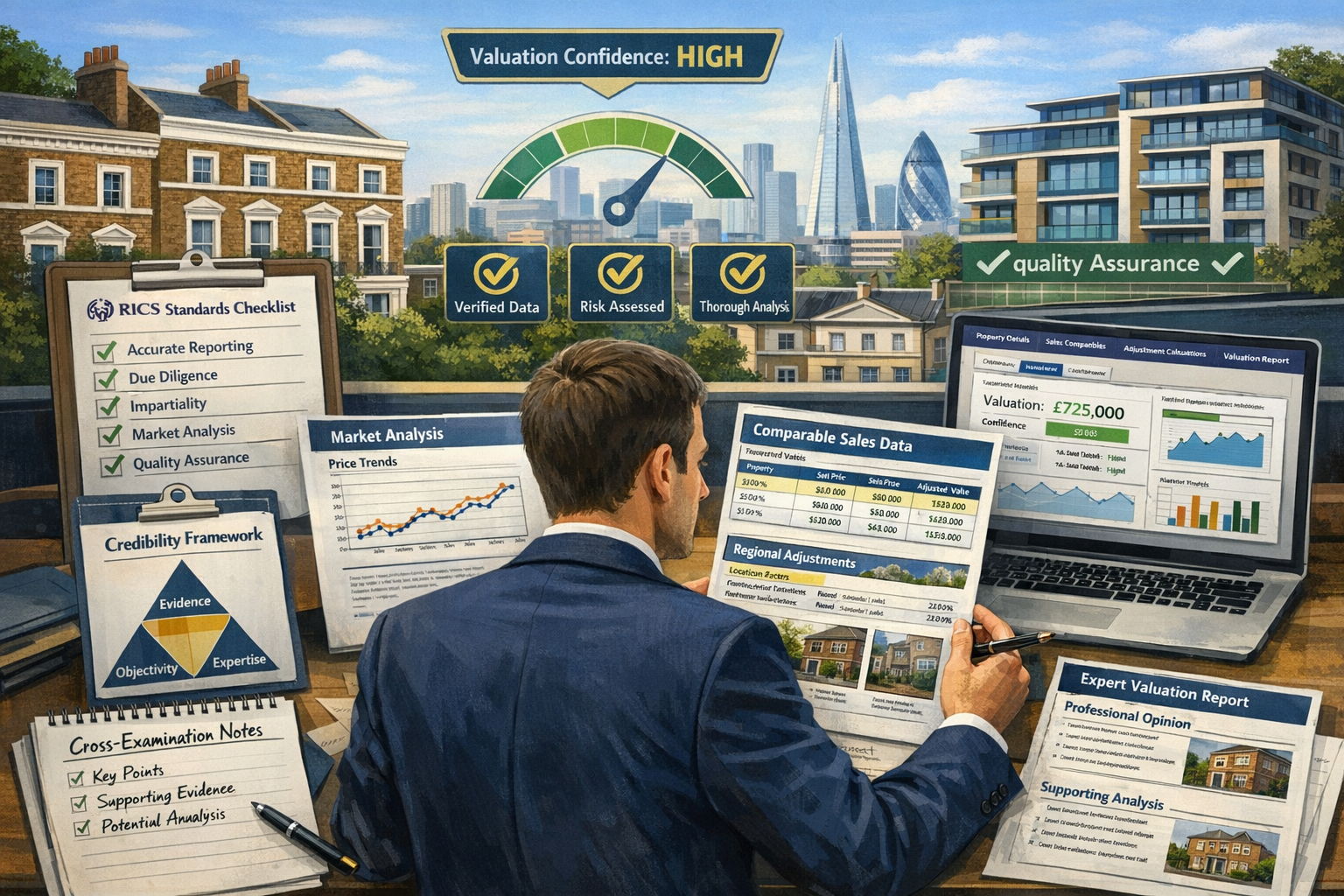
Digital evidence tools and analytics platforms will continue transforming expert witness work, with artificial intelligence and machine learning creating new capabilities for market analysis and comparable selection [3]. Expert witnesses must balance leveraging these technologies with maintaining the professional judgment that courts value.
Emerging technology applications include:
- 🤖 AI-powered comparable selection – Algorithms identifying relevant comparables from comprehensive databases
- 📊 Predictive analytics – Statistical models forecasting market trends with greater accuracy
- 🗺️ Advanced GIS analysis – Sophisticated spatial analysis revealing micro-market patterns
- 📱 Virtual property inspection – Remote assessment technologies supplementing physical inspections
- 🔗 Blockchain verification – Transaction authentication and property history validation
Expert witnesses should adopt technologies that enhance analysis quality and presentation effectiveness while remaining prepared to explain and defend technology-assisted conclusions under cross-examination.
Cross-Border Expertise Demand
The Asia-Pacific region's emergence as the fastest-growing market for expert witness services signals increasing globalization of property disputes [3]. Building surveyors with international experience or multi-jurisdictional knowledge will find expanding opportunities in cross-border cases.
International expertise applications:
- 🌏 Foreign investment disputes – Valuations involving international buyers and sellers
- 🏛️ Arbitration cases – International commercial arbitration requiring property valuation evidence
- 💼 Tax disputes – Cross-border tax issues requiring valuation opinions
- 🤝 Joint venture disagreements – International partnerships requiring property asset valuations
- 📜 Treaty interpretations – Cases involving bilateral investment treaties and property rights
Building surveyors should consider developing expertise in international valuation standards and cross-border transaction dynamics to access these expanding opportunities.
Professional Development Priorities
As expert witness work becomes increasingly specialized, continuing professional development focused specifically on litigation skills and expert testimony becomes essential for maintaining credibility and competitiveness.
Priority development areas include:
- Legal knowledge – Understanding civil procedure, evidence rules, and expert duties
- Communication skills – Presenting complex technical information clearly and persuasively
- Technology proficiency – Mastering digital tools for analysis and presentation
- Market expertise – Developing deep knowledge of specific property types or geographic markets
- Ethical awareness – Understanding professional obligations and independence requirements
Professional organizations, specialized training programs, and conferences like those offered by industry leaders provide structured development opportunities for building surveyors pursuing expert witness specialization [6][8].
Conclusion: Building Lasting Credibility in Expert Witness Work
Expert witness valuations in a recovering market: building credible cases amid 2026 price stabilization and regional uncertainty represents both a significant challenge and a valuable opportunity for building surveyors. The current market environment, characterized by uneven recovery patterns and geographic variations, creates demand for expert witnesses who can navigate complexity while maintaining credibility under scrutiny.
Success in expert witness work requires more than technical competence in property valuation. It demands comprehensive market knowledge, rigorous methodology, thorough documentation, effective communication, and unwavering professional independence. Building surveyors who develop these capabilities position themselves to provide valuable services to legal professionals and their clients while commanding premium compensation for specialized expertise.
The integration of digital tools, global networks, and sophisticated analytical approaches continues to reshape the expert witness landscape [3]. Professionals who embrace these developments while maintaining the fundamental principles of objectivity, thoroughness, and clear communication will thrive in this evolving market.
Actionable Next Steps
For building surveyors seeking to develop or enhance expert witness capabilities:
✅ Strengthen technical foundation – Ensure RICS qualification and pursue specialized certifications relevant to target practice areas
✅ Develop market expertise – Build deep knowledge of specific property types or geographic markets through focused practice and research
✅ Invest in training – Attend expert witness conferences, complete litigation skills courses, and study civil procedure and evidence law
✅ Establish documentation protocols – Implement comprehensive record-keeping systems that support expert witness work requirements
✅ Build professional networks – Cultivate relationships with legal professionals, participate in expert networks, and maintain professional visibility
✅ Leverage technology – Adopt digital tools that enhance analysis quality and presentation effectiveness
✅ Maintain independence – Establish clear engagement terms, appropriate fee structures, and ethical boundaries that preserve objectivity
✅ Seek mentorship – Connect with experienced expert witnesses who can provide guidance and feedback
The property market's transition from volatility to stabilization creates unprecedented demand for expert witnesses who can navigate regional uncertainty and defend valuations amid ambiguous comparable evidence. Building surveyors who rise to this challenge will find rewarding opportunities to apply their expertise in high-stakes litigation contexts while advancing the profession's contribution to property dispute resolution.
By combining technical excellence with litigation skills, market knowledge with communication ability, and analytical rigor with professional independence, building surveyors can build credible cases that withstand the most demanding cross-examination and provide genuine value to clients navigating complex property disputes in 2026's recovering market.
References
[1] Real Estate Valuation Expert Witnesses – https://www.jurispro.com/category/real-estate-valuation-s-82/CA
[2] Appraisal Valuation Expert Witness – https://www.seakexperts.com/specialties/appraisal-valuation-expert-witness?state=california
[3] Expert Witness Valuation Market May See Big Move Major Giants – https://www.openpr.com/news/4339465/expert-witness-valuation-market-may-see-big-move-major-giants
[4] Los Angeles Real Estate Expert Witness – https://edringtonandassociates.com/los-angeles-real-estate-expert-witness/
[5] 2025 10 23 Ac Commerical Appraisers – https://www.appraisalinstitute.org/insights-and-resources/insights/newsroom/ai-news-releases/2025-10-23-ac-commerical-appraisers
[6] 33rd Annual National Expert Witness Conference May 2 3 2026 Clearwater Beach Fl – https://store.seak.com/33rd-annual-national-expert-witness-conference-may-2-3-2026-clearwater-beach-fl/
[7] Real Estate Industry Displays Uneven Performance Heading Into 2026 Says Irr – https://rebusinessonline.com/real-estate-industry-displays-uneven-performance-heading-into-2026-says-irr/
[8] Forensisgroup Discusses 2026 Trends Affecting Expert Witness Testimony – https://natlawreview.com/press-releases/forensisgroup-discusses-2026-trends-affecting-expert-witness-testimony