

The Royal Institution of Chartered Surveyors (RICS) February 2026 residential market survey revealed a dramatic shift in sentiment: price expectations plummeted to a -18% net balance, marking one of the sharpest corrections in recent surveying history. For expert witnesses providing valuations in litigation, arbitration, and lender disputes, this seismic market shift demands immediate methodological recalibration. Understanding how to adjust Expert Witness Valuations Amid February 2026 RICS Market Slowdown: Adjusting for -18% Price Expectation Shifts has become critical for defensible testimony and credible professional opinions.
The challenge facing valuation professionals extends beyond simple price adjustments. When market sentiment deteriorates this rapidly, comparable evidence becomes unreliable, buyer enquiries collapse, and transaction volumes distort traditional valuation approaches. Expert witnesses must now demonstrate how they've incorporated subdued market conditions into their methodology while maintaining the rigorous standards required for expert building evaluation and litigation support.

Key Takeaways
- 📉 February 2026 RICS data shows -18% net balance in price expectations, representing a significant market correction from previous positive sentiment
- ⚖️ Expert witnesses must adjust valuation methodologies to reflect subdued buyer enquiries (-14% net balance) and reduced transaction activity
- 🔍 Comparable evidence requires careful temporal weighting as pre-slowdown sales no longer reflect current market reality
- 📊 Defensible adjustments demand transparent documentation of RICS market indicators and their impact on valuation conclusions
- 🛡️ Litigation and lender dispute valuations face heightened scrutiny when market conditions shift rapidly
Understanding the February 2026 RICS Market Slowdown Context
The Scale of the Market Correction
The February 2026 RICS Residential Market Survey captured a market in significant retreat. While the preceding year had shown resilience—with February 2025 recording a positive +11% net balance for house price growth[1]—the 12 months that followed brought dramatic changes. By February 2026, that positive sentiment had reversed entirely, with respondents reporting a -18% net balance in price expectations.
This shift wasn't isolated to price sentiment alone. The survey revealed weakening buyer demand across multiple metrics:
- Buyer enquiries: Subdued activity with negative net balances
- New instructions: Reduced property listings as sellers withdrew from uncertain markets
- Sales volumes: Transaction completions declined as purchasers adopted wait-and-see positions
- Time on market: Properties remained unsold for extended periods
For expert witnesses preparing valuations for court proceedings, arbitration, or lender disputes, these indicators provide crucial context. A RICS building survey conducted in January 2026 may have reflected different market assumptions than one completed just weeks later in March 2026.
What Drove the Slowdown?
Understanding causation helps expert witnesses explain valuation adjustments to tribunals and opposing counsel. Several factors converged in early 2026:
| Factor | Impact on Market | Relevance to Expert Valuations |
|---|---|---|
| Interest rate uncertainty | Mortgage affordability constraints | Affects comparable buyer pools |
| Stamp duty threshold changes | Buyer hesitation and timing delays | Creates transaction volume distortions |
| Economic confidence erosion | Risk-averse purchasing behavior | Reduces bid competition |
| Lending criteria tightening | Reduced mortgage approvals | Limits achievable prices |
The RICS survey methodology—which calculates net balances by subtracting the percentage of respondents reporting decreases from those reporting increases[1]—provides a standardized measure that expert witnesses can reference when defending adjustment decisions under cross-examination.
Expert Witness Valuations Amid February 2026 RICS Market Slowdown: Core Adjustment Principles
The Temporal Weighting Challenge
Traditional valuation approaches rely heavily on comparable sales evidence. However, when market conditions shift as dramatically as they did in February 2026, comparables from just three to six months earlier may no longer reflect current reality. Expert witnesses must apply temporal adjustments that account for the pace and magnitude of market change.
Consider a typical scenario: An expert witness values a property as of March 15, 2026, for a contractual dispute. Available comparables include:
- November 2025 sale: £850,000 (pre-slowdown sentiment)
- January 2026 sale: £835,000 (early warning signs)
- February 2026 sale: £795,000 (slowdown evident)
Simply averaging these comparables produces £826,667—but this figure fails to reflect the directional momentum captured in the RICS -18% price expectation shift. A defensible expert witness valuation must weight recent evidence more heavily and apply forward-looking adjustments based on market sentiment indicators.
Incorporating RICS Net Balance Data
The -18% net balance figure represents surveyor sentiment about future price movements, not current achieved prices. Expert witnesses must distinguish between:
- Backward-looking evidence: Completed transactions (Land Registry data)
- Current market evidence: Properties under offer and recent exchanges
- Forward-looking indicators: RICS net balances and market sentiment
When preparing expert building evaluation reports for litigation, the methodology section should explicitly address how each evidence category has been weighted. For February 2026 valuations, the RICS data suggests that:
- Comparables from Q4 2025 require downward adjustment to reflect deteriorating sentiment
- Current marketing evidence shows extended time on market and price reductions
- Buyer behavior indicates reduced competition and lower bid premiums
Adjustment Magnitude: From Sentiment to Price
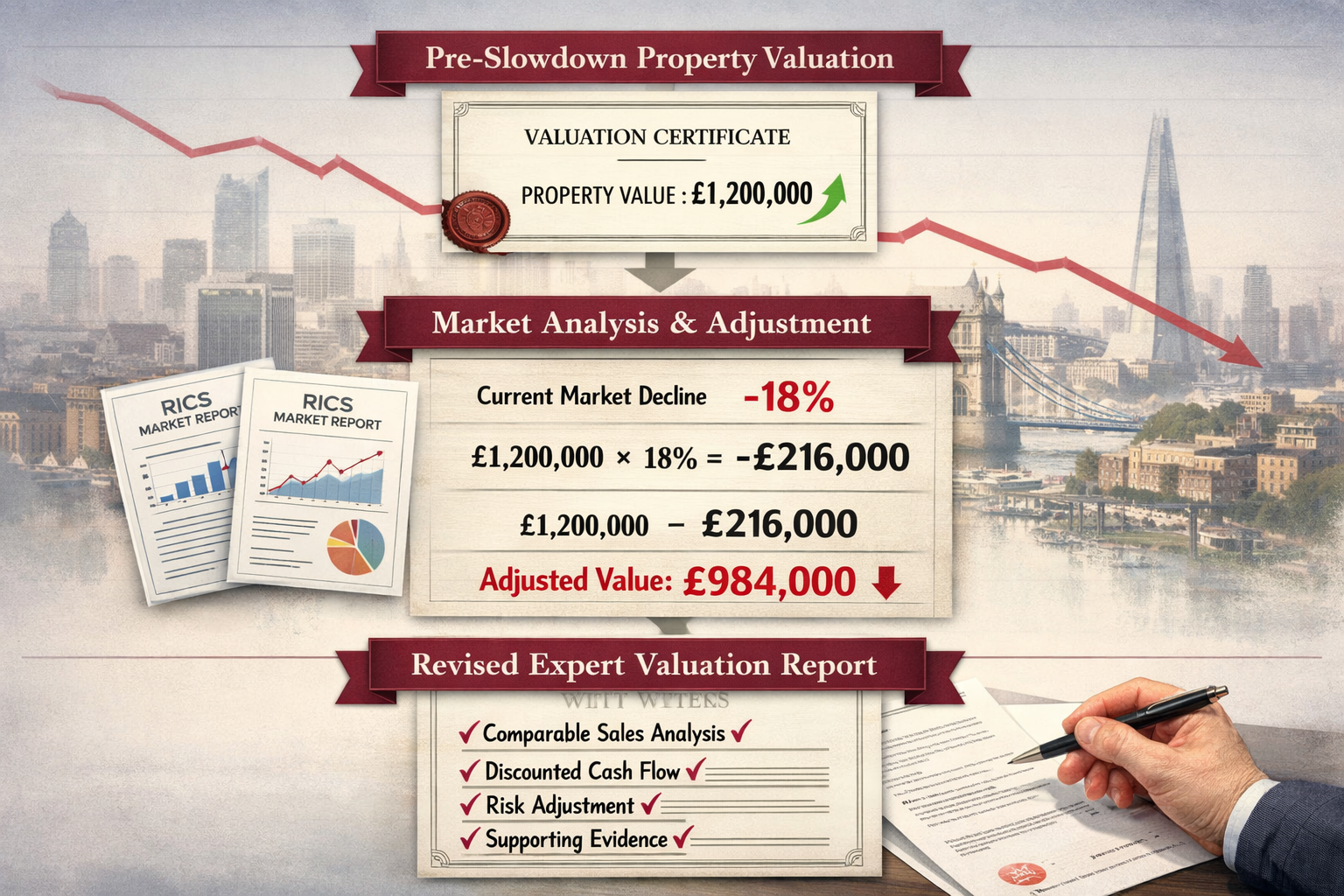
The critical question expert witnesses face: How does a -18% net balance in price expectations translate into actual valuation adjustments? This requires nuanced analysis rather than mechanical application.
The relationship is not linear. A -18% net balance doesn't mean prices will fall 18%. Instead, it indicates that 18% more surveyors expect prices to fall than expect them to rise. Historical analysis suggests that net balances of this magnitude typically correlate with actual price movements of 3-7% over subsequent quarters, depending on:
- Local market dynamics: London versus regional variations
- Property type: Prime versus secondary markets
- Transaction urgency: Forced sales versus discretionary moves
Expert witnesses should reference the RICS data as supporting evidence for adjustments derived from comparable analysis, rather than as a direct adjustment factor. The defensible approach states: "The -18% net balance in the February 2026 RICS survey corroborates the downward adjustment of 5.5% applied to Q4 2025 comparables, reflecting observed market weakening."
Practical Application: Adjusting Valuations for Litigation and Disputes
Building the Defensible Case
Expert witness credibility depends on transparent methodology and reproducible results. When adjusting valuations amid the February 2026 RICS market slowdown, the expert report should include:
1. Market Context Section 📋
Begin with a comprehensive overview of market conditions, citing specific RICS indicators:
- Current net balances (price expectations, buyer enquiries, new instructions)
- Trend analysis showing deterioration from previous quarters
- Comparison to historical slowdown periods
- Local market variations relevant to the subject property
This contextual foundation demonstrates that adjustments aren't arbitrary but grounded in recognized market intelligence. For properties in specific areas, experts might reference local surveyor insights from Richmond property surveyors or Wimbledon property surveyors to add granular market knowledge.
2. Comparable Evidence Analysis 🏘️
Present comparables in a structured format showing:
| Address | Sale Date | Price | £/sq ft | Adjustments | Adjusted Value |
|---|---|---|---|---|---|
| 12 Oak Road | Nov 2025 | £850,000 | £425 | -6% (market) | £799,000 |
| 45 Elm Ave | Jan 2026 | £835,000 | £418 | -3% (market) | £810,450 |
| 78 Ash Lane | Feb 2026 | £795,000 | £398 | 0% (current) | £795,000 |
The adjustment column should explicitly identify the market correction component, separate from physical or locational adjustments. This transparency allows tribunals to understand how the RICS market slowdown influenced the valuation conclusion.
3. Adjustment Justification Matrix ✅
Create a clear justification for each adjustment percentage:
For November 2025 Comparable (-6% adjustment):
- Transaction occurred pre-slowdown (positive market sentiment)
- RICS February 2026 survey shows -18% net balance shift
- Observed price reductions on similar properties: 4-8% range
- Extended marketing periods: +35 days average
- Conclusion: 6% downward adjustment reflects market deterioration
This level of detail withstands cross-examination and demonstrates professional rigor expected in property evaluation for legal proceedings.
Addressing Buyer Enquiry Weakness
The February 2025 RICS survey (one year prior) recorded buyer enquiries at a -14% net balance, the weakest reading since November 2023[1]. By February 2026, if this weakness persisted or intensified, expert witnesses must consider its implications:
Reduced buyer competition affects:
- Achievable sale prices (fewer bidders means lower premiums)
- Marketing periods (properties take longer to sell)
- Negotiating leverage (buyers can demand concessions)
- Forced sale scenarios (vendors under time pressure accept lower offers)
For expert witness valuations in lender repossession cases or divorce proceedings where sale timeframes matter, the buyer enquiry weakness becomes particularly relevant. The expert might conclude: "Given the -14% net balance in buyer enquiries and observed marketing periods of 120+ days, a forced sale scenario would likely achieve 8-12% below the market value established for willing buyer/willing seller assumptions."

Sector-Specific Considerations for Expert Witness Valuations
Residential Property Disputes
The February 2026 RICS market slowdown affected residential sectors unevenly. Expert witnesses must account for:
Prime Central London 🏛️
- Greater insulation from mass-market sentiment shifts
- International buyer pools less influenced by domestic RICS data
- However, economic uncertainty affects high-value discretionary purchases
Secondary Markets 🏘️
- More sensitive to mortgage availability and affordability
- RICS net balances more directly applicable
- First-time buyer segments particularly affected by stamp duty changes
Regional Variations 🗺️
- Areas with strong local economies showed resilience
- Commuter belt properties faced headwinds from hybrid working trends
- Expert witnesses should reference regional RICS data where available
When valuing properties in areas like Croydon or Lewisham, local market knowledge becomes essential for defensible adjustments.
Commercial and Mixed-Use Properties
While RICS residential market surveys focus on housing, the February 2026 slowdown had spillover effects on commercial valuations:
- Retail properties: Consumer confidence weakness reduced rental values
- Office space: Continued hybrid working uncertainty affected demand
- Development sites: Residential scheme viability impacted by house price expectations
Expert witnesses valuing commercial properties should reference residential RICS data as contextual evidence of broader economic sentiment, while relying primarily on commercial-specific indicators for adjustment calculations.
Common Pitfalls and How Expert Witnesses Avoid Them
Pitfall 1: Over-Reliance on Historical Averages ⚠️
The Error: Applying average adjustment factors from previous market cycles without considering the unique characteristics of the February 2026 slowdown.
The Solution: Build adjustments from first principles using current RICS data, comparable evidence, and observed market behavior. Reference historical patterns for context but don't mechanically apply them.
Pitfall 2: Ignoring Transaction Volume Effects ⚠️
The Error: Focusing solely on price indicators while overlooking the impact of reduced transaction volumes on comparable evidence reliability.
The Solution: When transaction volumes decline significantly (as indicated by weak buyer enquiries), expert witnesses should:
- Expand the geographical search area for comparables
- Extend the time period for comparable evidence (with appropriate adjustments)
- Consider alternative valuation approaches (cost, income) as cross-checks
Pitfall 3: Inadequate Documentation ⚠️
The Error: Applying adjustments without sufficient explanation of the methodology and reasoning.
The Solution: Expert reports should include:
- Detailed explanation of adjustment calculations
- Citations to RICS survey data with specific figures
- Sensitivity analysis showing valuation range under different assumptions
- Clear statement of limitations and uncertainties
This level of documentation aligns with the standards expected in property condition assessment and professional surveying practice.
Pitfall 4: Failing to Update Valuations ⚠️
The Error: Relying on valuations prepared before the market slowdown became evident without reassessment.
The Solution: When litigation timelines extend across market turning points, expert witnesses should:
- Provide updated valuations reflecting current market conditions
- Clearly explain how and why conclusions have changed
- Maintain consistency in methodology while updating inputs
Preparing for Cross-Examination: Defending Your Adjustments
Expert witnesses must anticipate challenges to their Expert Witness Valuations Amid February 2026 RICS Market Slowdown: Adjusting for -18% Price Expectation Shifts. Common lines of cross-examination include:
Challenge 1: "Isn't the RICS data just opinion, not fact?"
Effective Response: "The RICS survey represents the collective professional judgment of hundreds of practicing chartered surveyors actively working in the market. While it measures sentiment rather than completed transactions, it's a leading indicator that has historically correlated with subsequent price movements. I've used it as one input among several, including actual comparable sales and observed marketing evidence."
Challenge 2: "Why did you apply a 5% adjustment when the net balance is -18%?"
Effective Response: "The -18% net balance indicates the direction and strength of sentiment, not a direct price change. Historical analysis shows that net balances of this magnitude typically precede actual price movements of 3-7% over subsequent quarters. My 5% adjustment falls within this range and is corroborated by the observed price reductions on comparable properties currently on the market."
Challenge 3: "Aren't you cherry-picking data to support your client's position?"
Effective Response: "I've considered all available evidence, including comparables that both support and contradict my conclusion. The methodology section of my report explains how I weighted each piece of evidence and the reasoning behind adjustments. I've also provided a sensitivity analysis showing how the valuation would change under alternative assumptions."
Preparation for cross-examination should include reviewing:
- The original RICS survey reports[1][2]
- Land Registry price paid data for the relevant area
- Current property listings and price reduction patterns
- Previous expert witness decisions in similar market conditions
Technology and Data Tools for Robust Adjustments
Modern expert witnesses increasingly rely on technology to strengthen their Expert Witness Valuations Amid February 2026 RICS Market Slowdown: Adjusting for -18% Price Expectation Shifts:
Automated Valuation Models (AVMs) 🤖
While AVMs shouldn't replace professional judgment, they provide useful cross-checks. However, AVMs often lag market turning points, so expert witnesses should:
- Understand the AVM's data sources and update frequency
- Apply manual adjustments to AVM outputs during volatile periods
- Use AVMs as supporting evidence rather than primary valuation method
Research into accurate market appraisals demonstrates that combining professional expertise with data analytics produces more defensible valuations[5].
Market Data Platforms 📊
Subscription services providing:
- Real-time property listing data
- Price reduction tracking
- Time-on-market statistics
- Heatmaps showing geographic price variations
These tools help expert witnesses demonstrate that their adjustments reflect observed market behavior, not speculation.
Comparable Database Management 💾
Maintaining a well-organized database of comparables with:
- Detailed property characteristics
- Transaction circumstances (forced sale, related party, etc.)
- Adjustment factors applied
- Market conditions at transaction date
This systematic approach ensures consistency across valuations and facilitates efficient report preparation. For those preparing download house valuation forms, structured data collection becomes even more critical.
The Role of Professional Standards and Red Book Compliance
RICS professional standards (the "Red Book") provide the framework for defensible expert witness valuations. During market volatility like the February 2026 slowdown, compliance becomes particularly important:
Valuation Uncertainty Disclosure 🔍
The Red Book requires valuers to disclose material uncertainty when market conditions are unusually volatile. Expert witnesses should include explicit statements such as:
"Given the significant market sentiment shift evidenced by the February 2026 RICS survey (-18% net balance in price expectations) and reduced transaction volumes, this valuation is subject to greater uncertainty than would apply in stable market conditions. The valuation conclusion represents my professional opinion based on available evidence, but actual achievable prices may vary by ±5-8% depending on transaction timing and buyer circumstances."
This transparency enhances credibility rather than undermining it.
Assumptions and Special Assumptions 📝
Clearly state the valuation basis:
- Market value: Assumes willing buyer and willing seller, reasonable marketing period
- Forced sale value: Reflects constrained timeframe and limited buyer pool
- Special assumptions: Any departures from actual circumstances (e.g., "assuming planning permission granted")
During the February 2026 market slowdown, the difference between market value and forced sale value widened significantly due to reduced buyer enquiries and extended marketing periods.
Competence and Independence ⚖️
Expert witnesses must demonstrate:
- Relevant expertise: Experience valuing similar properties in similar market conditions
- Independence: Objectivity despite being instructed by one party
- Professional indemnity insurance: Adequate coverage for expert witness work
These professional standards provide the foundation for expert building evaluation that withstands legal scrutiny.
Case Study: Applying Adjustments in a Lender Dispute
Scenario: A lender disputes a borrower's valuation used to secure a £600,000 mortgage in December 2025. By March 2026, the property is in arrears and the lender seeks repossession. The expert witness must value the property as of March 2026 for repossession proceedings.
Original Valuation (December 2025): £750,000
- Based on comparables from September-November 2025
- Market sentiment still positive (+11% net balance in February 2025)[1]
- Buyer enquiries weak but not critical (-14% net balance)[1]
Expert Witness Revaluation (March 2026):
Step 1: Market Context Analysis
- RICS February 2026 survey shows -18% net balance in price expectations
- Buyer enquiries remained subdued or worsened
- Comparable properties showing 4-8% price reductions
- Marketing periods extended from 60 to 100+ days
Step 2: Comparable Evidence Review
| Property | Original Comp Date | Price | Market Adjustment | Adjusted Value |
|---|---|---|---|---|
| 23 High St | Oct 2025 | £745,000 | -7% | £693,850 |
| 67 Park Rd | Jan 2026 | £720,000 | -4% | £691,200 |
| 89 Church Ln | Feb 2026 | £695,000 | -1% | £687,550 |
Step 3: Valuation Conclusion
- Market value (willing buyer/seller, 6-month marketing): £690,000
- Forced sale value (3-month marketing, repossession): £620,000
- Adjustment from December 2025 valuation: -8%
Step 4: Justification
"The 8% reduction from the December 2025 valuation of £750,000 reflects the significant market deterioration evidenced by the February 2026 RICS survey and observed comparable sales. The -18% net balance in price expectations, combined with extended marketing periods and reduced buyer competition, supports this adjustment. For the forced sale scenario relevant to repossession proceedings, the further 10% reduction to £620,000 accounts for the constrained marketing period and the stigma associated with repossession sales."
This structured approach demonstrates how expert witnesses apply Expert Witness Valuations Amid February 2026 RICS Market Slowdown: Adjusting for -18% Price Expectation Shifts principles in real litigation contexts.
Looking Forward: Market Recovery Indicators
While the February 2026 RICS data painted a challenging picture, expert witnesses must also monitor recovery signals. The end of 2025 saw "confidence returning as expectations for sales and prices turn decisively more positive"[2], though this momentum reversed by February 2026.
Key indicators to watch:
- RICS net balance trends: Sequential improvement suggesting sentiment stabilization
- Mortgage approval volumes: Increased lending activity indicating buyer confidence
- Transaction volumes: Rising completions demonstrating market liquidity
- Price reduction frequency: Declining instances suggesting pricing equilibrium
Expert witnesses providing valuations in mid-to-late 2026 should assess whether the February slowdown represented a temporary correction or a sustained downturn. This forward-looking analysis helps tribunals understand the context for valuation dates falling during transitional market periods.
For those considering what to do before an RICS home survey, understanding these market dynamics becomes essential for realistic price expectations.
Conclusion
The February 2026 RICS market slowdown, characterized by a -18% net balance in price expectations and persistently weak buyer enquiries, demands rigorous methodological adjustments from expert witnesses providing valuations for litigation, arbitration, and lender disputes. Defensible Expert Witness Valuations Amid February 2026 RICS Market Slowdown: Adjusting for -18% Price Expectation Shifts require transparent documentation, careful temporal weighting of comparable evidence, and clear explanation of how market sentiment indicators translate into price adjustments.
Expert witnesses who successfully navigate this challenging environment will:
✅ Ground adjustments in multiple evidence sources: RICS survey data, comparable sales, observed marketing behavior, and transaction volumes
✅ Maintain professional standards: Red Book compliance, uncertainty disclosure, and independence
✅ Prepare for rigorous cross-examination: Anticipate challenges and document reasoning comprehensively
✅ Use technology appropriately: Leverage data tools while applying professional judgment
✅ Distinguish between valuation bases: Clearly articulate differences between market value, forced sale value, and other special assumptions
Actionable Next Steps
For expert witnesses and valuation professionals:
- Review current RICS survey data monthly to track market sentiment trends
- Update comparable databases with recent transactions and adjustment factors applied
- Document methodology changes when market conditions shift significantly
- Participate in professional development focused on valuation during volatile markets
- Maintain detailed working papers supporting all adjustment decisions
- Consider sensitivity analysis showing valuation ranges under different market scenarios
- Engage with local market intelligence from practicing surveyors in relevant areas
For parties instructing expert witnesses:
- Select experts with relevant market experience and demonstrated competence in volatile conditions
- Provide comprehensive instructions including specific valuation date and basis required
- Allow adequate time for thorough market research and comparable analysis
- Request preliminary discussions about market conditions and potential valuation ranges
- Ensure experts have access to necessary property information and transaction data
The February 2026 RICS market slowdown presents challenges, but expert witnesses who apply rigorous methodology, maintain professional standards, and communicate transparently will provide the defensible valuations that tribunals, lenders, and parties require for informed decision-making.
References
[1] National House Prices Continue To Rise Overall But Uncertainties Sap Momentum – https://www.rics.org/news-insights/national-house-prices-continue-to-rise-overall-but-uncertainties-sap-momentum
[2] Market Surveys – https://www.rics.org/news-insights/market-surveys
[3] Basel3 Banking Regulations Real Estate – https://ww3.rics.org/uk/en/journals/property-journal/basel3-banking-regulations-real-estate.html
[4] Valuation Adjustments For Londons February 2026 Price Slump Rics Techniques For 40 Net Balances – https://nottinghillsurveyors.com/blog/valuation-adjustments-for-londons-february-2026-price-slump-rics-techniques-for-40-net-balances
[5] The Secret To Accurate Market Appraisals With Sprift – https://sprift.com/blog/the-secret-to-accurate-market-appraisals-with-sprift