

The Northern England property market is experiencing an unprecedented surge in 2026, with property prices climbing 5-7% amid broader market recovery. This growth, while welcomed by homeowners and investors, has sparked a corresponding increase in property disputes—particularly concerning valuations, boundaries, and construction defects. As litigation intensifies, chartered surveyors are increasingly called upon to provide expert witness testimonies that can make or break high-stakes cases. Understanding the latest RICS guidelines for surveyors acting as expert witnesses has never been more critical, especially with the 5th edition of professional standards reshaping expectations for independence, impartiality, and global best practices.
Expert Witness Testimonies in 2026 Northern Housing Boom Disputes: RICS Guidelines for Surveyors represents a crucial intersection of professional competence, legal responsibility, and ethical conduct. Whether you're a seasoned chartered surveyor or new to expert witness work, navigating these complex requirements demands thorough knowledge of both RICS standards and Civil Procedure Rules.
Key Takeaways
✅ RICS 5th Edition Standards: The updated Professional Standard for Surveyors Acting as Expert Witnesses, published in late 2025/early 2026, introduces global application, enhanced conflict of interest requirements, and modern technology considerations.[1][2]
✅ Primary Duty to the Tribunal: Expert witnesses must prioritize their duty to the court or tribunal over client interests, ensuring all evidence remains independent, unbiased, and within their genuine area of expertise.[1]
✅ CPR Part 35 Compliance: All expert witness surveys and testimonies in English courts must comply with Civil Procedure Rules Part 35, which establishes strict criteria for expert evidence admissibility.[3]
✅ Northern Housing Boom Context: The 5-7% property price surge in Northern England has created increased demand for expert witness services in valuation disputes, boundary disagreements, and construction defect claims.
✅ Enhanced Professional Accountability: RICS regulation of chartered surveyors extends to their expert witness function, with clear consequences for non-compliance and ethical breaches.[6]
Understanding the 2026 Northern Housing Boom and Its Impact on Property Disputes
The Northern England property market has emerged as one of 2026's most dynamic regions, driven by remote work flexibility, infrastructure investment, and comparative affordability versus London and the Southeast. Cities including Manchester, Leeds, Liverpool, and Newcastle have witnessed sustained price growth that has outpaced national averages, creating wealth for existing homeowners while presenting challenges for first-time buyers.
The Surge in Property Litigation
This housing boom has generated several categories of disputes requiring expert witness input:
Valuation Disputes 📊
- Disagreements between buyers and sellers over fair market value
- Mortgage lender challenges to purchase prices
- Inheritance and divorce settlements requiring independent valuations
- Commercial property investment disputes
Boundary and Party Wall Conflicts 🏘️
- Increased development activity leading to party wall disputes
- Boundary line disagreements as properties change hands
- Encroachment claims and adverse possession cases
- Rights of way and easement disputes
Construction Defect Claims 🔨
- New build snagging issues escalating to litigation
- Structural defects discovered post-purchase
- Professional negligence claims against builders and developers
- Housing disrepair cases under evolving legislation including Awaab's Law
Leasehold and Service Charge Disputes 📋
- Challenges to service charge reasonableness
- Lease extension valuation disagreements
- Right to manage and enfranchisement disputes
- Building safety works cost allocation
The complexity and financial stakes of these disputes demand expert witnesses who can provide credible, defensible opinions grounded in professional standards and market knowledge. For surveyors, this means understanding not only property valuation and construction principles but also the legal framework governing expert evidence.
The Evolution of RICS Expert Witness Standards: What's New in the 5th Edition
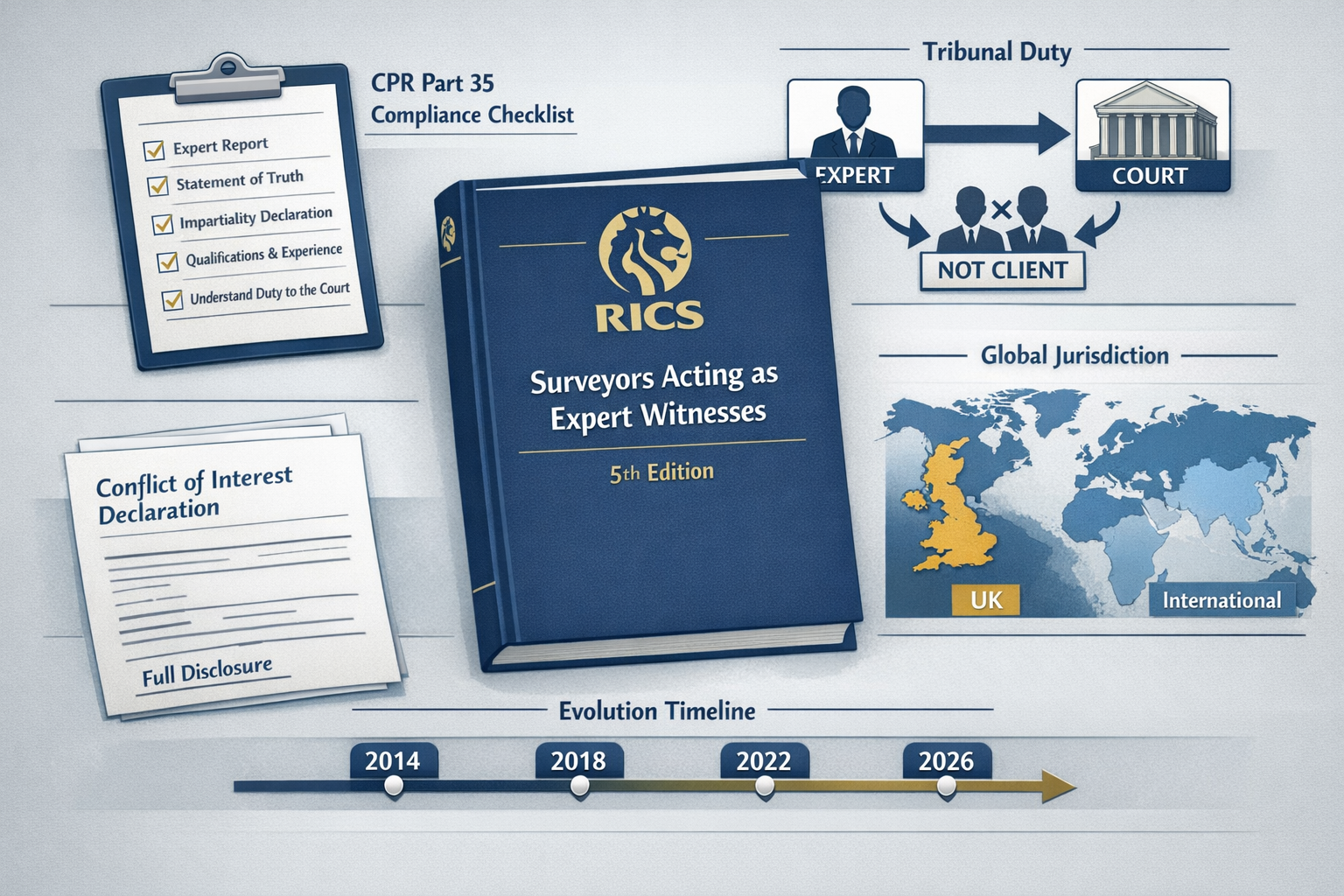
The Royal Institution of Chartered Surveyors (RICS) published the 5th edition of its Professional Standard for Surveyors Acting as Expert Witnesses in late 2025/early 2026, marking the first major comprehensive revision since April 2014.[2] This updated guidance represents a significant evolution in how chartered surveyors must approach expert witness work, particularly in the context of increasingly complex property disputes like those arising from the Northern housing boom.
Key Changes and Enhancements
Global Application Framework
Unlike the 4th edition which applied only to the UK, the 5th edition is designed for global application across different jurisdictions and legal systems.[1][2] This expansion recognizes that property disputes increasingly involve international investors, cross-border transactions, and multinational development projects. For surveyors working on Northern England cases with international stakeholders, this global framework provides clearer guidance on maintaining professional standards regardless of jurisdiction.
Enhanced Conflict of Interest Requirements
The updated standard includes significantly clearer requirements for identifying and disclosing conflicts of interest, along with detailed explanations of legal consequences for non-compliance.[1] In the competitive Northern property market, where surveyors may have existing relationships with developers, lenders, or property owners, these enhanced requirements ensure transparency and protect the integrity of expert evidence.
Common conflict scenarios include:
- Previous professional relationships with parties to the dispute
- Financial interests in the outcome of litigation
- Personal relationships with instructing solicitors or clients
- Concurrent work for related entities
- Fee arrangements that compromise independence
Conditional and Deferred Fee Guidance
One of the most practical additions to the 5th edition is clear guidance on conditional and deferred fees.[1] This addresses a growing concern in expert witness work where payment structures might create incentives that compromise professional independence. The standard clarifies when such arrangements are acceptable and when they pose unacceptable risks to impartiality.
Modern Technology Integration
The 5th edition acknowledges new risks associated with modern technology challenges, including the use of artificial intelligence, automated valuation models, and digital survey techniques.[4] As surveyors increasingly rely on technology for property assessments, the standard emphasizes maintaining professional judgment and ensuring technology enhances rather than replaces expert analysis.
Alignment with Evolving Legislation
The standard specifically addresses members' responsibilities regarding evolving housing legislation, including Awaab's Law (effective October 2025) and the Housing Health and Safety Rating System (HHSRS).[1] For expert witnesses involved in housing disrepair claims—a growing category in the Northern housing boom—this guidance ensures awareness of current legal frameworks affecting property standards.
The Consultation Process and Implementation Timeline
RICS launched a six-week public consultation on the draft 5th edition standard, inviting members and stakeholders to comment on the proposed changes.[1] This collaborative approach ensured the final standard reflects practical realities of expert witness work while maintaining rigorous professional requirements.
The publication in late 2025/early 2026 includes a transition period for implementation, allowing surveyors to familiarize themselves with new requirements and adjust their practices accordingly.[2] However, surveyors accepting new expert witness instructions in 2026 should ensure full compliance with the updated standard from the outset.
Expert Witness Testimonies in 2026 Northern Housing Boom Disputes: Core RICS Principles
At the heart of expert witness work lies a fundamental principle that distinguishes it from other surveying activities: the expert's primary duty is to the tribunal, not the client.[1] This overriding obligation shapes every aspect of how chartered surveyors must approach expert witness testimonies in property disputes.
The Primacy of Duty to the Tribunal
When a chartered surveyor accepts instructions as an expert witness, they assume a responsibility that supersedes normal client relationships. The expert must provide evidence that is:
Independent 🎯
- Free from bias or advocacy for either party
- Based solely on professional expertise and evidence
- Uninfluenced by who is paying the fees
- Objective in analysis and conclusions
Unbiased ⚖️
- Presenting all relevant facts, whether favorable or unfavorable to the instructing party
- Acknowledging limitations in evidence or expertise
- Avoiding selective presentation of information
- Maintaining neutrality in language and tone
Within True Expertise 📚
- Limited to areas where the surveyor has genuine competence
- Clearly identifying when issues fall outside expertise
- Avoiding speculation beyond professional knowledge
- Supporting opinions with recognized methodologies
This duty to the tribunal creates potential tension with commercial pressures, particularly in high-value Northern property disputes where clients may expect advocacy rather than objectivity. RICS standards make clear that surveyors who cannot maintain this independence should decline expert witness instructions.
Qualifications and Competence Requirements
Not every chartered surveyor is qualified to act as an expert witness. The RICS standards and Civil Procedure Rules establish specific competence requirements:
Professional Qualifications 📜
- RICS membership (MRICS or FRICS status)
- Relevant specialist knowledge in the dispute area
- Current practicing certificate and professional indemnity insurance
- Continuing professional development in expert witness work
Legal Knowledge ⚖️
- Familiarity with Civil Procedure Rules Part 35[3]
- Understanding of court procedures and evidence rules
- Knowledge of expert witness duties and responsibilities
- Awareness of jurisdiction-specific requirements
Practical Experience 💼
- Demonstrated expertise in the relevant property sector
- Track record of professional work in the dispute area
- Experience preparing expert reports and giving evidence
- Understanding of cross-examination processes
For surveyors new to expert witness work in the Northern housing boom, obtaining proper training and mentorship is essential. Many experienced practitioners recommend starting with smaller, less complex cases to develop competence before accepting high-stakes instructions.
CPR Part 35 Compliance
In English courts, expert witness evidence must comply with Civil Procedure Rules Part 35, which establishes the framework for expert evidence in civil proceedings.[3] Key requirements include:
| CPR Part 35 Requirement | Practical Application for Surveyors |
|---|---|
| Expert's Overriding Duty | Primary duty to help the court, not the instructing party |
| Written Questions | Experts must answer written questions from opposing parties within 28 days |
| Single Joint Expert | Courts may direct parties to instruct a single joint expert |
| Discussion Between Experts | Experts must meet to identify areas of agreement and disagreement |
| Contents of Report | Specific requirements for report structure and declarations |
| Amendment of Reports | Experts may clarify or correct reports but cannot fundamentally change opinions |
Understanding these procedural requirements is as important as technical surveying competence. A technically excellent valuation or building assessment loses value if it fails to meet CPR Part 35 requirements for admissibility.
RICS Regulatory Oversight
When a chartered surveyor agrees to appear in court as an expert witness, they are regulated in this function by RICS.[6] This means the institution can investigate complaints about expert witness conduct and impose sanctions for breaches of professional standards.
Common regulatory issues include:
- Failure to maintain independence and objectivity
- Providing opinions outside genuine expertise
- Inadequate disclosure of conflicts of interest
- Non-compliance with CPR Part 35 requirements
- Misleading or inaccurate evidence
For surveyors involved in Northern housing boom disputes, this regulatory oversight provides assurance to courts and clients while creating accountability for professional conduct. It also means that expert witness work carries reputational risks that extend beyond individual cases.
Preparing Expert Witness Testimonies for Northern Property Disputes: Practical Guidance
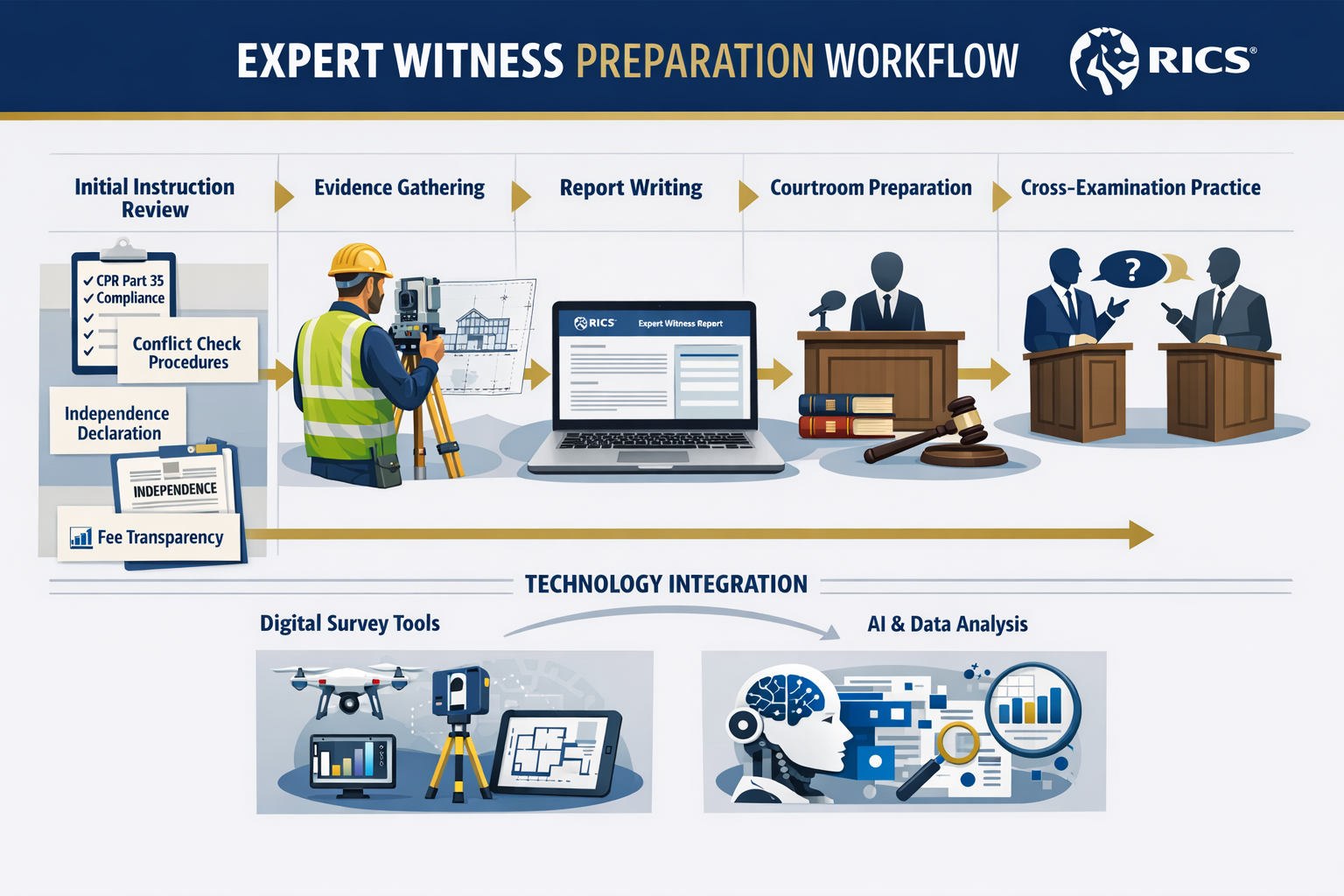
Successfully providing expert witness testimony in 2026 Northern housing boom disputes requires meticulous preparation, thorough documentation, and clear communication. The following practical guidance draws on RICS standards and best practices developed by experienced expert witnesses.
Initial Instructions and Conflict Checks
The expert witness engagement begins with careful review of initial instructions and comprehensive conflict checking:
Reviewing Instructions 📋
- Clarify the precise issues requiring expert opinion
- Confirm the dispute type (valuation, boundary, defect, etc.)
- Identify the jurisdiction and applicable legal framework
- Understand the timeline for report delivery and potential hearing dates
- Establish fee arrangements that preserve independence
Conflict Identification 🔍
Before accepting instructions, surveyors must thoroughly investigate potential conflicts:
- Previous work for any party to the dispute
- Existing relationships with instructing solicitors
- Financial interests in the property or area
- Personal relationships with parties or witnesses
- Concurrent instructions that might create conflicts
When conflicts exist, they must be disclosed immediately. In some cases, conflicts can be managed through informed consent; in others, the surveyor must decline the instruction.
Evidence Gathering and Site Inspections
Thorough evidence gathering forms the foundation of credible expert testimony. For Northern property disputes, this typically involves:
Documentary Evidence Review 📑
- Title deeds and land registry documents
- Previous survey reports and valuations
- Planning permissions and building control approvals
- Construction drawings and specifications
- Correspondence between parties
- Photographic evidence
- Market data and comparable transactions
Site Inspections 🏠
Conducting comprehensive property surveys requires systematic methodology:
- Pre-inspection preparation: Review all available documentation and prepare inspection checklist
- Comprehensive photography: Document all relevant features, defects, and conditions
- Detailed measurements: Record accurate dimensions for boundary disputes or space assessments
- Condition assessment: Evaluate structural elements, building fabric, and services
- Contextual observation: Note surrounding properties, access, amenities, and market factors
- Professional equipment: Use appropriate tools including moisture meters, thermal imaging, and survey instruments
For complex cases, multiple site visits may be necessary to observe conditions at different times or weather conditions.
Report Preparation: Structure and Content
The expert witness report is the primary vehicle for conveying professional opinion to the court. RICS standards and CPR Part 35 establish specific requirements for report content and structure:
Essential Report Elements 📝
-
Introduction and Qualifications
- Expert's name, professional qualifications, and RICS membership
- Summary of relevant experience and expertise
- Confirmation of understanding of expert witness duties
- Declaration of compliance with CPR Part 35
-
Instructions and Scope
- Clear statement of questions to be addressed
- Documents and evidence reviewed
- Site inspections undertaken
- Limitations or restrictions on the instruction
-
Factual Background
- Objective description of the property and dispute
- Chronology of relevant events
- Summary of parties' positions
- Relevant market context (particularly important for Northern housing boom cases)
-
Technical Analysis
- Detailed examination of the issues
- Application of professional methodology
- Reference to relevant standards, regulations, and guidance
- Consideration of alternative interpretations
-
Professional Opinion
- Clear, well-reasoned conclusions
- Explanation of the basis for opinions
- Acknowledgment of limitations or uncertainties
- Response to specific questions in instructions
-
Declaration of Truth
- Statement that the expert understands their duty to the court
- Confirmation that the report contains their true professional opinion
- Acknowledgment that the expert is aware of consequences of false evidence
Writing Style and Clarity ✍️
Effective expert reports balance technical precision with accessibility:
- Use clear, jargon-free language where possible
- Define technical terms when necessary
- Organize content logically with clear headings
- Use tables, diagrams, and photographs to illustrate points
- Maintain objectivity in tone and language
- Avoid advocacy or partisan language
For Northern property disputes, context about local market conditions, development patterns, and regional factors can be crucial. Experts should explain how the Northern housing boom affects valuations, demand patterns, or construction practices relevant to the case.
Expert Discussions and Joint Statements
CPR Part 35 often requires experts instructed by different parties to meet and discuss their evidence. These without prejudice discussions aim to:
- Identify areas of agreement and disagreement
- Narrow the issues for trial
- Clarify technical points
- Produce a joint statement summarizing positions
Best Practices for Expert Discussions 🤝
- Prepare thoroughly: Review all evidence and identify key points before the meeting
- Maintain independence: Discussions should be between experts, not with legal representatives present
- Focus on technical issues: Keep discussions professional and evidence-based
- Document agreements: Clearly record points of agreement and disagreement
- Explain differences: Where opinions differ, articulate the reasons clearly
- Remain respectful: Professional courtesy facilitates productive discussion
The joint statement produced from these discussions becomes an important case document, often significantly influencing settlement negotiations or trial preparation.
Giving Oral Evidence: Courtroom Testimony
While many cases settle before trial, surveyors must be prepared to give oral evidence if required. Effective courtroom testimony requires:
Pre-Trial Preparation 🎓
- Thoroughly review all reports and evidence
- Anticipate questions and challenges to opinions
- Practice explaining technical concepts clearly
- Understand courtroom procedures and etiquette
- Coordinate with instructing solicitors (while maintaining independence)
During Testimony ⚖️
- Answer questions directly and concisely
- Admit limitations or uncertainties honestly
- Maintain composure during cross-examination
- Request clarification if questions are unclear
- Refer to evidence and methodology to support opinions
- Avoid becoming defensive or argumentative
Common Cross-Examination Challenges 🎯
- Questions about qualifications and experience
- Challenges to methodology or assumptions
- Requests to comment on matters outside expertise
- Attempts to highlight inconsistencies or uncertainties
- Questions about fees and client relationships
Experienced expert witnesses recognize that cross-examination is a normal part of the process, not a personal attack. Maintaining professionalism and focusing on evidence-based responses serves both the tribunal and the expert's professional reputation.
Valuation Disputes in the Northern Housing Boom: Specific Considerations
Valuation disputes represent one of the most common categories of expert witness work arising from the 2026 Northern housing boom. The rapid price appreciation and market volatility create numerous scenarios where independent expert valuation becomes essential.
Market Context and Comparable Evidence
Providing credible valuation evidence in a rapidly appreciating market requires careful analysis of:
Comparable Transaction Selection 🏘️
- Recent sales of similar properties in the locality
- Adjustments for differences in size, condition, and features
- Timing adjustments reflecting market movement
- Consideration of motivation (distressed sales vs. arms-length transactions)
The Northern housing boom creates challenges in selecting appropriate comparables, as prices may have moved significantly even between closely-timed transactions. Experts must explain their methodology for temporal adjustments and market trend analysis.
Valuation Methodology 📊
Different valuation approaches may be appropriate depending on property type and dispute context:
| Valuation Method | Application | Northern Boom Considerations |
|---|---|---|
| Comparable Method | Residential properties | Requires careful adjustment for rapid market movement |
| Investment Method | Rental properties | Must reflect changing yields and rental growth |
| Residual Method | Development sites | Needs current construction costs and sales values |
| Profits Method | Commercial properties | Requires market-specific trading data |
| Depreciated Replacement Cost | Specialized properties | Must reflect current construction costs |
For many Northern property disputes, the comparable method predominates, but experts must be prepared to explain why particular comparables were selected and how adjustments were calculated.
Negotiating Property Prices with Survey Evidence
Expert witness work differs from advisory work, but understanding how survey evidence can help negotiate property prices provides context for valuation disputes. Many litigation cases arise when negotiations break down due to disagreement over survey findings or valuations.
Common scenarios include:
- Buyer refuses to complete based on survey revealing defects
- Seller disputes surveyor's valuation used by mortgage lender
- Parties disagree on value adjustment for identified issues
- Professional negligence claims against original surveyor
In these cases, the expert witness must independently assess both the property condition and its impact on value, potentially critiquing the methodology or conclusions of earlier surveys.
Boundary and Party Wall Disputes: Expert Evidence Requirements
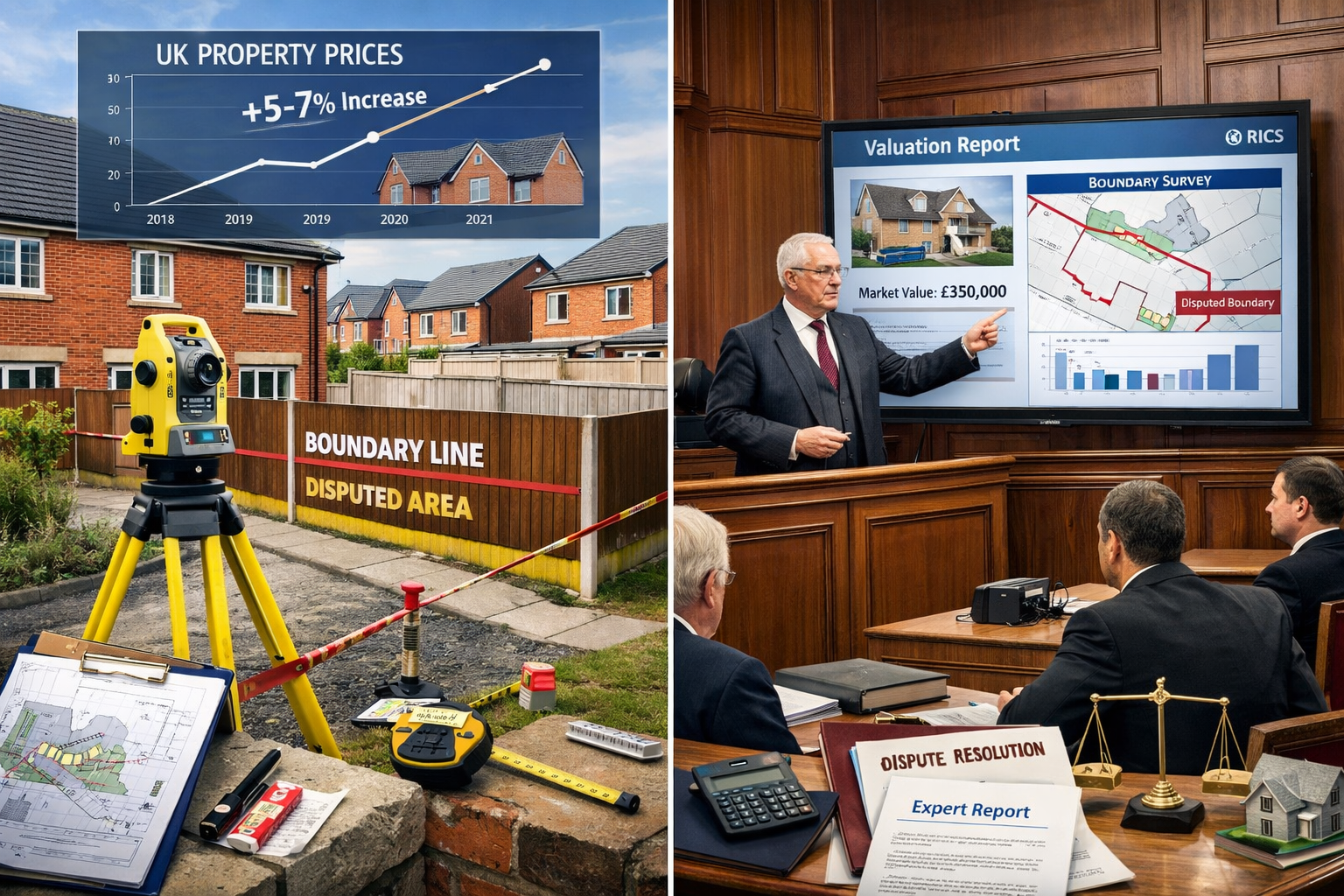
The Northern housing boom has intensified development activity, leading to increased party wall disputes and boundary conflicts. Expert surveyors play crucial roles in resolving these contentious matters.
Party Wall Act 1996 Compliance
Many Northern property disputes involve the Party Wall Act 1996, which governs building works affecting shared walls and boundaries. Expert witnesses in these cases must demonstrate thorough knowledge of:
Act Requirements 📋
- Notice procedures and timing requirements
- Types of works covered by the Act
- Surveyor appointment and award processes
- Rights and obligations of building and adjoining owners
- Remedies for non-compliance
Common Dispute Issues ⚠️
- Whether proper notices were served
- Scope and reasonableness of proposed works
- Adequacy of protective measures
- Damage causation and liability
- Award compliance and enforcement
Expert evidence often focuses on technical matters such as whether works comply with the Act's requirements, whether damage was caused by the works, and what remedial measures are appropriate.
Boundary Determination and Survey Evidence
Boundary disputes require precise survey evidence and careful interpretation of title documents:
Survey Techniques 📐
- Measured surveys establishing physical boundaries
- Analysis of Ordinal Survey data and Land Registry plans
- Historical document research
- Photographic evidence of boundary features
- Expert interpretation of ambiguous boundaries
Legal vs. Physical Boundaries 🗺️
Experts must understand the distinction between:
- Legal boundaries: Defined by title documents and Land Registry plans
- Physical boundaries: Actual features on the ground (walls, fences, hedges)
- Presumptions: Legal presumptions about boundary ownership and responsibility
In Northern housing boom areas where properties change hands frequently and development is intensive, boundary disputes often arise from unclear historical boundaries or encroachments that went unchallenged for years.
Construction Defect Claims: Technical Expert Evidence
The rapid development pace in Northern England's housing boom has unfortunately led to increased construction defect claims, requiring expert witnesses to assess building failures and attribute responsibility.
Defect Identification and Causation
Expert evidence in construction defect cases must address:
Defect Categories 🏗️
- Structural defects (foundation failures, structural movement, inadequate support)
- Building envelope failures (water ingress, thermal performance, air tightness)
- Services defects (heating, electrical, plumbing failures)
- Finishing defects (cosmetic issues vs. functional failures)
Causation Analysis 🔍
Determining why defects occurred requires investigation of:
- Design adequacy and compliance with Building Regulations
- Construction methodology and workmanship quality
- Materials selection and specification
- Site conditions and ground investigation
- Weather exposure and environmental factors
For new build properties in the Northern housing boom, experts must assess whether defects result from design flaws, construction failures, or inadequate maintenance, as this determines liability allocation.
Remedial Works Specification and Costing
Expert witnesses must often specify appropriate remedial works and provide cost estimates:
Remedial Scope 🔧
- Minimum intervention required to address defects
- Betterment issues (improvements beyond original specification)
- Access requirements and consequential works
- Temporary works and protection measures
Cost Assessment 💷
Credible cost evidence requires:
- Detailed specifications of required works
- Competitive quotations from qualified contractors
- Allowances for professional fees and contingencies
- VAT and other cost implications
- Timing considerations affecting costs
In the context of the Northern housing boom, construction costs have also risen, affecting remedial cost assessments. Experts must use current cost data and explain any assumptions about future cost movements.
Technology and Innovation in Expert Witness Work
The 5th edition RICS standards specifically address modern technology challenges facing expert witnesses.[4] Understanding how to appropriately integrate technology while maintaining professional judgment is increasingly important.
Digital Survey Techniques
Modern surveying technology offers powerful tools for evidence gathering:
Laser Scanning and 3D Modeling 📡
- Precise measurement and documentation of buildings
- Creation of detailed 3D models for court presentation
- Comparison of as-built vs. design conditions
- Virtual site visits for remote experts
Thermal Imaging and Moisture Detection 🌡️
- Non-invasive investigation of building defects
- Identification of thermal bridges and insulation failures
- Moisture ingress detection and tracking
- Evidence documentation through visual imagery
Drone Surveys 🚁
- Access to difficult or dangerous areas
- Roof condition assessment
- Site context and boundary documentation
- Photographic evidence from multiple perspectives
While these technologies enhance evidence quality, experts must ensure they understand the equipment's limitations, calibration requirements, and appropriate application. Courts increasingly accept digital evidence, but experts must be prepared to explain methodology and reliability.
Automated Valuation Models and AI
The rise of automated valuation models (AVMs) and artificial intelligence in property valuation creates both opportunities and challenges for expert witnesses:
Appropriate Use ✅
- Market trend analysis and comparable identification
- Data analysis and pattern recognition
- Preliminary valuations and range estimation
- Quality assurance and cross-checking
Limitations and Risks ⚠️
- Lack of property-specific inspection
- Inability to assess condition and quality factors
- Market lag in rapidly changing conditions (like the Northern boom)
- Algorithmic bias and data quality issues
RICS guidance emphasizes that technology should enhance, not replace, professional judgment.[6] Expert witnesses must maintain personal responsibility for opinions, even when using technological tools. Courts expect experts to explain how technology was used and why conclusions remain reliable despite any technological limitations.
Fee Structures and Independence: Navigating Commercial Pressures
The 5th edition RICS standards provide clear guidance on conditional and deferred fees to protect expert witness independence.[1] Understanding acceptable fee arrangements is crucial for maintaining professional integrity.
Acceptable Fee Arrangements
Hourly or Daily Rates ⏰
- Most common and generally acceptable
- Clear time recording and billing
- Predictable costs for straightforward matters
- May require estimates for budgeting
Fixed Fees 💰
- Appropriate for defined scope work
- Requires clear specification of deliverables
- Risk of scope creep affecting profitability
- Should include revision provisions
Retainers 📅
- Acceptable for securing availability
- Must not create dependency or bias
- Should be offset against fees for actual work
- Appropriate for complex, long-running cases
Unacceptable Fee Arrangements
The RICS standards prohibit fee arrangements that compromise independence:
Contingency Fees ❌
- Payment dependent on case outcome
- Creates direct financial interest in result
- Fundamentally incompatible with expert witness duties
- May render evidence inadmissible
Success Fees ❌
- Enhanced payment for favorable outcomes
- Similar issues to contingency fees
- Compromises objectivity and independence
- Prohibited under RICS standards
Deferred Fees ⚠️
- Payment only if case succeeds
- Generally problematic but may be acceptable in limited circumstances
- Requires careful consideration and disclosure
- Should be avoided where possible
Transparency and Disclosure
Regardless of fee structure, experts must:
- Disclose fee arrangements in reports
- Explain any unusual payment terms
- Confirm that fees do not affect independence
- Address fee-related questions during cross-examination
In high-value Northern property disputes, legal teams may pressure experts to accept fee arrangements that create commercial dependency. RICS members must resist such pressure and maintain fee structures that preserve professional independence.
Common Pitfalls and How to Avoid Them
Experience from numerous expert witness cases reveals common mistakes that undermine evidence credibility:
Exceeding Expertise Boundaries
The Pitfall 🚫
Providing opinions on matters outside genuine expertise, often due to client pressure or overconfidence.
How to Avoid ✅
- Clearly define expertise boundaries in initial instructions
- Decline to answer questions outside competence
- Recommend additional experts for specialized issues
- Acknowledge limitations explicitly in reports
Advocacy and Loss of Objectivity
The Pitfall 🚫
Becoming an advocate for the instructing party rather than maintaining independence.
How to Avoid ✅
- Remember the primary duty to the tribunal
- Present all relevant evidence, favorable or unfavorable
- Use neutral language and balanced analysis
- Resist pressure to modify opinions for tactical reasons
Inadequate Investigation
The Pitfall 🚫
Forming opinions without sufficient evidence gathering or analysis.
How to Avoid ✅
- Conduct thorough site inspections
- Review all relevant documentation
- Seek additional information when necessary
- Acknowledge when evidence is insufficient for firm conclusions
Poor Report Presentation
The Pitfall 🚫
Producing reports that are unclear, poorly structured, or fail to comply with CPR Part 35.
How to Avoid ✅
- Follow RICS report templates and guidance
- Use clear headings and logical structure
- Include all required declarations and statements
- Have reports reviewed by experienced colleagues
Inadequate Cross-Examination Preparation
The Pitfall 🚫
Appearing unprepared or defensive during cross-examination.
How to Avoid ✅
- Thoroughly review all evidence before testimony
- Practice explaining technical concepts clearly
- Anticipate challenges and prepare responses
- Maintain composure and professionalism
Professional Development and Training for Expert Witnesses
Becoming an effective expert witness requires ongoing professional development beyond general surveying competence:
RICS Training and Resources
RICS provides various resources for members undertaking expert witness work:
Formal Training 📚
- Expert witness training courses
- CPR Part 35 compliance workshops
- Report writing seminars
- Cross-examination skills training
Guidance Documents 📋
- Professional standards and practice statements
- Technical guidance notes
- Case law updates
- International practice guides
Peer Networks 👥
- Expert witness special interest groups
- Regional networking events
- Online forums and discussion groups
- Mentoring programs
Continuing Professional Development
Expert witness work should feature in annual CPD planning:
Technical Knowledge 🔧
- Updates on Building Regulations and standards
- Market analysis and valuation methodology
- Construction technology and materials
- Defect diagnosis and remediation
Legal Knowledge ⚖️
- Civil procedure updates
- Case law developments
- Expert witness duties and responsibilities
- Jurisdiction-specific requirements
Skills Development 💡
- Report writing and communication
- Cross-examination techniques
- Expert discussions and negotiations
- Technology application in surveying
For surveyors working on Northern housing boom disputes, specific CPD on regional market conditions, local development patterns, and area-specific construction practices adds valuable expertise.
The Future of Expert Witness Work: Trends and Developments
Looking beyond 2026, several trends are likely to shape expert witness work in property disputes:
Increased Digitalization
Courts are increasingly comfortable with digital evidence presentation, virtual hearings, and remote expert testimony. This trend, accelerated by pandemic-era adaptations, is likely to continue, offering both opportunities and challenges for expert witnesses.
Greater International Collaboration
The 5th edition's global application framework reflects increasing internationalization of property markets and disputes. Experts may increasingly work across jurisdictions, requiring familiarity with different legal systems and professional standards.
Enhanced Scrutiny of Expert Evidence
Courts are becoming more sophisticated in evaluating expert evidence, with judges increasingly willing to critique methodology, challenge assumptions, and exclude unreliable evidence. This trend demands higher standards of rigor and transparency from expert witnesses.
Technology Integration
Artificial intelligence, machine learning, and advanced analytics will play growing roles in property valuation and assessment. Experts must stay current with technological developments while maintaining the professional judgment that distinguishes expert opinion from automated analysis.
Climate and Sustainability Considerations
Property disputes increasingly involve climate resilience, energy performance, and sustainability issues. Expert witnesses need developing expertise in these emerging areas, particularly as building regulations evolve to address climate change.
Conclusion: Excellence in Expert Witness Practice
Expert Witness Testimonies in 2026 Northern Housing Boom Disputes: RICS Guidelines for Surveyors represents a critical intersection of professional competence, ethical responsibility, and legal expertise. As the Northern England property market continues its dynamic growth, chartered surveyors will increasingly be called upon to provide independent, credible evidence in high-stakes disputes.
Success in this specialized field requires:
✅ Thorough understanding of RICS professional standards, particularly the updated 5th edition requirements
✅ Unwavering commitment to the primary duty to the tribunal over client interests
✅ Technical excellence in surveying, valuation, and construction assessment
✅ Legal knowledge of CPR Part 35 and court procedures
✅ Professional integrity in fee arrangements, conflict management, and independence
✅ Continuous development through training, peer learning, and staying current with market and regulatory changes
Actionable Next Steps
For chartered surveyors seeking to develop or enhance expert witness capabilities:
-
Review the 5th Edition Standards: Obtain and thoroughly study the updated RICS Professional Standard for Surveyors Acting as Expert Witnesses to understand current requirements.[1][2]
-
Assess Current Competence: Honestly evaluate expertise areas and identify any gaps requiring development before accepting expert witness instructions.
-
Obtain Formal Training: Complete RICS-approved expert witness training covering CPR Part 35 compliance, report writing, and courtroom testimony.
-
Develop Specialization: Focus expert witness work on areas of genuine expertise, whether residential surveys, party wall matters, commercial valuations, or construction defects.
-
Build Professional Networks: Connect with experienced expert witnesses for mentorship and peer support through RICS networks and local professional groups.
-
Implement Quality Systems: Develop templates, checklists, and procedures ensuring consistent compliance with professional standards and CPR Part 35 requirements.
-
Stay Current: Maintain awareness of Northern housing market developments, regulatory changes, and case law affecting expert witness work.
The 2026 Northern housing boom presents both opportunities and responsibilities for chartered surveyors. By adhering to RICS guidelines, maintaining unwavering independence, and delivering technically excellent evidence, surveyors can serve the administration of justice while building rewarding expert witness practices. The updated professional standards provide a robust framework for excellence—surveyors must now implement these principles in their day-to-day expert witness work.
For property owners, developers, and legal professionals involved in Northern property disputes, understanding these expert witness standards helps in selecting qualified experts and evaluating the credibility of evidence presented. The quality of expert witness testimony often determines case outcomes, making proper expert selection and instruction critical to successful dispute resolution.
As the Northern England property market continues evolving through 2026 and beyond, the demand for credible, independent expert witness testimony will only increase. Chartered surveyors who embrace the highest professional standards and commit to continuous development will find themselves well-positioned to serve this important function while advancing their professional careers and contributing to fair, evidence-based dispute resolution.
References
[1] Rics Launches Global Consultation On Updated Expert Witness Standard – https://www.rics.org/news-insights/rics-launches-global-consultation-on-updated-expert-witness-standard
[2] Rics Consultation On Professional Standard For Surveyors Acting As Expert Witnesses 5th Edition 2025 – https://www.ewi.org.uk/News/rics-consultation-on-professional-standard-for-surveyors-acting-as-expert-witnesses-5th-edition-2025
[3] What Is An Expert Witness Survey – https://readingspropertygroup.com/housing-market/what-is-an-expert-witness-survey/
[4] Surveyors Acting As Expert Witnesses – https://www.rics.org/profession-standards/rics-standards-and-guidance/sector-standards/dispute-resolution-standards/surveyors-acting-as-expert-witnesses
[6] Ai Expert Witness – https://ww3.rics.org/uk/en/modus/technology-and-data/surveying-tools/ai-expert-witness.html