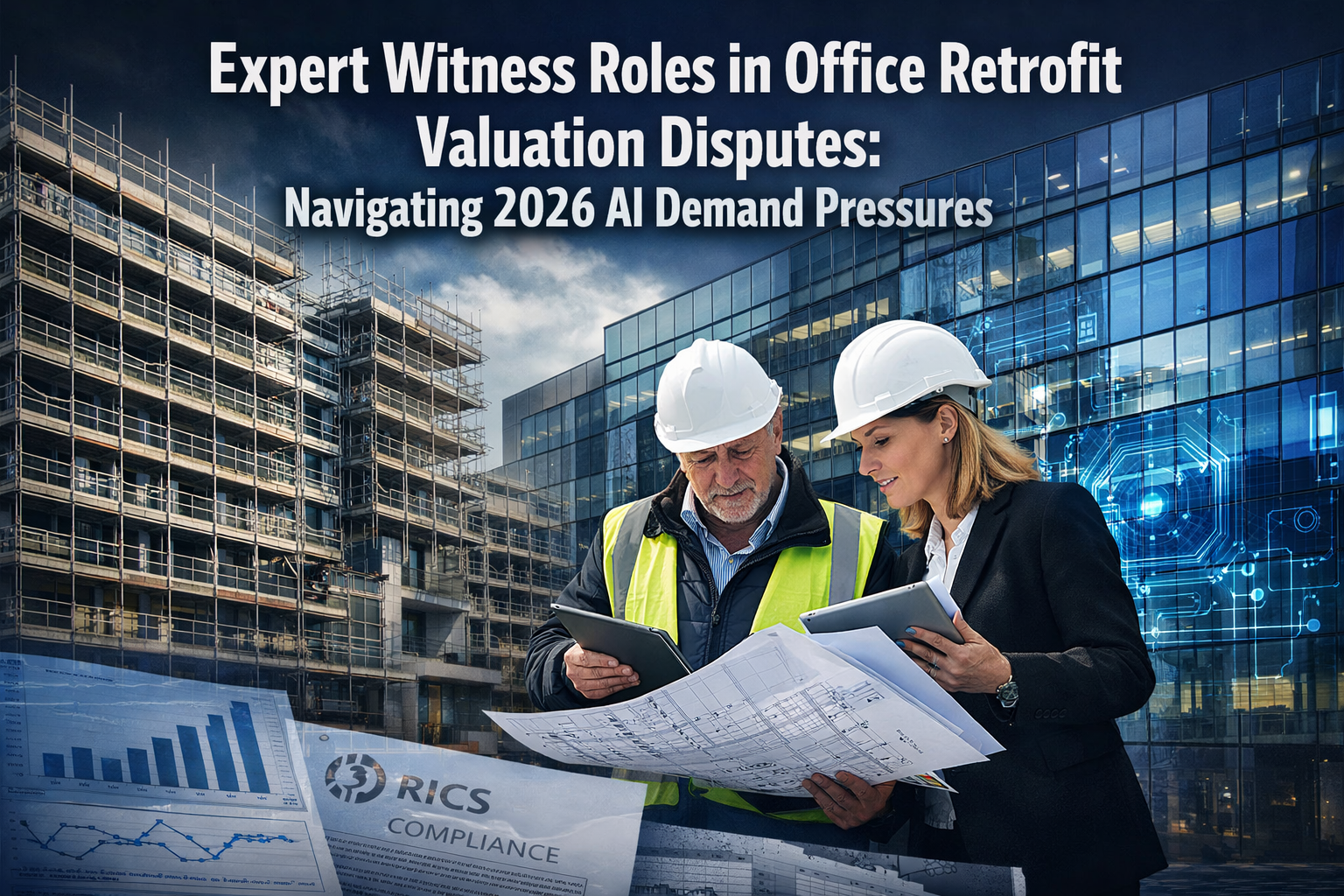
The commercial property landscape in 2026 faces unprecedented disruption. As artificial intelligence companies scramble for office space equipped with robust power infrastructure and advanced cooling systems, Expert Witness Roles in Office Retrofit Valuation Disputes: Navigating 2026 AI Demand Pressures have become critical to resolving conflicts between landlords, tenants, and investors.
Across Northern cities like Manchester, Leeds, and Newcastle, office buildings once considered outdated are suddenly valuable—but only if retrofitted correctly. These transformations spark heated debates: How much value does AI-ready infrastructure add? Who pays for upgrades? What rental premiums are justified? When negotiations fail, expert witnesses step in to provide objective, evidence-based valuations that courts and arbitrators can trust.
Key Takeaways
- 🏢 AI demand pressures are creating significant valuation disputes in office retrofit projects, particularly in Northern UK cities where older buildings require substantial infrastructure upgrades
- ⚖️ Expert witnesses apply RICS evidence standards to resolve conflicts over retrofit costs, rental growth projections, and lease regear negotiations
- 📊 Valuation methodologies must account for specialized AI infrastructure including enhanced electrical capacity, advanced HVAC systems, and fiber connectivity
- 🔍 Dispute resolution increasingly requires experts who understand both traditional property valuation and emerging technology infrastructure requirements
- 💼 Professional credibility depends on maintaining independence, following established protocols, and providing defensible opinions backed by market data
Understanding the 2026 Office Retrofit Valuation Landscape
The surge in AI adoption has fundamentally altered commercial real estate dynamics. Technology companies seeking to expand their operations need office spaces capable of supporting high-density computing equipment—requirements that most traditional office buildings cannot meet without significant investment.
The AI Infrastructure Premium
Modern AI operations demand:
- Enhanced electrical capacity: 100-150 watts per square foot versus traditional office requirements of 20-30 watts
- Advanced cooling systems: Precision HVAC capable of handling heat loads from server equipment
- Redundant power supplies: Uninterruptible power systems (UPS) and backup generators
- High-speed connectivity: Fiber optic infrastructure with multiple carrier access points
- Raised flooring: Cable management systems for dense power and data distribution
These upgrades can cost between £150-£400 per square foot, depending on the building's existing infrastructure and location [2]. The question that triggers disputes: Does this investment translate to proportional value increases?
Common Dispute Triggers
Valuation conflicts typically arise in several scenarios:
- Lease regear negotiations where landlords seek higher rents based on retrofit investments
- Tenant improvement disputes over who bears upgrade costs and who captures value
- Investment transactions where buyers and sellers disagree on post-retrofit valuations
- Insurance claims following retrofit-related damages or delays
- Partnership dissolutions requiring asset division of partially retrofitted properties
When parties cannot reconcile their positions, property disputes escalate to formal proceedings where expert witnesses become essential.
Expert Witness Roles in Office Retrofit Valuation Disputes: Core Responsibilities
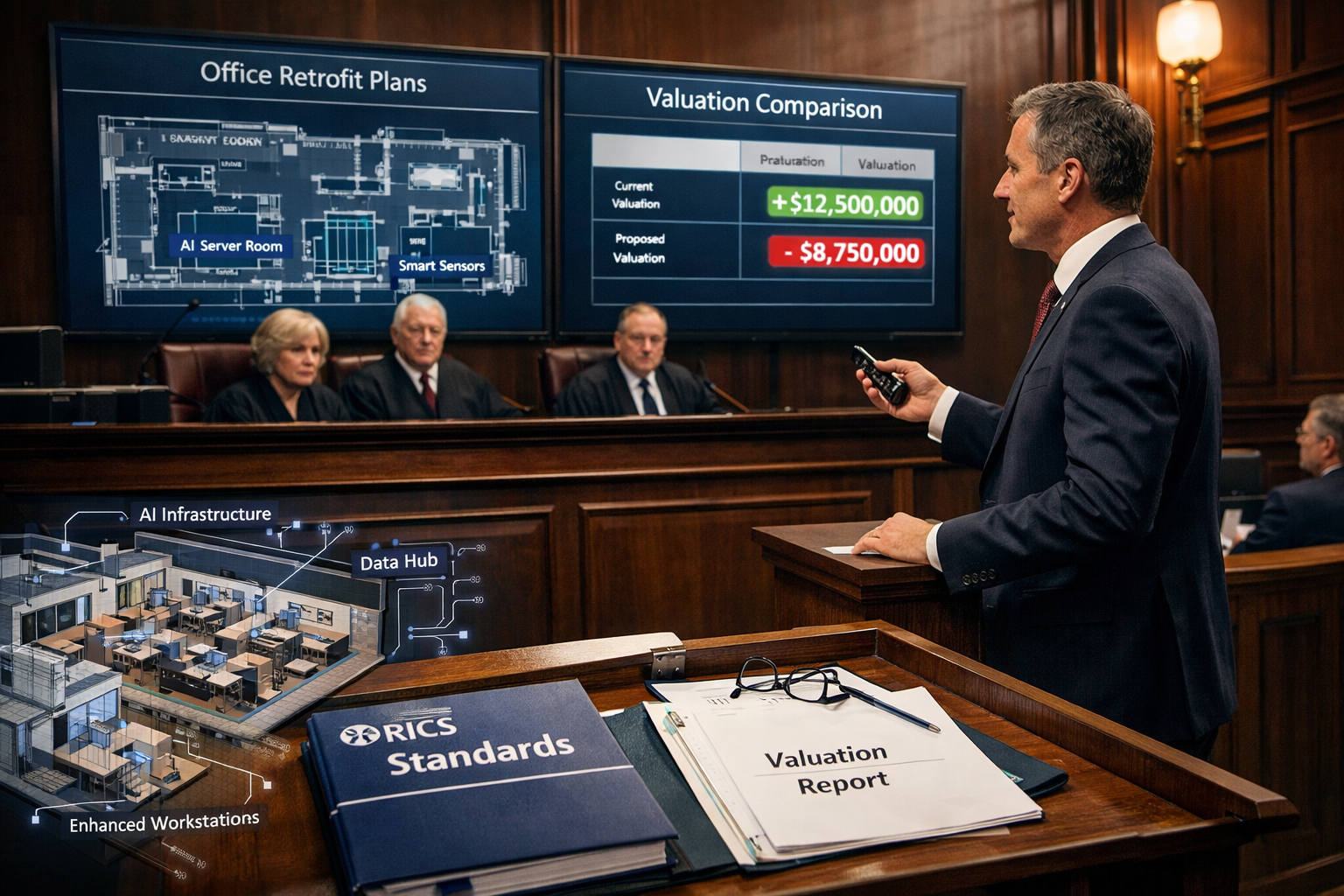
Expert witnesses serve as independent professionals who provide specialized knowledge to help courts, arbitrators, and mediators understand complex technical and financial matters. In office retrofit valuation disputes, their responsibilities extend across multiple dimensions.
Primary Functions
Independent Valuation Analysis 📋
Expert witnesses must conduct thorough, unbiased assessments of property values before and after retrofits. This involves:
- Analyzing comparable transactions of AI-ready office spaces
- Evaluating retrofit cost documentation and contractor estimates
- Assessing market rental rates for technology-equipped premises
- Reviewing lease terms and tenant improvement agreements
- Examining building evaluation reports and structural surveys
Evidence Preparation and Presentation
Experts prepare detailed reports that explain:
- Valuation methodologies applied
- Data sources and market research conducted
- Assumptions and limitations of the analysis
- Alternative scenarios and sensitivity analyses
- Professional opinions supported by evidence
These reports must comply with RICS (Royal Institution of Chartered Surveyors) standards and legal dispute procedural requirements [6].
Court Testimony and Cross-Examination
During proceedings, expert witnesses:
- Present findings clearly to non-technical audiences
- Defend methodologies under cross-examination
- Respond to opposing expert opinions
- Clarify technical concepts for judges and arbitrators
- Maintain professional composure under pressure
RICS Evidence Standards for Expert Witnesses
The RICS provides comprehensive guidance for expert witnesses, emphasizing:
| Standard | Requirement |
|---|---|
| Independence | Duty to the court/tribunal supersedes duty to instructing party |
| Competence | Must possess relevant qualifications and experience |
| Objectivity | Opinions based on evidence, not advocacy |
| Transparency | Disclose assumptions, limitations, and uncertainties |
| Currency | Use up-to-date market data and methodologies |
Professional surveyors offering professional surveyor services must maintain these standards throughout their engagement.
Specialized Knowledge Requirements
Effective expert witnesses in 2026 retrofit disputes need expertise spanning:
- Traditional valuation methods: Income capitalization, comparable sales, cost approach
- Technology infrastructure: Understanding AI operational requirements and associated costs
- Construction economics: Retrofit feasibility, phasing, and cost estimation
- Market dynamics: Regional variations in AI company demand and rental premiums
- Regulatory compliance: Building codes, energy efficiency standards, and safety requirements
This multidisciplinary knowledge distinguishes qualified experts from general practitioners.
Navigating 2026 AI Demand Pressures: Valuation Methodologies and Challenges
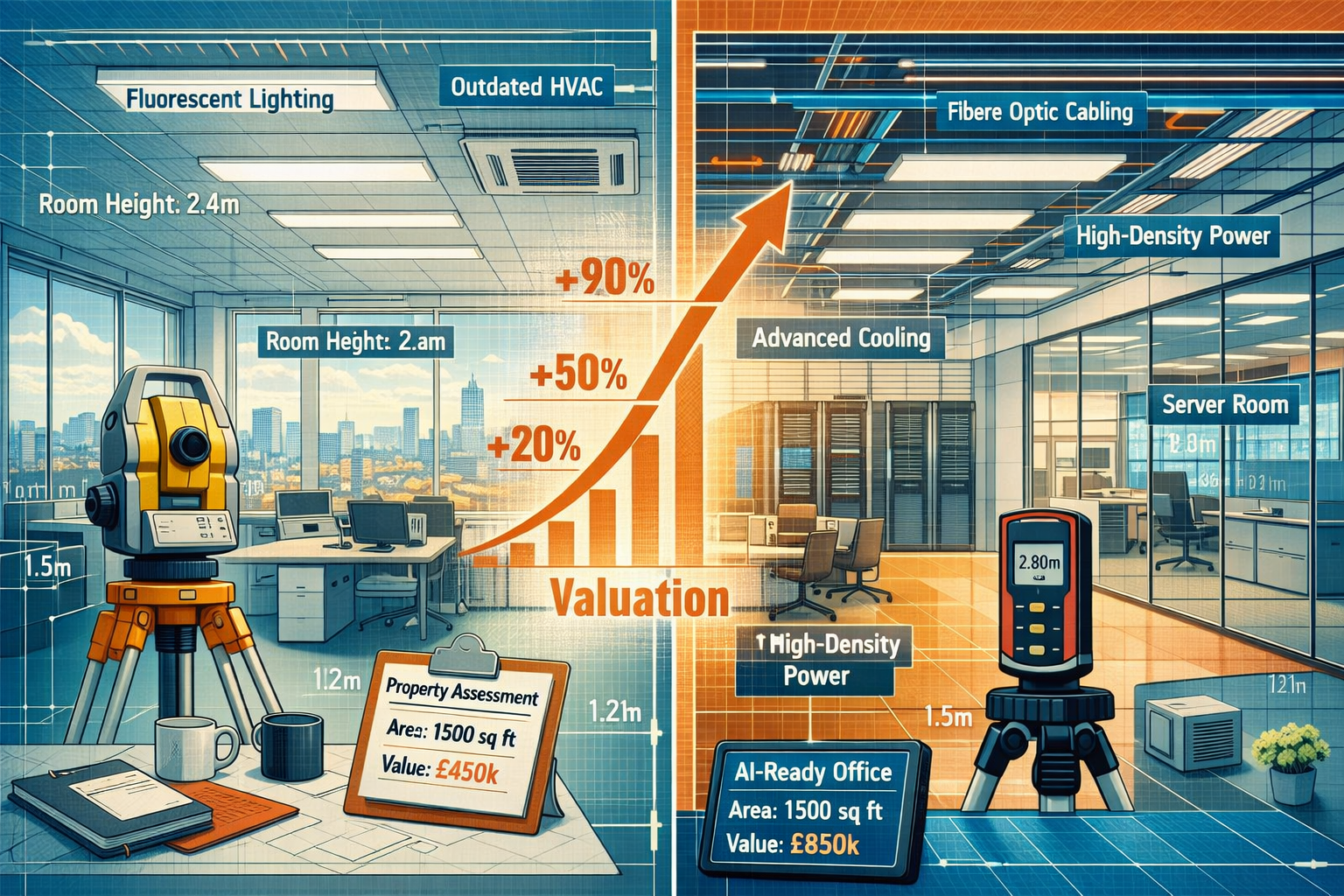
The unique characteristics of AI-driven office demand create specific valuation challenges that expert witnesses must address systematically.
Valuation Approach Considerations
Income Capitalization Method 💰
This approach values property based on income-generating potential. For AI-ready retrofits:
Advantages:
- Directly reflects rental premium from technology tenants
- Incorporates market-derived capitalization rates
- Accounts for lease terms and tenant quality
Challenges:
- Limited comparable data for AI-specific retrofits in 2026
- Uncertainty about sustainability of AI demand premiums
- Difficulty projecting long-term rental growth rates
Expert witnesses must justify rental rate assumptions with market evidence, considering factors like:
- Recent lease transactions for technology tenants
- Vacancy rates for standard versus AI-ready spaces
- Tenant retention rates in retrofitted buildings
- Regional economic indicators and technology sector growth
Cost Approach Adjustments
The cost approach adds retrofit investment to base property value. Key considerations include:
- Depreciation of existing improvements: How much value remains in pre-retrofit infrastructure?
- Functional obsolescence: What penalty applies to non-upgraded spaces?
- Economic obsolescence: Are market conditions supporting full cost recovery?
- Entrepreneurial profit: What return should developers expect on retrofit investments?
In Northern cities experiencing AI company influx, expert witnesses must analyze whether retrofit costs translate to equivalent value increases or if market constraints limit value capture [2].
Regional Market Variations
Northern City Hotspots 🏙️
Manchester, Leeds, and Newcastle have emerged as AI company destinations due to:
- Lower occupancy costs compared to London
- Strong university partnerships providing talent pipelines
- Government incentives for technology sector development
- Existing fiber infrastructure in central business districts
However, each market exhibits distinct characteristics:
| City | Average Retrofit Cost | AI Tenant Demand | Rental Premium |
|---|---|---|---|
| Manchester | £180-£320/sq ft | High | 25-40% |
| Leeds | £160-£280/sq ft | Moderate-High | 20-35% |
| Newcastle | £150-£260/sq ft | Moderate | 15-30% |
Note: Estimates based on 2026 market conditions and vary by building age and location within each city.
Expert witnesses must demonstrate familiarity with local market conditions when providing valuations, as assumptions valid in Manchester may not apply to Newcastle.
Addressing Uncertainty and Risk
The rapid evolution of AI technology creates valuation uncertainties:
Technology Obsolescence Risk ⚠️
Today's cutting-edge infrastructure may become inadequate within 3-5 years as AI computing requirements evolve. Expert witnesses should:
- Incorporate flexibility factors into valuations
- Consider modular infrastructure designs that allow future upgrades
- Analyze depreciation schedules reflecting technology lifecycles
- Review lease terms addressing future modification rights
Demand Sustainability Questions
Will AI company demand for specialized office space continue, or will remote work and cloud computing reduce physical space needs? Experts must:
- Present multiple scenarios (base case, optimistic, pessimistic)
- Explain sensitivity of valuations to demand assumptions
- Reference industry forecasts and technology trends
- Acknowledge limitations in predicting long-term market dynamics
Regulatory Changes
Energy efficiency mandates and building code updates may require additional investments. Expert witnesses should account for:
- Pending legislation affecting retrofit requirements
- Compliance costs for environmental standards
- Potential obsolescence of current retrofit specifications
Case Study Applications: Expert Witness Roles in Office Retrofit Valuation Disputes

Examining real-world scenarios illustrates how expert witnesses navigate complex retrofit valuation disputes.
Case Study 1: Lease Regear Dispute in Manchester
Background:
A landlord invested £2.8 million retrofitting a 15,000 sq ft office building with enhanced electrical systems, precision cooling, and fiber connectivity. Upon lease expiration, they proposed a 45% rent increase, citing the AI-ready infrastructure. The existing tenant, a traditional professional services firm, contested the increase, arguing they derived no benefit from the upgrades.
Expert Witness Role:
The appointed expert conducted:
- Market analysis of comparable AI-ready spaces, finding rental premiums of 25-40% for technology tenants
- Tenant-specific assessment showing the professional services firm required only standard office infrastructure
- Dual valuation calculating separate rental values for technology versus traditional tenants
- Allocation methodology apportioning retrofit costs between specialized and general improvements
Resolution:
The expert's analysis supported a 15% rent increase, reflecting general building improvements while acknowledging the tenant couldn't utilize specialized AI infrastructure. The landlord retained rights to higher premiums upon lease termination if securing a technology tenant.
Case Study 2: Investment Transaction Dispute in Leeds
Background:
A property fund acquired an office building for retrofit development, projecting a post-retrofit value of £12 million based on anticipated AI tenant demand. After completing £1.8 million in upgrades, they sought refinancing but received a £9.5 million valuation from the lender's appraiser, triggering a dispute.
Expert Witness Role:
The independent expert examined:
- Comparable sales data for retrofitted office buildings in Leeds
- Absorption rates for AI-ready versus standard office space
- Cost documentation verifying retrofit expenditures
- Market timing assessing whether AI tenant demand materialized as projected
Findings:
The expert determined:
- Retrofit quality met AI tenant requirements
- However, Leeds market absorption of premium space was slower than Manchester
- Comparable sales supported a £10.2 million valuation
- Original projections relied on overly optimistic rental rate assumptions
Outcome:
The expert's balanced analysis facilitated negotiation, with the property fund accepting a £10 million refinancing value while implementing revised leasing strategies to achieve projected returns over an extended timeline.
Case Study 3: Construction Defect and Delay Claims
Background:
A Newcastle office retrofit experienced significant delays when contractors discovered unexpected electrical infrastructure deficiencies. The tenant claimed £400,000 in damages for lost occupancy and business disruption. The landlord countered that delays resulted from tenant-requested design changes.
Expert Witness Role:
The appointed expert reviewed:
- Original retrofit specifications and timelines
- Construction project legal requirements and permitting processes
- Change order documentation and approval records
- Market rental rates for temporary alternative space
- Business interruption calculations
Analysis:
The expert allocated responsibility:
- 60% of delays attributable to unforeseen conditions (landlord responsibility)
- 40% attributable to tenant design changes (tenant responsibility)
Resolution:
Based on the expert's proportional allocation, the parties settled for £240,000 in damages, avoiding protracted litigation [1].
Best Practices for Expert Witnesses in Retrofit Valuation Disputes
Successful expert witnesses follow established protocols that enhance credibility and effectiveness.
Pre-Engagement Considerations ✅
Conflict Checking
Before accepting instructions, experts must:
- Verify no previous relationships with parties that could compromise independence
- Disclose any potential conflicts of interest
- Confirm availability to complete the engagement within required timeframes
- Ensure competence in the specific dispute subject matter
Terms of Engagement
Clear engagement letters should specify:
- Scope of work and deliverables
- Fee arrangements and payment terms
- Access to information and site inspection rights
- Report delivery schedules
- Testimony expectations
Investigation and Analysis Phase
Comprehensive Data Gathering 📊
Thorough experts collect:
- Complete property assessment documentation
- Lease agreements and tenant correspondence
- Retrofit design specifications and as-built drawings
- Contractor invoices and payment records
- Market research and comparable transaction data
- Regulatory compliance documentation
Independent Verification
Rather than accepting party representations, experts should:
- Conduct site inspections to verify retrofit quality and completion
- Interview contractors and design professionals
- Review building permits and inspection records
- Validate market data through multiple sources
- Cross-check financial documentation
Methodological Rigor
Defensible opinions require:
- Application of recognized valuation standards (RICS, IVSC)
- Transparent assumptions and calculations
- Sensitivity analyses showing impact of variable assumptions
- Consideration of alternative methodologies
- Documentation of reasoning and professional judgment
Report Preparation Standards
Expert reports should include:
- Executive Summary: Concise overview of opinions and conclusions
- Instructions and Scope: What the expert was asked to determine
- Qualifications: Credentials demonstrating expertise
- Methodology: Approaches used and justification
- Factual Findings: Verified information gathered during investigation
- Analysis: Application of methodology to facts
- Opinions: Professional conclusions supported by analysis
- Limitations: Constraints on scope, data, or assumptions
- Declaration: Statement of independence and compliance with standards
Reports must be written clearly for non-specialist audiences while maintaining technical accuracy.
Testimony Preparation and Delivery
Pre-Hearing Preparation 🎯
Effective witnesses:
- Review all case materials thoroughly
- Anticipate opposing counsel questions
- Prepare visual aids and demonstrative exhibits
- Practice explaining complex concepts simply
- Coordinate with instructing solicitors on procedural matters
Courtroom Conduct
During testimony, experts should:
- Speak clearly and at appropriate pace
- Address responses to the judge/arbitrator, not counsel
- Admit limitations or uncertainties honestly
- Avoid advocacy or defensiveness
- Request clarification of ambiguous questions
- Maintain professional demeanor under cross-examination
Post-Hearing Responsibilities
After testifying, experts may need to:
- Provide supplemental information requested by the tribunal
- Clarify or correct testimony if errors are identified
- Participate in expert conferences or joint statements
- Review draft judgments for factual accuracy (if permitted)
Emerging Trends and Future Considerations
The intersection of AI demand and office retrofit valuation continues evolving, creating new challenges for expert witnesses.
Technology Integration in Valuation
Advanced analytical tools are enhancing expert witness capabilities:
- AI-powered comparable analysis: Machine learning algorithms identifying relevant transactions
- 3D building modeling: Digital twins facilitating retrofit cost estimation
- Market forecasting tools: Predictive analytics for rental rate trends
- Remote inspection technology: Drones and sensors enabling detailed property assessment
However, experts must ensure technology enhances rather than replaces professional judgment, maintaining transparency about algorithmic assumptions [6].
Regulatory Developments
Anticipated changes affecting retrofit valuations include:
- Enhanced energy efficiency mandates: Requirements for carbon-neutral operations by 2030
- Grid capacity constraints: Limitations on electrical service upgrades in some areas
- Planning restrictions: Conservation area limitations on exterior modifications
- Tenant protection regulations: Restrictions on rent increases following retrofits
Expert witnesses must stay current with regulatory developments and incorporate compliance considerations into valuations.
Professional Development Requirements
As retrofit disputes become more complex, expert witnesses should pursue:
- Specialized training in AI infrastructure and technology requirements
- Market intelligence through industry conferences and networking
- Continuing education on valuation methodologies and legal standards
- Cross-disciplinary collaboration with engineers, architects, and technology consultants
Organizations like RICS and professional surveying bodies offer resources supporting expert witness development.
Alternative Dispute Resolution
Many parties prefer resolving retrofit valuation disputes through:
- Mediation: Facilitated negotiation with expert witnesses providing advisory opinions
- Arbitration: Binding decisions by specialized arbitrators with expert testimony
- Expert determination: Single expert appointed jointly to resolve specific valuation questions
These approaches can reduce costs and timelines compared to litigation while still benefiting from expert witness input [4].
Selecting the Right Expert Witness for Retrofit Valuation Disputes
Parties instructing expert witnesses should consider several factors to ensure effective representation.
Essential Qualifications
Professional Credentials 📜
Look for experts with:
- RICS chartered surveyor designation (MRICS or FRICS)
- Relevant specializations (commercial property, valuation, construction)
- Expert witness training and accreditation
- Professional indemnity insurance appropriate to case value
Experience Profile
Ideal experts demonstrate:
- Track record of similar retrofit valuation cases
- Familiarity with relevant geographic markets
- Understanding of AI infrastructure requirements
- Litigation or arbitration testimony experience
- Published research or thought leadership in the field
Evaluation Criteria
Technical Competence
Assess whether the expert:
- Understands both traditional valuation and technology infrastructure
- Can explain complex concepts clearly
- Applies current methodologies and data sources
- Recognizes limitations and uncertainties appropriately
Communication Skills
Effective experts:
- Write clear, well-organized reports
- Present confidently in formal proceedings
- Respond thoughtfully to challenging questions
- Adapt communication style to audience
Professional Reputation
Consider:
- References from previous instructing solicitors
- Peer recognition and professional standing
- Consistency of opinions across cases
- Absence of adverse findings or disciplinary actions
Red Flags to Avoid
Be cautious of experts who:
- Guarantee favorable outcomes before investigation
- Lack relevant experience in retrofit or technology property
- Show reluctance to acknowledge limitations or uncertainties
- Have conflicts of interest with parties or properties
- Provide opinions outside their area of expertise
Selecting qualified, credible experts significantly influences dispute resolution outcomes and can prevent challenges to testimony.
Practical Guidance for Property Professionals
Beyond formal disputes, understanding expert witness perspectives helps property professionals navigate retrofit decisions proactively.
For Landlords and Developers
Documentation Best Practices 📝
Maintain comprehensive records of:
- Retrofit feasibility studies and cost estimates
- Market research supporting investment decisions
- Contractor selection and bid comparison processes
- Construction progress and change order justifications
- Completion testing and commissioning results
Thorough documentation supports valuations and defends against future challenges.
Tenant Communication
Transparent discussions about retrofit plans, costs, and value implications can prevent disputes:
- Share retrofit specifications and expected benefits
- Negotiate cost-sharing arrangements clearly
- Document agreements regarding rent adjustments
- Provide regular construction progress updates
Market Positioning
Realistic expectations about retrofit value capture require:
- Understanding local market absorption rates for AI-ready space
- Recognizing tenant-specific value variations
- Planning for potential obsolescence and future upgrades
- Diversifying tenant mix to reduce technology sector concentration
For Tenants
Lease Negotiation Strategies
When considering AI-ready retrofitted space:
- Verify infrastructure specifications meet operational requirements
- Negotiate rent premiums based on actual utilization value
- Include provisions for future technology upgrades
- Clarify responsibilities for ongoing maintenance and obsolescence
Due Diligence
Before committing to retrofitted premises:
- Engage technical consultants to verify infrastructure quality
- Review building surveys and condition reports
- Assess energy efficiency and operating cost implications
- Confirm regulatory compliance and permitting
Dispute Prevention
Proactive measures include:
- Documenting pre-existing conditions before retrofit
- Participating in retrofit design review processes
- Establishing clear communication protocols with landlords
- Addressing concerns promptly before escalation
For Investors and Lenders
Risk Assessment Frameworks
Evaluate retrofit investments considering:
- Market demand sustainability for AI-ready space
- Geographic concentration and diversification
- Technology obsolescence and upgrade cycles
- Regulatory compliance and future requirements
Valuation Protocols
Implement robust valuation processes:
- Engage qualified appraisers with retrofit expertise
- Require sensitivity analyses and scenario modeling
- Verify comparable data quality and relevance
- Update valuations regularly as market conditions evolve
Financing Structures
Consider arrangements that:
- Stage funding based on leasing milestones
- Include value guarantees or performance metrics
- Allow for retrofit specification adjustments
- Provide contingency reserves for unforeseen conditions
Conclusion
Expert Witness Roles in Office Retrofit Valuation Disputes: Navigating 2026 AI Demand Pressures represent a critical intersection of property valuation, technology infrastructure, and dispute resolution. As artificial intelligence companies continue transforming office space requirements, conflicts over retrofit investments and resulting property values will persist.
Qualified expert witnesses bring essential capabilities to these disputes: technical knowledge spanning traditional property valuation and emerging technology requirements, methodological rigor applying RICS standards, and communication skills translating complex analyses into actionable insights for courts and arbitrators.
The unique characteristics of 2026's market—particularly concentrated AI demand in Northern cities like Manchester, Leeds, and Newcastle—create both opportunities and challenges. Retrofit investments can generate substantial value, but only when market conditions, tenant demand, and infrastructure quality align appropriately.
Key Success Factors
For expert witnesses:
- ✅ Maintain unwavering independence and objectivity
- ✅ Stay current with technology infrastructure requirements and market dynamics
- ✅ Apply transparent, defensible methodologies with comprehensive documentation
- ✅ Communicate findings clearly to non-specialist audiences
- ✅ Acknowledge uncertainties and limitations honestly
For property professionals:
- ✅ Conduct thorough market research before retrofit commitments
- ✅ Document decisions and maintain comprehensive project records
- ✅ Engage qualified experts early when disputes emerge
- ✅ Consider alternative dispute resolution to reduce costs and timelines
- ✅ Implement proactive communication strategies preventing escalation
Actionable Next Steps
If you're involved in an office retrofit valuation dispute:
- Assess the situation: Determine whether the dispute requires formal expert involvement or can be resolved through negotiation
- Identify qualified experts: Research chartered surveyors with relevant retrofit and technology property experience
- Gather documentation: Compile comprehensive records of retrofit specifications, costs, and market conditions
- Consider alternatives: Explore mediation or arbitration before pursuing litigation
- Engage professionals: Consult with professional surveyor services and legal advisors experienced in property disputes
The complexity of retrofit valuation disputes demands specialized expertise. Whether you're a landlord defending retrofit investments, a tenant contesting rent increases, or an investor evaluating acquisition opportunities, understanding expert witness roles and valuation methodologies positions you for more favorable outcomes.
As the commercial property landscape continues evolving under AI demand pressures, those who adapt quickly—supported by qualified expert guidance—will navigate disputes successfully and capitalize on emerging opportunities in this transformed market.
References
[1] Litigation Support – https://www.martinmartin.com/services/special-services/litigation-support/
[2] Party Wall Surveys For Ev Infrastructure Retrofits Compliance Amid 2026 Net Zero Mandates And Neighbour Disputes – https://nottinghillsurveyors.com/blog/party-wall-surveys-for-ev-infrastructure-retrofits-compliance-amid-2026-net-zero-mandates-and-neighbour-disputes
[4] Construction Defects Expert Witness – https://www.seakexperts.com/specialties/construction-defects-expert-witness
[6] Chicago Judicial Valuation Conference 2026 – https://www.cornerstone.com/insights/events/chicago-judicial-valuation-conference-2026/