
When property valuations become the battleground for legal disputes, the difference between winning and losing often hinges on one critical factor: expert witness testimony backed by robust market data. In 2026, Northern England's property markets are experiencing remarkable momentum, with the North West leading England's price growth at 3.1% year-over-year. This surge creates both opportunities and challenges for expert witnesses navigating valuation disputes in these outperforming regions. Understanding Expert Witness Roles in Northern England Price Momentum Disputes: Building Cases from RICS January 2026 Data has become essential for legal professionals, property surveyors, and parties involved in property litigation.
The Royal Institution of Chartered Surveyors (RICS) January 2026 data reveals a striking divergence between Northern England's robust performance and the weaker markets in London and the South [1]. This regional disparity creates fertile ground for disputes over property valuations, making expert witness testimony more critical than ever. Whether the dispute involves matrimonial proceedings, compulsory purchase compensation, lease renewals, or partnership dissolutions, expert witnesses must navigate complex market dynamics with precision and authority.
Key Takeaways
- Regional price momentum leadership: The North West recorded England's highest annual price increase at 3.1% in January 2026, while Northern England shows sustained upward trajectory [4]
- Market optimism surge: RICS respondents demonstrated +35% optimism for sales over the next twelve months, the strongest reading since December 2024 [2]
- Expert witness protocols: Building credible cases requires integrating RICS January 2026 data with Red Book standards and transparent methodology
- Valuation adjustments: Professionals should anticipate 3-5% price appreciation across Scotland, Northern Ireland, and Northern England during 2026 [3]
- Evidence hierarchy: Comparable evidence from outperforming regions demands careful adjustment and contextual analysis to withstand cross-examination
Understanding the Northern England Property Market Context in 2026
Regional Performance Disparities
The property market landscape across England has fragmented into distinct regional patterns, with Northern England emerging as a clear leader. The North West's 3.1% annual price growth represents not just statistical variance but a fundamental shift in market dynamics [4]. This performance contrasts sharply with London and the South, where price momentum has stalled or declined.
Several factors drive this regional divergence:
- Affordability advantages: Northern properties remain accessible to first-time buyers and investors seeking yield
- Economic regeneration: Major infrastructure investments in Manchester, Leeds, and Liverpool boost local property markets
- Remote work flexibility: Post-pandemic work patterns enable professionals to relocate from expensive southern markets
- Rental demand strength: Strong tenant demand supports both capital values and investment returns
The RICS January 2026 survey data confirms this trend isn't temporary. Respondents reported prices on an upward trajectory specifically in the North West and North of England, establishing a pattern that expert witnesses must acknowledge when forming opinions on value [1].
Market Sentiment and Future Expectations
Beyond current price movements, market sentiment indicators provide crucial context for expert witness testimony. The January 2026 RICS survey revealed remarkable optimism, with a net balance of +35% of respondents expecting sales to increase over the next twelve months [2]. This represents the strongest confidence reading since December 2024, signaling a fundamental market recovery.
For expert witnesses, this sentiment data serves multiple purposes:
- Contextualizing valuation dates: Understanding whether a valuation occurred during pessimistic or optimistic market phases
- Projecting future trends: Supporting forward-looking valuations required in certain dispute contexts
- Assessing market normality: Determining whether transaction evidence reflects typical or distorted market conditions
Professional surveyors should anticipate 3-5% price appreciation across Northern England during 2026, representing a moderation from earlier expectations but still indicating healthy market performance [3]. This projection becomes particularly relevant in disputes involving future loss calculations or development appraisals.
Expert Witness Roles in Northern England Price Momentum Disputes: Core Responsibilities and Standards
The Expert Witness Duty Framework
Expert witnesses occupy a unique position in legal proceedings. Unlike advocates who represent their client's interests, experts owe their primary duty to the court or tribunal, not to the party instructing them. This fundamental principle shapes every aspect of expert witness work, from initial instruction through cross-examination.
The Civil Procedure Rules (CPR) Part 35 establishes clear expectations:
- Independence: Experts must provide objective opinions uninfluenced by the pressures of litigation
- Transparency: Methodology, assumptions, and limitations must be clearly stated
- Competence: Experts should only opine on matters within their expertise
- Completeness: Reports must address all material facts, including those unfavorable to the instructing party
"An expert witness should provide independent, impartial, and unbiased opinion to the court. The expert's duty is to help the court on matters within their expertise, not to act as an advocate for the party who pays their fees."
When dealing with property disputes, this duty becomes particularly challenging. The RICS January 2026 data showing Northern England's strong performance might support higher valuations, but experts must resist pressure to cherry-pick data that favors their instructing party.
RICS Standards and the Red Book
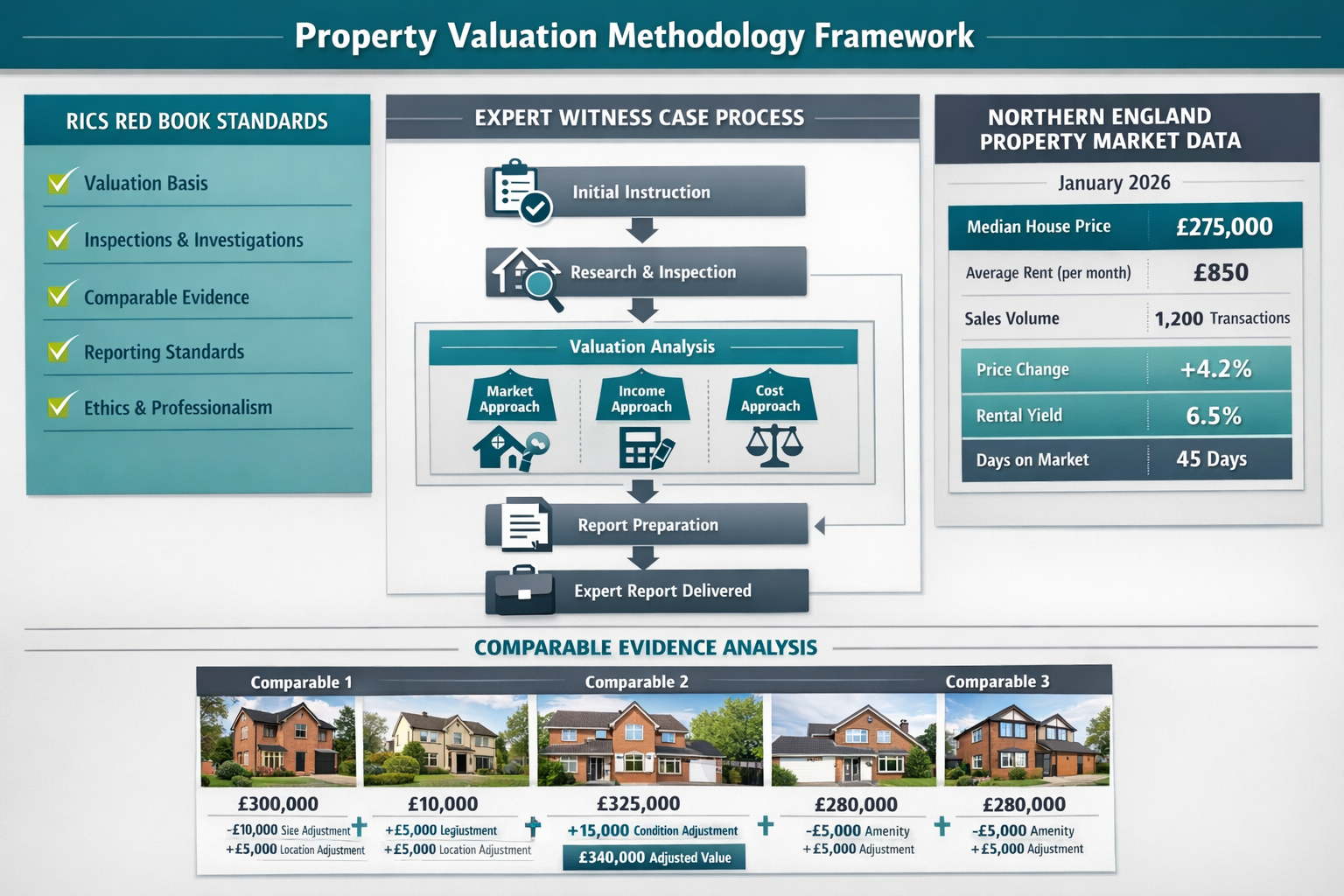
The RICS Valuation – Global Standards (commonly known as the Red Book) provides the professional framework for valuation work, including expert witness assignments. While the Red Book primarily governs valuations for secured lending and financial reporting, its principles apply equally to litigation support work.
Key Red Book principles relevant to expert witness roles include:
| Principle | Application to Expert Witness Work |
|---|---|
| Basis of Value | Clearly define whether using Market Value, Fair Value, or another basis appropriate to the dispute context |
| Valuation Approach | Document whether using comparable method, income approach, or cost approach, and justify the selection |
| Assumptions and Special Assumptions | Explicitly state all assumptions, particularly those that deviate from actual property circumstances |
| Investigations and Records | Maintain comprehensive records of property inspections, market research, and data analysis |
| Reporting | Provide clear, logical reports that non-surveyors can understand while maintaining technical rigor |
When building cases from RICS January 2026 data, experts must demonstrate how regional price momentum affects their valuation conclusions while maintaining adherence to these standards. The RICS property valuations framework ensures consistency and credibility.
Types of Property Disputes Requiring Expert Witness Testimony
Expert witnesses specializing in Northern England property markets encounter various dispute contexts:
1. Matrimonial Proceedings 🏠
Divorce settlements frequently require property valuations to divide marital assets. The January 2026 data showing 3.1% growth in the North West becomes crucial when determining whether valuations should reflect current market conditions or a specific historical date.
2. Compulsory Purchase Compensation 📋
When public authorities acquire property compulsorily, compensation disputes often hinge on expert valuations. Northern England's upward price momentum may significantly impact compensation calculations.
3. Lease Renewal and Rent Review Disputes 📝
Commercial and residential lease disputes require expert opinions on market rent levels. Regional market strength directly influences these determinations.
4. Partnership and Shareholder Disputes 🤝
Property-holding partnerships dissolving require valuations for buyout calculations. Expert witnesses must navigate both property valuation and business valuation principles.
5. Professional Negligence Claims ⚖️
When surveyors face negligence allegations, expert witnesses assess whether the original valuation met professional standards. The RICS January 2026 data provides contemporary market context for evaluating historical valuations.
Understanding data analysis techniques becomes essential across all these dispute types, particularly when interpreting regional market trends.
Building Cases from RICS January 2026 Data: Methodology and Best Practices
Integrating Regional Market Data into Valuation Opinions
The RICS January 2026 survey data provides invaluable market intelligence, but expert witnesses must integrate it carefully into their valuation methodology. Simply citing regional growth figures without proper context undermines credibility under cross-examination.
Effective integration strategies include:
Establishing Market Context
Begin by positioning the specific property within the broader Northern England market. If valuing a Manchester residential property, explain how the North West's 3.1% growth rate [4] relates to the specific neighborhood and property type. Not all properties participate equally in regional trends.
Temporal Alignment
Ensure the RICS data timeframe aligns with the valuation date. January 2026 data reflects market conditions at that specific point. For valuations dated earlier or later, experts must adjust their analysis accordingly, potentially incorporating subsequent RICS monthly surveys.
Comparable Evidence Hierarchy
Structure comparable evidence in order of reliability:
- Direct comparables: Recent transactions of similar properties in the immediate area
- Adjusted comparables: Transactions requiring adjustments for location, size, condition, or timing
- Market indices: RICS data and other indices providing general market movement indicators
- Expert judgment: Professional assessment filling gaps where transaction evidence is sparse
The RICS data functions primarily as a market movement indicator rather than a substitute for specific transaction evidence. When combined with property assessment techniques, this creates a robust valuation framework.
Adjusting for Market Momentum in Comparable Analysis
Northern England's price momentum creates specific challenges when analyzing comparable transactions. A sale that occurred six months before the valuation date occurred in a different market context than January 2026's strong performance environment.
Time adjustment methodology:
- Identify comparable transaction date: Establish precisely when the comparable sale completed
- Determine market movement: Use RICS monthly data to calculate market movement between comparable date and valuation date
- Apply appropriate adjustment: Adjust the comparable sale price to reflect market movement
- Document assumptions: Clearly state whether the adjustment assumes the specific property tracked general market trends
For example, if a comparable property sold in July 2025 for £250,000, and RICS data indicates 2% market growth between July 2025 and January 2026, the time-adjusted comparable value would be approximately £255,000. However, experts must explain why they believe this specific property would have tracked general market trends.
Location and property-type adjustments:
The North West's overall 3.1% growth masks variation between:
- Urban vs. suburban locations: City center apartments may perform differently than suburban houses
- Price brackets: Entry-level properties may show stronger growth than luxury segments
- Property types: Terraced houses, semi-detached, and detached properties often show different momentum
Expert witnesses must demonstrate awareness of these nuances rather than mechanically applying regional averages. Incorporating negotiation strategies knowledge helps anticipate opposing expert arguments.
Addressing Market Optimism in Forward-Looking Valuations
The January 2026 RICS survey's +35% optimism reading [2] provides powerful evidence of market sentiment, but experts must handle this data carefully in forward-looking valuations.
Appropriate applications include:
- Development appraisals: When valuing development sites, future sales values significantly impact residual land value calculations
- Investment valuations: Exit cap rates and future rental growth assumptions benefit from sentiment analysis
- Leasehold enfranchisement: Statutory valuations sometimes require projections of future value movements
Cautions and limitations:
⚠️ Sentiment ≠ Certainty: Market optimism indicates expectations, not guaranteed outcomes
⚠️ Reversion to mean: Property markets historically cycle; sustained optimism often precedes corrections
⚠️ External factors: Economic shocks, interest rate changes, or policy shifts can rapidly alter sentiment
Expert witnesses should present sentiment data as contextual information rather than definitive predictions. A balanced approach might state: "The RICS January 2026 survey indicates strong market optimism with +35% of respondents expecting sales increases. This suggests market participants anticipate continued price growth, though actual outcomes remain subject to economic and policy developments."
Documentation and Evidence Trail Requirements
Credible expert witness testimony rests on comprehensive documentation. When building cases from RICS January 2026 data, maintain detailed records of:
Data sources:
- Complete RICS survey reports with page references
- UK House Price Index official releases [4]
- Local authority planning and transaction data
- Property listing websites and sold price databases
Analysis methodology:
- Spreadsheets showing comparable adjustments with clear formulae
- Maps indicating comparable locations relative to subject property
- Photographs documenting property conditions
- Correspondence with estate agents or other market participants
Professional judgment rationale:
- Written notes explaining why certain comparables were selected or rejected
- Documentation of assumptions and their justification
- Sensitivity analysis showing how value conclusions change with different assumptions
This documentation serves two critical purposes: enabling peer review by opposing experts and providing material for cross-examination preparation. Courts increasingly expect experts to produce their working papers, making thorough documentation essential.
Understanding property condition assessment principles ensures physical property factors receive appropriate weight alongside market data.
Anticipating Challenges and Cross-Examination on Northern England Market Data
Common Opposing Arguments and Effective Responses
Expert witnesses using RICS January 2026 data to support valuations in Northern England should anticipate specific challenges from opposing counsel and experts:
Challenge 1: "Regional averages don't reflect this specific property's performance"
Effective response strategy:
Acknowledge the limitation while explaining the evidentiary hierarchy. "I agree that regional averages provide general market context rather than specific property predictions. However, in the absence of multiple direct comparables for this unique property, the RICS data provides reliable evidence of market direction. I've adjusted my analysis to account for property-specific factors including [list factors], resulting in a conclusion that reflects both general market trends and individual property characteristics."
Challenge 2: "Market optimism is subjective and unreliable"
Effective response strategy:
Distinguish between sentiment indicators and valuation methodology. "The +35% optimism reading from RICS respondents [2] serves as contextual information about market participant expectations rather than a direct valuation input. My primary valuation relies on actual transaction evidence, with sentiment data providing supporting context for understanding market dynamics during the relevant period."
Challenge 3: "You've cherry-picked data favorable to your client"
Effective response strategy:
Demonstrate comprehensive analysis. "My report references the complete RICS January 2026 survey [1], including data showing weaker performance in London and the South. I've focused on Northern England data because the subject property is located in [specific location], making regional data directly relevant. I've also considered contrary indicators including [list any negative factors], concluding that on balance, the evidence supports my valuation opinion."
Challenge 4: "The 3.1% growth rate is already outdated"
Effective response strategy:
Address temporal limitations transparently. "The valuation date is January 15, 2026, making the January 2026 RICS data contemporaneous with the valuation. While subsequent market movements have occurred, the expert's duty requires forming opinions based on information available at the valuation date. Retrospective analysis using later data would introduce hindsight bias inappropriate for valuation work."
Familiarity with court costs considerations helps experts understand the litigation context surrounding their testimony.
Maintaining Professional Credibility Under Pressure
Cross-examination creates intense pressure, particularly when opposing counsel challenges an expert's use of market data. Several principles help maintain credibility:
1. Acknowledge Limitations Proactively ✅
Address weaknesses in your analysis within your report rather than waiting for cross-examination. This demonstrates objectivity and reduces the impact of opposing counsel's attacks.
2. Avoid Overstatement ✅
Use qualified language appropriately: "In my professional opinion," "The evidence suggests," "Based on available data." Avoid absolute statements that opposing counsel can easily undermine with contrary examples.
3. Distinguish Facts from Opinion ✅
Be clear about what constitutes factual data (e.g., "The RICS survey reported +35% optimism") versus professional interpretation (e.g., "This suggests market participants expect continued growth").
4. Maintain Composure ✅
Respond to aggressive cross-examination calmly and professionally. Becoming defensive or argumentative undermines credibility regardless of the technical merits of your analysis.
5. Request Clarification ✅
If a question is unclear or contains multiple parts, politely ask for clarification rather than guessing at the questioner's intent.
Reconciling Conflicting Expert Opinions
Property disputes frequently feature competing expert witnesses reaching different valuation conclusions despite analyzing the same RICS January 2026 data. Understanding how courts reconcile these conflicts helps experts present more persuasive testimony.
Courts typically evaluate:
Methodology transparency:
Which expert more clearly explained their approach, assumptions, and reasoning? Opaque or overly technical reports reduce persuasiveness.
Data comprehensiveness:
Which expert demonstrated broader market knowledge, considering multiple data sources beyond RICS surveys?
Assumption reasonableness:
Which expert's assumptions appear more balanced and defensible? Aggressive assumptions favoring the instructing party raise credibility concerns.
Professional qualifications:
While both experts may be RICS-qualified, specific experience in Northern England markets and the relevant property sector carries weight.
Responsiveness to opposing arguments:
Experts who address contrary evidence and opposing expert opinions appear more credible than those who ignore inconvenient facts.
When building cases from RICS January 2026 data, anticipate that opposing experts will cite the same data but interpret it differently. Prepare explanations for why your interpretation better reflects the specific property and dispute context.
Knowledge of structural defects and their valuation impact helps experts provide comprehensive property analysis beyond pure market data.
Practical Case Study: Applying RICS January 2026 Data to a Manchester Matrimonial Dispute
Case Background
Consider a hypothetical matrimonial dispute involving a semi-detached family home in South Manchester. The couple is divorcing, and the property requires valuation for asset division purposes. The husband's expert values the property at £425,000, while the wife's expert concludes £455,000—a £30,000 difference representing 7% of the lower valuation.
Property details:
- Location: Didsbury, South Manchester (North West region)
- Type: Four-bedroom semi-detached house
- Condition: Good condition with recent kitchen renovation
- Valuation date: January 20, 2026
Expert Witness Analysis Using RICS Data
Husband's expert approach:
The husband's expert identified three comparable sales from August-October 2025, ranging from £410,000 to £435,000. He applied minimal time adjustments, arguing that market conditions remained relatively stable between the comparable dates and the January 2026 valuation date. His report briefly mentioned RICS data but didn't integrate it meaningfully into the valuation.
Weaknesses in this approach:
- Ignored the North West's 3.1% annual growth rate [4]
- Failed to adjust comparables for the 3-5 month time gap
- Didn't address the +35% market optimism reading [2]
Wife's expert approach:
The wife's expert used similar comparables but applied time adjustments based on RICS January 2026 data showing the North West's 3.1% annual growth. She calculated that between August 2025 and January 2026 (five months), market growth of approximately 1.3% (3.1% ÷ 12 × 5) was appropriate. Additionally, she identified two more recent comparables from December 2025 showing higher prices, which supported her conclusion.
Her report explicitly referenced:
- The RICS January 2026 survey's regional data [1]
- The +35% optimism reading as context for market direction [2]
- Local estate agent feedback confirming strong demand in Didsbury
Strengths in this approach:
- Transparent methodology linking RICS data to time adjustments
- Multiple data sources supporting conclusions
- Clear explanation of how regional trends apply to the specific location
Court Determination
In this hypothetical case, the court would likely prefer the wife's expert approach because:
- Data integration: She demonstrated how RICS January 2026 data informed her methodology rather than merely citing it
- Transparency: Her time adjustment calculations were clearly explained and defensible
- Comprehensiveness: She considered multiple data sources and recent market trends
- Balance: She acknowledged limitations in her analysis while explaining her reasoning
The court might not fully accept her £455,000 valuation but would likely conclude closer to her figure than the husband's £425,000, perhaps settling on £440,000-£445,000.
Lessons for Expert Witnesses
This case study illustrates several important principles:
📌 Integrate data meaningfully: Don't just cite RICS data—show how it informs your methodology
📌 Adjust comparables appropriately: Time adjustments based on market movement data enhance credibility
📌 Provide context: Market sentiment and regional trends help explain valuation conclusions
📌 Document thoroughly: Clear working papers showing calculations strengthen testimony
📌 Anticipate challenges: Address potential weaknesses proactively in your report
Professionals seeking to understand comprehensive property evaluation techniques can apply these principles across various dispute contexts.
Regional Variations Within Northern England: Nuanced Analysis for Expert Witnesses
Micro-Market Dynamics Beyond Regional Averages
While the RICS January 2026 data provides valuable regional insights, expert witnesses must recognize significant variations within Northern England. The North West's 3.1% growth rate [4] represents an average across diverse markets including:
Major Urban Centers:
- Manchester: Strong growth driven by tech sector employment and infrastructure investment
- Liverpool: Regeneration projects supporting property values, particularly in docklands areas
- Preston: More modest growth reflecting smaller employment base
Yorkshire and Humber Markets:
- Leeds: Professional services sector supporting city center apartment demand
- Sheffield: Industrial heritage areas showing varied performance
- York: Historic city premium maintaining values despite broader regional trends
North East England:
- Newcastle: Student population and regional center status supporting demand
- Durham: Historic character attracting premium buyers
- Middlesbrough: Industrial transition creating more challenging market conditions
Expert witnesses must research specific local markets rather than mechanically applying regional averages. A property in central Manchester likely outperformed the 3.1% regional average, while a property in a declining industrial town may have underperformed.
Property Type Segmentation
The RICS data doesn't distinguish between property types, yet performance varies significantly:
| Property Type | Typical Performance in Strong Markets | Typical Performance in Weak Markets |
|---|---|---|
| First-time buyer properties | Strong demand, above-average growth | Resilient due to affordability |
| Family homes | Steady growth, driven by school catchments | Moderate performance |
| Luxury properties | Volatile, dependent on high-earner confidence | Vulnerable to market downturns |
| Investment properties | Growth linked to rental yields | Affected by regulatory changes |
| New build developments | Premium pricing, potential for oversupply | Discounting common |
When valuing a specific property type, experts should seek comparable evidence from the same segment rather than assuming the property tracked general market trends. Understanding real estate appraisal fundamentals helps experts navigate these distinctions.
Urban vs. Rural Performance Disparities
Northern England encompasses diverse geographic contexts, from dense urban centers to remote rural areas. The RICS January 2026 data's regional focus primarily reflects urban markets where transaction volumes support statistical analysis.
Urban market characteristics:
- Higher transaction volumes providing more comparable evidence
- Greater sensitivity to employment trends and infrastructure investment
- More pronounced price momentum during growth phases
- Stronger rental markets supporting investment demand
Rural market characteristics:
- Lower transaction volumes creating valuation challenges
- Greater property heterogeneity reducing comparable reliability
- Lifestyle factors influencing values alongside pure investment considerations
- Potential disconnect from regional urban trends
Expert witnesses valuing rural properties should exercise caution when applying urban-focused RICS data. A farmhouse in the Yorkshire Dales may not participate in Leeds' urban market growth, requiring different analytical approaches.
Future Outlook: Implications for Expert Witness Work in 2026 and Beyond
Anticipated Market Developments
The RICS January 2026 data captures a specific moment in Northern England's property market trajectory. Expert witnesses must consider how market conditions may evolve throughout 2026 and beyond:
Interest rate environment:
Bank of England monetary policy significantly influences property markets. Any interest rate changes during 2026 could moderate or accelerate the price momentum observed in January 2026 data.
Economic performance:
Northern England's economic regeneration supports property values, but economic headwinds could disrupt this trend. Experts should monitor employment data, business investment, and consumer confidence indicators.
Government policy:
Planning reforms, tax changes, or housing policy initiatives could materially affect property values. The anticipated 3-5% appreciation [3] assumes policy stability.
Supply and demand dynamics:
New housing supply, particularly in urban centers, may moderate price growth if it exceeds demand increases. Experts should track planning permissions and construction starts.
Evolving Data Sources and Technology
Expert witness work increasingly incorporates sophisticated data analysis tools beyond traditional RICS surveys:
Automated Valuation Models (AVMs):
Algorithm-based valuations provide rapid market value estimates but require expert interpretation for dispute contexts. Courts increasingly question how AVMs relate to traditional valuation methodology.
Big data analytics:
Property portals, transaction databases, and economic indicators enable more granular market analysis. Experts who leverage these tools while maintaining professional judgment standards enhance their credibility.
Geographic Information Systems (GIS):
Mapping technology helps visualize comparable locations, market boundaries, and location-specific factors affecting value. Effective presentation of GIS analysis strengthens expert testimony.
Market sentiment analysis:
Beyond RICS surveys, social media sentiment, search data, and consumer confidence indicators provide additional market context. Experts must balance traditional and emerging data sources.
Professionals interested in surveying technology developments can explore how these tools enhance expert witness work.
Professional Development Recommendations
Expert witnesses seeking to excel in Northern England property disputes should pursue ongoing professional development:
Regional market expertise:
Develop deep knowledge of specific Northern England markets through regular research, networking with local agents, and monitoring planning developments.
Legal knowledge:
Understand civil procedure rules, evidence law, and specific dispute contexts (matrimonial, compulsory purchase, etc.) to provide legally relevant testimony.
Communication skills:
Practice explaining complex valuation concepts to non-technical audiences, including judges, barristers, and lay clients. Clear communication often matters more than technical sophistication.
Cross-examination experience:
Seek opportunities to provide expert testimony, learning from each experience. Mock cross-examinations with instructing solicitors provide valuable practice.
Data analysis capabilities:
Develop proficiency with statistical software, spreadsheet modeling, and data visualization tools to enhance analytical rigor.
RICS compliance:
Maintain current knowledge of Red Book updates, practice statements, and guidance notes affecting expert witness work.
Conclusion
Expert Witness Roles in Northern England Price Momentum Disputes: Building Cases from RICS January 2026 Data represents a critical competency for property professionals navigating the region's dynamic markets. The North West's leadership in England's price growth at 3.1% year-over-year [4], combined with unprecedented market optimism at +35% [2], creates both opportunities and challenges for expert witnesses.
Successful expert witness work in this context requires:
✅ Comprehensive data integration: Moving beyond simple citation of RICS data to meaningful incorporation into valuation methodology
✅ Transparent methodology: Clearly explaining assumptions, adjustments, and professional judgment
✅ Regional nuance: Recognizing micro-market variations within Northern England's diverse property landscape
✅ Professional independence: Maintaining objectivity despite litigation pressures
✅ Effective communication: Presenting complex analysis in accessible language for legal audiences
The anticipated 3-5% price appreciation across Northern England during 2026 [3] suggests continued relevance of these market dynamics for expert witnesses throughout the year. As regional disparities persist—with Northern England outperforming London and the South—valuation disputes will increasingly turn on expert witnesses' ability to analyze and explain these trends credibly.
Actionable Next Steps
For property professionals preparing to serve as expert witnesses in Northern England disputes:
-
Obtain complete RICS survey data: Access the full January 2026 survey report [1] and subsequent monthly releases to maintain current market knowledge
-
Develop local market intelligence: Build relationships with estate agents, auctioneers, and other market participants in your target regions
-
Create systematic documentation protocols: Establish procedures for recording comparable research, analysis methodology, and professional judgment rationale
-
Review Red Book requirements: Ensure familiarity with current RICS valuation standards and their application to expert witness work
-
Seek mentorship: Connect with experienced expert witnesses who can provide guidance on report writing and cross-examination preparation
-
Invest in technology: Explore data analysis tools, GIS software, and presentation technologies that enhance analytical capabilities
-
Pursue relevant CPD: Attend courses on expert witness duties, civil procedure, and regional market developments
The convergence of Northern England's strong market performance with increasing litigation over property values creates significant demand for competent expert witnesses. Those who master the integration of RICS January 2026 data with rigorous valuation methodology, transparent reporting, and effective testimony will find themselves well-positioned to serve courts, tribunals, and disputing parties throughout 2026 and beyond.
Property disputes ultimately require expert witnesses who can bridge technical valuation expertise with legal evidentiary requirements. By grounding opinions in robust data sources like the RICS January 2026 survey while maintaining professional independence and clear communication, expert witnesses contribute meaningfully to dispute resolution while upholding the integrity of the property profession.
References
[1] UK Residential Market Survey January 2026 – https://www.rics.org/content/dam/ricsglobal/documents/market-surveys/uk-residential-market-survey/UK-Residential-Market-Survey_January-2026.pdf
[2] UK Resi Survey Jan 2026 Report Shows Early Signs Market Recovery Despite Caution – https://www.rics.org/news-insights/uk-resi-survey-jan-2026-report-shows-early-signs-market-recovery-despite-caution
[3] Northern England Valuation Surge 2026 RICS Insights On Price Growth And Surveyor Adjustment Techniques – https://nottinghillsurveyors.com/blog/northern-england-valuation-surge-2026-rics-insights-on-price-growth-and-surveyor-adjustment-techniques
[4] UK House Price Index For January 2026 – https://www.gov.uk/government/news/uk-house-price-index-for-january-2026