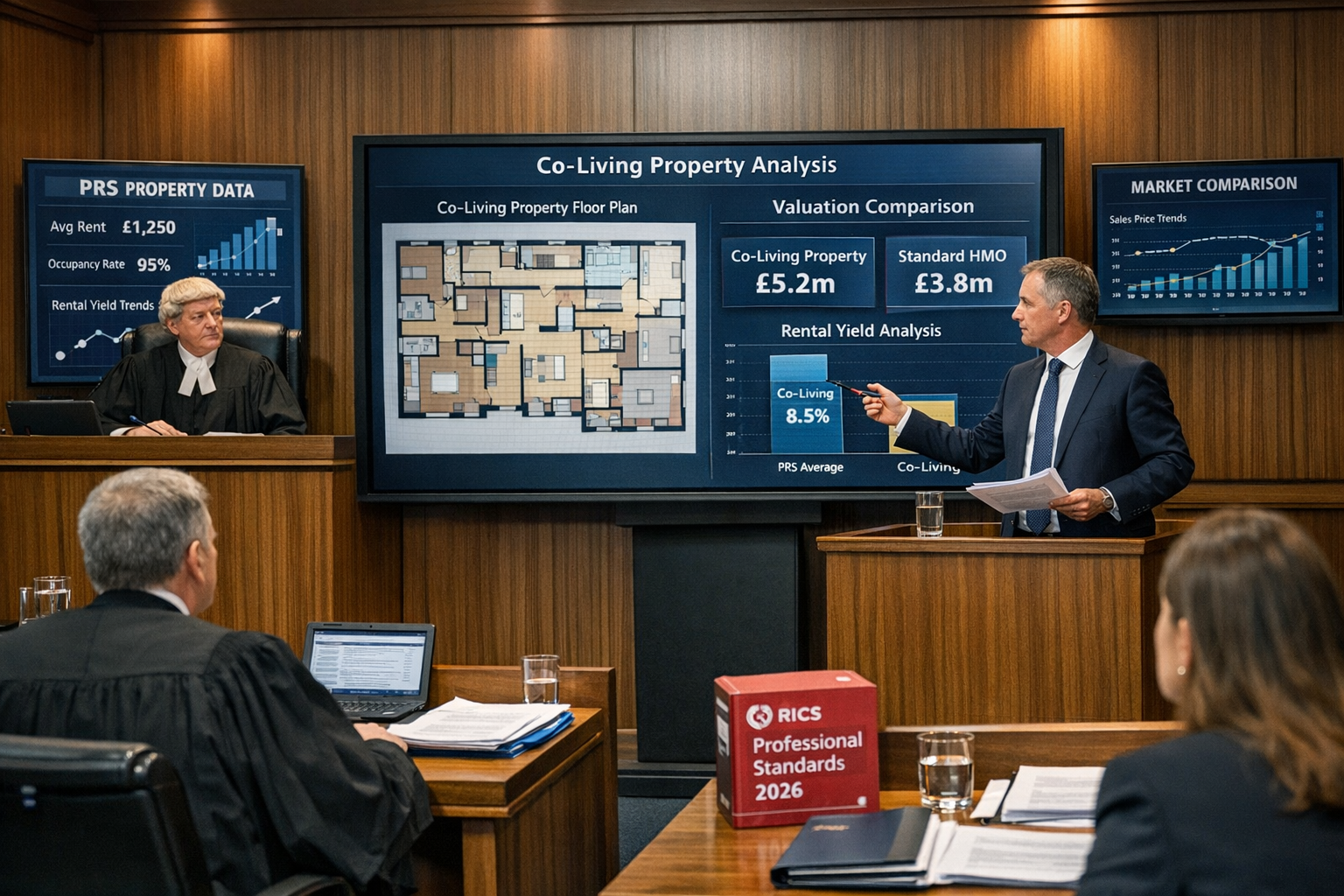
As the UK living sector faces unprecedented demand that far outpaces available supply in 2026, a new battleground has emerged in property valuation disputes. Expert witnesses are now playing a critical role in resolving conflicts over the valuation of co-living spaces and Private Rented Sector (PRS) properties, where regulatory pressures and market volatility create complex challenges. Understanding Expert Witness Roles in 2026 UK Living Sector Valuation Disputes: Surveying Co-Living and PRS Amid Stock Shortages has become essential for property professionals, investors, and legal practitioners navigating this evolving landscape.
The convergence of housing stock shortages, stricter landlord compliance requirements, and innovative living arrangements has created a perfect storm for valuation disagreements. When traditional valuation methods struggle to account for emerging property types and market dynamics, chartered surveyors with expert witness credentials become indispensable in tribunal and court proceedings.
Key Takeaways
✅ Expert witnesses in living sector disputes must navigate complex valuation methodologies for non-traditional property types like co-living and purpose-built rental stock, where standard comparables may not exist.
✅ Stock shortages in 2026 have intensified valuation disputes, as limited supply drives premium pricing that requires robust expert evidence to defend or challenge in legal proceedings.
✅ Professional standards for expert witness testimony extend significantly beyond routine surveying work, requiring adherence to Civil Procedure Rules and RICS guidance on providing expert evidence.[2]
✅ Co-living and PRS valuations demand specialized knowledge of rental yield calculations, amenity premiums, and regulatory compliance impacts that traditional residential surveyors may lack.
✅ Upfront survey requirements under homebuying reforms have created new dispute scenarios where expert witness testimony proves crucial in defending survey evidence and valuation conclusions.[1]
Understanding the 2026 UK Living Sector Landscape
The Co-Living Revolution and Stock Shortage Crisis
The UK living sector in 2026 is characterized by acute housing shortages that have transformed the rental market. Co-living developments—where residents occupy private bedrooms but share communal facilities—have emerged as a solution to affordability challenges, particularly in London and other major cities. However, these innovative housing models present unique valuation challenges.
Purpose-Built Rental Sector (PRS) properties, designed specifically for long-term rental rather than owner-occupation, have grown substantially. Yet supply remains woefully inadequate to meet demand. This imbalance has several consequences:
- Premium pricing that deviates from traditional valuation benchmarks
- Limited comparable evidence for newer property types
- Investor disputes over projected yields versus actual performance
- Regulatory uncertainty affecting long-term value assessments
The shortage has also intensified competition among institutional investors, creating scenarios where property evaluation becomes contentious during acquisition, refinancing, or partnership dissolution.
Regulatory Pressures Shaping Valuation Disputes
The 2026 regulatory environment has introduced stricter landlord compliance standards, energy efficiency requirements, and tenant protection measures. These regulations directly impact property valuations by:
- Increasing capital expenditure requirements for compliance upgrades
- Affecting rental income potential through rent control mechanisms
- Creating valuation uncertainty during regulatory transition periods
- Generating disputes over who bears compliance costs in joint ventures
Expert witnesses must understand how rental regulation disputes intersect with valuation methodologies, requiring adherence to professional standards that extend beyond routine surveying work.[2] The complexity demands specialized knowledge of both property valuation and regulatory frameworks.
Expert Witness Roles in 2026 UK Living Sector Valuation Disputes: Core Responsibilities
Establishing Credibility and Professional Standards
When serving as an expert witness in living sector valuation disputes, chartered surveyors must first establish their credentials and impartiality. The role differs fundamentally from that of an advocate or consultant.
Key professional requirements include:
| Requirement | Description | Regulatory Source |
|---|---|---|
| Independence | Duty to the court/tribunal supersedes duty to the instructing party | Civil Procedure Rule 35 |
| Competence | Demonstrated expertise in specific property type and valuation methodology | RICS Practice Standards |
| Transparency | Full disclosure of assumptions, limitations, and alternative views | RICS Guidance Note on Expert Witness Evidence |
| Objectivity | Evidence based on professional judgment, not desired outcome | Professional Conduct Standards |
The expert witness must be prepared to withstand cross-examination and defend their methodology against alternative valuation approaches. Understanding what surveyors do in their standard practice provides foundation, but expert witness work demands additional rigor.
Valuation Methodologies for Co-Living and PRS Properties
Valuing co-living and PRS properties requires specialized approaches that account for their unique characteristics:
Income Capitalization Method 🏢
This approach values properties based on rental income potential, applying appropriate capitalization rates. For co-living spaces, experts must consider:
- Room-by-room rental analysis versus whole-unit comparables
- Amenity premiums for shared facilities (gyms, co-working spaces, social areas)
- Management intensity affecting net operating income
- Occupancy rate assumptions in high-demand but volatile markets
Comparable Sales Analysis 📊
Finding appropriate comparables for purpose-built rental stock presents challenges:
- Limited transaction evidence for newer property types
- Adjustments required for location, specification, and amenity differences
- Distinguishing between investor yields and underlying property values
- Accounting for portfolio sales versus individual asset transactions
Residual Valuation Method 🔧
Particularly relevant for development disputes or conversion projects:
- Estimating gross development value for completed co-living schemes
- Deducting construction costs, fees, and developer profit
- Accounting for planning risks and regulatory compliance costs
- Sensitivity analysis for key assumptions
Expert witnesses must explain these methodologies clearly to non-technical tribunal members or judges, translating complex calculations into accessible language while maintaining technical accuracy.
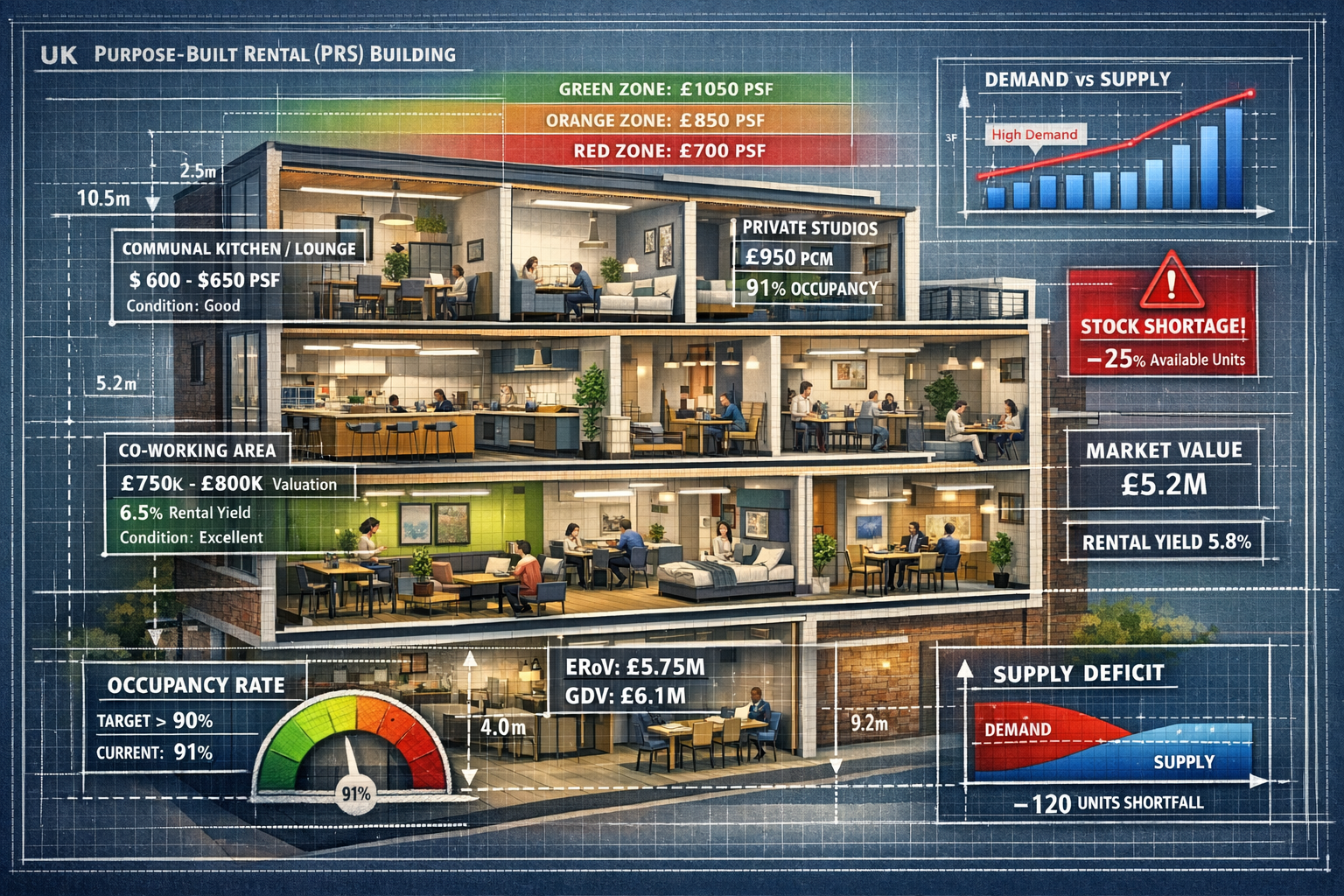
Surveying Co-Living and PRS Amid Stock Shortages: Practical Challenges
Dealing with Limited Comparable Evidence
The stock shortage crisis of 2026 creates a fundamental challenge: insufficient comparable evidence. When few similar properties have recently transacted, expert witnesses must employ creative yet defensible approaches:
Strategies for limited comparables:
- Geographical expansion – Using comparables from similar markets in other cities, with appropriate location adjustments
- Temporal adjustments – Applying market movement indices to older transactions
- Property type analogies – Drawing parallels with student accommodation or serviced apartments where appropriate
- Synthetic comparables – Building hypothetical comparisons based on rental yields and investment metrics
"In markets with acute stock shortages, the expert witness must balance the need for comparable evidence with the reality that truly comparable properties may not exist. Transparency about methodology becomes paramount."
Each approach requires careful justification and acknowledgment of limitations. The expert must demonstrate why their chosen methodology produces a reliable valuation despite data constraints.
Addressing Upfront Survey Evidence in Disputes
Recent homebuying reforms requiring upfront surveys have created new dispute scenarios. Upfront surveys directly impact property valuations, creating disputes where expert witness testimony proves crucial in defending survey evidence.[1]
Common dispute scenarios include:
- Valuation discrepancies between upfront survey valuations and subsequent market offers
- Condition assessment disputes affecting agreed purchase prices
- Defect identification leading to renegotiation or transaction collapse
- Professional negligence claims against surveyors who conducted upfront assessments
Expert witnesses may be called to evaluate whether the original surveyor's valuation was reasonable given market conditions, comparable evidence, and the property's condition at the time of inspection. This requires understanding both property inspection standards and valuation principles.
Navigating Rental Yield Disputes in PRS Valuations
Purpose-built rental properties are typically valued based on investment yields, making rental income projections central to valuation disputes. Expert witnesses must address:
Rental yield components:
- Gross rental income – Achievable rents per unit or per bed
- Occupancy rates – Realistic assumptions given market conditions
- Operating expenses – Management fees, maintenance, utilities, insurance
- Capital expenditure reserves – Lifecycle replacement costs
- Net operating income – The basis for yield calculations
In 2026's tight rental market, landlords may project optimistic yields based on current demand, while purchasers or lenders seek conservative valuations. The expert witness must provide evidence-based projections that account for:
✨ Market cyclicality – Current shortages may not persist indefinitely
✨ Regulatory risks – Potential rent controls or compliance costs
✨ Competition – New supply pipeline that may ease shortages
✨ Tenant demographics – Sustainability of demand for specific property types
Professional standards require adherence to guidance that extends significantly beyond routine surveying work when providing expert evidence in rental regulation disputes.[2]
Expert Witness Roles in 2026 UK Living Sector Valuation Disputes: Case Applications
Institutional Investor Disputes
Large-scale PRS portfolios often involve multiple stakeholders—institutional investors, fund managers, lenders, and developers. Valuation disputes arise during:
- Fund redemptions requiring portfolio valuations
- Partnership dissolutions with disagreement over asset values
- Refinancing where lender valuations differ from owner expectations
- Performance disputes over management fees tied to property values
Expert witnesses in these scenarios must understand investment structures, accounting standards (IFRS 13 for fair value), and institutional investment criteria. The stakes are high, with millions of pounds potentially at issue.
Planning and Development Disputes
Co-living developments face unique planning challenges, as local authorities grapple with classifying these properties (C3 residential versus sui generis). Valuation disputes emerge when:
- Planning permissions are granted with restrictive conditions
- Section 106 agreements impose affordable housing requirements
- Permitted development rights are challenged
- Viability assessments are disputed
Expert witnesses must value properties under different planning scenarios, demonstrating the financial impact of planning decisions on development viability. This intersects with property law and planning policy expertise.
Landlord-Tenant Disputes
While less common in PRS properties with institutional landlords, disputes still arise over:
- Lease renewal valuations for commercial co-living operators
- Dilapidations claims at lease end
- Service charge disputes affecting net rental values
- Rent review determinations in long-term PRS leases
These disputes require understanding both valuation principles and landlord-tenant law, with expert witnesses often working alongside legal experts.

Preparing Expert Witness Reports for Living Sector Disputes
Essential Report Components
A comprehensive expert witness report for a living sector valuation dispute should include:
- Executive Summary – Key conclusions and valuation figure
- Instructions and Context – What questions the expert was asked to address
- Property Description – Detailed description of the subject property
- Market Analysis – Overview of relevant market conditions and stock shortages
- Methodology – Explanation of valuation approach and why it was selected
- Comparable Evidence – Detailed analysis of comparable properties
- Valuation Calculations – Step-by-step valuation workings
- Sensitivity Analysis – How valuation changes with key assumptions
- Alternative Views – Acknowledgment of other possible approaches
- Professional Declaration – Statement of independence and compliance with CPR 35
The report must be written for a non-technical audience while maintaining technical rigor. Surveyor responsibilities in expert witness roles extend to clear communication.
Common Pitfalls to Avoid
❌ Advocacy – Appearing to argue for the instructing party's position
❌ Selective evidence – Ignoring comparable evidence that contradicts conclusions
❌ Unexplained assumptions – Failing to justify key valuation inputs
❌ Complexity without clarity – Using jargon without explanation
❌ Insufficient disclosure – Not revealing limitations or uncertainties
Expert witnesses who fall into these traps risk having their evidence given little weight or being criticized during cross-examination.
The Future of Expert Witness Roles in Living Sector Disputes
Emerging Trends for 2026 and Beyond
Several trends are shaping the evolution of expert witness work in the living sector:
Technology Integration 💻
Advanced valuation software, AI-assisted comparable analysis, and digital evidence presentation are becoming standard. Expert witnesses must demonstrate technological competence while explaining how technology supports (not replaces) professional judgment.
ESG Considerations 🌱
Environmental, Social, and Governance factors increasingly affect property valuations. Energy efficiency, carbon footprint, and social impact metrics are becoming material valuation considerations, particularly for institutional investors.
Regulatory Complexity 📋
As rental regulations continue evolving, expert witnesses need ongoing professional development to stay current. The intersection of valuation and compliance requires multidisciplinary knowledge.
Alternative Dispute Resolution 🤝
Many living sector disputes are resolved through mediation or arbitration rather than court proceedings. Expert witnesses must adapt their approach to these less formal but equally rigorous processes.
Professional Development Requirements
Maintaining expertise as an expert witness in this specialized field requires:
- Continuous market research – Staying current on rental trends, yields, and transaction evidence
- Regulatory updates – Understanding new compliance requirements and their valuation impacts
- Methodology refinement – Adapting valuation approaches to emerging property types
- Legal knowledge – Understanding evolving case law on expert witness duties
- Communication skills – Improving ability to explain complex concepts clearly
Professional bodies like RICS offer specialized training in expert witness work, complementing core surveying qualifications. Chartered surveyors seeking to specialize in expert witness work should pursue these additional credentials.
Conclusion
Expert Witness Roles in 2026 UK Living Sector Valuation Disputes: Surveying Co-Living and PRS Amid Stock Shortages represent a specialized and increasingly important area of professional practice. As housing shortages intensify and innovative living arrangements proliferate, valuation disputes will continue to require expert testimony from qualified surveyors who understand both traditional valuation principles and the unique characteristics of modern rental properties.
The role demands technical excellence, professional independence, and communication clarity. Expert witnesses must navigate limited comparable evidence, evolving regulatory frameworks, and complex investment structures while maintaining objectivity and transparency. Their evidence can determine outcomes in disputes worth millions of pounds, making the quality and credibility of their work paramount.
Actionable Next Steps
For surveyors considering expert witness work in the living sector:
- Pursue specialized training in expert witness procedures and report writing through RICS or legal training providers
- Build market knowledge by tracking PRS and co-living transactions, rental trends, and regulatory developments
- Develop a niche in specific property types or dispute scenarios where you can demonstrate genuine expertise
- Network with legal professionals who instruct expert witnesses in property disputes
- Maintain rigorous standards in all valuation work, as any report may potentially become subject to legal scrutiny
For property investors, developers, and legal practitioners:
- Engage qualified experts early when valuation disputes emerge, rather than waiting until positions become entrenched
- Provide comprehensive instructions that clearly define the questions the expert should address
- Allow expert independence rather than seeking to influence conclusions
- Consider joint expert appointments where appropriate to narrow issues in dispute
- Invest in quality evidence recognizing that expert witness testimony can be decisive in dispute outcomes
The living sector's evolution continues to create new challenges and opportunities for expert witnesses. Those who combine technical valuation expertise with professional integrity and clear communication will find themselves in high demand as the market navigates stock shortages, regulatory changes, and innovative property types throughout 2026 and beyond.
For comprehensive property evaluation services or to discuss expert witness requirements, professional surveyors remain your essential resource in navigating complex valuation landscapes.
References
[1] Expert Witness Roles In 2026 Homebuying Reform Disputes Defending Survey Evidence Under New Upfront Standards – https://nottinghillsurveyors.com/blog/expert-witness-roles-in-2026-homebuying-reform-disputes-defending-survey-evidence-under-new-upfront-standards
[2] Expert Witness Preparation For 2026 Rental Regulation Disputes Surveyor Evidence Amid Stricter Landlord Compliance – https://nottinghillsurveyors.com/blog/expert-witness-preparation-for-2026-rental-regulation-disputes-surveyor-evidence-amid-stricter-landlord-compliance