
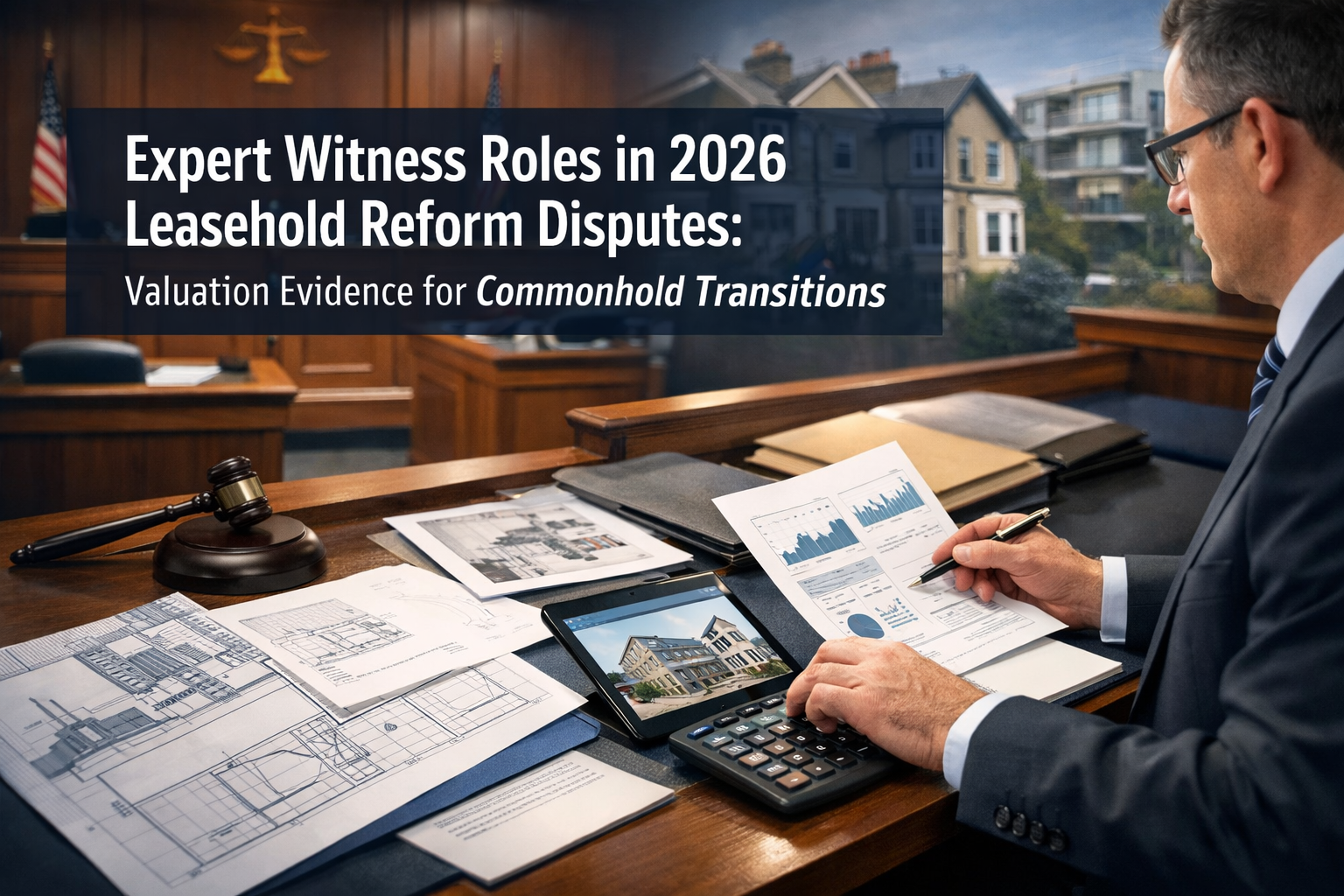
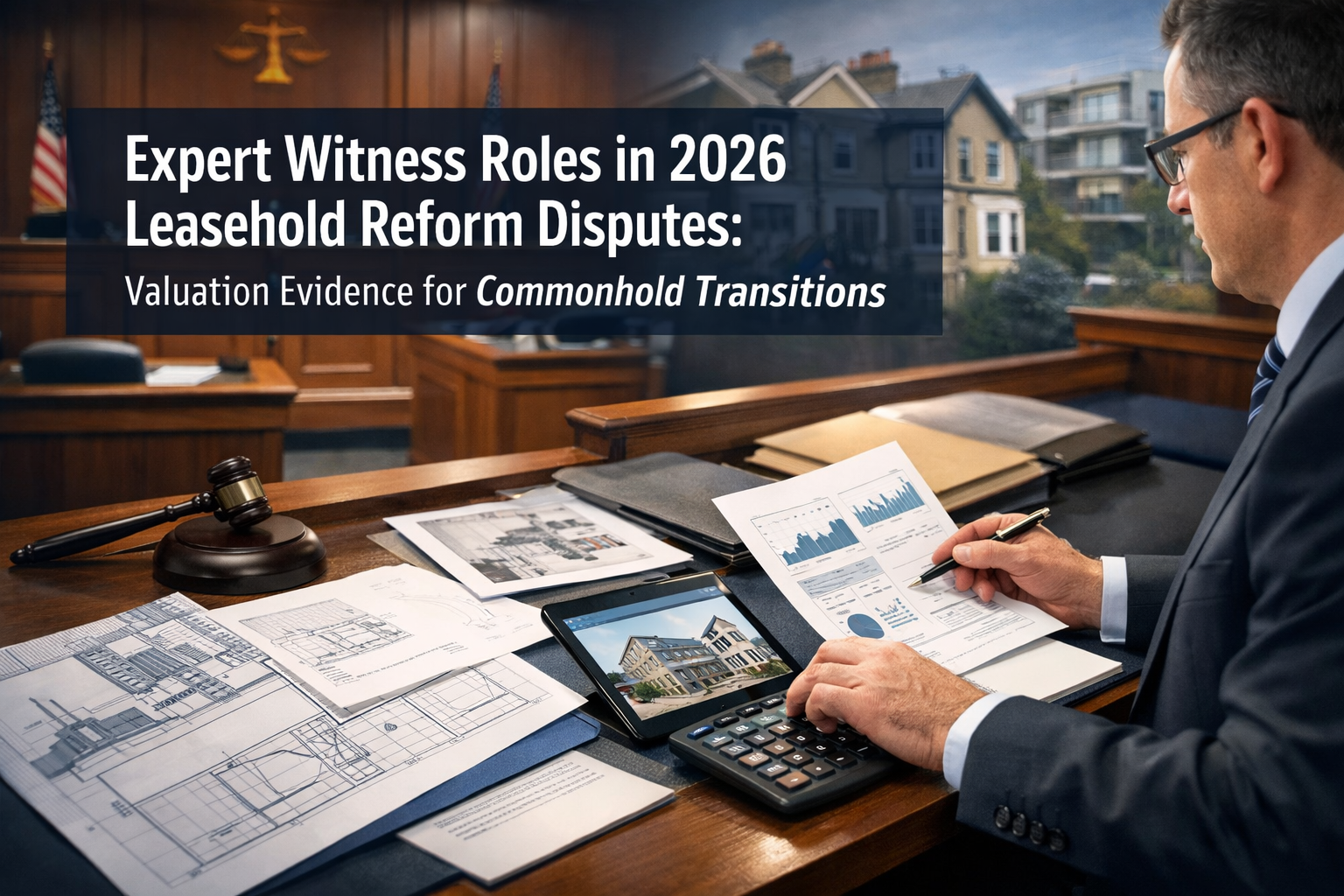
The landscape of UK property ownership is undergoing its most significant transformation in decades. As leasehold reforms accelerate the shift toward commonhold ownership in 2026, valuation disputes are erupting across the property sector—and expert witnesses find themselves at the epicenter of these high-stakes legal battles. With parliamentary inquiries underway and High Court challenges mounting, chartered surveyors must now master the art of building defensible cases using RICS standards and comprehensive regional data. The question isn't whether Expert Witness Roles in 2026 Leasehold Reform Disputes: Valuation Evidence for Commonhold Transitions will shape the future of property law—it's how prepared professionals are to meet this challenge.
Key Takeaways
- 🏛️ Parliamentary scrutiny intensifies: The UK Parliament's Housing, Communities and Local Government Committee is actively examining commonhold reform legislation with expert witness testimony from solicitors, barristers, and chartered surveyors shaping policy direction in March 2026
- ⚖️ High-stakes valuation disputes: Major property owners including John Lyon's Charity, Cadogan Group, and Grosvenor Group are challenging valuation provisions through High Court proceedings, with rulings expected throughout 2026
- 📊 RICS standards govern practice: Expert witnesses must maintain strict adherence to RICS professional standards, ensuring integrity, impartiality, and operation within defined areas of expertise
- 💼 Expanding service demand: Property litigation teams are experiencing surge in demand for expert witness services covering detailed valuations, dispute resolution, and comprehensive evidence reports
- 🔄 Implementation delays create uncertainty: Most provisions of the Leasehold and Freehold Reform Act 2024 remain dormant, forcing practitioners to provide predictive guidance while clients navigate timing decisions
Understanding the 2026 Leasehold Reform Landscape
The Leasehold and Freehold Reform Act 2024 represents the most comprehensive overhaul of property ownership structures in modern UK history. However, as 2026 progresses, the reality on the ground tells a complex story. Most provisions remain dormant, awaiting secondary legislation that will determine how these sweeping changes actually function in practice [5].
Current Legislative Status
The reform agenda encompasses several critical areas:
- Marriage value abolition: Proposed removal of marriage value calculations for lease extensions
- Ground rent caps: Restrictions on ground rent amounts for valuation purposes
- Commonhold promotion: Legislative framework encouraging transition from leasehold to commonhold ownership
- Enfranchisement simplification: Streamlined processes for leaseholders acquiring freeholds
The UK Parliament's Housing, Communities and Local Government Committee held evidence sessions on March 10, 2026, featuring testimony from legal and surveying professionals who possess intimate knowledge of how leasehold systems operate [2]. These sessions revealed significant concerns about unintended consequences of rushed implementation without adequate professional consultation.
The Commonhold Transition Challenge
Commonhold ownership—where flat owners collectively own the freehold of their building without lease limitations—has existed in UK law since 2002 but gained minimal traction. The 2026 reforms aim to change this trajectory by making commonhold the default tenure for new developments and facilitating conversions of existing leasehold properties.
This transition creates unprecedented valuation challenges:
| Valuation Factor | Leasehold Approach | Commonhold Approach | Dispute Risk Level |
|---|---|---|---|
| Marriage Value | Calculated based on lease length | Not applicable | ⚠️ High |
| Ground Rent | Capitalized into valuation | Eliminated | ⚠️ High |
| Service Charges | Variable, landlord-controlled | Collectively determined | 🟡 Medium |
| Property Rights | Diminishing asset | Perpetual ownership | 🟢 Low |
| Resale Value | Lease-length dependent | Stable | 🟡 Medium |
Understanding these distinctions is crucial for anyone involved in lease extension valuation work, as the methodologies fundamentally differ.
Expert Witness Roles in 2026 Leasehold Reform Disputes: Core Responsibilities
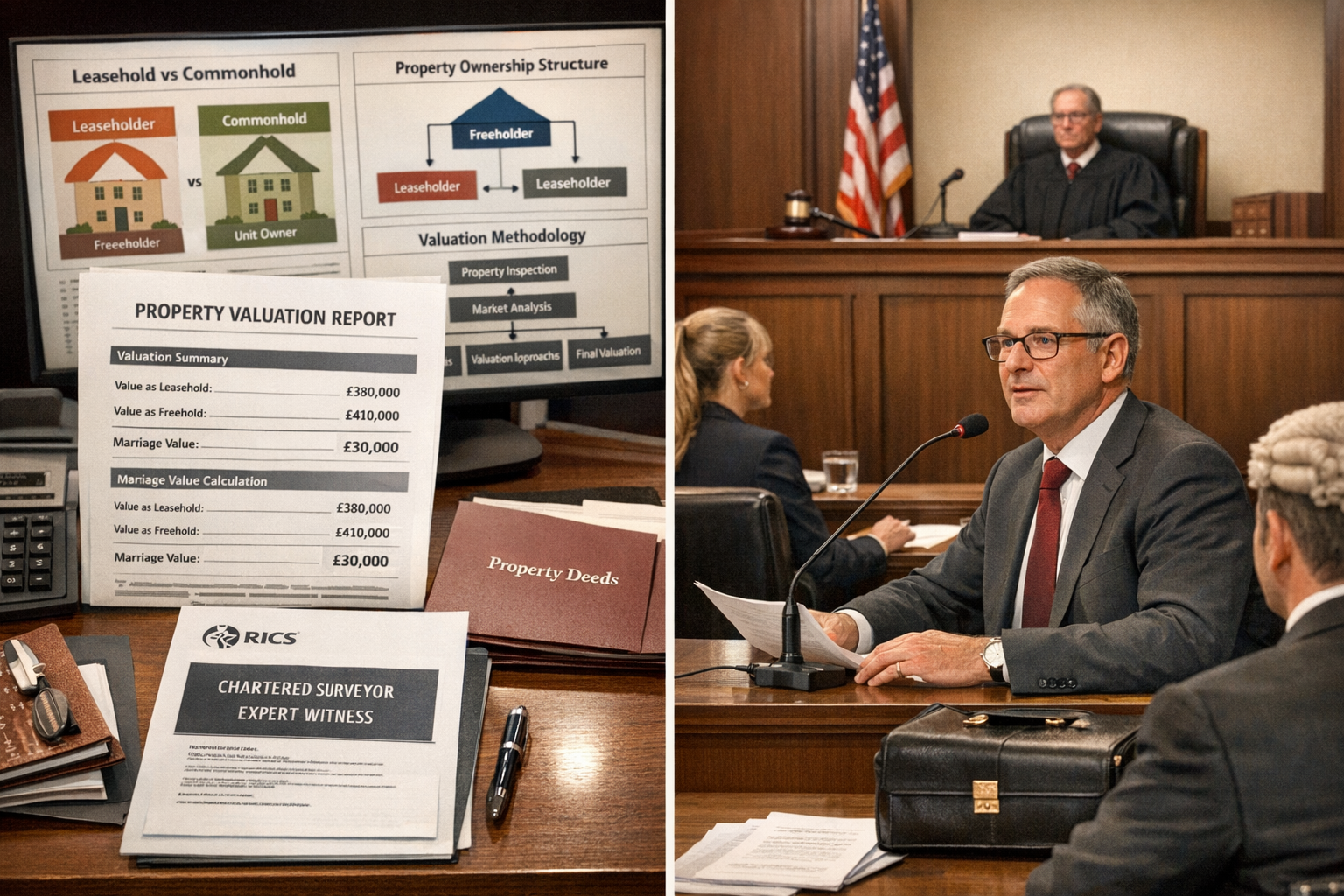
The role of expert witnesses in leasehold reform disputes extends far beyond simple property valuation. These professionals serve as critical bridges between complex technical concepts and legal decision-making processes. Their testimony can determine outcomes worth millions of pounds in contentious cases.
Primary Functions of Property Expert Witnesses
1. Detailed Valuation Analysis
Expert witnesses must provide comprehensive valuations that withstand rigorous cross-examination. This involves:
- Conducting thorough property inspections and market research
- Applying appropriate valuation methodologies consistent with RICS standards
- Documenting all assumptions, limitations, and data sources
- Preparing detailed calculations showing how conclusions were reached
Knight Frank's leasehold litigation team exemplifies this comprehensive approach, offering expert witness services that cover matrimonial proceedings, negligence claims, restrictive covenants, and contentious trusts [1]. Their work demonstrates how professional surveyors must adapt traditional valuation skills to adversarial legal contexts.
2. Dispute Resolution Support
Expert witnesses play pivotal roles in resolving valuation disagreements before they escalate to tribunal or court proceedings. This includes:
- Participating in without-prejudice discussions with opposing experts
- Identifying areas of agreement and disagreement
- Suggesting compromise positions based on technical evidence
- Preparing joint statements that narrow issues for determination
3. Evidence Preparation and Testimony
The preparation of expert witness reports requires meticulous attention to detail and adherence to strict professional standards. Reports must:
- State qualifications and relevant experience clearly
- Identify instructions received and scope of work undertaken
- Present findings in logical, accessible language
- Distinguish between facts, assumptions, and opinions
- Include appropriate caveats and limitations
- Comply with Civil Procedure Rules Part 35
"Expert witnesses in lettings market disputes and similar contexts must maintain integrity, impartiality, and operate strictly within their areas of expertise." [6]
This principle applies equally to Expert Witness Roles in 2026 Leasehold Reform Disputes: Valuation Evidence for Commonhold Transitions, where maintaining professional objectivity becomes paramount.
RICS Professional Standards Framework
The Royal Institution of Chartered Surveyors (RICS) establishes rigorous standards governing expert witness practice. Key requirements include:
Competence: Experts must possess appropriate qualifications, experience, and knowledge specific to the dispute at hand. For commonhold transition valuations, this means understanding both traditional leasehold valuation principles and emerging commonhold market dynamics.
Objectivity: The expert's primary duty is to the tribunal or court, not to the instructing party. This can create tension when clients expect advocacy rather than impartial analysis.
Transparency: All methodologies, data sources, and reasoning must be fully disclosed. Hidden assumptions or selective data presentation violate professional standards and undermine credibility.
Continuing Professional Development: Given the rapid evolution of leasehold reform legislation, experts must engage in ongoing education to maintain currency with legal and market developments.
For those navigating common questions about statutory lease extensions, understanding these professional standards helps identify qualified experts who will provide reliable testimony.
Valuation Evidence for Commonhold Transitions: Methodologies and Challenges
The technical heart of Expert Witness Roles in 2026 Leasehold Reform Disputes: Valuation Evidence for Commonhold Transitions lies in the valuation methodologies themselves. These approaches must balance established principles with unprecedented market conditions.
Traditional Leasehold Valuation Components
Before examining commonhold transitions, understanding traditional leasehold valuation remains essential:
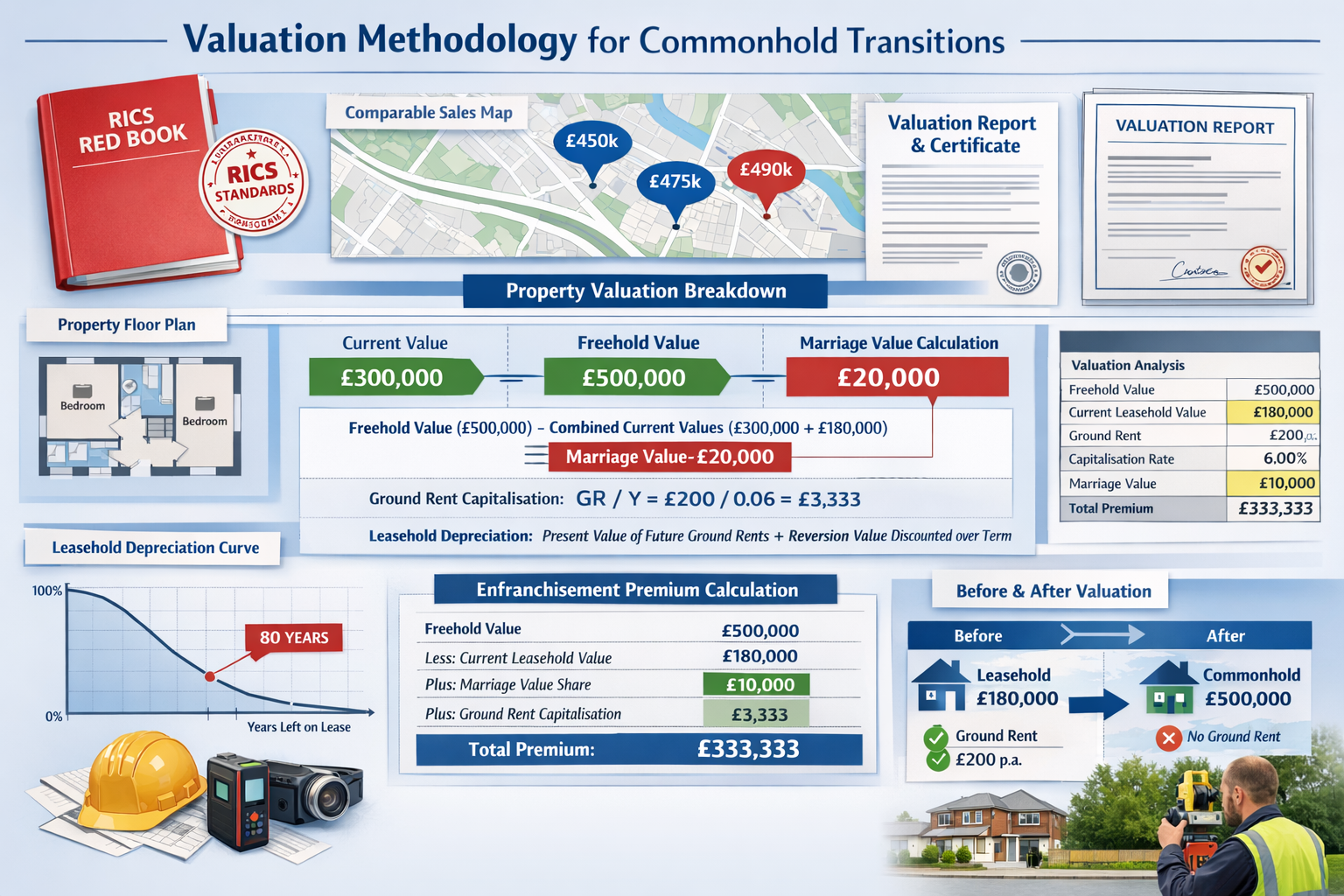
1. Marriage Value Calculation
Marriage value represents the increase in property value when a short lease is extended or the freehold is acquired. Traditionally calculated as:
Marriage Value = (Value with extended lease + Freehold value) - (Existing lease value + Freehold value)
The leaseholder typically pays 50% of this marriage value when the lease falls below 80 years. The proposed abolition of marriage value calculations has sparked intense legal challenges, with major landowners arguing this amounts to confiscation of property rights without adequate compensation [3].
2. Ground Rent Capitalization
Freeholders receive ground rent income, which is capitalized into the valuation using yield rates appropriate to the investment risk profile. The formula typically follows:
Capitalized Ground Rent = Annual Ground Rent × Years' Purchase multiplier
Proposed caps on ground rent for valuation purposes directly impact freeholder compensation, creating another flashpoint in current disputes.
3. Relativity Analysis
Relativity measures the relationship between the value of a lease with a given unexpired term and the freehold value. This requires extensive market data analysis and expert judgment, particularly for unusual lease lengths or property types.
Commonhold Transition Valuation Frameworks
Valuing properties transitioning to commonhold requires fundamentally different approaches:
Collective Ownership Assessment
Unlike leasehold, where individual flat values and freehold interests are separately valued, commonhold requires assessing the collective interest of all unit owners. This involves:
- Determining fair allocation of transition costs among unit owners
- Valuing management company shares and voting rights
- Assessing reserve fund requirements and their impact on individual unit values
- Evaluating the impact of commonhold status on marketability and resale values
Absence of Marriage Value
Commonhold eliminates the concept of marriage value entirely, as owners hold perpetual interests. Expert witnesses must explain to tribunals how this affects compensation calculations when conversions occur, particularly when some leaseholders have recently paid substantial sums for lease extensions under the old system.
Service Charge Implications
Commonhold shifts service charge determination from landlord control to collective owner decision-making. Valuation evidence must address:
- Historical service charge levels and trends
- Anticipated changes under commonhold management
- Reserve fund adequacy for major works
- Impact of collective control on property values
For properties with complex service charge histories, this analysis becomes particularly challenging. Those considering how to buy a flat on a short lease must now factor in potential commonhold conversion implications.
Regional Data and Market Evidence
Building defensible valuation cases requires comprehensive regional market data. Expert witnesses in 2026 must compile evidence including:
Comparable Sales Analysis
- Recent transactions of similar properties in the locality
- Adjustments for lease length, condition, and location differences
- Analysis of market trends affecting values
- Evidence of commonhold premium or discount in the market
Rental Market Evidence
- Current rental values for comparable properties
- Yield rates appropriate to the investment type
- Trends in rental demand and supply dynamics
- Impact of regulatory changes on investment yields
Development and Conversion Costs
- Professional fees for commonhold conversion
- Legal and administrative expenses
- Reserve fund establishment costs
- Building works required to facilitate conversion
The quality and comprehensiveness of this data directly determines the persuasiveness of expert evidence. As noted by professionals in the field, "consultation with practitioners is essential before further leasehold reform, as lawyers, surveyors, and managing agents possess practical knowledge of how leasehold operates" [3].
High-Profile Disputes Shaping Expert Witness Practice
Several landmark cases currently working through the UK court system are defining how Expert Witness Roles in 2026 Leasehold Reform Disputes: Valuation Evidence for Commonhold Transitions will evolve in practice.
The Major Landowner Challenges
High Court proceedings brought by John Lyon's Charity, Cadogan Group, and Grosvenor Group represent the most significant legal challenges to the 2024 reform legislation [3]. These cases focus on:
Constitutional Property Rights Arguments
The claimants argue that removing marriage value and capping ground rents for valuation purposes constitutes deprivation of property without adequate compensation, potentially violating Article 1 of Protocol 1 to the European Convention on Human Rights.
Expert witnesses in these proceedings must address:
- Historical precedent for compensation calculations
- Market evidence of actual financial impact
- Alternative valuation methodologies that might satisfy both policy objectives and property rights
- International comparisons with other jurisdictions' approaches
Valuation Methodology Disputes
These cases scrutinize the technical foundations of proposed valuation changes. Expert evidence examines:
- Whether marriage value truly represents "unearned windfall" or legitimate property interest
- The economic rationale for ground rent caps
- Market distortions created by differential treatment of existing vs. new leases
- Transitional arrangements and their fairness
First rulings are anticipated throughout 2026, with appeals likely extending these disputes into 2027 or beyond [3]. The outcomes will fundamentally shape how expert witnesses approach future valuations.
Parliamentary Evidence Sessions
The March 10, 2026 evidence sessions before the Housing, Communities and Local Government Committee provided rare public insight into professional perspectives on reform implementation [2].
Key themes from expert testimony included:
Implementation Timing Concerns
Witnesses emphasized that "most provisions of the Leasehold and Freehold Reform Act 2024 remain dormant and dependent on secondary legislation" [3]. This creates practical challenges for expert witnesses who must advise clients on whether to proceed with transactions under current rules or wait for potential changes.
Need for Professional Consultation
Multiple experts testified that inadequate consultation with practicing professionals risks creating unworkable systems. As one submission noted, "lawyers, surveyors, and managing agents possess practical knowledge of how leasehold operates and can anticipate unintended consequences of legislative changes" [3].
Market Uncertainty Effects
Expert witnesses described how legislative uncertainty is distorting market behavior, with some leaseholders rushing to extend leases before potential marriage value abolition, while others delay hoping for more favorable terms. This creates valuation challenges as market evidence becomes increasingly unreliable.
Emerging Case Law Patterns
Beyond the headline-grabbing challenges, numerous tribunal decisions are establishing precedents for how commonhold transition valuations should be approached:
Collective Enfranchisement Disputes
Cases involving multiple leaseholders collectively acquiring freeholds provide templates for commonhold conversions. Expert witnesses must navigate:
- Allocation of costs among participating and non-participating leaseholders
- Valuation of individual interests within collective acquisitions
- Treatment of commercial units within primarily residential buildings
- Rights of minority leaseholders who oppose conversion
Negligence Claims Against Professionals
As the complexity of leasehold reform increases, professional negligence claims against surveyors and solicitors who provided incorrect advice are rising. Expert witnesses in these cases must assess:
- Whether advice met professional standards at the time given
- Causation of financial loss
- Quantification of damages
- Contributory negligence by claimants
These cases underscore the importance of maintaining meticulous records and clear communication with clients about uncertainties in the evolving legal landscape.
Building Defensible Expert Witness Cases: Best Practices
Success in Expert Witness Roles in 2026 Leasehold Reform Disputes: Valuation Evidence for Commonhold Transitions requires systematic approaches to evidence gathering, analysis, and presentation.
Evidence Collection Strategies
Comprehensive Property Investigation
Expert witnesses must conduct thorough inspections covering:
- Physical condition and construction quality
- Compliance with building regulations and safety standards
- Service charge expenditure history and reserve fund status
- Management quality and leaseholder satisfaction
- Potential for commonhold conversion (structural and legal feasibility)
This investigation should be documented with photographs, measurements, and detailed notes that can withstand cross-examination months or years later.
Market Data Assembly
Building a robust comparable evidence base requires:
- Systematic searches of Land Registry data for recent transactions
- Analysis of asking prices and time-on-market statistics
- Interviews with local estate agents about market conditions
- Review of rental evidence and investment yields
- Assessment of development activity and planning permissions
For those working in specific areas, understanding local market dynamics becomes crucial to providing credible evidence.
Regulatory and Legislative Research
Expert witnesses must maintain current knowledge of:
- Latest statutory provisions and their implementation status
- Tribunal and court decisions establishing precedents
- RICS guidance notes and technical standards
- Government consultations and policy statements
- Industry best practice developments
Report Writing Excellence
The expert witness report serves as the primary vehicle for presenting evidence. Excellence requires:
Structural Clarity
Organize reports with clear sections:
- Executive Summary: Concise statement of key conclusions
- Instructions and Scope: What the expert was asked to do
- Qualifications and Experience: Establishing credibility
- Property Description: Factual information about the subject
- Methodology: Explaining the approach taken
- Market Analysis: Presenting comparable evidence
- Valuation Calculations: Showing all working
- Conclusions: Clear statement of opinions
- Declaration: Confirming compliance with professional duties
Technical Accessibility
While maintaining technical rigor, reports must be comprehensible to non-specialist readers including judges, tribunal members, and lay clients. This requires:
- Defining technical terms when first used
- Explaining the rationale behind methodological choices
- Using visual aids like charts, graphs, and photographs
- Providing worked examples of calculations
- Avoiding unnecessary jargon
Anticipating Challenges
Strong reports address potential weaknesses proactively:
- Acknowledging limitations in available data
- Explaining assumptions and their justification
- Discussing alternative approaches and why they were rejected
- Identifying areas of genuine uncertainty
- Providing sensitivity analysis showing impact of different assumptions
Courtroom and Tribunal Testimony Skills
Written reports provide the foundation, but oral testimony often determines outcomes. Expert witnesses should:
Prepare Thoroughly
- Review all case documents and correspondence
- Refresh memory of property inspection details
- Anticipate likely cross-examination questions
- Prepare clear explanations of complex concepts
- Coordinate with instructing solicitors on case strategy
Maintain Professional Demeanor
- Speak clearly and at appropriate pace
- Address answers to the judge or tribunal, not the questioning lawyer
- Admit limitations of knowledge or data when appropriate
- Avoid defensive or argumentative responses
- Maintain consistency with written report
Handle Cross-Examination Effectively
- Listen carefully to questions before answering
- Ask for clarification if questions are unclear
- Avoid speculation beyond expertise
- Acknowledge valid points made by opposing counsel
- Remain calm under pressure
The skills required extend beyond technical valuation expertise to encompass communication, psychology, and legal procedure understanding.
Future Outlook: Expert Witness Roles Beyond 2026
As leasehold reform continues evolving, Expert Witness Roles in 2026 Leasehold Reform Disputes: Valuation Evidence for Commonhold Transitions will adapt to new challenges and opportunities.
Technological Integration
Expert witnesses are increasingly incorporating technology into their practice:
Data Analytics Platforms
Advanced software enables:
- Automated comparable property searches
- Statistical analysis of market trends
- Visualization of complex valuation data
- Scenario modeling for different reform outcomes
Digital Evidence Presentation
Modern courtrooms accommodate:
- Interactive presentations of valuation evidence
- Real-time calculation adjustments during testimony
- Virtual property tours and 3D models
- Collaborative digital platforms for joint expert discussions
Artificial Intelligence Applications
While AI cannot replace expert judgment, it can assist with:
- Initial data gathering and organization
- Pattern recognition in market evidence
- Draft report generation for expert review
- Research of case law and precedents
These tools enhance efficiency but require experts to maintain critical oversight and professional judgment.
Specialization Trends
The complexity of leasehold reform is driving increased specialization among expert witnesses:
Niche Practice Areas
Emerging specializations include:
- Commonhold conversion feasibility assessment
- Mixed-use building valuation complexities
- Historic and listed building leasehold issues
- Large estate enfranchisement coordination
- Cross-border property ownership structures
Regional Expertise
Property markets vary significantly across the UK, creating demand for experts with deep knowledge of specific regions. London's prime central areas present different challenges than regional markets, requiring distinct approaches to comparable evidence and market analysis.
Continuing Professional Development Priorities
To maintain relevance, expert witnesses must prioritize:
Legislative Tracking
- Monitoring parliamentary debates and consultations
- Analyzing secondary legislation as it emerges
- Understanding judicial interpretation of new provisions
- Participating in professional body policy discussions
Skills Enhancement
- Advocacy and communication training
- Advanced valuation methodology courses
- Technology and data analytics capabilities
- Expert witness procedure and ethics updates
Professional Networking
- Engaging with other experts to share insights
- Participating in industry conferences and seminars
- Contributing to professional publications
- Mentoring junior practitioners entering the field
Organizations like RICS provide structured CPD frameworks supporting these development needs, ensuring expert witnesses maintain the highest professional standards.
Policy Development Influence
Expert witnesses increasingly contribute to policy formation through:
- Responding to government consultations
- Providing evidence to parliamentary committees
- Publishing research on reform impacts
- Educating policymakers about practical implications
This proactive engagement helps ensure future reforms benefit from professional expertise, potentially avoiding some of the implementation challenges currently facing the 2024 Act [3].
Conclusion
The transformation of UK property ownership through leasehold reform and commonhold promotion represents a watershed moment for property professionals. Expert Witness Roles in 2026 Leasehold Reform Disputes: Valuation Evidence for Commonhold Transitions have emerged as critical components of this evolution, with chartered surveyors and valuation experts serving as essential bridges between complex technical realities and legal decision-making processes.
The current landscape presents significant challenges: High Court proceedings questioning fundamental valuation provisions, parliamentary scrutiny of implementation approaches, and market uncertainty affecting transaction decisions. Yet these challenges also create opportunities for expert witnesses who can navigate complexity with professional rigor, maintain impartiality under pressure, and communicate technical concepts with clarity.
Success requires mastering multiple dimensions: comprehensive understanding of both traditional leasehold and emerging commonhold valuation methodologies, adherence to rigorous RICS professional standards, systematic evidence gathering using robust regional data, and effective communication skills for report writing and testimony. The integration of technology, development of specialized expertise, and ongoing professional development will distinguish leading practitioners in this evolving field.
Actionable Next Steps
For property professionals seeking to excel in expert witness roles:
-
Enhance Technical Knowledge: Undertake specialized training in commonhold valuation methodologies and leasehold reform legislation. Consider professional surveying qualifications that emphasize expert witness skills.
-
Build Evidence Databases: Develop systematic approaches to collecting and organizing regional market data, comparable sales evidence, and case law precedents relevant to your practice area.
-
Strengthen Communication Skills: Invest in training for report writing, oral testimony, and cross-examination handling. Practice explaining complex valuation concepts to non-specialist audiences.
-
Maintain Professional Standards: Ensure compliance with RICS guidance, engage in regular CPD activities, and stay current with legislative developments and court decisions.
-
Network Strategically: Connect with other expert witnesses, legal professionals, and industry bodies to share insights and identify emerging trends in leasehold reform disputes.
-
Consider Specialization: Identify niche areas within commonhold transitions where your expertise and experience can provide distinctive value to clients and tribunals.
The journey toward expertise in Expert Witness Roles in 2026 Leasehold Reform Disputes: Valuation Evidence for Commonhold Transitions demands commitment, continuous learning, and unwavering professional integrity. For those who embrace these challenges, the rewards include not only professional success but also meaningful contribution to shaping fairer, more transparent property ownership structures for future generations.
Whether you're navigating lease extension valuations, advising clients on common questions about statutory lease extensions, or providing expert testimony in high-stakes disputes, the principles outlined here provide a foundation for excellence in this critical and evolving field.
References
[1] Leasehold Reform Litigation – https://www.knightfrank.co.uk/residential/services/leasehold-reform-litigation
[2] Watch – https://www.youtube.com/watch?v=OF3ZpLNzk0g
[3] Why The Government Must Consult With Professionals On Leasehold Reform – https://www.newsontheblock.com/news-opinion-leasehold-reform/why-the-government-must-consult-with-professionals-on-leasehold-reform
[4] Leasehold Reform Latest News – https://www.bishopslaw.co.uk/leasehold-reform-latest-news/
[5] Blog Leasehold Reform Is Well Intentioned But Unfinished – https://www.landlordzone.co.uk/news/blog-leasehold-reform-is-well-intentioned-but-unfinished
[6] Expert Witness Roles In 2026 Lettings Market Disputes Navigating Tenant Demand Surge And Landlord Constraints – https://nottinghillsurveyors.com/blog/expert-witness-roles-in-2026-lettings-market-disputes-navigating-tenant-demand-surge-and-landlord-constraints