"
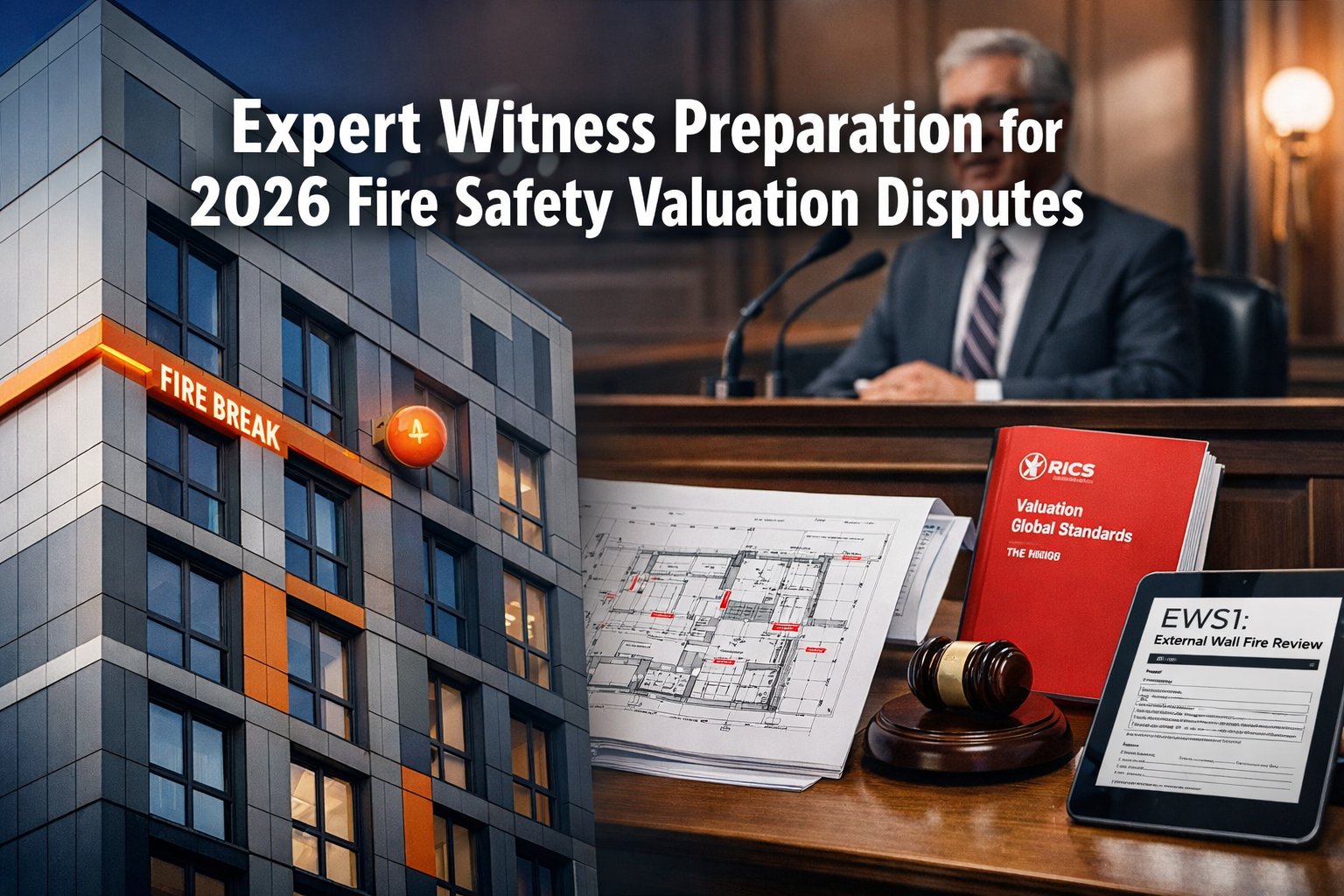
The landscape of property valuation has fundamentally shifted since the Grenfell Tower tragedy. As we navigate 2026, expert witnesses face unprecedented challenges in fire safety valuation disputes, where technical expertise meets legal scrutiny. With ongoing retrofit mandates affecting thousands of residential buildings across the UK, the demand for qualified expert witnesses who understand both RICS standards and courtroom procedures has never been higher. This comprehensive guide explores Expert Witness Preparation for 2026 Fire Safety Valuation Disputes: Post-Grenfell RICS Guidelines and Case Studies, providing essential insights for professionals navigating this complex intersection of property valuation, regulatory compliance, and legal testimony.
Key Takeaways
🔥 Expanded Fire Safety Coverage: As of July 2025, RICS professional indemnity insurance now covers internal fire-stopping measures, compartmentation, fire doors, and detection systems—not just external cladding[5]
📋 Enhanced Documentation Requirements: 2026 RICS building survey standards mandate verification of Fire Safety Strategy Compliance for all residential properties[7]
⚖️ Evidence-Based Methodology: Expert witnesses must demonstrate competence in fire safety assessments while maintaining strict adherence to RICS Red Book valuation principles
🏢 September 2026 Regulatory Changes: New Building Regulations Part B amendments impose stricter requirements for buildings 11m-18m, including combustible product limits and mandatory evacuation alert systems[6]
✅ EWS1 Remains Valid: External Wall System forms continue as essential lending requirements with no expiration date until updated assessments are completed[3]
Understanding the Post-Grenfell Regulatory Framework for Expert Witness Preparation
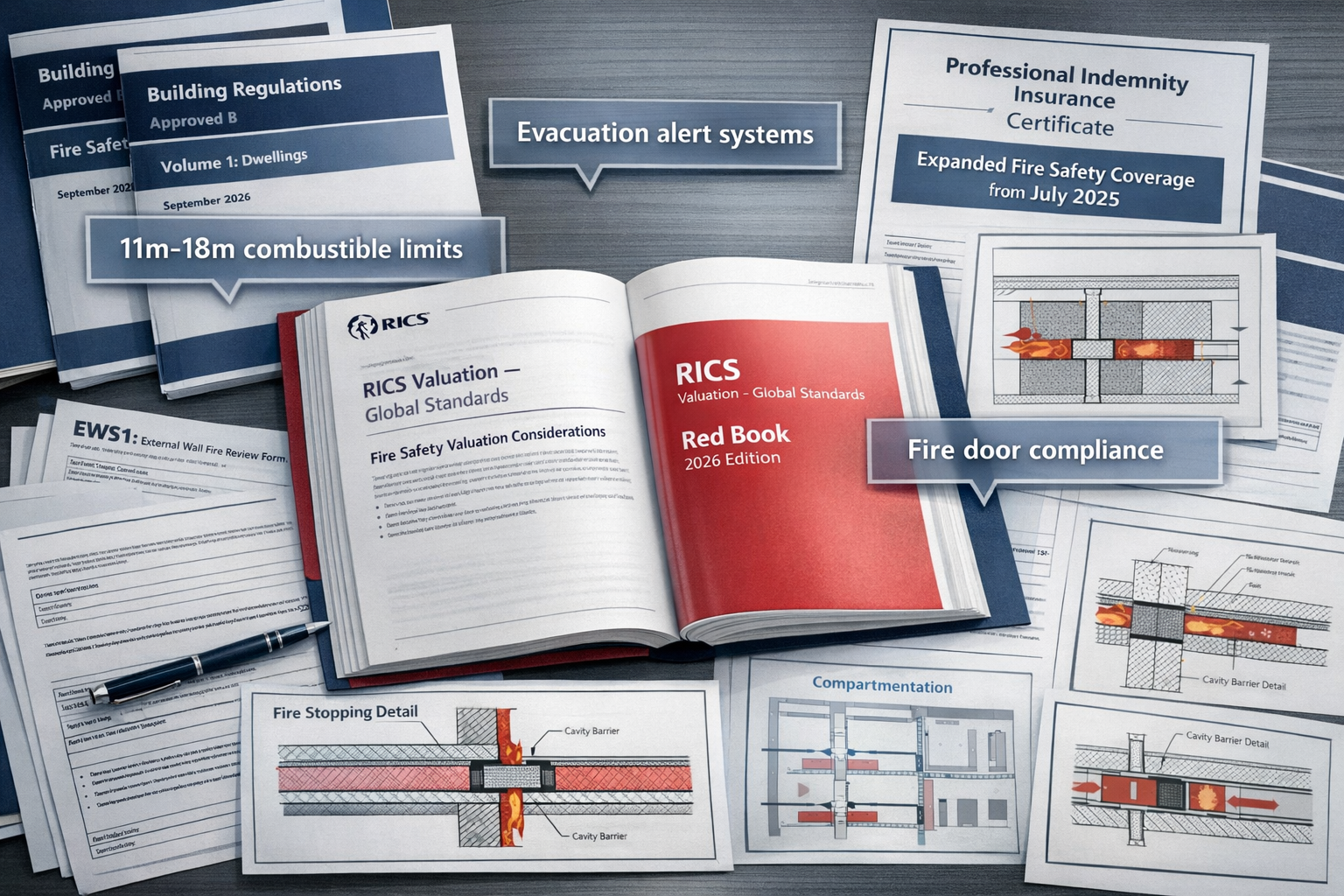
The regulatory environment surrounding fire safety valuations has evolved dramatically since 2017. Expert witnesses preparing for 2026 fire safety valuation disputes must understand the layered framework of RICS guidance, Building Regulations, and professional standards that govern their testimony.
Current RICS Standards and Practice Alerts
RICS has issued multiple practice alerts and guidance documents specifically addressing fire safety in residential valuations. The organization emphasizes that valuers must maintain appropriate professional indemnity insurance and demonstrate competence in fire safety assessments[5]. In February 2026, RICS issued a new Practice Alert notifying all members and regulated firms in Scotland of updated guidance relating to reinforced construction materials[8].
For expert witnesses, understanding these standards is crucial. When providing testimony in valuation disputes, witnesses must reference the specific RICS guidance applicable at the time of the original valuation. This temporal consideration becomes particularly important when disputes involve valuations conducted before recent regulatory changes.
The July 2025 Professional Indemnity Expansion
A watershed moment occurred on July 1, 2025, when RICS expanded the definition of fire safety coverage in professional indemnity insurance[5]. This expansion moved beyond external cladding to include:
- Internal fire-stopping measures (cavity barriers, fire collars, sprinklers)
- Compartmentation and passive fire protection
- Fire doors and internal escape routes
- Fire detection and alarm systems
This expansion significantly impacts expert witness preparation. Witnesses must now address whether valuers had adequate insurance coverage for the scope of fire safety advice provided. Many historical disputes involve valuations where the surveyor's insurance may not have covered internal fire safety elements—a critical point for cross-examination.
Professional RICS property valuations now require comprehensive fire safety assessments that extend well beyond visual inspection of external walls.
September 2026 Building Regulations Part B Amendments
Coming into force on September 30, 2026, significant amendments to Part B Building Regulations introduce new requirements that expert witnesses must incorporate into their analysis[6]:
| Building Height | New Requirements |
|---|---|
| 11m-18m | Limits on combustible products for residential buildings |
| Over 18m | Mandatory evacuation alert systems in blocks of flats |
| 11m and higher | Secure information boxes required in new construction |
Expert witnesses testifying in late 2026 and beyond must distinguish between properties assessed before and after these regulatory changes. The timing of valuations relative to these amendments can significantly impact defensibility arguments.
Fire Safety Strategy Compliance Documentation
The 2026 RICS building survey quality standards now require surveyors to document Fire Safety Strategy Compliance verification[7]. This represents a fundamental shift from previous practice where fire safety considerations were often limited to observable defects.
For expert witnesses, this creates both opportunities and challenges. On one hand, properly documented compliance verification strengthens the defensibility of valuations. On the other hand, the absence of such documentation in historical valuations may expose vulnerabilities that opposing counsel will exploit.
Understanding why choosing RICS surveyors matters becomes particularly relevant when expert witnesses evaluate whether original valuers met professional standards.
Evidence Gathering and Documentation for Expert Witness Preparation in Fire Safety Valuation Disputes
Effective expert witness testimony relies on comprehensive evidence gathering and meticulous documentation. In fire safety valuation disputes, the complexity of technical assessments combined with evolving regulatory standards demands a systematic approach to evidence compilation.
Essential Documentation Categories
Expert witnesses preparing for fire safety valuation disputes should organize evidence into distinct categories:
1. Regulatory Compliance Documentation
- EWS1 forms and fire risk assessments
- Building Control certificates and completion notices
- Fire Safety Strategy documents
- Compartmentation test results
- Fire door certification records
The EWS1 form remains a critical piece of evidence. RICS has confirmed that EWS1 forms remain valid and necessary for lending valuations, with no expiration date until new forms or updated fire risk assessments are completed[3]. Expert witnesses must verify the authenticity, scope, and limitations of any EWS1 forms referenced in valuation reports.
2. Valuation Methodology Evidence
- Original valuation instructions and scope
- Comparable property analysis
- Market evidence at valuation date
- Adjustment calculations for fire safety defects
- Professional indemnity insurance coverage details
When examining valuation methodology, expert witnesses should reference established RICS guidance on Red Book valuations to assess whether the original valuer followed appropriate procedures.
3. Technical Assessment Records
- Building inspection photographs and videos
- Material testing results
- Thermal imaging reports
- Intrusive investigation findings
- Remediation cost estimates
4. Communication Records
- Correspondence between valuer and client
- Instructions and scope limitations
- Assumptions and special assumptions disclosed
- Caveats regarding fire safety assessments
Conducting Site Inspections as an Expert Witness
Unlike the original valuer who may have conducted a single inspection, expert witnesses often have the advantage of hindsight and additional information. However, this creates both opportunities and ethical considerations.
Best practices for expert witness site inspections include:
✅ Document Current Conditions: Photograph and record current building conditions while noting any changes since the original valuation date
✅ Identify What Was Observable: Determine what fire safety issues would have been visible during the original inspection versus what required intrusive investigation
✅ Review Access Limitations: Consider whether the original valuer had access to all relevant areas, particularly communal spaces and building systems
✅ Assess Disclosure Requirements: Evaluate whether building owners or managing agents provided adequate fire safety information to the original valuer
Expert witnesses should approach site inspections with the mindset of reconstructing what the original valuer could reasonably have known, rather than applying current knowledge retrospectively. This temporal discipline is essential for credible testimony.
For properties requiring detailed structural assessment, understanding the scope of a comprehensive RICS building survey helps expert witnesses evaluate whether the original inspection was adequate.
Analyzing Comparable Evidence and Market Impact
One of the most contentious aspects of fire safety valuation disputes involves quantifying the market impact of fire safety defects. Expert witnesses must gather robust comparable evidence demonstrating how similar buildings with fire safety issues were valued in the relevant market at the material date.
Key considerations for comparable analysis:
-
Temporal Relevance: Market awareness of fire safety issues evolved significantly post-Grenfell. Comparables must reflect market knowledge at the valuation date.
-
Defect Similarity: Not all fire safety issues have equal market impact. ACM cladding typically causes greater value diminution than missing cavity barriers.
-
Remediation Status: Properties with funded remediation plans may trade at different discounts than those with unresolved liability.
-
Lending Availability: The presence or absence of mortgage lending significantly impacts market value, regardless of technical fire safety status.
Expert witnesses should compile a database of comparable transactions, including:
- Sale prices and dates
- Fire safety status at transaction date
- EWS1 rating (A1, A2, A3, B1, B2, or not assessed)
- Percentage discount from pre-Grenfell comparable values
- Remediation costs and funding arrangements
Professional Standards and Competence Evidence
Expert witnesses must demonstrate that they possess the necessary competence to provide fire safety valuation opinions. RICS emphasizes that valuers must maintain appropriate professional indemnity insurance and demonstrate competence in fire safety assessments, with firms needing to ensure staff are properly trained particularly for internal fire safety advice[5].
Documentation of expert competence should include:
📌 RICS membership status and relevant designations
📌 Continuing Professional Development (CPD) records in fire safety
📌 Previous experience with fire safety valuations
📌 Professional indemnity insurance coverage details
📌 Any relevant specialist qualifications or certifications
When evaluating the original valuer's competence, expert witnesses should consider whether the valuer had adequate training and insurance coverage for the fire safety advice provided. This becomes particularly relevant for valuations conducted before the July 2025 professional indemnity expansion[5].
Courtroom Strategies and Best Practices for Expert Witness Preparation in 2026 Fire Safety Valuation Disputes
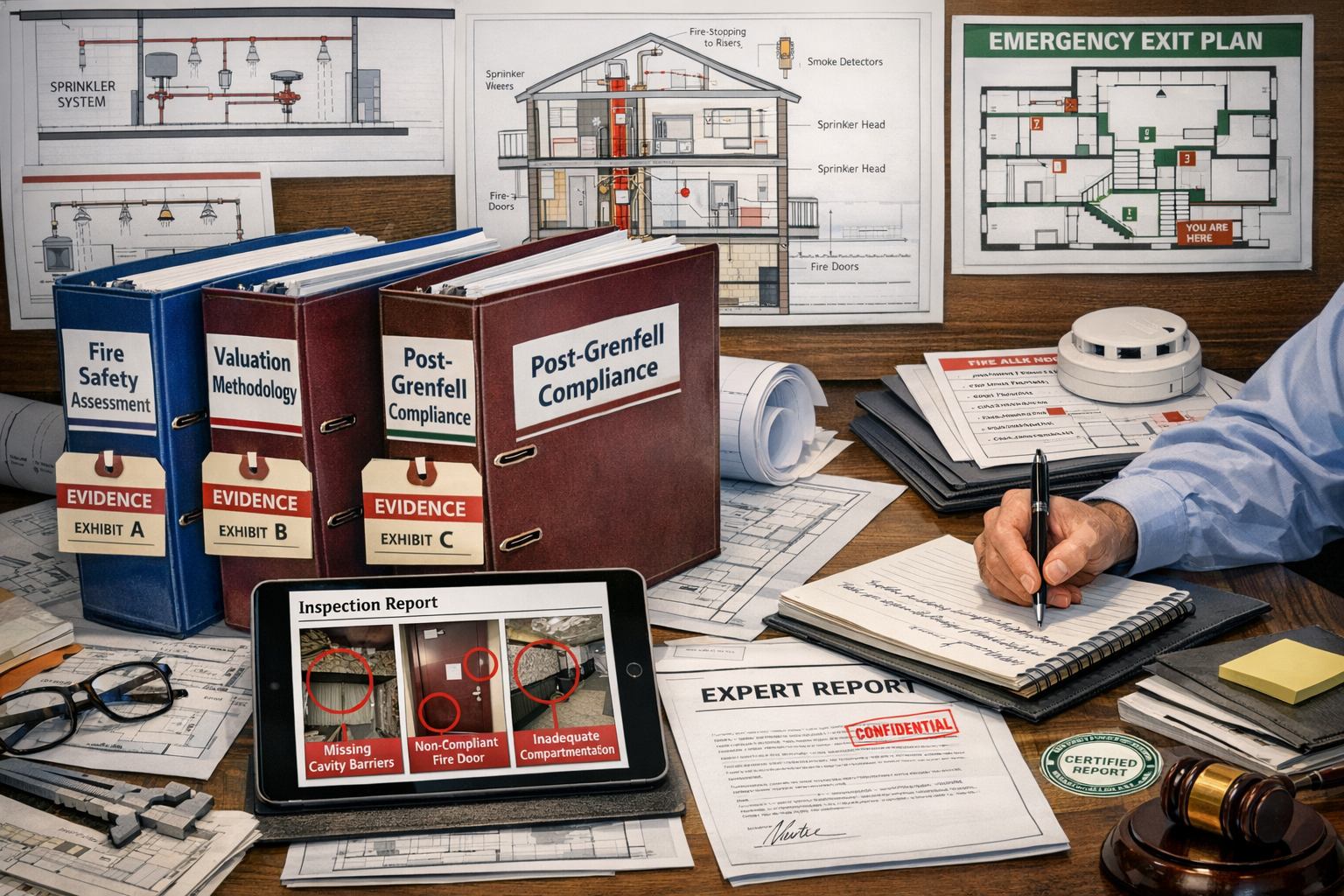
The courtroom environment presents unique challenges for expert witnesses in fire safety valuation disputes. Technical complexity, evolving regulations, and high financial stakes create a demanding setting where preparation and presentation skills are as important as technical knowledge.
Structuring Your Expert Report
The expert report forms the foundation of your testimony. In fire safety valuation disputes, the report must balance technical detail with accessibility for non-specialist readers, including judges, barristers, and jurors.
Essential components of an effective expert report:
1. Executive Summary
Provide a concise overview of your key findings and opinions. State clearly whether you believe the original valuation was reasonable and compliant with RICS standards at the material date.
2. Instructions and Scope
Detail the questions you were asked to address and any limitations on your investigation. Transparency about scope prevents opposing counsel from suggesting you overlooked relevant issues.
3. Regulatory Context
Explain the applicable RICS standards, Building Regulations, and fire safety guidance in effect at the valuation date. This temporal framing is crucial—avoid the hindsight bias of applying 2026 standards to 2020 valuations.
4. Factual Background
Present an objective chronology of events, including:
- Original valuation circumstances
- Discovery of fire safety issues
- Regulatory developments
- Remediation activities
- Market impact evidence
5. Technical Analysis
Provide detailed analysis of the fire safety issues, valuation methodology, and market evidence. Use clear headings, bullet points, and tables to enhance readability.
6. Opinion and Conclusions
State your professional opinion clearly, supported by reasoned analysis. Acknowledge areas of uncertainty and explain the basis for your conclusions.
7. Declaration of Truth
Include the required statement that you understand your duty to the court overrides any obligation to the party instructing you.
Handling Cross-Examination on Fire Safety Technical Issues
Cross-examination in fire safety valuation disputes often focuses on technical complexities that can confuse or intimidate expert witnesses. Preparation and clarity are your strongest defenses.
Common cross-examination tactics and responses:
Tactic: Highlighting Regulatory Changes
Opposing counsel may suggest the original valuer should have anticipated future regulatory changes.
Response: Emphasize that professional valuations are based on information reasonably available at the valuation date. Reference specific RICS guidance stating that valuers should not speculate about future regulatory changes. Distinguish between what was known, knowable, and unknowable at the material date.
Tactic: Technical Complexity
Counsel may use technical fire safety terminology to suggest the original valuer lacked necessary expertise.
Response: Acknowledge the distinction between fire safety engineering (specialist discipline) and valuation (professional competence in assessing market impact). Explain that valuers rely on specialist reports (EWS1 forms, fire risk assessments) rather than conducting independent fire engineering analysis.
Tactic: Comparable Evidence Challenges
Opposing experts may present different comparable evidence supporting alternative value conclusions.
Response: Explain your selection criteria for comparables, including temporal relevance, similarity of fire safety issues, and transaction reliability. Acknowledge that valuation involves professional judgment within a range of reasonable opinions.
Expert Witness Principle: "My duty is to assist the court with objective, unbiased opinion within my area of expertise. I have no interest in the outcome of this dispute beyond ensuring the court understands the professional standards applicable at the material date."
Addressing the EWS1 Form in Testimony
The External Wall System (EWS1) form frequently features in fire safety valuation disputes. Expert witnesses must understand both its technical content and its market impact.
Key points for EWS1 testimony:
✅ Purpose and Scope: Explain that EWS1 forms assess external wall system fire safety for lending purposes, not comprehensive building fire safety
✅ Rating Categories: Clarify the meaning of ratings (A1, A2, A3, B1, B2) and their market implications
✅ Temporal Considerations: Note when EWS1 forms became market requirements and how this affected lending and values
✅ Limitations: Acknowledge that EWS1 forms don't address internal fire safety issues now covered by expanded professional indemnity requirements[5]
✅ Ongoing Validity: Confirm that EWS1 forms remain valid with no expiration date until updated assessments are completed[3]
When testifying about properties valued before widespread EWS1 adoption, expert witnesses should explain how valuers assessed fire safety risks without this standardized framework. This contextual understanding demonstrates professional competence and fairness.
Case Study Analysis: Typical Fire Safety Valuation Dispute Scenarios
Understanding common dispute patterns helps expert witnesses prepare more effectively. Here are three typical scenarios encountered in 2026:
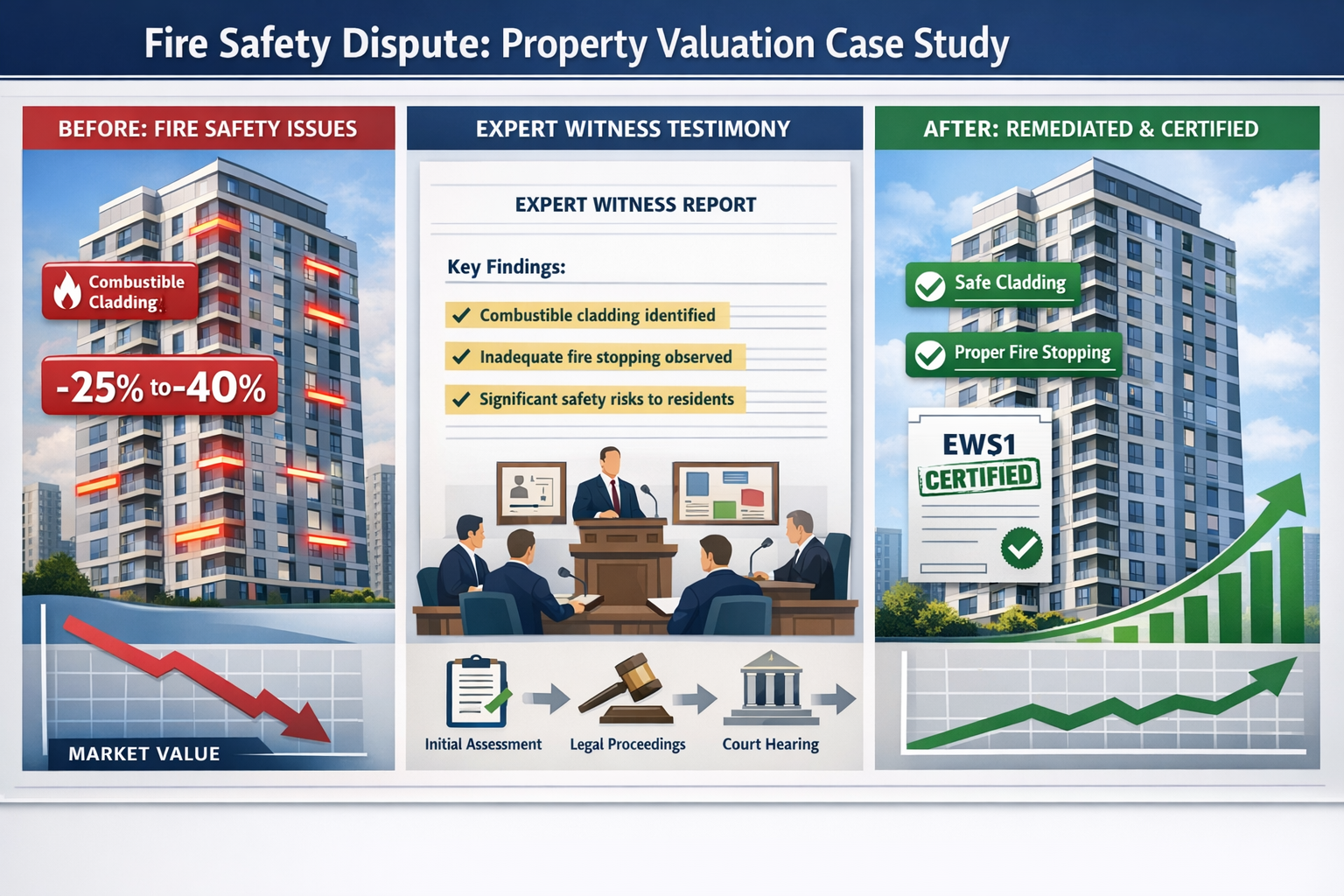
Scenario 1: Pre-Grenfell Valuation with Undisclosed ACM Cladding
Facts: Property valued in 2016 at £400,000. ACM cladding discovered in 2019. Current market value £240,000 (40% reduction). Owner claims negligent valuation.
Expert Witness Considerations:
- Was ACM cladding visible and identifiable during 2016 inspection?
- What was market awareness of cladding risks in 2016?
- Did the valuer have reasonable grounds to investigate cladding composition?
- What professional standards applied to cladding assessment in 2016?
Likely Conclusion: Unless specific red flags were present, valuers in 2016 were not expected to conduct detailed cladding investigations. Market awareness of ACM risks was limited before Grenfell.
Scenario 2: Post-Grenfell Valuation Failing to Reflect Internal Fire Safety Defects
Facts: Property valued in 2023 at £350,000. Subsequently discovered missing cavity barriers and non-compliant fire doors. Remediation cost £80,000. Owner claims valuation should have reflected these defects.
Expert Witness Considerations:
- Were internal fire safety defects observable during inspection?
- Did the valuer request or review fire risk assessments?
- What was the scope of the valuation instruction?
- Did professional indemnity insurance cover internal fire safety advice in 2023?
Likely Conclusion: Internal fire safety defects typically require intrusive investigation. Unless specifically instructed to assess internal fire safety or provided with specialist reports, the valuer may not have been negligent. However, post-July 2025 expanded insurance coverage[5] changes expectations for current valuations.
Scenario 3: Disputed Remediation Cost Impact on Valuation
Facts: Property valued in 2024 at £300,000 with known fire safety issues and estimated remediation cost of £50,000. Actual remediation cost £120,000. Owner claims valuation was negligent.
Expert Witness Considerations:
- What remediation cost evidence was available at valuation date?
- How did the valuer incorporate remediation costs into value opinion?
- What assumptions were disclosed about remediation scope and cost?
- How did market participants typically adjust for remediation costs?
Likely Conclusion: Remediation cost estimation involves uncertainty. If the valuer relied on reasonable cost estimates available at the valuation date and disclosed assumptions appropriately, subsequent cost overruns don't necessarily indicate negligence.
Maintaining Professional Independence and Credibility
The most valuable asset an expert witness possesses is credibility. In fire safety valuation disputes where technical issues are complex and financial stakes are high, maintaining professional independence is essential.
Best practices for expert witness independence:
🎯 Avoid Advocacy: Your role is to assist the court, not to advocate for the party instructing you. Present balanced analysis acknowledging strengths and weaknesses in both positions.
🎯 Acknowledge Uncertainty: Fire safety valuation involves professional judgment. Acknowledge areas where reasonable professionals might reach different conclusions.
🎯 Update Opinions When Appropriate: If new information emerges that changes your opinion, disclose this promptly. Credibility depends on intellectual honesty.
🎯 Resist Pressure: Instructing parties may pressure you to modify opinions. Maintain professional independence even if it jeopardizes future instructions.
🎯 Document Everything: Keep detailed records of your analysis, communications, and reasoning. This documentation supports your testimony and demonstrates thoroughness.
Understanding the broader context of property valuation helps expert witnesses maintain perspective on their role within the professional community.
Coordinating with Legal Teams While Maintaining Independence
Expert witnesses must balance cooperation with legal teams against the duty to maintain independence. This relationship requires clear boundaries and communication.
Effective coordination strategies:
- Pre-Report Conferences: Discuss the legal issues and questions the court needs addressed, but resist suggestions to reach predetermined conclusions
- Draft Report Review: Allow legal teams to review draft reports for clarity and completeness, but not to alter substantive opinions
- Cross-Examination Preparation: Practice testimony with legal teams, but ensure your answers remain truthful and balanced
- Joint Expert Meetings: Engage constructively with opposing experts to narrow issues and identify areas of agreement
The relationship between expert witness and instructing solicitor differs fundamentally from typical client relationships. Your primary duty is to the court, not to the party paying your fees. This distinction must be maintained throughout the engagement.
Conclusion
Expert Witness Preparation for 2026 Fire Safety Valuation Disputes: Post-Grenfell RICS Guidelines and Case Studies represents a critical intersection of technical expertise, professional standards, and legal procedure. As the UK continues to grapple with the aftermath of Grenfell and ongoing fire safety remediation, the demand for qualified expert witnesses who can navigate this complex landscape will only increase.
The regulatory framework has evolved significantly, with the July 2025 expansion of professional indemnity insurance coverage[5], the September 2026 Building Regulations Part B amendments[6], and updated RICS building survey quality standards requiring Fire Safety Strategy Compliance verification[7]. Expert witnesses must understand these developments while maintaining the temporal discipline to assess historical valuations against the standards applicable at the material date.
Effective expert witness preparation requires comprehensive evidence gathering, including regulatory compliance documentation, valuation methodology analysis, technical assessment records, and robust comparable evidence. Site inspections must balance current observations with reconstruction of what the original valuer could reasonably have known. Professional competence must be demonstrated through appropriate qualifications, CPD records, and insurance coverage.
In the courtroom, expert witnesses must structure clear, balanced reports that assist the court while maintaining professional independence. Cross-examination requires preparation for common tactics, particularly around regulatory changes, technical complexity, and comparable evidence disputes. Understanding typical dispute scenarios—from pre-Grenfell valuations with undisclosed cladding to post-Grenfell assessments of internal fire safety defects—enhances preparation effectiveness.
Actionable Next Steps
For professionals seeking to serve as expert witnesses in fire safety valuation disputes:
-
Update Your Knowledge: Complete CPD specifically addressing post-Grenfell RICS guidance, Building Regulations Part B amendments, and expanded professional indemnity requirements
-
Review Your Insurance: Ensure your professional indemnity insurance includes the expanded fire safety coverage effective July 2025[5]
-
Build Your Evidence Database: Compile comparable evidence showing market impact of various fire safety issues across different time periods
-
Develop Courtroom Skills: Seek training in expert witness testimony, report writing, and cross-examination techniques
-
Establish Independence Protocols: Create clear procedures for maintaining professional independence while working with legal teams
-
Network with Specialists: Build relationships with fire safety engineers, building control professionals, and remediation contractors who can provide technical support
The complexity of fire safety valuation disputes demands expert witnesses who combine technical competence with professional integrity and communication skills. By understanding the regulatory framework, mastering evidence gathering techniques, and developing effective courtroom strategies, expert witnesses can provide invaluable assistance to courts navigating these challenging disputes.
For property professionals seeking comprehensive assessments that meet current standards, engaging qualified RICS surveyors who understand fire safety requirements is essential. Whether conducting RICS homebuyer surveys or detailed building inspections, professional surveyors must now incorporate fire safety compliance verification into their standard practice.
The post-Grenfell landscape has permanently changed property valuation practice. Expert witnesses who embrace these changes while maintaining professional standards will play a crucial role in resolving disputes fairly and advancing industry best practices.
References
[1] Rics Valuation Practice Fire Safety In Residential Valuation – https://www.rics.org/news-insights/rics-valuation-practice-fire-safety-in-residential-valuation
[2] Ews1 Fire Safety Forms Future – https://ww3.rics.org/uk/en/journals/built-environment-journal/ews1-fire-safety-forms-future.html
[3] Fire Safety – https://www.rics.org/news-insights/current-topics-campaigns/fire-safety
[4] Valuation Of Properties In Multi Storey Multi Occupancy Residential Buildings With Cladding – https://www.rics.org/profession-standards/rics-standards-and-guidance/sector-standards/valuation-standards/valuation-of-properties-in-multi-storey-multi-occupancy-residential-buildings-with-cladding
[5] 2025 Rics Minimum Pi Terms Conditions Changes – https://www.howdengroup.com/uk-en/2025-rics-minimum-pi-terms-conditions-changes
[6] Part B Changes England Wales – https://ww3.rics.org/uk/en/journals/built-environment-journal/part-b-changes-england-wales.html
[7] Building Survey Quality Standards 2026 Navigating Rics Updates And Enhanced Home Inspection Requirements 4 – https://nottinghillsurveyors.com/blog/building-survey-quality-standards-2026-navigating-rics-updates-and-enhanced-home-inspection-requirements-4
[8] Regulation Practice Alerts – https://www.rics.org/regulation/how-we-regulate/regulation-practice-alerts
[9] Profession Standards – https://www.rics.org/profession-standards