
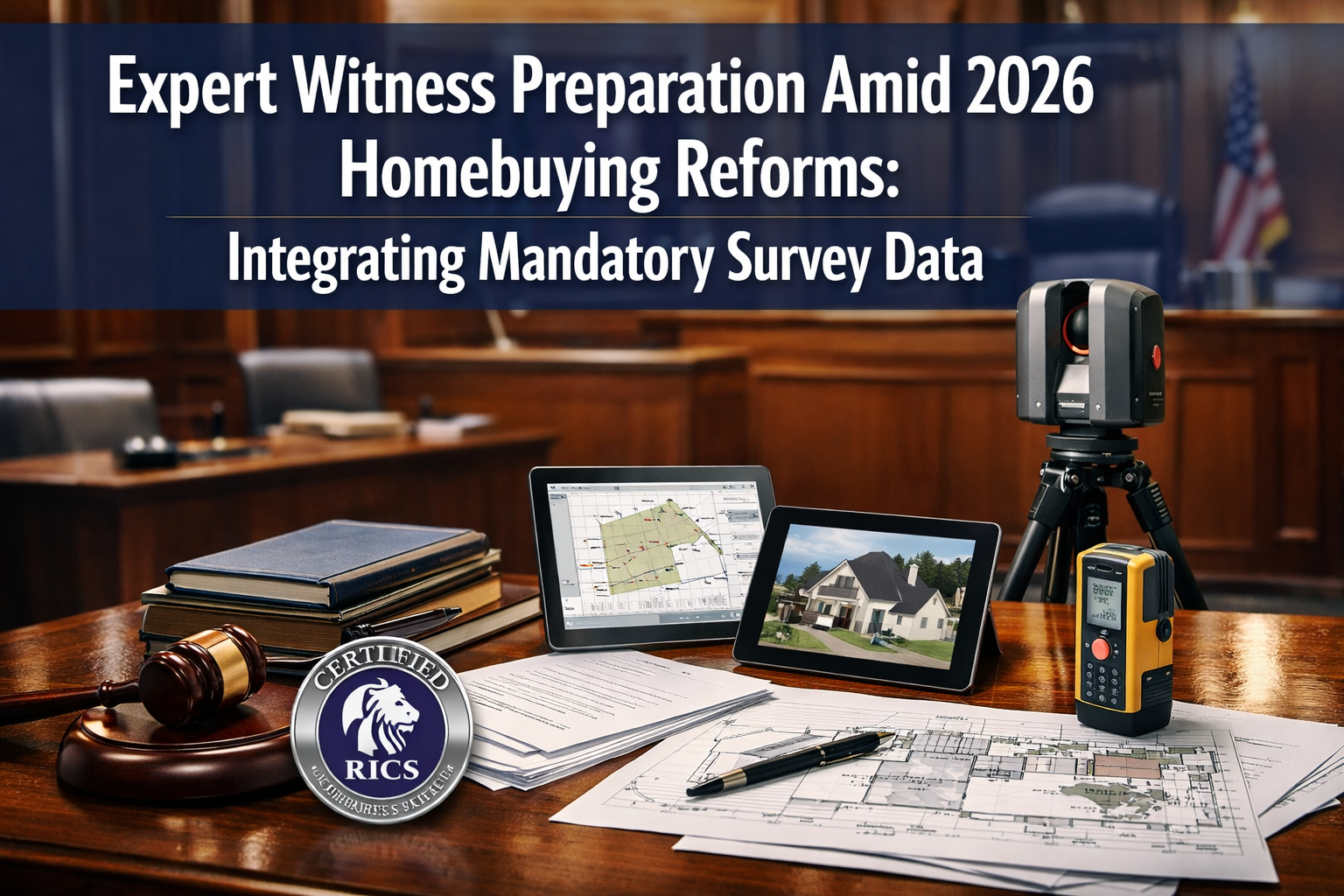
The UK property market stands at a pivotal crossroads in 2026. As proposed upfront survey mandates edge closer to implementation, a new wave of condition-based property disputes threatens to flood the courts. For expert witnesses specializing in property valuation and surveying, this regulatory shift presents both unprecedented challenges and remarkable opportunities. Expert Witness Preparation Amid 2026 Homebuying Reforms: Integrating Mandatory Survey Data into Dispute Resolutions has become the critical competency that separates credible testimony from courtroom failures.
The proposed reforms, which emerged from extensive government consultations that closed in late 2025, aim to revolutionize the homebuying process by requiring comprehensive property assessments before properties are marketed. While the exact implementation timeline remains uncertain—with RICS advocating for a minimum 24-month preparation period—the direction is clear: mandatory upfront condition data will fundamentally reshape how property disputes are argued, evidenced, and resolved.

Key Takeaways
- 📊 Mandatory upfront surveys under 2026 reforms will create standardized condition data that expert witnesses must master for credible testimony
- ⚖️ Property dispute volumes are expected to increase significantly as buyers gain access to detailed pre-purchase survey information
- 🎯 Expert witness credibility now depends on the ability to integrate, interpret, and contextualize mandatory survey data within legal frameworks
- 📋 New preparation protocols require witnesses to cross-reference multiple data sources including condition survey reports and standardized assessments
- 💼 Strategic advantages await expert witnesses who develop specialized knowledge of the 2026 reform requirements and data integration methodologies
Understanding the 2026 Homebuying Reform Landscape
What the Reforms Actually Mandate
The 2026 homebuying reforms represent the most significant overhaul of the UK property transaction process in decades. At their core, these reforms shift property condition assessments from an optional buyer expense to a mandatory seller obligation conducted before marketing begins.
Under the proposed framework, sellers must commission comprehensive property surveys that document:
- Structural integrity and defect identification
- Damp and timber condition assessments
- Electrical and plumbing system evaluations
- Energy efficiency ratings and improvement recommendations
- Boundary and title verification data
This upfront information package aims to reduce the current 30% transaction fall-through rate by eliminating surprises during the negotiation phase. However, this transparency comes with a trade-off: increased litigation potential when survey data is disputed, misinterpreted, or allegedly incomplete.
Timeline and Implementation Considerations
While government consultations concluded in December 2025, no definitive implementation date has been announced. RICS has emphasized that a minimum 24-month preparation period is essential to:
✅ Build surveying capacity across the industry
✅ Develop standardized reporting frameworks
✅ Create comprehensive guidance documentation
✅ Train professionals on new requirements
✅ Establish quality assurance mechanisms
This extended timeline provides expert witnesses with a critical window to develop specialized competencies in handling mandatory survey data within dispute resolution contexts.
Impact on Property Disputes
The introduction of mandatory upfront surveys fundamentally alters the dispute landscape. Traditional property litigation often centered on what should have been disclosed. Under the new regime, disputes will increasingly focus on:
- Data interpretation conflicts – disagreements about survey findings significance
- Valuation adjustment disputes – how defects should impact purchase price
- Survey quality challenges – allegations of inadequate or negligent assessments
- Remediation cost disagreements – disputes over repair estimates and timelines
- Liability allocation – determining responsibility when defects emerge post-purchase
Expert witnesses must prepare to address these evolving dispute types with authority and precision.

The Expert Witness Role in 2026 Homebuying Reforms: Integrating Mandatory Survey Data
Core Responsibilities Under the New Framework
Expert witnesses operating within the 2026 reform environment face expanded responsibilities that extend beyond traditional valuation testimony. The integration of mandatory survey data requires witnesses to:
Validate Survey Methodology: Expert witnesses must assess whether the original upfront survey followed proper protocols. This includes evaluating whether the surveyor conducted appropriate investigations for the property type, age, and condition. Understanding what to do before an RICS home survey becomes essential knowledge for contextualizing survey limitations.
Interpret Technical Findings: Mandatory surveys generate extensive technical data that non-specialist parties struggle to comprehend. Expert witnesses translate complex findings—moisture readings, structural movement measurements, material degradation assessments—into language that courts and juries can understand and weigh appropriately.
Contextualize Defect Significance: Not all defects carry equal weight. A hairline crack in a Victorian property may be entirely normal settlement, while the same crack in a five-year-old building could indicate serious structural failure. Expert witnesses must place survey findings within appropriate historical, architectural, and geographical contexts.
Quantify Financial Impacts: Perhaps most critically, expert witnesses must translate condition data into reliable financial valuations. When a mandatory survey identifies rising damp, what is the legitimate price reduction? How do multiple minor defects combine to affect overall property value? These questions demand sophisticated analysis grounded in both survey data and market realities.
Credibility Factors in the Reformed System
The mandatory nature of upfront surveys creates new credibility benchmarks for expert witnesses. Courts will increasingly expect witnesses to demonstrate:
| Credibility Factor | Traditional Approach | 2026 Reform Standard |
|---|---|---|
| Data Sources | Relied on commissioned reports | Must integrate mandatory survey data with independent analysis |
| Methodology Transparency | General valuation principles | Explicit connection between survey findings and valuation adjustments |
| Comparative Analysis | Market comparables | Market comparables plus condition-adjusted valuations |
| Defect Knowledge | General awareness | Detailed technical understanding of survey-identified issues |
| Regulatory Awareness | Basic compliance | Comprehensive knowledge of 2026 reform requirements |
Expert witnesses who fail to incorporate mandatory survey data into their testimony risk judicial criticism for incomplete analysis. Conversely, those who master data integration position themselves as indispensable authorities in property dispute resolution.
Distinguishing Between Survey Levels
The 2026 reforms will likely standardize around specific survey levels, making it essential for expert witnesses to understand distinctions between assessment types. The difference between Level 2 and Level 3 surveys significantly impacts the depth of available data and appropriate reliance levels.
Level 2 (Homebuyer Survey): Provides a visual inspection of accessible areas without moving furniture or lifting floor coverings. Expert witnesses must acknowledge inherent limitations when mandatory surveys use this level.
Level 3 (Building Survey): Offers comprehensive investigation including detailed defect analysis and repair recommendations. This level generates richer data for expert witness integration but also creates higher expectations for thorough analysis.
Understanding which survey level was mandated—and what that means for data completeness—becomes a foundational element of credible expert testimony.

Integrating Mandatory Survey Data into Dispute Resolutions: Practical Strategies
Pre-Testimony Preparation Protocols
Effective Expert Witness Preparation Amid 2026 Homebuying Reforms: Integrating Mandatory Survey Data into Dispute Resolutions begins long before courtroom appearance. A systematic preparation protocol ensures comprehensive data integration:
Step 1: Comprehensive Document Collection
Gather all available documentation including the mandatory upfront survey, any supplementary specialist reports (damp surveys, structural engineering assessments), transaction correspondence, and marketing materials. Cross-reference claims made during marketing against survey findings to identify potential misrepresentation issues.
Step 2: Data Verification and Validation
Independently verify key survey findings where possible. If the mandatory survey identified subsidence risk, review local geological data and neighboring property histories. If damp was noted, consider whether the damp survey cost and methodology were appropriate for the property type.
Step 3: Comparative Market Analysis
Conduct thorough market research identifying comparable properties with similar condition profiles. The goal is establishing how the open market typically values properties with the defects identified in the mandatory survey. This comparative approach strengthens valuation testimony credibility.
Step 4: Expert Consultation Network
For complex technical issues beyond core surveying expertise, consult specialist colleagues. If the mandatory survey identified potential Japanese knotweed, for example, understanding all about Japanese knotweed through specialist consultation enhances testimony depth.
Step 5: Timeline Reconstruction
Create a detailed timeline showing when the mandatory survey was conducted, when findings were disclosed, how parties responded, and when disputes emerged. This chronology often reveals critical context about whether parties acted reasonably given available information.
Data Integration Methodologies
Successfully integrating mandatory survey data into expert testimony requires structured analytical frameworks:
The Three-Layer Analysis Approach
Layer 1: Technical Accuracy Assessment
Evaluate whether the mandatory survey correctly identified and characterized defects. This requires reviewing survey methodology, inspector qualifications, and investigation scope. Were appropriate tools used? Were accessible areas properly examined? Did the surveyor follow current RICS standards?
Layer 2: Financial Impact Quantification
Translate technical findings into financial terms using multiple valuation methodologies:
- Cost-to-cure approach: Calculate remediation expenses for identified defects
- Market comparison approach: Identify price differentials for properties with similar conditions
- Income capitalization approach: For investment properties, assess rental impact of defects
The convergence of these methodologies produces robust valuation adjustments that withstand cross-examination.
Layer 3: Causation and Liability Analysis
Determine whether defects pre-existed the transaction, arose post-purchase, or represent progressive deterioration. This analysis often proves decisive in apportioning liability between parties.
Addressing Common Dispute Scenarios
Scenario 1: Survey Adequacy Challenges
When parties dispute whether the mandatory survey was sufficiently comprehensive, expert witnesses must evaluate:
- Whether the survey level matched property complexity and age
- If specialist investigations were reasonably required but not conducted
- Whether surveyor limitations were appropriately disclosed
- If additional investigations were recommended but ignored
Comparing the disputed survey against homebuyers report examples helps establish whether the assessment met professional standards.
Scenario 2: Defect Significance Disagreements
Parties frequently disagree about whether identified defects justify price reductions. Expert witnesses should:
📌 Categorize defects by urgency (immediate safety risks vs. cosmetic issues)
📌 Distinguish between maintenance items and structural concerns
📌 Assess whether defects are typical for property age and type
📌 Evaluate progressive deterioration potential
Understanding the average price reduction after survey findings provides market context for reasonable adjustment expectations.
Scenario 3: Post-Purchase Discovery Disputes
When defects emerge after completion that weren't identified in the mandatory survey, expert witnesses must determine:
- Whether the defect was reasonably discoverable during the survey
- If the defect existed at survey date or developed subsequently
- Whether survey limitations were adequately communicated
- If buyers conducted reasonable due diligence beyond the mandatory survey
These analyses often require detailed understanding of building survey methodologies and their inherent limitations.
Technology and Data Management Tools
Modern expert witnesses leverage technology to enhance data integration:
Digital Survey Platforms: Utilize software that overlays multiple survey reports, highlighting discrepancies and tracking defect progression over time.
Valuation Modeling Tools: Employ specialized software that applies standardized adjustment factors to comparable properties based on condition differentials.
Visual Documentation Systems: Create compelling visual presentations that translate complex survey data into accessible graphics for judicial audiences.
Case Management Databases: Maintain searchable databases of previous disputes, outcomes, and valuation adjustments to inform current testimony with empirical precedent.
Building Expertise in 2026 Reform Compliance
Professional Development Priorities
Expert witnesses seeking to excel in Expert Witness Preparation Amid 2026 Homebuying Reforms: Integrating Mandatory Survey Data into Dispute Resolutions should prioritize specific competency development:
Regulatory Knowledge Mastery: Stay current with evolving reform implementation details. Subscribe to RICS updates, attend industry seminars, and participate in consultation responses. Regulatory fluency distinguishes authoritative witnesses from generalists.
Advanced Survey Interpretation: Develop deep technical knowledge across all survey types and specializations. Understanding what a surveyor does at a granular level enables more sophisticated data integration.
Legal Framework Understanding: Study property law developments related to the reforms. Understand how courts interpret survey obligations, disclosure requirements, and liability standards under the new regime.
Cross-Examination Resilience: Practice defending data integration methodologies under hostile questioning. The most comprehensive analysis loses value if the witness cannot articulate it convincingly under pressure.
Creating Standardized Analytical Templates
Developing reusable analytical frameworks ensures consistency and efficiency:
Survey Data Extraction Template: Create standardized worksheets that systematically extract key data points from mandatory surveys—defect locations, severity ratings, recommended actions, cost estimates, and urgency classifications.
Valuation Adjustment Matrix: Develop matrices that apply consistent adjustment factors for common defects across different property types and values.
Dispute Classification System: Categorize disputes by type (adequacy, interpretation, valuation, causation) to quickly identify relevant precedents and analytical approaches.
Expert Report Structure: Standardize report formats that clearly present survey data integration, analytical methodology, conclusions, and supporting documentation.
These templates accelerate preparation while maintaining analytical rigor and professional presentation standards.
Collaborative Networks and Peer Review
No expert witness operates in isolation. Building collaborative networks enhances expertise:
🤝 Specialist Referral Relationships: Develop relationships with specialists in structural engineering, damp treatment, timber decay, and other technical areas for consultation on complex issues.
🤝 Peer Review Arrangements: Establish informal peer review systems where colleagues critique draft reports and testimony strategies before court appearances.
🤝 Cross-Disciplinary Learning: Engage with legal professionals, other expert witness specialties, and academic researchers to broaden perspective on dispute resolution dynamics.
🤝 Industry Association Participation: Active involvement in RICS committees, local surveyor groups, and expert witness associations provides early insight into emerging trends and best practices.
Conclusion
The convergence of mandatory upfront surveys and property dispute resolution represents a defining moment for expert witnesses in the UK property sector. Expert Witness Preparation Amid 2026 Homebuying Reforms: Integrating Mandatory Survey Data into Dispute Resolutions is no longer an optional specialization—it is becoming the baseline competency for credible testimony in property litigation.
As the reforms progress toward implementation, expert witnesses face a clear choice: proactively develop the skills, knowledge, and methodologies required to excel in this new environment, or risk professional obsolescence as courts increasingly expect sophisticated data integration capabilities.
The opportunities are substantial for those who invest in preparation. Property disputes will likely increase in volume and complexity as mandatory surveys generate more detailed condition information. Expert witnesses who master survey data integration will command premium fees, enjoy enhanced professional reputations, and provide genuinely valuable services to courts struggling with technical property issues.
Actionable Next Steps
For expert witnesses preparing for the 2026 reform environment:
-
Audit Current Capabilities: Honestly assess your current ability to integrate mandatory survey data into valuation testimony. Identify knowledge gaps and skill deficiencies.
-
Develop Technical Depth: Invest in advanced training on survey methodologies, defect analysis, and remediation costing. Consider specialized certifications in areas like damp assessment or structural evaluation.
-
Build Analytical Systems: Create standardized templates, checklists, and frameworks that ensure consistent, comprehensive data integration across all cases.
-
Strengthen Legal Knowledge: Study recent case law on survey obligations, disclosure requirements, and expert witness standards. Understand how courts evaluate expert testimony credibility.
-
Establish Quality Assurance: Implement peer review processes and maintain detailed case databases to continuously improve analytical approaches based on empirical outcomes.
-
Network Strategically: Build relationships with legal professionals, other expert witnesses, and specialist consultants who can enhance your capabilities and refer appropriate cases.
The 2026 homebuying reforms will fundamentally reshape property transactions and the disputes that arise from them. Expert witnesses who embrace this transformation—developing the specialized knowledge and methodologies required to integrate mandatory survey data into compelling, credible testimony—will not only survive the transition but thrive as indispensable authorities in property dispute resolution.
The preparation window is closing. The time to act is now. 🏛️