

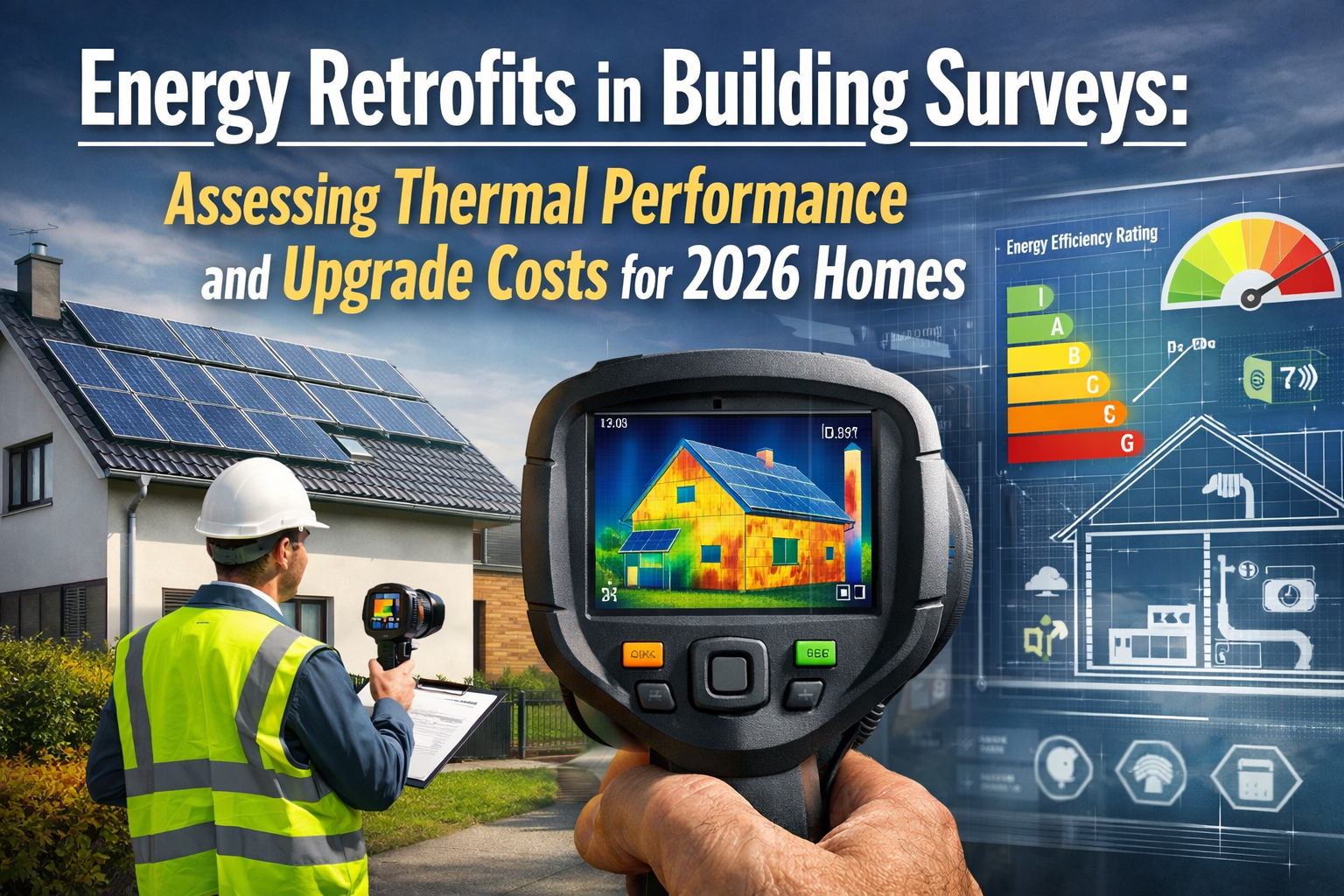
Rising energy costs and stricter environmental regulations have transformed how homeowners and buyers approach property assessments in 2026. Energy Retrofits in Building Surveys: Assessing Thermal Performance and Upgrade Costs for 2026 Homes has become an essential consideration for anyone looking to purchase, sell, or improve residential properties. Modern building surveys now provide detailed insights into insulation quality, ventilation efficiency, and heating system performance—information that helps buyers plan realistic retrofits and calculate long-term savings. With the global energy retrofit systems market valued at USD 199.59 billion in 2026 and projected to reach USD 258.17 billion by 2030[1], understanding thermal performance and upgrade costs has never been more critical for homeowners seeking to reduce energy bills and increase property value.
Key Takeaways
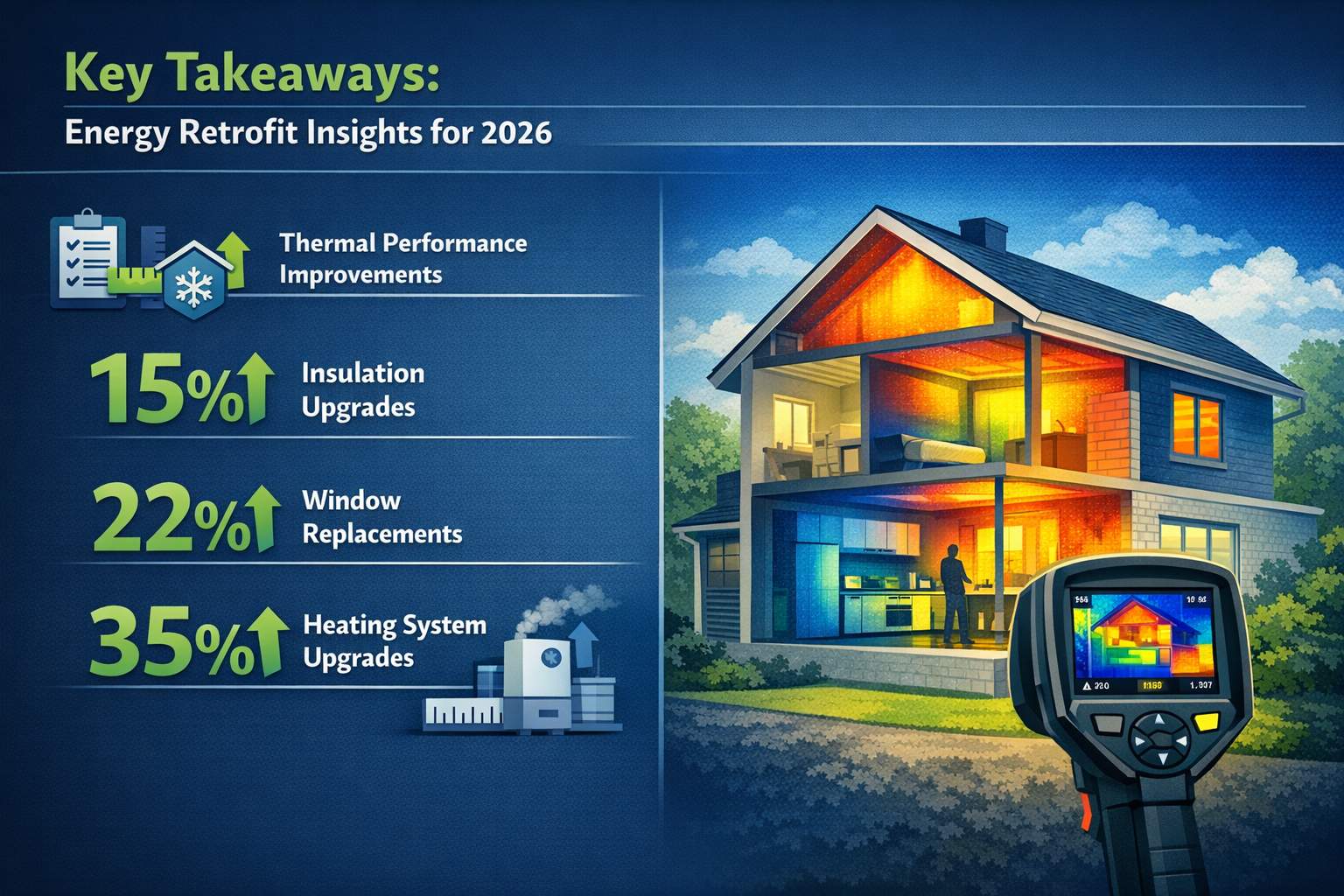
✅ Building surveys in 2026 now include comprehensive thermal performance assessments that identify heat loss areas, insulation gaps, and opportunities for energy-efficient upgrades.
✅ Energy retrofit costs vary significantly—from basic insulation improvements (£3,000-£8,000) to comprehensive whole-house retrofits (£25,000-£45,000)—making accurate survey data essential for budgeting.
✅ Over 57% of organizations plan to increase investment in energy efficiency in 2026[3], reflecting a strong market shift toward retrofit solutions rather than new construction.
✅ Modern surveys utilize thermal imaging technology and U-value calculations to provide precise data on building envelope performance and prioritize cost-effective improvements.
✅ Regulatory changes including Scope 1 and 2 emissions reporting beginning in 2026[4] are driving demand for detailed energy assessments in residential properties.
Understanding Energy Retrofits in Building Surveys for 2026
Energy retrofits represent systematic improvements to existing buildings designed to reduce energy consumption, lower carbon emissions, and enhance occupant comfort. In the context of building surveys, these assessments have evolved from simple visual inspections to sophisticated evaluations incorporating thermal imaging, air tightness testing, and detailed energy modeling.
What Makes 2026 Different for Energy Assessments
The landscape of building surveys has transformed dramatically. Energy efficiency in buildings has emerged as the No. 1 infrastructure priority for organizations, rising from 7th place in 2023[3]. This shift reflects several converging factors:
- Regulatory pressure from emissions reporting requirements
- Economic incentives driven by volatile energy prices
- Technological advances in assessment tools and retrofit solutions
- Market demand from environmentally conscious buyers
When conducting home surveys in 2026, surveyors now routinely include energy performance metrics alongside traditional structural assessments. This integrated approach provides buyers with a complete picture of both the property's current condition and its potential for energy improvements.
The Role of Building Surveys in Retrofit Planning
Professional building surveys serve as the foundation for effective retrofit planning. A comprehensive survey identifies:
🔍 Thermal weak points where heat escapes through walls, roofs, floors, and windows
🔍 Insulation deficiencies in cavity walls, lofts, and solid wall constructions
🔍 Ventilation issues that affect air quality and contribute to heat loss
🔍 Heating system efficiency and opportunities for modern heat pump installations
🔍 Moisture and condensation risks that may worsen with certain retrofit interventions
Understanding which home survey is right for you becomes particularly important when energy retrofits are a consideration. While basic condition reports may note obvious issues, Level 2 and Level 3 surveys provide the detailed analysis necessary for retrofit planning.
Assessing Thermal Performance: Methods and Technologies
Thermal performance assessment forms the cornerstone of effective energy retrofit planning. Modern surveyors employ multiple techniques to evaluate how well a building retains heat and where improvements will deliver the greatest impact.
Thermal Imaging and Heat Loss Detection
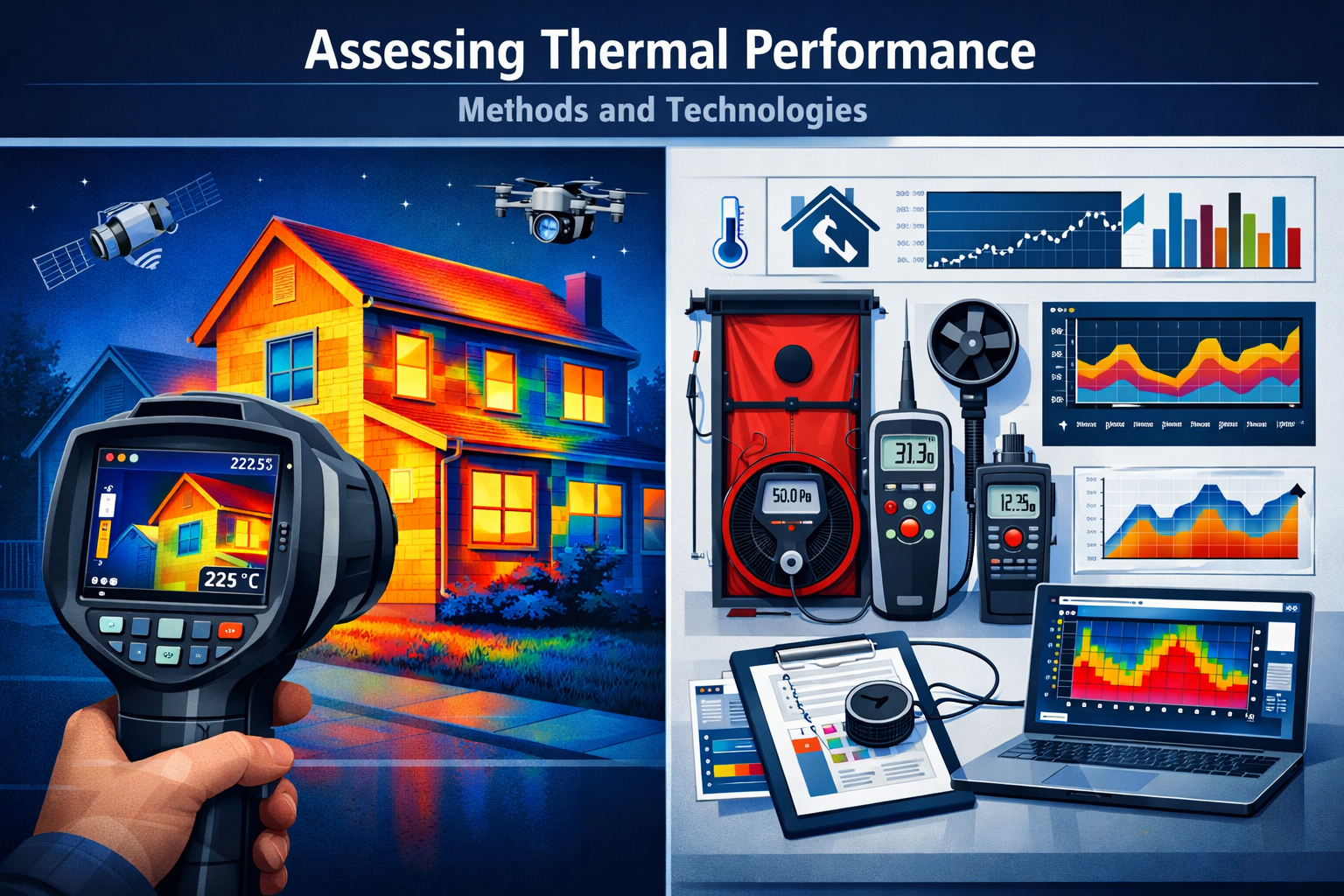
Thermal imaging cameras have become standard equipment for building surveyors conducting energy assessments. These devices detect infrared radiation and create visual maps showing temperature variations across building surfaces. Areas appearing cooler (often shown in blue or purple) indicate heat loss, while warmer areas (red or orange) may reveal thermal bridging or insulation gaps.
Key applications include:
- External envelope scanning to identify insulation voids in walls and roofs
- Window and door assessments to detect air leakage and frame inefficiencies
- Thermal bridge identification at junctions between different building elements
- Pre and post-retrofit verification to confirm improvement effectiveness
Thermal imaging works most effectively when conducted during cold weather with a temperature difference of at least 10°C between inside and outside. Surveyors typically perform these assessments in early morning hours when external temperatures are lowest.
U-Value Calculations and Building Fabric Assessment
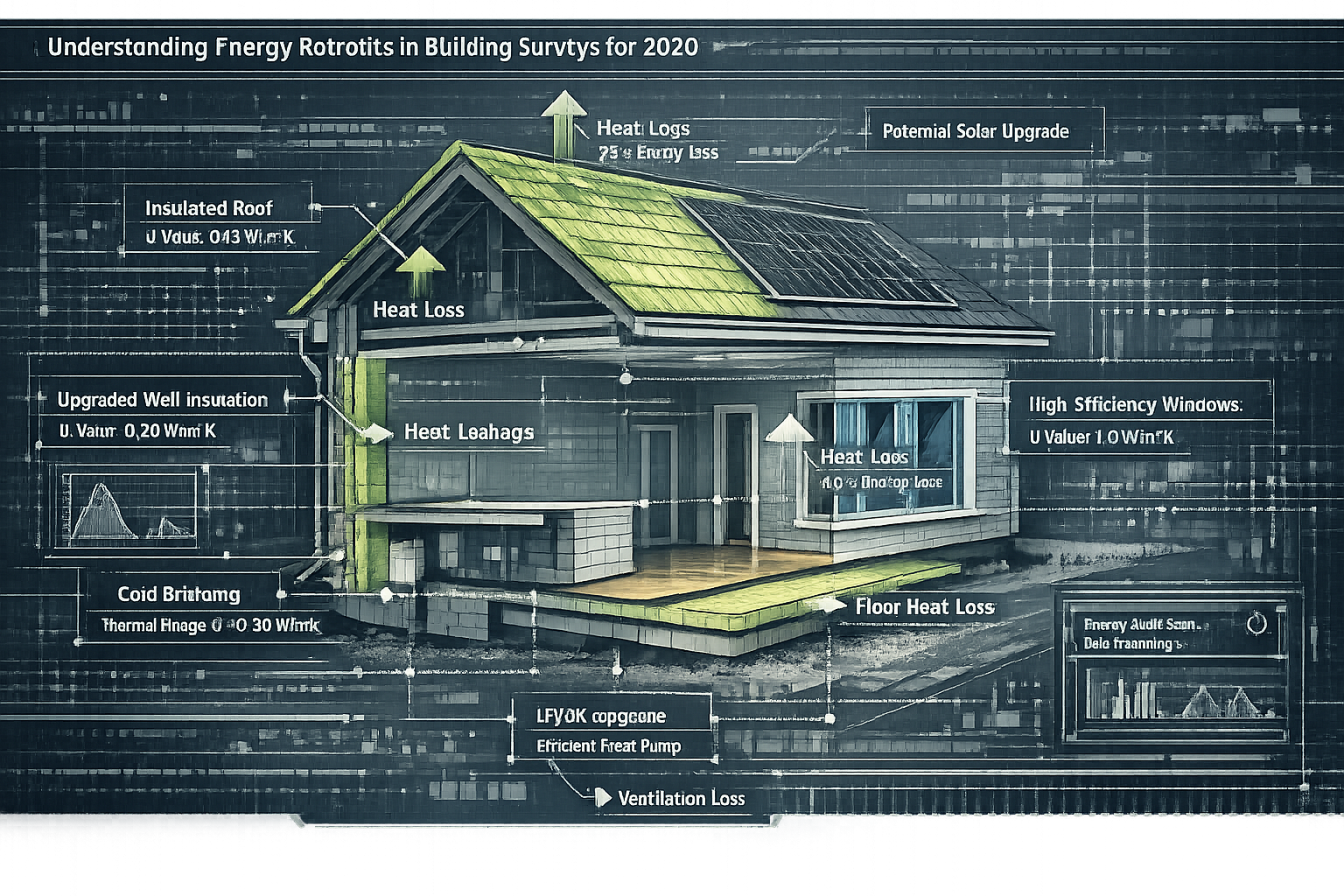
U-values measure the rate of heat transfer through building elements—the lower the U-value, the better the insulation performance. Modern building regulations require specific U-values for different components:
| Building Element | Current Building Regulations | Typical Existing Property | Retrofit Target |
|---|---|---|---|
| External Walls | 0.18 W/m²K | 1.5-2.0 W/m²K | 0.25-0.30 W/m²K |
| Roof/Loft | 0.16 W/m²K | 1.0-2.5 W/m²K | 0.16-0.20 W/m²K |
| Floor | 0.18 W/m²K | 0.7-1.5 W/m²K | 0.20-0.25 W/m²K |
| Windows | 1.4 W/m²K | 4.5-5.0 W/m²K | 1.2-1.6 W/m²K |
Surveyors calculate U-values based on:
- Material composition and thickness of each building layer
- Thermal conductivity of materials used
- Surface resistance values for internal and external faces
- Air gap characteristics in cavity wall constructions
These calculations inform retrofit recommendations by identifying which elements offer the greatest potential for improvement relative to investment cost.
Air Tightness Testing and Ventilation Analysis
Air leakage represents a significant source of heat loss in many properties. Professional air tightness testing uses a blower door system to pressurize or depressurize a building, measuring the rate of air change. Results are expressed as air changes per hour (ACH) at 50 Pascals pressure difference.
Typical air tightness values:
- New build standard: 5-8 ACH @ 50Pa
- Older properties: 15-25 ACH @ 50Pa
- Retrofit target: 8-10 ACH @ 50Pa
However, improving air tightness without addressing ventilation can create condensation and indoor air quality problems. Modern surveys assess the balance between reducing heat loss and maintaining healthy ventilation through:
- Mechanical ventilation with heat recovery (MVHR) systems
- Trickle vents and passive stack ventilation
- Humidity-controlled extract fans
- Whole-house ventilation strategies
When reviewing a building survey report, pay particular attention to recommendations that address both air tightness and ventilation together, as these elements must work in harmony.
Energy Performance Certificate (EPC) Integration
While EPCs provide a standardized energy rating (A-G scale), they often rely on assumptions rather than detailed measurements. Professional building surveys complement EPCs by:
- Validating assumptions made in the EPC assessment
- Identifying specific improvement opportunities beyond generic recommendations
- Quantifying potential energy savings from targeted interventions
- Prioritizing improvements based on cost-effectiveness
The integration of detailed survey data with EPC recommendations creates a robust foundation for retrofit planning, helping homeowners avoid costly mistakes and focus investment where it delivers maximum benefit.
Energy Retrofits in Building Surveys: Upgrade Options and Costs for 2026 Homes
Understanding the full spectrum of energy retrofit options and their associated costs enables homeowners to make informed decisions about which improvements to prioritize. The market for energy retrofit systems continues to expand, with rising demand for energy-efficient HVAC upgrades and growing integration of building automation systems[1] driving innovation and competitive pricing.
Insulation Upgrades: Walls, Roofs, and Floors
Insulation improvements typically offer the highest return on investment for energy retrofits, with relatively short payback periods and significant comfort improvements.
Loft and Roof Insulation
Cost: £300-£1,500 for DIY installation; £800-£2,500 for professional installation
Loft insulation remains one of the most cost-effective retrofits. Modern recommendations call for 270-300mm of insulation (achieving U-values around 0.16 W/m²K). Options include:
- Mineral wool rolls or batts: Most common and affordable
- Blown cellulose or mineral fiber: Excellent for irregular spaces
- Rigid insulation boards: Higher R-value per inch, suitable for limited depth
- Spray foam: Creates air barrier but may affect roof ventilation
Professional surveys identify potential complications such as inadequate ventilation, electrical wiring requiring repositioning, or roof structure concerns that affect insulation choices.
Cavity Wall Insulation
Cost: £1,000-£2,500 for typical semi-detached home
For properties with unfilled cavity walls (typically built 1920s-1980s), cavity wall insulation provides excellent value. Materials include:
- Mineral wool: Most common, good thermal and acoustic performance
- Polystyrene beads: Lightweight, moisture-resistant
- Polyurethane foam: Higher insulation value, fills irregular cavities
Building surveys assess cavity suitability by checking for:
- Adequate cavity width (minimum 50mm)
- Absence of bridging debris
- Wall condition and exposure to driving rain
- Existing damp issues that require resolution first
Solid Wall Insulation
Cost: £8,000-£22,000 depending on property size and method
Properties with solid walls (pre-1920s construction or no cavity) require either external wall insulation (EWI) or internal wall insulation (IWI):
External Wall Insulation (£100-£150 per m²):
- ✅ No loss of internal floor space
- ✅ Protects existing wall structure
- ✅ Transforms external appearance
- ❌ Higher cost
- ❌ May require planning permission
- ❌ Changes property aesthetics
Internal Wall Insulation (£50-£100 per m²):
- ✅ Lower cost than EWI
- ✅ No external appearance change
- ✅ No planning permission typically required
- ❌ Reduces room sizes by 100-150mm
- ❌ Requires relocation of radiators, sockets, switches
- ❌ Potential for interstitial condensation if poorly designed
Professional surveys help determine which approach suits the property's construction, condition, and constraints.
Floor Insulation
Cost: £800-£3,500 depending on floor type and access
Floor insulation addresses heat loss to the ground or unheated spaces below:
- Suspended timber floors: Insulation boards or mineral wool between joists (£20-£40 per m²)
- Solid concrete floors: Rigid insulation boards with new floor finish (£50-£80 per m²)
- Basement ceilings: Insulation boards attached to ceiling (£30-£50 per m²)
Surveys identify moisture issues, structural concerns, and access limitations that affect insulation feasibility and cost.
Heating System Upgrades and Heat Pump Installation
The shift toward heat pump technology represents one of the most significant trends in residential energy retrofits[4]. However, successful heat pump installation requires careful assessment of building thermal performance.
Air Source Heat Pumps (ASHP)
Cost: £8,000-£18,000 installed, including hot water cylinder and controls
ASHPs extract heat from outdoor air and deliver it to the home's heating system. Key considerations identified in building surveys include:
- Heat loss calculations to size the system correctly
- Space for outdoor unit (typically 1m x 1m footprint)
- Noise considerations for neighbors (40-60 decibels)
- Electrical supply adequacy (often requires upgrade to 100A service)
- Radiator sizing (may need larger radiators for lower flow temperatures)
- Hot water cylinder space (most ASHPs require 200-300L cylinder)
Building surveys assess whether the property's thermal performance supports efficient heat pump operation. Properties with poor insulation may require fabric improvements first to achieve acceptable running costs.
Ground Source Heat Pumps (GSHP)
Cost: £20,000-£35,000 installed
GSHPs offer higher efficiency than ASHPs but require significant ground works:
- Horizontal ground loops: Require 400-600m² of garden space
- Vertical boreholes: Need 2-4 boreholes at 70-100m depth
Surveys evaluate site suitability, ground conditions, and whether the higher capital cost justifies the efficiency improvement over ASHP alternatives.
Hybrid Systems and Conventional Boiler Upgrades
Cost: £3,000-£8,000 for hybrid systems; £2,500-£4,500 for condensing boiler replacement
For properties where full heat pump installation isn't feasible, alternatives include:
- Hybrid heat pumps: Combine ASHP with gas boiler for peak demand
- High-efficiency condensing boilers: 90-94% efficiency with smart controls
- Hydrogen-ready boilers: Future-proofed for potential hydrogen conversion
Window and Door Replacements
Cost: £400-£1,200 per window; £1,000-£3,000 per external door
Modern glazing significantly outperforms older windows:
- Single glazing: U-value 4.5-5.0 W/m²K
- Double glazing (air-filled): U-value 2.8-3.0 W/m²K
- Double glazing (argon-filled): U-value 1.6-2.0 W/m²K
- Triple glazing: U-value 0.8-1.2 W/m²K
Building surveys assess:
- Window condition and remaining service life
- Frame material (timber, uPVC, aluminum) and thermal performance
- Installation quality and air leakage around frames
- Prioritization based on exposure and condition
Smart Controls and Building Automation
Cost: £200-£2,000 depending on system complexity
The expansion of building automation systems[1] offers significant energy savings through better control:
- Smart thermostats: Learning algorithms and remote control (£150-£300)
- Thermostatic radiator valves (TRVs): Zone control (£30-£60 per radiator)
- Weather compensation: Adjusts heating based on outdoor temperature (£300-£600)
- Time and temperature zoning: Heats different areas at different times (£500-£1,500)
Professional surveys identify opportunities for control improvements that complement physical retrofits, often delivering 15-25% energy savings with minimal capital investment.
LED Lighting and Electrical Efficiency
Cost: £300-£1,500 for whole-house LED conversion
The expansion of LED lighting retrofits[1] continues as LED technology improves and costs decrease:
- LED bulb replacement: £3-£15 per bulb, 80-90% energy saving vs. incandescent
- Integrated LED fittings: £15-£100 per fitting, longer lifespan and better performance
- Smart lighting controls: Occupancy sensors and daylight dimming (£50-£200 per room)
While lighting represents a smaller portion of total energy use (typically 10-15%), LED retrofits offer quick payback periods of 1-3 years.
Cost-Benefit Analysis: Planning Your Energy Retrofit Investment
Understanding the financial implications of energy retrofits requires careful analysis of upfront costs, ongoing savings, available incentives, and property value impacts. With over half of surveyed organizations planning to increase investment in energy efficiency in 2026[3], the market for retrofit financing and support continues to evolve.
Calculating Payback Periods and Return on Investment
Payback period represents the time required for energy savings to equal the initial investment cost. This calculation helps prioritize improvements:
Simple Payback Period Formula:
Payback Period (years) = Total Installation Cost ÷ Annual Energy Savings
Example calculations for typical retrofits:
| Retrofit Measure | Installation Cost | Annual Savings | Payback Period |
|---|---|---|---|
| Loft Insulation (270mm) | £1,200 | £200-£300 | 4-6 years |
| Cavity Wall Insulation | £1,800 | £250-£350 | 5-7 years |
| Solid Wall Insulation (EWI) | £14,000 | £500-£700 | 20-28 years |
| ASHP (well-insulated home) | £12,000 | £600-£900 | 13-20 years |
| Double to Triple Glazing | £8,000 | £150-£250 | 32-53 years |
| Smart Heating Controls | £800 | £200-£300 | 2.5-4 years |
These calculations demonstrate why building surveys that prioritize improvements based on cost-effectiveness prove so valuable. The most expensive retrofits don't always deliver the best returns.
Government Incentives and Grant Programs
Various financial support mechanisms reduce the net cost of energy retrofits:
Boiler Upgrade Scheme (BUS)
- £7,500 grant for air source heat pumps
- £7,500 grant for ground source heat pumps
- £5,000 grant for biomass boilers
Available to homeowners replacing fossil fuel heating systems with low-carbon alternatives.
Energy Company Obligation (ECO4)
Provides funding for insulation and heating improvements for:
- Low-income households
- Properties with EPC ratings D-G
- Vulnerable residents
Grants cover up to 100% of costs for eligible households, with partial funding available for others.
Local Authority Programs
Many councils offer additional support:
- Interest-free loans for energy improvements
- Discounted retrofit assessments
- Bulk-buy schemes for solar panels and heat pumps
Building surveys help identify which improvements qualify for available funding, maximizing the financial benefit of retrofit investments.
Property Value Impacts and Market Premiums
Energy-efficient homes command market premiums that partially or fully offset retrofit costs:
- Properties with EPC rating A or B sell for 5-14% more than comparable D-rated properties
- Homes with heat pumps installed attract premium buyers concerned about future gas boiler bans
- Lower running costs make properties more affordable for buyers with tight budgets
- Future-proofed homes avoid the risk of mandatory upgrades under tightening regulations
Additionally, higher occupancy rates and tenant retention represent documented co-benefits of energy efficiency retrofits[2], particularly relevant for landlords and investors.
When considering home maintenance costs, energy retrofits should be viewed as investments that reduce ongoing expenses while increasing asset value.
Financing Options for Large-Scale Retrofits
For comprehensive retrofits costing £20,000-£45,000, several financing options exist:
Home Improvement Loans:
- Unsecured personal loans at 3-8% APR
- Loan terms of 3-10 years
- No property security required
Remortgaging:
- Access equity at mortgage rates (typically lower than personal loans)
- Extended repayment terms reduce monthly costs
- May incur early repayment charges on existing mortgage
Green Mortgages:
- Preferential rates for energy-efficient properties
- Additional borrowing for retrofit improvements
- Cashback incentives for achieving high EPC ratings
Equity Release (for older homeowners):
- Access property value without monthly payments
- Interest rolls up and is repaid on property sale
- Reduces inheritance but improves quality of life
Professional building surveys provide the detailed cost estimates and energy savings projections that lenders require for retrofit financing applications.
Whole-House Retrofit vs. Phased Improvements
Homeowners face a strategic choice between comprehensive whole-house retrofits and phased improvements over time:
Whole-House Retrofit (£25,000-£45,000):
- ✅ Optimized design with all elements working together
- ✅ Single disruption period
- ✅ Maximum energy savings achieved quickly
- ✅ Potential for bulk-buy discounts
- ❌ High upfront cost
- ❌ Requires significant financing
- ❌ Extended construction period
Phased Approach:
- ✅ Spreads costs over multiple years
- ✅ Allows learning from each phase
- ✅ More manageable financially
- ✅ Can prioritize high-impact, low-cost improvements first
- ❌ May result in suboptimal overall design
- ❌ Multiple disruption periods
- ❌ Some measures may need rework as others are added
Building surveys help develop phased retrofit plans that maintain design coherence while spreading costs. The typical priority sequence:
- Phase 1 (Year 1): Loft insulation, draught-proofing, smart controls (£2,000-£4,000)
- Phase 2 (Year 2): Cavity wall insulation or IWI, heating system upgrade (£10,000-£15,000)
- Phase 3 (Year 3-4): Window replacements, floor insulation (£8,000-£12,000)
- Phase 4 (Year 5+): Renewable energy systems, final improvements (£5,000-£15,000)
This approach allows energy savings from early phases to help fund later improvements while maintaining steady progress toward whole-house performance targets.
Integrating Energy Assessments into Your Building Survey Process
Successfully incorporating energy retrofit planning into property purchase or improvement decisions requires understanding how to leverage professional survey services effectively.
Choosing the Right Survey Level for Energy Assessment
Different survey types offer varying levels of energy performance analysis:
RICS Level 1 (Condition Report):
- Basic condition overview
- Limited energy assessment
- Relies primarily on existing EPC
- Best for: New or recently renovated properties where energy performance is already good
RICS Level 2 (HomeBuyer Report):
- Moderate detail on building fabric
- Identifies obvious thermal performance issues
- May include thermal imaging as optional extra
- Best for: Conventional properties in reasonable condition where major retrofits aren't anticipated
RICS Level 3 (Building Survey):
- Comprehensive building fabric analysis
- Detailed assessment of insulation, ventilation, and heating
- Often includes thermal imaging as standard
- Specific retrofit recommendations with cost estimates
- Best for: Older properties, those in poor condition, or when planning significant retrofits
Understanding the differences between survey levels helps ensure you commission the appropriate assessment for your energy retrofit planning needs.
Requesting Thermal Imaging and Specialist Assessments
While some surveyors include thermal imaging in standard Level 3 surveys, others offer it as an optional extra. When requesting thermal imaging:
Specify your requirements:
- External envelope scan
- Internal room-by-room assessment
- Specific problem area investigation
- Pre-purchase retrofit planning
Timing considerations:
- Schedule during heating season (October-March)
- Conduct early morning for best results
- Ensure property has been heated for 24 hours prior
- Minimum 10°C temperature difference required
Additional specialist assessments that complement building surveys include:
- Air tightness testing: £300-£600
- SAP calculations: £200-£400 (detailed energy modeling)
- Retrofit design consultation: £500-£1,500
- Moisture risk analysis: £300-£800
These assessments provide the detailed data necessary for complex retrofit projects, particularly when installing heat pumps or pursuing deep energy retrofits.
Working with Surveyors and Energy Assessors
The April 2025 launch of the RICS residential retrofit and energy improvement guide[1] reflects growing recognition of the need for integrated expertise. When commissioning surveys:
Look for qualifications:
- RICS chartered surveyor status
- Retrofit Coordinator or Retrofit Assessor certification
- Thermal imaging certification (Level 1 or 2)
- Heat pump design experience
Ask specific questions:
- "Can you provide U-value calculations for the main building elements?"
- "Will thermal imaging identify specific areas for improvement?"
- "Can you estimate costs for recommended retrofits?"
- "Do you have experience with heat pump feasibility assessments?"
Request detailed reporting:
- Prioritized list of improvements with cost ranges
- Estimated energy savings for each measure
- Identification of grant eligibility
- Phased implementation plan options
Professional surveyors with energy retrofit expertise provide significantly more value than those focused solely on structural condition, particularly when purchasing properties requiring thermal performance improvements.
Understanding Survey Findings and Retrofit Recommendations
Building survey reports addressing energy retrofits typically include:
Current Performance Assessment:
- Existing insulation levels and U-values
- Heating system age, type, and efficiency
- Window and door condition and performance
- Ventilation adequacy and air tightness estimates
- Current EPC rating and limiting factors
Identified Issues:
- Thermal bridging locations
- Insulation gaps or compression
- Air leakage points
- Condensation and moisture risks
- Heating system deficiencies
Improvement Recommendations:
- Prioritized list of retrofit measures
- Cost estimates for each improvement
- Expected energy savings
- Payback period calculations
- Potential grant funding opportunities
Implementation Considerations:
- Building regulation compliance requirements
- Planning permission needs
- Listed building or conservation area constraints
- Sequencing of improvements
- Risks and mitigation strategies
When reviewing recommendations, consider both the technical feasibility and your personal circumstances:
- How long do you plan to own the property?
- What is your available budget?
- Can you tolerate disruption from major works?
- Are there specific comfort or health issues to address?
- What are your environmental priorities?
These factors influence which recommendations to prioritize and how aggressively to pursue energy improvements.
Negotiating Property Prices Based on Energy Performance
Building survey findings regarding energy performance provide leverage for price negotiations:
Quantify the retrofit cost:
If the survey identifies £15,000 of necessary energy improvements, this represents a legitimate basis for price reduction or requesting seller contributions.
Highlight regulatory risks:
Properties with poor energy performance face increasing regulatory pressure:
- Potential future minimum EPC requirements for sales
- Higher energy bills affecting affordability for buyers
- Mandatory disclosure requirements reducing market appeal
Compare to market alternatives:
Properties with better energy performance at similar prices represent stronger value, justifying lower offers for less efficient homes.
Request seller completion of works:
Rather than price reduction, negotiate for the seller to complete specific improvements (e.g., loft insulation, boiler replacement) before completion.
Professional surveyors can provide written cost estimates that support negotiation positions, helping buyers achieve fair prices that reflect the true condition and performance of properties.
Future Trends: The Evolution of Energy Retrofits in Building Surveys
The energy retrofit landscape continues to evolve rapidly, driven by technological innovation, regulatory change, and market demand. Understanding emerging trends helps homeowners make future-proof investment decisions.
Regulatory Developments and Compliance Requirements
Scope 1 and 2 emissions reporting set to begin in 2026, with Scope 3 emissions reporting commencing in 2027[4], creates new drivers for building energy assessments. While initially focused on commercial buildings, these requirements signal future direction for residential properties:
Anticipated regulatory changes:
- Minimum EPC ratings for property sales (potentially EPC C by 2028)
- Mandatory energy performance disclosure at point of sale
- Stricter building regulation U-values for retrofit works
- Phase-out of fossil fuel heating systems (gas boiler ban from 2025 for new builds)
Massachusetts Large Building Energy Reporting (LBER) policy[4] provides a model for potential UK developments, requiring detailed energy usage reporting and public disclosure for larger buildings.
Building surveys that address current and anticipated regulatory requirements help buyers avoid purchasing properties that will require mandatory upgrades in the near future.
Technological Advances in Assessment and Monitoring
Emerging technologies are transforming how energy performance is assessed and improved:
Artificial Intelligence and Machine Learning:
- Automated thermal image analysis identifying retrofit priorities
- Predictive modeling of energy savings from different improvements
- Optimization algorithms for cost-effective retrofit packages
Internet of Things (IoT) Sensors:
- Continuous monitoring of temperature, humidity, and air quality
- Real-time identification of performance issues
- Data-driven retrofit decision-making
Digital Twin Technology:
- Virtual 3D models of buildings with integrated energy data
- Simulation of retrofit scenarios before implementation
- Ongoing performance tracking against design predictions
Drone-Based Thermal Surveys:
- Rapid roof and facade thermal assessment
- Access to difficult-to-reach areas
- Cost-effective large-scale surveys
These technologies are becoming increasingly accessible and affordable, with some already incorporated into standard survey offerings.
The Shift from "Build New" to "Retrofit Smart"
There is a strong pivot from "build new" to "retrofit smart" in 2026[9], driven by retrofits being faster, cheaper, and less carbon-intensive than new construction. This trend influences:
Market dynamics:
- Increased competition among retrofit contractors driving down costs
- Growing availability of skilled retrofit professionals
- Improved product availability and quality
- More competitive financing options
Innovation focus:
- Development of retrofit-specific products (e.g., slim-profile insulation for space-constrained properties)
- Integration of renewable energy with retrofit packages
- Whole-house retrofit systems designed for rapid installation
- Prefabricated retrofit solutions for common property types
Professional development:
- Expansion of retrofit training and certification programs
- Integration of energy assessment into standard surveyor education
- Growing specialization in retrofit design and coordination
These developments make energy retrofits increasingly attractive and accessible for homeowners, with building surveys playing a central role in identifying opportunities and guiding investment decisions.
Emerging Retrofit Technologies and Materials
Innovation in retrofit materials and systems continues to expand options for improving building performance:
Advanced Insulation Materials:
- Aerogel insulation: Ultra-thin, high-performance (R-value up to 10 per inch)
- Vacuum insulation panels: Exceptional performance in limited space
- Phase-change materials: Thermal mass enhancement for temperature stability
- Bio-based insulation: Hemp, wood fiber, and sheep's wool for sustainable retrofits
Next-Generation Heating Systems:
- High-temperature heat pumps: Operating at traditional radiator temperatures
- Hybrid heat pump systems: Optimized switching between heat pump and gas
- District heating connections: Shared renewable heat networks
- Hydrogen-ready boilers: Future-proofed for potential hydrogen conversion
Smart Building Integration:
- Predictive heating controls: Weather forecasting and occupancy prediction
- Grid-responsive systems: Demand-side response for lower energy costs
- Energy storage integration: Battery systems for renewable energy optimization
- Whole-house energy management: Coordinated control of heating, lighting, and appliances
Building surveys that identify opportunities for these emerging technologies help homeowners stay ahead of the curve and maximize long-term value.
Conclusion: Making Informed Decisions About Energy Retrofits in Building Surveys
Energy Retrofits in Building Surveys: Assessing Thermal Performance and Upgrade Costs for 2026 Homes represents a critical consideration for anyone purchasing, selling, or improving residential property in the current market. With the global energy retrofit systems market valued at USD 199.59 billion in 2026 and projected to reach USD 258.17 billion by 2030[1], the importance of understanding thermal performance and upgrade costs will only continue to grow.
Key Recommendations for Homeowners and Buyers
Commission the appropriate survey level: For properties built before 1990 or those showing signs of poor energy performance, invest in a comprehensive Level 3 building survey that includes thermal imaging and detailed energy assessment. Understanding which survey is right for you ensures you receive the information necessary for informed retrofit planning.
Prioritize cost-effective improvements: Building surveys help identify the retrofits that deliver the best return on investment. Generally, this means starting with insulation (loft, then walls), followed by heating controls, then heating system upgrades, and finally windows and doors.
Consider whole-house performance: Individual improvements work best when designed as part of a coherent whole-house strategy. Professional surveys provide the foundation for integrated retrofit planning that avoids unintended consequences like condensation or inadequate ventilation.
Factor in available incentives: Government grants and support programs can significantly reduce net retrofit costs. Ensure your survey identifies improvements that qualify for available funding.
Think long-term: Energy retrofits represent investments that pay back over many years through reduced energy bills, increased comfort, and enhanced property value. Consider your ownership timeline and personal priorities when deciding which improvements to pursue.
Actionable Next Steps
1️⃣ Commission a comprehensive building survey that includes energy performance assessment for any property you're considering purchasing or if you own a property built before 1990.
2️⃣ Request thermal imaging and U-value calculations to identify specific areas where heat loss occurs and quantify the potential for improvement.
3️⃣ Obtain detailed cost estimates for recommended retrofits, including material options and expected energy savings for each measure.
4️⃣ Research available grants and incentives for which your property and planned improvements may qualify, reducing net costs.
5️⃣ Develop a phased retrofit plan that prioritizes high-impact, cost-effective improvements while maintaining design coherence for future phases.
6️⃣ Consider financing options that spread costs over time while allowing you to benefit from energy savings immediately.
7️⃣ Engage qualified professionals with retrofit experience, RICS certification, and thermal imaging capabilities to ensure high-quality assessment and implementation.
The Future of Energy-Efficient Homes
The convergence of regulatory pressure, technological innovation, and market demand ensures that energy performance will remain a central consideration in property decisions. With over 57% of organizations planning to increase investment in energy efficiency in 2026[3] and the strong pivot from "build new" to "retrofit smart"[9], the retrofit market will continue to mature and expand.
Professional building surveys that comprehensively assess thermal performance and provide detailed retrofit recommendations empower homeowners to make informed decisions that reduce energy costs, enhance comfort, and increase property value. Whether you're purchasing a property that requires improvement or seeking to upgrade your existing home, understanding Energy Retrofits in Building Surveys: Assessing Thermal Performance and Upgrade Costs for 2026 Homes provides the foundation for successful, cost-effective energy improvements.
The investment in a thorough building survey pays dividends many times over through avoided mistakes, optimized retrofit strategies, and confidence that your property improvements will deliver the expected benefits. As energy costs remain volatile and environmental regulations continue to tighten, the value of expert energy performance assessment will only increase.
For professional building survey services that include comprehensive energy performance assessment, thermal imaging, and detailed retrofit recommendations, contact qualified RICS surveyors who specialize in energy efficiency and retrofit planning. The insights gained from expert assessment transform energy retrofits from daunting challenges into manageable, rewarding investments that benefit both homeowners and the environment.
References
[1] Energy Retrofit Systems Market Report – https://www.researchandmarkets.com/reports/6191010/energy-retrofit-systems-market-report
[2] Report Energy Efficiency Efforts In U S Buildings Should Focus On Improvements In Regulation And Financing – https://gbpn.org/report-energy-efficiency-efforts-in-u-s-buildings-should-focus-on-improvements-in-regulation-and-financing/
[3] Energy Efficiency In Buildings Tops Organizations Infrastructure Priorities – https://smartbuildingsmagazine.com/news/energy-efficiency-in-buildings-tops-organizations-infrastructure-priorities
[4] State Of The Industry 2026 Point Of Convergence – https://www.greenbuildermedia.com/blog/state-of-the-industry-2026-point-of-convergence
[9] 2026 Energy Trends For Buildings Efficiency Data Control – https://www.measurable.energy/blog/2026-energy-trends-for-buildings-efficiency-data-control