Modern property buyers no longer accept vague references to "poor insulation" or generic recommendations to "consider upgrading heating systems." In 2026, purchasers demand precise thermal performance data, realistic retrofit cost projections, and evidence-based energy efficiency roadmaps before committing to a property. Energy Performance and Retrofit Guidance in Building Surveys: Meeting 2026 Buyer Expectations for Long-Term Cost Clarity has evolved from a nice-to-have enhancement into a fundamental component of comprehensive property assessments, particularly in building surveys where detailed condition analysis meets future-focused investment planning.
The shift reflects a broader market transformation. With 80% of existing buildings expected to remain standing through 2050 [1], retrofit opportunities represent the fastest and least capital-intensive pathway to reducing carbon emissions and operational costs. Buyers recognize that purchasing a thermally inefficient property without understanding upgrade pathways creates significant financial uncertainty—potentially adding tens of thousands of pounds to ownership costs over the coming decade.
Key Takeaways
- Modern buyers expect detailed thermal performance data and realistic retrofit cost projections integrated into comprehensive building surveys, not just basic EPC ratings
- Regulatory frameworks now mandate energy benchmarking for commercial and larger residential properties, with compliance deadlines in 2026 and significant daily penalties for non-compliance
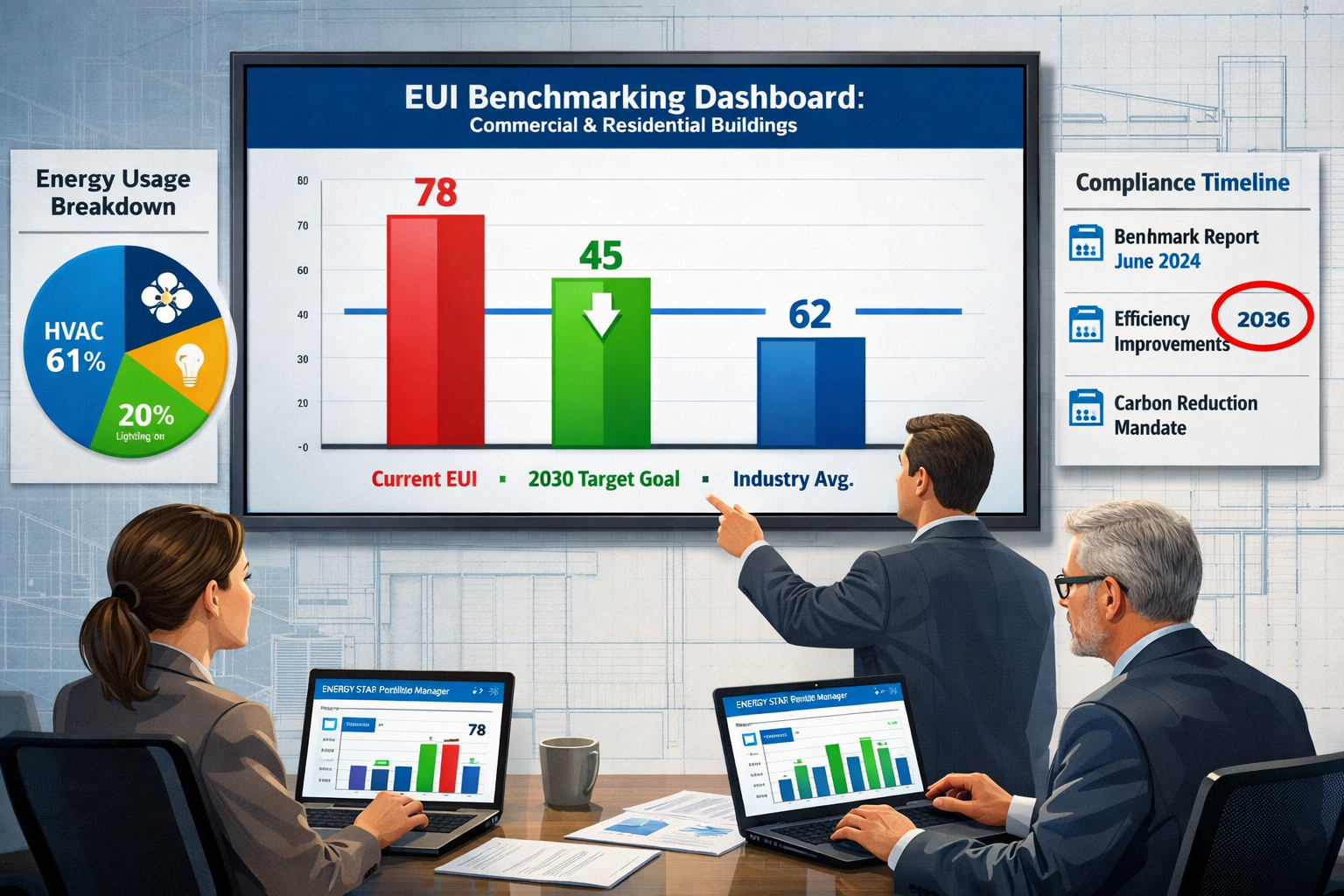
- HVAC systems account for 61% of commercial building energy use [2], making mechanical system assessments critical for accurate long-term cost forecasting
- Professional surveyors can differentiate services by incorporating thermal imaging, Energy Use Intensity benchmarking, and phased retrofit planning into Level 3 surveys
- Building Performance Standards evolve beyond disclosure to require documented improvements, renewable energy credits, and greenhouse gas emissions reductions on specific timelines
Why Energy Performance Has Become Central to Building Survey Value in 2026
The integration of energy performance analysis into building condition assessments represents more than regulatory compliance—it addresses fundamental buyer concerns about total cost of ownership. Traditional surveys identified structural defects and immediate repair needs but rarely quantified the ongoing operational expense of poor thermal performance or provided actionable upgrade guidance.
The Financial Impact of Thermal Inefficiency
Property buyers in 2026 understand that thermal inefficiency translates directly into measurable financial burden:
- Higher utility costs: Poorly insulated properties can cost £1,500-£3,000 annually more in heating expenses compared to well-insulated equivalents
- Reduced market value: Energy-inefficient properties face increasing buyer resistance and lower valuations as performance standards tighten
- Future compliance costs: Anticipated regulatory changes may require mandatory upgrades, creating unexpected capital expenditure
- Comfort and health implications: Poor thermal performance correlates with moisture issues, condensation, and reduced indoor air quality
Professional building surveys that quantify these impacts and provide costed improvement pathways deliver substantially greater value than assessments focused solely on structural condition.
Regulatory Drivers Reshaping Survey Expectations
Multiple regulatory frameworks now mandate energy performance disclosure and improvement, fundamentally changing what buyers expect from professional assessments:
ASHRAE Standard 100-2024 establishes authoritative energy benchmarks and emissions targets for existing buildings [2], providing standardized metrics that surveyors can reference when evaluating property performance against industry norms.
Building Performance Standards have evolved beyond simple disclosure requirements to mandate documented improvements over time [2]. Compliance pathways include:
- Renewable energy credit purchases
- Energy Use Intensity (EUI) reductions
- Greenhouse gas emissions targets
- Retro-commissioning and system optimization
For commercial properties and larger residential buildings, these standards create compliance obligations that directly affect property value and operational costs—information buyers need during the purchase decision process.
Geographic Variations in Compliance Requirements
Energy benchmarking and performance requirements vary significantly by location, creating complexity that professional surveyors must navigate:
| Location | Size Threshold | Reporting Deadline | Penalty Structure |
|---|---|---|---|
| Washington, D.C. | 10,000+ sq ft (private) | May 1, 2026 | Up to $100/day [2] |
| Seattle | 20,000+ sq ft | July 1 (annual) | Variable by violation [2] |
| Minnesota | 35,000+ sq ft (commercial/state) | Jan 1, 2030 (20% reduction) | TBD [3] |
Understanding these requirements enables surveyors to provide location-specific guidance on compliance obligations and associated costs when conducting homebuyers surveys in affected jurisdictions.
Integrating Energy Performance and Retrofit Guidance in Building Surveys: Practical Implementation Frameworks
Professional surveyors face a practical challenge: how to incorporate meaningful energy performance analysis and retrofit guidance into existing survey workflows without creating prohibitive cost increases or timeline extensions. The solution lies in tiered assessment approaches that match analysis depth to property type, buyer expectations, and budget constraints.
Four-Step Framework for Retrofit-Focused Surveys
Leading surveying practices have adopted a systematic framework for integrating energy performance into comprehensive building assessments [1]:
1. Understand Environmental Impact
- Document current energy consumption patterns using utility data when available
- Identify major energy-consuming systems (heating, cooling, hot water, lighting)
- Assess insulation levels in walls, roof spaces, and floors
- Evaluate window and door performance (single/double/triple glazing, air leakage)
2. Assess Improvement Opportunities
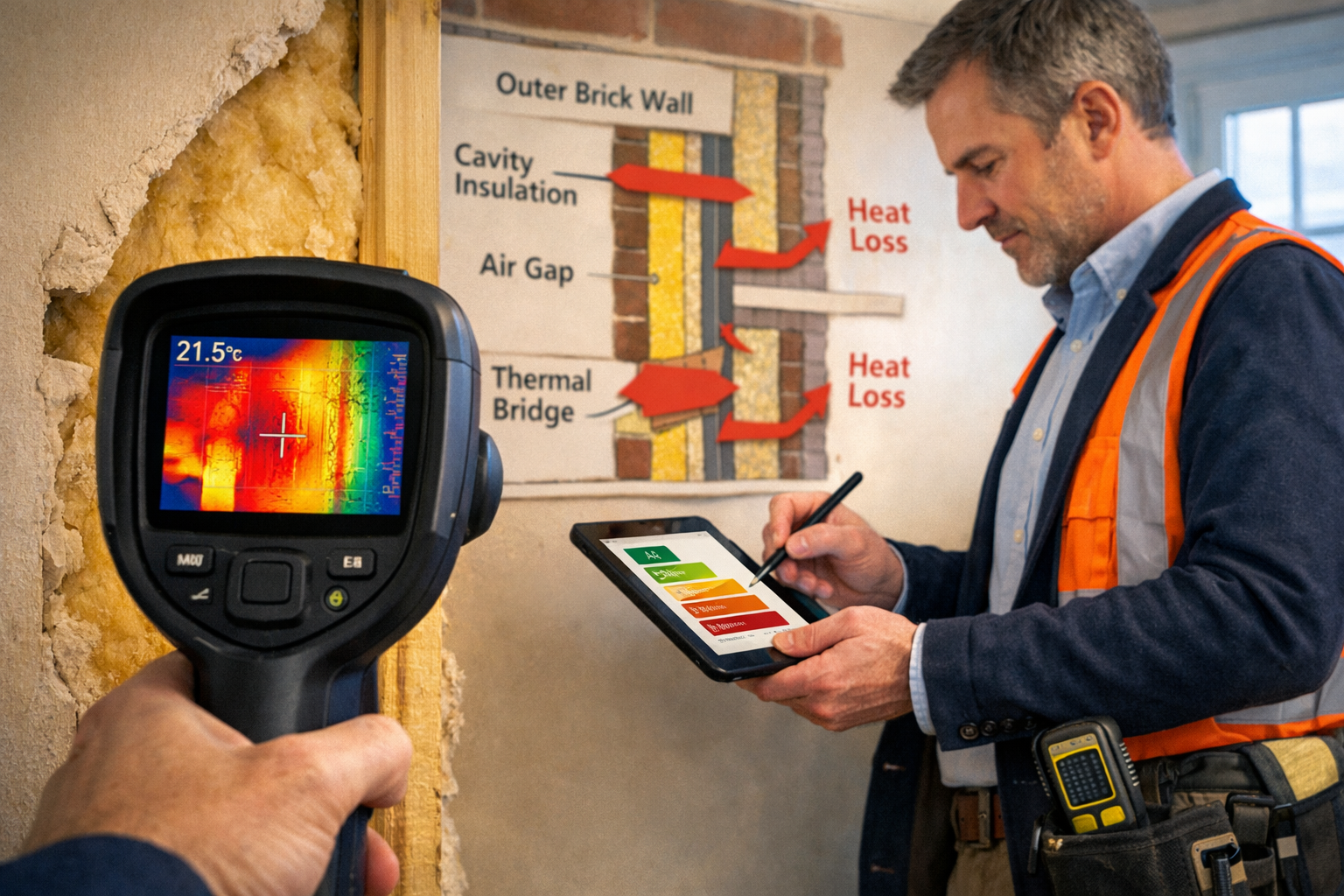
- Conduct thermal imaging surveys to identify heat loss zones and thermal bridges
- Evaluate HVAC system age, efficiency ratings, and replacement timelines
- Identify renewable energy potential (solar, heat pump viability, district heating connections)
- Assess moisture risk associated with retrofit measures (particularly insulation upgrades)
3. Benchmark Energy Use Intensity (EUI)
- Calculate property EUI using Energy Star Portfolio Manager methodology [2]
- Compare performance against similar property types and regional averages
- Identify specific systems or building elements underperforming benchmarks
- Document compliance status with applicable local/regional standards
4. Future-Proof for Evolving Standards
- Project likely regulatory requirements over 5-10 year ownership horizon
- Identify upgrade pathways that maintain flexibility for future improvements
- Recommend phased implementation approaches that spread capital costs
- Highlight measures with shortest payback periods for priority implementation
This framework provides structure while allowing customization based on property characteristics and client priorities.
Thermal Imaging Integration in Level 3 Surveys
Thermal imaging technology has become increasingly accessible and cost-effective, enabling surveyors to provide visual evidence of thermal performance issues that would remain invisible in traditional visual inspections. Modern handheld thermal cameras can identify:
- Heat loss through building fabric: Wall insulation gaps, roof thermal bridges, floor edge losses
- Air infiltration points: Window and door seals, service penetrations, construction joints
- Moisture accumulation zones: Cold spots indicating condensation risk or hidden water ingress
- HVAC system performance: Ductwork leakage, radiator distribution issues, underfloor heating faults
Including thermal imaging in building renovations planning provides buyers with concrete visual evidence of performance issues and helps prioritize improvement investments.
HVAC System Assessment: The 61% Factor
With HVAC systems accounting for 61% of commercial building energy use [2], mechanical system evaluation represents the single most impactful component of energy-focused surveys. Comprehensive HVAC assessment should include:
✅ Equipment age and expected remaining service life
- Document installation dates and manufacturer specifications
- Compare against typical equipment lifespans (15-20 years for boilers, 10-15 years for air conditioning)
- Identify systems approaching replacement thresholds
✅ Efficiency ratings and performance metrics
- Record boiler SEDBUK ratings or heat pump SCOP values
- Compare against current market standards and regulatory minimums
- Calculate efficiency degradation since installation
✅ Maintenance history and condition
- Review service records when available
- Assess visible condition indicators (corrosion, leaks, noise, vibration)
- Identify deferred maintenance issues affecting performance
✅ Upgrade pathways and costs
- Provide realistic replacement cost estimates for aging systems
- Evaluate heat pump conversion viability and associated costs
- Identify opportunities for zone controls and smart thermostats
This detailed mechanical assessment transforms vague "heating system is old" observations into actionable intelligence with specific cost implications.
Energy Star Portfolio Manager: The Standardized Compliance Tool
Energy Star Portfolio Manager has emerged as the standardized benchmarking platform across federal, state, and local mandatory policies [2]. Surveyors incorporating Portfolio Manager analysis into their assessments provide clients with:
- Standardized performance metrics: 1-100 Energy Star scores enabling direct comparison with similar properties
- Compliance documentation: Pre-formatted reports meeting regulatory submission requirements
- Improvement tracking: Baseline establishment for measuring retrofit effectiveness
- Market positioning data: Performance context for resale value discussions
For commercial properties and larger residential buildings subject to benchmarking requirements, Portfolio Manager integration demonstrates surveyor awareness of regulatory obligations and provides immediate compliance value.
Delivering Retrofit Cost Clarity: From Assessment to Implementation Roadmap
The ultimate value of Energy Performance and Retrofit Guidance in Building Surveys: Meeting 2026 Buyer Expectations for Long-Term Cost Clarity lies not in identifying problems but in providing actionable, costed solutions that enable informed purchase decisions and post-acquisition planning.
Phased Retrofit Planning Approaches
Most properties benefit from phased retrofit implementation rather than comprehensive simultaneous upgrades. Effective survey reports should outline multi-year improvement pathways that:
Phase 1: Quick Wins and Essential Repairs (Year 1)
- Air sealing and draught-proofing (£500-£2,000)
- Loft insulation upgrades (£300-£1,500)
- Heating controls and thermostatic radiator valves (£400-£1,200)
- LED lighting conversion (£200-£800)
- Typical Phase 1 Investment: £1,400-£5,500
- Expected Annual Savings: £300-£800
- Payback Period: 2-7 years
Phase 2: Major Building Fabric Improvements (Years 2-3)
- External or internal wall insulation (£8,000-£22,000)
- Window replacement with high-performance glazing (£5,000-£15,000)
- Floor insulation where accessible (£2,000-£6,000)
- Typical Phase 2 Investment: £15,000-£43,000
- Expected Annual Savings: £600-£1,500
- Payback Period: 10-25 years
Phase 3: Renewable Energy and Advanced Systems (Years 3-5)
- Air source heat pump installation (£8,000-£14,000 after grants)
- Solar PV array (£4,000-£8,000 for 4kW system)
- Battery storage integration (£4,000-£8,000)
- Typical Phase 3 Investment: £16,000-£30,000
- Expected Annual Savings: £800-£2,000
- Payback Period: 8-20 years
This phased approach spreads capital expenditure over multiple years while capturing immediate savings from quick-win measures.
Moisture Risk Assessment in Retrofit Planning
One critical aspect of retrofit guidance that distinguishes professional surveys from generic energy assessments is moisture risk evaluation. Improving building airtightness and adding insulation without adequate ventilation consideration can create serious condensation and mould problems.
RICS guidance for 2026 building surveys emphasizes the importance of assessing moisture risk and ventilation adequacy when recommending retrofit measures [4]. Professional surveyors should:
🔍 Evaluate existing ventilation provision
- Document mechanical ventilation systems and condition
- Assess natural ventilation adequacy (trickle vents, airbricks, passive stacks)
- Identify rooms with high moisture generation (kitchens, bathrooms, utility rooms)
🔍 Identify condensation risk factors
- Cold spots and thermal bridges revealed through thermal imaging
- Areas with poor air circulation or ventilation
- Historic moisture staining or mould growth patterns
🔍 Recommend coordinated improvements
- Specify mechanical ventilation with heat recovery (MVHR) when appropriate
- Ensure insulation upgrades include vapor control strategies
- Recommend moisture monitoring during and after retrofit implementation
This integrated approach prevents the common scenario where well-intentioned energy improvements create unintended moisture problems that undermine both comfort and building longevity.
Realistic Cost Estimation and Grant Availability
Retrofit cost estimates must reflect realistic market pricing for the property's location and construction type. Generic national averages often fail to account for:
- Regional labor cost variations: London and Southeast England typically 20-40% higher than national averages
- Property-specific complexity: Listed buildings, conservation areas, difficult access, asbestos presence
- Market capacity constraints: Installer availability for heat pumps and specialist insulation systems
- Ancillary work requirements: Electrical upgrades, structural modifications, planning permissions
Professional surveys should also reference available grant funding that reduces net retrofit costs:
- Boiler Upgrade Scheme: £7,500 grants for air source heat pumps (subject to eligibility)
- ECO4 (Energy Company Obligation): Funding for low-income households and vulnerable properties
- Local authority schemes: Variable programs supporting specific improvement types
- Green mortgages: Preferential rates for energy-efficient properties or planned improvements
Including grant information in survey reports demonstrates awareness of financial assistance mechanisms and provides more accurate net cost projections.
Integration with Negotiation Strategy
Energy performance findings and retrofit cost estimates provide powerful negotiation leverage during property transactions. When surveys document:
- Specific thermal performance deficiencies with visual thermal imaging evidence
- Realistic upgrade costs with itemized breakdowns
- Regulatory compliance obligations and associated deadlines
- Comparative performance against similar properties
Buyers gain concrete justification for price reductions or seller-funded improvements. The key is presenting findings with professional objectivity and supporting evidence rather than subjective opinions.
For example, documenting that a property's EUI significantly exceeds benchmark standards and requires £25,000 in upgrades to achieve compliance with anticipated 2030 standards provides substantially stronger negotiating position than simply noting "poor energy efficiency."
Meeting 2026 Buyer Expectations: The Competitive Advantage for Forward-Thinking Surveyors
The evolution toward Energy Performance and Retrofit Guidance in Building Surveys: Meeting 2026 Buyer Expectations for Long-Term Cost Clarity creates differentiation opportunities for surveying practices willing to invest in additional capabilities and training.
Enhanced Service Offerings and Market Positioning
Surveyors who develop expertise in energy performance assessment can position enhanced services as:
Standard Enhanced Survey
- Traditional structural and condition assessment
- Basic EPC review and commentary
- General energy efficiency observations
- Typical Fee: Standard market rate
Energy-Enhanced Building Survey
- Comprehensive structural and condition assessment
- Thermal imaging survey of building envelope
- Detailed HVAC system evaluation with efficiency ratings
- Energy Use Intensity benchmarking
- Phased retrofit recommendations with cost estimates
- Moisture risk assessment for proposed improvements
- Typical Fee: 20-35% premium over standard survey
Comprehensive Retrofit Planning Survey
- All Energy-Enhanced Survey components
- Detailed Energy Star Portfolio Manager analysis
- Renewable energy feasibility assessment
- Grant funding eligibility evaluation
- 10-year implementation roadmap with ROI projections
- Post-retrofit performance monitoring recommendations
- Typical Fee: 50-75% premium over standard survey
This tiered approach enables clients to select assessment depth appropriate to their needs while creating revenue opportunities for practices with enhanced capabilities.
Professional Development and Certification
Delivering credible energy performance guidance requires investment in professional development and technical capabilities:
- Thermal imaging certification: Infrared Thermography Level 1 certification from recognized bodies
- Energy assessment training: Domestic Energy Assessor (DEA) or Commercial Energy Assessor qualifications
- Building physics knowledge: Understanding heat transfer, moisture dynamics, and ventilation principles
- Retrofit coordination awareness: Familiarity with PAS 2035 retrofit assessment and design frameworks
- Technology investment: Quality thermal imaging equipment, moisture meters, and analysis software
RICS is developing updated guidance for 2026 building surveys to ensure assessments adequately address energy performance, moisture risk, and ventilation considerations [4], creating professional standards that surveyors must meet to maintain market credibility.
Case Study: Thermal Performance Assessment Value
Consider a typical scenario where enhanced energy assessment demonstrates clear value:
Property: 1930s semi-detached house, 120m², original single-glazed windows, uninsulated solid walls, aging gas boiler
Standard Survey Findings:
- "Property has original single-glazed windows showing signs of age"
- "Solid wall construction with no apparent insulation"
- "Gas boiler estimated 15+ years old, approaching end of service life"
- "Recommend budget for heating system replacement"
Energy-Enhanced Survey Findings:
- Thermal imaging reveals 35% heat loss through uninsulated solid walls, 25% through single-glazed windows, 20% through uninsulated loft
- Current EUI: 285 kWh/m²/year (78% above benchmark for property type)
- Estimated annual heating costs: £2,400 (vs. £1,200 for comparable insulated property)
- Boiler efficiency: 72% SEDBUK (modern condensing boiler: 90%+)
- Phased Retrofit Plan:
- Phase 1 (£3,500): Loft insulation, draught-proofing, heating controls → £400/year savings
- Phase 2 (£18,000): External wall insulation, window replacement → £800/year additional savings
- Phase 3 (£11,000): Air source heat pump installation → £600/year additional savings
- Total Investment: £32,500 | Total Annual Savings: £1,800 | Payback: 18 years
- Property value increase: Estimated £15,000-£25,000 based on EPC improvement from D to B
The enhanced assessment provides the buyer with concrete information to:
- Negotiate £20,000 price reduction based on documented upgrade costs
- Plan phased improvement implementation over 3-5 years
- Understand total cost of ownership over anticipated 10-year holding period
- Make informed decision about property suitability versus alternatives
This level of clarity directly addresses 2026 buyer expectations and justifies premium survey fees.
Conclusion
Energy Performance and Retrofit Guidance in Building Surveys: Meeting 2026 Buyer Expectations for Long-Term Cost Clarity represents a fundamental evolution in property assessment practice. Modern buyers demand comprehensive understanding of thermal performance, realistic upgrade costs, and evidence-based improvement roadmaps—information that traditional surveys focusing solely on structural condition cannot provide.
The regulatory landscape reinforces this shift. With 80% of existing buildings expected to remain standing through 2050 [1], retrofit represents the primary pathway to emissions reduction and operational cost management. Building Performance Standards now mandate documented improvements on specific timelines, creating compliance obligations that directly affect property value and ownership costs.
Professional surveyors who develop expertise in thermal imaging, energy benchmarking, HVAC assessment, and phased retrofit planning can deliver substantially greater value than competitors offering conventional assessments. The investment in professional development, certification, and technology creates differentiation opportunities and justifies premium fees for enhanced services.
Actionable Next Steps for Surveyors
- Invest in thermal imaging capability: Obtain Level 1 infrared thermography certification and quality equipment
- Develop energy assessment expertise: Pursue DEA qualification or equivalent energy performance training
- Create standardized retrofit assessment templates: Develop phased improvement frameworks adaptable to common property types
- Build installer network relationships: Establish connections with heat pump installers, insulation specialists, and renewable energy contractors for realistic cost data
- Market enhanced services: Clearly communicate energy-enhanced survey offerings and value proposition to prospective clients
- Monitor regulatory developments: Stay current with evolving Building Performance Standards and compliance requirements
Actionable Next Steps for Property Buyers
- Request energy-enhanced surveys: Specifically ask surveyors about thermal imaging and retrofit assessment capabilities when commissioning building surveys
- Provide utility data: Share 12 months of energy bills with surveyors to enable accurate consumption analysis
- Clarify ownership timeline: Communicate intended holding period to enable appropriate payback period analysis for retrofit recommendations
- Research grant eligibility: Investigate available funding schemes before finalizing retrofit budgets
- Consider phased implementation: Don't feel pressured to complete all improvements immediately—prioritize measures with shortest payback periods
The integration of energy performance and retrofit guidance into building surveys reflects the property market's maturation toward total cost of ownership thinking. Surveyors who embrace this evolution position themselves as essential advisors for the long-term property investment decisions that buyers face in 2026 and beyond.
For comprehensive property assessments that address both structural condition and energy performance, consider professional home surveys that incorporate thermal imaging and retrofit planning guidance tailored to your specific property and ownership goals.
References
[1] Gresb Quarterly Americas Cushman Wakefield On How To Retrofit Getting Ready For The 2026 Assessments A Spotlight On Gresbs Public Consultation – https://www.gresb.com/insights/gresb-quarterly-americas-cushman-wakefield-on-how-to-retrofit-getting-ready-for-the-2026-assessments-a-spotlight-on-gresbs-public-consultation/
[2] Energy Benchmarking – https://rimkus.com/article/energy-benchmarking/
[3] facilitiesdive – https://www.facilitiesdive.com/news/map-tracking-building-performance-standards-across-the-us/743214/
[4] Adapting Building Surveys For 2026 Retrofit Projects Rics Guidance Post Quality In Retrofit Summit – https://nottinghillsurveyors.com/blog/adapting-building-surveys-for-2026-retrofit-projects-rics-guidance-post-quality-in-retrofit-summit/