

UK commercial property transactions reached £52.3 billion in 2025, marking a 23% increase from the previous year as investors returned to the market following interest rate stabilization. Yet behind each successful acquisition lies a critical truth: inadequate due diligence remains the primary cause of post-purchase disputes and unexpected liabilities. As transaction volumes surge in 2026, chartered surveyors are deploying increasingly sophisticated protocols to protect buyers from hidden structural defects, compliance failures, and financial miscalculations that can transform promising investments into costly nightmares.
The Chartered Surveyors' Due Diligence Checklists for 2026 Commercial Property Acquisitions represent a comprehensive framework designed to identify and mitigate risks before contracts exchange. These systematic protocols combine structural assessments, regulatory compliance verification, financial analysis, and legal scrutiny to ensure buyers enter transactions with complete transparency.
Key Takeaways
- Comprehensive structural inspections identify hidden defects that can cost 15-30% of purchase price if discovered post-acquisition
- Multi-layered compliance checks verify planning permissions, building regulations, fire safety certificates, and environmental obligations across UK jurisdictions
- Financial due diligence extends beyond purchase price to analyze tenant covenants, service charge reconciliations, and capital expenditure forecasts
- Legal verification processes examine title integrity, restrictive covenants, and third-party rights that could limit property use or development potential
- Typical due diligence periods span 30-90 days depending on property complexity, with larger portfolios requiring extended timelines[3]
Understanding the Chartered Surveyors' Due Diligence Framework for 2026
The foundation of effective commercial property acquisition lies in systematic risk identification. Chartered surveyors employ a four-pillar approach that addresses structural integrity, regulatory compliance, financial viability, and legal soundness[1][3].
The Four Core Pillars of Commercial Due Diligence
1. Structural and Physical Assessment 🏗️
Professional chartered surveyors conduct thorough physical inspections that extend far beyond superficial walkthroughs. These assessments identify:
- Foundation integrity and subsidence indicators
- Roof condition, waterproofing, and drainage systems
- HVAC, electrical, and plumbing infrastructure
- Structural alterations and building envelope performance
- Accessibility compliance under Equality Act 2010
2. Regulatory and Compliance Verification ✅
UK commercial properties must satisfy multiple regulatory frameworks. Surveyors verify:
- Planning permission history and current use classifications
- Building regulations approval for all structural modifications
- Fire safety compliance including Fire Risk Assessments
- Asbestos management plans and surveys
- Energy Performance Certificates (EPC) meeting minimum standards
3. Financial Analysis and Valuation 💰
Beyond the asking price, financial due diligence examines income-generating capacity and hidden costs:
- Tenant covenant strength and lease terms analysis
- Service charge reconciliations for previous 3-5 years[4]
- Capital expenditure requirements over next decade
- Void period projections and re-letting assumptions
- Business rates liability and potential revaluations
4. Legal Title and Encumbrances 📋
Commercial property inspections must verify clean title and identify restrictions:
- Land Registry searches and title absolute confirmation
- Restrictive covenants limiting property use
- Easements, rights of way, and wayleaves
- Outstanding disputes or boundary disagreements
- Contaminated land register searches
The 2026 Enhanced Checklist Components
The Chartered Surveyors' Due Diligence Checklists for 2026 Commercial Property Acquisitions incorporate updated protocols addressing emerging risks in the recovering market. Professional surveyors now prioritize:
Climate Risk Assessment 🌍
- Flood risk mapping across all UK Environment Agency zones
- Future climate adaptation requirements
- Net zero carbon pathway compliance for institutional buyers
- Sustainable drainage system adequacy
Technology Infrastructure Evaluation
- Fiber connectivity and telecommunications capacity
- Electric vehicle charging infrastructure
- Smart building systems and IoT integration
- Cybersecurity considerations for connected systems
Post-Pandemic Workspace Standards
- Ventilation rates and air quality monitoring
- Flexible workspace conversion potential
- Touchless technology and hygiene facilities
- Social distancing capacity within building design
Structural Inspection Protocols: Identifying Hidden Liabilities
The physical condition assessment represents the most tangible component of due diligence, yet it's where buyers most frequently encounter unexpected costs. Condition survey reports provide detailed documentation of defects, but the inspection methodology determines what gets discovered.
Systematic Building Survey Methodology
External Envelope Assessment
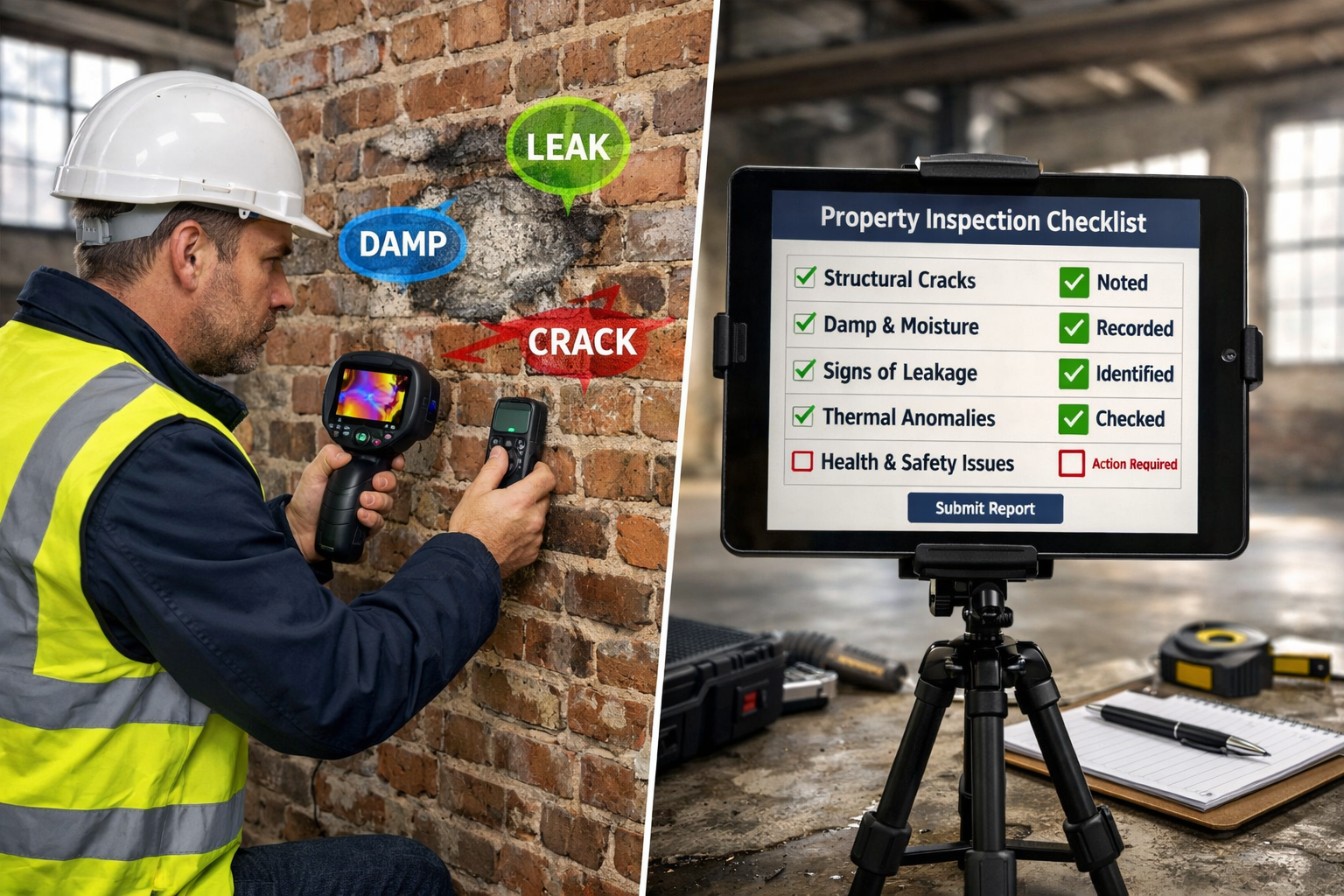
Chartered surveyors conduct systematic external inspections using:
- Drone technology for roof and high-level facade inspection
- Thermal imaging to identify insulation failures and moisture ingress
- Structural crack monitoring with digital measurement tools
- Drainage testing including CCTV surveys of underground systems
External defects often indicate more serious internal problems. A small roof leak can signal structural timber decay requiring £50,000+ remediation.
Internal Systems Evaluation
Mechanical and Electrical Infrastructure ⚡
Commercial properties depend on complex M&E systems that require specialist assessment:
| System Component | Inspection Focus | Typical Lifespan | Replacement Cost Impact |
|---|---|---|---|
| Boiler systems | Efficiency ratings, maintenance records | 15-20 years | £15,000-£80,000 |
| Electrical distribution | Capacity, safety certificates | 25-30 years | £30,000-£150,000 |
| Lifts | Maintenance contracts, LOLER compliance | 20-25 years | £40,000-£100,000 per unit |
| Air conditioning | Refrigerant compliance, efficiency | 15-20 years | £20,000-£200,000 |
| Fire alarm systems | BS 5839 compliance, zone coverage | 10-15 years | £10,000-£50,000 |
Structural Integrity Analysis
Professional surveyors identify:
- Load-bearing wall modifications without structural calculations
- Floor loading capacity for intended commercial use
- Concrete carbonation and steel reinforcement corrosion
- Timber frame condition and beetle/rot infestation
- Movement joints and expansion accommodation
"The difference between a £2 million investment and a £2.3 million liability often lies in the thoroughness of the structural inspection. Hidden defects don't negotiate." — Senior Chartered Surveyor, RICS
Specialized Testing and Investigations
Beyond visual inspection, comprehensive due diligence includes:
Invasive Investigations
- Opening up works to examine concealed elements
- Core sampling for concrete strength testing
- Electrical installation condition reports (EICR)
- Gas safety certificates and pressure testing
- Water quality and legionella risk assessments
Environmental Contamination Screening
- Phase I desktop environmental assessment
- Phase II intrusive soil sampling where risks identified
- Asbestos surveys (management, refurbishment, or demolition)
- Radon gas testing in affected geographical areas
- Oil storage tank integrity and soil contamination

Financial Due Diligence: Beyond the Purchase Price
The Chartered Surveyors' Due Diligence Checklists for 2026 Commercial Property Acquisitions emphasize that acquisition cost represents only the beginning of financial commitment. Comprehensive financial analysis prevents post-purchase surprises that erode investment returns.
Income Analysis and Tenant Review
Lease Documentation Verification 📄
Surveyors working alongside solicitors examine:
- Rent review mechanisms and next review dates
- Lease expiry schedules and break clause options
- Repairing obligations defining landlord vs. tenant responsibilities
- Service charge recovery provisions and reconciliation rights
- Alienation clauses governing assignment and subletting
Tenant Covenant Strength Assessment
Financial due diligence includes credit analysis of income-producing tenants:
- Company accounts and credit ratings for last 3 years
- Parent company guarantees and rent deposit deeds
- Trading performance indicators and sector outlook
- Historic payment records and arrears patterns
- Lease renewal probability based on business performance
Operating Expense Analysis
Service Charge Reconciliation Review 💷
One of the most contentious areas in commercial property involves service charges. Due diligence must verify:
- Reconciliation statements for previous 3-5 years[4]
- Disputed items and tenant challenges
- Management fees and procurement practices
- Sinking fund adequacy for major works
- Insurance premium trends and claims history
Capital Expenditure Forecasting
Surveyors prepare 10-year capital expenditure schedules identifying:
| Expenditure Category | Typical Timing | Cost Range | Due Diligence Verification |
|---|---|---|---|
| Roof replacement | 20-25 years | £80-£150/m² | Condition assessment, maintenance records |
| Window replacement | 25-30 years | £400-£800/m² | Thermal imaging, seal integrity |
| Lift refurbishment | 20-25 years | £40,000-£100,000 | LOLER reports, maintenance logs |
| Redecorations | 5-7 years | £20-£50/m² | Visual inspection, tenant obligations |
| Car park resurfacing | 10-15 years | £30-£60/m² | Surface condition, drainage |
Valuation Verification and Investment Analysis
Market Valuation Cross-Checking
Professional surveyors provide independent valuation opinions considering:
- Comparable transaction evidence from recent sales
- Yield analysis against market benchmarks
- Income capitalization using appropriate multipliers
- Discounted cash flow modeling for complex investments
- Depreciation factors affecting obsolescence
Investment Return Calculations 📊
Financial due diligence quantifies expected returns:
- Net initial yield after purchase costs
- Equivalent yield reflecting rent review and reversion
- Internal rate of return (IRR) over hold period
- Debt service coverage ratio for leveraged acquisitions[4]
- Total return projections including capital appreciation
Working with property surveyors across London ensures local market expertise informs valuation assumptions.
Legal and Regulatory Compliance Verification
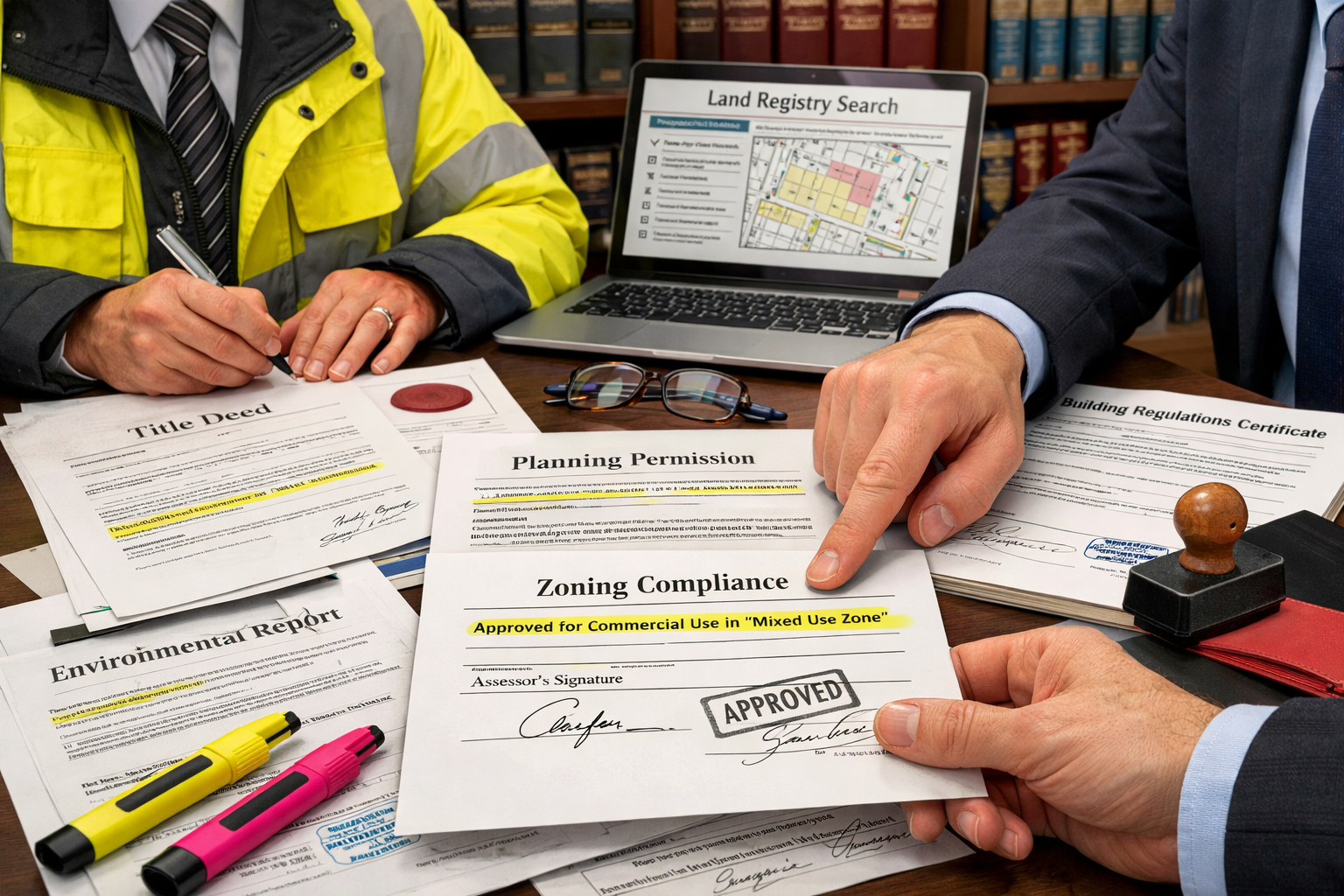
The third pillar of the Chartered Surveyors' Due Diligence Checklists for 2026 Commercial Property Acquisitions addresses legal title integrity and regulatory compliance—areas where deficiencies can render properties unsaleable or unusable.
Title Investigation and Legal Searches
Land Registry Examination 🔍
Chartered surveyors coordinate with solicitors to verify:
- Title absolute confirmation without qualifications
- Registered proprietor matching vendor identity
- Title plan accuracy reflecting physical boundaries
- Charges register showing mortgages and restrictions
- Easements and covenants affecting property use
Comprehensive Search Package
UK commercial acquisitions require multiple searches[6]:
| Search Type | Purpose | Key Risks Identified |
|---|---|---|
| Local authority | Planning, building control, highways | Enforcement notices, road schemes |
| Environmental | Contamination, flooding, radon | Remediation liabilities |
| Water and drainage | Sewer locations, water mains | Connection rights, adoption status |
| Coal mining | Historic mining activity | Subsidence risk, mine entries |
| Chancel repair | Ecclesiastical obligations | Repair cost liability |
| Company | Vendor insolvency risk | Transaction completion risk |
Planning and Development Compliance
Use Class Verification
The UK's Use Classes Order governs permitted property uses. Due diligence confirms:
- Current use class matches actual occupation
- Planning permission for any material changes of use
- Permitted development rights availability
- Section 106 agreements and planning obligations
- Conservation area or listed building restrictions
Building Regulations Compliance 🏛️
Surveyors verify building control approval for:
- Structural alterations and extensions
- Change of use works requiring approval
- Fire safety upgrades and compartmentation
- Disabled access improvements
- Energy efficiency measures
Unapproved works create significant liability. Buyers may face enforcement action requiring retrospective applications or even demolition of non-compliant structures.
Fire Safety and Health & Safety Compliance
Fire Risk Assessment Review
Following the Building Safety Act 2022 and subsequent amendments, commercial property due diligence must verify:
- Current Fire Risk Assessment (FRA) conducted by competent person
- Remedial actions identified and completion status
- Fire door integrity and emergency lighting functionality
- Fire alarm system certification to BS 5839
- Evacuation procedures and signage adequacy
Asbestos Management Compliance
Properties constructed before 2000 likely contain asbestos. Due diligence requires:
- Asbestos register and management plan
- Refurbishment and demolition survey if works planned
- Condition monitoring records
- Contractor notification procedures
- Removal certificates for any remediation works
Environmental Obligations and Energy Performance
Energy Performance Certificate (EPC) Requirements ⚡
Since April 2023, commercial properties must achieve minimum EPC rating of 'E' for new lettings. Due diligence examines:
- Current EPC rating and expiry date
- Improvement potential and cost estimates
- Exemption registration if applicable
- Future MEES (Minimum Energy Efficiency Standards) trajectory
- Grant funding availability for upgrades
Environmental Permits and Licenses
Certain commercial uses require environmental permits:
- Waste carrier licenses for waste-producing activities
- Environmental permits for industrial processes
- Discharge consents for trade effluent
- Hazardous substance consents
- Pollution prevention measures
The Due Diligence Timeline: Managing the Process
The Chartered Surveyors' Due Diligence Checklists for 2026 Commercial Property Acquisitions operate within defined timeframes that balance thoroughness with transaction momentum.
Standard Due Diligence Periods
Typical Timeline Framework ⏱️
Commercial property due diligence periods vary by complexity[3]:
- Simple single-let properties: 30-45 days
- Multi-tenanted buildings: 45-60 days
- Mixed-use developments: 60-75 days
- Portfolio acquisitions: 75-90+ days
Phased Approach to Due Diligence
Phase 1: Desktop Review (Days 1-7)
- Document collection and preliminary review
- Title examination and search ordering
- Financial statement analysis
- Initial risk identification
Phase 2: Physical Inspections (Days 8-21)
- Comprehensive building survey
- M&E systems assessment
- Specialist testing and investigations
- Tenant interviews and occupation verification
Phase 3: Detailed Analysis (Days 22-35)
- Financial modeling and valuation
- Legal report review and queries
- Compliance gap analysis
- Risk quantification and mitigation strategies
Phase 4: Reporting and Negotiation (Days 36-45)
- Consolidated due diligence report
- Price renegotiation based on findings
- Warranty and indemnity negotiation
- Conditional contract exchange
Managing Due Diligence Costs
Budget Allocation for Professional Fees 💰
Comprehensive due diligence requires investment in professional expertise:
| Service | Typical Cost Range | Value Delivered |
|---|---|---|
| Building survey | £2,000-£8,000 | Structural defect identification |
| M&E specialist report | £1,500-£5,000 | Systems condition assessment |
| Environmental assessment | £1,000-£3,000 | Contamination risk screening |
| Asbestos survey | £500-£2,000 | Hazardous material identification |
| Legal searches | £500-£1,500 | Regulatory compliance verification |
| Valuation report | £1,500-£5,000 | Independent price opinion |
While these costs represent 0.5-1.5% of typical transaction values, they prevent post-acquisition surprises costing 10-30% of purchase price.
Red Flags and Deal-Breakers: When to Walk Away
Experienced chartered surveyors recognize warning signs that indicate problematic acquisitions. The Chartered Surveyors' Due Diligence Checklists for 2026 Commercial Property Acquisitions help identify issues warranting transaction withdrawal.
Structural Red Flags 🚩
Immediate Deal-Breakers:
- Active structural movement without remediation
- Significant fire safety non-compliance
- Unresolved contaminated land designation
- Missing title documentation or boundary disputes
- Undisclosed enforcement notices or stop orders
Negotiation Opportunities:
- Deferred maintenance requiring capital investment
- Tenant lease expiries within 12 months
- Service charge disputes with resolution pathway
- Minor planning compliance issues with regularization potential
- Energy performance below minimum standards with upgrade feasibility
Financial Warning Signs
Income Risk Indicators:
- Tenant concentration exceeding 50% of income
- Declining rent collection rates
- Service charge shortfalls and sinking fund deficits
- Rental values below market comparables
- Lease structures with onerous landlord obligations
Hidden Cost Discoveries:
- Undisclosed capital expenditure requirements
- Management fee structures above market norms
- Insurance premium escalation without explanation
- Utility consumption patterns suggesting inefficiency
- Outstanding statutory compliance works
Working with Chartered Surveyors: Maximizing Due Diligence Value
The effectiveness of due diligence depends on selecting appropriately qualified professionals and managing the process collaboratively.
Selecting the Right Surveyor Team
Essential Qualifications and Expertise 🎓
Look for surveyors with:
- RICS (Royal Institution of Chartered Surveyors) membership
- Specialist commercial property experience
- Local market knowledge in target area
- Professional indemnity insurance coverage
- Track record in similar property types
Regional expertise matters significantly. Property surveyors in specific London boroughs understand local planning policies, market dynamics, and common building issues affecting different areas.
Coordinating Multi-Disciplinary Teams
Integrated Due Diligence Approach
Complex acquisitions require coordination between:
- Chartered building surveyors (structural assessment)
- Quantity surveyors (cost analysis and capital expenditure)
- M&E engineers (systems evaluation)
- Environmental consultants (contamination screening)
- Commercial property solicitors (legal verification)
- Tax advisors (SDLT and VAT implications)
- Planning consultants (development potential)
Professional surveyors orchestrate these specialists, ensuring comprehensive coverage without duplication.
Leveraging Technology in Due Diligence
Digital Tools Enhancing 2026 Protocols 💻
Modern due diligence employs:
- Building Information Modeling (BIM) for spatial analysis
- Digital twin technology for systems monitoring
- AI-powered document review for lease abstraction
- Drone surveys for roof and facade inspection
- Thermal imaging for insulation and moisture detection
- 3D laser scanning for dimensional accuracy
These technologies improve accuracy while reducing inspection timeframes.
Conclusion: Protecting Your Commercial Property Investment
The Chartered Surveyors' Due Diligence Checklists for 2026 Commercial Property Acquisitions provide the systematic framework necessary to navigate increasingly complex commercial property transactions. As UK commercial property markets continue their recovery trajectory, thorough due diligence separates successful investments from costly mistakes.
Key implementation steps for buyers:
- Engage chartered surveyors early in the acquisition process, ideally before making formal offers
- Allocate adequate time for comprehensive investigations—rushing due diligence inevitably misses critical issues
- Budget appropriately for professional fees, recognizing they represent insurance against far larger hidden costs
- Maintain flexibility to renegotiate terms or withdraw based on findings
- Document everything systematically for future reference and potential resale due diligence
The investment in professional due diligence typically represents less than 1.5% of transaction value while protecting against defects and liabilities that can exceed 30% of purchase price. In 2026's competitive commercial property market, buyers who prioritize thorough investigation gain significant advantages over those who rush to completion.
Your next steps:
- Request comprehensive due diligence proposals from qualified chartered surveyors before making offers
- Review the complete guide to property assessment options to understand different survey levels
- Establish realistic timelines allowing 45-90 days for thorough investigations
- Coordinate professional teams early to ensure comprehensive coverage
- Maintain detailed records of all findings for future reference
The recovering commercial property market offers significant opportunities for investors who approach acquisitions with appropriate diligence. By following structured protocols and engaging qualified professionals, buyers can confidently navigate complex transactions while minimizing risk exposure.
References
[1] Due Diligence Checklist For Acquisition Of Commercial Real Estate Investment – https://www.jimdunhamassociates.com/due-diligence-checklist-for-acquisition-of-commercial-real-estate-investment/
[3] The Due Diligence Checklist Every Commercial Property Buyer Needs – https://ipacommercial.com/2026/01/21/the-due-diligence-checklist-every-commercial-property-buyer-needs/
[4] Real Estate Due Diligence Checklist – https://www.northspyre.com/blog/real-estate-due-diligence-checklist/
[6] Commercial Property Acquisitions Buyers Checklist For 2026 – https://wspsolicitors.com/commercial-property-acquisitions-buyers-checklist-for-2026/