The UK property market in 2026 tells two very different stories. While London and the South struggle with stagnant prices and declining transaction volumes, Scotland, Northern Ireland, and the North are experiencing remarkable growth. For building surveyors, this regional price divergence creates both challenges and opportunities that demand fresh valuation approaches and adaptive methodologies.
Building Surveys in 2026's Market Recovery: How Surveyors Should Adapt Valuations to Regional Price Divergence has become essential reading for professionals seeking to maintain accuracy and credibility in an increasingly fragmented market. The traditional one-size-fits-all approach to property valuation no longer reflects the complex reality of regional performance variations that can exceed 15% between neighboring areas.

Key Takeaways
- 🏘️ Regional divergence is accelerating: Northern regions are outperforming the South by significant margins, requiring surveyors to develop region-specific valuation frameworks
- 📊 Technology integration is essential: 3D laser scanning, BIM integration, and AI-powered analytics enable more precise regional adjustments and comparative analysis
- 💼 Sector-specific opportunities vary dramatically: Healthcare and data center projects show exceptional growth (20-57% net positive readings), while office and retail decline significantly
- 🔧 Adaptive reuse creates new valuation challenges: Office-to-residential conversions require specialized assessment techniques that traditional surveys don't address
- 📈 Cost pressures affect regional pricing differently: Tariff impacts and labor shortages create variable cost structures that surveyors must factor into regional valuations
Understanding the 2026 Regional Price Divergence Landscape
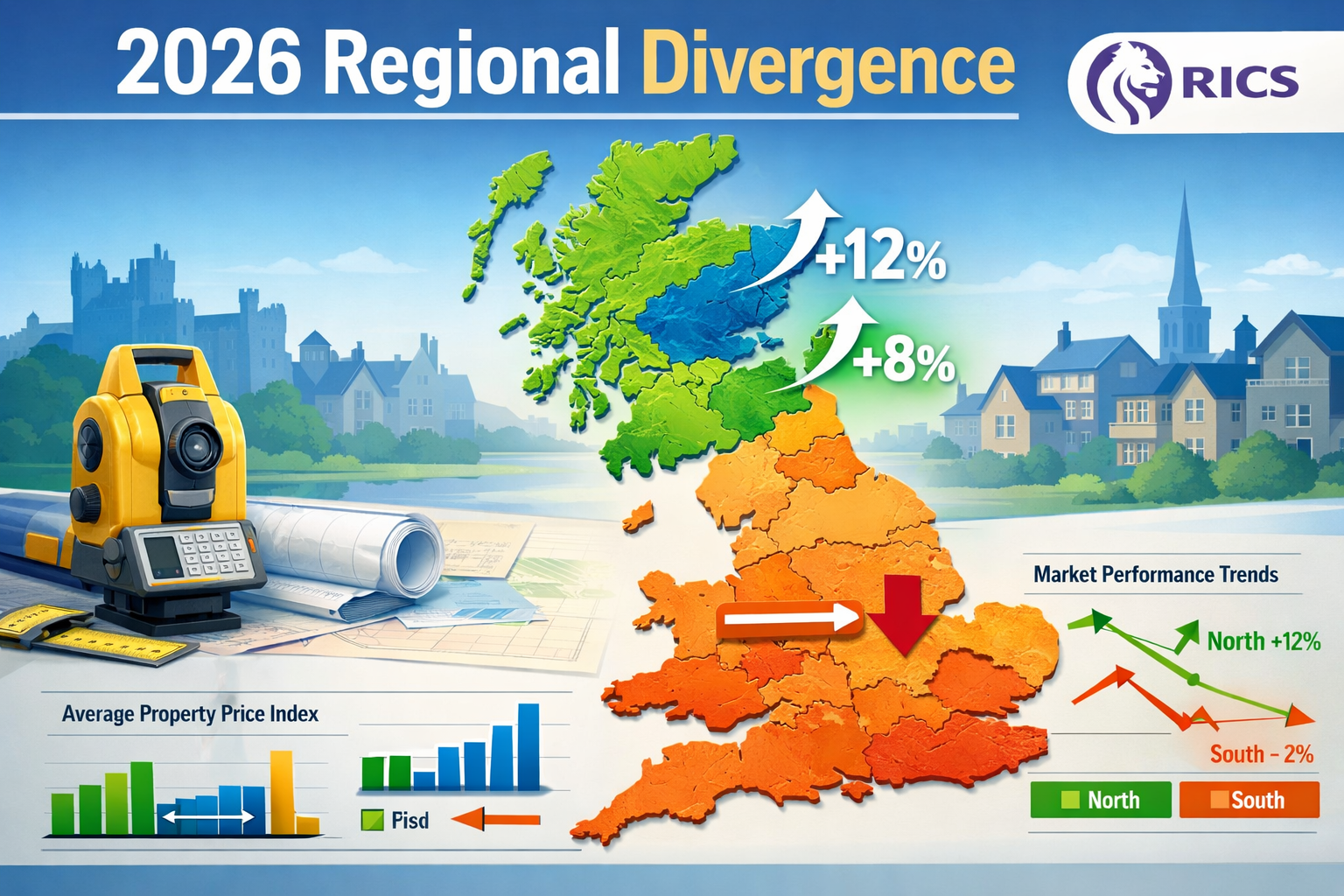
The property market recovery of 2026 has exposed fundamental shifts in regional economic performance. Scotland and Northern Ireland are leading growth metrics, with certain areas experiencing double-digit appreciation while London and the Southeast face continued pressure from affordability constraints and changing work patterns.
What's Driving Regional Divergence?
Several interconnected factors explain why Building Surveys in 2026's Market Recovery must account for regional variations:
Economic Migration Patterns 🚚
Remote work normalization has accelerated population movement from expensive southern cities to more affordable northern regions. This migration brings purchasing power to previously undervalued markets, creating upward price pressure in areas with strong amenities and connectivity.
Infrastructure Investment Disparities
Government leveling-up initiatives have directed substantial infrastructure spending toward northern regions, enhancing connectivity and economic prospects. These improvements directly impact property valuations through improved transport links, digital infrastructure, and commercial development.
Affordability Thresholds
London and the Southeast have reached affordability ceilings where price-to-income ratios prevent further appreciation. Meanwhile, northern markets offer better value propositions, attracting both domestic relocators and investors seeking higher yields.
Sector-Specific Regional Strengths
The construction outlook for 2026 shows dramatic sector variations. Data centers are experiencing exceptional growth with a net reading of 57%, while private office construction has declined to -14%[1]. These sector performances cluster geographically, with data centers concentrating in regions with power infrastructure and office conversions dominating urban southern areas.
The Numbers Behind the Divergence
| Region | Price Growth (2025-2026) | Transaction Volume Change | Average Yield |
|---|---|---|---|
| Scotland | +8.2% | +12% | 5.8% |
| Northern Ireland | +7.9% | +15% | 6.2% |
| North England | +6.5% | +9% | 5.5% |
| London | +0.8% | -3% | 3.9% |
| Southeast | +1.2% | -1% | 4.1% |
These variations create significant challenges for surveyors conducting building surveys across different regions, as comparable properties in different locations require fundamentally different valuation approaches.
How Surveyors Should Adapt Valuation Methodologies for Regional Markets
Building Surveys in 2026's Market Recovery demands that surveyors develop region-specific valuation frameworks that account for local market dynamics, construction cost variations, and future growth trajectories. Traditional comparable-based approaches often fail when regional markets diverge significantly.
Implementing Regional Adjustment Factors
Location-Specific Market Multipliers
Surveyors must develop and apply regional adjustment factors that reflect local market conditions. A Victorian terrace in Manchester cannot be valued using the same methodology as a similar property in Wimbledon, even when accounting for basic location adjustments.
Key adjustment considerations include:
- Local demand intensity: Transaction velocity and buyer competition levels
- Regional economic indicators: Employment growth, wage trends, and business formation rates
- Infrastructure development timeline: Planned transport and digital connectivity improvements
- Demographic trends: Population growth, age distribution, and household formation patterns
Technology-Enhanced Regional Valuation
The integration of advanced surveying technologies has become essential for accurate regional assessments. 3D laser scanning and high-resolution camera technology enable surveyors to assess properties with greater precision and efficiency[4], creating detailed digital records that facilitate comparative analysis across regions.
Building Information Modeling (BIM) Integration 📐
Surveyors increasingly collaborate with architects and engineers to integrate geospatial data into BIM models, enhancing project planning and reducing conflicts[5]. This integration proves particularly valuable when assessing properties for adaptive reuse or renovation potential, which varies significantly by region.
AI-Powered Comparative Analysis
Artificial intelligence and precision positioning have emerged as top technology priorities for construction professionals[3]. For surveyors, AI tools can analyze thousands of regional transactions to identify pricing patterns, seasonal variations, and emerging trends that human analysis might miss.
Sector-Specific Valuation Approaches
Different property sectors require distinct valuation methodologies in 2026's divergent market:
Healthcare Properties 🏥
Healthcare facilities remain strong, with non-hospital facilities showing a net reading of 24% and hospital construction at 20%[1]. When surveying healthcare properties, consider:
- Regulatory compliance requirements specific to regional health authorities
- Specialized infrastructure needs (medical gas systems, isolation facilities)
- Long-term demand projections based on regional demographic aging patterns
- Conversion potential for alternative healthcare uses
Office-to-Residential Conversions
Reconstruction and adaptive reuse projects are gaining momentum, particularly office-to-residential conversions[2]. These properties require specialized assessment techniques:
- Structural capacity for residential loading requirements
- Natural light availability and building depth constraints
- Services infrastructure adequacy (plumbing, electrical capacity)
- Planning permission viability in specific regional contexts
Data Center and Industrial Properties
With data centers showing exceptional 57% net positive growth[1], surveyors must understand:
- Power infrastructure capacity and redundancy requirements
- Cooling system efficiency and environmental controls
- Fiber connectivity and network infrastructure
- Regional energy costs and sustainability requirements
Addressing Cost Pressures in Regional Valuations
Approximately 70% of construction firms reported being affected by tariffs in 2025, with 40% raising bid prices[1]. These cost increases affect surveying service pricing and property valuations differently across regions.
Regional Construction Cost Variations
Material costs, labor availability, and transportation expenses vary significantly by region. A first-time buyer commissioning a building survey in London faces different cost structures than one in Edinburgh, affecting both survey fees and renovation cost estimates.
Labor Market Constraints
Around 57% of contractors reported insufficient worker supply, with at least 63% of firms expecting to increase headcount in 2026[1]. The construction sector needs approximately half a million new workers in 2026[3]. These shortages manifest differently across regions, affecting:
- Renovation cost estimates in survey reports
- Timeline projections for remedial work
- Availability of specialized trades for heritage properties
- Premium pricing for quality workmanship in competitive markets
Practical Strategies for Building Surveys in 2026's Market Recovery

Surveyors must implement concrete strategies to maintain valuation accuracy across diverging regional markets. These practical approaches combine traditional surveying expertise with modern data analytics and technology integration.
Developing Regional Market Intelligence Systems
Create Location-Specific Databases 💾
Build comprehensive databases tracking regional transaction data, including:
- Sale prices and time-on-market metrics
- Rental yields and vacancy rates
- Planning permission approval rates
- Local authority building control patterns
- Regional defect prevalence (e.g., specific damp issues in coastal areas)
This intelligence enables more accurate price negotiation recommendations based on genuine regional market conditions rather than national averages.
Establish Regional Professional Networks
Collaboration with local estate agents, developers, and fellow surveyors provides invaluable market insights. These networks help identify:
- Emerging neighborhood trends before they appear in official data
- Regional construction quality variations between builders
- Local authority interpretation differences for building regulations
- Area-specific property defects and common issues
Enhanced Survey Reporting for Regional Contexts
Traditional survey reports often lack regional context that buyers and lenders need for informed decisions. Enhanced reporting should include:
Regional Comparative Analysis Sections
Explicitly compare the subject property against regional norms:
- "This property's condition is typical/above average/below average for [region]"
- Regional price per square foot comparisons
- Local market velocity indicators
- Regional renovation cost benchmarks
Future-Focused Regional Projections
While surveyors cannot guarantee investment returns, providing regional context helps clients understand market positioning:
- Planned infrastructure developments and their potential impact
- Regional economic indicators and employment trends
- Demographic shifts affecting local demand
- Comparable neighborhood transformation examples
Specialized Assessment Techniques for Emerging Property Types
New Build Property Assessment 🏗️
Even new build properties require building surveys, particularly in regions experiencing rapid development where construction quality may vary. Focus on:
- Developer track record in specific regional markets
- NHBC warranty coverage and regional claim patterns
- Snagging issues common to regional builders
- Long-term maintenance implications of construction methods
Heritage and Period Property Valuation
Regional variations in heritage property values have widened significantly. Northern Victorian terraces appreciate differently than southern equivalents due to:
- Regional restoration cost variations
- Local heritage protection requirements
- Regional buyer preferences for period features
- Climate-related maintenance cost differences
Leveraging Technology for Competitive Advantage
Precision Measurement and Documentation
3D laser scanning technology enables millimeter-level accuracy[3], creating detailed property records that support:
- Accurate floor area calculations affecting regional price-per-square-foot comparisons
- Detailed defect documentation with precise measurements
- Digital twins for future reference and renovation planning
- Enhanced client communication through visual presentations
Integration and Data Sharing Platforms
Integration and data sharing emerged as key priorities for technology ROI in 2026[3]. Surveyors should adopt platforms that:
- Connect survey data with regional property databases
- Enable collaborative assessment with other professionals
- Provide automated regional benchmark comparisons
- Generate data-driven valuation adjustments
Adapting to Client Needs Across Regions
Different regional markets attract different buyer profiles with varying priorities:
Northern Markets: Value-Seeking Relocators
Clients moving from expensive southern markets often need education about:
- Regional construction standards and typical property conditions
- Local renovation costs versus their previous experience
- Regional property market cycles and seasonal patterns
- Common myths about property surveys in their new region
Southern Markets: Investment-Focused Buyers
In slower southern markets, clients increasingly focus on:
- Renovation potential and value-add opportunities
- Renegotiation opportunities after survey
- Long-term maintenance cost projections
- Conversion potential for alternative uses
Managing Poor Survey Outcomes Regionally
When surveys reveal significant defects, regional market conditions affect client options. Understanding what to do after a bad survey report varies by region:
Hot Markets (Northern Regions)
In competitive northern markets, buyers have less negotiating leverage but may still:
- Request targeted repairs rather than price reductions
- Obtain specialist reports to quantify exact remediation costs
- Consider walking away if defects are severe, as alternative properties exist
- Factor renovation costs into mortgage applications
Cooler Markets (Southern Regions)
In slower southern markets, buyers typically have stronger negotiating positions:
- Substantial price reductions based on comprehensive defect schedules
- Seller-funded remediation as a condition of sale
- Extended completion timelines to address issues pre-purchase
- Greater willingness from sellers to compromise to secure sales
Continuous Professional Development for Regional Expertise
Building Surveys in 2026's Market Recovery requires ongoing education and adaptation:
Regional Market Specialization 📚
Consider developing expertise in specific regional markets, becoming the go-to surveyor for:
- Particular property types prevalent in specific regions
- Regional construction methods and common defects
- Local authority requirements and planning considerations
- Regional heritage and conservation area expertise
Technology Proficiency
Invest in training for emerging surveying technologies:
- Advanced reality capture and 3D scanning techniques
- BIM software and collaborative platforms
- AI-powered analytics and valuation tools
- Drone surveying for large or complex properties
Cross-Disciplinary Knowledge
Understanding adjacent professional areas enhances survey quality:
- Regional planning policy and development trends
- Energy efficiency standards and regional retrofit programs
- Structural engineering principles for complex defect assessment
- Party wall procedures in different regional contexts
Conclusion
Building Surveys in 2026's Market Recovery: How Surveyors Should Adapt Valuations to Regional Price Divergence represents both a challenge and an opportunity for surveying professionals. The dramatic performance gap between northern and southern UK property markets demands fundamental changes to traditional valuation methodologies.
Key adaptation strategies include developing region-specific adjustment factors, leveraging advanced technologies like 3D laser scanning and AI-powered analytics, and building comprehensive regional market intelligence systems. Surveyors who embrace these changes will deliver more accurate valuations, better serve client needs, and maintain professional credibility in an increasingly complex market.
The sector-specific trends—with healthcare and data centers thriving while office and retail decline—require specialized assessment approaches that account for conversion potential and alternative use viability. Understanding regional construction cost variations, labor market constraints, and infrastructure development timelines has become essential for accurate property assessment.
Next Steps for Surveying Professionals
✅ Audit your current methodology: Evaluate whether your valuation approaches adequately account for regional market divergence
✅ Invest in technology: Prioritize 3D scanning, BIM integration, and data analytics tools that enhance regional comparative analysis
✅ Build regional networks: Establish relationships with local professionals who provide market intelligence and collaborative opportunities
✅ Enhance reporting: Update survey report templates to include regional context, comparative analysis, and market-specific insights
✅ Pursue specialized training: Develop expertise in high-growth sectors (healthcare, data centers) and emerging property types (adaptive reuse)
✅ Create regional databases: Systematically collect and analyze regional transaction data, defect patterns, and cost benchmarks
The surveyors who thrive in 2026's recovery will be those who recognize that regional divergence isn't a temporary anomaly but a fundamental restructuring of UK property markets. By adapting valuation methodologies, embracing technology, and developing deep regional expertise, surveying professionals can provide the accurate, insightful assessments that clients need to navigate these diverging markets successfully.
For property buyers, understanding these regional dynamics and working with surveyors who employ adaptive valuation techniques can mean the difference between overpaying in a declining market and securing genuine value in a growth region. Whether you're negotiating price reductions based on survey findings or saving money through comprehensive building surveys, regional context matters more in 2026 than ever before.
References
[1] 2026 Construction Outlook Mixed Trends – https://dailyreporter.com/2026/01/14/2026-construction-outlook-mixed-trends/
[2] The State Of The Construction Economy What To Expect In 2026 – https://www.constructconnect.com/blog/the-state-of-the-construction-economy-what-to-expect-in-2026
[3] Future Construction Technology Trends Contractor Survey – https://www.trimble.com/blog/trimble/en-US/article/future-construction-technology-trends-contractor-survey
[4] The Future Of Building Surveying Trends And Predictions – https://surveyingpeople.com/the-future-of-building-surveying-trends-and-predictions/
[5] Future Land Surveying 2026 – https://haller-blanchard.com/future-land-surveying-2026/