


Scotland's housing market is experiencing a remarkable transformation in 2026. After months of uncertainty, fresh data reveals a strengthening market with rising buyer enquiries, increasing property prices, and renewed confidence among both sellers and purchasers. For first-time buyers entering this upward-trending market, understanding the critical role of building surveys in protecting their investment has never been more important. Building Surveys for Scotland's 2026 Housing Recovery: Capturing Upward Price Momentum represents not just a market observation, but a strategic framework for navigating property purchases during this pivotal period of growth.
The latest RICS (Royal Institution of Chartered Surveyors) data paints an encouraging picture: a net balance of 21% of Scottish survey respondents reported rising buyer enquiries in January 2026, while an impressive 42% indicated house prices rising over the past three months—the strongest reading in nearly a year[1]. These figures signal that Scotland is outperforming wider UK trends, creating both opportunities and challenges for prospective homeowners.
Key Takeaways
✅ Scotland leads UK recovery: A net balance of 42% of Scottish respondents reported house price increases over the past three months, significantly outperforming the national average[1]
✅ Buyer activity surging: 21% net balance reported rising buyer enquiries in January 2026, with 27% indicating increased instructions to sell[1]
✅ Forward momentum building: 23% expect prices to rise over the next three months, while 55% anticipate higher prices over the coming year[1]
✅ Building surveys critical: As competition intensifies in a strengthening market, comprehensive property assessments protect first-time buyers from costly defects
✅ Regional advantage: Scotland's competitive affordability compared to pricier UK regions continues to support sustained buyer activity[1]
Understanding Scotland's 2026 Housing Market Dynamics

The RICS Survey Data: What the Numbers Really Mean
The January 2026 RICS Residential Market Survey delivers compelling evidence of Scotland's housing recovery. When surveyors across the country report their observations, the net balance figure represents the difference between those seeing increases versus decreases in various market indicators.
A net balance of 21% reporting rising buyer enquiries means significantly more chartered surveyors witnessed increased interest from prospective purchasers than those who saw declining interest[1]. This metric serves as an early warning system for market direction, and the current reading suggests genuine momentum building across Scottish property markets.
Even more striking is the 27% net balance indicating an increase in instructions to sell[1]. When homeowners feel confident enough to list their properties, it typically reflects optimism about achieving favorable sale prices—a sentiment clearly present in Scotland's current market environment.
Price Momentum: Scotland's Competitive Advantage
The standout statistic from recent surveys is the 42% net balance of Scottish respondents reporting house prices rising over the past three months[1]. This represents the strongest price growth reading in nearly a year and positions Scotland as one of the UK's best-performing regional markets.
Looking forward, the sentiment remains decidedly positive:
- 23% expect prices to rise over the next three months
- 55% anticipate higher prices over the coming year
- +43% of respondents expect higher prices over the year ahead—the most positive outlook since February 2025[2]
This upward price trajectory creates a unique environment for first-time buyers. While rising prices may seem discouraging, they also reflect genuine market health and economic confidence. The key to navigating this environment successfully lies in thorough property assessment through professional building surveys.
Regional Context: Scotland vs. the Wider UK Market
Scotland's performance becomes even more impressive when viewed against national trends. While the UK-wide buyer enquiries balance stood at -15% in January (improving from -21% in December and -29% in November), Scotland's positive reading of +21% demonstrates the region's exceptional momentum[2].
Similarly, while nationally agreed sales recorded -9% (the least negative reading since June 2025), Scotland showed a modestly positive net balance of 2% in January[1][2]. Forward-looking indicators suggest this strengthening activity will continue as the year progresses.
Regional Performance Comparison (January 2026):
| Region | Price Growth Trend | Market Sentiment |
|---|---|---|
| Scotland | Strongest growth (42% net balance) | Highly positive |
| Northern Ireland | Strong growth | Positive |
| North West England | Moderate growth | Improving |
| London | Lagging | Affordability challenges |
| South East | Lagging | Affordability challenges |
| South West | Below average | Mixed signals |
Price growth remains strongest in Scotland and Northern Ireland, with upward trends also reported in the North West and North of England[2]. Meanwhile, London, the South East, South West, and East Anglia continue to lag behind the national average, reflecting ongoing affordability challenges[2].
Affordability: Scotland's Enduring Appeal
One of the fundamental drivers behind Scotland's housing recovery is its competitive affordability when compared with pricier UK regions[1]. While average property prices in London and the South East often exceed £500,000, many Scottish markets offer quality housing at significantly lower price points.
This affordability advantage attracts first-time buyers, families seeking more space, and professionals relocating from more expensive regions. However, affordability should never compromise due diligence. Understanding what you're buying through comprehensive building surveys remains essential, regardless of price point.
Building Surveys for Scotland's 2026 Housing Recovery: Essential Defect-Spotting Protocols
Why Building Surveys Matter More in a Rising Market
In a strengthening market with upward price momentum, the temptation to rush property purchases intensifies. Competition increases, viewing-to-offer timelines compress, and buyers may feel pressured to make quick decisions. This environment creates perfect conditions for overlooking critical property defects.
Building surveys serve as your protection mechanism against costly mistakes. A comprehensive survey conducted by an RICS-accredited surveyor identifies structural issues, maintenance concerns, and potential future expenses that could significantly impact your investment's true value.
For first-time buyers entering Scotland's 2026 market, understanding what to do before an RICS home survey can streamline the process and ensure maximum value from the assessment.
Core Defect Categories in Scottish Properties
Scottish properties, particularly traditional stone-built homes common throughout Edinburgh, Glasgow, Aberdeen, and rural areas, present unique structural considerations. Professional building surveyors focus on several critical defect categories:
1. Dampness and Water Ingress 💧
Scotland's climate creates persistent moisture challenges. Surveyors examine:
- Rising damp from ground level
- Penetrating damp through stone walls
- Condensation issues in poorly ventilated spaces
- Roof water ingress and gutter failures
- Basement and cellar moisture problems
Moisture-related defects represent some of the most expensive remediation challenges. A damp survey can identify these issues before they become your financial burden.
2. Structural Movement and Subsidence
Traditional Scottish properties may exhibit:
- Settlement cracks in stone masonry
- Subsidence from soil movement or tree root activity
- Lintel failures above windows and doors
- Wall bulging or leaning
- Foundation issues
Understanding whether wall cracks indicate serious structural problems requires professional assessment. Not all cracks signal disaster, but distinguishing between cosmetic and structural issues demands expertise.
3. Roof and Timber Defects
Scottish weather places significant stress on roofing systems:
- Slate or tile displacement and deterioration
- Timber decay in roof structures
- Inadequate roof ventilation
- Chimney stack instability
- Flat roof failures
Timber decay from moisture exposure can compromise structural integrity. Early detection through building surveys prevents minor issues from escalating into major reconstruction projects.
4. Building Services and Systems
Modern building surveys assess:
- Electrical system safety and capacity
- Plumbing condition and water pressure
- Heating system efficiency and safety
- Drainage adequacy
- Insulation effectiveness
These systems significantly impact both safety and ongoing running costs—critical considerations for first-time buyers managing tight budgets.
Survey Types: Choosing the Right Assessment Level
The RICS offers standardized survey products designed for different property types and buyer needs. Understanding the difference between survey levels helps you select appropriate protection for your circumstances.
RICS Level 2 Survey (HomeBuyer Report):
- Suitable for conventional properties in reasonable condition
- Visual inspection of accessible areas
- Traffic light rating system for defects
- Market valuation included
- Cost-effective for standard properties
RICS Level 3 Survey (Building Survey):
- Comprehensive assessment for older, altered, or unusual properties
- Detailed examination of structure and fabric
- Extensive defect analysis and repair guidance
- No market valuation (unless separately requested)
- Essential for traditional Scottish stone properties
For first-time buyers purchasing traditional Scottish homes, the Level 3 Building Survey typically provides the most comprehensive protection. While the upfront cost exceeds a Level 2 report, the detailed defect identification can save tens of thousands in unexpected repairs.
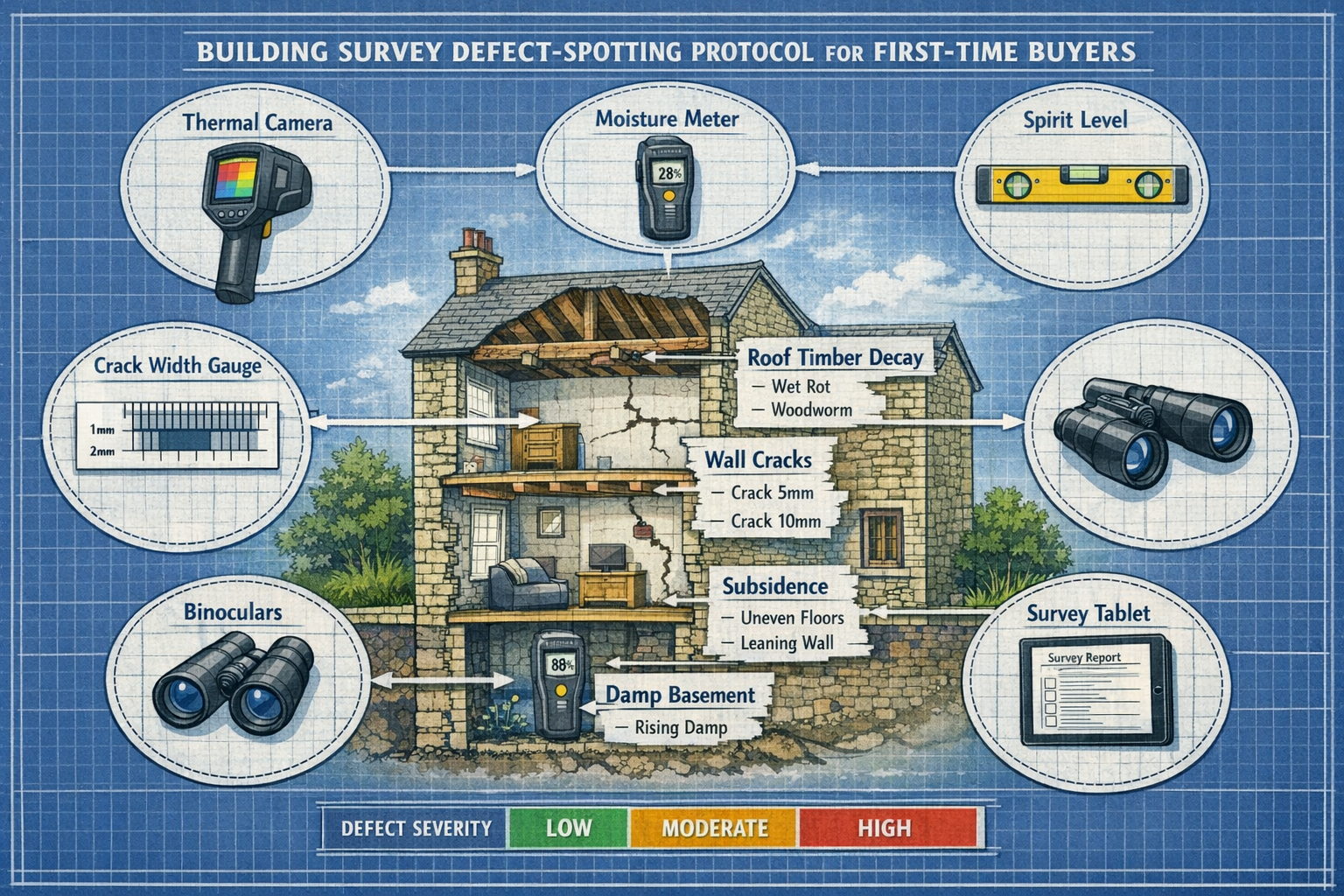
The Surveyor's Toolkit: Modern Defect Detection Technology
Contemporary building surveyors employ sophisticated diagnostic equipment beyond visual inspection:
Thermal Imaging Cameras 🔍
- Detect heat loss and insulation defects
- Identify hidden moisture patterns
- Reveal concealed structural issues
- Map thermal bridging and energy inefficiency
Moisture Meters
- Measure moisture content in walls, floors, and timbers
- Distinguish between surface and deep-seated dampness
- Provide quantitative data for remediation planning
Borescopes and Endoscopes
- Inspect concealed spaces without destructive investigation
- Examine roof voids, wall cavities, and under-floor areas
- Document conditions photographically
Laser Measuring Devices
- Accurately measure crack widths and structural movement
- Track changes over multiple inspections
- Provide precise dimensional data
This technology-enhanced approach ensures nothing escapes scrutiny, even in hard-to-access areas of traditional Scottish properties.
Navigating Building Surveys for Scotland's 2026 Housing Recovery: Strategic Buyer Guidance
Pre-Survey Preparation: Maximizing Your Investment
Before commissioning a building survey, first-time buyers should undertake preliminary research to maximize the assessment's value:
1. Document Your Concerns
Create a written list of specific concerns observed during property viewings. Share these with your surveyor to ensure focused attention on areas that worried you.
2. Research Property History
Investigate previous ownership, any planning applications, historical alterations, and local environmental factors. This context helps surveyors understand the property's evolution.
3. Understand Local Conditions
Scotland's diverse geology means subsidence risks, flooding potential, and soil conditions vary significantly by location. Research local environmental factors that might impact the property.
4. Clarify Survey Scope
Discuss with your surveyor exactly what the inspection will and won't cover. Understand limitations regarding inaccessible areas, specialist testing, and boundary disputes.
5. Schedule Strategically
Time your survey after your offer is accepted but before exchange of contracts. This positioning allows you to renegotiate after a poor building survey result if significant defects emerge.
Interpreting Survey Results: Beyond the Traffic Lights
Building survey reports can seem overwhelming, particularly for first-time buyers unfamiliar with construction terminology. Understanding how to interpret findings empowers informed decision-making.
Defect Severity Classifications:
🟢 Condition Rating 1 (Green): No repair currently needed. Normal maintenance required.
🟡 Condition Rating 2 (Amber): Defects requiring future repair or replacement. Factor into long-term maintenance planning.
🔴 Condition Rating 3 (Red): Serious defects requiring urgent repair or significant future expenditure. May affect property value or pose safety risks.
The presence of Condition 3 issues doesn't automatically mean you should abandon the purchase. Instead, it provides negotiating leverage and informs your financial planning. Many traditional Scottish properties will have some amber or red ratings—the key is understanding the remediation costs and timeframes.
Negotiation Strategies: Leveraging Survey Findings
A comprehensive building survey transforms your negotiating position. When significant defects emerge, buyers have several strategic options:
1. Price Reduction Request
Request a purchase price reduction equivalent to estimated repair costs. Obtain contractor quotes to support your position with concrete figures.
2. Seller Remediation
Negotiate for the seller to complete specific repairs before completion. Ensure any agreed work is documented in writing and verified by your surveyor.
3. Retention Agreement
Arrange for a portion of the purchase price to be held in escrow until specified repairs are completed post-purchase.
4. Walk Away
If defects are too severe or costly, exercising your right to withdraw protects you from a potentially disastrous investment.
Understanding price reduction tactics based on survey findings can save thousands of pounds while maintaining positive seller relationships.
Timeline Integration: Survey Scheduling in Scotland's Fast-Moving Market
With a net balance of 34% of Scottish respondents anticipating higher sales volumes over the next three months[1], competition for quality properties will intensify. Efficient survey scheduling becomes critical:
Recommended Timeline:
- Day 1-3: Offer accepted, survey commissioned immediately
- Day 7-10: Survey conducted (subject to surveyor availability)
- Day 12-14: Survey report received and reviewed
- Day 15-17: Negotiation based on findings
- Day 18-21: Agreement reached, proceed to legal completion
In Scotland's current market environment, delays can cost opportunities. However, rushing the survey process to beat competition creates far greater risks. Balance speed with thoroughness.
First-Time Buyer Considerations: Special Circumstances
First-time buyers face unique challenges when commissioning building surveys:
Budget Constraints
Survey costs (typically £400-£1,000+ depending on property size and survey level) represent a significant expense alongside legal fees, mortgage arrangement fees, and moving costs. However, this expenditure prevents far larger future costs from undetected defects.
Knowledge Gaps
Without previous property ownership experience, first-time buyers may struggle to contextualize survey findings. Don't hesitate to request a follow-up call with your surveyor to discuss the report in plain language.
Emotional Investment
After finding a property you love, negative survey findings can be emotionally difficult. Remember: the survey protects your financial future. Better to discover problems before purchase than after.
Mortgage Lender Requirements
Some mortgage lenders require specific survey types or may commission their own valuation. Understand your lender's requirements and how they interact with your building survey. For guidance on this process, review resources for first-time buyers booking building surveys.
Scotland's 2026 Market Outlook: What Building Surveys Reveal About Future Trends
Property Condition as Market Indicator
Building surveys provide more than individual property assessments—they offer aggregate insights into Scotland's housing stock condition. Surveyors working across multiple properties observe patterns that indicate broader market trends.
Current Observations from Scottish Surveyors:
Deferred Maintenance Backlog
Many properties entering the market in 2026 show evidence of deferred maintenance from the challenging economic years of 2023-2024. Sellers who postponed non-essential repairs are now listing properties with accumulated maintenance needs.
Energy Efficiency Focus
With increasing awareness of energy costs and environmental impact, surveys now place greater emphasis on insulation, heating efficiency, and renewable energy potential. Properties with poor Energy Performance Certificate (EPC) ratings face market resistance.
Period Property Challenges
Scotland's abundant traditional stone properties require specialized maintenance knowledge. Many first-time buyers underestimate the ongoing costs of maintaining period features, making detailed building surveys essential for realistic budgeting.
Regional Variations: Edinburgh, Glasgow, and Beyond
Scotland's housing recovery isn't uniform across all regions. Building survey findings reflect these geographical differences:
Edinburgh and East Lothian
- High proportion of traditional stone tenement flats
- Common issues: shared roof responsibilities, stone repointing needs
- Strong market demand maintaining upward price pressure
- Premium pricing for properties in good condition
Glasgow and West Central Scotland
- Mix of Victorian tenements and post-war construction
- Common issues: dampness, render deterioration, chimney problems
- Affordability advantage attracting first-time buyers
- Renovation opportunities for properties requiring work
Aberdeen and Northeast Scotland
- Granite construction presents unique challenges
- Oil industry fluctuations impact local market dynamics
- Common issues: exposed location weather damage, specialized stone repair costs
Rural Scotland
- Properties often older with more extensive grounds
- Common issues: septic systems, private water supplies, access road maintenance
- Survey scope must extend beyond building fabric to services and boundaries
The Six Themes Defining Scotland's 2026 Property Market
Industry analysis identifies six key themes shaping Scotland's property landscape in 2026[3]:
- Mortgage Rate Stabilization: Reduced volatility in lending costs supports buyer confidence
- First-Time Buyer Resurgence: Government schemes and improved affordability drive new entrant activity
- Energy Efficiency Premium: Properties with strong EPC ratings command price premiums
- Urban-Rural Balance: Hybrid working patterns sustain demand across diverse locations
- Build Quality Focus: Buyers increasingly prioritize condition over cosmetic presentation
- Long-Term Value Perspective: Purchasers adopting longer holding periods emphasize structural integrity
Each theme reinforces the critical importance of thorough building surveys. As buyers focus on long-term value and build quality, professional property assessments become non-negotiable elements of the purchase process.
New Build Properties: Do You Still Need a Survey?
With Scotland's housing recovery driving new construction, first-time buyers often question whether new build properties require building surveys.
Despite NHBC warranties and building regulation compliance, independent surveys on new builds frequently identify:
- Snagging issues requiring developer remediation
- Drainage and ground condition problems
- Workmanship defects not covered by standard warranties
- Specification deviations from marketing materials
Even in new construction, independent professional assessment protects your interests and ensures developers fulfill their obligations.
Practical Action Plan: Implementing Building Surveys for Scotland's 2026 Housing Recovery

Step 1: Select Your RICS-Accredited Surveyor
Not all surveyors possess equal expertise. When selecting a professional to conduct your building survey:
Verify RICS Accreditation
Ensure your surveyor holds RICS (Royal Institution of Chartered Surveyors) membership. This guarantees professional standards, insurance, and complaints procedures. Understanding why to choose RICS surveyors clarifies the value of this accreditation.
Confirm Local Experience
Scottish properties present unique challenges. Select surveyors with demonstrated experience in your specific region and property type.
Review Sample Reports
Request example reports to assess thoroughness, clarity, and presentation quality. Well-structured reports make interpretation easier for first-time buyers.
Discuss Specialist Knowledge
If purchasing a property with specific features (thatched roof, listed building status, extensive grounds), confirm your surveyor's expertise in these areas.
Step 2: Commission the Survey at the Right Time
Timing your building survey optimally within the purchase process protects your interests while maintaining transaction momentum:
After Offer Acceptance
Wait until your offer is accepted before commissioning the survey. Conducting surveys on properties you might not purchase wastes money.
Before Legal Commitment
Complete the survey before exchange of contracts or conclusion of missives (Scotland's equivalent). This timing preserves your ability to renegotiate or withdraw without penalty.
Allow Adequate Time
Don't pressure surveyors to rush inspections. Thorough assessment requires time, particularly for larger or more complex properties.
Coordinate with Legal Process
Inform your solicitor when the survey is scheduled so legal due diligence and building assessment proceed in parallel.
Step 3: Prepare the Property for Survey
While surveyors work around occupied properties, certain preparations maximize inspection effectiveness:
Ensure Access
Confirm the surveyor can access all areas including lofts, cellars, outbuildings, and gardens. Locked or inaccessible spaces limit assessment scope.
Clear Obstructions
Request that sellers temporarily move furniture blocking access to walls, floors, or built-in features requiring inspection.
Utilities Available
Ensure electricity and water are connected so surveyors can test systems and services.
Weather Considerations
Scotland's weather can limit survey scope. Heavy rain, snow, or high winds may prevent safe roof access or external inspection. Schedule flexibly to accommodate weather delays.
Step 4: Review the Survey Report Systematically
When your survey report arrives, approach it methodically:
Initial Read-Through
Read the entire report once without making decisions. Familiarize yourself with the overall property condition and major findings.
Prioritize Critical Issues
Identify all Condition 3 (red) items requiring urgent attention or significant expenditure. These drive your negotiation strategy.
Cost Estimation
Obtain contractor quotes for remedying identified defects. Concrete cost figures strengthen negotiation positions.
Question Everything
Create a list of questions or unclear points for follow-up discussion with your surveyor. Most provide telephone consultations to clarify report contents.
Consult Specialists
For complex issues (structural movement, extensive dampness, electrical rewiring), consider commissioning specialist investigations before proceeding.
Step 5: Negotiate Based on Findings
Armed with survey evidence and cost estimates, approach negotiation strategically:
Quantify Your Position
Present sellers with specific cost figures for required repairs. Vague concerns carry less weight than documented estimates.
Prioritize Requests
Focus negotiation on significant defects rather than minor maintenance items. Requesting £15,000 off for roof replacement is reasonable; requesting £500 for decorating is petty.
Remain Reasonable
Recognize that most properties have some defects. Perfect properties command premium prices. Balance your expectations with market realities.
Document Agreements
Ensure any negotiated price reductions or agreed repairs are documented in writing and incorporated into the legal contract.
Step 6: Plan Post-Purchase Remediation
Even after successful negotiation, you'll likely face some remediation work post-purchase:
Create Priority Schedule
Rank required works by urgency: safety issues first, weatherproofing second, cosmetic improvements last.
Budget Realistically
Add 10-20% contingency to contractor quotes for unexpected complications. Period properties particularly often reveal hidden issues during renovation.
Engage Qualified Contractors
For significant structural or damp remediation, engage contractors with proven expertise in traditional Scottish construction methods.
Consider Phased Approach
If budget constraints limit immediate work, phase projects over time. Ensure weatherproofing and structural stability are addressed first.
Maintain Records
Document all remediation work with photographs, invoices, and guarantees. This evidence adds value when you eventually sell.
Conclusion: Securing Your Investment in Scotland's Housing Recovery
Building Surveys for Scotland's 2026 Housing Recovery: Capturing Upward Price Momentum represents far more than a market observation—it's a strategic imperative for first-time buyers entering one of the UK's strongest regional property markets. With a net balance of 42% of Scottish respondents reporting house price increases over the past three months, and 55% anticipating higher prices over the coming year[1], the momentum is undeniable.
However, rising prices and increased competition should never compromise due diligence. Comprehensive building surveys protect your investment, identify hidden defects, strengthen negotiating positions, and provide realistic cost expectations for property ownership.
Scotland's housing stock, rich with traditional stone-built properties and period features, demands specialized assessment expertise. The unique challenges of Scottish construction—from dampness management in our climate to maintaining traditional building materials—require surveyors with local knowledge and RICS accreditation.
As you navigate Scotland's 2026 housing recovery, remember these fundamental principles:
🏠 Never skip the survey, regardless of market pressure or competition
📊 Use survey findings strategically for negotiation and financial planning
🔍 Engage RICS-accredited professionals with Scottish property expertise
💰 Budget realistically for both purchase and post-acquisition remediation
📈 Think long-term: thorough assessment protects value over your ownership period
Your Next Steps
- Research RICS-accredited surveyors in your target area with proven Scottish property experience
- Understand survey types and select the appropriate level for your property
- Budget survey costs into your overall purchase expenses (typically £400-£1,000+)
- Prepare questions about specific property concerns to discuss with your surveyor
- Review negotiation strategies so you're ready to act on survey findings
- Connect with your solicitor to coordinate survey timing with legal processes
Scotland's housing market offers genuine opportunity in 2026. The combination of competitive affordability, strengthening buyer demand, and positive price momentum creates favorable conditions for first-time buyers willing to approach purchases strategically. Building surveys transform this opportunity into security, ensuring your investment in Scotland's housing recovery is built on solid foundations—literally and figuratively.
The market data is clear: Scotland is outperforming national trends, buyer confidence is returning, and property values are rising[1][2]. Position yourself to capture this upward momentum while protecting against hidden risks. Your future self will thank you for the diligence you demonstrate today.
References
[1] Scottish Housing Market 2026 Rics Survey – https://www.simpsonmarwick.com/journal/scottish-housing-market-2026-rics-survey
[2] Uk Resi Survey Jan 2026 Report Shows Early Signs Market Recovery Despite Caution – https://www.rics.org/news-insights/uk-resi-survey-jan-2026-report-shows-early-signs-market-recovery-despite-caution
[3] Six Themes That Will Define Scotlands Property Market In 2026 – https://gilsongray.co.uk/properties/six-themes-that-will-define-scotlands-property-market-in-2026/
[4] remax-scotland.homes – https://www.remax-scotland.homes/estate-agents/bonnyrigg/blog/sell-your-house-in-2026-edinburgh-midlothian-borders-market-update/57415