{"cover":"Professional landscape format (1536×1024) editorial hero image featuring bold text overlay 'Building Surveys for Office-to-Residential Conversion: Assessing Retrofit Viability in London's Underpriced Market 2026' in extra large 72pt white sans-serif font with dark gradient shadow, positioned in upper third. Background shows split composition: left side displays vacant London office building exterior with large windows, right side shows modern residential apartment interior with natural light. Overlay includes subtle architectural blueprint lines and surveyor's measuring tools. Color scheme: deep navy blue, white, gold accents representing London's premium property market. High contrast, magazine cover quality, professional real estate editorial style with urban sophistication.","content":["Landscape format (1536×1024) detailed infographic showing office-to-residential conversion regulatory timeline in London, featuring March 2024 permitted development changes with before/after comparison charts, 56-day prior approval process flowchart, Article 4 Direction zones marked on simplified London map, 12.9 million square feet opportunity visualization with building icons, space standards requirements illustrated with floor plan diagrams, natural light penetration angles shown with cross-section building diagram, professional surveyor examining building plans in corner, color scheme navy blue and gold, clean modern design with data visualization elements","Landscape format (1536×1024) comprehensive building survey assessment visualization showing cross-section of London office building being evaluated for residential conversion, labeled structural elements including floor-to-ceiling heights with measurement annotations, window-to-wall ratios highlighted, services infrastructure marked in different colors (plumbing blue, electrical yellow, HVAC green), thermal performance zones indicated with heat map overlay, damp risk areas circled in red, RICS surveyor with clipboard and laser measure in foreground, cost estimate callouts pointing to retrofit requirements, professional technical drawing style with photorealistic elements, muted professional color palette","Landscape format (1536×1024) financial analysis dashboard showing London office conversion market opportunities, large central display of £99.98 per square foot pricing metric from GSK Brentford example, pie chart showing 31% investor preference for London offices as underpriced asset class, bar graph comparing retrofit costs versus residential sale values across different London boroughs, timeline showing 2026 market trends with upward trajectory, calculator and financial documents in foreground, modern glass office buildings transforming into residential units in background, professional financial presentation style with gold and navy accents, clean data visualization aesthetic"]"}
London's commercial property landscape is experiencing a seismic shift. With 31% of investors identifying London offices as the most underpriced asset class, the race to convert vacant office buildings into residential units has never been more competitive. As regulatory barriers continue to fall and demand for housing intensifies, Building Surveys for Office-to-Residential Conversion: Assessing Retrofit Viability in London's Underpriced Market 2026 has become the critical due diligence tool separating profitable conversions from costly mistakes.
The opportunity is substantial: 12.9 million square feet of office space across the South East has been identified as prime conversion candidates[2]. However, not every vacant office building can successfully transform into quality residential accommodation. Building surveyors now play a pivotal role in evaluating structural suitability, calculating retrofit costs, and ensuring compliance with evolving RICS standards that emerged from recent quality summits.
Key Takeaways
- 🏢 Regulatory changes in March 2024 removed the three-month vacancy requirement and 1,500 sq m floorspace limit, opening buildings of any size to permitted development conversion[2]
- 📊 London offices represent significant value opportunity with 31% of investors viewing them as the most underpriced asset class in 2026
- 🔍 Comprehensive building surveys are essential to assess structural viability, retrofit costs, and compliance with mandatory space standards and natural light requirements
- ⚖️ Article 4 Directions remain a blocking mechanism that can prevent conversions in specific areas, requiring careful pre-purchase investigation
- 💰 Market pricing reflects conversion potential with recent transactions like the GSK Brentford building selling for £99.98 per square foot[2]
Understanding the Regulatory Framework for Office-to-Residential Conversion in 2026
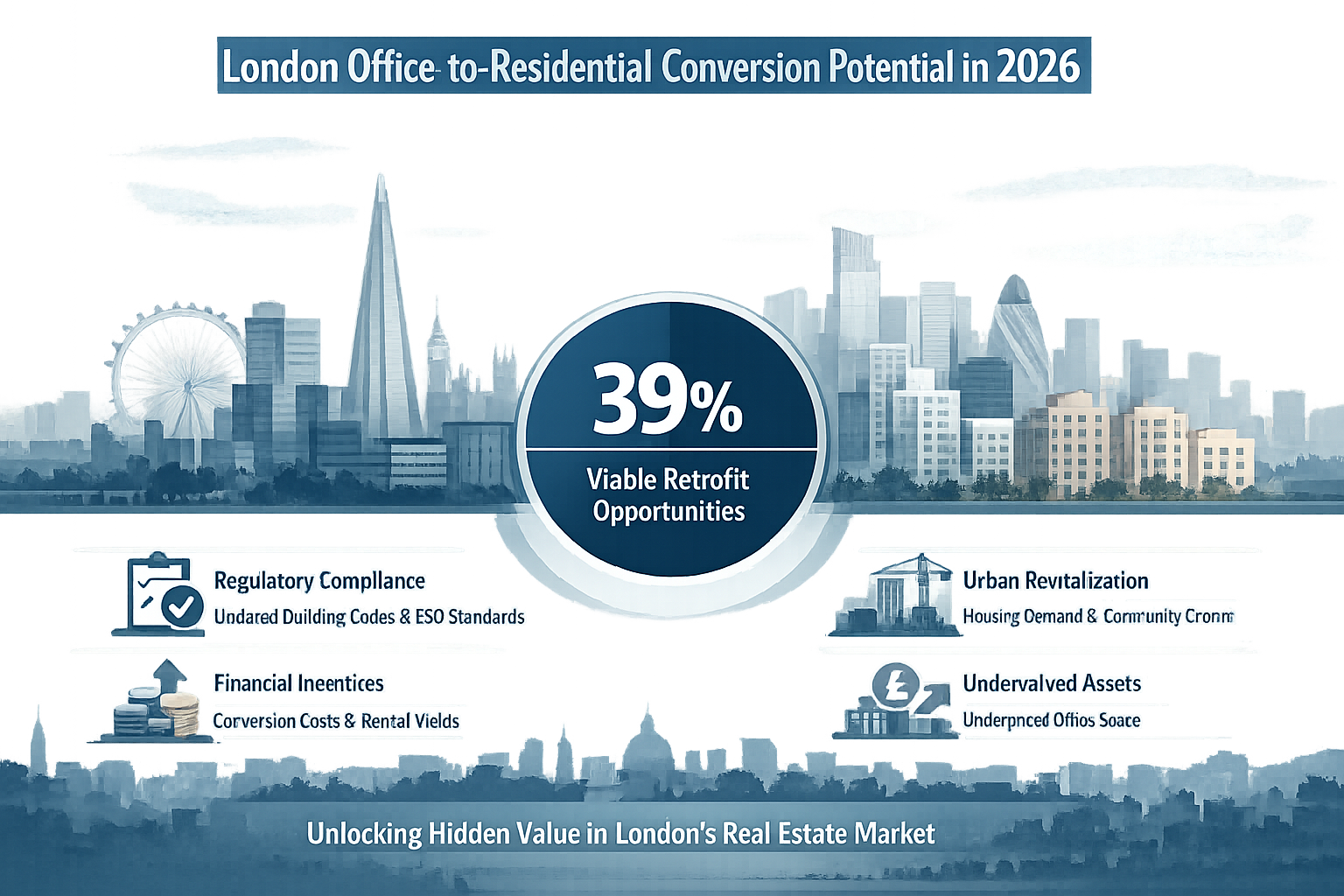
The landscape of Building Surveys for Office-to-Residential Conversion: Assessing Retrofit Viability in London's Underpriced Market 2026 fundamentally changed on March 5, 2024, when two critical restrictions were eliminated from permitted development rights[2]. These regulatory shifts have created unprecedented opportunities for investors and developers willing to navigate the technical complexities.
Permitted Development Rights: What Changed
Prior to March 2024, office-to-residential conversions faced two significant hurdles:
- Three-month continuous vacancy requirement – Buildings had to demonstrate sustained emptiness
- Cumulative floorspace limit of 1,500 sq m – Larger buildings required full planning permission
Both restrictions have been completely removed[2]. Buildings of any size can now proceed through the streamlined prior approval process rather than full planning permission, dramatically reducing timelines and costs.
The Prior Approval Process
While full planning permission is no longer required, developers must still obtain prior approval from local councils, who have 56 days to decide on applications[1]. This process evaluates specific considerations:
- Transport and highways impacts
- Contamination risks
- Flooding potential
- Noise from commercial premises
- Adequate natural light provision
- Compliance with nationally described space standards
A comprehensive building survey provides the technical evidence councils require during prior approval assessment, particularly regarding structural capacity and compliance with residential standards.
Article 4 Directions: The Local Authority Override
Despite liberalized permitted development rights, local planning authorities retain the power to implement Article 4 Directions that remove these rights in specific areas[2]. These directions typically aim to:
✅ Protect employment space in strategic locations
✅ Maintain commercial character in designated zones
✅ Prevent loss of office stock in high-demand areas
Speculation suggests some councils may increase use of Article 4 Directions to counter the expanded permitted development regime[2]. Before acquiring any office property for conversion, investors must verify whether Article 4 Directions apply to the specific location—a critical component of pre-purchase due diligence that building surveys should address.
Political and Policy Uncertainty
The Labour manifesto has indicated potential changes to the National Policy Planning Framework, creating uncertainty about the longevity of current permitted development rights[2]. This political backdrop makes thorough technical assessment even more critical—investors need to move quickly on viable opportunities while regulatory conditions remain favorable.
Critical Assessment Criteria in Building Surveys for Office-to-Residential Conversion
When evaluating Building Surveys for Office-to-Residential Conversion: Assessing Retrofit Viability in London's Underpriced Market 2026, surveyors must examine multiple technical dimensions that determine whether a building can successfully transition from commercial to residential use. These assessments go far beyond basic structural integrity.
Space Standards and Layout Viability
Mandatory space standards remain non-negotiable constraints on conversions[2]. The Nationally Described Space Standard (NDSS) establishes minimum floor areas for different dwelling types:
| Dwelling Type | Minimum Gross Internal Area |
|---|---|
| 1 bed, 1 person | 37 sq m |
| 1 bed, 2 person | 50 sq m |
| 2 bed, 3 person | 61 sq m |
| 2 bed, 4 person | 70 sq m |
| 3 bed, 5 person | 86 sq m |
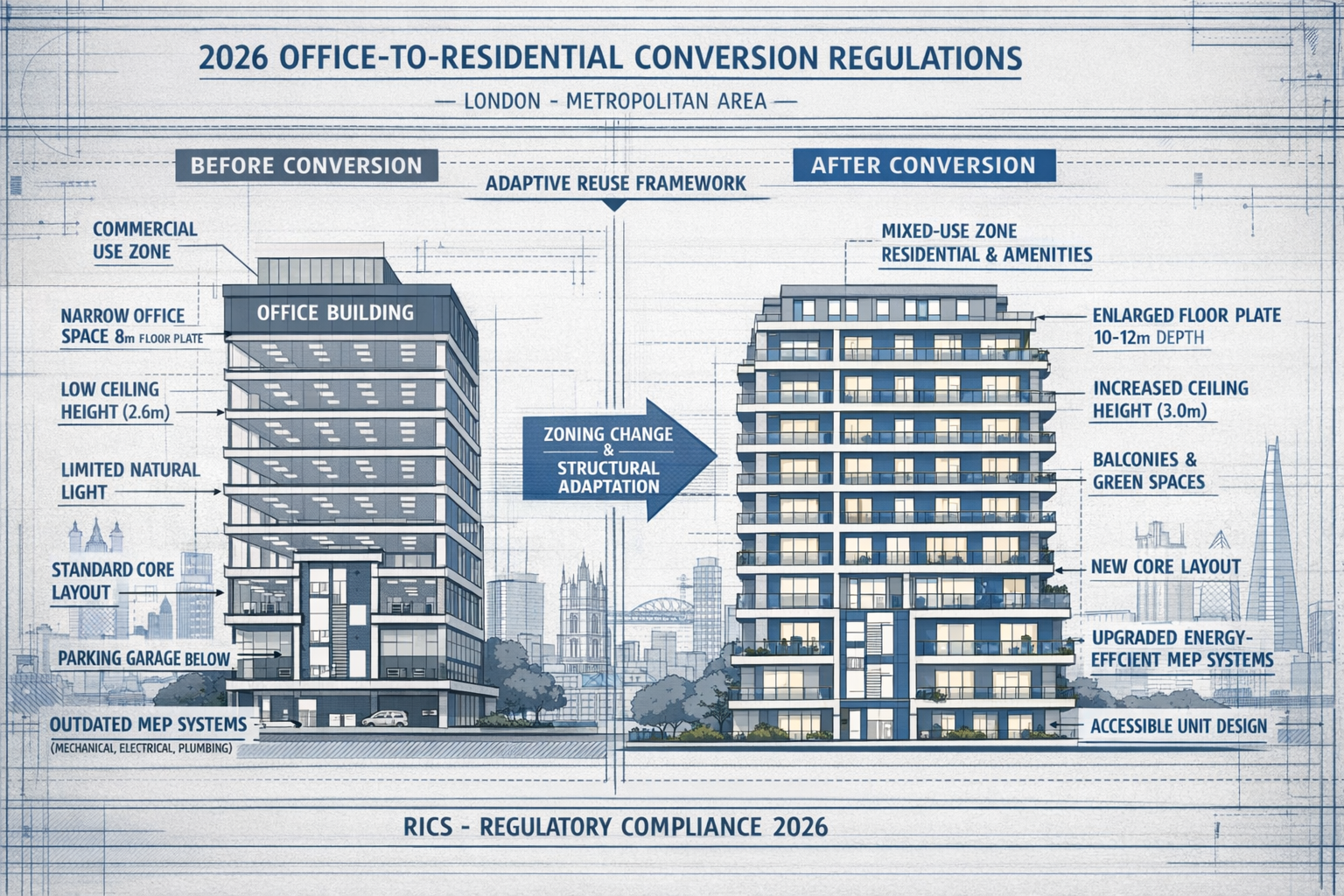
Building surveyors must evaluate whether the building footprint, column spacing, and core positioning allow efficient subdivision into compliant residential units. Office buildings with deep floor plates and central cores often struggle to achieve adequate unit layouts without significant structural intervention.
Natural Light and Ventilation Requirements
Perhaps the most challenging technical constraint is natural light provision[2]. Residential units require significantly more daylight penetration than office spaces. Building surveyors assess:
- Window-to-wall ratios and glazing percentages
- Floor-to-ceiling heights and their impact on light distribution
- Building orientation relative to solar paths
- Obstruction from adjacent buildings or structures
- Compliance with British Standard 8206-2 for natural lighting
Buildings with narrow floor plates, good orientation, and generous window provision demonstrate higher conversion viability. Conversely, deep-plan office buildings built in the 1960s-1980s often fail natural light requirements without expensive facade modifications.
Structural Capacity and Loading
Office buildings and residential buildings have fundamentally different structural loading requirements. A detailed building condition assessment must evaluate:
🔧 Floor loading capacity – Residential units require different load distributions, particularly in bathrooms and kitchens
🔧 Structural modifications required – Can partition walls be added without compromising structural integrity?
🔧 Foundation adequacy – Will additional loading from residential fit-out exceed design parameters?
🔧 Fire compartmentation – Can the building achieve required fire separation between units?
The age and construction method of the building significantly impacts retrofit complexity. Modern office buildings with flexible structural grids typically convert more easily than older buildings with load-bearing walls.
Building Services and Infrastructure
Existing building services in office buildings rarely meet residential requirements. Comprehensive surveys must assess:
Plumbing and Drainage
- Capacity for multiple kitchens and bathrooms per floor
- Vertical service risers and their positioning
- Water pressure and supply adequacy
- Drainage capacity for increased residential demand
Electrical Systems
- Individual metering capability for each unit
- Electrical capacity for residential loads (cooking, heating, appliances)
- Distribution infrastructure and upgrade requirements
Heating, Ventilation, and Air Conditioning (HVAC)
- Replacement of centralized office systems with individual unit controls
- Acoustic performance of mechanical ventilation
- Energy efficiency compliance with Building Regulations Part L
Telecommunications and Connectivity
- Fiber broadband infrastructure
- TV aerial and satellite provision
- Individual unit connectivity requirements
Building Envelope and Thermal Performance
The external envelope must meet residential thermal performance standards, which often exceed office building requirements. Surveyors evaluate:
- U-values of existing walls, windows, and roof against current Building Regulations
- Air tightness and infiltration rates
- Thermal bridging at junctions and penetrations
- Condensation risk in upgraded insulation scenarios
Many office buildings require complete facade overcladding or window replacement to achieve residential energy performance standards—costs that can fundamentally alter conversion economics.
Damp, Defects, and Remediation
Standard defect identification remains essential. Surveyors should investigate:
- Rising damp and ground floor moisture issues
- Penetrating damp from facade defects or roof failures
- Condensation problems in poorly ventilated areas
- Structural movement or settlement
- Concrete carbonation in older concrete-framed buildings
- Asbestos presence requiring removal
A London damp specialist should be consulted when moisture issues are identified, as remediation costs can significantly impact conversion viability.
Market Opportunities and Financial Viability Assessment
The financial case for Building Surveys for Office-to-Residential Conversion: Assessing Retrofit Viability in London's Underpriced Market 2026 depends on accurate cost estimation and realistic market value projections. Building surveyors play a crucial role in providing the technical data that underpins financial modeling.
Identifying Prime Conversion Candidates
Research has identified 12.9 million square feet of office space across the South East as prime conversion targets[2]. The most viable candidates share common characteristics:
✨ Built before 2012 – Older buildings often occupy sites with higher residential values
✨ High vacancy rates – Buildings with sustained low occupancy
✨ Significant lease breaks within two years – Upcoming vacancy provides conversion windows
✨ Locations with strong residential demand – Areas where residential values exceed commercial
✨ Favorable planning context – Absence of Article 4 Directions
The GSK Brentford example from Q1 2024 illustrates market dynamics: a private investor purchased the former GSK building for £69 million with residential conversion plans, reflecting a market price of £99.98 per square foot[2]. This transaction demonstrates investor confidence in conversion economics despite significant retrofit requirements.
Cost Estimation Framework
Accurate cost estimation requires detailed technical assessment. Building surveyors should quantify:
Category A: Essential Structural Works
- Structural modifications and reinforcement
- Fire compartmentation and escape routes
- Facade modifications for natural light compliance
- Roof repairs or replacement
Category B: Services Installation
- Complete mechanical and electrical infrastructure
- Individual unit plumbing and drainage
- Heating system installation
- Telecommunications infrastructure
Category C: Envelope Upgrades
- Thermal insulation improvements
- Window replacement or upgrading
- Facade overcladding
- Roof insulation
Category D: Compliance and Remediation
- Asbestos removal
- Damp remediation
- Accessibility improvements
- Building control and certification fees
Category E: Fit-Out and Finishes
- Individual unit internal finishes
- Common area improvements
- External works and landscaping
Conversion costs typically range from £150-£350 per square foot depending on building condition and specification level. A thorough building survey provides the itemized assessment needed for accurate budgeting.
Value Creation and Return Analysis
The conversion business case compares:
Acquisition Cost + Retrofit Cost versus Completed Residential Value
In London's underpriced office market, this equation increasingly favors conversion. Key value drivers include:
📈 Residential premium over commercial – London residential values typically exceed office values per square foot
📈 Permitted development savings – Avoiding full planning permission reduces time and costs
📈 Housing demand fundamentals – Sustained undersupply supports residential pricing
📈 Location arbitrage – Office buildings in residential neighborhoods unlock latent value
However, surveyors must also flag value constraints:
⚠️ Space standard compliance – Inefficient layouts reduce saleable area
⚠️ Natural light limitations – Poor daylight reduces unit values
⚠️ Service charge burdens – Expensive building systems create ongoing costs
⚠️ Leasehold ground rent – Unfavorable lease terms impact marketability
Risk Mitigation Through Comprehensive Surveys
Saving money with building surveys becomes particularly relevant in conversion projects where unforeseen issues can derail financial projections. A comprehensive pre-acquisition survey should:
✅ Identify deal-breakers early – Issues that make conversion unviable
✅ Quantify remediation costs – Accurate budgeting for defects
✅ Support price negotiation – Evidence for negotiating the purchase price
✅ Inform planning strategy – Technical evidence for prior approval applications
✅ Reduce financing risk – Lenders require detailed condition reports
The investment required for a thorough building survey represents a small fraction of total project costs but can prevent catastrophically expensive mistakes.
Target Building Profiles for 2026
Based on current market analysis, the most attractive conversion opportunities in London's underpriced office market include:
1980s-1990s Suburban Office Buildings
- Typically 3-6 stories
- Locations with strong residential character
- Adequate parking for residential conversion
- Manageable retrofit requirements
1960s-1970s Central London Secondary Offices
- Prime residential locations
- Outdated for modern office requirements
- High land values support conversion economics
- Often require substantial facade work
Former Headquarters Buildings
- Large floorplates requiring creative subdivision
- Established locations with good transport links
- Potential for mixed-use retention of ground floor commercial
Obsolete Business Parks
- Suburban locations with residential development potential
- Car parking already in place
- Opportunity for comprehensive estate regeneration
Compliance with Emerging RICS Standards Post-Quality Summit
The RICS Quality Summit has prompted renewed focus on survey standards and professional competence. For Building Surveys for Office-to-Residential Conversion: Assessing Retrofit Viability in London's Underpriced Market 2026, this means enhanced rigor in assessment and reporting.
Enhanced Survey Scope Requirements
Conversion feasibility surveys must now address:
Technical Competence Demonstration
- Explicit statement of surveyor qualifications for conversion assessment
- Specialist input on structural, services, and energy performance matters
- Clear limitation statements on scope and assumptions
Comprehensive Risk Identification
- Systematic evaluation against residential building standards
- Quantified assessment of compliance gaps
- Prioritized remediation recommendations
Financial Implications
- Detailed cost estimates for identified works
- Cashflow implications of phased remediation
- Impact on conversion viability and return projections
Reporting Standards and Client Communication
Post-Quality Summit expectations emphasize clear communication of findings. Conversion survey reports should include:
📋 Executive Summary – Clear viability conclusion with key constraints
📋 Regulatory Compliance Section – Assessment against permitted development criteria
📋 Technical Assessment – Detailed evaluation of structure, services, envelope
📋 Cost Schedule – Itemized retrofit cost estimates
📋 Risk Register – Identified risks with probability and impact ratings
📋 Recommendations – Prioritized action plan for conversion delivery
The report must enable informed decision-making by investors who may lack technical expertise but need to understand viability clearly.
Professional Indemnity and Liability Considerations
Conversion projects carry heightened liability exposure for surveyors. Adequate professional indemnity insurance must cover:
- Errors in viability assessment leading to financial loss
- Missed defects requiring expensive remediation
- Compliance failures resulting in regulatory enforcement
- Cost estimate inaccuracies affecting project financing
Surveyors should ensure their professional indemnity policies specifically cover commercial-to-residential conversion assessments and maintain appropriate coverage limits relative to project values.
Practical Steps for Investors and Developers
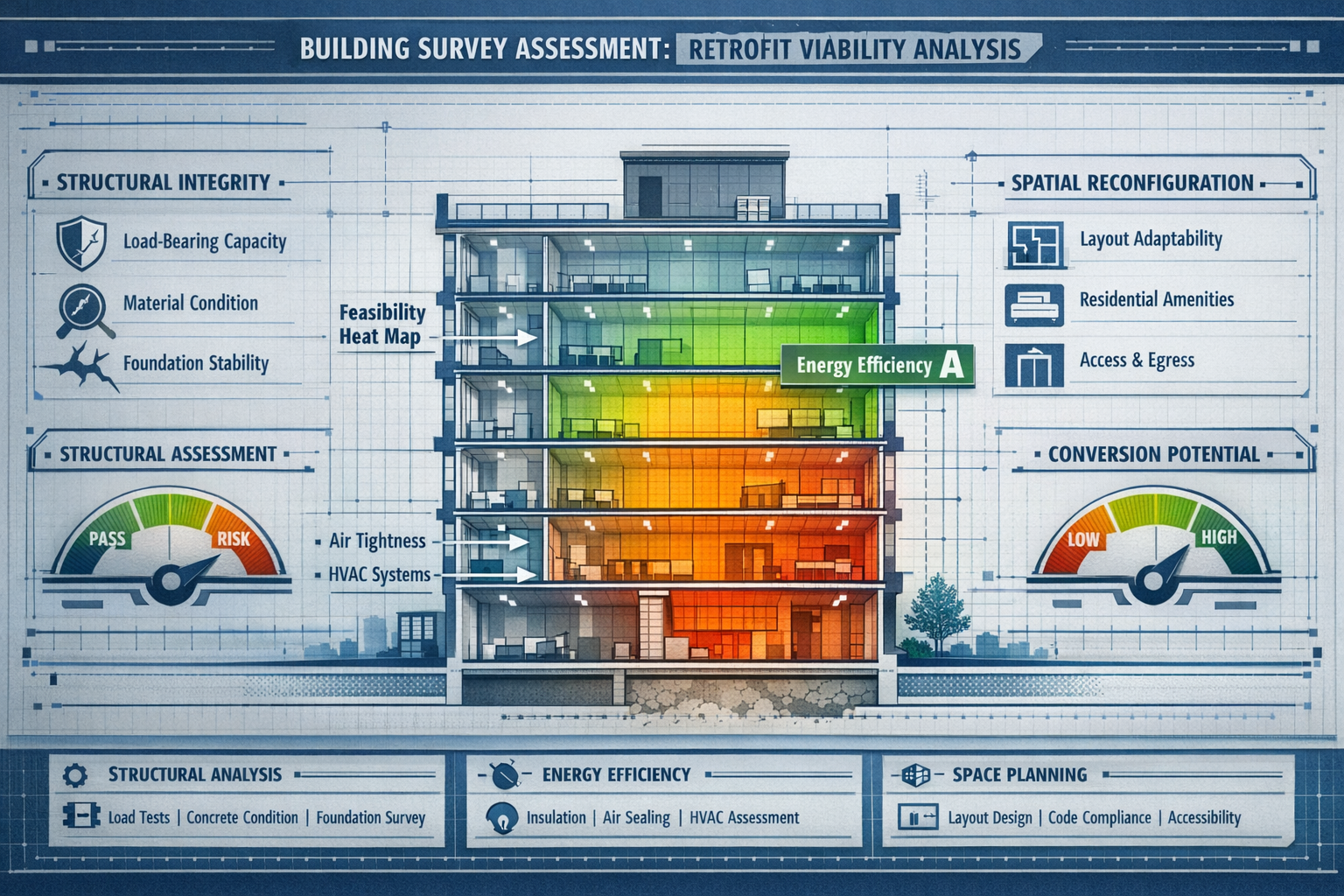
For those pursuing opportunities in Building Surveys for Office-to-Residential Conversion: Assessing Retrofit Viability in London's Underpriced Market 2026, a systematic approach maximizes success probability.
Pre-Acquisition Due Diligence Checklist
Before committing to purchase:
1. Regulatory Verification
- Confirm permitted development rights apply
- Check for Article 4 Directions
- Review local plan policies on office retention
- Assess prior approval likelihood
2. Initial Feasibility Assessment
- Desktop review of building age, construction, and layout
- Preliminary space standard compliance evaluation
- Natural light and orientation analysis
- Comparable residential values research
3. Comprehensive Building Survey
- Engage qualified surveyors with conversion experience
- Commission specialist reports (structural, services, energy)
- Obtain detailed cost estimates for retrofit works
- Request explicit viability opinion
4. Financial Modeling
- Build detailed project cashflow incorporating survey findings
- Stress-test assumptions on costs and values
- Calculate return metrics (IRR, profit on cost)
- Assess financing viability and structure
5. Legal Due Diligence
- Title review for restrictive covenants
- Lease analysis if not freehold
- Planning history examination
- Environmental searches
Selecting the Right Survey Team
Conversion projects require multidisciplinary expertise. The survey team should include:
🏗️ Chartered Building Surveyor – Overall condition assessment and project coordination
🏗️ Structural Engineer – Structural capacity and modification requirements
🏗️ M&E Consultant – Mechanical and electrical services evaluation
🏗️ Energy Assessor – Thermal performance and Building Regulations compliance
🏗️ Quantity Surveyor – Detailed cost estimation and value engineering
A London-based surveyor consultancy with conversion experience can coordinate these specialists and provide integrated reporting.
Timing Considerations for 2026
Several factors make 2026 a particularly opportune moment:
⏰ Regulatory window – Current permitted development rights may not persist indefinitely
⏰ Market pricing – London offices remain undervalued relative to conversion potential
⏰ Lease break opportunities – Many office leases signed in 2019-2021 reach break clauses
⏰ Lender appetite – Increasing financing availability for conversion projects
However, investors should move decisively—as more market participants recognize the opportunity, competition for the best conversion candidates will intensify and pricing will adjust.
Common Pitfalls to Avoid
Experience with conversion projects reveals recurring mistakes:
❌ Underestimating natural light challenges – Many projects fail at prior approval stage
❌ Inadequate services budget – M&E costs frequently exceed initial estimates
❌ Ignoring Article 4 risk – Councils can implement directions during project timelines
❌ Overlooking leasehold constraints – Unfavorable lease terms can block conversion
❌ Insufficient contingency – Conversion projects encounter unexpected issues
❌ Poor unit mix optimization – Layout inefficiency destroys value
Comprehensive building surveys conducted by experienced professionals mitigate these risks by identifying issues before financial commitment.
Conclusion
Building Surveys for Office-to-Residential Conversion: Assessing Retrofit Viability in London's Underpriced Market 2026 represents a critical intersection of opportunity and risk. With London offices identified by 31% of investors as the most underpriced asset class, and regulatory barriers significantly reduced since March 2024, the potential for value creation through conversion has never been greater.
However, success depends absolutely on rigorous technical assessment. Not every vacant office building can successfully transition to residential use—space standards, natural light requirements, structural constraints, and services infrastructure all create viability thresholds that many buildings cannot meet economically.
The role of comprehensive building surveys has evolved from simple defect identification to sophisticated feasibility assessment. Surveyors must evaluate regulatory compliance, quantify retrofit costs, assess market positioning, and provide clear viability opinions that enable informed investment decisions.
Actionable Next Steps
For investors and developers pursuing conversion opportunities:
1. Identify candidate buildings meeting the prime conversion profile—pre-2012 construction, high vacancy, strong residential location, no Article 4 restrictions
2. Commission comprehensive pre-acquisition surveys from qualified professionals with conversion experience, ensuring scope addresses all critical viability factors
3. Build detailed financial models incorporating survey findings, with realistic cost estimates and appropriate contingencies
4. Move decisively on viable opportunities while regulatory conditions remain favorable and market pricing reflects office rather than residential values
5. Engage early with local planning authorities to understand prior approval requirements and likelihood of approval
The window of opportunity created by expanded permitted development rights and underpriced office assets may not remain open indefinitely. Political uncertainty and potential policy changes create urgency for those positioned to act. However, this urgency must be balanced with thorough technical due diligence—the foundation of successful conversion projects.
Professional building surveys provide the evidence base for confident decision-making in this complex market. As London's office-to-residential conversion market matures through 2026, the competitive advantage will belong to those who combine market insight with technical rigor, transforming underpriced office assets into quality residential accommodation that meets genuine housing need while generating attractive returns.
References
[1] How To Convert Offices Into Homes Without Planning Permission – https://urbanistarchitecture.co.uk/how-to-convert-offices-into-homes-without-planning-permission/
[2] Office To Residential Permitted Development – https://www.lsh.co.uk/explore/research-and-views/view-points/2024/june/office-to-residential-permitted-development
[3] How To Successfully Convert Offices Into Homes – https://www.garnessjones.co.uk/news/how-to-successfully-convert-offices-into-homes
[4] Convert Commercial To Residential – https://osbournepinner.com/blog/convert-commercial-to-residential/
[5] Lease Conversions A Market Shift For 2026 – https://www.newsontheblock.com/news-opinion/lease-conversions-a-market-shift-for-2026
[6] Bpie 2025 Conversion Of Offices Into Affordable Housing – https://circulareconomy.europa.eu/platform/sites/default/files/2026-02/BPIE-2025_Conversion-of-offices-into-affordable-housing.pdf
[7] Unlocking New Opportunities – https://www.cushmanwakefield.com/en/united-kingdom/insights/unlocking-new-opportunities