

The institutional buy-to-let market in 2026 is experiencing unprecedented growth, with professional landlords and investment firms acquiring residential properties at scale despite regulatory headwinds and tax pressures. As Building Surveys for Institutional Buy-to-Let Portfolios: 2026 Risk Protocols in a Bullish Landlord Market become increasingly sophisticated, surveyors must adapt their assessment methodologies to meet the unique demands of large-scale property investors. Unlike individual landlords purchasing single properties, institutional investors require comprehensive risk management frameworks that evaluate structural integrity, compliance standards, and long-term capital expenditure across entire portfolios—often comprising hundreds or thousands of units.
The landscape has shifted dramatically. With refinancing rates ranging from 6.6–7.5% in the current environment[2], and regulatory changes including the January 20, 2026 Executive Order aimed at limiting institutional single-family rental acquisitions[3], professional building surveys have become the cornerstone of due diligence for institutional portfolios. These assessments must now address not only traditional structural concerns but also portfolio-wide risk exposure, compliance verification, and strategic valuation considerations that directly impact investment returns.
Key Takeaways
- Portfolio-scale risk management: Institutional investors utilize standardized building survey protocols to assess and manage risk exposure across hundreds of properties simultaneously, requiring surveyors to develop scalable assessment frameworks[1]
- Enhanced reserve planning: Best practice now mandates maintaining 10–15% of total rental income in combined reserves, split between operating expenses, capital expenditure ($200–$300 monthly per property), and vacancy buffers[2]
- Regulatory compliance focus: The 2026 Executive Order restricting institutional single-family purchases requires enhanced due diligence and compliance verification during property acquisition surveys[3]
- Cap rate-driven valuations: Multifamily Class A properties average 4.74% cap rates while office properties range from 8.4–9.02%, making accurate building condition assessments critical for investment modeling[2]
- Strategic diversification requirements: Institutional portfolios must balance residential, commercial, and alternative assets, requiring surveyors to provide specialized assessments across multiple property types[2]
Understanding Institutional Buy-to-Let Portfolio Requirements in 2026
The Shift Toward Professional Landlord Dominance
Institutional investors have fundamentally transformed the buy-to-let landscape. In 2024 alone, approximately 30% (33,000 units) of large institutional investor acquisitions consisted of homes in build-to-rent communities[4], signaling a strategic shift toward purpose-built rental housing. This concentration reflects the professional landlord's preference for standardized, scalable assets that can be efficiently managed across portfolio holdings.
The bullish market conditions persist despite tax pressures and regulatory scrutiny. Research indicates that institutional investor entry decreased homes available for owner-occupiers by only 0.22 units per home purchased by single-family rental firms, with rents declining modestly on net due to transfer of units into the rental sector and greater operating efficiencies[5]. These findings challenge conventional narratives about institutional investor impact while highlighting the importance of rigorous building assessments.
For surveyors, this shift demands a fundamental rethinking of survey protocols. Traditional RICS building surveys designed for individual homebuyers must be adapted for institutional clients who require:
- Standardized assessment criteria across portfolio holdings
- Comparative risk ratings enabling portfolio-wide prioritization
- Capital expenditure forecasting for 5–10 year planning horizons
- Compliance verification against evolving regulatory frameworks
- Scalable reporting formats suitable for executive decision-making
Key Metrics Driving Institutional Investment Decisions
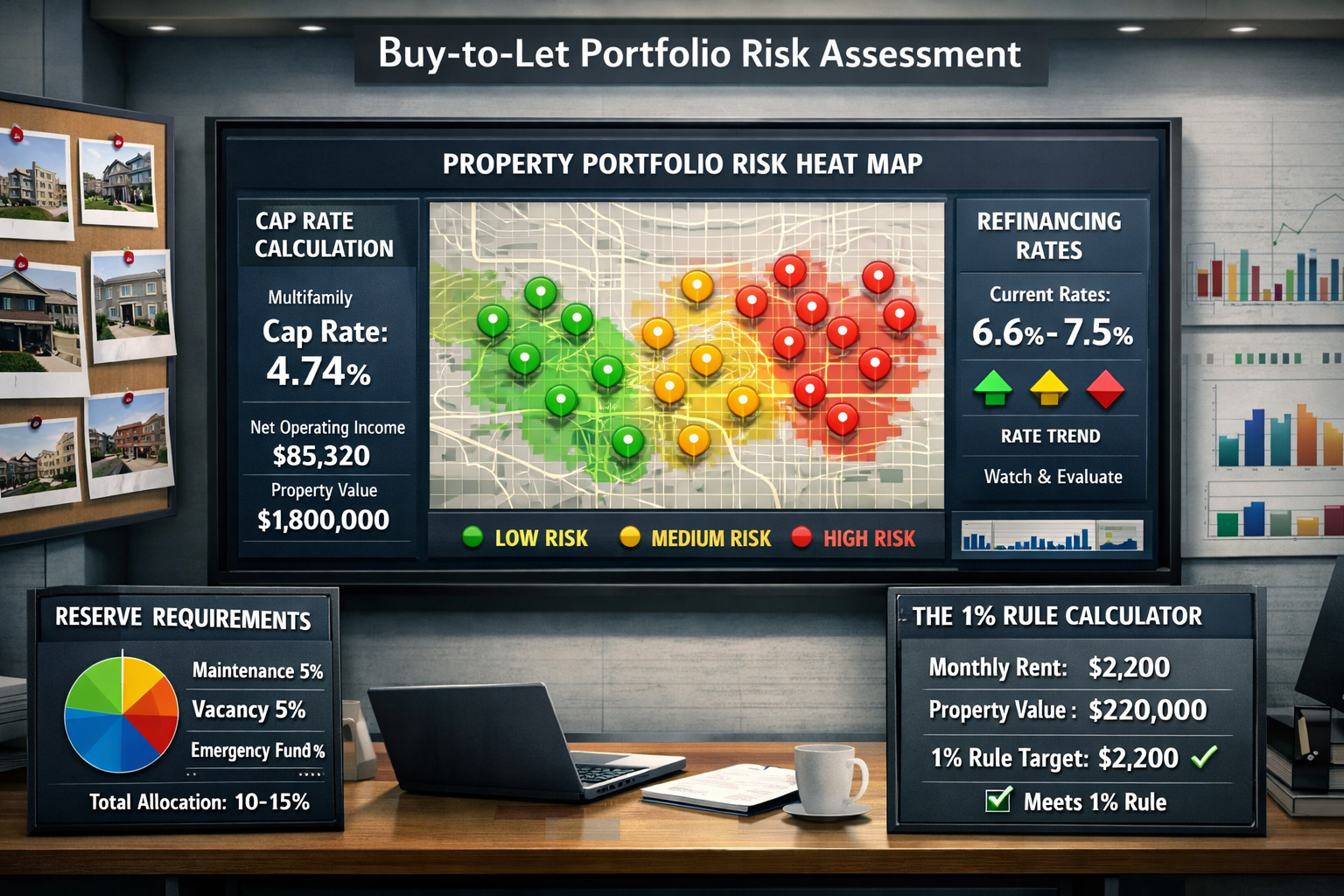
Institutional investors evaluate potential acquisitions using sophisticated financial models where building condition directly impacts investment viability. The 1% rule provides a quick assessment metric: monthly rental income should equal at least 1% of the purchase price to ensure positive cash flow and acceptable returns[2]. A property purchased for £300,000 must generate £3,000 monthly rent to meet this threshold.
Cap rates (capitalization rates) vary significantly by property type and condition:
| Property Type | Class | Average Cap Rate (2026) |
|---|---|---|
| Multifamily | Class A | 4.74% |
| Office | Class A | 8.4% |
| Office | Class C | 9.02% |
| Hotel (Luxury Metro) | Premium | 6.48% |
| Hotel (Suburban) | Standard | 7.85% |
These variations reflect risk levels directly influenced by building condition, location, and tenant quality[2]. A comprehensive building survey that identifies deferred maintenance or structural deficiencies can shift a property's classification and dramatically alter its cap rate—and therefore its investment value.
Building Surveys for Institutional Buy-to-Let Portfolios: Risk Assessment Frameworks
Structural Red Flags That Impact Portfolio Performance
Institutional investors cannot afford surprises. A single property with undisclosed structural defects can undermine portfolio performance and trigger cascading financial consequences. Surveyors must identify and quantify specific structural red flags that pose portfolio-wide risks:
Foundation and Structural Movement 🏗️
- Subsidence patterns indicating soil instability
- Differential settlement affecting multiple units
- Crack propagation suggesting ongoing structural movement
- Inadequate underpinning in properties with basement conversions
Building Envelope Deficiencies
- Roof membrane failures requiring premature replacement
- Facade deterioration affecting multiple units simultaneously
- Window and door seal failures increasing energy costs
- Inadequate weatherproofing leading to moisture ingress
Systems and Services Obsolescence
- Electrical systems nearing end-of-life requiring complete rewiring
- Plumbing infrastructure with recurring failure patterns
- HVAC systems operating beyond manufacturer specifications
- Fire safety systems requiring compliance upgrades
For institutional portfolios, these issues must be evaluated not just for individual properties but for their portfolio-wide implications. A surveyor discovering aluminum wiring in one property should flag the potential for similar installations across properties acquired during the same construction period, enabling proactive portfolio-wide remediation planning.
Damp, Timber, and Environmental Hazards
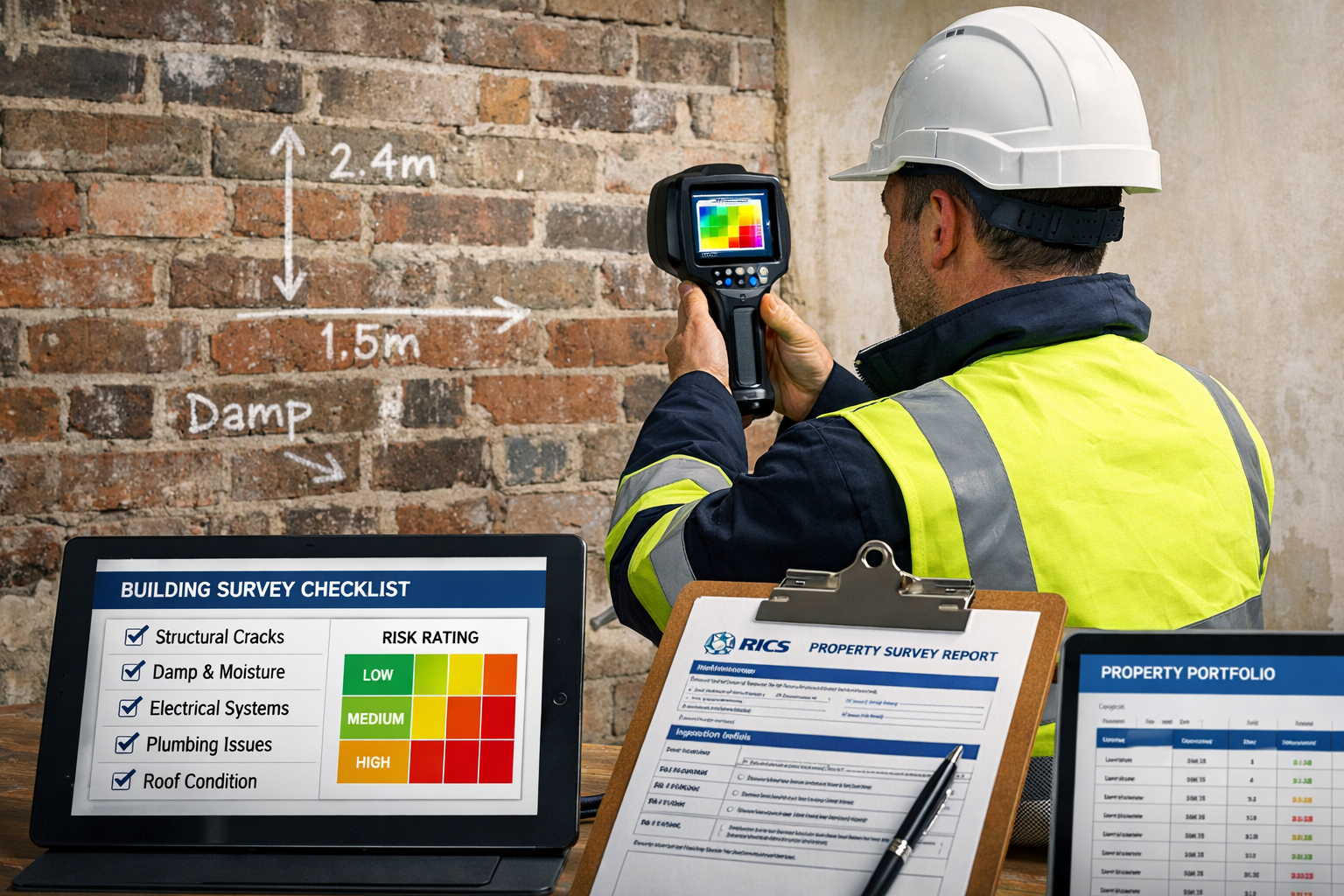
Moisture-related defects represent one of the most significant risk categories for institutional buy-to-let portfolios. Unlike cosmetic issues, damp problems escalate over time and can render properties uninhabitable if left unaddressed. Professional damp surveys should form a critical component of institutional building assessments.
Critical damp assessment protocols include:
- Rising damp verification using moisture meters and salt analysis
- Penetrating damp source identification through thermal imaging
- Condensation risk assessment based on ventilation adequacy
- Timber decay evaluation including dry rot and wet rot presence
- Mold growth documentation affecting tenant health and safety
Institutional investors must understand the cost of remedying damp and timber problems when modeling acquisition economics. A £15,000 damp remediation cost on a £250,000 property acquisition represents a 6% reduction in effective purchase price—material to investment returns when multiplied across portfolio holdings.
Compliance and Regulatory Verification
The 2026 regulatory environment presents unprecedented compliance challenges for institutional landlords. The Executive Order signed January 20, 2026, aimed at limiting institutional investors from purchasing single-family rental homes[3], requires enhanced due diligence during property acquisition. While the Order requires legislative action to become fully effective, prudent institutional investors are already adapting their acquisition protocols.
Essential compliance verification areas include:
✅ Energy Performance Certificate (EPC) ratings and upgrade pathways
✅ Electrical Installation Condition Reports (EICR) validity and findings
✅ Gas Safety Certificates and appliance compliance
✅ Fire safety assessments including smoke/CO detector placement
✅ HMO licensing requirements for multi-occupancy properties
✅ Planning permission verification for any structural alterations
✅ Building regulation compliance for extensions and conversions
Surveyors conducting building condition assessments for institutional clients must document compliance status comprehensively, as regulatory violations can trigger enforcement action affecting multiple properties simultaneously.
Strategic Survey Protocols for Building Surveys for Institutional Buy-to-Let Portfolios: 2026 Risk Protocols
Portfolio-Wide Standardization and Comparative Analysis
Institutional investors require standardized assessment frameworks that enable direct comparison across portfolio holdings. A surveyor assessing 50 properties using inconsistent methodologies provides limited strategic value. Best practice protocols for 2026 include:
Standardized Risk Rating Matrix
- Category A (Green): No significant defects; routine maintenance only
- Category B (Amber): Moderate defects requiring planned remediation within 12–24 months
- Category C (Red): Significant defects requiring immediate attention or affecting habitability
This classification system enables portfolio managers to prioritize capital allocation efficiently. Properties rated Category C receive immediate remediation funding, while Category B properties enter scheduled maintenance programs.
Quantified Capital Expenditure Forecasting
Rather than qualitative descriptions, institutional surveys must provide specific cost estimates:
- Immediate repairs (0–6 months): £X,XXX itemized by system/component
- Short-term maintenance (6–24 months): £X,XXX with priority ranking
- Medium-term capital expenditure (2–5 years): £X,XXX for major systems
- Long-term replacement reserves (5–10 years): £X,XXX for roof, facade, systems
These quantified forecasts feed directly into financial models, enabling accurate reserve planning. The recommended practice of maintaining 10–15% of total rental income in combined reserves[2] requires precise capital expenditure forecasting to ensure adequate funding.
Integration with Valuation and Investment Modeling
Building survey findings directly impact property valuations and investment returns. Surveyors working with institutional clients must understand how their assessments influence RICS property valuations and acquisition decisions.
Survey Impact on Cap Rate Calculations
A property generating £24,000 annual net operating income (NOI) with a market cap rate of 5% would be valued at £480,000 (£24,000 ÷ 0.05). However, if a building survey identifies £50,000 in deferred maintenance, the effective valuation becomes £430,000, representing a 10.4% reduction.
Institutional investors increasingly demand that surveyors provide valuation-adjusted recommendations:
- Current market value assuming disclosed condition
- Adjusted value reflecting identified defects
- Stabilized value post-remediation
- Optimal acquisition price accounting for remediation costs
This integration ensures that building surveys inform rather than merely document investment decisions.
Technology-Enabled Survey Delivery
The scale of institutional portfolios demands technology-enabled survey methodologies. Leading surveyors in 2026 utilize:
Digital Survey Platforms 📱
- Tablet-based data collection with standardized templates
- Cloud-based reporting accessible to distributed investment teams
- Photographic documentation with geolocation tagging
- Integration with property management systems
Advanced Diagnostic Tools
- Thermal imaging cameras for moisture and insulation assessment
- Laser measuring devices for precise dimensional verification
- Moisture meters with data logging capabilities
- Drone photography for roof and facade inspection
Portfolio Dashboard Integration
- Real-time survey status tracking across acquisition pipeline
- Comparative analytics showing risk distribution across portfolio
- Capital expenditure aggregation and forecasting
- Compliance status monitoring and alert systems
These technological enhancements enable institutional investors to manage survey programs across hundreds of properties simultaneously while maintaining quality and consistency.
Managing Portfolio Risks: Building Surveys for Institutional Buy-to-Let Portfolios in Practice
Reserve Planning and Capital Allocation Strategies
Effective reserve planning separates successful institutional portfolios from those experiencing financial distress. Building survey findings provide the foundational data for reserve calculations, which should be divided into three distinct categories[2]:
1. Operating Reserves (3–6 months of expenses)
These funds cover routine maintenance, emergency repairs, and temporary income disruptions. Building surveys identify properties with higher maintenance requirements that may need enhanced operating reserves.
2. Capital Expenditure Reserves (£200–£300 per month per property)
Major system replacements—roofs, HVAC, plumbing, electrical—require dedicated funding. Surveys documenting system age and condition enable precise reserve calculations. A portfolio of 100 properties should maintain £240,000–£360,000 annually for capital expenditures.
3. Vacancy Reserves (1–2 months' rent per property)
Properties requiring significant remediation may experience extended vacancy periods. Survey findings identifying major defects should trigger enhanced vacancy reserve allocations for affected properties.
The combined 10–15% reserve requirement means a portfolio generating £2 million in annual rental income should maintain £200,000–£300,000 in liquid reserves—a substantial commitment that requires accurate forecasting based on comprehensive building surveys.
BRRRR Strategy Risks in the 2026 Market
The Buy, Rehab, Rent, Refinance, Repeat (BRRRR) strategy remains popular among institutional investors seeking to scale portfolios rapidly. However, the 2026 market environment presents significant risks that building surveys must address[2]:
Renovation Cost Overruns 💰
Surveys that underestimate renovation scope or costs can destroy BRRRR economics. A property purchased for £200,000 with anticipated £40,000 renovation costs and £300,000 after-repair value (ARV) provides £60,000 equity extraction potential. If actual renovation costs reach £65,000, the entire strategy fails.
Market Downturns Preventing Refinancing
Properties must appraise at projected values to enable refinancing. Surveys must provide realistic ARV estimates based on comparable properties in similar condition, not optimistic projections.
Extended Vacancy Periods
Renovation timelines extending beyond projections increase carrying costs and delay rental income. Surveys should identify potential complications—asbestos, structural issues, planning restrictions—that could extend renovation periods.
Higher Refinancing Costs
With investment property refinancing rates ranging from 6.6–7.5% in 2026[2], significantly higher than previous years, the amount of equity extractable through refinancing has decreased. Surveys must account for this reality in ARV calculations.
Professional surveyors can add tremendous value by providing renovation feasibility assessments that identify high-risk BRRRR candidates before acquisition, protecting institutional investors from costly mistakes.
Diversification Across Property Types and Locations
Institutional portfolios increasingly diversify beyond traditional residential buy-to-let into commercial, industrial, and alternative assets[2]. This diversification requires surveyors to develop expertise across multiple property types:
Residential Multi-Family
- Unit standardization and replication potential
- Common area maintenance requirements
- Tenant turnover impact on building condition
- Amenity space functionality and appeal
Commercial Office
- HVAC system capacity and efficiency
- ADA/accessibility compliance
- Tenant improvement allowance implications
- Technology infrastructure adequacy
Industrial/Warehouse
- Structural load capacity verification
- Clear height and column spacing
- Loading dock functionality
- Environmental contamination screening
Alternative Assets (Data Centers, Student Housing, Senior Living)
- Specialized system requirements
- Regulatory compliance frameworks
- Operational efficiency metrics
- Demographic demand sustainability
Each property type requires specialized survey protocols, but institutional investors benefit from consistent risk rating frameworks that enable portfolio-level comparison regardless of asset class.
Navigating Regulatory Uncertainty
The regulatory environment for institutional buy-to-let investors remains fluid in 2026. Beyond the January 20 Executive Order[3], proposed legislation including the "End Hedge Fund Control of American Homes Act" (S. 3402) sponsored by Senators Warren and Sanders could further restrict institutional single-family rental acquisitions[5].
Survey protocols must address regulatory risk by:
- Documenting current compliance status comprehensively
- Identifying potential non-conforming uses or structures
- Assessing retrofit costs for anticipated regulatory changes
- Evaluating portfolio concentration in jurisdictions with restrictive proposals
- Providing alternative use analysis for properties potentially affected by restrictions
While research suggests that institutional investor entry has minimal impact on housing affordability—decreasing available homes for owner-occupiers by only 0.22 units per institutional purchase[5]—political momentum for restrictions continues. Prudent institutional investors incorporate regulatory risk into acquisition decisions, with building surveys providing critical compliance documentation.
Conclusion: Adapting Survey Practice for Institutional Excellence
The evolution of Building Surveys for Institutional Buy-to-Let Portfolios: 2026 Risk Protocols in a Bullish Landlord Market represents a fundamental shift in surveying practice. No longer can surveyors rely solely on traditional assessment methodologies designed for individual homebuyers. Institutional clients demand standardized frameworks, quantified risk assessments, technology-enabled delivery, and strategic integration with investment decision-making.
The bullish institutional buy-to-let market persists despite regulatory headwinds, tax pressures, and elevated refinancing costs. Cap rates appear to have peaked in 2024–2025 and may begin compressing as interest rates decline and market conditions stabilize[2], creating opportunities for well-positioned institutional investors. Those who succeed will be supported by surveying professionals who understand portfolio-scale risk management, compliance verification, and capital planning.
Actionable Next Steps for Institutional Investors
✅ Standardize survey protocols across all portfolio acquisitions using consistent risk rating frameworks
✅ Implement technology platforms enabling real-time survey data collection and portfolio-wide analytics
✅ Establish reserve policies maintaining 10–15% of rental income across operating, capital expenditure, and vacancy categories
✅ Develop surveyor partnerships with firms demonstrating institutional portfolio expertise and scalable delivery capacity
✅ Integrate survey findings directly into acquisition models, valuation adjustments, and capital allocation decisions
✅ Monitor regulatory developments and ensure survey protocols address compliance verification comprehensively
✅ Diversify across property types while maintaining consistent risk assessment standards
For surveyors seeking to serve institutional clients, the opportunity is substantial but demands professional development. Understanding cap rate calculations, reserve planning, BRRRR strategy risks, and portfolio diversification requirements separates commodity service providers from strategic advisors. Those who make this transition will find themselves indispensable to the institutional investors driving the 2026 buy-to-let market forward.
The integration of comprehensive building surveyor services with institutional investment strategy represents the future of professional surveying practice. As the market continues evolving, surveyors who adapt their methodologies, embrace technology, and deliver portfolio-scale value will thrive in this dynamic environment.
References
[1] Surveying The 2026 Buy To Let Boom Building Survey Protocols For Institutional Landlord Investments – https://nottinghillsurveyors.com/blog/surveying-the-2026-buy-to-let-boom-building-survey-protocols-for-institutional-landlord-investments
[2] Building A Real Estate Investment Portfolio Your Complete Guide – https://www.amerisave.com/learn/building-a-real-estate-investment-portfolio-your-complete-guide
[3] Single Family Rental Institutional Curbs Not Material For Securitizations 19 02 2026 – https://www.fitchratings.com/research/structured-finance/single-family-rental-institutional-curbs-not-material-for-securitizations-19-02-2026
[4] President Trump And Institutional Investors In Single Family Rentals – https://www.aei.org/articles/president-trump-and-institutional-investors-in-single-family-rentals
[5] The Ripple Effects Of Banning Institutional Purchases Of Single Family Rentals – https://www.brookings.edu/articles/the-ripple-effects-of-banning-institutional-purchases-of-single-family-rentals