
The UK property market is experiencing a seismic shift in 2026. 🏢 Institutional investors and professional landlords are aggressively expanding their portfolios, capitalizing on regulatory changes that are pushing smaller landlords out of the market. With over 400,000 BTL limited companies now registered and transaction volumes reaching £19 billion in Q4 2025[1][3], the landscape of buy-to-let investment has fundamentally changed. Building Surveys for Institutional Buy-to-Let Growth: Assessing Risk and Yield in 2026's Professional Landlord Boom has become essential for investors seeking to maximize returns while minimizing long-term risks in this rapidly evolving market.
This transformation demands a sophisticated approach to property assessment. Traditional homebuyer surveys no longer suffice when evaluating multi-property portfolios worth millions of pounds. Institutional investors require specialized building surveys that can accurately assess yield potential, identify hidden structural issues, and forecast long-term maintenance costs across diverse property types.
Key Takeaways
- Institutional dominance is accelerating: Market share continues shifting toward institutional investors and professional landlords, with two-thirds planning portfolio expansion in 2026[1][2]
- Specialized surveys are critical: Building surveys must now assess yield optimization, regulatory compliance, and long-term investment viability for institutional portfolios
- Risk assessment has evolved: Modern surveys require comprehensive analysis of structural integrity, energy efficiency, and maintenance forecasting to support data-driven investment decisions
- Yields remain attractive: Despite regulatory pressures, UK BTL yields remain high, particularly in northern regions, making thorough due diligence essential[1]
- Technology integration is essential: Advanced survey methodologies including thermal imaging, moisture detection, and digital reporting are now standard for institutional-grade assessments
Understanding the 2026 Professional Landlord Landscape
The Institutional Investment Surge
The buy-to-let market in 2026 bears little resemblance to the sector of five years ago. Institutional investors and build-to-rent operators have become dominant forces, driven by several converging factors. The implementation of the Renters Rights Act from May 2026 has created regulatory pressures that smaller, highly leveraged landlords struggle to navigate[2]. Meanwhile, well-capitalized professional landlords have adapted by forming limited companies—now the single biggest business type in BTL with over 400,000 registered firms[1].
This shift reflects a fundamental restructuring of the rental market. Smaller landlords operating one or two properties are increasingly selling to larger operators who can absorb compliance costs, implement professional management systems, and leverage economies of scale. For building surveyors, this means working with clients who demand institutional-grade assessments rather than basic property inspections.
Market Dynamics Driving Growth
Several powerful market forces are fueling this professional landlord boom:
Strong Transaction Volumes: Q4 2025 saw investment activity rebound to £19 billion, representing a 20% improvement over Q4 2024 and the strongest quarter since mid-2022[3]. This surge demonstrates renewed confidence among institutional investors who are deploying capital into quality residential assets.
Favorable Interest Rate Environment: The majority of analysts expect multiple interest rate cuts throughout 2026, with average fixed mortgage rates on new lending potentially falling below 3.5% in early 2026[2]. This improving cost of capital makes leveraged property investment increasingly attractive for professional landlords.
Supply-Demand Imbalances: New rental records are expected in 2026 as supply constraints continue putting upward pressure on rents[1]. For institutional investors, this translates to reliable yield growth and strong tenant demand across most UK markets.
Regional Yield Opportunities: Yields remain particularly high across northern regions[1], creating geographic arbitrage opportunities for investors willing to deploy capital outside traditional London-centric markets.
Understanding these dynamics is crucial when conducting building surveys for professional landlords, as investment decisions must account for both current conditions and projected market evolution.
Building Surveys for Institutional Buy-to-Let Growth: Specialized Assessment Requirements
Beyond Standard Homebuyer Reports
When assessing properties for institutional BTL portfolios, standard homebuyer reports fall dramatically short. Professional landlords require comprehensive building surveys that address specific investment criteria:
Yield Optimization Analysis: Surveys must evaluate how property condition impacts rental income potential. This includes assessing whether modernization investments would justify rent increases, identifying features that command premium rents, and evaluating how property layout affects tenant appeal and turnover rates.
Long-Term Maintenance Forecasting: Institutional investors operate on 10-20 year investment horizons. Building surveys must provide detailed forecasts of major maintenance requirements, including roof replacement timelines, heating system longevity, window replacement schedules, and structural repair needs. These forecasts directly impact cash flow projections and investment returns.
Regulatory Compliance Assessment: The 2026 regulatory environment demands rigorous compliance evaluation. Surveys must verify Energy Performance Certificate (EPC) ratings, assess feasibility of achieving higher ratings, identify fire safety compliance issues, and evaluate accessibility standards. Non-compliance can trigger immediate remediation costs or rental restrictions.
Portfolio Scalability Evaluation: Professional landlords often acquire multiple similar properties. Surveys should identify standardization opportunities, assess whether maintenance can be efficiently scaled across similar units, and evaluate property management complexity.
Critical Survey Components for Institutional Investors
A comprehensive building survey for institutional BTL growth must include these essential elements:
| Survey Component | Institutional Requirement | Impact on Investment Decision |
|---|---|---|
| Structural Integrity | Detailed analysis of foundations, load-bearing walls, roof structure | Identifies catastrophic risk and major capital expenditure needs |
| Building Services | Comprehensive assessment of heating, electrical, plumbing systems | Determines replacement schedules and operating cost forecasts |
| Energy Efficiency | Current EPC rating plus improvement pathway analysis | Affects rental competitiveness and regulatory compliance |
| Moisture & Damp | Thermal imaging and moisture meter surveys | Prevents hidden deterioration and tenant health issues |
| External Envelope | Roof, windows, doors, external walls condition | Major maintenance cost driver over investment horizon |
| Internal Condition | Decoration, fixtures, layout efficiency | Impacts rental positioning and refurbishment budgets |
Professional surveyors must recognize that poor building survey results can trigger renegotiation, making accuracy and comprehensiveness paramount for institutional clients making multi-property acquisitions.
Specialized Survey Methodologies
Modern institutional BTL surveys employ advanced techniques that go far beyond visual inspection:
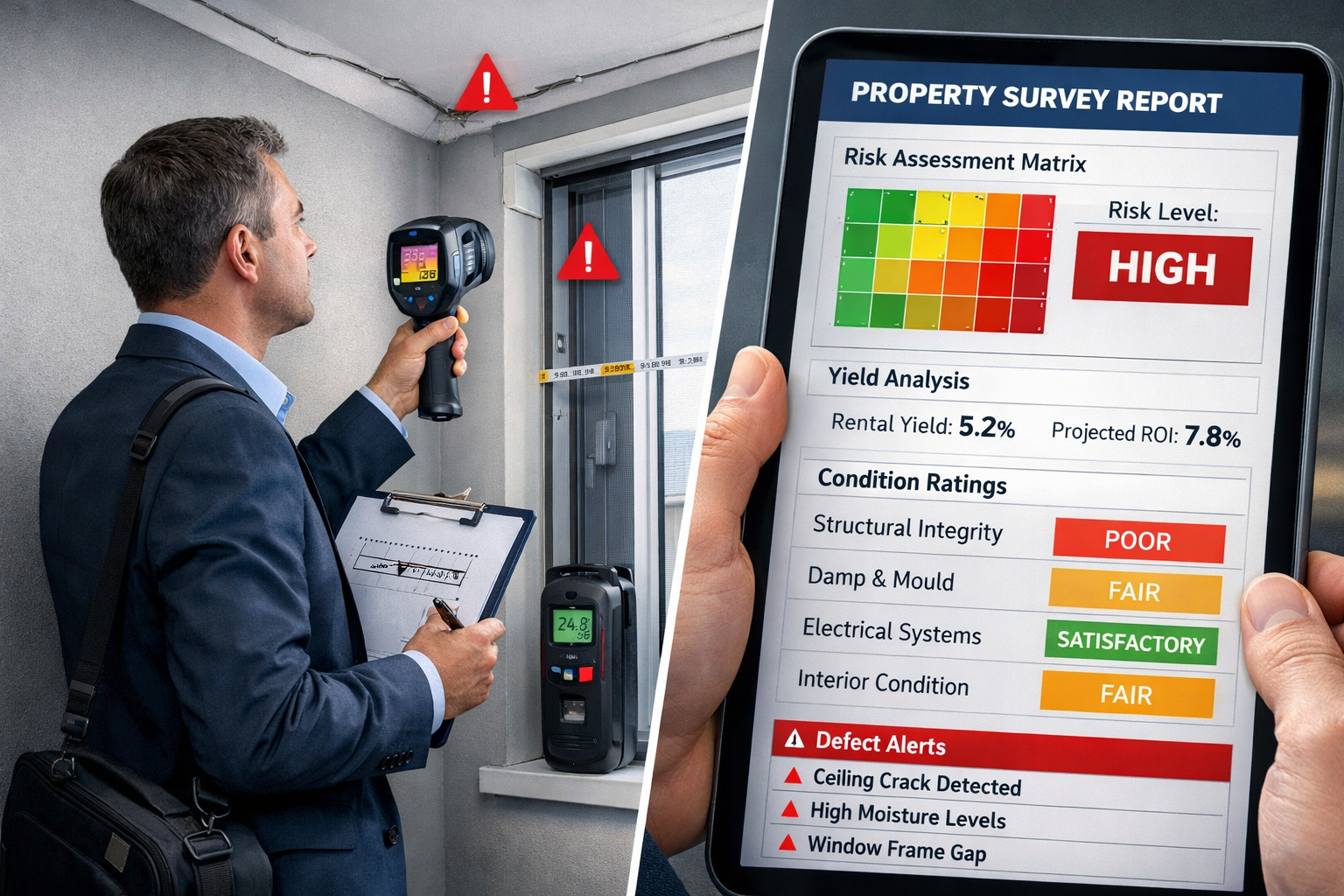
Thermal Imaging Technology: Infrared cameras reveal heat loss patterns, identify hidden moisture intrusion, detect insulation gaps, and uncover structural thermal bridging. For institutional investors focused on energy efficiency and operating costs, thermal surveys provide invaluable data.
Moisture Detection Systems: Professional-grade moisture meters and hygrometers identify damp issues before they become visible. Early detection prevents costly remediation and protects long-term asset value. Comprehensive damp surveys are essential for older properties in institutional portfolios.
Digital Documentation: Institutional investors require detailed, shareable reports with photographic evidence, annotated floor plans, and digital measurement data. Cloud-based reporting systems enable portfolio managers to compare conditions across multiple properties and track remediation progress.
Drone Roof Surveys: For multi-story buildings or properties with difficult roof access, drone surveys provide comprehensive roof condition assessment without scaffolding costs. This technology is particularly valuable when surveying multiple properties in acquisition pipelines.
Risk Assessment Frameworks for Institutional BTL Portfolios
Quantifying Investment Risk
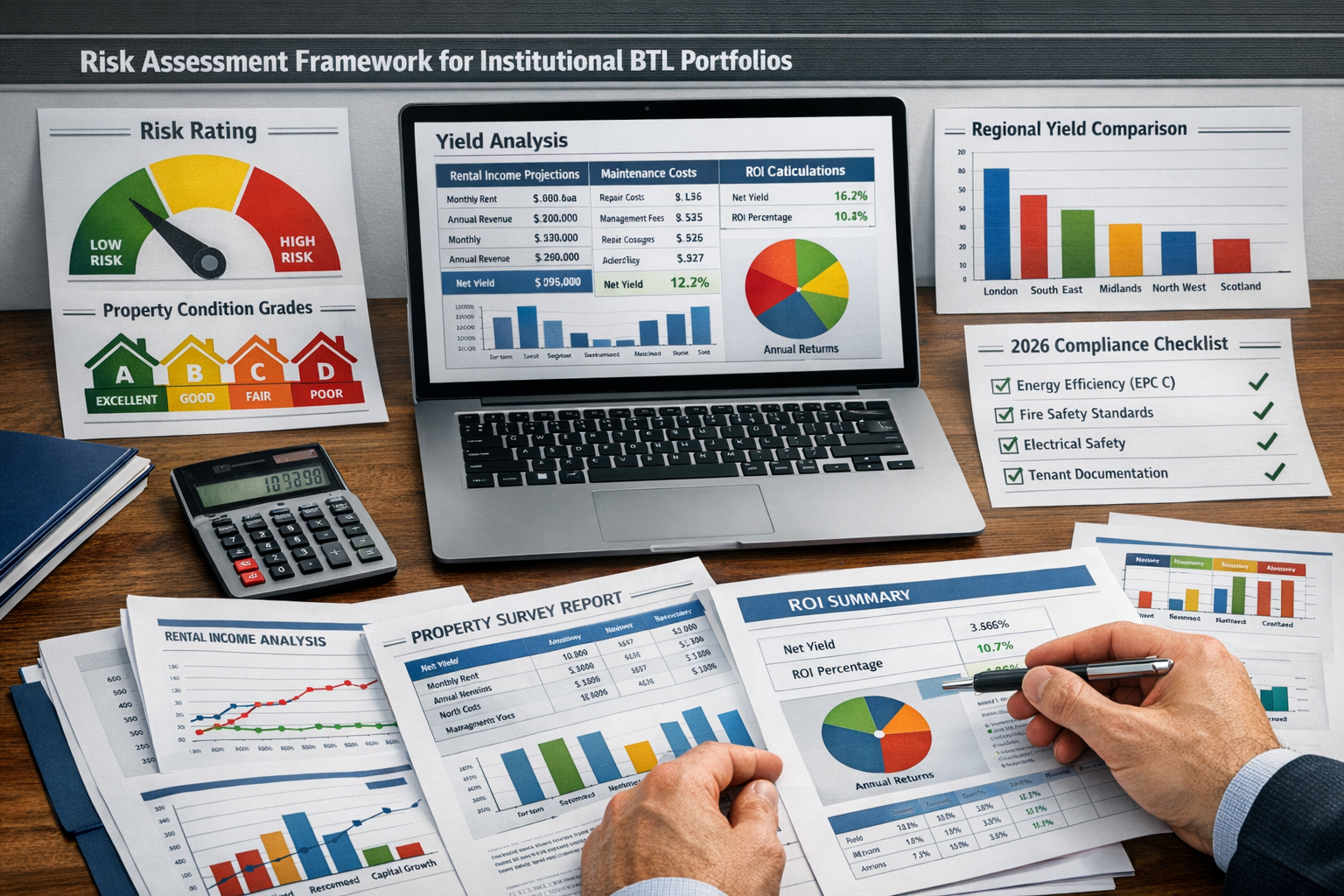
Institutional investors demand rigorous risk quantification that translates building condition into financial impact. Effective risk assessment frameworks categorize issues by severity and financial consequence:
Critical Risks (Immediate Action Required):
- Structural instability or foundation failure
- Active water ingress causing progressive damage
- Non-compliant electrical systems creating safety hazards
- Fire safety deficiencies in multi-occupancy buildings
- Hazardous materials (asbestos, lead) requiring immediate remediation
High Risks (Address Within 12 Months):
- Roof deterioration approaching failure point
- Heating system end-of-life requiring replacement
- Significant damp issues affecting habitability
- EPC ratings below minimum rental standards
- External envelope failures accelerating deterioration
Medium Risks (Plan for 2-5 Year Timeline):
- Window replacements for aging units
- Bathroom and kitchen modernization needs
- Decorative repairs and cosmetic improvements
- Minor structural repairs and preventive maintenance
- Energy efficiency upgrades for competitive positioning
Low Risks (Monitor and Plan Beyond 5 Years):
- Minor cosmetic defects
- Routine maintenance items
- Gradual wear on non-critical components
- Optional enhancement opportunities
This risk stratification enables institutional investors to accurately forecast capital expenditure requirements and incorporate them into investment models. Understanding what to do after a bad survey report becomes crucial when critical risks emerge during due diligence.
Yield Impact Analysis
Building condition directly affects achievable yields through multiple mechanisms:
Rental Income Effects: Properties in excellent condition command premium rents, while those requiring modernization face rental discounts. Survey findings must quantify this differential. For example, a property requiring £15,000 in kitchen and bathroom upgrades might achieve £150/month higher rent, representing a 12% annual return on improvement investment.
Void Period Implications: Properties with deferred maintenance experience longer void periods between tenancies. Institutional investors model void rates into yield calculations, making property condition a critical factor. A well-maintained property might achieve 95% occupancy versus 85% for a neglected equivalent.
Operating Cost Variations: Energy-inefficient properties impose higher utility costs on tenants (if included) or reduce tenant appeal (if excluded). Properties with aging heating systems face higher maintenance call-out costs. These operational factors directly impact net yields.
Capital Expenditure Timing: Survey findings enable investors to optimize capital expenditure timing. Proactive replacement of aging systems during void periods minimizes disruption and maximizes return, while reactive emergency repairs during tenancies impose premium costs and tenant dissatisfaction.
Regulatory Compliance Risk
The 2026 regulatory environment creates substantial compliance risk that building surveys must address:
EPC Requirements: Minimum energy efficiency standards continue tightening. Properties below EPC rating C face potential rental restrictions in coming years. Surveys must assess current ratings and identify cost-effective improvement pathways to achieve compliance.
Safety Standards: Fire safety regulations, particularly for multi-occupancy buildings, have intensified following recent legislative changes. Surveys must verify fire door specifications, emergency lighting functionality, alarm system adequacy, and compartmentation integrity.
Licensing Requirements: Many local authorities now require selective or additional licensing for BTL properties. Survey findings affect licensing eligibility, making compliance assessment essential during acquisition due diligence.
Electrical Safety: The Electrical Safety Standards in the Private Rented Sector (England) Regulations require comprehensive electrical installation condition reports. Building surveys should identify obvious electrical deficiencies and recommend specialist electrical surveys where concerns exist.
Professional surveyors serving institutional clients must maintain current knowledge of evolving regulations and incorporate compliance assessment into every survey. This expertise distinguishes professional surveyor services from basic inspection providers.
Optimizing Yield Through Strategic Building Surveys
Identifying Value-Add Opportunities
Sophisticated building surveys for institutional investors don't merely identify problems—they uncover value-creation opportunities:
Reconfiguration Potential: Surveys should assess whether property layouts can be optimized to increase rental income. Can a large four-bedroom house be converted to a five-bedroom HMO? Can underutilized loft space be converted to additional accommodation? These opportunities can dramatically improve yields.
Energy Efficiency Upgrades: With tenants increasingly cost-conscious and regulations tightening, energy efficiency improvements offer multiple benefits. Surveys should identify cost-effective upgrade pathways: loft insulation, cavity wall insulation, modern condensing boilers, double glazing, and solar panels. These improvements reduce operating costs, improve EPC ratings, and enhance tenant appeal.
Amenity Enhancement: Modern tenants value specific amenities that justify premium rents. Surveys should evaluate feasibility of adding desirable features: en-suite bathrooms, modern kitchens, outdoor spaces, parking, or storage. Understanding structural and services constraints enables accurate feasibility assessment.
Preventive Maintenance Planning: Identifying issues before they become critical enables cost-effective preventive intervention. Repointing chimneys before water penetration causes internal damage, replacing aging gutters before they fail, or servicing heating systems before breakdown—all reduce lifetime costs and protect yields.
Portfolio-Level Survey Strategies
Institutional investors acquiring multiple properties benefit from portfolio-level survey approaches:
Standardized Assessment Criteria: Developing consistent evaluation frameworks enables meaningful comparison across properties. Standardized condition ratings, maintenance forecasting methodologies, and risk categorization allow portfolio managers to prioritize capital allocation efficiently.
Bulk Survey Efficiencies: When acquiring multiple similar properties, surveyors can achieve efficiencies through standardized inspection protocols, template reporting with property-specific variations, and coordinated scheduling. These efficiencies reduce per-property costs while maintaining quality.
Comparative Analysis: Portfolio surveys enable comparative benchmarking. Which properties require most urgent attention? Which offer best value-add opportunities? Which present highest long-term risk? This comparative intelligence supports strategic portfolio management.
Lifecycle Planning: Portfolio-level surveys enable coordinated lifecycle planning. If multiple properties require roof replacement in similar timeframes, bulk procurement achieves cost savings. If heating systems across a portfolio approach end-of-life, standardized replacement specifications simplify maintenance management.
Technology Integration for Yield Optimization
Modern building surveys leverage technology to provide institutional investors with actionable intelligence:
Building Information Modeling (BIM): Advanced surveys create digital twins of properties, enabling scenario modeling for refurbishment options, accurate quantity surveying for improvement projects, and ongoing asset management throughout ownership.
Predictive Analytics: Machine learning algorithms analyze survey data alongside market conditions to forecast maintenance requirements, predict component failure timelines, and optimize intervention timing for maximum return.
Portfolio Dashboards: Digital survey platforms aggregate data across entire portfolios, providing real-time condition monitoring, capital expenditure tracking, compliance status visualization, and performance benchmarking.
Mobile Survey Applications: Field surveyors using tablet-based applications capture data more efficiently, ensure consistent reporting standards, enable real-time photo annotation, and accelerate report delivery to time-sensitive institutional clients.
These technological capabilities distinguish modern surveying services from traditional approaches, providing institutional investors with the data infrastructure needed for sophisticated portfolio management.
Due Diligence Best Practices for Professional Landlords
Pre-Acquisition Survey Protocols
Institutional investors should implement rigorous pre-acquisition survey protocols:
Early Survey Commissioning: Engage surveyors immediately after offer acceptance to maximize due diligence period. Early findings enable renegotiation or withdrawal before significant legal costs accumulate. Understanding what to do when your offer is accepted includes immediate survey commissioning.
Comprehensive Scope Definition: Clearly specify survey scope to address institutional requirements. Standard RICS Building Survey Level 3 provides baseline, but institutional clients often require additional elements: energy assessment, regulatory compliance review, yield optimization analysis, and lifecycle costing.
Specialist Surveys Where Indicated: Building surveys identify issues requiring specialist investigation. Commission these promptly: structural engineers for significant defects, electrical contractors for installation testing, drainage specialists for underground systems, and arboricultural consultants for tree-related concerns.
Financial Impact Quantification: Require surveyors to provide cost estimates for identified remediation. Institutional investors need financial quantification to adjust offer prices, negotiate seller contributions, or plan post-acquisition capital expenditure.
Leveraging Survey Findings in Negotiations
Building survey findings provide powerful negotiation leverage for institutional buyers:
Price Renegotiation: Significant defects justify price reduction requests. If surveys reveal £50,000 in required structural repairs, buyers can legitimately request equivalent price reduction or seller remediation. Professional negotiation using survey findings protects investment returns.
Completion Condition Precedents: For critical issues, buyers can make completion conditional on seller remediation. This approach works particularly well for safety-critical items: electrical deficiencies, structural instability, or regulatory non-compliance.
Retention Mechanisms: When sellers dispute repair costs, buyers can propose retention of disputed amounts from purchase price, held in escrow pending post-completion remediation cost verification.
Walk-Away Thresholds: Institutional investors should establish clear walk-away criteria. If survey findings reveal risks exceeding predetermined thresholds, disciplined investors withdraw rather than proceeding with compromised investments.
Post-Acquisition Survey Applications
Building surveys continue providing value after acquisition:
Baseline Documentation: Comprehensive acquisition surveys establish baseline property condition, supporting future insurance claims, defending against tenant damage allegations, and tracking deterioration over ownership period.
Maintenance Planning: Survey findings inform systematic maintenance programs. Institutional landlords develop multi-year maintenance schedules based on survey recommendations, optimizing intervention timing and budgeting capital expenditure accurately.
Refurbishment Prioritization: When managing large portfolios, surveys enable data-driven refurbishment prioritization. Properties with highest yield improvement potential receive capital allocation priority, maximizing portfolio-level returns.
Exit Strategy Preparation: When preparing properties for sale, reviewing acquisition surveys identifies remediation that enhances sale value. Addressing deferred maintenance before marketing improves buyer appeal and achieves premium pricing.
Selecting Survey Providers for Institutional Requirements
Essential Qualifications and Experience
Institutional investors should select survey providers meeting rigorous criteria:
RICS Accreditation: All surveyors must hold Royal Institution of Chartered Surveyors (RICS) membership, ensuring professional standards, ethical conduct, and continuing professional development. RICS accreditation provides quality assurance and professional indemnity insurance protection.
BTL Specialization: Surveyors serving institutional landlords should demonstrate specific buy-to-let experience. Understanding rental market dynamics, yield optimization, and landlord regulatory requirements distinguishes specialist providers from general residential surveyors.
Portfolio Experience: Surveyors experienced with multi-property portfolios understand institutional requirements: standardized reporting, comparative analysis, and efficient bulk survey delivery. This experience accelerates due diligence and improves decision support quality.
Technology Capabilities: Modern institutional surveys require advanced technology: thermal imaging, moisture detection, drone surveys, and digital reporting platforms. Verify providers possess necessary equipment and expertise.
Local Market Knowledge: Surveyors with deep local market knowledge provide valuable context: typical property construction methods, common regional defects, local regulatory requirements, and market-specific yield expectations.
Evaluating Survey Quality
Institutional investors should assess survey quality through multiple dimensions:
Report Comprehensiveness: Quality surveys provide detailed condition descriptions, clear defect identification, photographic evidence, repair cost estimates, and prioritized recommendations. Vague or superficial reports lack decision-support value.
Risk Communication: Effective surveys clearly communicate risk severity using consistent categorization frameworks. Institutional clients need unambiguous understanding of which issues require immediate attention versus long-term planning.
Financial Quantification: Investment-grade surveys quantify financial implications: repair costs, yield impact, regulatory compliance expenditure, and value-add opportunity costs. This quantification enables sophisticated investment analysis.
Actionable Recommendations: Quality surveys provide specific, actionable recommendations rather than generic advice. "Replace failed damp-proof course in rear wall, estimated cost £3,500-£4,500" provides more value than "address damp issues."
Timely Delivery: Institutional acquisition timelines demand prompt survey delivery. Quality providers deliver comprehensive reports within 5-7 business days of inspection, enabling timely due diligence completion.
Building Long-Term Survey Partnerships
Sophisticated institutional investors develop ongoing relationships with preferred survey providers:
Consistent Quality: Working with established providers ensures consistent quality across portfolio acquisitions. Familiarity with investor requirements, reporting preferences, and decision criteria improves efficiency.
Preferential Pricing: Volume clients negotiate favorable pricing structures: discounted rates for multiple properties, priority scheduling, and flexible payment terms.
Portfolio Insights: Long-term survey partners develop deep understanding of portfolio characteristics, enabling valuable comparative insights and strategic advice beyond individual property assessments.
Responsive Service: Established relationships ensure responsive service during time-critical acquisitions, flexible scheduling for urgent surveys, and priority access during busy market periods.
Future-Proofing Institutional BTL Investments Through Surveys

Anticipating Regulatory Evolution
Building surveys in 2026 must anticipate continuing regulatory evolution:
EPC Trajectory: While current minimum standards require EPC rating E, trajectory points toward rating C becoming mandatory for all rentals. Surveys should assess improvement pathways to C rating and identify properties where compliance is cost-prohibitive.
Decarbonization Requirements: Government net-zero commitments will drive increasing energy efficiency requirements. Surveys should evaluate properties' decarbonization potential: heat pump suitability, solar panel feasibility, and insulation improvement capacity.
Safety Standard Evolution: Fire safety, electrical safety, and carbon monoxide regulations continue tightening. Surveys should identify properties requiring proactive upgrades to meet anticipated future standards.
Licensing Expansion: Selective and additional licensing schemes are expanding across local authorities. Surveys should flag properties in areas with existing or proposed licensing, assessing compliance feasibility.
Climate Resilience Assessment
Climate change creates new assessment requirements for long-term institutional investments:
Flood Risk: Properties in flood-prone areas face increasing insurance costs, tenant concerns, and potential value impairment. Surveys should reference Environment Agency flood maps and assess property-specific flood resilience measures.
Overheating Risk: Rising temperatures make overheating assessment increasingly relevant. Surveys should evaluate south-facing glazing, insulation levels, ventilation adequacy, and cooling system feasibility.
Weather Resilience: Extreme weather events are intensifying. Surveys should assess building envelope robustness: roof wind resistance, drainage capacity for intense rainfall, and external material durability under weather stress.
Subsidence Risk: Changing rainfall patterns affect subsidence risk, particularly for properties with clay soils and nearby trees. Comprehensive subsidence assessment protects long-term investment value.
Technology and Smart Building Integration
Forward-looking surveys assess smart building integration potential:
Smart Heating Controls: Modern tenants value app-controlled heating systems that reduce costs and improve comfort. Surveys should assess heating system compatibility with smart controls.
Security Systems: Integrated security systems (smart locks, video doorbells, alarm systems) enhance tenant appeal and property security. Surveys should evaluate infrastructure readiness for these technologies.
Broadband Infrastructure: High-speed broadband is now essential for tenant satisfaction. Surveys should verify fiber availability and assess internal wiring adequacy for modern connectivity requirements.
Energy Monitoring: Smart meters and energy monitoring systems appeal to cost-conscious tenants. Surveys should identify opportunities for energy management technology integration.
Conclusion
Building Surveys for Institutional Buy-to-Let Growth: Assessing Risk and Yield in 2026's Professional Landlord Boom represents a fundamental evolution in property assessment. The surge of institutional capital into UK buy-to-let—evidenced by £19 billion in Q4 2025 transactions and over 400,000 registered BTL companies[1][3]—demands sophisticated survey methodologies that go far beyond traditional homebuyer reports.
Professional landlords require comprehensive building surveys that quantify investment risk, forecast long-term maintenance costs, assess regulatory compliance, and identify yield optimization opportunities. Advanced survey techniques including thermal imaging, moisture detection, and digital reporting provide the analytical rigor institutional investors demand when deploying capital into multi-property portfolios.
The 2026 market environment—characterized by favorable interest rates, strong rental demand, and continuing regulatory evolution—creates both opportunities and risks for institutional BTL investors. Thorough building surveys serve as essential risk management tools, protecting investment returns while identifying value-creation opportunities that maximize portfolio performance.
Actionable Next Steps
For institutional investors and professional landlords seeking to capitalize on the 2026 BTL boom:
- Commission comprehensive building surveys for all acquisition targets, specifying institutional requirements including yield analysis, lifecycle costing, and regulatory compliance assessment
- Engage RICS-accredited surveyors with demonstrated BTL specialization and portfolio experience to ensure survey quality meets institutional standards
- Develop standardized assessment frameworks across your portfolio to enable meaningful property comparison and strategic capital allocation
- Leverage survey findings in negotiations to protect acquisition pricing and ensure investments meet target return thresholds
- Implement technology-enabled survey solutions including thermal imaging, digital reporting, and portfolio dashboards to support data-driven investment decisions
- Plan for regulatory evolution by assessing properties' ability to meet anticipated future EPC, safety, and licensing requirements
- Build long-term relationships with quality survey providers to ensure consistent service, preferential pricing, and valuable portfolio insights
The institutional buy-to-let opportunity in 2026 is substantial, with two-thirds of landlords planning portfolio expansion[1] and yields remaining attractive across UK markets. Success requires rigorous due diligence supported by professional building surveys that transform property assessment from cost center to strategic investment tool.
By implementing the specialized survey methodologies, risk assessment frameworks, and yield optimization strategies outlined in this guide, institutional investors can confidently navigate the professional landlord boom while maximizing returns and minimizing long-term risk in this dynamic market environment.
References
[1] Booming Buy To Let Changes You Need To Know – https://www.mfsuk.com/blog/booming-buy-to-let-changes-you-need-to-know/
[2] Uk Property Market Outlook 2026 – https://jensiebritsconsulting.com/uk-property-market-outlook-2026/
[3] Uk Real Estate Market Commentary January 2026 – https://www.schroders.com/en-gb/uk/institutional/insights/uk-real-estate-market-commentary—january-2026/
[4] Are Successful Investors Back In The High Value Property Market For 2026 – https://togethermoney.com/blog/are-successful-investors-back-in-the-high-value-property-market-for-2026