{"cover":"Professional landscape format (1536x1024) editorial hero image with bold text overlay 'Building Surveys for Flats in London's Stabilizing Market' in extra large 72pt white sans-serif font with subtle dark shadow, positioned in upper third center. Background features modern London apartment building facade with contemporary glass balconies and brick detailing, RICS surveyor with tablet inspecting property in foreground, subtle overlay of market trend graph showing stabilization curve. Color palette: deep navy blue, white, gold accents representing confidence and professionalism. High contrast, magazine cover quality, architectural photography style with slight tilt-shift effect, professional assessment atmosphere.","content":["Landscape format (1536x1024) detailed illustration showing RICS Level 2 and Level 3 survey comparison chart for London flats, split-screen composition with modern apartment cross-section on left showing inspection points (roof, walls, services, foundations) marked with colored indicators, right side displaying detailed survey report pages with traffic light rating system, magnifying glass highlighting energy efficiency ratings and cladding assessments, professional color scheme of blue, green, and amber, clean infographic style with icons representing structural elements, moisture meters, and thermal imaging cameras, London skyline silhouette in background.","Landscape format (1536x1024) professional photograph of surveyor conducting flat inspection in contemporary London apartment, inspector using thermal imaging camera on exterior wall near floor-to-ceiling windows, visible moisture detection equipment and tablet showing digital survey form, modern open-plan living space with kitchen visible in background, natural daylight streaming through windows, close-up inset showing damp meter readings and cavity wall insulation check, professional assessment atmosphere, documentary photography style, focus on due diligence protocols, clipboard with checklist visible, color grading emphasizing trust and thoroughness with cool blue tones.","Landscape format (1536x1024) conceptual business illustration showing buyer confidence restoration in London flat market, central image of diverse couple reviewing positive building survey report with satisfied expressions, surrounded by circular infographic elements showing: downward trending interest rate arrow, upward buyer activity graph, energy efficiency certificate with A-rating, negotiation handshake icon, property valuation adjustment chart, London flat building in background with 'SOLD' sign, professional color scheme of green (confidence), blue (trust), and gold (value), clean modern design with connecting lines between elements, optimistic and forward-looking composition, 2026 market indicators visible."]
}

London's flat market is entering a pivotal phase in 2026. After years of uncertainty and price adjustments, asking prices have finally aligned with realistic market values, and buyer activity is showing genuine signs of recovery. For property surveyors, this transitional period presents both opportunities and challenges—identifying flats that will attract renewed interest while thoroughly assessing risks in a market that's still finding its footing. Understanding the assessment protocols that restore buyer confidence has never been more critical.
The landscape has shifted dramatically. With London flats forecast to achieve modest 1-2% price growth this year—well below the national average—buyers are approaching purchases with heightened caution. They're demanding comprehensive due diligence, particularly for properties with energy efficiency concerns, cladding issues, or questionable build quality. Building Surveys for Flats in London's Stabilizing Market: Assessment Protocols for Returning Buyer Confidence have become essential tools for navigating this complex environment.
Key Takeaways
- 🏢 London's flat market is stabilizing with realistic pricing and increased buyer activity, but growth remains subdued at 1-2% compared to the national average
- 📋 Comprehensive survey protocols focusing on energy efficiency, cladding safety, and building defects are essential for restoring buyer confidence in 2026
- 💡 Energy performance assessments have become the top priority, with 94% of buyers prioritizing efficiency following recent cost-of-living pressures
- 🔍 Enhanced due diligence on new-build and ex-rental flats is critical, particularly in East London where oversupply continues to suppress values
- 💰 Strategic survey findings enable effective price negotiations and help buyers secure properties with genuine long-term value potential
Understanding London's Flat Market Stabilization in 2026
The London flat market has undergone a significant correction over the past two years. Price expectations have adjusted downward, particularly in areas saturated with new-build developments and former rental properties. This recalibration has created a more balanced market where realistic valuations are finally attracting serious buyers.
Current Market Dynamics
Several factors are driving the stabilization:
Price Adjustment Reality 📉
- Flats experiencing 1-2% growth versus 2-4% for houses nationally
- East London particularly affected by new-build oversupply
- Former rental properties facing additional valuation challenges
- Sellers accepting market realities after prolonged listing periods
Construction Activity Slowdown 🏗️
- Only 3,248 new homes began construction in London during Q1-Q3 2025
- Represents just 3.7% of housing delivery targets
- Reduced pipeline alleviating future oversupply concerns
- Potential for gradual price stabilization as supply constraints tighten
Buyer Confidence Indicators 📈
- December 2025 RICS survey shows "significantly more positive" sales expectations
- Interest rate reductions supporting affordability improvements
- Urban apartment preferences rising to 22% among buyers
- Younger demographics valuing walkability and cultural amenities
The rental market dynamics also influence buyer decisions. With new landlord instructions deeply negative at -39% and rents forecast to rise approximately 3% over the next twelve months, many renters are reconsidering ownership as a viable alternative.
For buyers navigating this transitional market, understanding which home survey is right for you becomes paramount to making informed decisions.
Essential Survey Protocols for Building Surveys for Flats in London's Stabilizing Market
Professional building surveys must adapt to address the specific concerns emerging in London's stabilizing flat market. Traditional inspection protocols require enhancement to capture the nuanced risks and opportunities present in 2026.
Comprehensive Assessment Framework
Energy Efficiency Evaluation ⚡
Energy performance has emerged as the dominant buyer concern, with 94% prioritizing efficiency. Survey protocols must include:
- EPC rating verification and improvement potential analysis
- Insulation quality assessment (walls, roof, windows)
- Heating system efficiency and age evaluation
- Double/triple glazing condition and thermal performance
- Potential upgrade costs and payback period calculations
Cladding and Fire Safety Review 🔥
Post-Grenfell awareness remains heightened. Surveyors must:
- Identify external cladding materials and construction methods
- Review EWS1 forms and fire safety certifications
- Assess compartmentation and fire door compliance
- Evaluate emergency egress routes and signage
- Flag potential remediation costs and insurance implications
Structural and Building Defect Analysis 🏗️
Standard structural assessments require enhanced scrutiny for:
| Assessment Area | Key Focus Points | Risk Indicators |
|---|---|---|
| Foundation & Subsidence | Settlement cracks, movement patterns | Diagonal cracking, door/window misalignment |
| Damp & Moisture | Penetrating/rising damp, condensation | Staining, mold growth, timber decay |
| Roof & Envelope | Flat roof condition, parapet walls | Ponding, membrane deterioration |
| Services | Plumbing, electrical, heating age | Outdated systems, safety concerns |
| Common Areas | Shared facilities, maintenance standards | Deferred maintenance, management issues |
For those wondering about the difference between survey levels, our guide on exploring the key difference between Level 2 and Level 3 survey provides valuable insights.
New-Build and Ex-Rental Specific Protocols 🆕
Properties in these categories require additional scrutiny:
- Snagging defects in properties under 10 years old
- Wear patterns indicating intensive rental use
- Developer reputation and warranty coverage review
- Service charge history and projected increases
- Building management quality and responsiveness
First-time buyers particularly benefit from understanding why they should book a building survey in London before committing to a purchase.
Modern Buyer Priorities Integration
Survey protocols must address evolving buyer preferences:
Space Functionality Assessment 🏠
- Open-plan living arrangements (desired by 76% of buyers)
- Separate living space availability for acoustic privacy
- Home office potential and connectivity infrastructure
- Storage adequacy and built-in solutions
- Balcony/outdoor space condition and usability
Future-Proofing Evaluation 🔮
- Electric vehicle charging installation potential
- Smart home integration capabilities
- Accessibility features and adaptation potential
- Climate resilience (flood risk, overheating susceptibility)
- Lease length and extension prospects for leasehold properties
Restoring Buyer Confidence Through Building Surveys for Flats in London's Stabilizing Market

The ultimate goal of enhanced survey protocols is restoring buyer confidence in a market still recovering from significant uncertainty. Professional assessments serve multiple confidence-building functions.
Transparent Risk Communication
Traffic Light Rating Systems 🚦
Effective surveys employ clear risk categorization:
- 🟢 Green (Condition Rating 1): No repair currently needed
- 🟡 Amber (Condition Rating 2): Repairs or replacement requiring future attention
- 🔴 Red (Condition Rating 3): Urgent defects requiring immediate attention
This visual clarity helps buyers quickly grasp property condition and prioritize concerns.
Cost Projection Accuracy 💷
Detailed surveys should include:
- Immediate repair cost estimates (next 12 months)
- Medium-term maintenance projections (1-5 years)
- Long-term replacement schedules (5-10 years)
- Energy efficiency upgrade investment requirements
- Total cost of ownership comparison against alternatives
When surveys reveal significant issues, buyers can learn how to renegotiate after a poor building survey result to protect their investment.
Negotiation Leverage and Value Protection
Professional survey findings provide concrete negotiation tools:
Price Adjustment Strategies 📊
Understanding average price reduction after survey empowers buyers to:
- Request seller-funded repairs before completion
- Negotiate purchase price reductions reflecting defect costs
- Require retention amounts held in escrow pending repairs
- Walk away from properties with disproportionate risk
Decision-Making Confidence ✅
Comprehensive surveys enable buyers to:
- Compare multiple properties objectively using consistent criteria
- Identify properties offering genuine long-term value
- Avoid emotional decision-making based on cosmetic appeal
- Understand true total cost of ownership
- Make informed offers reflecting actual property condition
For buyers uncertain about next steps, guidance on what to do after a bad report on building survey provides actionable strategies.
Specialized Assessment Protocols
Leasehold Considerations 📜
Flat purchases involve unique leasehold complexities requiring survey attention:
- Remaining lease term and extension requirements
- Ground rent and service charge reasonableness
- Freeholder reputation and management quality
- Major works provisions and sinking fund adequacy
- Restrictive covenants affecting usage or alterations
Damp and Moisture Expertise 💧
Given London's climate and older building stock, specialized damp assessment is often necessary. Understanding damp survey costs and what to expect helps buyers budget appropriately for comprehensive evaluations.
Building Management Quality 🏢
Survey protocols should evaluate:
- Common area maintenance standards
- Financial health of residents' association or management company
- History of major works and future plans
- Responsiveness to maintenance requests
- Dispute resolution track record
Technology-Enhanced Assessment
Modern survey protocols leverage technology for enhanced accuracy:
Digital Documentation 📱
- Thermal imaging for insulation defects and moisture detection
- Drone photography for roof and high-level inspections
- Moisture meters for precise damp quantification
- Digital floor plans with annotated defect locations
- Photographic evidence libraries
Predictive Analytics 📈
- Building performance modeling
- Lifecycle cost projections
- Energy consumption forecasting
- Maintenance schedule optimization
- Comparable property benchmarking
Strategic Considerations for Different Flat Types
Building Surveys for Flats in London's Stabilizing Market: Assessment Protocols for Returning Buyer Confidence must adapt to property-specific characteristics.
Purpose-Built Flats vs. Conversions
Purpose-Built Advantages 🏢
- Designed sound insulation between units
- Proper fire compartmentation
- Dedicated service infrastructure
- Clear management structures
- Predictable maintenance requirements
Conversion Challenges 🔄
- Acoustic separation concerns
- Adapted services and utilities
- Shared responsibility ambiguities
- Building regulation compliance verification
- Hidden structural modifications
Period Properties vs. Modern Developments
Period Flat Considerations 🏛️
- Character features requiring specialist maintenance
- Older service infrastructure needing replacement
- Listed building restrictions on alterations
- Higher heating costs and energy efficiency challenges
- Potential for hidden defects in concealed areas
Modern Development Focus 🆕
- Warranty coverage and developer reputation
- Snagging defect identification
- Building management quality from inception
- Energy efficiency performance verification
- New-build premium justification
For guidance on new-build assessments, explore whether you need a building survey for a new build.
Location-Specific Risk Factors
Central London Premium Areas 💎
- Service charge sustainability at premium levels
- Investment buyer competition dynamics
- Rental yield potential for future flexibility
- Prestige building maintenance standards
- Lease length criticality for value preservation
East London Growth Corridors 🌆
- New-build oversupply impact on values
- Infrastructure development timelines
- Gentrification trajectory assessment
- Ex-rental stock quality variation
- Future transport connectivity improvements
Suburban London Locations 🌳
- Commuter accessibility and transport links
- Local amenity availability and development
- School catchment area considerations
- Parking provision and necessity
- Community cohesion and turnover rates
Practical Implementation for Buyers and Professionals

Selecting the Right Survey Level
Understanding survey options is crucial for appropriate due diligence:
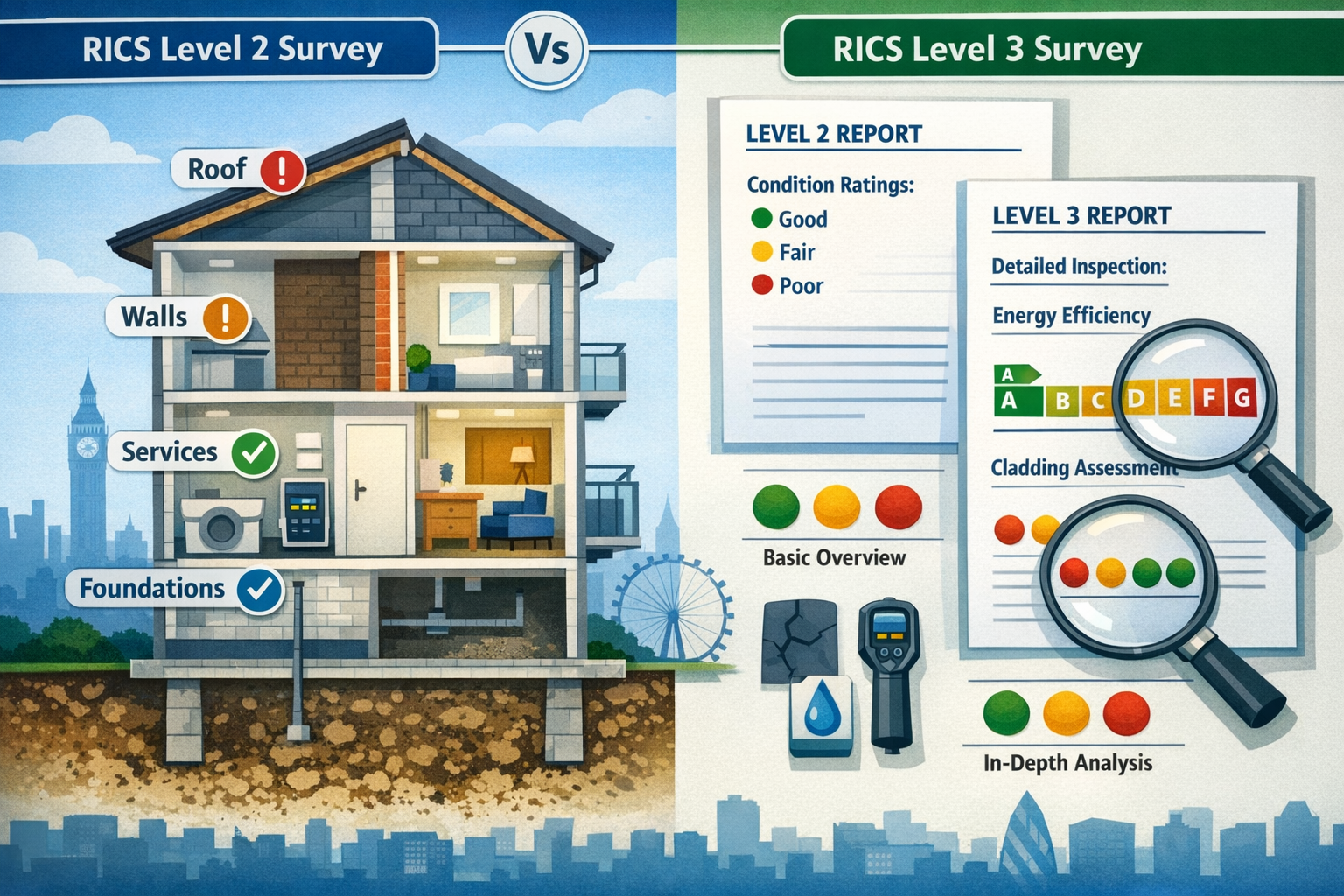
RICS Level 2 Survey (HomeBuyer Report) 📋
- Suitable for conventional flats in reasonable condition
- Cost-effective for properties built post-1990
- Provides condition ratings and essential defect identification
- Limited invasive investigation
- Typically £400-£600 for standard London flat
RICS Level 3 Survey (Building Survey) 🔍
- Recommended for older properties or those with visible defects
- Comprehensive investigation including accessible areas
- Detailed defect analysis with repair recommendations
- Essential for conversions or properties with alterations
- Typically £600-£1,200 depending on property size and complexity
Comparing homebuyer report or building survey options helps buyers make informed choices based on property characteristics and risk tolerance.
Timing and Process Optimization
Survey Scheduling Strategy ⏰
- Book surveys immediately after offer acceptance
- Allow 5-7 working days for inspection scheduling
- Expect report delivery within 5-7 days post-inspection
- Build in negotiation time before exchange deadline
- Consider seasonal factors (damp more visible in wet seasons)
Maximizing Survey Value 💡
- Attend the inspection to ask questions and gain insights
- Request clarification on any unclear report sections
- Obtain multiple specialist quotes for flagged repairs
- Use findings to inform final purchase decision
- Retain report for future reference and resale transparency
Understanding what to do when your property offer has been accepted ensures surveys fit seamlessly into the purchase timeline.
Cost-Benefit Analysis
Survey Investment Returns 📊
Professional surveys deliver measurable value:
- Negotiation savings: Average price reductions of 5-10% when significant defects identified
- Avoided disasters: Preventing purchase of properties with structural issues worth tens of thousands
- Maintenance planning: Accurate budgeting for future repairs and improvements
- Insurance benefits: Some insurers offer premium reductions for surveyed properties
- Peace of mind: Confidence in purchase decision and property condition understanding
Buyers can learn more about saving money with building surveys through strategic use of professional assessments.
Building Long-Term Confidence
Post-Purchase Benefits 🏡
Survey reports provide ongoing value:
- Maintenance schedule creation based on identified needs
- Warranty claim support for new-build defects
- Renovation planning with prioritized improvement areas
- Resale transparency demonstrating property knowledge
- Insurance claim documentation for pre-existing conditions
Market Knowledge Development 📚
Engaging with survey processes educates buyers about:
- Construction quality indicators across different eras
- Common defects in specific building types
- Realistic maintenance costs and timelines
- Value-for-money assessment criteria
- Red flags to avoid in future property searches
Conclusion
London's flat market stabilization in 2026 presents a genuine opportunity for buyers who approach purchases with appropriate due diligence. Building Surveys for Flats in London's Stabilizing Market: Assessment Protocols for Returning Buyer Confidence are not merely procedural requirements—they're essential tools for navigating a transitional market where realistic pricing meets renewed buyer interest.
The modest 1-2% growth forecast for London flats reflects a market finding equilibrium after years of correction. Buyers entering this stabilized environment must prioritize comprehensive assessments that address energy efficiency, cladding safety, building defects, and future-proofing considerations. Professional surveys provide the transparency and risk quantification necessary to make confident purchase decisions.
Actionable Next Steps
For Prospective Buyers 🎯
- Determine appropriate survey level based on property age, type, and visible condition
- Budget £400-£1,200 for professional RICS survey depending on complexity
- Schedule survey immediately after offer acceptance to maintain transaction momentum
- Attend the inspection to gain firsthand insights and ask questions
- Use findings strategically for price negotiation or informed withdrawal decisions
- Retain survey reports for future maintenance planning and resale transparency
For Property Professionals 👔
- Enhance protocols to address 2026 buyer priorities around energy efficiency and safety
- Invest in technology for thermal imaging, moisture detection, and digital documentation
- Develop specializations in new-build snagging, period property assessment, or cladding evaluation
- Communicate clearly using traffic light systems and accurate cost projections
- Build reputation through transparent, comprehensive reporting that genuinely serves client interests
The return of buyer confidence to London's flat market depends fundamentally on trust—trust that asking prices reflect genuine value, that properties meet modern standards, and that purchases represent sound long-term investments. Professional building surveys are the cornerstone of that trust, providing the objective assessment and expert guidance necessary for successful transactions in this stabilizing market.
Whether you're a first-time buyer entering the market, an investor seeking value opportunities, or a professional surveyor adapting protocols to current conditions, embracing comprehensive assessment standards will prove essential to success in London's evolving flat market throughout 2026 and beyond.